MBA E Semester II RegistrationNo.:1322006
Operations Management MBAE 231
Dussa Pullaiah, Executive MBA, Christ University
Assignment-2: Articles on Six Sigma, Lean Manufacturing, Kaizen, Poka Yoke, ISO 9001:2000
1. Lean Manufacturing - Working More efficiently
Waste costs youand your customers’ money.Andif yourcustomershave to
pay more because of it,theymightgo elsewhere.Beingcompetitive also
requiresalotof flexibility.Youmustbe able tomeetthe changingdemands
of yourcustomersquicklyandeffectively,andadaptto a rapidlychanging
businessenvironment.
So,how can youreduce waste and dothingsmore efficiently?Andhowcan
youkeepupwiththe changingdemandsof consumers?
FirstmentionedinJamesWomack's1990 book,"The Machine That Changed
the World,"Lean Manufacturingisa theorythat can helpyouto simplifyandorganize yourworking
environmentsothatyou can reduce waste,andkeepyourpeople,equipment,andworkspace
responsive towhat'sneededrightnow.
 A Brief History of LeanManufacturing
HenryFord wasone of the firstpeople todevelopthe ideasbehindLeanManufacturing.He usedthe
ideaof "continuousflow"onthe assemblyline forhisModel Tautomobile,where he keptproduction
standardsextremelytight,soeachstage of the processfittedtogetherwitheachotherstage,perfectly.
Thisresultedinlittle waste.
But Ford's processwasn'tflexible.Hisassemblylinesproducedthe same thing,againandagain,andthe
processdidn'teasilyallowforanymodificationsorchangestothe endproduct – a Model T assembly
line producedonlythe Model T.It wasalsoa "push"process,where Fordsetthe level of production,
insteadof a "pull"processledbyconsumerdemand.Thisledtolarge inventoriesof unsoldautomobiles,
ultimatelyresultinginlotsof wastedmoney.
Othermanufacturersbegantouse Ford's ideas,butmanyrealizedthatthe inflexibilityof hissystemwas
a problem.Taiichi Ohnoof Toyotathendevelopedthe ToyotaProductionSystem(TPS),whichused Just
In Time manufacturingmethodstoincrease efficiency.AsWomackreportedinhisbook,Toyotaused
thisprocesssuccessfullyand,asa result,eventuallyemergedasone the mostprofitable manufacturing
companiesinthe world.
 Lean Manufacturing Basics
Lean manufacturingisbasedonfindingefficienciesandremovingwasteful stepsthatdon'taddvalue to
the endproduct.There'sno needtoreduce qualitywithleanmanufacturing –the cuts are a resultof
findingbetter,more efficientwaysof accomplishingthe same tasks.
To findthe efficiencies,leanmanufacturingadoptsacustomer-valuefocus,asking"Whatisthe
customerwillingtopayfor?" Customerswantvalue,andthey'll payonlyif youcanmeettheirneeds.
Theyshouldn'tpayfor defects,orforthe extracost of havinglarge inventories.Inotherwords,they
shouldn'tpayfor yourwaste.
MBA E Semester II RegistrationNo.:1322006
Waste is anythingthatdoesn'taddvalue to the endproduct.In LeanManufacturing,there are eight
categoriesof waste thatyou should monitor:
1. Overproduction– Are youproducingmore than consumersdemand?
2. Waiting– Howmuch lag time isthere betweenproductionsteps?
3. Inventory(workin progress) –Are yoursupplylevelsandworkinprogressinventoriestoohigh?
4. Transportation – Do you move materialsefficiently?
5. Over-processing– Do youworkon the product too manytimes,orotherwise workinefficiently?
6. Motion– Do people andequipmentmove betweentasksefficiently?
7. Defects– Howmuch time doyou spendfindingandfixingproduction mistakes?
8. Workforce – Do youuse workersefficiently?
Lean Manufacturinggivesprioritytosimple,small,andcontinuousimprovementsuchaschanging
the placementof a tool,or puttingtwoworkstationsclosertogether.Asthese small improvements
are addedtogether,theycanleadtoa higherlevelof efficiencythroughoutthe whole system.
 Lean Manufacturing Process
The Lean Manufacturingprocesshasthree keystages:
Stage 1 –Identify Waste
Accordingto the Lean Manufacturingphilosophy,wastealwaysexists,andnomatterhow goodyour
processisright now,itcan alwaysbe better.LeanManufacturingreliesonthisfundamental philosophy
of continuousimprovement,knownas
Kaizen .
One of the keytoolsusedtofindthiswaste isa Value Stream Map (VSM).Thisshowshow materials
and processesflowthroughyourorganizationtobringyourproductor service tothe consumer.Itlooks
at how actionsanddepartmentsare connected,andithighlightsthe waste.Asyouanalyze the VSM,
you'll see the processesthataddvalue andthose that don't.You can thencreate a "future state"VSM
that includesasfewnon-value-addingactivitiesaspossible.
Stage 2– Analyze the Waste, and Findthe Root Cause
For eachwaste you identifiedinthe firststage,figure outwhat'scausingitbyusing Root Cause
Analysis . If a machine isconstantlybreakingdown,you mightthinkthe problemismechanical and
decide topurchase a newmachine.ButRoot Cause Analysiscouldshow thatthe real problemispoorly
trainedoperatorswhodon'tuse the machine properly.Othereffective toolsforfindingarootcause
include Brainstorming and Cause and EffectDiagrams.
Stage 3– Solve the Root Cause, and Repeat the Cycle
Usingan appropriate problem-solving process,decide whatyoumustdoto fix the issue tocreate more
efficiency.
Tools to Reduce Waste
Once you have identifiedwastesusingthe three keystagesabove,youcanthenapplythisnextsetof
toolsto helpyoureduce waste further:
 Just in Time – Thisis the core ideaof LeanManufacturingand isbasedon the "pull"model.To
minimize stockandresources,youonlypurchase materials,andproduce anddistribute products
whenrequired.Youalsoproduce small,continuousbatchesof productstohelp productionrun
MBA E Semester II RegistrationNo.:1322006
smoothlyandefficiently.Byreducingbatchsize,youcanalsomonitorqualityandcorrectany
defectsasyougo. Thisreducesthe likelihoodof qualitybeingpoorinfuture batches.
(Inmanufacturing,akeyway of doingthisisto use Kanban,below.)
 Kanban – Thisisone of the keywaysto involve people inthe leanmanufacturingprocess.Here,
yousupportthe JustIn Time model bydevelopingcuesinthe systemtosignal thatyouneedto
replace,order,orlocate something.The focusisonreducingoverproduction,sothatyouhave
whatyou need,onlywhenyouneedit.
 Zero Defects – Thissystemfocuses ongettingthe productrightthe firsttime,ratherthan
spendingextratime andmoneyfixingpoor-qualityproducts.Byusingthe ZeroDefectssystem,
you'll reinforce the notionthatnodefectisacceptable,andencourage peopletodothingsright
the firsttime that theydosomething.
 Single Minute Exchange of Die (SMED) – Thishelpsyoubuildflexibilityintoyourproduction.For
example,inthe automotive industry,itcouldtake daystochange a line to produce a differentcar
model.WithSMED, the assemblyprocessandmachineryare designedtosupportquickand
efficientchangeovers.(Here,a"die"isa tool usedto shape anobjector material.)
 The 5S Philosophy– LeanManufacturingdependsonstandardization.Youwantyourtools,
processes,andworkplace arrangementstobe as simple andasstandardas possible.Thiscreates
fewerplacesforthingstogo wrong,and reducesthe inventoryof replacementpartsthatyou
needtohold.To accomplisha goodlevel of standardization,use the 5SSystem
2. KAIZEN
The fastestwayto resolve anissue mightactuallybe by
usingtoolsfocusedonchange.Inthisrapidlychanging
environment,if youfindthatprocesschangesare
occurringon a regularbasis,yourprocess
improvementinitiativesalsoneedtohave the speedand
agilitytochange withthe times.Gone are the year-long
teamsto determine feasibilityof aprocesschange or
productenhancement!
It isnot to say that a Kaizeneventisthe end-all,be-all
solutiontofix all of today’seconomicissues,butitisa
goodstart to solvingsome of them.Asthe U.S.
governmentstepsintoenactchange and provide support
to the variousinstitutionsinthe country,there are additional changesthatmusttake place withinthese
institutions—somelarge,some procedural andsome,hopefully,cultural.
Kaizenasa methodologyhasthe abilitytospeedupthatchange processand more importantlyfinalize
the solutionsintostandardizedprocessesexpeditiously.Thisbenefitsthe organizationbynothaving
“floating”processesinplace andthe end-userbymakingaseamlessprocesseasytouse.Kaizendoes
thisby havinga structuredapproach,withspecificdeliverables,andownershipof the changesafter
the Kaizen iscompleted.
 Facilitating aSuccessful KaizenProcess
MBA E Semester II RegistrationNo.:1322006
A refinedapproachtocompletingaKaizenisthe keytoensuringresults.More importantly,the
approach needstobe facilitatedbyanindividual who hasgoodpeople skills,excellentteamwork
capabilities,quickconflictresolutionskillsandin-depthnegotiatingskills.Thistype of leader,coupled
withan empoweredteam, isbestpoisedforsuccess.We canall relate toa projectwe were exposedto
that didnot quite reachitsfull potential,eitherbecause of the lackof directioninthe project
managementorthe lack of experience inthe projectmanager.Kaizencaneasilymitigateissuesbyusing
the above criteriaforthe facilitatorwhile followingarigorousapplicationof a10-stepmethodology.
 Kaizen’s Ten-StepProcess
Your favorite processimprovementmethodologycanbe moldedfrom Kaizen’s10 steps,includingSix
Sigma,PlanDo CheckAct (PCDA),orevenSelectClarifyOrganize RunEvaluate (SCORE).Thisflexibility
givesthe Kaizenanabilitytobe usedthroughoutyourorganizationbyanyexperiencedfacilitator.These
10 stepsare the processmap throughwhichthe eventiskeptontrack and participantsremainengaged.
See the stepsbelowtocompare the othermethodologiestothe Kaizenprocess.
1. Define the problem
2. Documentthe currentsituation
3. Visualizethe ideal situation
4. Define measurementtargets
5. Brainstormsolutionstothe problem
6. DevelopKaizenplan
7. Implementplan
8. Measure,recordand compare resultstotargets
9. Prepare summarydocuments
10. Create shortterm actionplan,on-goingstandardsandsustainingplan
 Empowering Process Change
Additionally,itisimperativethatthe participantsinthe eventbe empoweredtoimplementany
changes.This isa keyto successotherwise the new processesorprocesschangeswill be shortlivedand
the people doingthe workona day-to-daybasiswill quicklyrevertbacktothe old methods.
There are alsokeypeople thatneedtobe presentina Kaizenevent:the subjectmatterexpert,the
processowner,one ortwo of the front-lineworkers(those peoplethatexperience the processona
regularbasis) andan outside novice (someone unfamiliarwiththe process).However,none of these
positionsshouldbe filledby the facilitator.I’dsuggestthatyouuse a facilitatorfromoutside the areato
preventthatindividual fromunconsciouslysteeringthe eventinaparticulardirection,or,evenworse,
consciouslysteeringthe eventinaparticulardirection.
 Timing is Key
The difference betweenKaizenandothereventsistiming.Kaizenbydefinitionissmall changesforthe
better.Today,Kaizeneventsare knowntohave the resultsimplementedbefore the conclusionof the
event.Thisjust-in-time processimprovementcapabilityalsohingesonall of the participantsbuying-in
MBA E Semester II RegistrationNo.:1322006
to consensusthatthe changesare correct andbeneficial.Thisalsoleadstoaninherentpride of
ownershipinthe changes(alsoafactor inensuringsustainability).
As youcan expect,there are alwaysexceptionstothe rule,andsome thingscannot be changedduring
an event.If yourorganizationisregulated,thenyoumaynotbe able toinstantaneouslychange
processesorprocedures.Keepinmindthatanytime thisisanissue,the topicmaybe too complex fora
Kaizen.Forsome of these items,the Kaizensponsorshouldoverseethe completionof a30-day action
plan.Thisplanshouldbe tightlymonitoredandreviewedonaweeklybasistoensure thatthe itemson
the listare beingaddressedappropriately.
Some examplesof the 30-dayactionitemsare updatingprocedures,printingoutnew brochures,
distributingnew formstousersandreconfiguringoffices(inamanufacturingenvironmentthismaybe a
simple taskthatcan be easilycompletedinthe event;however,inaservicesorganizationitmayrequire
vendorsupportandpurchasing and facilitiescoordination).
 Identifying Topics for Kaizen
Here are some commonthemesthatmay be addressedforKaizen:
 Improvingcustomerformsreceivedingoodorder.
 Improvingfirsttime call resolutioninacall center.
 Streamliningthe ordertopaymentprocessinpurchasing.
 Streamliningthe reportingof hoursworkedtopayroll.
 Reducingtime tohire andonboardnew employees.
 Reducingthe submissiontocompletion cycle time forfacilitiesrequests.
 Co-designingformsorcontent(fora webapplication)withthe largestsingle user(thismaybe
an external Kaizenwithgreatpartneringopportunities).
 Why KaizenCan Work for Your Organization
Kaizenisan excellent waytoformalizesome simple improvementactivitiesthatare not alwaysrunin an
optimal format.Kaizenalsoavoidsthe stigmaof aformalizedprojectthatmay be drawnout over
several weeksormonths.Mostimportantly,Kaizenprovidesjust-in-timeprocessimprovements.By
usingthe above 10-stepmethodology,ensuringthe relevantpartiesare participatingandempowered,
and that those stepsnotable tobe completedinthe eventare completedwithin30days,Kaizencan
enable significantandsustainable improvementstoanyorganization.
3. Poka Yoke or Mistake Proofing - An Overview
What is it?
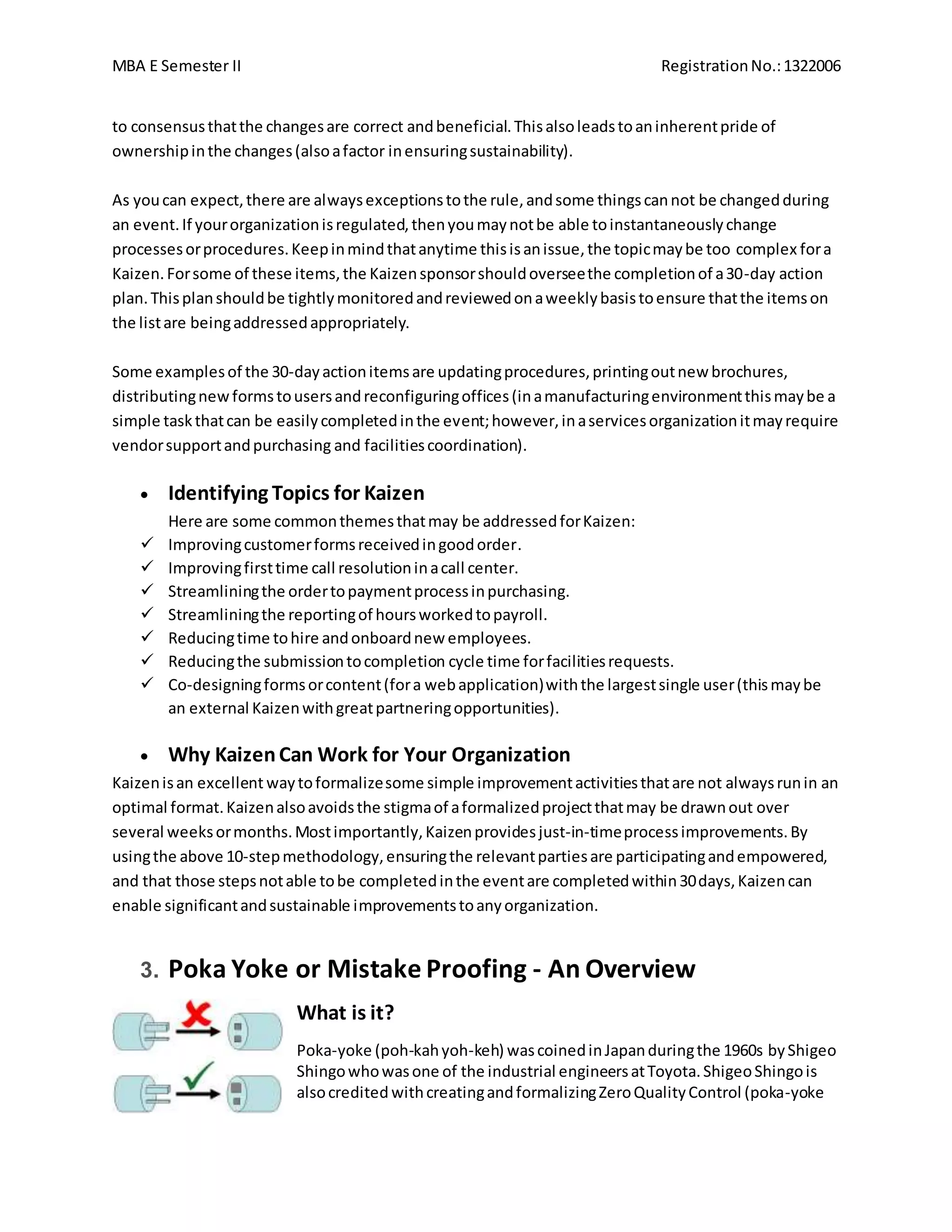
Poka-yoke (poh-kahyoh-keh) wascoinedinJapanduringthe 1960s byShigeo
Shingowhowasone of the industrial engineersatToyota.ShigeoShingois
alsocredited withcreatingandformalizingZeroQualityControl (poka-yoke
MBA E Semester II RegistrationNo.:1322006
techniquestocorrectpossible defects+source inspectiontopreventdefectsequalszeroquality
control).
The initial termwasbaka-yoke,whichmeans‘fool-proofing’.In1963, a workerat Arakawa Body
Companyrefusedtouse baka-yoke mechanismsinherworkarea,because of the term’sdishonorable
and offensive connotation.Hence,the termwaschangedtopoka-yoke,whichmeans‘mistake-proofing’
or more literallyavoiding(yokeru)inadvertenterrors(poka).Ideally,poka-yokesensure thatproper
conditionsexistbeforeactuallyexecutingaprocessstep,preventingdefectsfromoccurringinthe first
place.Where thisisnot possible,poka-yokesperformadetective function,eliminatingdefectsin the
processas earlyas possible.
 Why it is important
Poka-yoke helpspeople andprocessesworkrightthe firsttime.Poka-yoke referstotechniquesthat
make it impossible tomake mistakes.These techniquescandrive defectsoutof productsand processes
and substantiallyimprovequalityandreliability.Itcanbe thoughtof as an extensionof FMEA.It can also
be usedto fine tune improvementsandprocessdesignsfromsix-sigmaDefine - Measure - Analyze -
Improve - Control (DMAIC) projects.The use of simple poka-yoke ideasandmethodsinproductand
processdesigncaneliminate bothhumanandmechanical errors.Poka-yokedoesnotneedtobe costly.
For instance,Toyotahasan average of 12 mistake-proofingdevicesateachworkstationanda goal of
implementingeachmistake-proofingdevice forunder$150.
 When touse it
Poka-yoke canbe usedwhereversomethingcangowrong or an error can be made.It isa technique,a
tool that can be appliedtoanytype of processbe it inmanufacturingorthe service industry.Errorsare
manytypes -
1 Processingerror
Processoperationmissedornotperformedperthe standardoperatingprocedure.
2 Setuperror
Usingthe wrongtoolingorsettingmachine adjustmentsincorrectly.
3 Missingpart
Notall partsincluded inthe assembly,welding,orotherprocesses.
4 Improperpart/item
Wrong part usedinthe process.
5 Operationserror
Carryingout an operationincorrectly;havingthe incorrectversionof the specification.
6 Measurementerror
Errors in machine adjustment,testmeasurementordimensionsof apart cominginfrom a
supplier.
 How to use it
Stepby stepprocessinapplying poka-yoke:
1. Identifythe operationorprocess - basedon a pareto.
MBA E Semester II RegistrationNo.:1322006
2. Analyze the 5-whysandunderstandthe waysaprocesscan fail.
3. Decide the rightpoka-yoke approach,suchasusinga shut outtype (preventinganerrorbeing
made),oran attentiontype (highlightingthatanerror hasbeenmade) poka-yoke take amore
comprehensive approachinsteadof merelythinkingof poka-yokesaslimitswitches,or
automaticshutoffsapoka-yoke canbe electrical,mechanical,procedural,visual,humanorany
otherformthat preventsincorrectexecutionof aprocessstep
4. Determine whetheracontact- use of shape,size orotherphysical attributesfordetection,
constantnumber- errortriggeredif a certainnumberof actionsare notmade sequence method
- use of a checklisttoensure completingall processsteps isappropriate
5. Trial the methodandsee if itworks
6. Train the operator,reviewperformance andmeasure success.
4. Six Sigma
 Six Sigma'saimis to eliminate waste andinefficiency,therebyincreasing
customersatisfactionbydeliveringwhatthe customerisexpecting.
 Six Sigmaisahighlydisciplinedprocessthathelpsusfocuson developing
and delivering near-perfect products and services.
 Six Sigmafollowsastructuredmethodology,andhasdefinedrolesforthe
participants.
 Six Sigma is a data driven methodology, and requires accurate data collection for the processes being
analyzed.
 Six Sigma is about putting results on Financial Statements.
 Six Sigma is a business-driven, multi-dimensional structured approach to:
 Improving Processes
 Lowering Defects
 Reducing process variability
 Reducing costs
 Increasing customer satisfaction
 Increased profits
The word Sigma is a statistical term that measures how far a given process deviates from perfection.
The central idea behindSix Sigmais that if you can measure how many "defects"youhave in a process,
youcan systematicallyfigure out howtoeliminate themandgetasclose to"zerodefects"aspossibleand
specifically it means a failure rate of 3.4 parts per million or 99.9997% perfect.
 Key Concepts of Six Sigma
At its core, Six Sigma revolves around a few key concepts.
 Critical to Quality: Attributes most important to the customer.
 Defect: Failing to deliver what the customer wants.
 Process Capability: What your process can deliver.
 Variation: What the customer sees and feels.
 Stable Operations:Ensuringconsistent,predictable processestoimprove whatthe customer
sees and feels.
 Design for Six Sigma: Designing to meet customer needs and process capability.
MBA E Semester II RegistrationNo.:1322006
Our Customers Feel the Variance, Not the Mean. So Six Sigma focuses first on reducing process
variation and then on improving the process capability.
 Myths about Six Sigma:
There are several myths and misunderstandings about Six Sigma. Few are given below:
 Six Sigma is only concerned with reducing defects.
 Six Sigma is a process for production or engineering.
 Six Sigma can not be applied to engineering activities.
 Six Sigma uses difficult-to-understand statistics.
 Six Sigma is just training.
 The Benefits of Six Sigma
There are following six major benefits of Six Sigma that attract companies.
 Generates sustained success.
 Sets a performance goal for everyone.
 Enhances value to customers.
 Accelerates the rate of improvement.
 Promotes learning and cross-pollination.
 Executes strategic change.
 Origin of Six Sigma
 Six Sigma originated at Motorola in the early 1980s in response to achieving 10X reduction in
product-failure levels in 5 years.
 EngineerBillSmithinventedSixSigma,butdiedof aheartattackinthe Motorolacafeteriain1993
never knowing the scope of the craze and controversy he had touched off.
 Six Sigma is based on various quality management theories (e.g.: Deming's 14 point for
management, Juran's 10 steps on achieving quality ).
5. ISO 9000 - Quality management
The ISO 9000 familyaddressesvariousaspectsof qualitymanagement
and containssome of ISO’sbestknown standards.The standardsprovide
guidance andtoolsforcompaniesandorganizationswhowanttoensure
that theirproductsand servicesconsistentlymeetcustomer’s
requirements,andthatqualityisconsistentlyimproved.
There are manystandardsinthe ISO9000 family,including:
 ISO9001:2008 - setsout the requirementsof aqualitymanagementsystem
 ISO9000:2005 - coversthe basic conceptsandlanguage
 ISO9004:2009 - focusesonhowto make a qualitymanagementsystemmore efficientandeffective
MBA E Semester II RegistrationNo.:1322006
 ISO19011:2011 - setsout guidance oninternal andexternal auditsof qualitymanagementsystems.
ISO 9001:2008
ISO9001:2008 setsout the criteriafor a qualitymanagementsystemandisthe onlystandardinthe
familythatcan be certifiedto(althoughthisisnota requirement).Itcanbe usedbyany organization,
large or small,regardlessof itsfieldof activity.InfactISO9001:2008 isimplementedbyoverone million
companiesandorganizationsinover170 countries.
Quality ManagementPrinciples
The standard isbasedon a numberof qualitymanagementprinciplesincludingastrongcustomerfocus,
the motivationandimplicationof topmanagement,the processapproachandcontinual improvement.
These principlesare explainedinmore detail inthe pdf QualityManagementPrinciples.UsingISO
9001:2008 helpsensure thatcustomersgetconsistent,goodqualityproductsandservices,whichinturn
bringsmanybusinessbenefits.
Audits
Checkingthatthe systemworksisa vital part of ISO9001:2008. Anorganizationmustperforminternal
auditsto checkhowits qualitymanagementsystemisworking.Anorganizationmaydecidetoinvite an
independentcertificationbody toverifythatitisinconformitytothe standard,but there isno
requirementforthis.Alternatively,itmightinviteitsclientstoauditthe qualitysystemforthemselves.
References:
1. http://www.mindtools.com/pages/article/newSTR_44.htm
2. http://www.iso.org/iso/home.html
3. http://thequalityportal.com/pokayoke.htm
4. http://www.processexcellencenetwork.com/organizational-change/articles/kaizen-
rapid-change-for-a-rapidly-changing-world/

Lean manufacturing

  • 1.
    MBA E SemesterII RegistrationNo.:1322006 Operations Management MBAE 231 Dussa Pullaiah, Executive MBA, Christ University Assignment-2: Articles on Six Sigma, Lean Manufacturing, Kaizen, Poka Yoke, ISO 9001:2000 1. Lean Manufacturing - Working More efficiently Waste costs youand your customers’ money.Andif yourcustomershave to pay more because of it,theymightgo elsewhere.Beingcompetitive also requiresalotof flexibility.Youmustbe able tomeetthe changingdemands of yourcustomersquicklyandeffectively,andadaptto a rapidlychanging businessenvironment. So,how can youreduce waste and dothingsmore efficiently?Andhowcan youkeepupwiththe changingdemandsof consumers? FirstmentionedinJamesWomack's1990 book,"The Machine That Changed the World,"Lean Manufacturingisa theorythat can helpyouto simplifyandorganize yourworking environmentsothatyou can reduce waste,andkeepyourpeople,equipment,andworkspace responsive towhat'sneededrightnow.  A Brief History of LeanManufacturing HenryFord wasone of the firstpeople todevelopthe ideasbehindLeanManufacturing.He usedthe ideaof "continuousflow"onthe assemblyline forhisModel Tautomobile,where he keptproduction standardsextremelytight,soeachstage of the processfittedtogetherwitheachotherstage,perfectly. Thisresultedinlittle waste. But Ford's processwasn'tflexible.Hisassemblylinesproducedthe same thing,againandagain,andthe processdidn'teasilyallowforanymodificationsorchangestothe endproduct – a Model T assembly line producedonlythe Model T.It wasalsoa "push"process,where Fordsetthe level of production, insteadof a "pull"processledbyconsumerdemand.Thisledtolarge inventoriesof unsoldautomobiles, ultimatelyresultinginlotsof wastedmoney. Othermanufacturersbegantouse Ford's ideas,butmanyrealizedthatthe inflexibilityof hissystemwas a problem.Taiichi Ohnoof Toyotathendevelopedthe ToyotaProductionSystem(TPS),whichused Just In Time manufacturingmethodstoincrease efficiency.AsWomackreportedinhisbook,Toyotaused thisprocesssuccessfullyand,asa result,eventuallyemergedasone the mostprofitable manufacturing companiesinthe world.  Lean Manufacturing Basics Lean manufacturingisbasedonfindingefficienciesandremovingwasteful stepsthatdon'taddvalue to the endproduct.There'sno needtoreduce qualitywithleanmanufacturing –the cuts are a resultof findingbetter,more efficientwaysof accomplishingthe same tasks. To findthe efficiencies,leanmanufacturingadoptsacustomer-valuefocus,asking"Whatisthe customerwillingtopayfor?" Customerswantvalue,andthey'll payonlyif youcanmeettheirneeds. Theyshouldn'tpayfor defects,orforthe extracost of havinglarge inventories.Inotherwords,they shouldn'tpayfor yourwaste.
  • 2.
    MBA E SemesterII RegistrationNo.:1322006 Waste is anythingthatdoesn'taddvalue to the endproduct.In LeanManufacturing,there are eight categoriesof waste thatyou should monitor: 1. Overproduction– Are youproducingmore than consumersdemand? 2. Waiting– Howmuch lag time isthere betweenproductionsteps? 3. Inventory(workin progress) –Are yoursupplylevelsandworkinprogressinventoriestoohigh? 4. Transportation – Do you move materialsefficiently? 5. Over-processing– Do youworkon the product too manytimes,orotherwise workinefficiently? 6. Motion– Do people andequipmentmove betweentasksefficiently? 7. Defects– Howmuch time doyou spendfindingandfixingproduction mistakes? 8. Workforce – Do youuse workersefficiently? Lean Manufacturinggivesprioritytosimple,small,andcontinuousimprovementsuchaschanging the placementof a tool,or puttingtwoworkstationsclosertogether.Asthese small improvements are addedtogether,theycanleadtoa higherlevelof efficiencythroughoutthe whole system.  Lean Manufacturing Process The Lean Manufacturingprocesshasthree keystages: Stage 1 –Identify Waste Accordingto the Lean Manufacturingphilosophy,wastealwaysexists,andnomatterhow goodyour processisright now,itcan alwaysbe better.LeanManufacturingreliesonthisfundamental philosophy of continuousimprovement,knownas Kaizen . One of the keytoolsusedtofindthiswaste isa Value Stream Map (VSM).Thisshowshow materials and processesflowthroughyourorganizationtobringyourproductor service tothe consumer.Itlooks at how actionsanddepartmentsare connected,andithighlightsthe waste.Asyouanalyze the VSM, you'll see the processesthataddvalue andthose that don't.You can thencreate a "future state"VSM that includesasfewnon-value-addingactivitiesaspossible. Stage 2– Analyze the Waste, and Findthe Root Cause For eachwaste you identifiedinthe firststage,figure outwhat'scausingitbyusing Root Cause Analysis . If a machine isconstantlybreakingdown,you mightthinkthe problemismechanical and decide topurchase a newmachine.ButRoot Cause Analysiscouldshow thatthe real problemispoorly trainedoperatorswhodon'tuse the machine properly.Othereffective toolsforfindingarootcause include Brainstorming and Cause and EffectDiagrams. Stage 3– Solve the Root Cause, and Repeat the Cycle Usingan appropriate problem-solving process,decide whatyoumustdoto fix the issue tocreate more efficiency. Tools to Reduce Waste Once you have identifiedwastesusingthe three keystagesabove,youcanthenapplythisnextsetof toolsto helpyoureduce waste further:  Just in Time – Thisis the core ideaof LeanManufacturingand isbasedon the "pull"model.To minimize stockandresources,youonlypurchase materials,andproduce anddistribute products whenrequired.Youalsoproduce small,continuousbatchesof productstohelp productionrun
  • 3.
    MBA E SemesterII RegistrationNo.:1322006 smoothlyandefficiently.Byreducingbatchsize,youcanalsomonitorqualityandcorrectany defectsasyougo. Thisreducesthe likelihoodof qualitybeingpoorinfuture batches. (Inmanufacturing,akeyway of doingthisisto use Kanban,below.)  Kanban – Thisisone of the keywaysto involve people inthe leanmanufacturingprocess.Here, yousupportthe JustIn Time model bydevelopingcuesinthe systemtosignal thatyouneedto replace,order,orlocate something.The focusisonreducingoverproduction,sothatyouhave whatyou need,onlywhenyouneedit.  Zero Defects – Thissystemfocuses ongettingthe productrightthe firsttime,ratherthan spendingextratime andmoneyfixingpoor-qualityproducts.Byusingthe ZeroDefectssystem, you'll reinforce the notionthatnodefectisacceptable,andencourage peopletodothingsright the firsttime that theydosomething.  Single Minute Exchange of Die (SMED) – Thishelpsyoubuildflexibilityintoyourproduction.For example,inthe automotive industry,itcouldtake daystochange a line to produce a differentcar model.WithSMED, the assemblyprocessandmachineryare designedtosupportquickand efficientchangeovers.(Here,a"die"isa tool usedto shape anobjector material.)  The 5S Philosophy– LeanManufacturingdependsonstandardization.Youwantyourtools, processes,andworkplace arrangementstobe as simple andasstandardas possible.Thiscreates fewerplacesforthingstogo wrong,and reducesthe inventoryof replacementpartsthatyou needtohold.To accomplisha goodlevel of standardization,use the 5SSystem 2. KAIZEN The fastestwayto resolve anissue mightactuallybe by usingtoolsfocusedonchange.Inthisrapidlychanging environment,if youfindthatprocesschangesare occurringon a regularbasis,yourprocess improvementinitiativesalsoneedtohave the speedand agilitytochange withthe times.Gone are the year-long teamsto determine feasibilityof aprocesschange or productenhancement! It isnot to say that a Kaizeneventisthe end-all,be-all solutiontofix all of today’seconomicissues,butitisa goodstart to solvingsome of them.Asthe U.S. governmentstepsintoenactchange and provide support to the variousinstitutionsinthe country,there are additional changesthatmusttake place withinthese institutions—somelarge,some procedural andsome,hopefully,cultural. Kaizenasa methodologyhasthe abilitytospeedupthatchange processand more importantlyfinalize the solutionsintostandardizedprocessesexpeditiously.Thisbenefitsthe organizationbynothaving “floating”processesinplace andthe end-userbymakingaseamlessprocesseasytouse.Kaizendoes thisby havinga structuredapproach,withspecificdeliverables,andownershipof the changesafter the Kaizen iscompleted.  Facilitating aSuccessful KaizenProcess
  • 4.
    MBA E SemesterII RegistrationNo.:1322006 A refinedapproachtocompletingaKaizenisthe keytoensuringresults.More importantly,the approach needstobe facilitatedbyanindividual who hasgoodpeople skills,excellentteamwork capabilities,quickconflictresolutionskillsandin-depthnegotiatingskills.Thistype of leader,coupled withan empoweredteam, isbestpoisedforsuccess.We canall relate toa projectwe were exposedto that didnot quite reachitsfull potential,eitherbecause of the lackof directioninthe project managementorthe lack of experience inthe projectmanager.Kaizencaneasilymitigateissuesbyusing the above criteriaforthe facilitatorwhile followingarigorousapplicationof a10-stepmethodology.  Kaizen’s Ten-StepProcess Your favorite processimprovementmethodologycanbe moldedfrom Kaizen’s10 steps,includingSix Sigma,PlanDo CheckAct (PCDA),orevenSelectClarifyOrganize RunEvaluate (SCORE).Thisflexibility givesthe Kaizenanabilitytobe usedthroughoutyourorganizationbyanyexperiencedfacilitator.These 10 stepsare the processmap throughwhichthe eventiskeptontrack and participantsremainengaged. See the stepsbelowtocompare the othermethodologiestothe Kaizenprocess. 1. Define the problem 2. Documentthe currentsituation 3. Visualizethe ideal situation 4. Define measurementtargets 5. Brainstormsolutionstothe problem 6. DevelopKaizenplan 7. Implementplan 8. Measure,recordand compare resultstotargets 9. Prepare summarydocuments 10. Create shortterm actionplan,on-goingstandardsandsustainingplan  Empowering Process Change Additionally,itisimperativethatthe participantsinthe eventbe empoweredtoimplementany changes.This isa keyto successotherwise the new processesorprocesschangeswill be shortlivedand the people doingthe workona day-to-daybasiswill quicklyrevertbacktothe old methods. There are alsokeypeople thatneedtobe presentina Kaizenevent:the subjectmatterexpert,the processowner,one ortwo of the front-lineworkers(those peoplethatexperience the processona regularbasis) andan outside novice (someone unfamiliarwiththe process).However,none of these positionsshouldbe filledby the facilitator.I’dsuggestthatyouuse a facilitatorfromoutside the areato preventthatindividual fromunconsciouslysteeringthe eventinaparticulardirection,or,evenworse, consciouslysteeringthe eventinaparticulardirection.  Timing is Key The difference betweenKaizenandothereventsistiming.Kaizenbydefinitionissmall changesforthe better.Today,Kaizeneventsare knowntohave the resultsimplementedbefore the conclusionof the event.Thisjust-in-time processimprovementcapabilityalsohingesonall of the participantsbuying-in
  • 5.
    MBA E SemesterII RegistrationNo.:1322006 to consensusthatthe changesare correct andbeneficial.Thisalsoleadstoaninherentpride of ownershipinthe changes(alsoafactor inensuringsustainability). As youcan expect,there are alwaysexceptionstothe rule,andsome thingscannot be changedduring an event.If yourorganizationisregulated,thenyoumaynotbe able toinstantaneouslychange processesorprocedures.Keepinmindthatanytime thisisanissue,the topicmaybe too complex fora Kaizen.Forsome of these items,the Kaizensponsorshouldoverseethe completionof a30-day action plan.Thisplanshouldbe tightlymonitoredandreviewedonaweeklybasistoensure thatthe itemson the listare beingaddressedappropriately. Some examplesof the 30-dayactionitemsare updatingprocedures,printingoutnew brochures, distributingnew formstousersandreconfiguringoffices(inamanufacturingenvironmentthismaybe a simple taskthatcan be easilycompletedinthe event;however,inaservicesorganizationitmayrequire vendorsupportandpurchasing and facilitiescoordination).  Identifying Topics for Kaizen Here are some commonthemesthatmay be addressedforKaizen:  Improvingcustomerformsreceivedingoodorder.  Improvingfirsttime call resolutioninacall center.  Streamliningthe ordertopaymentprocessinpurchasing.  Streamliningthe reportingof hoursworkedtopayroll.  Reducingtime tohire andonboardnew employees.  Reducingthe submissiontocompletion cycle time forfacilitiesrequests.  Co-designingformsorcontent(fora webapplication)withthe largestsingle user(thismaybe an external Kaizenwithgreatpartneringopportunities).  Why KaizenCan Work for Your Organization Kaizenisan excellent waytoformalizesome simple improvementactivitiesthatare not alwaysrunin an optimal format.Kaizenalsoavoidsthe stigmaof aformalizedprojectthatmay be drawnout over several weeksormonths.Mostimportantly,Kaizenprovidesjust-in-timeprocessimprovements.By usingthe above 10-stepmethodology,ensuringthe relevantpartiesare participatingandempowered, and that those stepsnotable tobe completedinthe eventare completedwithin30days,Kaizencan enable significantandsustainable improvementstoanyorganization. 3. Poka Yoke or Mistake Proofing - An Overview What is it? Poka-yoke (poh-kahyoh-keh) wascoinedinJapanduringthe 1960s byShigeo Shingowhowasone of the industrial engineersatToyota.ShigeoShingois alsocredited withcreatingandformalizingZeroQualityControl (poka-yoke
  • 6.
    MBA E SemesterII RegistrationNo.:1322006 techniquestocorrectpossible defects+source inspectiontopreventdefectsequalszeroquality control). The initial termwasbaka-yoke,whichmeans‘fool-proofing’.In1963, a workerat Arakawa Body Companyrefusedtouse baka-yoke mechanismsinherworkarea,because of the term’sdishonorable and offensive connotation.Hence,the termwaschangedtopoka-yoke,whichmeans‘mistake-proofing’ or more literallyavoiding(yokeru)inadvertenterrors(poka).Ideally,poka-yokesensure thatproper conditionsexistbeforeactuallyexecutingaprocessstep,preventingdefectsfromoccurringinthe first place.Where thisisnot possible,poka-yokesperformadetective function,eliminatingdefectsin the processas earlyas possible.  Why it is important Poka-yoke helpspeople andprocessesworkrightthe firsttime.Poka-yoke referstotechniquesthat make it impossible tomake mistakes.These techniquescandrive defectsoutof productsand processes and substantiallyimprovequalityandreliability.Itcanbe thoughtof as an extensionof FMEA.It can also be usedto fine tune improvementsandprocessdesignsfromsix-sigmaDefine - Measure - Analyze - Improve - Control (DMAIC) projects.The use of simple poka-yoke ideasandmethodsinproductand processdesigncaneliminate bothhumanandmechanical errors.Poka-yokedoesnotneedtobe costly. For instance,Toyotahasan average of 12 mistake-proofingdevicesateachworkstationanda goal of implementingeachmistake-proofingdevice forunder$150.  When touse it Poka-yoke canbe usedwhereversomethingcangowrong or an error can be made.It isa technique,a tool that can be appliedtoanytype of processbe it inmanufacturingorthe service industry.Errorsare manytypes - 1 Processingerror Processoperationmissedornotperformedperthe standardoperatingprocedure. 2 Setuperror Usingthe wrongtoolingorsettingmachine adjustmentsincorrectly. 3 Missingpart Notall partsincluded inthe assembly,welding,orotherprocesses. 4 Improperpart/item Wrong part usedinthe process. 5 Operationserror Carryingout an operationincorrectly;havingthe incorrectversionof the specification. 6 Measurementerror Errors in machine adjustment,testmeasurementordimensionsof apart cominginfrom a supplier.  How to use it Stepby stepprocessinapplying poka-yoke: 1. Identifythe operationorprocess - basedon a pareto.
  • 7.
    MBA E SemesterII RegistrationNo.:1322006 2. Analyze the 5-whysandunderstandthe waysaprocesscan fail. 3. Decide the rightpoka-yoke approach,suchasusinga shut outtype (preventinganerrorbeing made),oran attentiontype (highlightingthatanerror hasbeenmade) poka-yoke take amore comprehensive approachinsteadof merelythinkingof poka-yokesaslimitswitches,or automaticshutoffsapoka-yoke canbe electrical,mechanical,procedural,visual,humanorany otherformthat preventsincorrectexecutionof aprocessstep 4. Determine whetheracontact- use of shape,size orotherphysical attributesfordetection, constantnumber- errortriggeredif a certainnumberof actionsare notmade sequence method - use of a checklisttoensure completingall processsteps isappropriate 5. Trial the methodandsee if itworks 6. Train the operator,reviewperformance andmeasure success. 4. Six Sigma  Six Sigma'saimis to eliminate waste andinefficiency,therebyincreasing customersatisfactionbydeliveringwhatthe customerisexpecting.  Six Sigmaisahighlydisciplinedprocessthathelpsusfocuson developing and delivering near-perfect products and services.  Six Sigmafollowsastructuredmethodology,andhasdefinedrolesforthe participants.  Six Sigma is a data driven methodology, and requires accurate data collection for the processes being analyzed.  Six Sigma is about putting results on Financial Statements.  Six Sigma is a business-driven, multi-dimensional structured approach to:  Improving Processes  Lowering Defects  Reducing process variability  Reducing costs  Increasing customer satisfaction  Increased profits The word Sigma is a statistical term that measures how far a given process deviates from perfection. The central idea behindSix Sigmais that if you can measure how many "defects"youhave in a process, youcan systematicallyfigure out howtoeliminate themandgetasclose to"zerodefects"aspossibleand specifically it means a failure rate of 3.4 parts per million or 99.9997% perfect.  Key Concepts of Six Sigma At its core, Six Sigma revolves around a few key concepts.  Critical to Quality: Attributes most important to the customer.  Defect: Failing to deliver what the customer wants.  Process Capability: What your process can deliver.  Variation: What the customer sees and feels.  Stable Operations:Ensuringconsistent,predictable processestoimprove whatthe customer sees and feels.  Design for Six Sigma: Designing to meet customer needs and process capability.
  • 8.
    MBA E SemesterII RegistrationNo.:1322006 Our Customers Feel the Variance, Not the Mean. So Six Sigma focuses first on reducing process variation and then on improving the process capability.  Myths about Six Sigma: There are several myths and misunderstandings about Six Sigma. Few are given below:  Six Sigma is only concerned with reducing defects.  Six Sigma is a process for production or engineering.  Six Sigma can not be applied to engineering activities.  Six Sigma uses difficult-to-understand statistics.  Six Sigma is just training.  The Benefits of Six Sigma There are following six major benefits of Six Sigma that attract companies.  Generates sustained success.  Sets a performance goal for everyone.  Enhances value to customers.  Accelerates the rate of improvement.  Promotes learning and cross-pollination.  Executes strategic change.  Origin of Six Sigma  Six Sigma originated at Motorola in the early 1980s in response to achieving 10X reduction in product-failure levels in 5 years.  EngineerBillSmithinventedSixSigma,butdiedof aheartattackinthe Motorolacafeteriain1993 never knowing the scope of the craze and controversy he had touched off.  Six Sigma is based on various quality management theories (e.g.: Deming's 14 point for management, Juran's 10 steps on achieving quality ). 5. ISO 9000 - Quality management The ISO 9000 familyaddressesvariousaspectsof qualitymanagement and containssome of ISO’sbestknown standards.The standardsprovide guidance andtoolsforcompaniesandorganizationswhowanttoensure that theirproductsand servicesconsistentlymeetcustomer’s requirements,andthatqualityisconsistentlyimproved. There are manystandardsinthe ISO9000 family,including:  ISO9001:2008 - setsout the requirementsof aqualitymanagementsystem  ISO9000:2005 - coversthe basic conceptsandlanguage  ISO9004:2009 - focusesonhowto make a qualitymanagementsystemmore efficientandeffective
  • 9.
    MBA E SemesterII RegistrationNo.:1322006  ISO19011:2011 - setsout guidance oninternal andexternal auditsof qualitymanagementsystems. ISO 9001:2008 ISO9001:2008 setsout the criteriafor a qualitymanagementsystemandisthe onlystandardinthe familythatcan be certifiedto(althoughthisisnota requirement).Itcanbe usedbyany organization, large or small,regardlessof itsfieldof activity.InfactISO9001:2008 isimplementedbyoverone million companiesandorganizationsinover170 countries. Quality ManagementPrinciples The standard isbasedon a numberof qualitymanagementprinciplesincludingastrongcustomerfocus, the motivationandimplicationof topmanagement,the processapproachandcontinual improvement. These principlesare explainedinmore detail inthe pdf QualityManagementPrinciples.UsingISO 9001:2008 helpsensure thatcustomersgetconsistent,goodqualityproductsandservices,whichinturn bringsmanybusinessbenefits. Audits Checkingthatthe systemworksisa vital part of ISO9001:2008. Anorganizationmustperforminternal auditsto checkhowits qualitymanagementsystemisworking.Anorganizationmaydecidetoinvite an independentcertificationbody toverifythatitisinconformitytothe standard,but there isno requirementforthis.Alternatively,itmightinviteitsclientstoauditthe qualitysystemforthemselves. References: 1. http://www.mindtools.com/pages/article/newSTR_44.htm 2. http://www.iso.org/iso/home.html 3. http://thequalityportal.com/pokayoke.htm 4. http://www.processexcellencenetwork.com/organizational-change/articles/kaizen- rapid-change-for-a-rapidly-changing-world/