Lean Thinking and Methods
Kaizen
Kaizen, Japanese for "improvement" or "change for the best", often is
considered to be the "building block" of all lean production methods.
Kaizen focuses on eliminating waste, improving productivity, and
achieving sustained continual improvement in targeted activities and
processes of an organization.
Lean production is founded on the idea of kaizen – or continual
improvement. This philosophy implies that small, incremental changes
routinely applied and sustained over a long period result in significant
improvements.
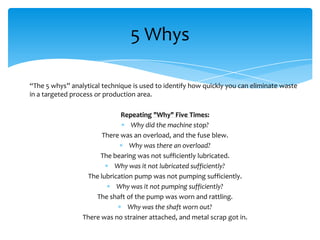
5 Whys
“The 5 whys” analytical technique is used to identify how quickly you can eliminate waste
in a targeted process or production area.
Repeating "Why" Five Times:
Why did the machine stop?
There was an overload, and the fuse blew.
Why was there an overload?
The bearing was not sufficiently lubricated.
Why was it not lubricated sufficiently?
The lubrication pump was not pumping sufficiently.
Why was it not pumping sufficiently?
The shaft of the pump was worn and rattling.
Why was the shaft worn out?
There was no strainer attached, and metal scrap got in.
Kaizen Benefits

Kaizen can be a powerful tool for uncovering hidden
wastes or waste-generating activities and eliminating
them.
Kaizen focuses on waste elimination activities that
optimize existing processes and that can be
accomplished quickly without significant capital
investment. This creates a higher likelihood of quick,
sustained results.
5S

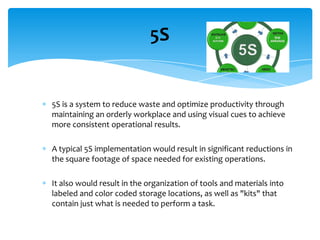
5S is a system to reduce waste and optimize productivity through
maintaining an orderly workplace and using visual cues to achieve
more consistent operational results.

A typical 5S implementation would result in significant reductions in
the square footage of space needed for existing operations.
It also would result in the organization of tools and materials into
labeled and color coded storage locations, as well as "kits" that
contain just what is needed to perform a task.
5S Implementation Approach
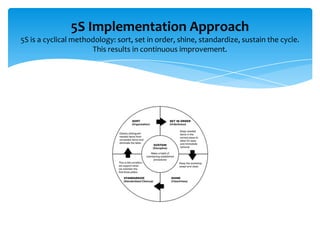
5S is a cyclical methodology: sort, set in order, shine, standardize, sustain the cycle.
This results in continuous improvement.
The 5S Pillars

Sort - the first S, focuses on eliminating unnecessary items from the workplace that are not needed for
current production operations. An effective visual method to identify these unneeded items is called "red
tagging”. A red tag is placed on all items that are not important for operations or that are not in the
proper location or quantity.
Set In Order focuses on creating efficient and effective storage methods to arrange items so that they are
easy to use and to label them so that they are easy to find and put away.
Shine - once the waste is eliminated and remaining items are organized, the next step is to thoroughly
clean the work area.
Standardize – is the method to maintain the first three pillars, creates a consistent approach with which
tasks and procedures are done.
Sustain – is often the most difficult S to implement and achieve, because of the tendency to return to the
status quo and the comfort zone of the "old way" of doing things. Tools for sustaining 5S include signs
and posters, newsletters, pocket manuals, team and management check-ins, performance reviews, etc.
Kanban
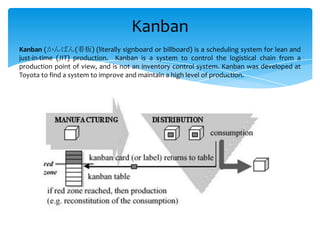
Kanban (かんばん(看板) (literally signboard or billboard) is a scheduling system for lean and
just-in-time (JIT) production. Kanban is a system to control the logistical chain from a
production point of view, and is not an inventory control system. Kanban was developed at
Toyota to find a system to improve and maintain a high level of production.
Kanban Description

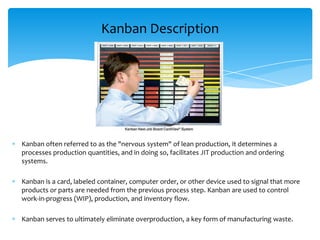
Kanban often referred to as the "nervous system" of lean production, it determines a
processes production quantities, and in doing so, facilitates JIT production and ordering
systems.
Kanban is a card, labeled container, computer order, or other device used to signal that more
products or parts are needed from the previous process step. Kanban are used to control
work-in-progress (WIP), production, and inventory flow.

Kanban serves to ultimately eliminate overproduction, a key form of manufacturing waste.
KANBAN
Benefits
Kanban systems reduce the amount of necessary in-process and postprocess inventory, thereby reducing the potential for products to be
damaged during handling and storage.
Typically Kanban requires less floor space for equal levels of production.
Hence, reduce in energy use for heating, air conditioning, and lighting.
Kanban systems also help facilitate worker-lead process improvements,
as workers are more motivated to make product improvements when
there is no excess inventory remaining to be sold.
Six Sigma
δ

6 Sigma Intro δ

Six Sigma consists of a set of statistical methods for systemically analyzing processes
to reduce process variation, which are sometimes used to support and guide supply
chain continual improvement activities.
Six Sigma was developed by Motorola in the 1990s, drawing on well-established
statistical quality control techniques and data analysis methods.
The term sigma is a Greek alphabet letter (σ) used to describe variability. A sigma
quality level serves as an indicator of how often defects are likely to occur in
processes, parts, or products. A Six Sigma quality level equates to approximately 3.4
defects per million opportunities, representing high quality and minimal process
variability.
Implementation Approach

A sequence of steps called the Six Sigma DMAIC (Define, Measure, Analyze, Improve, and
Control) is typically used to guide implementation of Six Sigma statistical tools and to
identify process wastes and weaknesses.
Define. This phase focuses on defining the project improvement activity goals and identifying
the issues that need to be addressed to achieve a higher sigma level.

Measure. In this phase, the aim is to gather information about the targeted process.
Analyze. This phase is concerned with identifying the root cause(s) of quality problems, and
confirming those causes using appropriate statistical tools.
Improve – implementation phase of creative solutions - ways to do things better, cheaper,
and/or faster - that address the problems identified during the analysis phase takes place.
Control. This phase involves integration of the improved system by modifying policies,
procedures, and other management systems. Process performance results are again
periodically monitored to ensure productivity improvements are sustained.
Six Sigma Benefits
A reduction in defects can help eliminate waste from processes in three
fundamental ways:
fewer defects decreases the number of products that must be scrapped;
fewer defects also means that the raw materials, energy, and resulting
waste associated with the scrap are eliminated;
fewer defects decreases the amount of energy, raw material, and wastes
that are used or generated to fix defective products that can be re-worked.

Six Sigma techniques that focus on product durability and reliability can
increase the lifespan of products. This can reduce the frequency with which
the product will need to be replaced, reducing the overall environmental
impacts associated with meeting the customer need.
3P: Production Preparation Process

Lean experts typically view 3P as one of the most powerful and
transformative advanced manufacturing tools, and it is typically
only used by organizations that have experience implementing
other lean methods.
Whereas kaizen and other lean methods take a production
process as a given and seek to make improvements, the
Production Preparation Process (3P) focuses on eliminating
waste through product and process design.
Method and Implementation
Approach
The project team spends usually several days working to develop multiple alternatives for each process step
and evaluating each alternative against manufacturing criteria and a preferred cost. The goal is typically to
develop a process or product design that meets customer requirements best in the "least waste way". The
typical steps in a 3P are:
Define Product or Process Design Objectives/Needs: The team seeks to understand the core customer
needs that need to be met. If a product or product prototype is available, the project team breaks it
down into component parts and raw materials to assess the function that each plays.
Diagraming: A fishbone diagram or other type of illustration is created to demonstrate the flow from raw
material to finish product.
Find and Analyze Examples in Nature: The project team then tries to find examples of each process
keyword.
Build, Present, and Select Process Prototypes: The team prototypes and then evaluates the chosen
process, spending several days (if necessary) working with different variations of the mock-up to ensure
it will meet criteria.
Hold Design Review: Once a concept has been selected for additional refinement, it is presented to a
larger group (including the original product designers) for feedback.
Develop Project Implementation plan: If the project is selected to proceed, the team selects a project
implementation leader who helps determine the schedule, process, resource requirements, and
distribution of responsibilities for completion.

Lean thinking and methods

  • 1.
  • 2.
    Kaizen Kaizen, Japanese for"improvement" or "change for the best", often is considered to be the "building block" of all lean production methods. Kaizen focuses on eliminating waste, improving productivity, and achieving sustained continual improvement in targeted activities and processes of an organization. Lean production is founded on the idea of kaizen – or continual improvement. This philosophy implies that small, incremental changes routinely applied and sustained over a long period result in significant improvements.
  • 3.
    5 Whys “The 5whys” analytical technique is used to identify how quickly you can eliminate waste in a targeted process or production area. Repeating "Why" Five Times: Why did the machine stop? There was an overload, and the fuse blew. Why was there an overload? The bearing was not sufficiently lubricated. Why was it not lubricated sufficiently? The lubrication pump was not pumping sufficiently. Why was it not pumping sufficiently? The shaft of the pump was worn and rattling. Why was the shaft worn out? There was no strainer attached, and metal scrap got in.
  • 4.
    Kaizen Benefits Kaizen canbe a powerful tool for uncovering hidden wastes or waste-generating activities and eliminating them. Kaizen focuses on waste elimination activities that optimize existing processes and that can be accomplished quickly without significant capital investment. This creates a higher likelihood of quick, sustained results.
  • 5.
    5S 5S is asystem to reduce waste and optimize productivity through maintaining an orderly workplace and using visual cues to achieve more consistent operational results. A typical 5S implementation would result in significant reductions in the square footage of space needed for existing operations. It also would result in the organization of tools and materials into labeled and color coded storage locations, as well as "kits" that contain just what is needed to perform a task.
  • 6.
    5S Implementation Approach 5Sis a cyclical methodology: sort, set in order, shine, standardize, sustain the cycle. This results in continuous improvement.
  • 7.
    The 5S Pillars Sort- the first S, focuses on eliminating unnecessary items from the workplace that are not needed for current production operations. An effective visual method to identify these unneeded items is called "red tagging”. A red tag is placed on all items that are not important for operations or that are not in the proper location or quantity. Set In Order focuses on creating efficient and effective storage methods to arrange items so that they are easy to use and to label them so that they are easy to find and put away. Shine - once the waste is eliminated and remaining items are organized, the next step is to thoroughly clean the work area. Standardize – is the method to maintain the first three pillars, creates a consistent approach with which tasks and procedures are done. Sustain – is often the most difficult S to implement and achieve, because of the tendency to return to the status quo and the comfort zone of the "old way" of doing things. Tools for sustaining 5S include signs and posters, newsletters, pocket manuals, team and management check-ins, performance reviews, etc.
  • 8.
    Kanban Kanban (かんばん(看板) (literallysignboard or billboard) is a scheduling system for lean and just-in-time (JIT) production. Kanban is a system to control the logistical chain from a production point of view, and is not an inventory control system. Kanban was developed at Toyota to find a system to improve and maintain a high level of production.
  • 9.
    Kanban Description Kanban oftenreferred to as the "nervous system" of lean production, it determines a processes production quantities, and in doing so, facilitates JIT production and ordering systems. Kanban is a card, labeled container, computer order, or other device used to signal that more products or parts are needed from the previous process step. Kanban are used to control work-in-progress (WIP), production, and inventory flow. Kanban serves to ultimately eliminate overproduction, a key form of manufacturing waste.
  • 10.
    KANBAN Benefits Kanban systems reducethe amount of necessary in-process and postprocess inventory, thereby reducing the potential for products to be damaged during handling and storage. Typically Kanban requires less floor space for equal levels of production. Hence, reduce in energy use for heating, air conditioning, and lighting. Kanban systems also help facilitate worker-lead process improvements, as workers are more motivated to make product improvements when there is no excess inventory remaining to be sold.
  • 11.
  • 12.
    δ 6 Sigma Introδ Six Sigma consists of a set of statistical methods for systemically analyzing processes to reduce process variation, which are sometimes used to support and guide supply chain continual improvement activities. Six Sigma was developed by Motorola in the 1990s, drawing on well-established statistical quality control techniques and data analysis methods. The term sigma is a Greek alphabet letter (σ) used to describe variability. A sigma quality level serves as an indicator of how often defects are likely to occur in processes, parts, or products. A Six Sigma quality level equates to approximately 3.4 defects per million opportunities, representing high quality and minimal process variability.
  • 13.
    Implementation Approach A sequenceof steps called the Six Sigma DMAIC (Define, Measure, Analyze, Improve, and Control) is typically used to guide implementation of Six Sigma statistical tools and to identify process wastes and weaknesses. Define. This phase focuses on defining the project improvement activity goals and identifying the issues that need to be addressed to achieve a higher sigma level. Measure. In this phase, the aim is to gather information about the targeted process. Analyze. This phase is concerned with identifying the root cause(s) of quality problems, and confirming those causes using appropriate statistical tools. Improve – implementation phase of creative solutions - ways to do things better, cheaper, and/or faster - that address the problems identified during the analysis phase takes place. Control. This phase involves integration of the improved system by modifying policies, procedures, and other management systems. Process performance results are again periodically monitored to ensure productivity improvements are sustained.
  • 14.
    Six Sigma Benefits Areduction in defects can help eliminate waste from processes in three fundamental ways: fewer defects decreases the number of products that must be scrapped; fewer defects also means that the raw materials, energy, and resulting waste associated with the scrap are eliminated; fewer defects decreases the amount of energy, raw material, and wastes that are used or generated to fix defective products that can be re-worked. Six Sigma techniques that focus on product durability and reliability can increase the lifespan of products. This can reduce the frequency with which the product will need to be replaced, reducing the overall environmental impacts associated with meeting the customer need.
  • 15.
    3P: Production PreparationProcess Lean experts typically view 3P as one of the most powerful and transformative advanced manufacturing tools, and it is typically only used by organizations that have experience implementing other lean methods. Whereas kaizen and other lean methods take a production process as a given and seek to make improvements, the Production Preparation Process (3P) focuses on eliminating waste through product and process design.
  • 16.
    Method and Implementation Approach Theproject team spends usually several days working to develop multiple alternatives for each process step and evaluating each alternative against manufacturing criteria and a preferred cost. The goal is typically to develop a process or product design that meets customer requirements best in the "least waste way". The typical steps in a 3P are: Define Product or Process Design Objectives/Needs: The team seeks to understand the core customer needs that need to be met. If a product or product prototype is available, the project team breaks it down into component parts and raw materials to assess the function that each plays. Diagraming: A fishbone diagram or other type of illustration is created to demonstrate the flow from raw material to finish product. Find and Analyze Examples in Nature: The project team then tries to find examples of each process keyword. Build, Present, and Select Process Prototypes: The team prototypes and then evaluates the chosen process, spending several days (if necessary) working with different variations of the mock-up to ensure it will meet criteria. Hold Design Review: Once a concept has been selected for additional refinement, it is presented to a larger group (including the original product designers) for feedback. Develop Project Implementation plan: If the project is selected to proceed, the team selects a project implementation leader who helps determine the schedule, process, resource requirements, and distribution of responsibilities for completion.