Project Controls Addressing the Skills Shortage and Establishing a Career Path Shane Forth Manager of Project Controls  Power & Process Europe
Agenda  Introduction BCECA Project Control  Managers Committee ECITB Working Groups Project Control Apprenticeship Project Controls Career Path  Project Control NVQ Project Control NVQ - Levels 2,3 and 4 Project Control NVQ – Unit Contents and Example Unit Assessment Structure and Approved Assessment Centres Typical Profiles of Level 2, 3 & 4  Candidates at Start What the Candidates Say Progress Since 2006 What are the Benefits ?
Shane Forth FAPM, FACostE Professional Manager of Project Controls  (17 of last 21 years with AMEC) SPMM Project Controls Champion Operational Excellence  (Lead Planning & Scheduling SME)  AMEC Project Academy  (Lead AMEC Presenter – Project Controls) Specialist support and peer assists,  recommendation and implementation of  project control improvements to major projects BCECA Chairman Project Control Managers Working Group Association of Cost Engineers Vice-President  Chairman, Planning & Scheduling SIG Website Contact, Project Management & Control  ECITB Working Groups   National Working Group, Project Control Apprenticeship North East Working Group, Project Control Apprenticeship Project Controls, National Occupational Standards Working Group
BCECA Project Control Managers Committee In September 2002, BCECA Project Control Managers Committee was formed at the request of member companies HR departments to find a solution to the shortage of project controls staff and discuss whether a combined effort on training new staff would be useful . BCECA  is the trade association representing the principal EPC and project management  companies in the UK and provides a focal point for representation of its members interests  to UK Government, European Union  International Institutions and  Clients
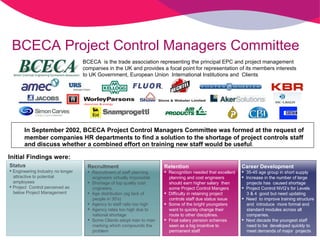
BCECA Project Control Managers Committee Status Engineering Industry no longer    attractive to potential    employees  Project  Control perceived as    below Project Management  In September 2002, BCECA Project Control Managers Committee was formed at the request of member companies HR departments to find a solution to the shortage of project controls staff and discuss whether a combined effort on training new staff would be useful . Initial Findings were:  Retention Recognition needed that excellent    planning and cost engineers    should earn higher salary  then    some Project Control Mangers  Difficulty in retaining project    controls staff due status issue Some of the bright youngsters    want to quickly change their    route to other disciplines. Final salary pension schemes    seen as a big incentive to    permanent staff Recruitment Recruitment of staff planning    engineers virtually impossible  Shortage of top quality cost    cngineers.  Age distribution (eg lack of    people in 30's) Agency to staff ratio too high  Agency rates too high due to    national shortage Some Clients adopt man to man    marking which compounds the    problem  Career Development 35-45 age group in short supply Increase in the number of large   projects has  caused shortage Project Control NVQ’s for Levels    3 & 4  good but need updating Need  to improve training structure    and  introduce  more formal and    standard modules across all    companies. Next decade the youngest staff    need to be  developed quickly to    meet demands of major  projects BCECA  is the trade association representing the principal EPC and project management  companies in the UK and provides a focal point for representation of its members interests  to UK Government, European Union  International Institutions and  Clients
ECITB Working Groups Proposal for redevelopment and reaccreditation by QCA,  funding, functional analysis   review of existing standards, iterative drafts, national consultation  National Working Group  (2002 – 2004)  Update of PC NOS and Level 3 and 4 NVQ’s   OSC Eng Pro V oc In April 2005 the new Project Control NOS’s for Levels 3 & 4 were launched at three national seminars including at Davy Technology Centre, Thornaby  But … Occupational Standards (OS) and Project Control Level 3 and 4 NVQ’s in place since 1996 needed updating to fit in with National framework (ie NOS’s). Full redevelopment and approval cycle, was necessary – a time consuming process
ECITB Working Groups National Working Group  (2005 -2007) Development  of Level 2 Project Control Standards Proposal for redevelopment and reaccreditation by QCA,  funding, functional analysis   review of existing standards, iterative drafts, national consultation  National Working Group  (2002 – 2004)  Update of PC NOS and Level 3 and 4 NVQ’s   Funding, functional analysis, iterative drafts, national consultation  OSC Eng Pro V oc Pro V oc In April 2005 the new Project Control NOS’s for Levels 3 & 4 were launched at three national seminars including at Davy Technology Centre, Thornaby  Feedback from Industry was loud and clear - a  Level 2  Project Control NVQ was required as the entry point to attract people into a career in project controls But … Occupational Standards (OS) and Project Control Level 3 and 4 NVQ’s in place since 1996 needed updating to fit in with National framework (ie NOS’s). Full redevelopment and approval cycle, was necessary – a time consuming process
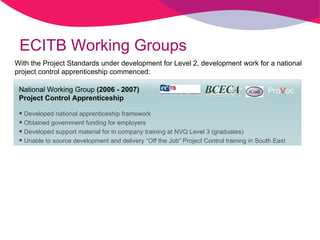
ECITB Working Groups Pro V oc National Working Group  (2006 - 2007) Project Control Apprenticeship  Developed national apprenticeship framework Obtained government funding for employers Developed support material for in company training at NVQ Level 3 (graduates) Unable to source development and delivery “Off the Job” Project Control training in South East With the Project Standards under development for Level 2, development work for a national  project control apprenticeship commenced:
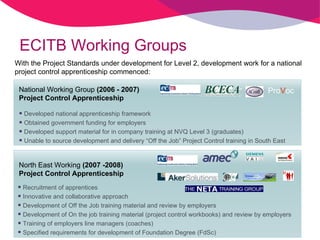
ECITB Working Groups Recruitment of apprentices Innovative and collaborative approach Development of Off the Job training material and review by employers Development of On the job training material (project control workbooks) and review by employers Training of employers line managers (coaches) Specified requirements for development of Foundation Degree (FdSc) Pro V oc National Working Group  (2006 - 2007) Project Control Apprenticeship  North East Working  (2007 -2008) Project Control Apprenticeship Developed national apprenticeship framework Obtained government funding for employers Developed support material for in company training at NVQ Level 3 (graduates) Unable to source development and delivery “Off the Job” Project Control training in South East With the Project Standards under development for Level 2, development work for a national  project control apprenticeship commenced:
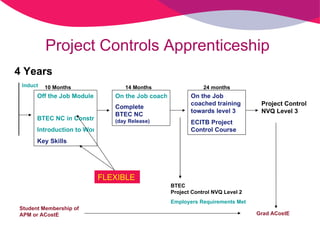
Project Controls Apprenticeship On the Job coached training Complete  BTEC NC (day Release) Induct Off the Job Modules(4 days/week)  BTEC NC in Construction(day release) Introduction to Work Key Skills 10 Months Student Membership of  APM or ACostE 14 Months BTEC  Project Control NVQ Level 2 Employers Requirements Met On the Job coached training towards level 3 ECITB Project Control Course 24 months Grad ACostE Project Control NVQ Level 3 4 Years FLEXIBLE
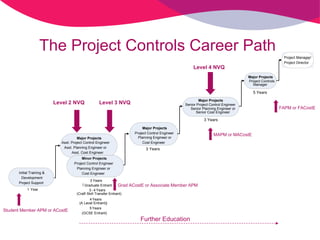
The Project Controls Career Path Level 2 NVQ Level 3 NVQ Level 4 NVQ Further Education Initial Training & Development Project Support 1  Year Major Projects Project Control Engineer  Planning Engineer or Cost Engineer 3  Years Senior Project Control Engineer  Senior Planning Engineer or Senior Cost Engineer 3  Years Project Controls  Manager 5 Years Major Projects Asst. Project Control Engineer  Asst. Planning Engineer or Asst. Cost Engineer Minor Projects Project Control Engineer  Planning Engineer or Cost Engineer 5  Years  4  Years  - (A Level Entrant) ) 3  Years  ( Graduate Entrant 3  - 4  Years  (Craft Skill Transfer Entrant) Project Manager/  /  Project Director Student Member APM or ACostE FAPM or FACostE   Grad ACostE or Associate Member APM MAPM or MACostE (GCSE Entrant) Major Projects Major Projects
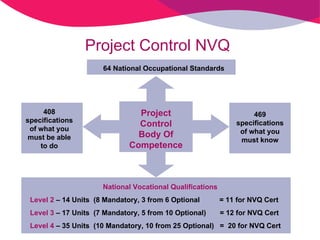
Project Control NVQ Project Control Body Of Competence 64 National Occupational Standards 408 specifications of what you must be able to do 469 specifications of what you must know National Vocational Qualifications Level 2  – 14 Units  (8 Mandatory, 3 from 6 Optional  = 11 for NVQ Cert Level 3  – 17 Units  (7 Mandatory, 5 from 10 Optional)  = 12 for NVQ Cert Level 4  – 35 Units  (10 Mandatory, 10 from 25 Optional)  =  20 for NVQ Cert
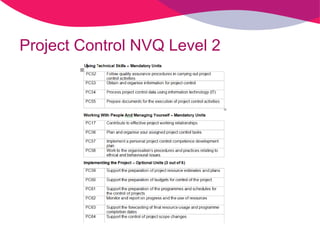
Project Control NVQ Level 2
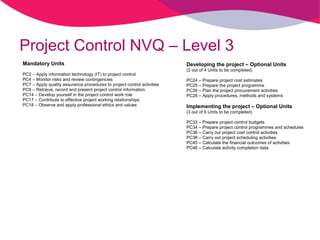
Project Control NVQ – Level 3
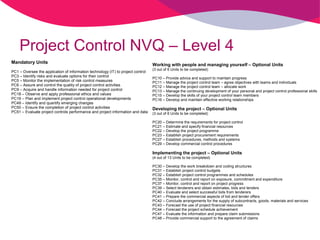
Project Control NVQ – Level 4
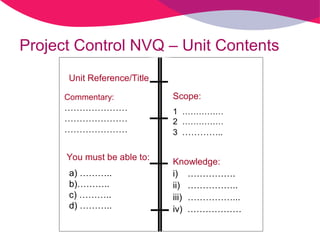
Project Control NVQ – Unit Contents
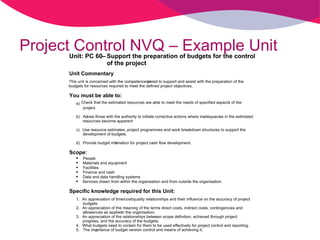
Project Control NVQ – Example Unit Unit: PC 60  – Support the preparation of budgets for the control  of the project Unit Commentary This unit is concerned with the competence re quired to support and assist with the preparation of the  budgets for resources required to meet the defined project objectives. You must be able to: a) Check that the estimated resources are able to meet the needs of specified aspects of the  project. b) Ad vise those with the authority to initiate corrective actions where inadequacies in the estimated  resources become apparent c) Use resource estimates, project programmes and work breakdown structures to support the  development of budgets. d) Provide budget info rmation for project cash flow development. Scope:  People  Materials and equipment  Facilities  Finance and cash  Data and data handling systems  Services drawn from within the organisation and from outside the organisation Specific knowledge required for this Unit: 1. An appreciation of time/cost/quality relationships and their influence on the accuracy of project  budgets. 2. An appreciation of the meaning of the terms direct costs, indirect costs, contingencies and  allowances as applied in the organisation. 3. An appreciation of the relationships between scope definition, achieved through project  progress, and the accuracy of the budgets. 4. What budgets need to contain for them to be used effectively for project control and reporting. 5. The imp ortance of budget version control and means of achieving it.
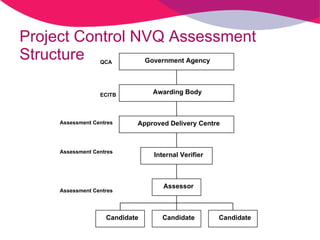
Project Control NVQ Assessment Structure  QCA ECITB Assessment Centres Assessment Centres Assessment Centres Candidate Candidate Candidate Assessor Internal Verifier Approved Delivery Centre Awarding Body  Government Agency
Approved Assessment Centres
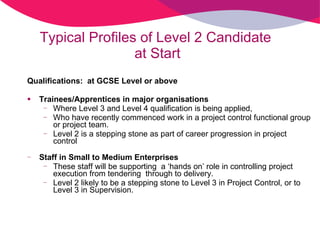
Typical Profiles of Level 2 Candidate  at Start Qualifications:  at GCSE Level or above Trainees/Apprentices in major organisations  Where Level 3 and Level 4 qualification is being applied,  Who have recently commenced work in a project control functional group or project team. Level 2 is a stepping stone as part of career progression in project control  Staff in Small to Medium Enterprises  These staff will be supporting  a ‘hands on’ role in controlling project execution from tendering  through to delivery.  Level 2 likely to be a stepping stone to Level 3 in Project Control, or to  Level 3 in Supervision.
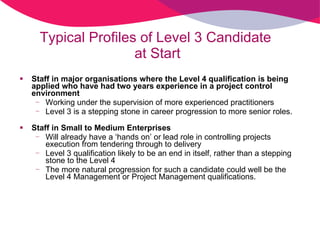
Staff in major organisations where the Level 4 qualification is being applied who have had two years experience in a project control environment Working under the supervision of more experienced practitioners Level 3 is a stepping stone in career progression to more senior roles. Staff in Small to Medium Enterprises  Will already have a ‘hands on’ or lead role in controlling projects execution from tendering through to delivery  Level 3 qualification likely to be an end in itself, rather than a stepping stone to the Level 4  The more natural progression for such a candidate could well be the Level 4 Management or Project Management qualifications. Typical Profiles of Level 3 Candidate  at Start
Typical Profiles of Level 4 Candidate  at Start Qualifications : HNC or above Several years as a practitioner in a major organisation One or two  years in a position of recognisable authority and responsibility after achieving Level 3 or equivalent experience Key member of multi-discipline project teams or specialist providing control services into project teams.
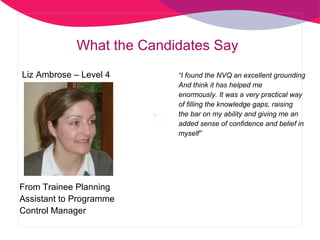
What the Candidates Say “ I found the NVQ an excellent grounding And think it has helped me enormously. It was a very practical way of filling the knowledge gaps, raising the bar on my ability and giving me an added sense of confidence and belief in myself” Liz Ambrose – Level 4  From Trainee Planning  Assistant to Programme Control Manager
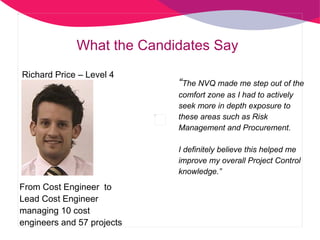
“ The NVQ made me step out of the comfort zone as I had to actively seek more in depth exposure to these areas such as Risk Management and Procurement.  I definitely believe this helped me improve my overall Project Control knowledge.”  What the Candidates Say Richard Price – Level 4  From Cost Engineer  to  Lead Cost Engineer managing 10 cost engineers and 57 projects
What the Candidates Say “ Initially I was unsure how beneficial the NVQ  would be in my personal development and career progression.  It soon became apparent how highly recognised the NVQ is, and how it identified perfectly which areas of skill I needed to become a competent PCP.  After 5 years achieving academic qualifications, I appreciate the benefit of a vocational qualification which allows me to demonstrate my ability in a practical manner whilst compiling evidence to prove can do the job . This has given me the motivation and confidence to continually develop myself and realise my potential “ Eden Day – Level 3 From Business Services Graduate to Graduate Project Controller
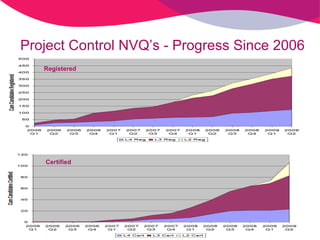
Project Control NVQ’s - Progress Since 2006 Registered Certified
Company  Key measure to resolve shortage of competent project controllers  Growing our own, engagement with the business, building loyalty  Bringing more balance and diversity to the organisation Skill levels accredited against National Occupational Standards  “ Can Do” requirements of NVQ’s prove they can do the job (competence) Development of rounded Project Controllers (Estimating/Planning/Cost)  rather than single discipline Project Control apprentices  have no baggage so readily learn, accept and apply key principles and procedures  for the “AMEC Way” Another route to Project Management Contributes to the building of AMEC’s Project Management Army Enhanced career development framework and succession planning Employees Job satisfaction and security Formal career path with continued measure of success Focus on self development Able to compare oneself with peers Recognition, Promotion, Reward What are the Benefits ?

Addressing the Skills Shortage and Establishing a Career Path

  • 1.
    Project Controls Addressingthe Skills Shortage and Establishing a Career Path Shane Forth Manager of Project Controls Power & Process Europe
  • 2.
    Agenda IntroductionBCECA Project Control Managers Committee ECITB Working Groups Project Control Apprenticeship Project Controls Career Path Project Control NVQ Project Control NVQ - Levels 2,3 and 4 Project Control NVQ – Unit Contents and Example Unit Assessment Structure and Approved Assessment Centres Typical Profiles of Level 2, 3 & 4 Candidates at Start What the Candidates Say Progress Since 2006 What are the Benefits ?
  • 3.
    Shane Forth FAPM,FACostE Professional Manager of Project Controls (17 of last 21 years with AMEC) SPMM Project Controls Champion Operational Excellence (Lead Planning & Scheduling SME) AMEC Project Academy (Lead AMEC Presenter – Project Controls) Specialist support and peer assists, recommendation and implementation of project control improvements to major projects BCECA Chairman Project Control Managers Working Group Association of Cost Engineers Vice-President Chairman, Planning & Scheduling SIG Website Contact, Project Management & Control ECITB Working Groups National Working Group, Project Control Apprenticeship North East Working Group, Project Control Apprenticeship Project Controls, National Occupational Standards Working Group
  • 4.
    BCECA Project ControlManagers Committee In September 2002, BCECA Project Control Managers Committee was formed at the request of member companies HR departments to find a solution to the shortage of project controls staff and discuss whether a combined effort on training new staff would be useful . BCECA is the trade association representing the principal EPC and project management companies in the UK and provides a focal point for representation of its members interests to UK Government, European Union International Institutions and Clients
  • 5.
    BCECA Project ControlManagers Committee Status Engineering Industry no longer attractive to potential employees Project Control perceived as below Project Management In September 2002, BCECA Project Control Managers Committee was formed at the request of member companies HR departments to find a solution to the shortage of project controls staff and discuss whether a combined effort on training new staff would be useful . Initial Findings were: Retention Recognition needed that excellent planning and cost engineers should earn higher salary then some Project Control Mangers Difficulty in retaining project controls staff due status issue Some of the bright youngsters want to quickly change their route to other disciplines. Final salary pension schemes seen as a big incentive to permanent staff Recruitment Recruitment of staff planning engineers virtually impossible Shortage of top quality cost cngineers. Age distribution (eg lack of people in 30's) Agency to staff ratio too high Agency rates too high due to national shortage Some Clients adopt man to man marking which compounds the problem Career Development 35-45 age group in short supply Increase in the number of large projects has caused shortage Project Control NVQ’s for Levels 3 & 4 good but need updating Need to improve training structure and introduce more formal and standard modules across all companies. Next decade the youngest staff need to be developed quickly to meet demands of major projects BCECA is the trade association representing the principal EPC and project management companies in the UK and provides a focal point for representation of its members interests to UK Government, European Union International Institutions and Clients
  • 6.
    ECITB Working GroupsProposal for redevelopment and reaccreditation by QCA, funding, functional analysis review of existing standards, iterative drafts, national consultation National Working Group (2002 – 2004) Update of PC NOS and Level 3 and 4 NVQ’s OSC Eng Pro V oc In April 2005 the new Project Control NOS’s for Levels 3 & 4 were launched at three national seminars including at Davy Technology Centre, Thornaby But … Occupational Standards (OS) and Project Control Level 3 and 4 NVQ’s in place since 1996 needed updating to fit in with National framework (ie NOS’s). Full redevelopment and approval cycle, was necessary – a time consuming process
  • 7.
    ECITB Working GroupsNational Working Group (2005 -2007) Development of Level 2 Project Control Standards Proposal for redevelopment and reaccreditation by QCA, funding, functional analysis review of existing standards, iterative drafts, national consultation National Working Group (2002 – 2004) Update of PC NOS and Level 3 and 4 NVQ’s Funding, functional analysis, iterative drafts, national consultation OSC Eng Pro V oc Pro V oc In April 2005 the new Project Control NOS’s for Levels 3 & 4 were launched at three national seminars including at Davy Technology Centre, Thornaby Feedback from Industry was loud and clear - a Level 2 Project Control NVQ was required as the entry point to attract people into a career in project controls But … Occupational Standards (OS) and Project Control Level 3 and 4 NVQ’s in place since 1996 needed updating to fit in with National framework (ie NOS’s). Full redevelopment and approval cycle, was necessary – a time consuming process
  • 8.
    ECITB Working GroupsPro V oc National Working Group (2006 - 2007) Project Control Apprenticeship Developed national apprenticeship framework Obtained government funding for employers Developed support material for in company training at NVQ Level 3 (graduates) Unable to source development and delivery “Off the Job” Project Control training in South East With the Project Standards under development for Level 2, development work for a national project control apprenticeship commenced:
  • 9.
    ECITB Working GroupsRecruitment of apprentices Innovative and collaborative approach Development of Off the Job training material and review by employers Development of On the job training material (project control workbooks) and review by employers Training of employers line managers (coaches) Specified requirements for development of Foundation Degree (FdSc) Pro V oc National Working Group (2006 - 2007) Project Control Apprenticeship North East Working (2007 -2008) Project Control Apprenticeship Developed national apprenticeship framework Obtained government funding for employers Developed support material for in company training at NVQ Level 3 (graduates) Unable to source development and delivery “Off the Job” Project Control training in South East With the Project Standards under development for Level 2, development work for a national project control apprenticeship commenced:
  • 10.
    Project Controls ApprenticeshipOn the Job coached training Complete BTEC NC (day Release) Induct Off the Job Modules(4 days/week) BTEC NC in Construction(day release) Introduction to Work Key Skills 10 Months Student Membership of APM or ACostE 14 Months BTEC Project Control NVQ Level 2 Employers Requirements Met On the Job coached training towards level 3 ECITB Project Control Course 24 months Grad ACostE Project Control NVQ Level 3 4 Years FLEXIBLE
  • 11.
    The Project ControlsCareer Path Level 2 NVQ Level 3 NVQ Level 4 NVQ Further Education Initial Training & Development Project Support 1 Year Major Projects Project Control Engineer Planning Engineer or Cost Engineer 3 Years Senior Project Control Engineer Senior Planning Engineer or Senior Cost Engineer 3 Years Project Controls Manager 5 Years Major Projects Asst. Project Control Engineer Asst. Planning Engineer or Asst. Cost Engineer Minor Projects Project Control Engineer Planning Engineer or Cost Engineer 5 Years 4 Years - (A Level Entrant) ) 3 Years ( Graduate Entrant 3 - 4 Years (Craft Skill Transfer Entrant) Project Manager/ / Project Director Student Member APM or ACostE FAPM or FACostE Grad ACostE or Associate Member APM MAPM or MACostE (GCSE Entrant) Major Projects Major Projects
  • 12.
    Project Control NVQProject Control Body Of Competence 64 National Occupational Standards 408 specifications of what you must be able to do 469 specifications of what you must know National Vocational Qualifications Level 2 – 14 Units (8 Mandatory, 3 from 6 Optional = 11 for NVQ Cert Level 3 – 17 Units (7 Mandatory, 5 from 10 Optional) = 12 for NVQ Cert Level 4 – 35 Units (10 Mandatory, 10 from 25 Optional) = 20 for NVQ Cert
  • 13.
  • 14.
  • 15.
  • 16.
    Project Control NVQ– Unit Contents
  • 17.
    Project Control NVQ– Example Unit Unit: PC 60 – Support the preparation of budgets for the control of the project Unit Commentary This unit is concerned with the competence re quired to support and assist with the preparation of the budgets for resources required to meet the defined project objectives. You must be able to: a) Check that the estimated resources are able to meet the needs of specified aspects of the project. b) Ad vise those with the authority to initiate corrective actions where inadequacies in the estimated resources become apparent c) Use resource estimates, project programmes and work breakdown structures to support the development of budgets. d) Provide budget info rmation for project cash flow development. Scope:  People  Materials and equipment  Facilities  Finance and cash  Data and data handling systems  Services drawn from within the organisation and from outside the organisation Specific knowledge required for this Unit: 1. An appreciation of time/cost/quality relationships and their influence on the accuracy of project budgets. 2. An appreciation of the meaning of the terms direct costs, indirect costs, contingencies and allowances as applied in the organisation. 3. An appreciation of the relationships between scope definition, achieved through project progress, and the accuracy of the budgets. 4. What budgets need to contain for them to be used effectively for project control and reporting. 5. The imp ortance of budget version control and means of achieving it.
  • 18.
    Project Control NVQAssessment Structure QCA ECITB Assessment Centres Assessment Centres Assessment Centres Candidate Candidate Candidate Assessor Internal Verifier Approved Delivery Centre Awarding Body Government Agency
  • 19.
  • 20.
    Typical Profiles ofLevel 2 Candidate at Start Qualifications: at GCSE Level or above Trainees/Apprentices in major organisations Where Level 3 and Level 4 qualification is being applied, Who have recently commenced work in a project control functional group or project team. Level 2 is a stepping stone as part of career progression in project control Staff in Small to Medium Enterprises These staff will be supporting a ‘hands on’ role in controlling project execution from tendering through to delivery. Level 2 likely to be a stepping stone to Level 3 in Project Control, or to Level 3 in Supervision.
  • 21.
    Staff in majororganisations where the Level 4 qualification is being applied who have had two years experience in a project control environment Working under the supervision of more experienced practitioners Level 3 is a stepping stone in career progression to more senior roles. Staff in Small to Medium Enterprises Will already have a ‘hands on’ or lead role in controlling projects execution from tendering through to delivery Level 3 qualification likely to be an end in itself, rather than a stepping stone to the Level 4 The more natural progression for such a candidate could well be the Level 4 Management or Project Management qualifications. Typical Profiles of Level 3 Candidate at Start
  • 22.
    Typical Profiles ofLevel 4 Candidate at Start Qualifications : HNC or above Several years as a practitioner in a major organisation One or two years in a position of recognisable authority and responsibility after achieving Level 3 or equivalent experience Key member of multi-discipline project teams or specialist providing control services into project teams.
  • 23.
    What the CandidatesSay “ I found the NVQ an excellent grounding And think it has helped me enormously. It was a very practical way of filling the knowledge gaps, raising the bar on my ability and giving me an added sense of confidence and belief in myself” Liz Ambrose – Level 4 From Trainee Planning Assistant to Programme Control Manager
  • 24.
    “ The NVQmade me step out of the comfort zone as I had to actively seek more in depth exposure to these areas such as Risk Management and Procurement. I definitely believe this helped me improve my overall Project Control knowledge.” What the Candidates Say Richard Price – Level 4 From Cost Engineer to Lead Cost Engineer managing 10 cost engineers and 57 projects
  • 25.
    What the CandidatesSay “ Initially I was unsure how beneficial the NVQ would be in my personal development and career progression. It soon became apparent how highly recognised the NVQ is, and how it identified perfectly which areas of skill I needed to become a competent PCP. After 5 years achieving academic qualifications, I appreciate the benefit of a vocational qualification which allows me to demonstrate my ability in a practical manner whilst compiling evidence to prove can do the job . This has given me the motivation and confidence to continually develop myself and realise my potential “ Eden Day – Level 3 From Business Services Graduate to Graduate Project Controller
  • 26.
    Project Control NVQ’s- Progress Since 2006 Registered Certified
  • 27.
    Company Keymeasure to resolve shortage of competent project controllers Growing our own, engagement with the business, building loyalty Bringing more balance and diversity to the organisation Skill levels accredited against National Occupational Standards “ Can Do” requirements of NVQ’s prove they can do the job (competence) Development of rounded Project Controllers (Estimating/Planning/Cost) rather than single discipline Project Control apprentices have no baggage so readily learn, accept and apply key principles and procedures for the “AMEC Way” Another route to Project Management Contributes to the building of AMEC’s Project Management Army Enhanced career development framework and succession planning Employees Job satisfaction and security Formal career path with continued measure of success Focus on self development Able to compare oneself with peers Recognition, Promotion, Reward What are the Benefits ?

Editor's Notes

  • #14 Juts to run you through the why and how we develop training for the Industry Industry forum identify a need ECITB convene a forum and take actions to research and develop these training needs ECITB research training needs and report back to Industry forum ECITB research training solutions if required and report back to IF ECITB contract for desired solution Contractor design product Training Provider pilots delivery of Product, in this case EC Harris design and deliver as specialists You tell us how relevant the Product is to your needs from a user perspective Will be a feedback form at the end of the day. The feedback is designed to capture your reaction to the course. This course is unique as we are giving you the opportunity to take an action plan away with you. This action plan has a primary objective of helping us evaluate the course. If you use the action plan and the course helps you achieve identified actions then we can justifiably say this course adds value. If however you don’t use the action plan then we can question the benefits of the course and not waste industry money. To enable me to do a follow up I’ve asked for your contact details on the validation form which you will be given at the end of the day.
  • #15 Juts to run you through the why and how we develop training for the Industry Industry forum identify a need ECITB convene a forum and take actions to research and develop these training needs ECITB research training needs and report back to Industry forum ECITB research training solutions if required and report back to IF ECITB contract for desired solution Contractor design product Training Provider pilots delivery of Product, in this case EC Harris design and deliver as specialists You tell us how relevant the Product is to your needs from a user perspective Will be a feedback form at the end of the day. The feedback is designed to capture your reaction to the course. This course is unique as we are giving you the opportunity to take an action plan away with you. This action plan has a primary objective of helping us evaluate the course. If you use the action plan and the course helps you achieve identified actions then we can justifiably say this course adds value. If however you don’t use the action plan then we can question the benefits of the course and not waste industry money. To enable me to do a follow up I’ve asked for your contact details on the validation form which you will be given at the end of the day.
  • #16 Juts to run you through the why and how we develop training for the Industry Industry forum identify a need ECITB convene a forum and take actions to research and develop these training needs ECITB research training needs and report back to Industry forum ECITB research training solutions if required and report back to IF ECITB contract for desired solution Contractor design product Training Provider pilots delivery of Product, in this case EC Harris design and deliver as specialists You tell us how relevant the Product is to your needs from a user perspective Will be a feedback form at the end of the day. The feedback is designed to capture your reaction to the course. This course is unique as we are giving you the opportunity to take an action plan away with you. This action plan has a primary objective of helping us evaluate the course. If you use the action plan and the course helps you achieve identified actions then we can justifiably say this course adds value. If however you don’t use the action plan then we can question the benefits of the course and not waste industry money. To enable me to do a follow up I’ve asked for your contact details on the validation form which you will be given at the end of the day.
  • #17 Juts to run you through the why and how we develop training for the Industry Industry forum identify a need ECITB convene a forum and take actions to research and develop these training needs ECITB research training needs and report back to Industry forum ECITB research training solutions if required and report back to IF ECITB contract for desired solution Contractor design product Training Provider pilots delivery of Product, in this case EC Harris design and deliver as specialists You tell us how relevant the Product is to your needs from a user perspective Will be a feedback form at the end of the day. The feedback is designed to capture your reaction to the course. This course is unique as we are giving you the opportunity to take an action plan away with you. This action plan has a primary objective of helping us evaluate the course. If you use the action plan and the course helps you achieve identified actions then we can justifiably say this course adds value. If however you don’t use the action plan then we can question the benefits of the course and not waste industry money. To enable me to do a follow up I’ve asked for your contact details on the validation form which you will be given at the end of the day.
  • #18 Juts to run you through the why and how we develop training for the Industry Industry forum identify a need ECITB convene a forum and take actions to research and develop these training needs ECITB research training needs and report back to Industry forum ECITB research training solutions if required and report back to IF ECITB contract for desired solution Contractor design product Training Provider pilots delivery of Product, in this case EC Harris design and deliver as specialists You tell us how relevant the Product is to your needs from a user perspective Will be a feedback form at the end of the day. The feedback is designed to capture your reaction to the course. This course is unique as we are giving you the opportunity to take an action plan away with you. This action plan has a primary objective of helping us evaluate the course. If you use the action plan and the course helps you achieve identified actions then we can justifiably say this course adds value. If however you don’t use the action plan then we can question the benefits of the course and not waste industry money. To enable me to do a follow up I’ve asked for your contact details on the validation form which you will be given at the end of the day.
  • #19 Juts to run you through the why and how we develop training for the Industry Industry forum identify a need ECITB convene a forum and take actions to research and develop these training needs ECITB research training needs and report back to Industry forum ECITB research training solutions if required and report back to IF ECITB contract for desired solution Contractor design product Training Provider pilots delivery of Product, in this case EC Harris design and deliver as specialists You tell us how relevant the Product is to your needs from a user perspective Will be a feedback form at the end of the day. The feedback is designed to capture your reaction to the course. This course is unique as we are giving you the opportunity to take an action plan away with you. This action plan has a primary objective of helping us evaluate the course. If you use the action plan and the course helps you achieve identified actions then we can justifiably say this course adds value. If however you don’t use the action plan then we can question the benefits of the course and not waste industry money. To enable me to do a follow up I’ve asked for your contact details on the validation form which you will be given at the end of the day.
  • #20 Juts to run you through the why and how we develop training for the Industry Industry forum identify a need ECITB convene a forum and take actions to research and develop these training needs ECITB research training needs and report back to Industry forum ECITB research training solutions if required and report back to IF ECITB contract for desired solution Contractor design product Training Provider pilots delivery of Product, in this case EC Harris design and deliver as specialists You tell us how relevant the Product is to your needs from a user perspective Will be a feedback form at the end of the day. The feedback is designed to capture your reaction to the course. This course is unique as we are giving you the opportunity to take an action plan away with you. This action plan has a primary objective of helping us evaluate the course. If you use the action plan and the course helps you achieve identified actions then we can justifiably say this course adds value. If however you don’t use the action plan then we can question the benefits of the course and not waste industry money. To enable me to do a follow up I’ve asked for your contact details on the validation form which you will be given at the end of the day.