Why is it Essential
   for Workforce Development
   & Economic Development
   to Join Forces in Each Region?
Presented by: Colleen LaRose
North East Regional Employment and Training Association


     All Rights Reserved
Blueprint for community and
regional success

Teamwork..not silos of service…
"Collaboration is the stuff of growth"
                           Anonymous
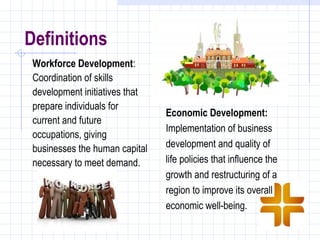
Definitions
 Workforce Development:
 Coordination of skills
 development initiatives that
 prepare individuals for
                                Economic Development:
 current and future
                                Implementation of business
 occupations, giving
 businesses the human capital   development and quality of
 necessary to meet demand.      life policies that influence the
                                growth and restructuring of a
                                region to improve its overall
                                economic well-being.
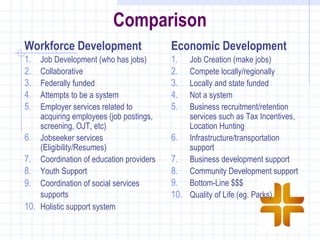
Comparison
Workforce Development                    Economic Development
1.  Job Development (who has jobs)       1.  Job Creation (make jobs)
2.  Collaborative                        2.  Compete locally/regionally
3.  Federally funded                     3.  Locally and state funded
4.  Attempts to be a system              4.  Not a system
5.  Employer services related to         5.  Business recruitment/retention
    acquiring employees (job postings,       services such as Tax Incentives,
    screening, OJT, etc)                     Location Hunting
6. Jobseeker services                    6. Infrastructure/transportation
    (Eligibility/Resumes)                    support
7. Coordination of education providers   7. Business development support
8. Youth Support                         8. Community Development support
9. Coordination of social services       9. Bottom-Line $$$
    supports                             10. Quality of Life (eg. Parks)
10. Holistic support system
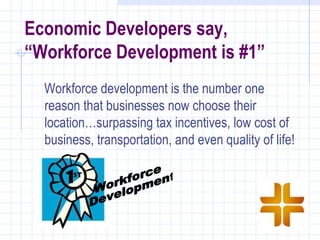
Economic Developers say,
“Workforce Development is #1”
  Workforce development is the number one
  reason that businesses now choose their
  location…surpassing tax incentives, low cost of
  business, transportation, and even quality of life!
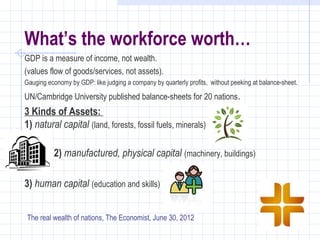
What’s the workforce worth…
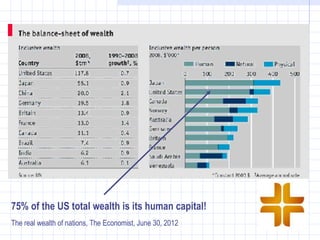
GDP is a measure of income, not wealth.
(values flow of goods/services, not assets).
Gauging economy by GDP: like judging a company by quarterly profits, without peeking at balance-sheet.

UN/Cambridge University published balance-sheets for 20 nations .
3 Kinds of Assets:
1) natural capital (land, forests, fossil fuels, minerals)

           2) manufactured, physical capital (machinery, buildings)

3) human capital (education and skills)


 The real wealth of nations, The Economist, June 30, 2012
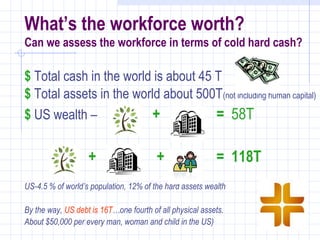
What’s the workforce worth?
Can we assess the workforce in terms of cold hard cash?

$ Total cash in the world is about 45 T
$ Total assets in the world about 500T(not including human capital)
$ US wealth –             +           = 58T

                   +                    +                 = 118T
US-4.5 % of world’s population, 12% of the hard assets wealth

By the way, US debt is 16T…one fourth of all physical assets.
About $50,000 per every man, woman and child in the US)
75% of the US total wealth is its human capital!
The real wealth of nations, The Economist, June 30, 2012
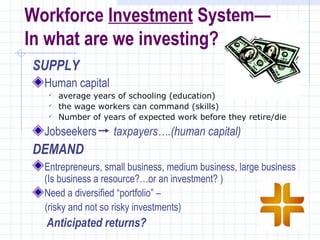
Workforce Investment System—
In what are we investing?
SUPPLY
  Human capital
     average years of schooling (education)
     the wage workers can command (skills)
     Number of years of expected work before they retire/die
  Jobseekers       taxpayers….(human capital)
DEMAND
  Entrepreneurs, small business, medium business, large business
  (Is business a resource?…or an investment? )
  Need a diversified “portfolio” –
  (risky and not so risky investments)
  Anticipated returns?
Employment and Training?
 Workforce Investment System
 includes business owners….
 Entrepreneurship is employment
 Must rethink traditional
 models of employment
 Need more than training
 to grow out of this economic crisis
Reality Check:
There are not enough jobs!!!
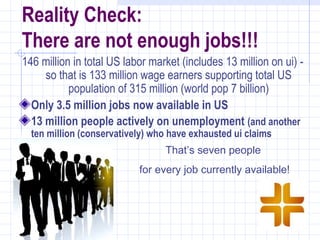
146 million in total US labor market (includes 13 million on ui) -
     so that is 133 million wage earners supporting total US
           population of 315 million (world pop 7 billion)
  Only 3.5 million jobs now available in US
  13 million people actively on unemployment (and another
  ten million (conservatively) who have exhausted ui claims
                                 That’s seven people
                           for every job currently available!
So, even if we spend all
workforce dollars to train
everyone perfectly for every
job currently available….
             There would still be six people
             in line waiting for a job for every
             job that was filled…
             Or conservatively over 18
             million people still out of work!
              SIMPLY PUT…
              WE NEED MORE JOBS!
JOB CREATION
  What does job creation mean?
(Entrepreneurship? Innovation? Start-ups? Collateral growth? Growing
  companies? Importing companies? )
  Who is responsible?
 (Economic development? Politicians? Business leaders? Educational
  institutions?)
  Is there a role for workforce development in JOB CREATION?
 New paradigm of “work?” – Seeding/training entrepreneurs?
 Helping companies recognize expansion opportunities?
 Providing HR support/onboarding?
 Providing workforce management?
(change management, org. development, team training, etc.)
Liaison to economic development and funders?
Understanding the Potential….
     75% of businesses in the US have no employees….
     52% of all small businesses are home based
     Small business employs half of all private sector
     employees
     Stage 2 businesses (10-99 employees) are the major
     employers! Creating 90% of all new jobs in America
Workforce development professionals must
become more than training providers!
They must begin contributing to Job Creation!
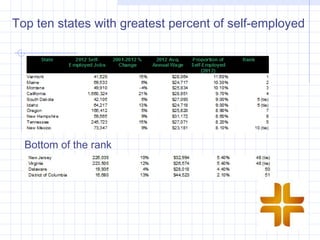
Top ten states with greatest percent of self-employed


  Bottom of the rank
Problem….
  Workforce Investment Boards are not
  treated as leaders in their communities
  because they are seen, (and often act)
  as program managers. 
Effect….
  WIB’s are usually not invited to be part of community
 planning. Because they are not part of the decision-
 making for the community. they have little say in the
 direction their region is going.
 Because WIB’s have little/no authority, they have difficulty
 making significant impacts.
 WIB’s are not seen as “job creators” or “huge impact
 makers”
Solution….
  Integrate WIB’s with their regional planning
   bodies (politicians and economic
   development) so that they become part of the
   ONGOING planning and strategizing process. 

  Give WIB directors leadership and economic
  development planning training so that they
  can “hold their own” in these discussions.
Benefits….
1) Not managers          strategic planning leaders 

 2) Elevates the standing of workforce development, (more program $$$?) 

 3) Supports new business start-ups, (may force change on some bad rules that thwart
 business start-ups) 

 4) Communities seen as engines of growth – Asset-based planning (not business
 recruitment). Not apathy, but looking within the community for hope and possibilities!

 5) Team environment (ed, wd politicians, business) in each region... All planning and
 strategizing together. Equally responsible for decisions and outcomes. 

 6) Assures business owners get all services they need because all are now responsible
 to provide every possible business benefit consideration 

Can you imagine the power of hundreds of teams like this across the US?
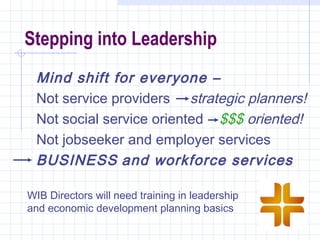
Stepping into Leadership
 Mind shift for everyone –
 Not service providers strategic planners!
 Not social service oriented $$$ oriented!
 Not jobseeker and employer services
 BUSINESS and workforce services

WIB Directors will need training in leadership
and economic development planning basics
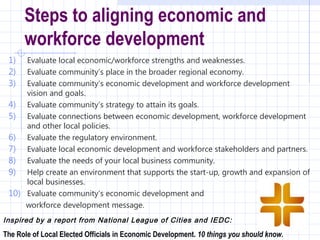
Steps to aligning economic and
      workforce development
 1)  Evaluate local economic/workforce strengths and weaknesses.
 2)  Evaluate community’s place in the broader regional economy.
 3)  Evaluate community’s economic development and workforce development
     vision and goals.
 4) Evaluate community’s strategy to attain its goals.
 5) Evaluate connections between economic development, workforce development
     and other local policies.
 6) Evaluate the regulatory environment.
 7) Evaluate local economic development and workforce stakeholders and partners.
 8) Evaluate the needs of your local business community.
 9) Help create an environment that supports the start-up, growth and expansion of
     local businesses.
 10) Evaluate community’s economic development and
     workforce development message.
Inspired by a report from National League of Cities and IEDC:
The Role of Local Elected Officials in Economic Development. 10 things you should know.
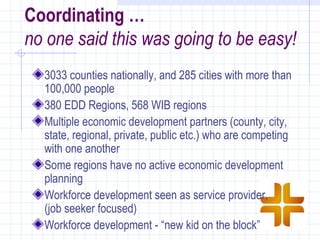
Coordinating …
no one said this was going to be easy!
  3033 counties nationally, and 285 cities with more than
  100,000 people
  380 EDD Regions, 568 WIB regions
  Multiple economic development partners (county, city,
  state, regional, private, public etc.) who are competing
  with one another
  Some regions have no active economic development
  planning
  Workforce development seen as service provider,
  (job seeker focused)
  Workforce development - “new kid on the block”
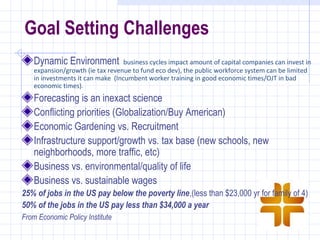
Goal Setting Challenges
    Dynamic Environment            business cycles impact amount of capital companies can invest in
    expansion/growth (ie tax revenue to fund eco dev), the public workforce system can be limited
    in investments it can make (Incumbent worker training in good economic times/OJT in bad
    economic times).
    Forecasting is an inexact science
    Conflicting priorities (Globalization/Buy American)
    Economic Gardening vs. Recruitment
    Infrastructure support/growth vs. tax base (new schools, new
    neighborhoods, more traffic, etc)
    Business vs. environmental/quality of life
    Business vs. sustainable wages
25% of jobs in the US pay below the poverty line,(less than $23,000 yr for family of 4)
50% of the jobs in the US pay less than $34,000 a year
From Economic Policy Institute
Come to the table bearing gifts
  Money (grant opportunities, etc)
  Connections (other collaborative partners who
  bring value)
  Ideas
  Training
  Leadership succession planning
  Other resources (talent, technology, staff, etc)
Both Workforce Development and
Economic Development

 Work with same employers
 Assure employers have trained workforce
 Use labor market information (career cluster studies)
 Entrepreneurship support
Work with same employers???

Customer Resource Management (CRM)

 Shared database to coordinate contact with
 businesses
 Examples: Zoho, Salesforce , Sage, ACT!,
 Goldmine, Microsoft Dynamics,
Mobilize Eastern Maine

 How many jobs created
 How many jobs retained
Oh - Penn
Regional labor market planning
Use labor market information
 (career cluster studies)
Durham, North Carolina
  Structural change (WIB Director also
  Director of Economic Development)
Virginia -CEDS
  38 WIBs have participated in CEDS.
  WIB Director should be in the CEDS
  planning
 WIB Director is a professional planner
 Chairs come and go
 Chairs do not have the depth in workforce system
  that the Director has
 Chair is private sector (may have their own agenda)
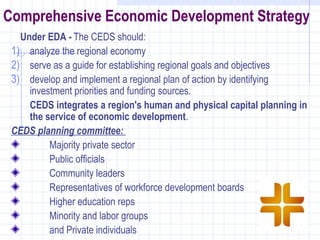
Comprehensive Economic Development Strategy
   Under EDA - The CEDS should:
 1) analyze the regional economy
 2) serve as a guide for establishing regional goals and objectives
 3) develop and implement a regional plan of action by identifying
     investment priorities and funding sources.
     CEDS integrates a region's human and physical capital planning in
     the service of economic development.
 CEDS planning committee:
          Majority private sector
          Public officials
          Community leaders
          Representatives of workforce development boards
          Higher education reps
          Minority and labor groups
          and Private individuals
CEDS Plan of Action
Plan of action:
Promotes economic development and opportunity; including:
   Transportation access;
   Environmental protection;
   Workforce development (consistent with State or local
   workforce strategy);
   Technology (such as access to high-speed telecommunications);
   Balancing of resources through sound management of physical
   development;
   and obtains and utilizes adequate funds and other resources
Entrepreneurial Support
 Introducing entrepreneurship
 Investing in scalable companies
 Access to funding:
  o   Micro loans
  o   Venture Capitalists/Angel Investors
  o   Non-traditional funding opportunities
        New markets tax credits
        Crowd funding
        DPO’s (BALLE – Business Alliance for Local Living Economies)
Growth of Gigging….
  The new workforce paradigm …
  Women now own 29% of businesses in US but
  generate 4% of all business revenues… will
  own 50% of all business by 2020. How do we
  improve their revenue generation?
  How do we turn these small start-up businesses
  into employers?
Preparing for the future
 Creative Molecular Economy -
 Molecular captures that the future system mirrors biological/organic principles (opposed to
 physics principles, the dominate science in the industrial economy).
 Molecular encompasses networks, ecosystems, where rigid structure is less effective than
 adaptable open structures where more persons can be involved and engaged.
 Transformational vs.reforming
 What if:
There was a public work system?
There were no more employers…and everyone worked for
 themselves?
Training was entirely self-directed?
All types of intelligence were $ equal?
All levels of jobs were equal?
Social Media
  Use modern strategies of online media
  to:
  Make conversations more inclusive
  (more people involved)
  Allow for more robust conversations
  (more ideas can be heard/no time
  constraints)
  Allow for greater collaboration
How do we prepare people for
jobs that don’t exist yet?
 Adaptable
 Technology savvy
 Problem solving skills/Critical thinking
 Team simulations (experiential learning)
 Imagination/Creative thinking
 Curiosity
 Trust
 Transferable skills
 Collaborative
 Entrepreneurial
 ID strengths
 In charge of destiny
 New thinking for safety nets (health ins, ui)
Summary
 Workforce development must see themselves
 as leaders
 Need training/awareness of economic
 development (asset-based approach)
 Employ collaborative strategies that help
 workforce development be seen as planning
 leadership (ceds, social media, crm’s, $,
 connections, ideas)
 Potential systemic or structural changes
 Focus on entrepreneurship/business –
 JOB CREATION
 Future focus
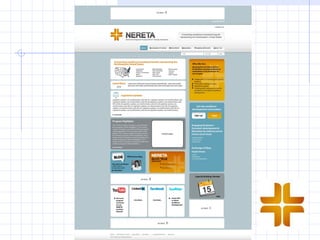
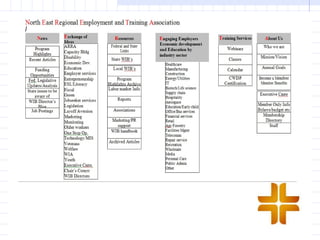
NERETA
Currently Linked In groups:
 Linkd.in/nereta.org
  Linkd.in/workforcesurvival
Envisioned to be an online social media site
   Increase collaboration, share info on issues and legislation,
  promote public image of public workforce system and
  support entrepreneurship


  Conference for economic and workforce
 
development professionals in the north east?
Contact
Colleen LaRose
Founder
North East Regional Employment and Training Association
Email: Colleen@nereta.org
Phone (908) 995-7718
Cell   (908) 239 6030
Website: www.nereta.org
Twitter: @neretaorg
Linked In group: http://linkd.in/neretaorg

Why is it essential for workforce development and economic development to join forces in each region?

  • 1.
    Why is itEssential for Workforce Development & Economic Development to Join Forces in Each Region? Presented by: Colleen LaRose North East Regional Employment and Training Association All Rights Reserved
  • 2.
    Blueprint for communityand regional success Teamwork..not silos of service… "Collaboration is the stuff of growth" Anonymous
  • 3.
    Definitions Workforce Development: Coordination of skills development initiatives that prepare individuals for Economic Development: current and future Implementation of business occupations, giving businesses the human capital development and quality of necessary to meet demand. life policies that influence the   growth and restructuring of a   region to improve its overall economic well-being.
  • 4.
    Comparison Workforce Development Economic Development 1. Job Development (who has jobs) 1. Job Creation (make jobs) 2. Collaborative 2. Compete locally/regionally 3. Federally funded 3. Locally and state funded 4. Attempts to be a system 4. Not a system 5. Employer services related to 5. Business recruitment/retention acquiring employees (job postings, services such as Tax Incentives, screening, OJT, etc) Location Hunting 6. Jobseeker services 6. Infrastructure/transportation (Eligibility/Resumes) support 7. Coordination of education providers 7. Business development support 8. Youth Support 8. Community Development support 9. Coordination of social services 9. Bottom-Line $$$ supports 10. Quality of Life (eg. Parks) 10. Holistic support system
  • 5.
    Economic Developers say, “WorkforceDevelopment is #1” Workforce development is the number one reason that businesses now choose their location…surpassing tax incentives, low cost of business, transportation, and even quality of life!
  • 6.
    What’s the workforceworth… GDP is a measure of income, not wealth. (values flow of goods/services, not assets). Gauging economy by GDP: like judging a company by quarterly profits, without peeking at balance-sheet. UN/Cambridge University published balance-sheets for 20 nations . 3 Kinds of Assets: 1) natural capital (land, forests, fossil fuels, minerals) 2) manufactured, physical capital (machinery, buildings) 3) human capital (education and skills) The real wealth of nations, The Economist, June 30, 2012
  • 7.
    What’s the workforceworth? Can we assess the workforce in terms of cold hard cash? $ Total cash in the world is about 45 T $ Total assets in the world about 500T(not including human capital) $ US wealth – + = 58T + + = 118T US-4.5 % of world’s population, 12% of the hard assets wealth By the way, US debt is 16T…one fourth of all physical assets. About $50,000 per every man, woman and child in the US)
  • 8.
    75% of theUS total wealth is its human capital! The real wealth of nations, The Economist, June 30, 2012
  • 9.
    Workforce Investment System— Inwhat are we investing? SUPPLY Human capital  average years of schooling (education)  the wage workers can command (skills)  Number of years of expected work before they retire/die Jobseekers taxpayers….(human capital) DEMAND Entrepreneurs, small business, medium business, large business (Is business a resource?…or an investment? ) Need a diversified “portfolio” – (risky and not so risky investments) Anticipated returns?
  • 10.
    Employment and Training? Workforce Investment System includes business owners…. Entrepreneurship is employment Must rethink traditional models of employment Need more than training to grow out of this economic crisis
  • 11.
    Reality Check: There arenot enough jobs!!! 146 million in total US labor market (includes 13 million on ui) - so that is 133 million wage earners supporting total US population of 315 million (world pop 7 billion) Only 3.5 million jobs now available in US 13 million people actively on unemployment (and another ten million (conservatively) who have exhausted ui claims That’s seven people for every job currently available!
  • 12.
    So, even ifwe spend all workforce dollars to train everyone perfectly for every job currently available…. There would still be six people in line waiting for a job for every job that was filled… Or conservatively over 18 million people still out of work! SIMPLY PUT… WE NEED MORE JOBS!
  • 13.
    JOB CREATION What does job creation mean? (Entrepreneurship? Innovation? Start-ups? Collateral growth? Growing companies? Importing companies? ) Who is responsible? (Economic development? Politicians? Business leaders? Educational institutions?) Is there a role for workforce development in JOB CREATION? New paradigm of “work?” – Seeding/training entrepreneurs? Helping companies recognize expansion opportunities? Providing HR support/onboarding? Providing workforce management? (change management, org. development, team training, etc.) Liaison to economic development and funders?
  • 14.
    Understanding the Potential…. 75% of businesses in the US have no employees…. 52% of all small businesses are home based Small business employs half of all private sector employees Stage 2 businesses (10-99 employees) are the major employers! Creating 90% of all new jobs in America Workforce development professionals must become more than training providers! They must begin contributing to Job Creation!
  • 15.
    Top ten stateswith greatest percent of self-employed Bottom of the rank
  • 16.
    Problem…. WorkforceInvestment Boards are not treated as leaders in their communities because they are seen, (and often act) as program managers. 
  • 17.
    Effect…. WIB’sare usually not invited to be part of community planning. Because they are not part of the decision- making for the community. they have little say in the direction their region is going. Because WIB’s have little/no authority, they have difficulty making significant impacts. WIB’s are not seen as “job creators” or “huge impact makers”
  • 18.
    Solution…. IntegrateWIB’s with their regional planning bodies (politicians and economic development) so that they become part of the ONGOING planning and strategizing process.  Give WIB directors leadership and economic development planning training so that they can “hold their own” in these discussions.
  • 19.
    Benefits…. 1) Not managers strategic planning leaders  2) Elevates the standing of workforce development, (more program $$$?)  3) Supports new business start-ups, (may force change on some bad rules that thwart business start-ups)  4) Communities seen as engines of growth – Asset-based planning (not business recruitment). Not apathy, but looking within the community for hope and possibilities! 5) Team environment (ed, wd politicians, business) in each region... All planning and strategizing together. Equally responsible for decisions and outcomes.  6) Assures business owners get all services they need because all are now responsible to provide every possible business benefit consideration  Can you imagine the power of hundreds of teams like this across the US?
  • 20.
    Stepping into Leadership Mind shift for everyone – Not service providers strategic planners! Not social service oriented $$$ oriented! Not jobseeker and employer services BUSINESS and workforce services WIB Directors will need training in leadership and economic development planning basics
  • 21.
    Steps to aligningeconomic and workforce development 1) Evaluate local economic/workforce strengths and weaknesses. 2) Evaluate community’s place in the broader regional economy. 3) Evaluate community’s economic development and workforce development vision and goals. 4) Evaluate community’s strategy to attain its goals. 5) Evaluate connections between economic development, workforce development and other local policies. 6) Evaluate the regulatory environment. 7) Evaluate local economic development and workforce stakeholders and partners. 8) Evaluate the needs of your local business community. 9) Help create an environment that supports the start-up, growth and expansion of local businesses. 10) Evaluate community’s economic development and workforce development message. Inspired by a report from National League of Cities and IEDC: The Role of Local Elected Officials in Economic Development. 10 things you should know.
  • 22.
    Coordinating … no onesaid this was going to be easy! 3033 counties nationally, and 285 cities with more than 100,000 people 380 EDD Regions, 568 WIB regions Multiple economic development partners (county, city, state, regional, private, public etc.) who are competing with one another Some regions have no active economic development planning Workforce development seen as service provider, (job seeker focused) Workforce development - “new kid on the block”
  • 23.
    Goal Setting Challenges Dynamic Environment business cycles impact amount of capital companies can invest in expansion/growth (ie tax revenue to fund eco dev), the public workforce system can be limited in investments it can make (Incumbent worker training in good economic times/OJT in bad economic times). Forecasting is an inexact science Conflicting priorities (Globalization/Buy American) Economic Gardening vs. Recruitment Infrastructure support/growth vs. tax base (new schools, new neighborhoods, more traffic, etc) Business vs. environmental/quality of life Business vs. sustainable wages 25% of jobs in the US pay below the poverty line,(less than $23,000 yr for family of 4) 50% of the jobs in the US pay less than $34,000 a year From Economic Policy Institute
  • 24.
    Come to thetable bearing gifts Money (grant opportunities, etc) Connections (other collaborative partners who bring value) Ideas Training Leadership succession planning Other resources (talent, technology, staff, etc)
  • 25.
    Both Workforce Developmentand Economic Development Work with same employers Assure employers have trained workforce Use labor market information (career cluster studies) Entrepreneurship support
  • 26.
    Work with sameemployers??? Customer Resource Management (CRM) Shared database to coordinate contact with businesses Examples: Zoho, Salesforce , Sage, ACT!, Goldmine, Microsoft Dynamics,
  • 27.
    Mobilize Eastern Maine How many jobs created How many jobs retained
  • 28.
    Oh - Penn Regionallabor market planning Use labor market information (career cluster studies)
  • 29.
    Durham, North Carolina Structural change (WIB Director also Director of Economic Development)
  • 30.
    Virginia -CEDS 38 WIBs have participated in CEDS. WIB Director should be in the CEDS planning  WIB Director is a professional planner  Chairs come and go  Chairs do not have the depth in workforce system that the Director has  Chair is private sector (may have their own agenda)
  • 31.
    Comprehensive Economic DevelopmentStrategy Under EDA - The CEDS should: 1) analyze the regional economy 2) serve as a guide for establishing regional goals and objectives 3) develop and implement a regional plan of action by identifying investment priorities and funding sources. CEDS integrates a region's human and physical capital planning in the service of economic development. CEDS planning committee: Majority private sector Public officials Community leaders Representatives of workforce development boards Higher education reps Minority and labor groups and Private individuals
  • 32.
    CEDS Plan ofAction Plan of action: Promotes economic development and opportunity; including: Transportation access; Environmental protection; Workforce development (consistent with State or local workforce strategy); Technology (such as access to high-speed telecommunications); Balancing of resources through sound management of physical development; and obtains and utilizes adequate funds and other resources
  • 33.
    Entrepreneurial Support Introducingentrepreneurship Investing in scalable companies Access to funding: o Micro loans o Venture Capitalists/Angel Investors o Non-traditional funding opportunities  New markets tax credits  Crowd funding  DPO’s (BALLE – Business Alliance for Local Living Economies)
  • 34.
    Growth of Gigging…. The new workforce paradigm … Women now own 29% of businesses in US but generate 4% of all business revenues… will own 50% of all business by 2020. How do we improve their revenue generation? How do we turn these small start-up businesses into employers?
  • 35.
    Preparing for thefuture Creative Molecular Economy - Molecular captures that the future system mirrors biological/organic principles (opposed to physics principles, the dominate science in the industrial economy). Molecular encompasses networks, ecosystems, where rigid structure is less effective than adaptable open structures where more persons can be involved and engaged. Transformational vs.reforming What if: There was a public work system? There were no more employers…and everyone worked for themselves? Training was entirely self-directed? All types of intelligence were $ equal? All levels of jobs were equal?
  • 36.
    Social Media Use modern strategies of online media to: Make conversations more inclusive (more people involved) Allow for more robust conversations (more ideas can be heard/no time constraints) Allow for greater collaboration
  • 37.
    How do weprepare people for jobs that don’t exist yet? Adaptable Technology savvy Problem solving skills/Critical thinking Team simulations (experiential learning) Imagination/Creative thinking Curiosity Trust Transferable skills Collaborative Entrepreneurial ID strengths In charge of destiny New thinking for safety nets (health ins, ui)
  • 38.
    Summary Workforce developmentmust see themselves as leaders Need training/awareness of economic development (asset-based approach) Employ collaborative strategies that help workforce development be seen as planning leadership (ceds, social media, crm’s, $, connections, ideas) Potential systemic or structural changes Focus on entrepreneurship/business – JOB CREATION Future focus
  • 39.
    NERETA Currently Linked Ingroups:  Linkd.in/nereta.org   Linkd.in/workforcesurvival Envisioned to be an online social media site Increase collaboration, share info on issues and legislation, promote public image of public workforce system and support entrepreneurship Conference for economic and workforce   development professionals in the north east?
  • 42.
    Contact Colleen LaRose Founder North EastRegional Employment and Training Association Email: Colleen@nereta.org Phone (908) 995-7718 Cell (908) 239 6030 Website: www.nereta.org Twitter: @neretaorg Linked In group: http://linkd.in/neretaorg