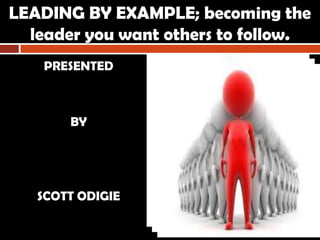
LEADING BY EXAMPLE; becoming the
leader you want others to follow.
PRESENTED
BY
SCOTT ODIGIE
INTRODUCTION
What comes to our minds
when we hear the word
leader? For most of us, it
is the picture of someone
who occupies a position,
especially in government.
In terms of natural resources, Africa is the world's
richest continent. It has 50% of the world's gold,
most of the world's diamonds and chromium, 90%
of the cobalt, 40% of the world's potential
hydroelectric power, 65% of the manganese,
millions of acres of untilled farmland, as well as
other natural resources. Despite its natural wealth,
Africa is home to the world's most impoverished and
abused people. African leaders are quick to blame
the legacy of colonialism, others accuse its neo-
colonial dimension, and some others pose culture,
climate and bio-geographic factors as the
explanation to the ?why? of the African problems.
CONCEPT OF LEADERSHIP
Leadership is all about
influence; it is helping
others to achieve great
goals or find
significance.
CONCEPT OF LEADERSHIP
Leadership is not by
acquisition (of power,
position and money),
but by entrustment.
CONCEPT OF LEADERSHIP
Leadership is not by
coercion, negotiation
but by inspiration.
CONCEPT OF LEADERSHIP
Leadership is not
necessarily the number
of followers, but leading
in your own sphere of
capacity.
CONCEPT OF LEADERSHIP
Leadership begins when
your life becomes a
challenge to others.
FALSE IDEOLOGY WHY WE DON’T
LEAD BY EXAMPLE?
1. The African-Nigerian
concept or definition of
leadership
-Leadership is
synonymous to
superiority.
-Only few are born
leaders.
-Leadership is what we
do.
FALSE IDEOLOGY WHY WE DON’T
LEAD BY EXAMPLE?
2. Personal insecurity.
This describes low self-
esteem; not finding
personal fulfillment from
within. Defining oneself by
the position you occupy.
FALSE IDEOLOGY WHY WE DON’T
LEAD BY EXAMPLE?
3. Inadequate
apprenticeship spirit.
many are leaders by
circumstances and not
from experience.
HOW TO LEAD BY EXAMPLE?
1. Don’t look for what
or who to blame for
your failures-take
responsibility!
HOW TO LEAD BY EXAMPLE?
2. Give accurate
representation to the
“led.” Be a person of
integrity.
HOW TO LEAD BY EXAMPLE?
3. Take calculated risks
that demonstrate
commitment to a larger
purpose for the benefit
of the people.
HOW TO LEAD BY EXAMPLE?
4. Listen, ask questions
and Seek to understand.
HOW TO LEAD BY EXAMPLE?
5. Live by principles
and uphold core values.
WHY WE MUST LEAD BY EXAMPLE?
1. It creates a picture of
possibility .People can look at
you and say, "Well, if he can
do it, I can do it." When you
lead by example, you make it
easy for others to follow you.
WHY WE MUST LEAD BY EXAMPLE?
2. It brings about
economic and political
development.
WHY WE MUST LEAD BY EXAMPLE?
3. Paradigm shift.
WHY WE MUST LEAD BY EXAMPLE?
4. It raises the ethical
and moral standards in
the society.
CONCLUSION
Leadership is all about
influence. Thank you
for listening.

Leading by example

  • 1.
    LEADING BY EXAMPLE;becoming the leader you want others to follow. PRESENTED BY SCOTT ODIGIE
  • 2.
    INTRODUCTION What comes toour minds when we hear the word leader? For most of us, it is the picture of someone who occupies a position, especially in government.
  • 3.
    In terms ofnatural resources, Africa is the world's richest continent. It has 50% of the world's gold, most of the world's diamonds and chromium, 90% of the cobalt, 40% of the world's potential hydroelectric power, 65% of the manganese, millions of acres of untilled farmland, as well as other natural resources. Despite its natural wealth, Africa is home to the world's most impoverished and abused people. African leaders are quick to blame the legacy of colonialism, others accuse its neo- colonial dimension, and some others pose culture, climate and bio-geographic factors as the explanation to the ?why? of the African problems.
  • 4.
    CONCEPT OF LEADERSHIP Leadershipis all about influence; it is helping others to achieve great goals or find significance.
  • 5.
    CONCEPT OF LEADERSHIP Leadershipis not by acquisition (of power, position and money), but by entrustment.
  • 6.
    CONCEPT OF LEADERSHIP Leadershipis not by coercion, negotiation but by inspiration.
  • 7.
    CONCEPT OF LEADERSHIP Leadershipis not necessarily the number of followers, but leading in your own sphere of capacity.
  • 8.
    CONCEPT OF LEADERSHIP Leadershipbegins when your life becomes a challenge to others.
  • 9.
    FALSE IDEOLOGY WHYWE DON’T LEAD BY EXAMPLE? 1. The African-Nigerian concept or definition of leadership
  • 10.
    -Leadership is synonymous to superiority. -Onlyfew are born leaders. -Leadership is what we do.
  • 11.
    FALSE IDEOLOGY WHYWE DON’T LEAD BY EXAMPLE? 2. Personal insecurity. This describes low self- esteem; not finding personal fulfillment from within. Defining oneself by the position you occupy.
  • 12.
    FALSE IDEOLOGY WHYWE DON’T LEAD BY EXAMPLE? 3. Inadequate apprenticeship spirit. many are leaders by circumstances and not from experience.
  • 13.
    HOW TO LEADBY EXAMPLE? 1. Don’t look for what or who to blame for your failures-take responsibility!
  • 14.
    HOW TO LEADBY EXAMPLE? 2. Give accurate representation to the “led.” Be a person of integrity.
  • 15.
    HOW TO LEADBY EXAMPLE? 3. Take calculated risks that demonstrate commitment to a larger purpose for the benefit of the people.
  • 16.
    HOW TO LEADBY EXAMPLE? 4. Listen, ask questions and Seek to understand.
  • 17.
    HOW TO LEADBY EXAMPLE? 5. Live by principles and uphold core values.
  • 18.
    WHY WE MUSTLEAD BY EXAMPLE? 1. It creates a picture of possibility .People can look at you and say, "Well, if he can do it, I can do it." When you lead by example, you make it easy for others to follow you.
  • 19.
    WHY WE MUSTLEAD BY EXAMPLE? 2. It brings about economic and political development.
  • 20.
    WHY WE MUSTLEAD BY EXAMPLE? 3. Paradigm shift.
  • 21.
    WHY WE MUSTLEAD BY EXAMPLE? 4. It raises the ethical and moral standards in the society.
  • 22.
    CONCLUSION Leadership is allabout influence. Thank you for listening.