Values-driven LeadershipRichard BarrettMay  2011
What is Culture?
What is Culture?“The way things are done around here”The culture of an organisation or any group of individuals is a reflection of the values, beliefs and behaviours of leaders of the group and the legacy of past leaders.
What are Values?
What are Values?Values- A shorthand method of describing our individual and collective motivations and what is important to us.Values can be positive or potentially limiting.Positive Values: trust, creativity, passion, honesty, integrity, clarityPotentially Limiting Values: power, blame, greed, status, being liked
Values in OrganisationsTom Boardman Former CEO of Nedbank, South Africa
The Leader and the ValuesLeadership values and excellenceThe excellent companies developed cultures that incorporated the values and practices of their great leaders, and those shared values can be seen to survive for decades.Tom Peters, “In Search of Excellence: Lessons from America’s best run companies”, 1983
The Leader and the Values The real role of the leader is to manage the values of the corporation.Tom Peters, “In Search of Excellence: Lessons from America’s best run companies”, 1983
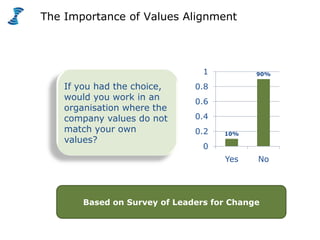
The Importance of Values AlignmentIf you had the choice, would you work in an organisation where the company values do not match your own values? Based on Survey of Leaders for Change
Culture and Strategy
Culture and StrategyStrong CultureGood StrategyHigh Performance
Culture and StrategyFull Spectrum LeadershipCompelling VisionInspiring MissionStrong CulturePersonal AlignmentGroup CohesionStructural AlignmentGood StrategyClear GoalsMeasurable Objectives Key Performance IndicatorsHigh Performance
Both Culture and Strategy are Important In firms with strong corporate cultures, managers tend to march energetically in the same direction. The alignment, motivation,  organisation, and control can help performance, but only if the resulting actions fit an intelligent business strategy for the specific environment in which the firm operates.John P. Kotter and James L. Heskett, “Corporate Culture and Performance”, 1992
Culture and Brand
Culture and BrandThe Culture Vision   Mission Values    Behaviours Do you consciously create your culture, or do you have a default, unconscious culture?Employee PerspectiveCustomer PerspectiveCULTURE                              BRAND Who you are on the inside, looks a lot like who you are on the outside
Building a High-Performance 	Organisation
How do you Build a High-Performance Organisation? By creating an adaptable, vision-guided, values-driven culture that focuses on all stake holder needs and in particular the employee and customer experience.
Firms of Endearment*Investor returns over 3, 5 and 10 years comparing S&P 500, Good to Great and Firms of Endearment.“... the distinguishing feature of “firms of endearment” is that they treat all stakeholders—employees, customers, investors, partners, and society—equally. In addition, they fully recognize that they are a part of an economic ecosystem with many interdependent participants. They are committed to exemplary citizenship, and they embrace the concept of servant leadership. * Rajendra S. Sisodia, David B. Wolfe, and Jagdish N. Seth, Firms of Endearment: The Pursuit of Purpose and Profit (Upper Saddle River, N.J.: Wharton School of Publishing, 2007).
Firms of Endearment“FoEs share five primary elements in their corporate visions.  A broader purpose than wealth generation
  Dedication to servant leadership
  Emotionally intelligent leadership
  Commitment to exemplary citizenship
  Recognition that they are part of an economic ecosystem      with many interdependent participants”Firms of Endearment: How World-Class Companies Profit from Passion and Purpose, David Wolfe, 2006
Fortune’s Best Companies to Work ForBetter returnsA portfolio of the top twenty publicly listed best companies to work for in the USA in 2008 would have returned an average annualized return of 16.74% over the past ten years – compared to 2.83% for the S&P 500.S&P 500
Best Employers have Lowest EntropyCultural Entropy The degree of dysfunction in the culture – bureaucracy, internal competition, etc.This research of 163 organisations in Australia was carried out by Hewitt Associates and the Barrett Values Centre in 2008
Low Entropy Leads to High Financial ReturnsCultural Entropy The degree of dysfunction in the culture – bureaucracy, internal competition, etc.This research of 163 organisations in Australia was carried out by Hewitt Associates and the Barrett Values Centre in 2008
Best employers focus on …Employee needs and employee experienceThe distinguishing feature of the best employers was their focus on employee needs and the employees’ experience. The values that were present in the top ten current culture values of the best companies, that were not present in the worst companies.Coaching/mentoringTeamworkBalance (home/work)Employee recognition
The Three Mantras of 	Culture Change
The Three Mantras of Culture ChangeCultural Capital is the new frontier of competitive advantage.Organisational transformation begins with the personal transformation of the leaders.Measurement matters. If you can measure it you can manage it.
From Leader’s Values to Shareholder ValueCorporate SectorLeader’s Values/ Behaviours Performance & Shareholder ValueCorporate CultureCompetitiveAdvantage &Resilience
From Leadership to Customer SatisfactionPublic SectorLeader’s values/ behaviours OrganisationalCultureCustomerSatisfactionMission Assurance
Measuring Culture by Mapping Values
The Model and Cultural Transformation ToolsPages:  55-101Pages:  19-67
Growth Needs and Deficiency NeedsSelf ActualizationGrowth NeedsWhen these needs are fulfilled they do not go away, they engender deeper levels of motivation and commitment.Know and UnderstandDeficiency NeedsAn individual gains no sense  of lasting satisfaction from being able to meet these needs, but feels a sense of anxiety if these needs are not met. Self-esteemAbraham MaslowLove & BelongingSafety Physiological
Maslow’s Needs to Barrett’s ConsciousnessSelf-Actualization Know and UnderstandKnow and UnderstandAbraham Maslow Richard BarrettSelf-esteemLove & BelongingSafety Physiological NeedsConsciousness
Maslow’s Needs to Barrett’s Consciousness 1. Expansion of self-actualization into multiple levels.         2. Substitute ‘states of 	consciousness’for hierarchy of needs.3. Each state of consciousness      is defined by specific values        and behaviours.Know and UnderstandKnow and UnderstandSelf-esteemLove & BelongingSafety Physiological ConsciousnessNeeds
Stages in the Development of Personal ConsciousnessPositive Focus / Excessive Focus Service to Humanity and the PlanetDevoting your life in self-less service to your purpose and visionServiceCollaborating with PartnersWorking with others to make a positive difference by actively implementing your purpose and visionMaking a differenceFinding Personal MeaningUncovering your sense of purpose and creating a vision for the future you want to createInternal CohesionPersonal GrowthUnderstanding your deepest motivations, experiencing responsible freedom by letting go of your fearsTransformationSelf-worth Feeling a positive sense of pride in self and ability to manage your  life. Power, statusSelf-esteemBelongingFeeling a personal sense of belonging, feeling loved by self and others. Being liked, blameRelationshipFinancial Security & SafetyCreating a safe secure environment for self and significant others. Control, greed Survival
Stages in the Development of Organisational ConsciousnessPositive Focus / Excessive Focus Service To Humanity And The PlanetSocial responsibility, future generations, long-term perspective, ethics, compassion, humilityServiceStrategic Alliances and PartnershipsEnvironmental awareness, community involvement, employee fulfillment, coaching/mentoringMaking a differenceBuilding Corporate CommunityShared values, vision, commitment, integrity, trust, passion, creativity, openness, transparency Internal CohesionContinuous Renewal and LearningAccountability, adaptability, empowerment, teamwork, goals orientation, personal growthTransformationHigh PerformanceSystems, processes, quality, best practices, pride in performance. Bureaucracy, complacencySelf-esteemBelongingLoyalty, open communication, customer satisfaction, friendship. Manipulation, blameRelationshipFinancial StabilityShareholder value, organisational growth, employee health, safety. Control, corruption, greedSurvival
Placement of Values by LevelCurrent Culture 100 EmployeesTop Ten Values1. tradition (L) (59)2. diversity (54)3. control (L) (53)4. goals orientation (46)5. knowledge (43)6. creativity (42)7. productivity (37)8. image (L) (36)   9. profit (36)10. open communication (31)ServiceMaking a difference6Internal CohesionTransformation425Self-esteem7810110Relationship93Survival
Distribution of Values by LevelCurrent Culture 100 Employees7Service6Making a difference5Internal Cohesion4TransformationCultural EntropySelf-esteem311%2Relationship1Survival
	Your Results (Based on Feedback from 	Leaders for Change)
The values you believe are necessary for your company to achieve its full potentialLeaders 4 Change: Employed by an organization (95)Personal ValuesCurrent Culture ValuesDesired Culture ValuesLevel 7Level 6Level 5Level 4Level 3Level 2Level 1The values that are important in your personal lives.IROS (P)= 1-1-5-0 | IROS (L)= 0-1-4-0IROS (P)= 1-3-6-0 | IROS (L)= 0-0-0-0IRS (P)= 8-2-0 | IRS (L)= 0-0-0MatchesPV - CC	1CC - DC	2PV - DC	2Health Index (PL)PV: 10-0CC: 7-5DC: 10-0Black Underline= PV & CCOrange= CC & DC	P = Positive	L = Potentially Limiting 	I = Individual	O = OrganizationalOrange= PV, CC & DCBlue= PV & DC		(white circle)	R = Relationship	S = SocietalHow you experience your company - What is working well?  What is undermining the performance of your company.Values PlotCopyright 2011 Barrett Values CentreMay 2011
Personal ValuesCurrent Culture ValuesDesired Culture ValuesLeaders 4 Change: Employed by an organization (95)CTSTotal number of votes for all values at each levelCTS = 49-24-27Entropy = 2%CTS = 26-21-53Entropy = 22%CTS = 42-30-28Entropy = 1%C = Common GoodT = TransformationS = Self-InterestCultural Entropy % of Votes for Limiting ValuesPositive ValuesPotentially Limiting ValuesValues DistributionCopyright 2011 Barrett Values CentreMay 2011
Cultural entropy represents the degree of dysfunction in a cultureCultural Entropy
Leaders 4 Change: Employed by an organization (95)Values JumpsA value jump occurs when there are more votes for a value in the Desired Culture than in the Current Culture.  Listed below are the values with the largest increase in votes. The values in bold are represented in the Desired Culture.Values Jumps TableCopyright 2011 Barrett Values CentreMay 2011
The New Leadership Paradigm	Learning System More than a Book...A Leadership Development Learning System for the 21st Century LeaderAnd also ...A Manual for Evolutionary Coaching
The New Leadership Paradigm
Components of the New Leadership Paradigm Learning SystemThe BookThe Multi-mediaWeb site The Workbooks and Journals
The Book A  Leadership Development Text Book for the 21st Century Leader(530 pages)Part 1: FundamentalsPart 2: Leading SelfPart 3: Leading OthersPart 4: Leading an OrganisationPart 5: Leading in SocietyPart 6: AnnexesAnnex 1: The Learning SystemAnnex 2: Cultural Transformation ToolsAnnex 3: The Seven Levels of Consciousness
The Web SiteA State-of-the-Art, Multi-media, Web site that is constantly updated based on the feedback of users and as new articles, videos, books and other materials become available www.newleadershipparadigm.com
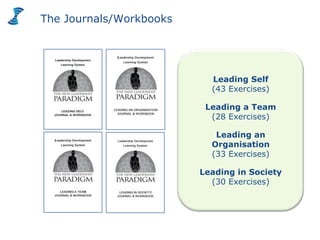
The Journals/WorkbooksLeading Self (43 Exercises)Leading a Team (28 Exercises)Leading an Organisation  (33 Exercises)Leading in Society (30 Exercises)
Leading YourselfIf you can’t lead yourself, then you will not be able to lead othersIf you can’t lead others, then you will not be able to lead an organisationIf you can’t lead an organisation, then you will not be able to lead a community or a nation
Who Will Be Using the Learning System? Consultants and Coaches who are supporting the next generation of leaders
 Change agents and OD practitioners who are looking for new, cost effective ways to make leadership training available to large numbers of people in their organisations
Universities and Business Schools searching for cutting-edge training materials to support their undergraduate and mature students
Individuals who want to grow, develop and become all they can becomeNedbank, South Africa: 	An Example of Cultural Evolution
Vision and Values Tom Boardman Former CEO of Nedbank, South Africa
Nedbank: Current Culture Evolution200520062007200820091. accountability2. client-driven3. client satisfaction  4. cost-consciousness5. community involvement 6. achievement7. teamwork8. employee recognition 9. being the best10. performance driven  1. client-driven2. accountability3. client satisfaction  4. cost-consciousness5. community involvement6. performance driven 7. profit8. achievement9. being the best 10. results orientation  1. accountability2. client-driven3. client satisfaction  4. community involvement 5. achievement6. cost-consciousness7. teamwork8. performance driven9. being the best 10. delivery1. cost-consciousness2. profit 3. accountability4. community involvement  5. client-driven6. process-driven7. bureaucracy (L)8. results orientation 9. client satisfaction10. silo mentality (L)1. cost-consciousness2. accountability3. client-driven4. client satisfaction  5. results orientation  6. performance driven7. profit8. bureaucracy (L)9. teamwork10. community involvement 4 matches6 matches4 matches5 matches3 matchesEntropy 14%Entropy 25%Entropy 13%Entropy 19%Entropy 17%
Nedbank: Cultural EvolutionEntropy ScoresEntropy reduction leads to improved performance—increased revenues, profits and share price. Working toward entropy of <10% will result in healthy functioning of the organisation and improvement of staff morale.Entropy risk bands<10%       Healthy functioning10-19%    Some problems requiring careful monitoring20-29%    Significant problems requiring attention30-39%    Crisis situation requiring immediate change40%>       Impending risk of implosion, bankruptcy or              failure
Cultural entropy represents the degree of dysfunction in a cultureCultural Entropy
Nedbank: Response Rate to Values Survey63.0% Response rate 50.4% 35.5% number of participants28.0% 20.2% 28,898 employees in 2009
Nedbank: Cultural EvolutionNedbank Staff Survey Scores
Nedbank: Financial Impact of Cultural EvolutionShare Price grewon average 20.4% (CAGR) per year from 2004 to 2007Revenue grew on average 16.9% (CAGR) per year from 2004 to 2007CAGR : Compound Annual Growth Rate
Whole System Change
The Concept of Whole System ChangePages:  119-157Pages:  370-379
Four Conditions for Whole System ChangeThe Four QuadrantsExteriorInteriorPersonality: Values and Beliefs  of an IndividualCharacter: Actions  and Behavioursof an IndividualIndividualSocial Structures: Actions and Behaviours  of a GroupCulture: Values and Beliefs of a Group CollectiveBased on the Four Quadrants of Ken Wilber
Four Conditions for Whole System ChangeThe Four Conditions for Whole System ChangeExteriorInteriorPersonality: Values and Beliefs  of an IndividualCharacter: Actions  and Behavioursof an IndividualPersonal AlignmentIndividualMission  AlignmentValues AlignmentSocial Structures: Actions and Behaviours  of a GroupCulture: Values and Beliefs of a Group Structural AlignmentCollective
Whole System Change: Nine Step ProcessCommitment from leadership       team to personal transformation2. Baseline measurement of the      culture and key performance       indicators. Create scorecard.3. Revisit the     Vision and     Mission of     the     Organisation5. Develop compelling     reasons for change4. Define core     values &     behaviours of    the     organisationHow do we build a high-performance cultureHow do we become and remain agile and adaptable?How can we position ourselves for the future?How can we build our long-term resilience?
Whole System Change: Nine Step ProcessWhole System Change: Implementation Phase8. Values Alignment6. Personal Alignment7. Structural AlignmentInculcate espoused values and behavioursinto the executive and employee population. Explore personal values.Begin with the leadership team and then expand to the larger leadership group including managers and supervisors (Leading Self and Leading a Team)Set up incentives to make the espoused values and behaviours pervasive  New employee/  Executive selection New employee/  Executive orientation Employee/executive  performance evaluation Employee/executive  promotion criteria Talent selection and   development programme Management   development programme Leadership development   programmeWhy?9. Mission AlignmentIntegrate the vision and mission of the organisation into the executive and employee population. Explore personal motivations.
Begin with the Leadership Team  Personal Alignment of Leaders
  Internal Cohesion in the Leadership Team   Cultural Evolution Begins with Personal EvolutionCulture ValuesLeader’s ValuesThe culture ofan organisationis a reflectionof the leadership consciousness.CVA Current Culture LV A Feedback 14 AssessorsPL= 1-10 | IROS (P)= 0-0-1-0 | IROS (L)= 2-4-4-0PL = 1-9 | IRO (P) = 1-0-0 | IRO (L) = 1-8-0Cultural Entropy 38%Personal Entropy 64%
Cultural Evolution Begins with Personal EvolutionCulture ValuesLeader’s ValuesThe culture ofan organisationis a reflectionof the leadershipconsciousness.CVA Current CultureLV A Feedback 27 AssessorsPL= 12-0 | IROS (P)= 4-2-5-1 | IROS (L)= 0-0-0-0PL = 12-0 | IRO (P) = 9-1-2 | IRO (L) = 0-0-0Cultural Entropy 7%Personal Entropy 9%
Personal Alignment of the LeadersWhen leaders change their beliefs and values (1), their behaviours change (2). This influences the culture of the group (3), which in turn changes the behaviours of the group (4).  12Organisational transformation begins with the personal transformation of the leaders. Organisations don’t  transform. People do. 34Wilber’s Four Quadrants
The Leadership Values Assessment is a feedback instrument that compares a leader’s perception of the values he or she believes best describe his or her management/operational style with their colleagues’ perception of their management/operational style. The instrument also compares leader’s perception of their own strengths, and the behaviours that they believe they need to improve or stop, with the assessors’ perceptions and measures personal entropy.Leadership Values Assessment
Jeff VaderJeff's ValuesAssessors' Top 11 ValuesMatching ValuesHow Others see JeffPL = 10-0 | IRO (P) = 4-5-1 | IRO (L) = 0-0-0PL = 11-0 | IRO (P) = 3-7-1 | IRO (L) = 0-0-0Matches 5How Jeff sees himselfOrange= Values match	P = Positive		I = Individual			L = Potentially Limiting 	R = Relationship		      		(white circle)		O = organisationalAugust 2008Leadership Values PlotCopyright 2008 Barrett Values Centre
C = Common GoodT = TransformationS = Self-InterestPositive ValuesPotentially Limiting ValuesJeff VaderJeff's ValuesAssessors'   ValuesCTSLevel of Personal EntropyCTS = 80-10-10Entropy = 0%CTS = 72-9-19Entropy = 0%Leadership DistributionCopyright 2008 Barrett Values CentreAugust 2008

Values driven leadership

  • 1.
  • 2.
  • 3.
    What is Culture?“Theway things are done around here”The culture of an organisation or any group of individuals is a reflection of the values, beliefs and behaviours of leaders of the group and the legacy of past leaders.
  • 4.
  • 5.
    What are Values?Values-A shorthand method of describing our individual and collective motivations and what is important to us.Values can be positive or potentially limiting.Positive Values: trust, creativity, passion, honesty, integrity, clarityPotentially Limiting Values: power, blame, greed, status, being liked
  • 6.
    Values in OrganisationsTomBoardman Former CEO of Nedbank, South Africa
  • 7.
    The Leader andthe ValuesLeadership values and excellenceThe excellent companies developed cultures that incorporated the values and practices of their great leaders, and those shared values can be seen to survive for decades.Tom Peters, “In Search of Excellence: Lessons from America’s best run companies”, 1983
  • 8.
    The Leader andthe Values The real role of the leader is to manage the values of the corporation.Tom Peters, “In Search of Excellence: Lessons from America’s best run companies”, 1983
  • 9.
    The Importance ofValues AlignmentIf you had the choice, would you work in an organisation where the company values do not match your own values? Based on Survey of Leaders for Change
  • 10.
  • 11.
    Culture and StrategyStrongCultureGood StrategyHigh Performance
  • 12.
    Culture and StrategyFullSpectrum LeadershipCompelling VisionInspiring MissionStrong CulturePersonal AlignmentGroup CohesionStructural AlignmentGood StrategyClear GoalsMeasurable Objectives Key Performance IndicatorsHigh Performance
  • 13.
    Both Culture andStrategy are Important In firms with strong corporate cultures, managers tend to march energetically in the same direction. The alignment, motivation, organisation, and control can help performance, but only if the resulting actions fit an intelligent business strategy for the specific environment in which the firm operates.John P. Kotter and James L. Heskett, “Corporate Culture and Performance”, 1992
  • 14.
  • 15.
    Culture and BrandTheCulture Vision Mission Values Behaviours Do you consciously create your culture, or do you have a default, unconscious culture?Employee PerspectiveCustomer PerspectiveCULTURE BRAND Who you are on the inside, looks a lot like who you are on the outside
  • 16.
  • 17.
    How do youBuild a High-Performance Organisation? By creating an adaptable, vision-guided, values-driven culture that focuses on all stake holder needs and in particular the employee and customer experience.
  • 18.
    Firms of Endearment*Investorreturns over 3, 5 and 10 years comparing S&P 500, Good to Great and Firms of Endearment.“... the distinguishing feature of “firms of endearment” is that they treat all stakeholders—employees, customers, investors, partners, and society—equally. In addition, they fully recognize that they are a part of an economic ecosystem with many interdependent participants. They are committed to exemplary citizenship, and they embrace the concept of servant leadership. * Rajendra S. Sisodia, David B. Wolfe, and Jagdish N. Seth, Firms of Endearment: The Pursuit of Purpose and Profit (Upper Saddle River, N.J.: Wharton School of Publishing, 2007).
  • 19.
    Firms of Endearment“FoEsshare five primary elements in their corporate visions. A broader purpose than wealth generation
  • 20.
    Dedicationto servant leadership
  • 21.
    Emotionallyintelligent leadership
  • 22.
    Commitmentto exemplary citizenship
  • 23.
    Recognitionthat they are part of an economic ecosystem with many interdependent participants”Firms of Endearment: How World-Class Companies Profit from Passion and Purpose, David Wolfe, 2006
  • 24.
    Fortune’s Best Companiesto Work ForBetter returnsA portfolio of the top twenty publicly listed best companies to work for in the USA in 2008 would have returned an average annualized return of 16.74% over the past ten years – compared to 2.83% for the S&P 500.S&P 500
  • 25.
    Best Employers haveLowest EntropyCultural Entropy The degree of dysfunction in the culture – bureaucracy, internal competition, etc.This research of 163 organisations in Australia was carried out by Hewitt Associates and the Barrett Values Centre in 2008
  • 26.
    Low Entropy Leadsto High Financial ReturnsCultural Entropy The degree of dysfunction in the culture – bureaucracy, internal competition, etc.This research of 163 organisations in Australia was carried out by Hewitt Associates and the Barrett Values Centre in 2008
  • 27.
    Best employers focuson …Employee needs and employee experienceThe distinguishing feature of the best employers was their focus on employee needs and the employees’ experience. The values that were present in the top ten current culture values of the best companies, that were not present in the worst companies.Coaching/mentoringTeamworkBalance (home/work)Employee recognition
  • 28.
    The Three Mantrasof Culture Change
  • 29.
    The Three Mantrasof Culture ChangeCultural Capital is the new frontier of competitive advantage.Organisational transformation begins with the personal transformation of the leaders.Measurement matters. If you can measure it you can manage it.
  • 30.
    From Leader’s Valuesto Shareholder ValueCorporate SectorLeader’s Values/ Behaviours Performance & Shareholder ValueCorporate CultureCompetitiveAdvantage &Resilience
  • 31.
    From Leadership toCustomer SatisfactionPublic SectorLeader’s values/ behaviours OrganisationalCultureCustomerSatisfactionMission Assurance
  • 32.
    Measuring Culture byMapping Values
  • 33.
    The Model andCultural Transformation ToolsPages: 55-101Pages: 19-67
  • 34.
    Growth Needs andDeficiency NeedsSelf ActualizationGrowth NeedsWhen these needs are fulfilled they do not go away, they engender deeper levels of motivation and commitment.Know and UnderstandDeficiency NeedsAn individual gains no sense of lasting satisfaction from being able to meet these needs, but feels a sense of anxiety if these needs are not met. Self-esteemAbraham MaslowLove & BelongingSafety Physiological
  • 35.
    Maslow’s Needs toBarrett’s ConsciousnessSelf-Actualization Know and UnderstandKnow and UnderstandAbraham Maslow Richard BarrettSelf-esteemLove & BelongingSafety Physiological NeedsConsciousness
  • 36.
    Maslow’s Needs toBarrett’s Consciousness 1. Expansion of self-actualization into multiple levels. 2. Substitute ‘states of consciousness’for hierarchy of needs.3. Each state of consciousness is defined by specific values and behaviours.Know and UnderstandKnow and UnderstandSelf-esteemLove & BelongingSafety Physiological ConsciousnessNeeds
  • 37.
    Stages in theDevelopment of Personal ConsciousnessPositive Focus / Excessive Focus Service to Humanity and the PlanetDevoting your life in self-less service to your purpose and visionServiceCollaborating with PartnersWorking with others to make a positive difference by actively implementing your purpose and visionMaking a differenceFinding Personal MeaningUncovering your sense of purpose and creating a vision for the future you want to createInternal CohesionPersonal GrowthUnderstanding your deepest motivations, experiencing responsible freedom by letting go of your fearsTransformationSelf-worth Feeling a positive sense of pride in self and ability to manage your life. Power, statusSelf-esteemBelongingFeeling a personal sense of belonging, feeling loved by self and others. Being liked, blameRelationshipFinancial Security & SafetyCreating a safe secure environment for self and significant others. Control, greed Survival
  • 38.
    Stages in theDevelopment of Organisational ConsciousnessPositive Focus / Excessive Focus Service To Humanity And The PlanetSocial responsibility, future generations, long-term perspective, ethics, compassion, humilityServiceStrategic Alliances and PartnershipsEnvironmental awareness, community involvement, employee fulfillment, coaching/mentoringMaking a differenceBuilding Corporate CommunityShared values, vision, commitment, integrity, trust, passion, creativity, openness, transparency Internal CohesionContinuous Renewal and LearningAccountability, adaptability, empowerment, teamwork, goals orientation, personal growthTransformationHigh PerformanceSystems, processes, quality, best practices, pride in performance. Bureaucracy, complacencySelf-esteemBelongingLoyalty, open communication, customer satisfaction, friendship. Manipulation, blameRelationshipFinancial StabilityShareholder value, organisational growth, employee health, safety. Control, corruption, greedSurvival
  • 39.
    Placement of Valuesby LevelCurrent Culture 100 EmployeesTop Ten Values1. tradition (L) (59)2. diversity (54)3. control (L) (53)4. goals orientation (46)5. knowledge (43)6. creativity (42)7. productivity (37)8. image (L) (36) 9. profit (36)10. open communication (31)ServiceMaking a difference6Internal CohesionTransformation425Self-esteem7810110Relationship93Survival
  • 40.
    Distribution of Valuesby LevelCurrent Culture 100 Employees7Service6Making a difference5Internal Cohesion4TransformationCultural EntropySelf-esteem311%2Relationship1Survival
  • 41.
    Your Results (Basedon Feedback from Leaders for Change)
  • 42.
    The values youbelieve are necessary for your company to achieve its full potentialLeaders 4 Change: Employed by an organization (95)Personal ValuesCurrent Culture ValuesDesired Culture ValuesLevel 7Level 6Level 5Level 4Level 3Level 2Level 1The values that are important in your personal lives.IROS (P)= 1-1-5-0 | IROS (L)= 0-1-4-0IROS (P)= 1-3-6-0 | IROS (L)= 0-0-0-0IRS (P)= 8-2-0 | IRS (L)= 0-0-0MatchesPV - CC 1CC - DC 2PV - DC 2Health Index (PL)PV: 10-0CC: 7-5DC: 10-0Black Underline= PV & CCOrange= CC & DC P = Positive L = Potentially Limiting I = Individual O = OrganizationalOrange= PV, CC & DCBlue= PV & DC (white circle) R = Relationship S = SocietalHow you experience your company - What is working well? What is undermining the performance of your company.Values PlotCopyright 2011 Barrett Values CentreMay 2011
  • 43.
    Personal ValuesCurrent CultureValuesDesired Culture ValuesLeaders 4 Change: Employed by an organization (95)CTSTotal number of votes for all values at each levelCTS = 49-24-27Entropy = 2%CTS = 26-21-53Entropy = 22%CTS = 42-30-28Entropy = 1%C = Common GoodT = TransformationS = Self-InterestCultural Entropy % of Votes for Limiting ValuesPositive ValuesPotentially Limiting ValuesValues DistributionCopyright 2011 Barrett Values CentreMay 2011
  • 44.
    Cultural entropy representsthe degree of dysfunction in a cultureCultural Entropy
  • 45.
    Leaders 4 Change:Employed by an organization (95)Values JumpsA value jump occurs when there are more votes for a value in the Desired Culture than in the Current Culture. Listed below are the values with the largest increase in votes. The values in bold are represented in the Desired Culture.Values Jumps TableCopyright 2011 Barrett Values CentreMay 2011
  • 46.
    The New LeadershipParadigm Learning System More than a Book...A Leadership Development Learning System for the 21st Century LeaderAnd also ...A Manual for Evolutionary Coaching
  • 47.
  • 48.
    Components of theNew Leadership Paradigm Learning SystemThe BookThe Multi-mediaWeb site The Workbooks and Journals
  • 49.
    The Book A Leadership Development Text Book for the 21st Century Leader(530 pages)Part 1: FundamentalsPart 2: Leading SelfPart 3: Leading OthersPart 4: Leading an OrganisationPart 5: Leading in SocietyPart 6: AnnexesAnnex 1: The Learning SystemAnnex 2: Cultural Transformation ToolsAnnex 3: The Seven Levels of Consciousness
  • 50.
    The Web SiteAState-of-the-Art, Multi-media, Web site that is constantly updated based on the feedback of users and as new articles, videos, books and other materials become available www.newleadershipparadigm.com
  • 51.
    The Journals/WorkbooksLeading Self(43 Exercises)Leading a Team (28 Exercises)Leading an Organisation (33 Exercises)Leading in Society (30 Exercises)
  • 52.
    Leading YourselfIf youcan’t lead yourself, then you will not be able to lead othersIf you can’t lead others, then you will not be able to lead an organisationIf you can’t lead an organisation, then you will not be able to lead a community or a nation
  • 53.
    Who Will BeUsing the Learning System? Consultants and Coaches who are supporting the next generation of leaders
  • 54.
    Change agentsand OD practitioners who are looking for new, cost effective ways to make leadership training available to large numbers of people in their organisations
  • 55.
    Universities and BusinessSchools searching for cutting-edge training materials to support their undergraduate and mature students
  • 56.
    Individuals who wantto grow, develop and become all they can becomeNedbank, South Africa: An Example of Cultural Evolution
  • 58.
    Vision and ValuesTom Boardman Former CEO of Nedbank, South Africa
  • 59.
    Nedbank: Current CultureEvolution200520062007200820091. accountability2. client-driven3. client satisfaction 4. cost-consciousness5. community involvement 6. achievement7. teamwork8. employee recognition 9. being the best10. performance driven 1. client-driven2. accountability3. client satisfaction 4. cost-consciousness5. community involvement6. performance driven 7. profit8. achievement9. being the best 10. results orientation 1. accountability2. client-driven3. client satisfaction 4. community involvement 5. achievement6. cost-consciousness7. teamwork8. performance driven9. being the best 10. delivery1. cost-consciousness2. profit 3. accountability4. community involvement 5. client-driven6. process-driven7. bureaucracy (L)8. results orientation 9. client satisfaction10. silo mentality (L)1. cost-consciousness2. accountability3. client-driven4. client satisfaction 5. results orientation 6. performance driven7. profit8. bureaucracy (L)9. teamwork10. community involvement 4 matches6 matches4 matches5 matches3 matchesEntropy 14%Entropy 25%Entropy 13%Entropy 19%Entropy 17%
  • 60.
    Nedbank: Cultural EvolutionEntropyScoresEntropy reduction leads to improved performance—increased revenues, profits and share price. Working toward entropy of <10% will result in healthy functioning of the organisation and improvement of staff morale.Entropy risk bands<10% Healthy functioning10-19% Some problems requiring careful monitoring20-29% Significant problems requiring attention30-39% Crisis situation requiring immediate change40%> Impending risk of implosion, bankruptcy or failure
  • 61.
    Cultural entropy representsthe degree of dysfunction in a cultureCultural Entropy
  • 62.
    Nedbank: Response Rateto Values Survey63.0% Response rate 50.4% 35.5% number of participants28.0% 20.2% 28,898 employees in 2009
  • 63.
  • 64.
    Nedbank: Financial Impactof Cultural EvolutionShare Price grewon average 20.4% (CAGR) per year from 2004 to 2007Revenue grew on average 16.9% (CAGR) per year from 2004 to 2007CAGR : Compound Annual Growth Rate
  • 65.
  • 66.
    The Concept ofWhole System ChangePages: 119-157Pages: 370-379
  • 67.
    Four Conditions forWhole System ChangeThe Four QuadrantsExteriorInteriorPersonality: Values and Beliefs of an IndividualCharacter: Actions and Behavioursof an IndividualIndividualSocial Structures: Actions and Behaviours of a GroupCulture: Values and Beliefs of a Group CollectiveBased on the Four Quadrants of Ken Wilber
  • 68.
    Four Conditions forWhole System ChangeThe Four Conditions for Whole System ChangeExteriorInteriorPersonality: Values and Beliefs of an IndividualCharacter: Actions and Behavioursof an IndividualPersonal AlignmentIndividualMission AlignmentValues AlignmentSocial Structures: Actions and Behaviours of a GroupCulture: Values and Beliefs of a Group Structural AlignmentCollective
  • 69.
    Whole System Change:Nine Step ProcessCommitment from leadership team to personal transformation2. Baseline measurement of the culture and key performance indicators. Create scorecard.3. Revisit the Vision and Mission of the Organisation5. Develop compelling reasons for change4. Define core values & behaviours of the organisationHow do we build a high-performance cultureHow do we become and remain agile and adaptable?How can we position ourselves for the future?How can we build our long-term resilience?
  • 70.
    Whole System Change:Nine Step ProcessWhole System Change: Implementation Phase8. Values Alignment6. Personal Alignment7. Structural AlignmentInculcate espoused values and behavioursinto the executive and employee population. Explore personal values.Begin with the leadership team and then expand to the larger leadership group including managers and supervisors (Leading Self and Leading a Team)Set up incentives to make the espoused values and behaviours pervasive New employee/ Executive selection New employee/ Executive orientation Employee/executive performance evaluation Employee/executive promotion criteria Talent selection and development programme Management development programme Leadership development programmeWhy?9. Mission AlignmentIntegrate the vision and mission of the organisation into the executive and employee population. Explore personal motivations.
  • 71.
    Begin with theLeadership Team Personal Alignment of Leaders
  • 72.
    InternalCohesion in the Leadership Team Cultural Evolution Begins with Personal EvolutionCulture ValuesLeader’s ValuesThe culture ofan organisationis a reflectionof the leadership consciousness.CVA Current Culture LV A Feedback 14 AssessorsPL= 1-10 | IROS (P)= 0-0-1-0 | IROS (L)= 2-4-4-0PL = 1-9 | IRO (P) = 1-0-0 | IRO (L) = 1-8-0Cultural Entropy 38%Personal Entropy 64%
  • 73.
    Cultural Evolution Beginswith Personal EvolutionCulture ValuesLeader’s ValuesThe culture ofan organisationis a reflectionof the leadershipconsciousness.CVA Current CultureLV A Feedback 27 AssessorsPL= 12-0 | IROS (P)= 4-2-5-1 | IROS (L)= 0-0-0-0PL = 12-0 | IRO (P) = 9-1-2 | IRO (L) = 0-0-0Cultural Entropy 7%Personal Entropy 9%
  • 74.
    Personal Alignment ofthe LeadersWhen leaders change their beliefs and values (1), their behaviours change (2). This influences the culture of the group (3), which in turn changes the behaviours of the group (4). 12Organisational transformation begins with the personal transformation of the leaders. Organisations don’t transform. People do. 34Wilber’s Four Quadrants
  • 75.
    The Leadership ValuesAssessment is a feedback instrument that compares a leader’s perception of the values he or she believes best describe his or her management/operational style with their colleagues’ perception of their management/operational style. The instrument also compares leader’s perception of their own strengths, and the behaviours that they believe they need to improve or stop, with the assessors’ perceptions and measures personal entropy.Leadership Values Assessment
  • 76.
    Jeff VaderJeff's ValuesAssessors'Top 11 ValuesMatching ValuesHow Others see JeffPL = 10-0 | IRO (P) = 4-5-1 | IRO (L) = 0-0-0PL = 11-0 | IRO (P) = 3-7-1 | IRO (L) = 0-0-0Matches 5How Jeff sees himselfOrange= Values match P = Positive I = Individual L = Potentially Limiting R = Relationship (white circle) O = organisationalAugust 2008Leadership Values PlotCopyright 2008 Barrett Values Centre
  • 77.
    C = CommonGoodT = TransformationS = Self-InterestPositive ValuesPotentially Limiting ValuesJeff VaderJeff's ValuesAssessors' ValuesCTSLevel of Personal EntropyCTS = 80-10-10Entropy = 0%CTS = 72-9-19Entropy = 0%Leadership DistributionCopyright 2008 Barrett Values CentreAugust 2008

Editor's Notes

  • #21 42% Publicly Listed58% Private10 in top 25 (40%)7 in next 25 (28%)12 in next 25 (48%)13 in next 25 (52%)f the 14 &quot;all star&quot; employers who have been on the list for 10 years, 7 public, 7 private.Only 34% of publicly traded in top 5050% in bottom 50