QUALITATIVE
RESEARCH
METHODS
IRENE C. CULASTE-QUIMBO
SEPS – Planning and Research
SDO Bukidnon
Objectives
At the end of the session, participants should be able to:
• describe what qualitative research method is;
• identify situations when qualitative research method is
appropriate for Action Research;
• determine techniques in obtaining data for qualitative
Action Research;
• describe the steps to be followed in qualitative data
analysis;
• write qualitative research proposal.
Activity 1
Complete the research questions then classify if it is
quantitative or qualitative in nature.
1. How do experimental and control groups compare in
terms of __________ scores after intervention
____________ is implemented?
2. Is there a difference between scores in __________
obtained before and after intervention ____________ is
implemented?
3. How do _________ and _________ interact in
_________ classroom when intervention ___________ is
used?
4. What are the effects of intervention ____________ on
__________?
•Action Research topics
should be properly
classified as quantitative or
qualitative.
Comparing Qualitative and Quantitative Action Research
(Hancock, Ockleford, and Windridge (2009)
Qualitative Action
Research
Quantitative Action
Research (Experiments)
focuses on how the
subjects look or feel
about their experiences
with the intervention or
treatment as
implemented
focuses on quantitative
or numerical assessment
of the effects of the
intervention or
treatment as
implemented
Comparing Qualitative and Quantitative Action Research
(Hancock, Ockleford, and Windridge (2009)
Qualitative Action
Research
Quantitative Action
Research (Experiments)
describes in detail the
classroom phenomenon
before, during, and after
intervention or
treatment by portraying
the real-world classroom
context
summarizes the
classroom phenomenon
before and after
intervention or
treatment by precisely
stating differences in
scores or grades
Comparing Qualitative and Quantitative Action Research
(Hancock, Ockleford, and Windridge (2009)
Qualitative Action
Research
Quantitative Action
Research (Experiments)
studies effect of
intervention or
treatment using the
subjects’ narrative
accounts as data
examines the effect of
intervention or
treatment using tests,
rating scales, or
numerical instruments
Comparing Qualitative and Quantitative Action Research
(Hancock, Ockleford, and Windridge (2009)
Qualitative Action Research Quantitative Action
Research (Experiments)
uses thematic analysis of
narrative reports of
experiences
uses statistical techniques
that allow Action Researchers
to talk about “how likely” it is
that the effect of the
intervention or treatment
applied is “true” for a given
population in an objective or
measurable way
Comparing Qualitative and Quantitative Action Research
(Hancock, Ockleford, and Windridge (2009)
Qualitative Action Research Quantitative Action
Research (Experiments)
employs the systematic
Action Research process with
more flexibility such that the
procedures are “emergent”
adheres to the prescribed
procedure of the specific
experimental design selected
UNDERSTANDING
QUALITATIVE
ACTION RESEARCH
UNDERSTANDING QUALITATIVE ACTION
RESEARCH
• its purpose is to understand some aspects of the
subjects’ experiences after an intervention or
treatment is applied to address a problem or issue
• Data come in the form of verbal descriptions.
• Data collection methods involve interviews,
observations, and documents—methods that either
generate words or provide verbal information rather
than numbers
-Patton and Cochran 2002-
UNDERSTANDING QUALITATIVE ACTION
RESEARCH
•applied when the interest is to gain
knowledge about underlying sentiments,
opinions, and motivations following the
introduction or implementation of an
intervention or treatment
•It uncovers trends in thoughts, opinions, and
feelings that are not described in
quantitative Action Research (experimental
design).
UNDERSTANDING QUALITATIVE ACTION
RESEARCH
•Qualitative data enhance the usefulness
of the intervention or treatment in its
succeeding applications because these
clarify some of the possible reactions or
responses of recipients to the
intervention or treatment.
UNDERSTANDING QUALITATIVE ACTION
RESEARCH
•gives a more in-depth and detailed
description of the situation in which the
intervention was successfully (or
unsuccessfully) applied in order to
duplicate the success factors or remedy
the reasons for failure.
UNDERSTANDING QUALITATIVE ACTION
RESEARCH
• aims to answer questions about the “what,” “how,” or
“why” of an intervention or treatment rather than
“how many” or ”how much” has been its effect, which
are answered by experimental design
• If the goal is to understand how a class or individual
students perceive the institution of an intervention or
treatment to address a particular problem or issue,
then qualitative research method is the appropriate
research design.
UNDERSTANDING QUALITATIVE ACTION
RESEARCH
•is also useful if you want to initially try out
an intervention or treatment, such as a new
instructional design or a learning material,
to address a certain learning problem prior
to formally using it for the entire class
Appropriateness of Qualitative
Research
•When variables cannot be quantified
•When variables are best understood in their
natural settings
•When variables are studied over time
•When studying roles, processes, and groups
•When the paramount objective is
“understanding”
COMMON TYPES OF QUALITATIVE
RESEARCH
•Case Study
•Ethnography
•Phenomenological study
CASE STUDY
Case Study
•an in-depth study of one person, group, or
event through multiple types of data
sources.
•nearly every aspect of the subject’s life and
history is analyzed to seek patterns and
causes of behavior
•Case studies can be explanatory,
exploratory, descriptive, multiple-case,
intrinsic, instrumental, collective.
Explanatory Case Study
• When an incident occurs in a field, an explanation is
required. An explanatory report investigates the cause of
the event. It will include explanations for that cause.
• The study will also share details about the impact of the
event. In most cases, this report will use evidence
to predict future occurrences. The results of explanatory
reports are definitive.
• Note that there is no room for interpretation here. The
results are absolute.
Exploratory Case Study
• An explanatory report is a self-contained document. An
exploratory one is only the beginning of an
investigation.
• Exploratory cases act as the starting point of studies.
This is usually conducted as a precursor to large-scale
investigations. The research is used to suggest why

further investigations are needed.
• An exploratory study can also be used to suggest
methods for further examination.
Descriptive Case Study
• When you have an existing hypothesis, you can design a
descriptive study. This type of report starts with a
description. The aim is to find connections between the
subject being studied and a theory.
• Once these connections are found, the study can
conclude. The results of this type of study will usually
suggest how to develop a theory further.
• A descriptive report would use the quantitative data as a
suggestion for researching the subject deeply.
Examples of Case Study
•One pupil who is given a behavior-modification
intervention to help him or her manage
disruptive or violent behavior.
•A teacher-monitoring system applied to an at-
risk student who is frequently absent from class.
•An entire class undergoing brief daily-
homeroom sessions with their adviser to discuss
learning, relational, and personal difficulties.
The experience of the entire class may be the
subject of the qualitative case study.
ETHNOGRAPHIC
STUDY
Ethnographic Study
• Action Researcher immerses himself or herself in the target
participants’ environment to understand their goals and
culture, as well as the challenges they face and motivations for
life.
• For example, let us say that you are curious if being accessible
to your students after school for tutorial might help improve
their scores in Physics. You may request permission to be
allowed to spend two hours after school, say, 5–7 p.m. to tutor
students. As you implement your after-school tutorials, you also
get to know the life of students and the kind of activities that
take much of their time and deter them from focusing on doing
their homework.
Ethnographic Study
•An approach relying on the collection of data in
the natural environment. Ethnographers are
interested in how the behavior of individuals is
influenced or mediated by culture in which they
live.
•So, human behavior can only be understood if
studied in the setting in which it occurs. As
people can influence and be influenced by the
groups they live in.
PHENOMENOLOGICAL
STUDY
Phenomenological Study
• examines experiences (called “lived experiences”) through
their own descriptions
• Its goal is to describe the meaning that experiences hold for
each individual participant. This type of research is suitable
for topics in which there is little knowledge (Donalek 2004).
• Any intervention or treatment developed to address a
specific issue can also be tentatively applied using this type
of qualitative research similar to how a case study or an
ethnographic study could be conducted prior to its full
implementation for groups of learners.
Phenomenological Study
For example, let us say you notice that some pupils in your advisory class
have “absentee” parents (either deceased or working abroad or elsewhere)
or have been put in the care of grandparents or other relatives by their own
parents. You also notice that they often have difficulties submitting
requirements due to lack of finances. You are thinking of matching each of
these pupils with other pupils whose family may help provide these needs
and may occasionally invite the “disadvantaged” pupils to their homes in the
hope that this will provide a semblance of “parental care.” After
implementing this “Adopt-a-classmate” intervention for one quarter, you
examine its effectiveness by interviewing the participants. Participants, both
the “adopted” pupil and the “adopting” pupil with his or her family, narrate
the activities that they engaged in and share their feelings and views about
them.
SAMPLING METHOD
Qualitative Sampling Method
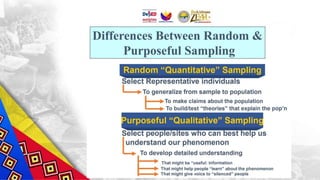
• Qualitative Action Research usually uses purposive
sampling.
• The goal is to get the deepest possible
understanding of the setting being studied.
• Requires identifying participants who can provide
information about the particular topic and setting
being studied.
DATA COLLECTION
METHOD
Data Collection Method
• data are primarily in the form of words, not numbers
• Some common methods of data collection for
qualitative research are the following:
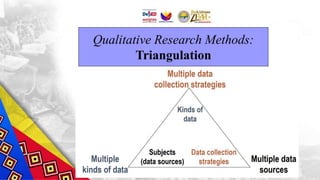
1. individual interviews
2. focus groups or focus group discussions
3. participant observations
4. documents or materials
5. open-ended questionnaires
ETHICAL
CONSIDERATIONS
Ethical Considerations
DATA ANALYSIS
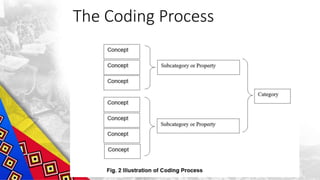
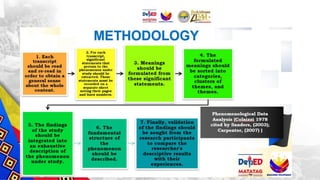
STEPS in Qualitative Data Analysis
1. The qualitative data are prepared for analysis.
2. Data or responses are read thoroughly to get to know them.
3. From the preliminary study of the data, categories or themes
are developed.
4. Responses are classified according to the categories or themes.
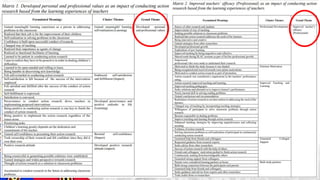
5. Data are tallied then a summary table is prepared with
frequencies and percentages for the categories or themes.
Specific responses are also selected to serve as examples of
how research participants expressed each category or theme.
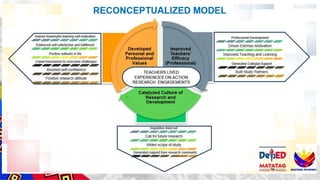
Preparation for Lesson
Clarification of Lesson
Increase in Student’s Comprehension
Confusion
THEMES
Sample Qualitative
Research
Sample Case Study
Sample
Phenomenological Study
Activity 2:
Write an outline of your qualitative research proposal
that includes the following:
Title
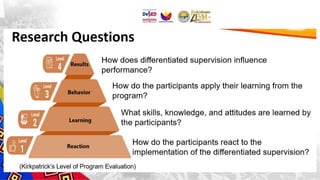
Research Questions
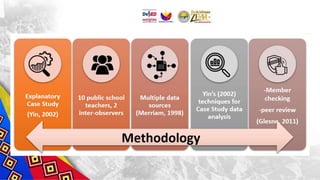
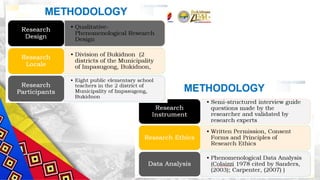
Methodology
Research Design
Sampling Method/Participants/Locale of the Study
Data Collection Method
Data Analysis
Qualitative-Research-Method-introduction to reseach.pptx

Qualitative-Research-Method-introduction to reseach.pptx

  • 1.
    QUALITATIVE RESEARCH METHODS IRENE C. CULASTE-QUIMBO SEPS– Planning and Research SDO Bukidnon
  • 2.
    Objectives At the endof the session, participants should be able to: • describe what qualitative research method is; • identify situations when qualitative research method is appropriate for Action Research; • determine techniques in obtaining data for qualitative Action Research; • describe the steps to be followed in qualitative data analysis; • write qualitative research proposal.
  • 3.
    Activity 1 Complete theresearch questions then classify if it is quantitative or qualitative in nature. 1. How do experimental and control groups compare in terms of __________ scores after intervention ____________ is implemented? 2. Is there a difference between scores in __________ obtained before and after intervention ____________ is implemented? 3. How do _________ and _________ interact in _________ classroom when intervention ___________ is used? 4. What are the effects of intervention ____________ on __________?
  • 4.
    •Action Research topics shouldbe properly classified as quantitative or qualitative.
  • 5.
    Comparing Qualitative andQuantitative Action Research (Hancock, Ockleford, and Windridge (2009) Qualitative Action Research Quantitative Action Research (Experiments) focuses on how the subjects look or feel about their experiences with the intervention or treatment as implemented focuses on quantitative or numerical assessment of the effects of the intervention or treatment as implemented
  • 6.
    Comparing Qualitative andQuantitative Action Research (Hancock, Ockleford, and Windridge (2009) Qualitative Action Research Quantitative Action Research (Experiments) describes in detail the classroom phenomenon before, during, and after intervention or treatment by portraying the real-world classroom context summarizes the classroom phenomenon before and after intervention or treatment by precisely stating differences in scores or grades
  • 7.
    Comparing Qualitative andQuantitative Action Research (Hancock, Ockleford, and Windridge (2009) Qualitative Action Research Quantitative Action Research (Experiments) studies effect of intervention or treatment using the subjects’ narrative accounts as data examines the effect of intervention or treatment using tests, rating scales, or numerical instruments
  • 8.
    Comparing Qualitative andQuantitative Action Research (Hancock, Ockleford, and Windridge (2009) Qualitative Action Research Quantitative Action Research (Experiments) uses thematic analysis of narrative reports of experiences uses statistical techniques that allow Action Researchers to talk about “how likely” it is that the effect of the intervention or treatment applied is “true” for a given population in an objective or measurable way
  • 9.
    Comparing Qualitative andQuantitative Action Research (Hancock, Ockleford, and Windridge (2009) Qualitative Action Research Quantitative Action Research (Experiments) employs the systematic Action Research process with more flexibility such that the procedures are “emergent” adheres to the prescribed procedure of the specific experimental design selected
  • 10.
  • 11.
    UNDERSTANDING QUALITATIVE ACTION RESEARCH •its purpose is to understand some aspects of the subjects’ experiences after an intervention or treatment is applied to address a problem or issue • Data come in the form of verbal descriptions. • Data collection methods involve interviews, observations, and documents—methods that either generate words or provide verbal information rather than numbers -Patton and Cochran 2002-
  • 12.
    UNDERSTANDING QUALITATIVE ACTION RESEARCH •appliedwhen the interest is to gain knowledge about underlying sentiments, opinions, and motivations following the introduction or implementation of an intervention or treatment •It uncovers trends in thoughts, opinions, and feelings that are not described in quantitative Action Research (experimental design).
  • 13.
    UNDERSTANDING QUALITATIVE ACTION RESEARCH •Qualitativedata enhance the usefulness of the intervention or treatment in its succeeding applications because these clarify some of the possible reactions or responses of recipients to the intervention or treatment.
  • 14.
    UNDERSTANDING QUALITATIVE ACTION RESEARCH •givesa more in-depth and detailed description of the situation in which the intervention was successfully (or unsuccessfully) applied in order to duplicate the success factors or remedy the reasons for failure.
  • 15.
    UNDERSTANDING QUALITATIVE ACTION RESEARCH •aims to answer questions about the “what,” “how,” or “why” of an intervention or treatment rather than “how many” or ”how much” has been its effect, which are answered by experimental design • If the goal is to understand how a class or individual students perceive the institution of an intervention or treatment to address a particular problem or issue, then qualitative research method is the appropriate research design.
  • 16.
    UNDERSTANDING QUALITATIVE ACTION RESEARCH •isalso useful if you want to initially try out an intervention or treatment, such as a new instructional design or a learning material, to address a certain learning problem prior to formally using it for the entire class
  • 17.
    Appropriateness of Qualitative Research •Whenvariables cannot be quantified •When variables are best understood in their natural settings •When variables are studied over time •When studying roles, processes, and groups •When the paramount objective is “understanding”
  • 19.
    COMMON TYPES OFQUALITATIVE RESEARCH •Case Study •Ethnography •Phenomenological study
  • 20.
  • 21.
    Case Study •an in-depthstudy of one person, group, or event through multiple types of data sources. •nearly every aspect of the subject’s life and history is analyzed to seek patterns and causes of behavior •Case studies can be explanatory, exploratory, descriptive, multiple-case, intrinsic, instrumental, collective.
  • 22.
    Explanatory Case Study •When an incident occurs in a field, an explanation is required. An explanatory report investigates the cause of the event. It will include explanations for that cause. • The study will also share details about the impact of the event. In most cases, this report will use evidence to predict future occurrences. The results of explanatory reports are definitive. • Note that there is no room for interpretation here. The results are absolute.
  • 23.
    Exploratory Case Study •An explanatory report is a self-contained document. An exploratory one is only the beginning of an investigation. • Exploratory cases act as the starting point of studies. This is usually conducted as a precursor to large-scale investigations. The research is used to suggest why further investigations are needed. • An exploratory study can also be used to suggest methods for further examination.
  • 24.
    Descriptive Case Study •When you have an existing hypothesis, you can design a descriptive study. This type of report starts with a description. The aim is to find connections between the subject being studied and a theory. • Once these connections are found, the study can conclude. The results of this type of study will usually suggest how to develop a theory further. • A descriptive report would use the quantitative data as a suggestion for researching the subject deeply.
  • 25.
    Examples of CaseStudy •One pupil who is given a behavior-modification intervention to help him or her manage disruptive or violent behavior. •A teacher-monitoring system applied to an at- risk student who is frequently absent from class. •An entire class undergoing brief daily- homeroom sessions with their adviser to discuss learning, relational, and personal difficulties. The experience of the entire class may be the subject of the qualitative case study.

  • 26.
  • 27.
    Ethnographic Study • ActionResearcher immerses himself or herself in the target participants’ environment to understand their goals and culture, as well as the challenges they face and motivations for life. • For example, let us say that you are curious if being accessible to your students after school for tutorial might help improve their scores in Physics. You may request permission to be allowed to spend two hours after school, say, 5–7 p.m. to tutor students. As you implement your after-school tutorials, you also get to know the life of students and the kind of activities that take much of their time and deter them from focusing on doing their homework.
  • 28.
    Ethnographic Study •An approachrelying on the collection of data in the natural environment. Ethnographers are interested in how the behavior of individuals is influenced or mediated by culture in which they live. •So, human behavior can only be understood if studied in the setting in which it occurs. As people can influence and be influenced by the groups they live in.
  • 29.
  • 30.
    Phenomenological Study • examinesexperiences (called “lived experiences”) through their own descriptions • Its goal is to describe the meaning that experiences hold for each individual participant. This type of research is suitable for topics in which there is little knowledge (Donalek 2004). • Any intervention or treatment developed to address a specific issue can also be tentatively applied using this type of qualitative research similar to how a case study or an ethnographic study could be conducted prior to its full implementation for groups of learners.
  • 31.
    Phenomenological Study For example,let us say you notice that some pupils in your advisory class have “absentee” parents (either deceased or working abroad or elsewhere) or have been put in the care of grandparents or other relatives by their own parents. You also notice that they often have difficulties submitting requirements due to lack of finances. You are thinking of matching each of these pupils with other pupils whose family may help provide these needs and may occasionally invite the “disadvantaged” pupils to their homes in the hope that this will provide a semblance of “parental care.” After implementing this “Adopt-a-classmate” intervention for one quarter, you examine its effectiveness by interviewing the participants. Participants, both the “adopted” pupil and the “adopting” pupil with his or her family, narrate the activities that they engaged in and share their feelings and views about them.
  • 32.
  • 33.
    Qualitative Sampling Method •Qualitative Action Research usually uses purposive sampling. • The goal is to get the deepest possible understanding of the setting being studied. • Requires identifying participants who can provide information about the particular topic and setting being studied.
  • 35.
  • 36.
    Data Collection Method •data are primarily in the form of words, not numbers • Some common methods of data collection for qualitative research are the following: 1. individual interviews 2. focus groups or focus group discussions 3. participant observations 4. documents or materials 5. open-ended questionnaires
  • 41.
  • 42.
  • 43.
  • 46.
    STEPS in QualitativeData Analysis 1. The qualitative data are prepared for analysis. 2. Data or responses are read thoroughly to get to know them. 3. From the preliminary study of the data, categories or themes are developed. 4. Responses are classified according to the categories or themes. 5. Data are tallied then a summary table is prepared with frequencies and percentages for the categories or themes. Specific responses are also selected to serve as examples of how research participants expressed each category or theme.
  • 50.
    Preparation for Lesson Preparationfor Lesson Clarification of Lesson Clarification of Lesson Increase in Student’s Comprehension Increase in Student’s Comprehension Increase in Student’s Comprehension Increase in Student’s Comprehension Increase in Student’s Comprehension Confusion THEMES
  • 54.
  • 55.
  • 62.
  • 71.
    Activity 2: Write anoutline of your qualitative research proposal that includes the following: Title Research Questions Methodology Research Design Sampling Method/Participants/Locale of the Study Data Collection Method Data Analysis