



Faculty of Engineering and Technology
Department of Architectural Engineering
ARC 323 : Human Studies in
Architecture
Fall 2018
Dr. Yasser Mahgoub
Lecture 6 - Data Collection
Key Ideas
1. Obtaining permissions for data collection
2. Selecting participants for data collection
3. Identifying data options
4. Recording and administering data collection
Procedures for Collecting Quantitative
Data
1. Obtain permissions
– identify the unit of analysis
–secure permissions
–obtain informed consent from participants
Obtaining Permissions
• Institutional or organizational (e.g. school
district)
• Site-specific (e.g. secondary school)
• Individual participants or parents
• Campus approval (e.g. university or college)
Procedures for Collecting Quantitative
Data
2. Select participants
–specify a population and sample
–use probability and non-probability
sampling
–choose a sample size
Select Participants
Choose a Sample Size
• Select a sample size as large as possible from
the individuals available
• Select a sufficient number of participants for
the statistical tests you will use (e.g. 15 per
group for experiments)
Procedures for Collecting Quantitative
Data
3. Identify data options
–specify variables
– operationalize variables
– select scales of measurement
– choose types of data measures
Procedures for Collecting Quantitative
Data
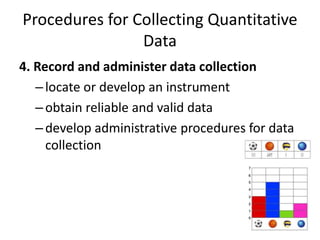
4. Record and administer data collection
–locate or develop an instrument
–obtain reliable and valid data
–develop administrative procedures for data
collection
Select Participants
Select Participants
Specify a Population and Sample
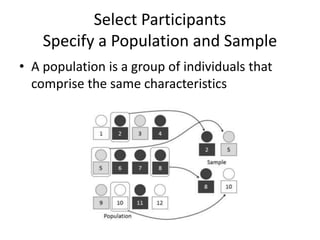
• A population is a group of individuals that
comprise the same characteristics
Select Participants
Specify a Population and Sample
• A sample is a sub-group of the target
population that the researcher plans to study
for the purpose about making generalizations
about the target population.
Sampling
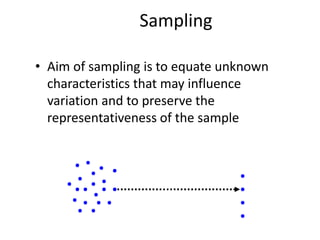
• Aim of sampling is to equate unknown
characteristics that may influence
variation and to preserve the
representativeness of the sample
Populations and Samples
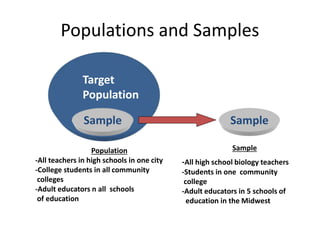
Sample
Target
Population
Sample
Population
-All teachers in high schools in one city
-College students in all community
colleges
-Adult educators n all schools
of education
Sample
-All high school biology teachers
-Students in one community
college
-Adult educators in 5 schools of
education in the Midwest
Two Classes of Sampling Techniques:
1. Non-probability Sampling
2. Probability Sampling
Select Participants: Use Probability and Non-
Probability Sampling
• Probability sampling is the selection of
individuals from the population so that they
are representative of the population
• Non-probability sampling is the selection of
participants because they are available,
convent, or represent some characteristic the
investigator wants to study.
Probability Samples
Probability Sampling
• Common feature is that each unit in the
population has a known, nonzero
probability of being included in the
sample
Advantages of Probability Sampling
• Objective standards remove possibility of
unknown confounds
• Intent to remove bias in selection process
Types of Probability Samples
• Simple Random: selecting a sample from the
population so all in the population have an
equal chance of being selected
• Systematic: choosing every “nth” individual
or site in the population until the desired
sample size is achieved
Types of Probability Samples
• Stratified sampling: stratifying the population
on a characteristic (e.g. gender) than sampling
from each stratum.
• Multi-Stage Cluster Sampling: a sample
chosen in one or two stages because the
population is not easily identified or is large
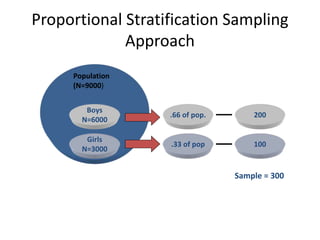
Proportional Stratification Sampling
Approach
Boys
N=6000
Girls
N=3000
Population
(N=9000)
.66 of pop. 200
.33 of pop 100
Sample = 300
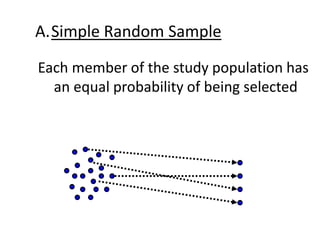
A.Simple Random Sample
Each member of the study population has
an equal probability of being selected
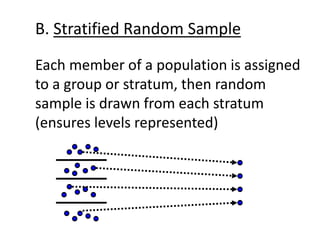
B. Stratified Random Sample
Each member of a population is assigned
to a group or stratum, then random
sample is drawn from each stratum
(ensures levels represented)
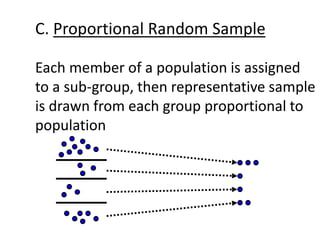
C. Proportional Random Sample
Each member of a population is assigned
to a sub-group, then representative sample
is drawn from each group proportional to
population
Non-Probability Samples
Non-probability Sampling
• Common feature is that subjective
judgments are used to determine the
population that are contained in the
sample.
Advantages of Non-probability sampling
• Fast, low effortcost methods
• Useful in exploratory research
Types of Non-Probability
Samples
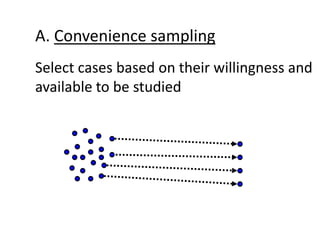
A. Convenience sampling
Select cases based on their willingness and
available to be studied
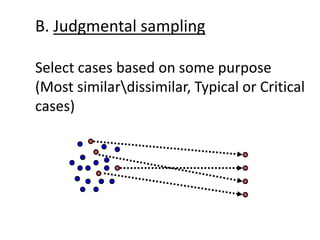
B. Judgmental sampling
Select cases based on some purpose
(Most similardissimilar, Typical or Critical
cases)
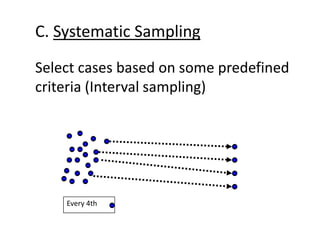
C. Systematic Sampling
Every 4th
Select cases based on some predefined
criteria (Interval sampling)
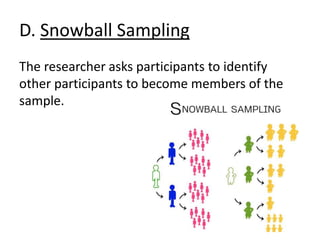
D. Snowball Sampling
The researcher asks participants to identify
other participants to become members of the
sample.
End

Arc 323 human studies in architecture fall 2018 lecture 6-data collection

  • 1.
    Faculty of Engineeringand Technology Department of Architectural Engineering ARC 323 : Human Studies in Architecture Fall 2018 Dr. Yasser Mahgoub Lecture 6 - Data Collection
  • 2.
    Key Ideas 1. Obtainingpermissions for data collection 2. Selecting participants for data collection 3. Identifying data options 4. Recording and administering data collection
  • 3.
    Procedures for CollectingQuantitative Data 1. Obtain permissions – identify the unit of analysis –secure permissions –obtain informed consent from participants
  • 4.
    Obtaining Permissions • Institutionalor organizational (e.g. school district) • Site-specific (e.g. secondary school) • Individual participants or parents • Campus approval (e.g. university or college)
  • 5.
    Procedures for CollectingQuantitative Data 2. Select participants –specify a population and sample –use probability and non-probability sampling –choose a sample size
  • 6.
    Select Participants Choose aSample Size • Select a sample size as large as possible from the individuals available • Select a sufficient number of participants for the statistical tests you will use (e.g. 15 per group for experiments)
  • 7.
    Procedures for CollectingQuantitative Data 3. Identify data options –specify variables – operationalize variables – select scales of measurement – choose types of data measures
  • 8.
    Procedures for CollectingQuantitative Data 4. Record and administer data collection –locate or develop an instrument –obtain reliable and valid data –develop administrative procedures for data collection
  • 9.
  • 10.
    Select Participants Specify aPopulation and Sample • A population is a group of individuals that comprise the same characteristics
  • 11.
    Select Participants Specify aPopulation and Sample • A sample is a sub-group of the target population that the researcher plans to study for the purpose about making generalizations about the target population.
  • 12.
    Sampling • Aim ofsampling is to equate unknown characteristics that may influence variation and to preserve the representativeness of the sample
  • 13.
    Populations and Samples Sample Target Population Sample Population -Allteachers in high schools in one city -College students in all community colleges -Adult educators n all schools of education Sample -All high school biology teachers -Students in one community college -Adult educators in 5 schools of education in the Midwest
  • 14.
    Two Classes ofSampling Techniques: 1. Non-probability Sampling 2. Probability Sampling
  • 15.
    Select Participants: UseProbability and Non- Probability Sampling • Probability sampling is the selection of individuals from the population so that they are representative of the population • Non-probability sampling is the selection of participants because they are available, convent, or represent some characteristic the investigator wants to study.
  • 16.
  • 17.
    Probability Sampling • Commonfeature is that each unit in the population has a known, nonzero probability of being included in the sample
  • 18.
    Advantages of ProbabilitySampling • Objective standards remove possibility of unknown confounds • Intent to remove bias in selection process
  • 19.
    Types of ProbabilitySamples • Simple Random: selecting a sample from the population so all in the population have an equal chance of being selected • Systematic: choosing every “nth” individual or site in the population until the desired sample size is achieved
  • 20.
    Types of ProbabilitySamples • Stratified sampling: stratifying the population on a characteristic (e.g. gender) than sampling from each stratum. • Multi-Stage Cluster Sampling: a sample chosen in one or two stages because the population is not easily identified or is large
  • 21.
  • 22.
    A.Simple Random Sample Eachmember of the study population has an equal probability of being selected
  • 23.
    B. Stratified RandomSample Each member of a population is assigned to a group or stratum, then random sample is drawn from each stratum (ensures levels represented)
  • 24.
    C. Proportional RandomSample Each member of a population is assigned to a sub-group, then representative sample is drawn from each group proportional to population
  • 25.
  • 26.
    Non-probability Sampling • Commonfeature is that subjective judgments are used to determine the population that are contained in the sample.
  • 27.
    Advantages of Non-probabilitysampling • Fast, low effortcost methods • Useful in exploratory research
  • 28.
  • 29.
    A. Convenience sampling Selectcases based on their willingness and available to be studied
  • 30.
    B. Judgmental sampling Selectcases based on some purpose (Most similardissimilar, Typical or Critical cases)
  • 31.
    C. Systematic Sampling Every4th Select cases based on some predefined criteria (Interval sampling)
  • 32.
    D. Snowball Sampling Theresearcher asks participants to identify other participants to become members of the sample.
  • 33.