1
1
LOGO
Trait
Approach
Leadership
Sher Bahader Khan Mashriqi
Overview
Great Person Theories
1
Historical Shifts in Trait Perspective
2
Major Leadership Traits
3
How Does the Trait Approach Work?
4
5 Strengths, and Criticisms
Great Person Theories
Trait Approach: is a major approach
To Study of human personality. Traits are
defined as habitual patterns of behavior
Thought, and emotion
“Great Man” Theories (early1900s)
Focused on identifying innate qualities
and characteristics possessed by
great social, political, & military
leaders
Historical Shifts in Trait
Perspective
Early 1900s
1
1930-50s
2
1970s-90s
3
Today
4
Great Man
Theories
•Research focused
on individual
characteristics
that universally
differentiated
leaders
from non leaders
Innate Qualities
Traits Interacting
With Situational
Demands on Leaders
• Landmark Stogdill (1948)
study - analyzed and
synthesized 124 trait studies
- Leadership
reconceptualized
as a relationship between
people in a social situation
• Mann (1959) reviewed 1,400
findings of personality and
leadership in small groups
- Less emphasis on situations
- Suggested personality traits
could be used to discriminate
leaders from non leaders
5 Major
Leadership
Traits
• Intelligence
• Self-Confidence
• Determination
• Integrity
• Sociability
Revival of Critical Role of
Traits in Leader
Effectiveness
• Stogdill (1974)
- Analyzed 163 new studies
with 1948 study findings
- Validated original study
- 10 characteristics
positively identified with
leadership
• Lord, DeVader, & Alliger
(1986) meta-analysis
- Personality traits can be
used to differentiate
leaders/nonleaders
• Kirkpatrick & Locke (1991)
- 6 traits make up the
“Right Stuff” for leaders
Situations Personality / Behaviors
Leadership Traits
Studies of Leadership Traits and Characteristics
Major Leadership Traits
Traits to possess or cultivate if one seeks to be
perceived by others as a leader:
1 Intelligence – Intellectual ability including verbal,
perceptual, and reasoning capabilities
Self-Confidence – Ability to be certain about
one’s competencies and skills
Determination – The desire to get the job done
(i.e., initiative, persistence, dominance, drive)
3
2
Continued…
Integrity – The quality of honesty and
trustworthiness
Sociability – Leader’s inclination to seek
out pleasant social relationships
4
5
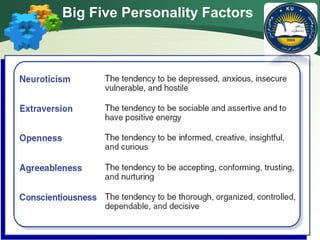
Big Five Personality Factors
5-Factor Personality Model & Leadership
Study using meta-analysis (Judge et al, 2002)
1
2
3
4
Big Five & Leadership
Results –a strong relationship between
personality traits and leadership
Extraversion–factor most strongly associated with
leadership
 Most important trait of effective leaders
Conscientiousness – 2nd most related factor
Neuroticism & Openness – next most related
 Neuroticism negatively associated to leadership
Agreeableness – only weakly related to leadership
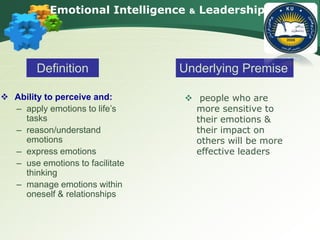
Emotional Intelligence & Leadership
Definition
 Ability to perceive and:
– apply emotions to life’s
tasks
– reason/understand
emotions
– express emotions
– use emotions to facilitate
thinking
– manage emotions within
oneself & relationships
 people who are
more sensitive to
their emotions &
their impact on
others will be more
effective leaders
Underlying Premise
How Does the Trait Approach
Work?
Focus of Trait Approach
Trait Leadership exclusively focuses on the leader not
necessarily the followers or situation, the leader
exhibits a certain set of traits to be an effective leader,
trait leadership works well for an organization with
managers in leadership position have specific traits,
that the company will go out and get the people with
those traits.
Strengths
Provides benchmarks
for what to look for in
a leader
Criticisms
Fails to delimit
a definitive list of
leadership traits
1 1
Application
 Provides direction as to which traits are good to
have if one aspires to a leadership position
 Through various tests and questionnaires,
individuals can determine whether they have the
select leadership traits and can pinpoint their
strengths and weaknesses
 Can be used by managers to assess where they
stand within their organization and what is needed
to strengthen their position
1
2
3
LOGO
www.Win2Farsi.com

Trait approach

  • 1.
  • 2.
  • 3.
    Overview Great Person Theories 1 HistoricalShifts in Trait Perspective 2 Major Leadership Traits 3 How Does the Trait Approach Work? 4 5 Strengths, and Criticisms
  • 4.
    Great Person Theories TraitApproach: is a major approach To Study of human personality. Traits are defined as habitual patterns of behavior Thought, and emotion “Great Man” Theories (early1900s) Focused on identifying innate qualities and characteristics possessed by great social, political, & military leaders
  • 5.
    Historical Shifts inTrait Perspective Early 1900s 1 1930-50s 2 1970s-90s 3 Today 4 Great Man Theories •Research focused on individual characteristics that universally differentiated leaders from non leaders Innate Qualities Traits Interacting With Situational Demands on Leaders • Landmark Stogdill (1948) study - analyzed and synthesized 124 trait studies - Leadership reconceptualized as a relationship between people in a social situation • Mann (1959) reviewed 1,400 findings of personality and leadership in small groups - Less emphasis on situations - Suggested personality traits could be used to discriminate leaders from non leaders 5 Major Leadership Traits • Intelligence • Self-Confidence • Determination • Integrity • Sociability Revival of Critical Role of Traits in Leader Effectiveness • Stogdill (1974) - Analyzed 163 new studies with 1948 study findings - Validated original study - 10 characteristics positively identified with leadership • Lord, DeVader, & Alliger (1986) meta-analysis - Personality traits can be used to differentiate leaders/nonleaders • Kirkpatrick & Locke (1991) - 6 traits make up the “Right Stuff” for leaders Situations Personality / Behaviors
  • 6.
    Leadership Traits Studies ofLeadership Traits and Characteristics
  • 7.
    Major Leadership Traits Traitsto possess or cultivate if one seeks to be perceived by others as a leader: 1 Intelligence – Intellectual ability including verbal, perceptual, and reasoning capabilities Self-Confidence – Ability to be certain about one’s competencies and skills Determination – The desire to get the job done (i.e., initiative, persistence, dominance, drive) 3 2
  • 8.
    Continued… Integrity – Thequality of honesty and trustworthiness Sociability – Leader’s inclination to seek out pleasant social relationships 4 5
  • 9.
  • 10.
    5-Factor Personality Model& Leadership Study using meta-analysis (Judge et al, 2002) 1 2 3 4 Big Five & Leadership Results –a strong relationship between personality traits and leadership Extraversion–factor most strongly associated with leadership  Most important trait of effective leaders Conscientiousness – 2nd most related factor Neuroticism & Openness – next most related  Neuroticism negatively associated to leadership Agreeableness – only weakly related to leadership
  • 11.
    Emotional Intelligence &Leadership Definition  Ability to perceive and: – apply emotions to life’s tasks – reason/understand emotions – express emotions – use emotions to facilitate thinking – manage emotions within oneself & relationships  people who are more sensitive to their emotions & their impact on others will be more effective leaders Underlying Premise
  • 12.
    How Does theTrait Approach Work? Focus of Trait Approach Trait Leadership exclusively focuses on the leader not necessarily the followers or situation, the leader exhibits a certain set of traits to be an effective leader, trait leadership works well for an organization with managers in leadership position have specific traits, that the company will go out and get the people with those traits.
  • 13.
    Strengths Provides benchmarks for whatto look for in a leader Criticisms Fails to delimit a definitive list of leadership traits 1 1
  • 14.
    Application  Provides directionas to which traits are good to have if one aspires to a leadership position  Through various tests and questionnaires, individuals can determine whether they have the select leadership traits and can pinpoint their strengths and weaknesses  Can be used by managers to assess where they stand within their organization and what is needed to strengthen their position 1 2 3
  • 15.