




Leadership Stress: An In-depth
     Look at How Stress Can
          Impact Leaders and
                Organizations

                   Sherry Perkins
           VP Enterprise Solutions
                          Services


                     June 27, 2012
Introducing Profiles International

Who We Are – Employee assessment specialists
                                      Profiles International: A High-level Overview

                                      • Founded   in 1991

                                      •World Leaders in Assessment Solutions

                                      • Delivered more than 45M assessments to

                                      •40,000 organizations across

                                      •Numerous Industry Sectors in

                                      •122 Countries and in
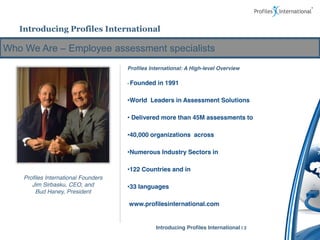
    Profiles International Founders
       Jim Sirbasku, CEO, and         •33 languages
         Bud Haney, President

                                      www.profilesinternational.com


                                                 Introducing Profiles International | 2
Your Facilitator

 Scheherazade Perkins, M.A.
 Organizational Development

V.P. Enterprise Solutions Services
       30 Years Experience
  Technology/Management/HR
         Business Owner
    Chair Waco WIB Alliance
        SCORE Counselor
  UOP Management Instructor
                                     sherry.perkins@profilesmail.com
                                               254-399-5517
About the Author

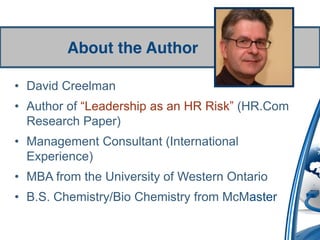
• David Creelman
• Author of “Leadership  as  an  HR  Risk”  (HR.Com
  Research Paper)
• Management Consultant (International
  Experience)
• MBA from the University of Western Ontario
• B.S. Chemistry/Bio Chemistry from McMaster
Learning Objectives


Audience
This webinar is designed for business owners, executives, strategic
managers and business professionals who want to understand more about
the impact of stress in the life of a leader and the role of the organization in
the managing stress levels for its leaders.


Learning Objectives:
•   Describe stress levels in terms of its positive and negative impact on
    leader performance and effectiveness.
•   Evaluate stress levels among leaders within their organizations in terms
    of predictive stress indicators.
•   Set in place actions to anticipate and proactively eliminate the effect of
    destructive stress levels among leaders within their organizations.
Let’s  Take  a  Pulse.
• On average, how much stress
  do you experience in a typical
    work week?
  – About right
  – A little more than reasonable
  – Entirely too much
How about another pulse check.

• Any body else in your situation
  would probably have. . .
 – Resigned
 – Resorted to Heavy Medication
 – Refused to Play
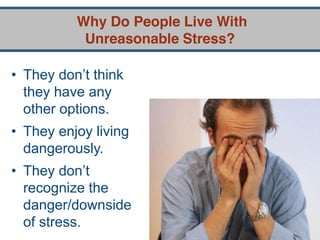
Why Do People Live With
             Unreasonable Stress?

• They  don’t  think  
  they have any
  other options.
• They enjoy living
  dangerously.
• They  don’t  
  recognize the
  danger/downside
  of stress.
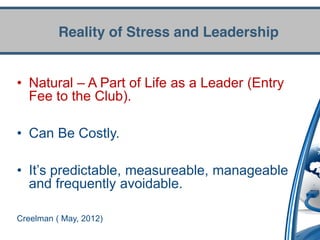
Reality of Stress and Leadership


• Natural – A Part of Life as a Leader (Entry
  Fee to the Club).

• Can Be Costly.

• It’s  predictable,  measureable,  manageable  
  and frequently avoidable.

Creelman ( May, 2012)
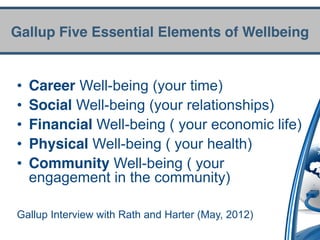
Gallup Five Essential Elements of Wellbeing


•   Career Well-being (your time)
•   Social Well-being (your relationships)
•   Financial Well-being ( your economic life)
•   Physical Well-being ( your health)
•   Community Well-being ( your
    engagement in the community)

Gallup Interview with Rath and Harter (May, 2012)
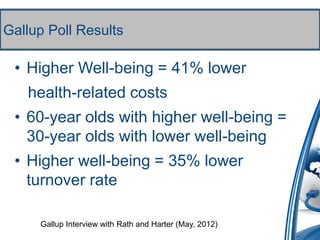
Gallup Poll Results

 • Higher Well-being = 41% lower
   health-related costs
 • 60-year olds with higher well-being =
   30-year olds with lower well-being
 • Higher well-being = 35% lower
   turnover rate

     Gallup Interview with Rath and Harter (May, 2012)
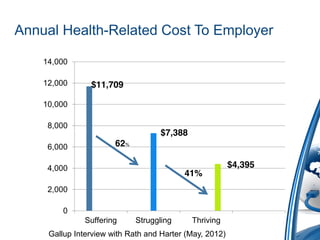
Annual Health-Related Cost To Employer

    14,000

    12,000      $11,709

    10,000

     8,000
                                   $7,388
     6,000             62%

     4,000                                               $4,395
                                          41%
     2,000

         0
               Suffering     Struggling     Thriving
     Gallup Interview with Rath and Harter (May, 2012)
Risks of Stress and Leadership


   1. Loss of senior talent due to
      burn-out
   2. Deteriorating Engagement in
      the department
   3. Bad decision making
David Creelman, 2012. www.hr.com
Enhancing Your Leadership Charisma: A Step-by-Step Guide


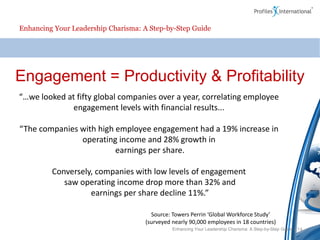
Engagement = Productivity & Profitability
“…we  looked  at  fifty  global  companies  over  a  year,  correlating  employee  
                engagement levels with financial results...

“The  companies with high employee engagement had a 19% increase in
                operating income and 28% growth in
                          earnings per share.

          Conversely, companies with low levels of engagement
             saw operating income drop more than 32% and
                    earnings per share  decline  11%.”

                                          Source:  Towers  Perrin  ‘Global  Workforce  Study’
                                        (surveyed nearly 90,000 employees in 18 countries)
                                                  Enhancing Your Leadership Charisma: A Step-by-Step Guide |
Enhancing Your Leadership Charisma: A Step-by-Step Guide


Engagement = Productivity & Profitability
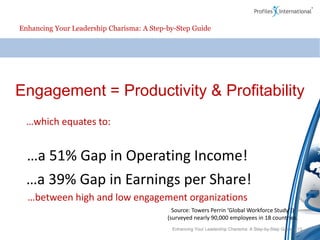
  …which  equates  to:


  …a  51%  Gap  in  Operating  Income!
  …a  39%  Gap  in  Earnings  per  Share!
  …between  high  and  low  engagement  organizations
                                             Source:  Towers  Perrin  ‘Global  Workforce  Study’))
                                           (surveyed nearly 90,000 employees in 18 countries.
                                             Enhancing Your Leadership Charisma: A Step-by-Step Guide |
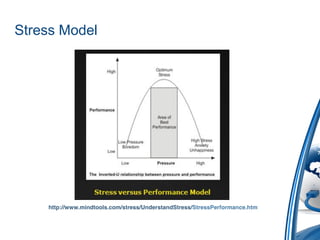
Stress Model


    http://www.mindtools.com/stress/UnderstandStress/StressPerformance.htm
Study Finds Boredom can Actually
                   Kill You
                            Rajshri on February 09, 2010


  Researchers from University College London interviewed more than
 7,500 people aged between 35 to 55 years in a three year period from
 1985 to 1988. Last year, the researchers followed up on the study and
found that almost 40 percent of those who admitted to feeling great deal
                         of boredom had died.


        Read more: Study Finds Boredom can Actually Kill You | MedIndia http://www.medindia.net

             /news/Study-Finds-Boredom-can-Actually-Kill-You-64822-1.htm#ixzz1yAgySr00
Risks of Stress and Leadership


1. Loss of senior talent due to
   burn-out
2. Deteriorating Engagement in
   the department
3. Bad decision making
David Creelman, 2012. www.hr.com
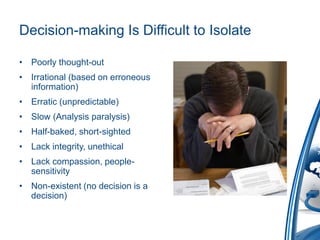
Decision-making Is Difficult to Isolate

• Poorly thought-out
• Irrational (based on erroneous
  information)
• Erratic (unpredictable)
• Slow (Analysis paralysis)
• Half-baked, short-sighted
• Lack integrity, unethical
• Lack compassion, people-
  sensitivity
• Non-existent (no decision is a
  decision)
Reality of Stress and Leadership


• Natural – A Part of Life as a Leader (Entry
  Fee to the Club).

• Can Be Costly.

• It’s  predictable,  measureable,  manageable  
  and frequently avoidable.

Creelman ( May, 2012)
Key Points

1.           Loss of Senior Talent Due to Burn-out
       –        Pre-mature Attrition
       –        Health Care Costs
       –        Decision-Making Impaired
2.           Deteriorating Engagement in the Department
       –      Lower Performance, Productivity and
              Profitability
3.           Stress Levels Must Be Balanced
David Creelman, 2012. www.hr.com
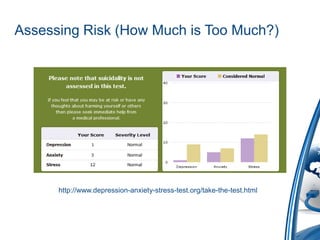
Assessing Risk (How Much is Too Much?)


      http://www.depression-anxiety-stress-test.org/take-the-test.html
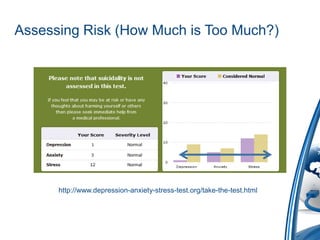
Assessing Risk (How Much is Too Much?)


      http://www.depression-anxiety-stress-test.org/take-the-test.html
Risk Mitigation

            Programs                    Emergency Response
• Stress Management Training        • Employee Assistance
                                      Programs
• “Ten  Minute  Fitness”
                                    • Coaches
• Good habits
                                    • Group Interventions/Focus
    – Take a break
                                      Groups
    – Exercise
    – Think before Accepting Work
    – Create Predictable Time Off
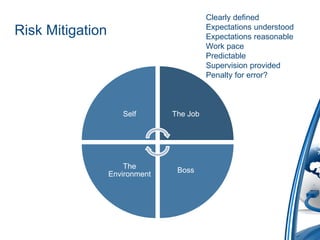
Clearly defined
Risk Mitigation                           Expectations understood
                                          Expectations reasonable
                                          Work pace
                                          Predictable
                                          Supervision provided
                                          Penalty for error?


                     Self       The Job


                      The
                                 Boss
                  Environment
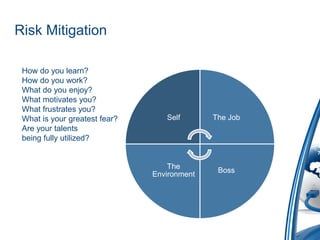
Risk Mitigation

 How do you learn?
 How do you work?
 What do you enjoy?
 What motivates you?
 What frustrates you?
 What is your greatest fear?      Self       The Job
 Are your talents
 being fully utilized?


                                   The
                                              Boss
                               Environment
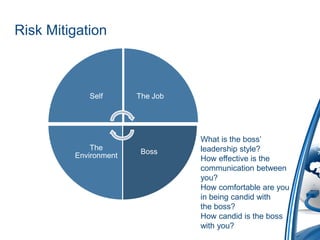
Risk Mitigation


            Self       The Job


                                 What  is  the  boss’  
             The                 leadership style?
                        Boss
         Environment             How effective is the
                                 communication between
                                 you?
                                 How comfortable are you
                                 in being candid with
                                 the boss?
                                 How candid is the boss
                                 with you?
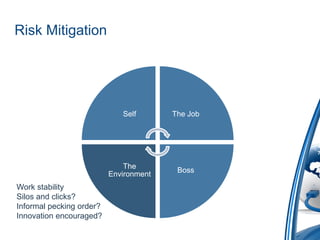
Risk Mitigation


                             Self       The Job


                              The
                                         Boss
                          Environment
Work stability
Silos and clicks?
Informal pecking order?
Innovation encouraged?
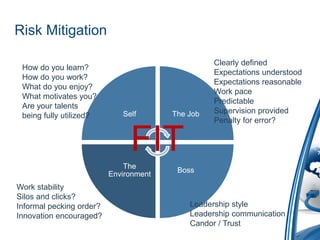
Risk Mitigation

                                                  Clearly defined
 How do you learn?
                                                  Expectations understood
 How do you work?
                                                  Expectations reasonable
 What do you enjoy?
                                                  Work pace
 What motivates you?
                                                  Predictable
 Are your talents
                             Self       The Job   Supervision provided
 being fully utilized?
                                                  Penalty for error?


                               FIT
                              The
                                         Boss
                          Environment
Work stability
Silos and clicks?
Informal pecking order?                     Leadership style
Innovation encouraged?                      Leadership communication
                                            Candor / Trust
The Real You


  What I can   What the
    expect     employee
   from the    will need
  employee.    from me.
The Real You


  What I can     What the
    expect       employee
   from theFIT   will need
  employee.      from me.
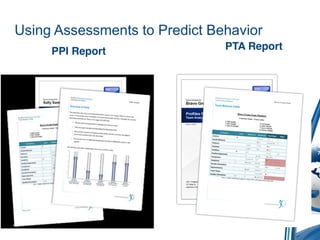
Using Assessments to Predict Behavior
     PPI Report                PTA Report
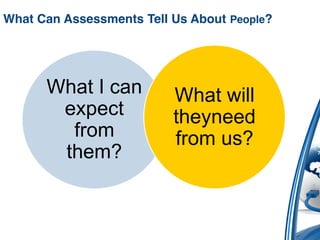
What Can Assessments Tell Us About People?


      What I can          What will
       expect             theyneed
        from              from us?
       them?
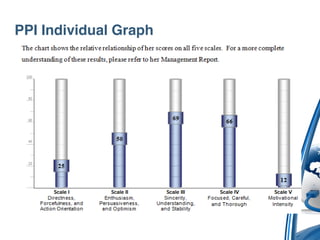
PPI Individual Graph
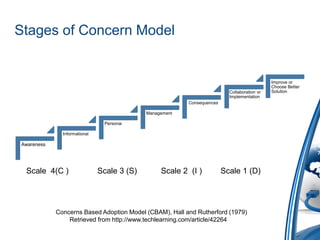
Stages of Concern Model


                                                                                             Improve or
                                                                                             Choose Better
                                                                          Collaboration or   Solution
                                                                          Implementation
                                                         Consequences

                                            Management

                               Personal

              Informational

Awareness


 Scale 4(C )                  Scale 3 (S)        Scale 2 (I )           Scale 1 (D)


            Concerns Based Adoption Model (CBAM), Hall and Rutherford (1979)
                Retrieved from http://www.techlearning.com/article/42264
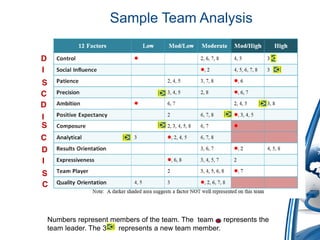
Sample Team Analysis

D
I
S
C
D
I
S
C
D
I
S
C


    Numbers represent members of the team. The team represents the
    team leader. The 3  represents a new team member.
Reality of Stress and Leadership


• Natural – A Part of Life as a Leader (Entry
  Fee to the Club).

• Can Be Costly.

• It’s  predictable,  measureable,  manageable  
  and frequently avoidable.

Creelman ( May, 2012)
Key Points

1.         Stress Levels Can Be Measured.
2.         Stress Levels Can Be Managed.
      –          Assessments
      –          FIT
3. Stress Levels Can Be Avoided.
  – Predictive Models
  – Individual and Team Analysis

David Creelman, 2012. www.hr.com
Learning Objectives


Audience
This webinar is designed for business owners, executives, strategic
managers and business professionals who want to understand more about
the impact of stress in the life of a leader and the role of the organization in
the managing stress levels for its leaders.


Learning Objectives:
•   Describe stress levels in terms of its positive and negative impact on
    leader performance and effectiveness.
•   Evaluate stress levels among leaders within their organizations in terms
    of predictive stress indicators.
•   Set in place actions to anticipate and proactively eliminate the effect of
    destructive stress levels among leaders within their organizations.
What’s  Next?  
                  • Survey your organization to
                    determine the level of
                    engagement of your
                    workforce?


                  • Examine your team for pockets
                    of imbalance and high stress
                    levels?


                  • Assess  one  of  your  leader’s  to  
                    determine the sources of
                    stress and measures needed
                    to counteract.
Who Wants a Free
Leader Assessment?


        Yes / No
Questions ?
Contact Us

           Profiles Assessment Asia (Pte.) Limited
                    An Authorized Strategic Business Partner of Profiles International


14 , Robinson Road, #08-01A, Far East Finance,
Singapore 048545
Email: info@profiles.com.sg
Telephone: 65717031
Fax: 63334636

Website: http://www.profiles.com.sg


                                                                     Share , Connect and Follow Us 


 Know your people..Grow your business

Leadership stress

  • 1.
    Leadership Stress: AnIn-depth Look at How Stress Can Impact Leaders and Organizations Sherry Perkins VP Enterprise Solutions Services June 27, 2012
  • 2.
    Introducing Profiles International WhoWe Are – Employee assessment specialists Profiles International: A High-level Overview • Founded in 1991 •World Leaders in Assessment Solutions • Delivered more than 45M assessments to •40,000 organizations across •Numerous Industry Sectors in •122 Countries and in Profiles International Founders Jim Sirbasku, CEO, and •33 languages Bud Haney, President www.profilesinternational.com Introducing Profiles International | 2
  • 3.
    Your Facilitator ScheherazadePerkins, M.A. Organizational Development V.P. Enterprise Solutions Services 30 Years Experience Technology/Management/HR Business Owner Chair Waco WIB Alliance SCORE Counselor UOP Management Instructor sherry.perkins@profilesmail.com 254-399-5517
  • 4.
    About the Author •David Creelman • Author of “Leadership  as  an  HR  Risk”  (HR.Com Research Paper) • Management Consultant (International Experience) • MBA from the University of Western Ontario • B.S. Chemistry/Bio Chemistry from McMaster
  • 5.
    Learning Objectives Audience This webinaris designed for business owners, executives, strategic managers and business professionals who want to understand more about the impact of stress in the life of a leader and the role of the organization in the managing stress levels for its leaders. Learning Objectives: • Describe stress levels in terms of its positive and negative impact on leader performance and effectiveness. • Evaluate stress levels among leaders within their organizations in terms of predictive stress indicators. • Set in place actions to anticipate and proactively eliminate the effect of destructive stress levels among leaders within their organizations.
  • 6.
    Let’s  Take  a Pulse. • On average, how much stress do you experience in a typical work week? – About right – A little more than reasonable – Entirely too much
  • 7.
    How about anotherpulse check. • Any body else in your situation would probably have. . . – Resigned – Resorted to Heavy Medication – Refused to Play
  • 8.
    Why Do PeopleLive With Unreasonable Stress? • They  don’t  think   they have any other options. • They enjoy living dangerously. • They  don’t   recognize the danger/downside of stress.
  • 9.
    Reality of Stressand Leadership • Natural – A Part of Life as a Leader (Entry Fee to the Club). • Can Be Costly. • It’s  predictable,  measureable,  manageable   and frequently avoidable. Creelman ( May, 2012)
  • 10.
    Gallup Five EssentialElements of Wellbeing • Career Well-being (your time) • Social Well-being (your relationships) • Financial Well-being ( your economic life) • Physical Well-being ( your health) • Community Well-being ( your engagement in the community) Gallup Interview with Rath and Harter (May, 2012)
  • 11.
    Gallup Poll Results • Higher Well-being = 41% lower health-related costs • 60-year olds with higher well-being = 30-year olds with lower well-being • Higher well-being = 35% lower turnover rate Gallup Interview with Rath and Harter (May, 2012)
  • 12.
    Annual Health-Related CostTo Employer 14,000 12,000 $11,709 10,000 8,000 $7,388 6,000 62% 4,000 $4,395 41% 2,000 0 Suffering Struggling Thriving Gallup Interview with Rath and Harter (May, 2012)
  • 13.
    Risks of Stressand Leadership 1. Loss of senior talent due to burn-out 2. Deteriorating Engagement in the department 3. Bad decision making David Creelman, 2012. www.hr.com
  • 14.
    Enhancing Your LeadershipCharisma: A Step-by-Step Guide Engagement = Productivity & Profitability “…we  looked  at  fifty  global  companies  over  a  year,  correlating  employee   engagement levels with financial results... “The  companies with high employee engagement had a 19% increase in operating income and 28% growth in earnings per share. Conversely, companies with low levels of engagement saw operating income drop more than 32% and earnings per share  decline  11%.” Source:  Towers  Perrin  ‘Global  Workforce  Study’ (surveyed nearly 90,000 employees in 18 countries) Enhancing Your Leadership Charisma: A Step-by-Step Guide |
  • 15.
    Enhancing Your LeadershipCharisma: A Step-by-Step Guide Engagement = Productivity & Profitability …which  equates  to: …a  51%  Gap  in  Operating  Income! …a  39%  Gap  in  Earnings  per  Share! …between  high  and  low  engagement  organizations Source:  Towers  Perrin  ‘Global  Workforce  Study’)) (surveyed nearly 90,000 employees in 18 countries. Enhancing Your Leadership Charisma: A Step-by-Step Guide |
  • 16.
    Stress Model http://www.mindtools.com/stress/UnderstandStress/StressPerformance.htm
  • 17.
    Study Finds Boredomcan Actually Kill You Rajshri on February 09, 2010 Researchers from University College London interviewed more than 7,500 people aged between 35 to 55 years in a three year period from 1985 to 1988. Last year, the researchers followed up on the study and found that almost 40 percent of those who admitted to feeling great deal of boredom had died. Read more: Study Finds Boredom can Actually Kill You | MedIndia http://www.medindia.net /news/Study-Finds-Boredom-can-Actually-Kill-You-64822-1.htm#ixzz1yAgySr00
  • 18.
    Risks of Stressand Leadership 1. Loss of senior talent due to burn-out 2. Deteriorating Engagement in the department 3. Bad decision making David Creelman, 2012. www.hr.com
  • 19.
    Decision-making Is Difficultto Isolate • Poorly thought-out • Irrational (based on erroneous information) • Erratic (unpredictable) • Slow (Analysis paralysis) • Half-baked, short-sighted • Lack integrity, unethical • Lack compassion, people- sensitivity • Non-existent (no decision is a decision)
  • 20.
    Reality of Stressand Leadership • Natural – A Part of Life as a Leader (Entry Fee to the Club). • Can Be Costly. • It’s  predictable,  measureable,  manageable   and frequently avoidable. Creelman ( May, 2012)
  • 21.
    Key Points 1. Loss of Senior Talent Due to Burn-out – Pre-mature Attrition – Health Care Costs – Decision-Making Impaired 2. Deteriorating Engagement in the Department – Lower Performance, Productivity and Profitability 3. Stress Levels Must Be Balanced David Creelman, 2012. www.hr.com
  • 22.
    Assessing Risk (HowMuch is Too Much?) http://www.depression-anxiety-stress-test.org/take-the-test.html
  • 23.
    Assessing Risk (HowMuch is Too Much?) http://www.depression-anxiety-stress-test.org/take-the-test.html
  • 24.
    Risk Mitigation Programs Emergency Response • Stress Management Training • Employee Assistance Programs • “Ten  Minute  Fitness” • Coaches • Good habits • Group Interventions/Focus – Take a break Groups – Exercise – Think before Accepting Work – Create Predictable Time Off
  • 25.
    Clearly defined Risk Mitigation Expectations understood Expectations reasonable Work pace Predictable Supervision provided Penalty for error? Self The Job The Boss Environment
  • 26.
    Risk Mitigation Howdo you learn? How do you work? What do you enjoy? What motivates you? What frustrates you? What is your greatest fear? Self The Job Are your talents being fully utilized? The Boss Environment
  • 27.
    Risk Mitigation Self The Job What  is  the  boss’   The leadership style? Boss Environment How effective is the communication between you? How comfortable are you in being candid with the boss? How candid is the boss with you?
  • 28.
    Risk Mitigation Self The Job The Boss Environment Work stability Silos and clicks? Informal pecking order? Innovation encouraged?
  • 29.
    Risk Mitigation Clearly defined How do you learn? Expectations understood How do you work? Expectations reasonable What do you enjoy? Work pace What motivates you? Predictable Are your talents Self The Job Supervision provided being fully utilized? Penalty for error? FIT The Boss Environment Work stability Silos and clicks? Informal pecking order? Leadership style Innovation encouraged? Leadership communication Candor / Trust
  • 30.
    The Real You What I can What the expect employee from the will need employee. from me.
  • 31.
    The Real You What I can What the expect employee from theFIT will need employee. from me.
  • 32.
    Using Assessments toPredict Behavior PPI Report PTA Report
  • 33.
    What Can AssessmentsTell Us About People? What I can What will expect theyneed from from us? them?
  • 34.
  • 35.
    Stages of ConcernModel Improve or Choose Better Collaboration or Solution Implementation Consequences Management Personal Informational Awareness Scale 4(C ) Scale 3 (S) Scale 2 (I ) Scale 1 (D) Concerns Based Adoption Model (CBAM), Hall and Rutherford (1979) Retrieved from http://www.techlearning.com/article/42264
  • 36.
    Sample Team Analysis D I S C D I S C D I S C Numbers represent members of the team. The team represents the team leader. The 3 represents a new team member.
  • 37.
    Reality of Stressand Leadership • Natural – A Part of Life as a Leader (Entry Fee to the Club). • Can Be Costly. • It’s  predictable,  measureable,  manageable   and frequently avoidable. Creelman ( May, 2012)
  • 38.
    Key Points 1. Stress Levels Can Be Measured. 2. Stress Levels Can Be Managed. – Assessments – FIT 3. Stress Levels Can Be Avoided. – Predictive Models – Individual and Team Analysis David Creelman, 2012. www.hr.com
  • 39.
    Learning Objectives Audience This webinaris designed for business owners, executives, strategic managers and business professionals who want to understand more about the impact of stress in the life of a leader and the role of the organization in the managing stress levels for its leaders. Learning Objectives: • Describe stress levels in terms of its positive and negative impact on leader performance and effectiveness. • Evaluate stress levels among leaders within their organizations in terms of predictive stress indicators. • Set in place actions to anticipate and proactively eliminate the effect of destructive stress levels among leaders within their organizations.
  • 40.
    What’s  Next?   • Survey your organization to determine the level of engagement of your workforce? • Examine your team for pockets of imbalance and high stress levels? • Assess  one  of  your  leader’s  to   determine the sources of stress and measures needed to counteract.
  • 41.
    Who Wants aFree Leader Assessment? Yes / No
  • 42.
  • 43.
    Contact Us Profiles Assessment Asia (Pte.) Limited An Authorized Strategic Business Partner of Profiles International 14 , Robinson Road, #08-01A, Far East Finance, Singapore 048545 Email: info@profiles.com.sg Telephone: 65717031 Fax: 63334636 Website: http://www.profiles.com.sg Share , Connect and Follow Us Know your people..Grow your business