THE LEADER AS
    A COACH
     The Leadership
     Excellence Series


        WHERE LEADERS
          ARE MADE
THE LEADER AS
                                                                                  A COACH


                                                                                   The Leadership
                                                                                   ­Excellence Series

                  TOASTMASTERS INTERNATIONAL
                  P.O. Box 9052 • Mission Viejo, CA 92690 • USA
                      Phone: 949-858-8255 • Fax: 949-858-1207
                            www.toastmasters.org/members


        © 2011 Toastmasters International. All rights reserved. Toastmasters
            International, the Toastmasters International logo, and all other
Toastmasters International trademarks and copyrights are the sole property
      of Toastmasters International and may be used only with permission.
                                                                                   WHERE LEADERS
                                                 Rev. 5/2011      Item 318A          ARE MADE
THE LEADERSHIP EXCELLENCE SERIES
                           Toastmasters International’s The Leadership Excellence Series is a set of presentations addressing the
                           subject of leadership. Members will learn about the skills they will need to be successful leaders
                           inside and outside of Toastmasters.
                               Presentations in The Leadership Excellence Series may be offered by any club member and
                           require 10 to 15 minutes to present.

                           CONDUCTING THE PRESENTATION
                           “The Leader as a Coach” discusses how leaders can help their teams improve performance by apply-
                           ing specific principles and techniques. This product consists of four parts:

                              Definition and explanation of the presentation
                              Guidelines for your introduction to the audience
                              Outline for the development of your speech
                              CD of a PowerPoint presentation to be viewed along with your speech


                                  In Your Own Words
                                  The outline is not a script and should not be read word-for-word. Instead, use the
                                  document as a guide for presenting the material in your own words and with your
                                  own narrative style. The outline is a structure on which to build your presentation.
                                  Use the points of the outline to develop your speech, but be the author of your
                                  own oration.


                           Here are some tips on using this outline to develop and deliver your presentation:

                              Study the outline carefully. Familiarize yourself with the general structure. Preparation is the
                                key to a successful presentation.
                              Use the outline to build your own speech using your own words. Prepare a set of notes indi-
                                cating where you wish to pause, gesture, or add special verbal emphasis. Highlight key words
                                or sentences to help you present the material most effectively.
                              Be expressive when delivering your speech. Use all of the presentation skills you have learned
                                as a Toastmaster including vocal variety and gestures.

                           USING VISUAL AIDS EFFECTIVELY
                           Visual aids add interest to any presentation and help your audience retain information. You are
                           encouraged to use them. If you plan to use the PowerPoint slides for this presentation as visual aids,
                           you will need a data projector, a laptop computer, a table to support them, and a screen for view-
                           ing. In the outline, there are indications for placement of the PowerPoint slides. Each is numbered.
                           For example, V1 refers to the first visual aid.
                               Please note that the first slide in the PowerPoint show is a title slide and is not included in this
                           numbering system.


2   THE LEADERSHIP EXCELLENCE SERIES • THE LEADER AS A COACH
If you cannot arrange for projection equipment but still would like to use visuals, you may
copy the material on the visuals onto a flipchart. Do this before the presentation. Use a heavy
marking pen that does not seep through the paper, and write on every third or fourth page so
succeeding visuals will not show through. Also, make your letters large and heavy, with plenty
of space between them.
    Follow these tips when using visual aids:

  Set them up and test them before the meeting begins. Place them so they are easily visible
    to listeners. Place your projector so it projects a large, high, undistorted image on the screen.
    Focus the image.
  Bring spare equipment, including a projector bulb, extension cord, extra marking pens, etc.
  Display your visuals only when they are needed. If you are using a flipchart, flip the page back
    out of view when you are finished with it.
  Remember not to stand between the screen or flipchart and your audience or you will block
    their view.
  Maintain eye contact with your listeners. Do not talk to the screen or flipchart. If you must turn
    your back to point out something, pause as you point it out, and then resume speaking only
    after you are once again facing your audience.

EVALUATION AND THE ADVANCED LEADER BRONZE (ALB) AWARD
Because this is an outlined presentation, for presenting it you will not receive credit toward com-
pleting a manual speech project, but you may receive credit toward your Advanced Leader Bronze
(ALB) award. Ask your vice president education to assign an evaluator for your presentation.
    Conducting any two presentations from The Successful Club Series and/or The Leadership
Excellence Series is one component of qualification for ALB recognition. For further details, please
view the Toastmasters International website: www.toastmasters.org/membereducation.


                                                                         THE LEADERSHIP EXCELLENCE SERIES • THE LEADER AS A COACH   3
THE LEADER AS A COACH
                           Introducing the Presenter

                           TIPS FOR THE PRESENTER: WRITE YOUR INTRODUCTION
                           All prepared speeches in Toastmasters require an introduction. A proper introduction of you and
                           your speech is important to the success of your presentation. Use the following as a guide in writing
                           your introduction:

                              Include the purpose of The Leadership Excellence Series.
                              Explain why “The Leader as a Coach” is important for a Toastmasters club, stating the purpose
                                and one or more objectives of your presentation.
                              Incorporate some background about yourself.
                              Read When You’re the Introducer (Item 1167E) for further details on giving a proper
                                introduction.
                              Give your finished introduction to the person who will be introducing you.

                           TIPS FOR THE INTRODUCER

                              Ask the presenter any clarifying questions.
                              Rehearse the introduction.


4   THE LEADERSHIP EXCELLENCE SERIES • THE LEADER AS A COACH
THE LEADER AS A COACH
 Outline

INTRODUCTION:
The world needs strong, competent leaders now more than ever before. Effective leaders are
needed not only in government and industry, but in our communities and civic organizations as
well. Even in Toastmasters, the difference between a successful club and an unsuccessful club is the
quality of leadership within the club. Leadership abilities are not inherited. Just like communication
skills, leadership skills are learned and honed through experience by facing challenges and learning
from failures and successes.

UNIVERSAL PRINCIPLES                                                                                               V1

As a leader, you are measured, recognized, and rewarded not for what you do, but for the accom-
plishments and achievements of the people you lead. If you want to achieve your goals, you must
do everything you can to help your team succeed. If you consider present and past great leaders,
they are alike in three areas:

  1.	 They provide a clear direction through their mission, vision, values, goals, and plans.
  2.	 They foster collaboration through team building, delegation, coaching, and a service
      leadership attitude.
  3.	 They motivate team members to achieve by providing feedback, support, and recognition,
      and by resolving conflict.

THE FUNDAMENTALS OF COACHING                                                                                      V2
Coaching is the process of guiding and encouraging team members to achieve superior perfor-
mance results. You need to work with team members to help them improve. Your purpose as a
coach is to ensure team members do what they are supposed to do, perform better, and reach their
full potential.
     To perform effectively, team members need to know what is expected of them. They need
to know:

  What they are supposed to do
  Why they are supposed to do it
  How they are supposed to do it
  How well they are expected to do it
  How well they are doing

A COACH’S RESPONSIBILITY                                                                                          V3
A coach’s responsibility is to provide team members with the direction and feedback they need.
Specifically, a coach:

  Sets high but achievable expectations
  Guides team members


                                                                           THE LEADERSHIP EXCELLENCE SERIES • THE LEADER AS A COACH   5
Offers support
                              Gives advice
                              Provides feedback
                              Encourages team members

                V4         FIVE STEPS TO EFFECTIVE COACHING
                           Ideally, your team will function effectively and make great progress toward its goals, and team
                           members will know what they are supposed to do and how to do it. In these situations, you should
                           praise and encourage your team members and help them to perform even better. What do you do
                           if one or more team members are not performing to your expectations? In these cases, your role
                           as coach becomes even more important. Your responsibility is to help the member or members
                           perform to your expectations. Coaching is important since it results in better performance. There
                           are five steps to effective coaching:

                              1.	 Compare performance with expectations. Note where the team member is not meeting
                                  your standards, then try to determine the reason by asking:
                                     ■■ Does the team member know what is expected?
                                     ■■ Is the problem beyond his or her control?
                              2.	 Meet with the team member. If the problem is within the control of the team member, meet
                                  with him, explain the problem as you see it, and the effect it has on the team and its goals.
                              3.	 Ask for acknowledgement. For coaching to be successful, both parties must agree a prob-
                                  lem exists. When the team member acknowledges a problem, determine why he or she is
                                  not performing to expectation. You may suspect the cause, but you could be wrong. Listen
                                  carefully to the team member’s response.
                              4.	 Work toward a solution. Both you and the team member should work together on a
                                  solution. You could ask:
                                     ■■ What actions can the team member take to resolve the problem?
                                     ■■ What actions can you (the coach) take to resolve the problem?
                              5.	 Follow up. Monitor the team member’s performance to ensure the problem is resolved.

                V5         TIPS FOR DISCUSSION
                           In your discussions with team members, show care and concern. You will be more effective and
                           avoid making the team member defensive if you:
                              Talk with them, not down to them.
                              Admit when you have made a mistake.
                              Keep it simple. Elaborate descriptions are not necessary.
                              Listen. Do not interrupt.
                              Keep it short and specific. Address the issues directly.
                              Be sincere.
                              Be timely. Do not wait weeks or months to address the problem.


6   THE LEADERSHIP EXCELLENCE SERIES • THE LEADER AS A COACH
BENEFITS OF COACHING                                                                                           V6
Again, coaching results in improved performance. There are other benefits, too.

  High morale. When everyone is working together and achieving goals, team members feel
    good about their work.
  Empowerment. People feel confident and willingly accept more responsibility.
  Development. Team members learn and improve. As they grow, they become more creative
    and are able to contribute even more.

    As a leader, you benefit from coaching, too. Team productivity increases, and the team com-
pletes tasks to your expectations. As their skills increase, you can delegate more so you have more
time for other leadership responsibilities.

CONCLUSION                                                                                                     V7
You have a duty as a leader to ensure you do everything possible to improve the performance of
your team. Few things motivate people more than praise or help from a leader. As a coach, you
can always show them how they can help themselves, and how they can help their organization
improve its overall performance.


                                                                        THE LEADERSHIP EXCELLENCE SERIES • THE LEADER AS A COACH   7
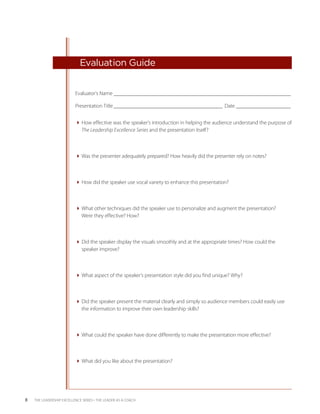
 Evaluation Guide


                           Evaluator’s Name _________________________________________________________________

                           Presentation Title ________________________________________  Date ______ ______________
                                                                                                  _


                           How effective was the speaker’s introduction in helping the audience understand the purpose of
                             The Leadership Excellence Series and the presentation itself?


                           Was the presenter adequately prepared? How heavily did the presenter rely on notes?


                           How did the speaker use vocal variety to enhance this presentation?


                           What other techniques did the speaker use to personalize and augment the presentation?
                             Were they effective? How?


                           Did the speaker display the visuals smoothly and at the appropriate times? How could the
                             speaker improve?


                           What aspect of the speaker’s presentation style did you find unique? Why?


                           Did the speaker present the material clearly and simply so audience members could easily use
                             the information to improve their own leadership skills?


                           What could the speaker have done differently to make the presentation more effective?


                           What did you like about the presentation?


8   THE LEADERSHIP EXCELLENCE SERIES • THE LEADER AS A COACH
www.toastmasters.org

The Leader as a Coach (PDF)

  • 1.
    THE LEADER AS A COACH The Leadership Excellence Series WHERE LEADERS ARE MADE
  • 2.
    THE LEADER AS A COACH The Leadership ­Excellence Series TOASTMASTERS INTERNATIONAL P.O. Box 9052 • Mission Viejo, CA 92690 • USA Phone: 949-858-8255 • Fax: 949-858-1207 www.toastmasters.org/members © 2011 Toastmasters International. All rights reserved. Toastmasters International, the Toastmasters International logo, and all other Toastmasters International trademarks and copyrights are the sole property of Toastmasters International and may be used only with permission. WHERE LEADERS Rev. 5/2011      Item 318A ARE MADE
  • 3.
    THE LEADERSHIP EXCELLENCESERIES Toastmasters International’s The Leadership Excellence Series is a set of presentations addressing the subject of leadership. Members will learn about the skills they will need to be successful leaders inside and outside of Toastmasters. Presentations in The Leadership Excellence Series may be offered by any club member and require 10 to 15 minutes to present. CONDUCTING THE PRESENTATION “The Leader as a Coach” discusses how leaders can help their teams improve performance by apply- ing specific principles and techniques. This product consists of four parts: Definition and explanation of the presentation Guidelines for your introduction to the audience Outline for the development of your speech CD of a PowerPoint presentation to be viewed along with your speech In Your Own Words The outline is not a script and should not be read word-for-word. Instead, use the document as a guide for presenting the material in your own words and with your own narrative style. The outline is a structure on which to build your presentation. Use the points of the outline to develop your speech, but be the author of your own oration. Here are some tips on using this outline to develop and deliver your presentation: Study the outline carefully. Familiarize yourself with the general structure. Preparation is the key to a successful presentation. Use the outline to build your own speech using your own words. Prepare a set of notes indi- cating where you wish to pause, gesture, or add special verbal emphasis. Highlight key words or sentences to help you present the material most effectively. Be expressive when delivering your speech. Use all of the presentation skills you have learned as a Toastmaster including vocal variety and gestures. USING VISUAL AIDS EFFECTIVELY Visual aids add interest to any presentation and help your audience retain information. You are encouraged to use them. If you plan to use the PowerPoint slides for this presentation as visual aids, you will need a data projector, a laptop computer, a table to support them, and a screen for view- ing. In the outline, there are indications for placement of the PowerPoint slides. Each is numbered. For example, V1 refers to the first visual aid. Please note that the first slide in the PowerPoint show is a title slide and is not included in this numbering system. 2   THE LEADERSHIP EXCELLENCE SERIES • THE LEADER AS A COACH
  • 4.
    If you cannotarrange for projection equipment but still would like to use visuals, you may copy the material on the visuals onto a flipchart. Do this before the presentation. Use a heavy marking pen that does not seep through the paper, and write on every third or fourth page so succeeding visuals will not show through. Also, make your letters large and heavy, with plenty of space between them. Follow these tips when using visual aids: Set them up and test them before the meeting begins. Place them so they are easily visible to listeners. Place your projector so it projects a large, high, undistorted image on the screen. Focus the image. Bring spare equipment, including a projector bulb, extension cord, extra marking pens, etc. Display your visuals only when they are needed. If you are using a flipchart, flip the page back out of view when you are finished with it. Remember not to stand between the screen or flipchart and your audience or you will block their view. Maintain eye contact with your listeners. Do not talk to the screen or flipchart. If you must turn your back to point out something, pause as you point it out, and then resume speaking only after you are once again facing your audience. EVALUATION AND THE ADVANCED LEADER BRONZE (ALB) AWARD Because this is an outlined presentation, for presenting it you will not receive credit toward com- pleting a manual speech project, but you may receive credit toward your Advanced Leader Bronze (ALB) award. Ask your vice president education to assign an evaluator for your presentation. Conducting any two presentations from The Successful Club Series and/or The Leadership Excellence Series is one component of qualification for ALB recognition. For further details, please view the Toastmasters International website: www.toastmasters.org/membereducation. THE LEADERSHIP EXCELLENCE SERIES • THE LEADER AS A COACH   3
  • 5.
    THE LEADER ASA COACH Introducing the Presenter TIPS FOR THE PRESENTER: WRITE YOUR INTRODUCTION All prepared speeches in Toastmasters require an introduction. A proper introduction of you and your speech is important to the success of your presentation. Use the following as a guide in writing your introduction: Include the purpose of The Leadership Excellence Series. Explain why “The Leader as a Coach” is important for a Toastmasters club, stating the purpose and one or more objectives of your presentation. Incorporate some background about yourself. Read When You’re the Introducer (Item 1167E) for further details on giving a proper introduction. Give your finished introduction to the person who will be introducing you. TIPS FOR THE INTRODUCER Ask the presenter any clarifying questions. Rehearse the introduction. 4   THE LEADERSHIP EXCELLENCE SERIES • THE LEADER AS A COACH
  • 6.
    THE LEADER ASA COACH Outline INTRODUCTION: The world needs strong, competent leaders now more than ever before. Effective leaders are needed not only in government and industry, but in our communities and civic organizations as well. Even in Toastmasters, the difference between a successful club and an unsuccessful club is the quality of leadership within the club. Leadership abilities are not inherited. Just like communication skills, leadership skills are learned and honed through experience by facing challenges and learning from failures and successes. UNIVERSAL PRINCIPLES V1 As a leader, you are measured, recognized, and rewarded not for what you do, but for the accom- plishments and achievements of the people you lead. If you want to achieve your goals, you must do everything you can to help your team succeed. If you consider present and past great leaders, they are alike in three areas: 1. They provide a clear direction through their mission, vision, values, goals, and plans. 2. They foster collaboration through team building, delegation, coaching, and a service leadership attitude. 3. They motivate team members to achieve by providing feedback, support, and recognition, and by resolving conflict. THE FUNDAMENTALS OF COACHING V2 Coaching is the process of guiding and encouraging team members to achieve superior perfor- mance results. You need to work with team members to help them improve. Your purpose as a coach is to ensure team members do what they are supposed to do, perform better, and reach their full potential. To perform effectively, team members need to know what is expected of them. They need to know: What they are supposed to do Why they are supposed to do it How they are supposed to do it How well they are expected to do it How well they are doing A COACH’S RESPONSIBILITY V3 A coach’s responsibility is to provide team members with the direction and feedback they need. Specifically, a coach: Sets high but achievable expectations Guides team members THE LEADERSHIP EXCELLENCE SERIES • THE LEADER AS A COACH   5
  • 7.
    Offers support Gives advice Provides feedback Encourages team members V4 FIVE STEPS TO EFFECTIVE COACHING Ideally, your team will function effectively and make great progress toward its goals, and team members will know what they are supposed to do and how to do it. In these situations, you should praise and encourage your team members and help them to perform even better. What do you do if one or more team members are not performing to your expectations? In these cases, your role as coach becomes even more important. Your responsibility is to help the member or members perform to your expectations. Coaching is important since it results in better performance. There are five steps to effective coaching: 1. Compare performance with expectations. Note where the team member is not meeting your standards, then try to determine the reason by asking: ■■ Does the team member know what is expected? ■■ Is the problem beyond his or her control? 2. Meet with the team member. If the problem is within the control of the team member, meet with him, explain the problem as you see it, and the effect it has on the team and its goals. 3. Ask for acknowledgement. For coaching to be successful, both parties must agree a prob- lem exists. When the team member acknowledges a problem, determine why he or she is not performing to expectation. You may suspect the cause, but you could be wrong. Listen carefully to the team member’s response. 4. Work toward a solution. Both you and the team member should work together on a solution. You could ask: ■■ What actions can the team member take to resolve the problem? ■■ What actions can you (the coach) take to resolve the problem? 5. Follow up. Monitor the team member’s performance to ensure the problem is resolved. V5 TIPS FOR DISCUSSION In your discussions with team members, show care and concern. You will be more effective and avoid making the team member defensive if you: Talk with them, not down to them. Admit when you have made a mistake. Keep it simple. Elaborate descriptions are not necessary. Listen. Do not interrupt. Keep it short and specific. Address the issues directly. Be sincere. Be timely. Do not wait weeks or months to address the problem. 6   THE LEADERSHIP EXCELLENCE SERIES • THE LEADER AS A COACH
  • 8.
    BENEFITS OF COACHING V6 Again, coaching results in improved performance. There are other benefits, too. High morale. When everyone is working together and achieving goals, team members feel good about their work. Empowerment. People feel confident and willingly accept more responsibility. Development. Team members learn and improve. As they grow, they become more creative and are able to contribute even more. As a leader, you benefit from coaching, too. Team productivity increases, and the team com- pletes tasks to your expectations. As their skills increase, you can delegate more so you have more time for other leadership responsibilities. CONCLUSION V7 You have a duty as a leader to ensure you do everything possible to improve the performance of your team. Few things motivate people more than praise or help from a leader. As a coach, you can always show them how they can help themselves, and how they can help their organization improve its overall performance. THE LEADERSHIP EXCELLENCE SERIES • THE LEADER AS A COACH   7
  • 9.
     Evaluation Guide Evaluator’s Name _________________________________________________________________ Presentation Title ________________________________________  Date ______ ______________ _ How effective was the speaker’s introduction in helping the audience understand the purpose of The Leadership Excellence Series and the presentation itself? Was the presenter adequately prepared? How heavily did the presenter rely on notes? How did the speaker use vocal variety to enhance this presentation? What other techniques did the speaker use to personalize and augment the presentation? Were they effective? How? Did the speaker display the visuals smoothly and at the appropriate times? How could the speaker improve? What aspect of the speaker’s presentation style did you find unique? Why? Did the speaker present the material clearly and simply so audience members could easily use the information to improve their own leadership skills? What could the speaker have done differently to make the presentation more effective? What did you like about the presentation? 8   THE LEADERSHIP EXCELLENCE SERIES • THE LEADER AS A COACH
  • 10.