Talent Management Overview Gregory P. Smith President Chart Your Course International Inc. [email_address] ChartCourse.com HighRetention.com “ Accelerating Individual & Organizational Performance”
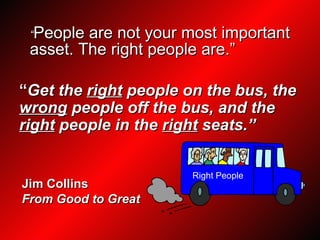
“ People are not your most important asset. The right people are.” “ Get the  right  people on the bus, the  wrong  people off the bus, and the  right  people in the  right  seats.” Jim Collins From Good to Great Right People
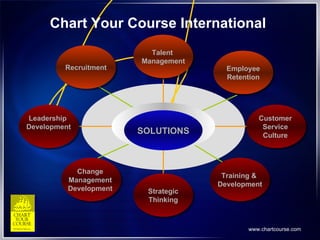
Leadership  Development Customer  Service  Culture   Strategic Thinking Talent  Management SOLUTIONS Change  Management  Development   Training &  Development Recruitment Employee Retention Chart Your Course International
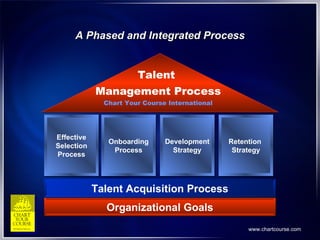
A Phased and Integrated Process Organizational Goals Effective Selection Process Talent  Management Process Chart Your Course International Talent Acquisition Process Onboarding Process Development Strategy Retention  Strategy
What Do the “Right” People Look Like?
Have You Experienced these Situations? Frustrated with people who have the right skills, are great people, but create chronic tension with your team? Place people in positions who just don’t produce results? Hire good people who were performing well, but end up quitting anyway?
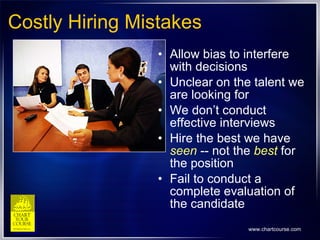
Costly Hiring Mistakes Allow bias to interfere with decisions  Unclear on the talent we are looking for We don’t conduct effective interviews Hire the best we have  seen  -- not the  best  for the position Fail to conduct a complete evaluation of the candidate
 
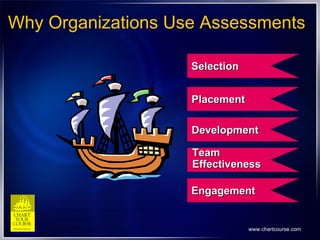
Why Organizations Use Assessments   Selection Placement Development Team Effectiveness Engagement
The Missing Piece Assessments provide you an unemotional evaluation of a candidate’s behavior, attitudes,values and talent – qualities difficult to judge in an interview alone.
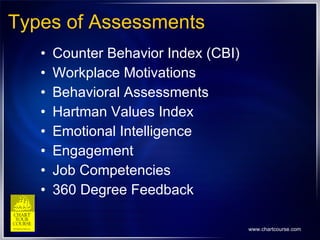
Types of Assessments Counter Behavior Index (CBI) Workplace Motivations Behavioral Assessments Hartman Values Index Emotional Intelligence Engagement Job Competencies 360 Degree Feedback
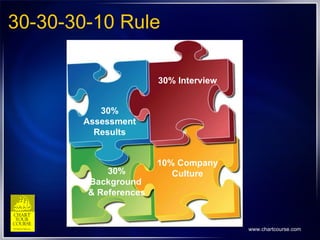
30-30-30-10 Rule 30% Assessment Results 30% Interview 10% Company Culture 30% Background  & References
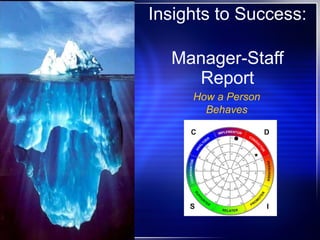
Insights to Success:  Manager-Staff Report How a Person Behaves
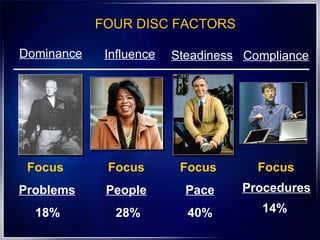
Dominance Focus Problems Focus   People   28% Influence Focus   Pace 40% Steadiness Compliance Focus Procedures   14%   FOUR DISC FACTORS 18%
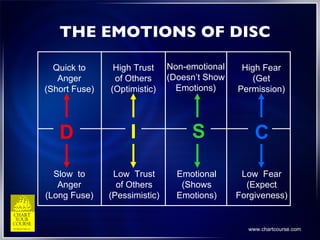
THE EMOTIONS OF DISC Quick to Anger (Short Fuse) High Trust of Others (Optimistic) Non-emotional (Doesn’t Show Emotions) High Fear (Get Permission) Slow  to Anger (Long Fuse) Low  Trust of Others (Pessimistic) Emotional (Shows Emotions) Low  Fear (Expect Forgiveness) D I S C
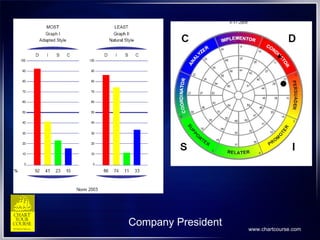
Company President
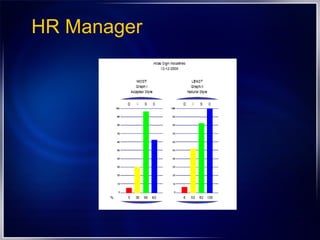
HR Manager
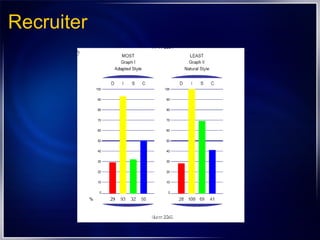
Recruiter Recruiting Manager
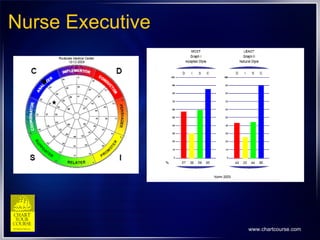
Nurse Executive


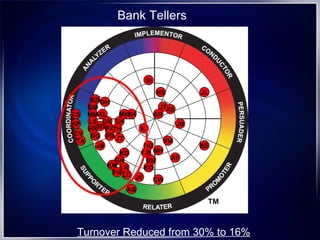
Bank Tellers Turnover Reduced from 30% to 16% KM GH LC TA TH JT PD RE SI JL JB KI NS JT ER DH KB BM SH MM JB AL CW KD PA NG BD HR KP CS PN MM DK LS CV JE AB LR TH CP BN KO DG MH VM AF BE
Case Study:  Technical, Multi-National Manufacturing Plant Conflict Between President & Plant Manager “Analysis Paralysis” We -They Syndrome Poor Communication Low Employee Motivation HR Director Stuck in the Middle
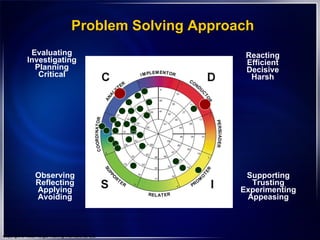
Evaluating Investigating Planning Critical Problem Solving Approach Reacting Efficient Decisive Harsh Supporting Trusting Experimenting Appeasing Observing Reflecting Applying Avoiding Copyright © 1998. Target Training International, Ltd.
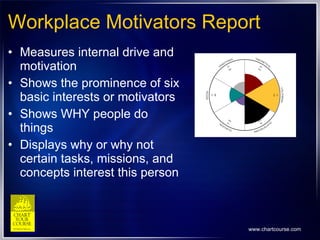
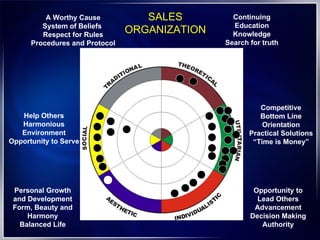
Workplace Motivators Report Measures internal drive and motivation  Shows the prominence of six basic interests or motivators Shows WHY people do things  Displays why or why not certain tasks, missions, and concepts interest this person
A Worthy Cause System of Beliefs  Respect for Rules Procedures and Protocol Help Others Harmonious Environment Opportunity to Serve Personal Growth and Development Form, Beauty and Harmony Balanced Life Opportunity to Lead Others Advancement Decision Making Authority Continuing Education Knowledge Search for truth Competitive Bottom Line Orientation Practical Solutions “ Time is Money” SALES ORGANIZATION
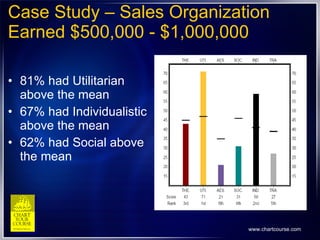
Case Study – Sales Organization Earned $500,000 - $1,000,000 81% had Utilitarian above the mean 67% had Individualistic above the mean 62% had Social above the mean
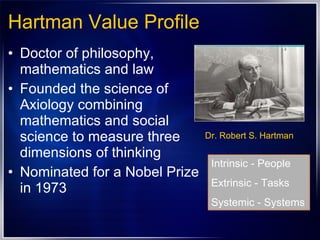
Hartman Value Profile Doctor of philosophy, mathematics and law Founded the science of Axiology combining mathematics and social science to measure three dimensions of thinking Nominated for a Nobel Prize in 1973 Intrinsic - People Extrinsic - Tasks Systemic - Systems Dr. Robert S. Hartman
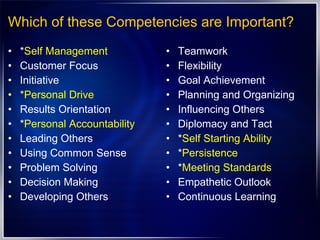
Which of these Competencies are Important? * Self Management Customer Focus Initiative * Personal Drive Results Orientation * Personal Accountability Leading Others Using Common Sense Problem Solving Decision Making Developing Others Teamwork Flexibility Goal Achievement Planning and Organizing Influencing Others Diplomacy and Tact * Self Starting Ability * Persistence * Meeting Standards Empathetic Outlook Continuous Learning
Benchmarking the Job Each position has a different talent profile for success
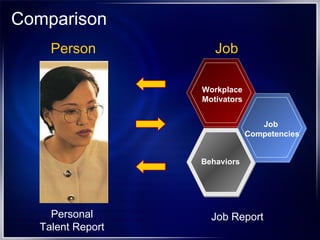
Comparison Person Job Personal Talent Report Job Report Behaviors Workplace Motivators Job  Competencies
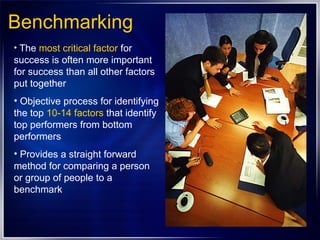
Benchmarking The  most critical factor  for success is often more important for success than all other factors put together Objective process for identifying the top  10-14 factors  that identify top performers from bottom performers  Provides a straight forward method for comparing a person or group of people to a benchmark
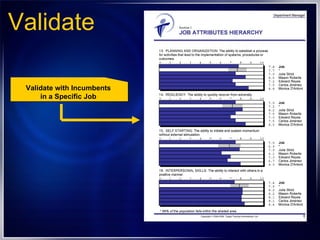
Validate  Validate with Incumbents  in a Specific Job
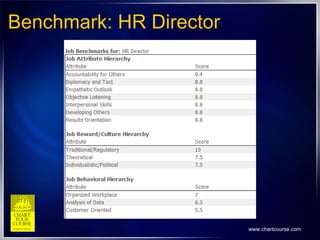
Benchmark: HR Director
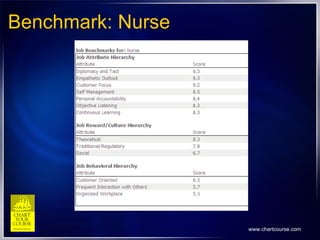
Benchmark: Nurse
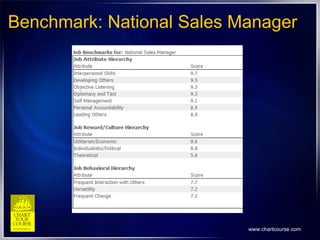
Benchmark: National Sales Manager
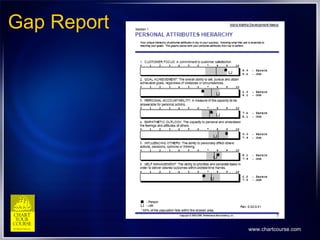
Gap Report
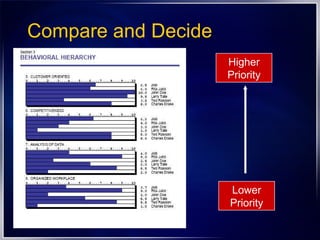
Compare and Decide Lower Priority Higher Priority
Human Resource Executive Magazine "Realizing that the talent crisis isn’t likely to go away anytime soon, smart companies are now taking extraordinary steps to ensure their best employees have reasons to stay and reasons to perform. Gregory P. Smith provides a comprehensive road map for not only attracting and keeping talented employees, but for motivating them to achieve a higher level of performance."  David Shadovitz Editor-in-Chief  Human Resource Executive  Magazine
Blue Ridge Judicial Circuit " Your background and experience has been instrumental in helping me create a more productive office where people enjoy coming to work.  The ideas you have provided us have been instrumental in retaining our staff."   Garry Moss District Attorney Blue Ridge Judicial Circuit
Nicholas & Company “ We needed an easy-to-deploy, consistent and meaningful assessment. I chose Greg Smith's TTI survey because of its amazing accuracy, but more importantly, Greg's strong knowledge on how to understand this tool.  With his piercing insight, and amazing ability to coach on the results, I found we had discovered a gold mine so rich that I have designed a years worth of management training, customized to each manager, based on the information contained in each person's assessment.  If you are the captain of your ship, Greg is the trusted navigator who will get you where you wish to go." Wes Stockman Performance Development Manager
ChartCourse.com BehaviorProfile.com ManagingTopTalent.com Chart Your Course International 770-860-9464 [email_address] Take a Free Behavior Report http://www.chartcourse.com/free_assessment.html

Using Assessments to Hire & Develop Top Talent

  • 1.
    Talent Management OverviewGregory P. Smith President Chart Your Course International Inc. [email_address] ChartCourse.com HighRetention.com “ Accelerating Individual & Organizational Performance”
  • 2.
    “ People arenot your most important asset. The right people are.” “ Get the right people on the bus, the wrong people off the bus, and the right people in the right seats.” Jim Collins From Good to Great Right People
  • 3.
    Leadership DevelopmentCustomer Service Culture Strategic Thinking Talent Management SOLUTIONS Change Management Development Training & Development Recruitment Employee Retention Chart Your Course International
  • 4.
    A Phased andIntegrated Process Organizational Goals Effective Selection Process Talent Management Process Chart Your Course International Talent Acquisition Process Onboarding Process Development Strategy Retention Strategy
  • 5.
    What Do the“Right” People Look Like?
  • 6.
    Have You Experiencedthese Situations? Frustrated with people who have the right skills, are great people, but create chronic tension with your team? Place people in positions who just don’t produce results? Hire good people who were performing well, but end up quitting anyway?
  • 7.
    Costly Hiring MistakesAllow bias to interfere with decisions Unclear on the talent we are looking for We don’t conduct effective interviews Hire the best we have seen -- not the best for the position Fail to conduct a complete evaluation of the candidate
  • 8.
  • 9.
    Why Organizations UseAssessments Selection Placement Development Team Effectiveness Engagement
  • 10.
    The Missing PieceAssessments provide you an unemotional evaluation of a candidate’s behavior, attitudes,values and talent – qualities difficult to judge in an interview alone.
  • 11.
    Types of AssessmentsCounter Behavior Index (CBI) Workplace Motivations Behavioral Assessments Hartman Values Index Emotional Intelligence Engagement Job Competencies 360 Degree Feedback
  • 12.
    30-30-30-10 Rule 30%Assessment Results 30% Interview 10% Company Culture 30% Background & References
  • 13.
    Insights to Success: Manager-Staff Report How a Person Behaves
  • 14.
    Dominance Focus ProblemsFocus People 28% Influence Focus Pace 40% Steadiness Compliance Focus Procedures 14% FOUR DISC FACTORS 18%
  • 15.
    THE EMOTIONS OFDISC Quick to Anger (Short Fuse) High Trust of Others (Optimistic) Non-emotional (Doesn’t Show Emotions) High Fear (Get Permission) Slow to Anger (Long Fuse) Low Trust of Others (Pessimistic) Emotional (Shows Emotions) Low Fear (Expect Forgiveness) D I S C
  • 16.
  • 17.
  • 18.
  • 19.
  • 20.
  • 21.
  • 22.
  • 23.
    Bank Tellers TurnoverReduced from 30% to 16% KM GH LC TA TH JT PD RE SI JL JB KI NS JT ER DH KB BM SH MM JB AL CW KD PA NG BD HR KP CS PN MM DK LS CV JE AB LR TH CP BN KO DG MH VM AF BE
  • 24.
    Case Study: Technical, Multi-National Manufacturing Plant Conflict Between President & Plant Manager “Analysis Paralysis” We -They Syndrome Poor Communication Low Employee Motivation HR Director Stuck in the Middle
  • 25.
    Evaluating Investigating PlanningCritical Problem Solving Approach Reacting Efficient Decisive Harsh Supporting Trusting Experimenting Appeasing Observing Reflecting Applying Avoiding Copyright © 1998. Target Training International, Ltd.
  • 26.
    Workplace Motivators ReportMeasures internal drive and motivation Shows the prominence of six basic interests or motivators Shows WHY people do things Displays why or why not certain tasks, missions, and concepts interest this person
  • 27.
    A Worthy CauseSystem of Beliefs Respect for Rules Procedures and Protocol Help Others Harmonious Environment Opportunity to Serve Personal Growth and Development Form, Beauty and Harmony Balanced Life Opportunity to Lead Others Advancement Decision Making Authority Continuing Education Knowledge Search for truth Competitive Bottom Line Orientation Practical Solutions “ Time is Money” SALES ORGANIZATION
  • 28.
    Case Study –Sales Organization Earned $500,000 - $1,000,000 81% had Utilitarian above the mean 67% had Individualistic above the mean 62% had Social above the mean
  • 29.
    Hartman Value ProfileDoctor of philosophy, mathematics and law Founded the science of Axiology combining mathematics and social science to measure three dimensions of thinking Nominated for a Nobel Prize in 1973 Intrinsic - People Extrinsic - Tasks Systemic - Systems Dr. Robert S. Hartman
  • 30.
    Which of theseCompetencies are Important? * Self Management Customer Focus Initiative * Personal Drive Results Orientation * Personal Accountability Leading Others Using Common Sense Problem Solving Decision Making Developing Others Teamwork Flexibility Goal Achievement Planning and Organizing Influencing Others Diplomacy and Tact * Self Starting Ability * Persistence * Meeting Standards Empathetic Outlook Continuous Learning
  • 31.
    Benchmarking the JobEach position has a different talent profile for success
  • 32.
    Comparison Person JobPersonal Talent Report Job Report Behaviors Workplace Motivators Job Competencies
  • 33.
    Benchmarking The most critical factor for success is often more important for success than all other factors put together Objective process for identifying the top 10-14 factors that identify top performers from bottom performers Provides a straight forward method for comparing a person or group of people to a benchmark
  • 34.
    Validate Validatewith Incumbents in a Specific Job
  • 35.
  • 36.
  • 37.
  • 38.
  • 39.
    Compare and DecideLower Priority Higher Priority
  • 40.
    Human Resource ExecutiveMagazine "Realizing that the talent crisis isn’t likely to go away anytime soon, smart companies are now taking extraordinary steps to ensure their best employees have reasons to stay and reasons to perform. Gregory P. Smith provides a comprehensive road map for not only attracting and keeping talented employees, but for motivating them to achieve a higher level of performance." David Shadovitz Editor-in-Chief Human Resource Executive Magazine
  • 41.
    Blue Ridge JudicialCircuit " Your background and experience has been instrumental in helping me create a more productive office where people enjoy coming to work.  The ideas you have provided us have been instrumental in retaining our staff."   Garry Moss District Attorney Blue Ridge Judicial Circuit
  • 42.
    Nicholas & Company“ We needed an easy-to-deploy, consistent and meaningful assessment. I chose Greg Smith's TTI survey because of its amazing accuracy, but more importantly, Greg's strong knowledge on how to understand this tool. With his piercing insight, and amazing ability to coach on the results, I found we had discovered a gold mine so rich that I have designed a years worth of management training, customized to each manager, based on the information contained in each person's assessment. If you are the captain of your ship, Greg is the trusted navigator who will get you where you wish to go." Wes Stockman Performance Development Manager
  • 43.
    ChartCourse.com BehaviorProfile.com ManagingTopTalent.comChart Your Course International 770-860-9464 [email_address] Take a Free Behavior Report http://www.chartcourse.com/free_assessment.html

Editor's Notes

  • #32 _______________________________________________________________________________________________________________________________________________________________________________________________________________________________________________________________________________________________________________________________________________________________________________________________________________________________________________________________________________________________________________________________________________________________________________________________________________________________________________________________________________________________________________________________________________________________________________________________________________________________________________________________________________________________________________________________________________________________________________________________________________________________________________________________________________________________________________________________________________________________________________________________________________________________________________________________________________________________________________________________________________________________________________________________________________________________________________________________________________________________________________________________________________________