Edited By
JQuek
 The Technology concept and rationale.
 The advantages and disadvantages of
information technology.
 B2B e-Commerce and supply chain information
systems
 Decision support system.
 Risk on decision making.
1. Why use Technology?
a) gain supply chain visibility,
b) improve operating efficiency,
c) use data to strategically manage business
1. Transportation Management Systems (TMS)
2. Warehouse Management Systems (WMS)
3. Global Visibility Tools
4. Labor Management
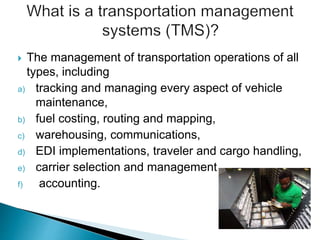
 The management of transportation operations of all
types, including
a) tracking and managing every aspect of vehicle
maintenance,
b) fuel costing, routing and mapping,
c) warehousing, communications,
d) EDI implementations, traveler and cargo handling,
e) carrier selection and management
f) accounting.
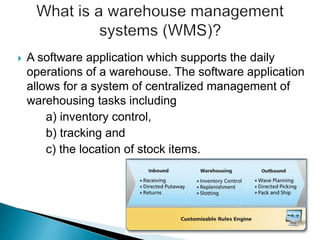
 A software application which supports the daily
operations of a warehouse. The software application
allows for a system of centralized management of
warehousing tasks including
a) inventory control,
b) tracking and
c) the location of stock items.
 Visibility means more than just awareness of where
materials are at a given point in time or the amount
of goods in a warehouse. Instead, visibility means a
window into a wider range of data, supply chain
processes, events, and patterns that enable
automation, dynamic responses, and predictability.
 Global Visibility Tools are software that will enable a
supply chain to be more VISIBLE to the world
 A Labor supply chain comprises all of the manual
functions required to receive, build and deliver
products from supplier to customer, and to provide
customer support.
 To manage this labor supply chain, one must be able
to monitor & control
a) Time and attendance
b) Performance Management
c) Incentives and rewards
d) Scorecards and Analytics
 Information sharing
 Auto updates/ auto renewal/ auto request/ auto
supply
 the ability for companies to collaborate
Collaborations are designed for the mutual
benefit of all parties
 Better use of existing resources and paves the
way for a larger profit margin
 Resistance from vendors:
1. high cost for initial set up
2. lack of trust
How to overcome:
◦ 1. able to see the profit potential on their end
of the arrangement
◦ 2. Create/ develop strong relationship
 Resistance from employees:
1. costs them their jobs
2. feel that their work is more tedious or more
complicated
3. software mistakes: tend to make them in
losing faith in the system
 How to Overcome:
1. train them to trust the system & the company
2. train them to adopt the system & able to
cope with technology.
 Supply chain performance is a key factor in a
company's competitiveness
 leading organizations are meeting the
performance challenge through adopting
Internet tools, build-to-order / mass
customization programs, vendor managed
inventory and other productivity initiatives.
 Understanding the very latest systems, practices
and world-class performance
 on-time delivery,
 cycle time reduction,
 cost control,
 inventory carrying costs,
 fill rates: % of customer or consumption
orders satisfied from stock at hand.
measure of an inventory's ability to meet
demand.
 return rates: % of returned products
 lead time: The amount of time that elapses
between when a process starts and when it is
completed
 cash-to-cash conversion,
 days sales outstanding,
 days payables outstanding,
 Internet tools,
 the exchange of products, services, or
information between businesses rather than
between businesses and consumers, through:
a. Company Web sites
b. Product supply and procurement
exchanges (e-procurement site)
c. Specialized industry portals
d. Brokering sites
e. Information sites
 Some decisions are better made by people:
(flexibility, intuition, wisdom)
 Some decisions are better made by computers
 DSS allow computers and people to work
together to make better decisions, range from
spreadsheets to expert systems.
 computer-based information system that supports
business or organizational decision-making
activities.
 Demand planning
 Supply planning: distribution resource planning
system (DRP)
 Manufacturing planning and scheduling
 Monetary cost
 Overemphasize decision making
 Transfer of power
 Obscuring responsibility
 Status reduction
 Information overload

NMIT-SUPPLY-CHAIN-MANAGEMENT-Lesson2

  • 1.
  • 2.
     The Technologyconcept and rationale.  The advantages and disadvantages of information technology.  B2B e-Commerce and supply chain information systems  Decision support system.  Risk on decision making.
  • 3.
    1. Why useTechnology? a) gain supply chain visibility, b) improve operating efficiency, c) use data to strategically manage business
  • 4.
    1. Transportation ManagementSystems (TMS) 2. Warehouse Management Systems (WMS) 3. Global Visibility Tools 4. Labor Management
  • 5.
     The managementof transportation operations of all types, including a) tracking and managing every aspect of vehicle maintenance, b) fuel costing, routing and mapping, c) warehousing, communications, d) EDI implementations, traveler and cargo handling, e) carrier selection and management f) accounting.
  • 6.
     A softwareapplication which supports the daily operations of a warehouse. The software application allows for a system of centralized management of warehousing tasks including a) inventory control, b) tracking and c) the location of stock items.
  • 7.
     Visibility meansmore than just awareness of where materials are at a given point in time or the amount of goods in a warehouse. Instead, visibility means a window into a wider range of data, supply chain processes, events, and patterns that enable automation, dynamic responses, and predictability.  Global Visibility Tools are software that will enable a supply chain to be more VISIBLE to the world
  • 8.
     A Laborsupply chain comprises all of the manual functions required to receive, build and deliver products from supplier to customer, and to provide customer support.  To manage this labor supply chain, one must be able to monitor & control a) Time and attendance b) Performance Management c) Incentives and rewards d) Scorecards and Analytics
  • 9.
     Information sharing Auto updates/ auto renewal/ auto request/ auto supply  the ability for companies to collaborate Collaborations are designed for the mutual benefit of all parties  Better use of existing resources and paves the way for a larger profit margin
  • 10.
     Resistance fromvendors: 1. high cost for initial set up 2. lack of trust How to overcome: ◦ 1. able to see the profit potential on their end of the arrangement ◦ 2. Create/ develop strong relationship
  • 11.
     Resistance fromemployees: 1. costs them their jobs 2. feel that their work is more tedious or more complicated 3. software mistakes: tend to make them in losing faith in the system  How to Overcome: 1. train them to trust the system & the company 2. train them to adopt the system & able to cope with technology.
  • 12.
     Supply chainperformance is a key factor in a company's competitiveness  leading organizations are meeting the performance challenge through adopting Internet tools, build-to-order / mass customization programs, vendor managed inventory and other productivity initiatives.  Understanding the very latest systems, practices and world-class performance
  • 13.
     on-time delivery, cycle time reduction,  cost control,  inventory carrying costs,  fill rates: % of customer or consumption orders satisfied from stock at hand. measure of an inventory's ability to meet demand.  return rates: % of returned products
  • 14.
     lead time:The amount of time that elapses between when a process starts and when it is completed  cash-to-cash conversion,  days sales outstanding,  days payables outstanding,  Internet tools,
  • 15.
     the exchangeof products, services, or information between businesses rather than between businesses and consumers, through: a. Company Web sites b. Product supply and procurement exchanges (e-procurement site) c. Specialized industry portals d. Brokering sites e. Information sites
  • 16.
     Some decisionsare better made by people: (flexibility, intuition, wisdom)  Some decisions are better made by computers  DSS allow computers and people to work together to make better decisions, range from spreadsheets to expert systems.  computer-based information system that supports business or organizational decision-making activities.
  • 17.
     Demand planning Supply planning: distribution resource planning system (DRP)  Manufacturing planning and scheduling
  • 18.
     Monetary cost Overemphasize decision making  Transfer of power  Obscuring responsibility  Status reduction  Information overload