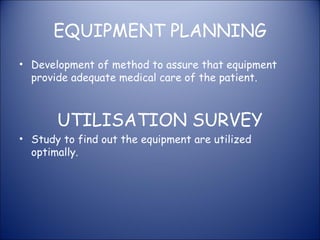
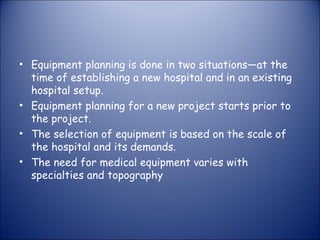
EQUIPPING THE
HOSPITAL
EQUIPMENT PLANNING
• Development of method to assure that equipment
provide adequate medical care of the patient.

UTILISATION SURVEY

• Study to find out the equipment are utilized
optimally.
• Equipment planning is done in two situations—at the
time of establishing a new hospital and in an existing
hospital setup.
• Equipment planning for a new project starts prior to
the project.
• The selection of equipment is based on the scale of
the hospital and its demands.
• The need for medical equipment varies with
specialties and topography
WHOSE RESPONSIBILITY
• It is the responsibility of Hospital
Administrator to determine all the items of
equipments necessary, & then write their
specification, recommended bids (tender) &
purchase according to hospitals policy.
• It is adequate in quantity and of a quality that
assures durability and performance
• The Architect is responsible for the Built in
equipments.
MEDICAL EQUIPMENT PLANNER ROLE
DURING THE DESIGN STAGE:
• To determine quantities, sizes of essential and
complementary equipment.
• To determine electromechanical requirements for
medical equipment.
• To provide technical specification of equipment.
DURING CONSTRUCTION STAGE:
• Review of shop drawing and on-site coordination
requirement.
• Site survey and inspection
• Coordinate delivery schedule with contractors.
• Physical inspection, testing, installation supervision
• Coordinate training of end users by suppliers.
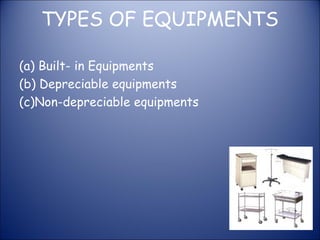
TYPES OF EQUIPMENTS
(a) Built- in Equipments
(b) Depreciable equipments
(c)Non-depreciable equipments
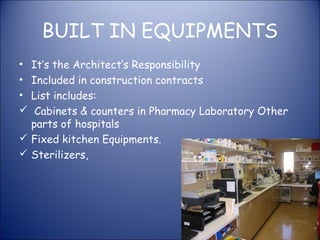
BUILT IN EQUIPMENTS
• It’s the Architect’s Responsibility
• Included in construction contracts
• List includes:
 Cabinets & counters in Pharmacy Laboratory Other
parts of hospitals
 Fixed kitchen Equipments.
 Sterilizers,
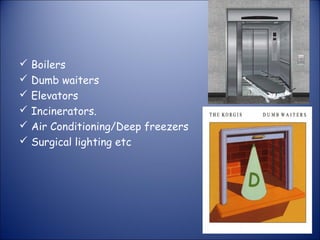
 Boilers
 Dumb waiters
 Elevators
 Incinerators.
 Air Conditioning/Deep freezers
 Surgical lighting etc
DEPRECIABLE EQUIPMENTS
• The Equipments that have a life of 5yrs or more are
k/a DEPRECIABLE equipments
• These large items of furniture and Equipments have a
reasonable fixed location in the hospital building but
are capable of being moved.
EXAMPLES OF DEPRECIABLE
EQUIPMENTS
•
•
•
•
•
•
•
•
•

Surgical Apparatuses
Diagnostic & Therapeutic Equipment
Lab & pharmacy Equipment
Office Equipment : Typewriter, Intercoms ; Computers/Electronic
exchanges
Refrigerator
Physiotherapy equipments
Suction machines
Diagnostic and Therapeutic Equipments . Like X-Ray machine , Cutlery,
ECG machine
Incubators
NON-DEPRECIABLE EQUIPMENTS

• These Equipments have life span less
than 5 yrs
• low cost equipments.
• Examples are
 Kitchen utensils
 Surgical instruments
 Catheters
Linen, sheets, Blankets
 Lamps, dust bins etc.
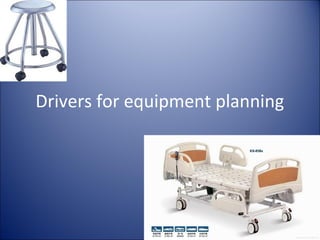
Drivers for equipment planning
The Need
• Be it a new project or an existing one, need
drives the purchase of medical equipment.
• The need is known from the medical
practitioners, the end users of the equipment.
Depending on the patient flow, the demand
for the equipment increases, which in turn
creates a necessity for the equipment.
The Technology
• The second main driver in the purchase of equipment
is the technology. In recent years, the healthcare
industry is witnessing rapid growth, especially in
research and development.
• Newer equipment is regularly introduced in the
market with additional features and better
technology.
• "Sometimes, the same equipment can be upgraded to
the new technology by adding additional software,
The Service
• The next important aspect is the service rendered by
manufacturers and vendors, both within the warranty
period and afterwards.
• If the hospital is in a town or rural area, the

proximity to the service centre should be considered.
The Price
• The equipment with best price is ultimately
bought. "Best price doesn't mean the
lowest price
• We analyze the price based on various
factors like software and hardware
package, technical specifications, after
sales support, warranty and so on
• cost alone cannot be seen as critical for
purchase. The quality of the product
should meet our standards,
Training
• To keep oneself abreast of the latest
technology is very important.
• To have excellent equipment but no
skilled manpower to utilize it is as good
as not procuring at all. "When it comes
to training, we expect the vendor or
manufacturer to assist technicians
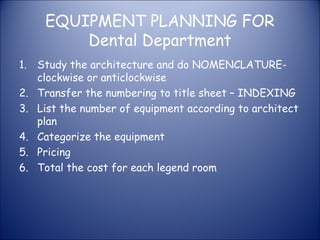
EQUIPMENT PLANNING FOR
Dental Department
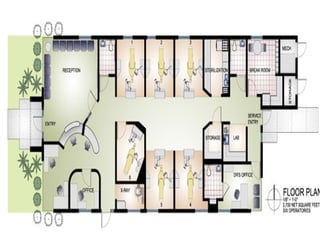
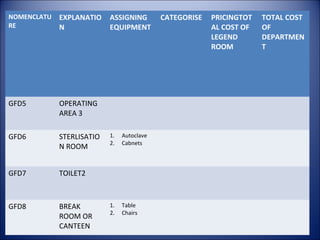
1. Study the architecture and do NOMENCLATUREclockwise or anticlockwise
2. Transfer the numbering to title sheet – INDEXING
3. List the number of equipment according to architect
plan
4. Categorize the equipment
5. Pricing
6. Total the cost for each legend room
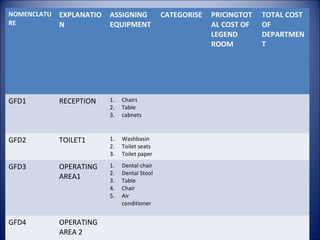
NOMENCLATU
RE

EXPLANATIO
N

ASSIGNING
EQUIPMENT

GFD1

RECEPTION

1.
2.
3.

Chairs
Table
cabnets

GFD2

TOILET1

1.
2.
3.

Washbasin
Toilet seats
Toilet paper

GFD3

OPERATING
AREA1

1.
2.
3.
4.
5.

Dental chair
Dental Stool
Table
Chair
Air
conditioner

GFD4

OPERATING
AREA 2

CATEGORISE

PRICINGTOT
AL COST OF
LEGEND
ROOM

TOTAL COST
OF
DEPARTMEN
T
NOMENCLATU
RE

EXPLANATIO
N

GFD5

OPERATING
AREA 3

GFD6

STERLISATIO
N ROOM

GFD7

TOILET2

GFD8

BREAK
ROOM OR
CANTEEN

ASSIGNING
EQUIPMENT

1.
2.

Autoclave
Cabnets

1.
2.

Table
Chairs

CATEGORISE

PRICINGTOT
AL COST OF
LEGEND
ROOM

TOTAL COST
OF
DEPARTMEN
T
NOMENCLATU
RE

EXPLANATIO
N

ASSIGNING
EQUIPMENT

GFD9

MECHANICAL
ROOM

1.
2.

Lathe
Almira

GFD10

STORAGE
ROOM 1

1.

Cabnets

GFD11

LAB

1.

Hot water
gyser
Autoclave

2.

GFD12

STORAGE
ROOM

CATEGORISE

PRICINGTOT
AL COST OF
LEGEND
ROOM

TOTAL COST
OF
DEPARTMEN
T
NOMENCLATU
RE

EXPLANATIO
N

ASSIGNING
EQUIPMENT

GFD13

DR ROOM

1.
2.
3.
4.

GFD14

TOILET 3

GFD15

OPERATING
AREA 4

GFD16

OPERATING
AREA 5

Table
Chair
Cabnets
cupboards

CATEGORISE

PRICINGTOT
AL COST OF
LEGEND
ROOM

TOTAL COST
OF
DEPARTMEN
T
NOMENCLATU
RE

EXPLANATIO
N

ASSIGNING
EQUIPMENT

GFD17

XRAY ROOM

1.
2.

X-ray machine
OPG

GFD18

OPERATING
AREA 6

GFD19

OFFICE

1.
2.
3.

Cupboards
Table
Chair

CATEGORISE

PRICINGTOT
AL COST OF
LEGEND
ROOM

TOTAL COST
OF
DEPARTMEN
T
Guidelines Required
• USFDA is one governing body that prescribes

guidelines on equipment manufacturing. These
guidelines are widely accepted in most countries
including India.
• Other widely accepted certifications are ISO
(International Organization for Standards), IEC
(International Electro technical Committee) and
CE certification from European Union. "These
certifications are for the quality of the
equipment.
• Presented by:
Arshpreet Kaur

Equipping hospital

  • 1.
  • 2.
    EQUIPMENT PLANNING • Developmentof method to assure that equipment provide adequate medical care of the patient. UTILISATION SURVEY • Study to find out the equipment are utilized optimally.
  • 3.
    • Equipment planningis done in two situations—at the time of establishing a new hospital and in an existing hospital setup. • Equipment planning for a new project starts prior to the project. • The selection of equipment is based on the scale of the hospital and its demands. • The need for medical equipment varies with specialties and topography
  • 4.
    WHOSE RESPONSIBILITY • Itis the responsibility of Hospital Administrator to determine all the items of equipments necessary, & then write their specification, recommended bids (tender) & purchase according to hospitals policy. • It is adequate in quantity and of a quality that assures durability and performance • The Architect is responsible for the Built in equipments.
  • 5.
    MEDICAL EQUIPMENT PLANNERROLE DURING THE DESIGN STAGE: • To determine quantities, sizes of essential and complementary equipment. • To determine electromechanical requirements for medical equipment. • To provide technical specification of equipment.
  • 6.
    DURING CONSTRUCTION STAGE: •Review of shop drawing and on-site coordination requirement. • Site survey and inspection • Coordinate delivery schedule with contractors. • Physical inspection, testing, installation supervision • Coordinate training of end users by suppliers.
  • 7.
    TYPES OF EQUIPMENTS (a)Built- in Equipments (b) Depreciable equipments (c)Non-depreciable equipments
  • 8.
    BUILT IN EQUIPMENTS •It’s the Architect’s Responsibility • Included in construction contracts • List includes:  Cabinets & counters in Pharmacy Laboratory Other parts of hospitals  Fixed kitchen Equipments.  Sterilizers,
  • 9.
     Boilers  Dumbwaiters  Elevators  Incinerators.  Air Conditioning/Deep freezers  Surgical lighting etc
  • 10.
    DEPRECIABLE EQUIPMENTS • TheEquipments that have a life of 5yrs or more are k/a DEPRECIABLE equipments • These large items of furniture and Equipments have a reasonable fixed location in the hospital building but are capable of being moved.
  • 11.
    EXAMPLES OF DEPRECIABLE EQUIPMENTS • • • • • • • • • SurgicalApparatuses Diagnostic & Therapeutic Equipment Lab & pharmacy Equipment Office Equipment : Typewriter, Intercoms ; Computers/Electronic exchanges Refrigerator Physiotherapy equipments Suction machines Diagnostic and Therapeutic Equipments . Like X-Ray machine , Cutlery, ECG machine Incubators
  • 12.
    NON-DEPRECIABLE EQUIPMENTS • TheseEquipments have life span less than 5 yrs • low cost equipments. • Examples are  Kitchen utensils  Surgical instruments  Catheters Linen, sheets, Blankets  Lamps, dust bins etc.
  • 13.
  • 14.
    The Need • Beit a new project or an existing one, need drives the purchase of medical equipment. • The need is known from the medical practitioners, the end users of the equipment. Depending on the patient flow, the demand for the equipment increases, which in turn creates a necessity for the equipment.
  • 15.
    The Technology • Thesecond main driver in the purchase of equipment is the technology. In recent years, the healthcare industry is witnessing rapid growth, especially in research and development. • Newer equipment is regularly introduced in the market with additional features and better technology. • "Sometimes, the same equipment can be upgraded to the new technology by adding additional software,
  • 16.
    The Service • Thenext important aspect is the service rendered by manufacturers and vendors, both within the warranty period and afterwards. • If the hospital is in a town or rural area, the proximity to the service centre should be considered.
  • 17.
    The Price • Theequipment with best price is ultimately bought. "Best price doesn't mean the lowest price • We analyze the price based on various factors like software and hardware package, technical specifications, after sales support, warranty and so on • cost alone cannot be seen as critical for purchase. The quality of the product should meet our standards,
  • 18.
    Training • To keeponeself abreast of the latest technology is very important. • To have excellent equipment but no skilled manpower to utilize it is as good as not procuring at all. "When it comes to training, we expect the vendor or manufacturer to assist technicians
  • 19.
    EQUIPMENT PLANNING FOR DentalDepartment 1. Study the architecture and do NOMENCLATUREclockwise or anticlockwise 2. Transfer the numbering to title sheet – INDEXING 3. List the number of equipment according to architect plan 4. Categorize the equipment 5. Pricing 6. Total the cost for each legend room
  • 21.
    NOMENCLATU RE EXPLANATIO N ASSIGNING EQUIPMENT GFD1 RECEPTION 1. 2. 3. Chairs Table cabnets GFD2 TOILET1 1. 2. 3. Washbasin Toilet seats Toilet paper GFD3 OPERATING AREA1 1. 2. 3. 4. 5. Dentalchair Dental Stool Table Chair Air conditioner GFD4 OPERATING AREA 2 CATEGORISE PRICINGTOT AL COST OF LEGEND ROOM TOTAL COST OF DEPARTMEN T
  • 22.
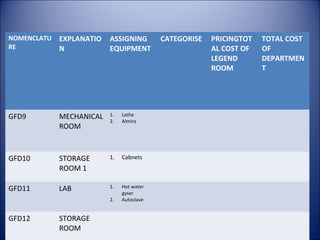
    NOMENCLATU RE EXPLANATIO N GFD5 OPERATING AREA 3 GFD6 STERLISATIO N ROOM GFD7 TOILET2 GFD8 BREAK ROOMOR CANTEEN ASSIGNING EQUIPMENT 1. 2. Autoclave Cabnets 1. 2. Table Chairs CATEGORISE PRICINGTOT AL COST OF LEGEND ROOM TOTAL COST OF DEPARTMEN T
  • 23.
  • 24.
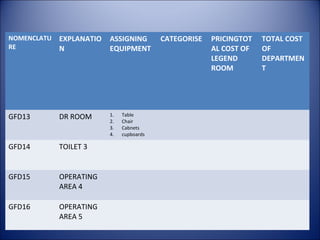
    NOMENCLATU RE EXPLANATIO N ASSIGNING EQUIPMENT GFD13 DR ROOM 1. 2. 3. 4. GFD14 TOILET 3 GFD15 OPERATING AREA4 GFD16 OPERATING AREA 5 Table Chair Cabnets cupboards CATEGORISE PRICINGTOT AL COST OF LEGEND ROOM TOTAL COST OF DEPARTMEN T
  • 25.
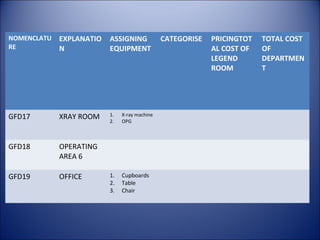
    NOMENCLATU RE EXPLANATIO N ASSIGNING EQUIPMENT GFD17 XRAY ROOM 1. 2. X-ray machine OPG GFD18 OPERATING AREA6 GFD19 OFFICE 1. 2. 3. Cupboards Table Chair CATEGORISE PRICINGTOT AL COST OF LEGEND ROOM TOTAL COST OF DEPARTMEN T
  • 26.
    Guidelines Required • USFDAis one governing body that prescribes guidelines on equipment manufacturing. These guidelines are widely accepted in most countries including India. • Other widely accepted certifications are ISO (International Organization for Standards), IEC (International Electro technical Committee) and CE certification from European Union. "These certifications are for the quality of the equipment.
  • 27.