Overview of
Supply Chain
Management
1
Arpit Doshi
Outline
 What is a Supply Chain?
 The Importance of Supply Chain
Flows
 Process View of a Supply Chain
 Examples of Supply Chains
2
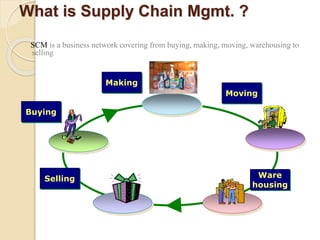
What is Supply Chain Mgmt. ?
SCM is a business network covering from buying, making, moving, warehousing to
selling
Buying
Selling
Making
Moving
Ware
housing
What is a Supply Chain?
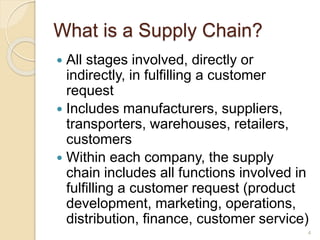
 All stages involved, directly or
indirectly, in fulfilling a customer
request
 Includes manufacturers, suppliers,
transporters, warehouses, retailers,
customers
 Within each company, the supply
chain includes all functions involved in
fulfilling a customer request (product
development, marketing, operations,
distribution, finance, customer service)
4
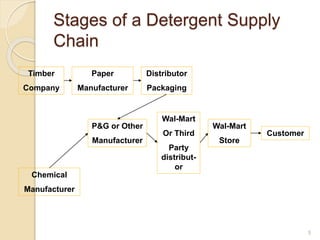
Stages of a Detergent Supply
Chain
5
Timber
Company
Paper
Manufacturer
Distributor
Packaging
Chemical
Manufacturer
P&G or Other
Manufacturer
Wal-Mart
Or Third
Party
distribut-
or
Wal-Mart
Store
Customer
What is a Supply Chain?
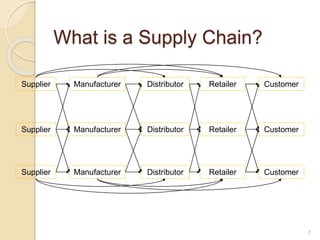
 Customer is an integral part of the supply chain
 Includes movement of products from suppliers to
manufacturers to distributors, but also includes
movement of information, funds, and products in
both directions
 Probably more accurate to use the term “supply
network” or “supply web”
 Typical supply chain stages: customers, retailers,
distributors, manufacturers, suppliers
 All stages may not be present in all supply chains
(e.g., no retailer or distributor for Dell)
6
What is a Supply Chain?
7
Supplier Manufacturer Distributor Retailer Customer
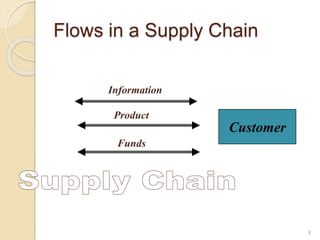
Flows in a Supply Chain
8
Customer
Information
Product
Funds
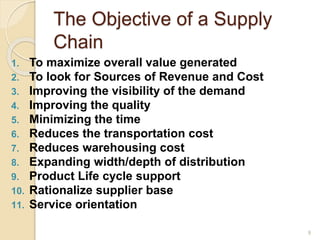
The Objective of a Supply
Chain
1. To maximize overall value generated
2. To look for Sources of Revenue and Cost
3. Improving the visibility of the demand
4. Improving the quality
5. Minimizing the time
6. Reduces the transportation cost
7. Reduces warehousing cost
8. Expanding width/depth of distribution
9. Product Life cycle support
10. Rationalize supplier base
11. Service orientation
9
The Objective of a Supply
Chain
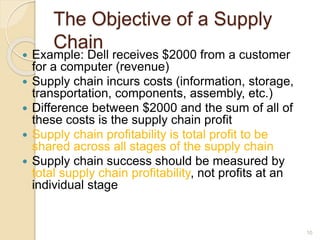
 Example: Dell receives $2000 from a customer
for a computer (revenue)
 Supply chain incurs costs (information, storage,
transportation, components, assembly, etc.)
 Difference between $2000 and the sum of all of
these costs is the supply chain profit
 Supply chain profitability is total profit to be
shared across all stages of the supply chain
 Supply chain success should be measured by
total supply chain profitability, not profits at an
individual stage
10
Process View of a Supply
Chain
 Cycle view: processes in a supply
chain are divided into a series of
cycles, each performed at the
interfaces between two successive
supply chain stages
 Push/pull view: processes in a supply
chain are divided into two categories
depending on whether they are
executed in response to a customer
order (pull) or in anticipation of a
customer order (push) 11
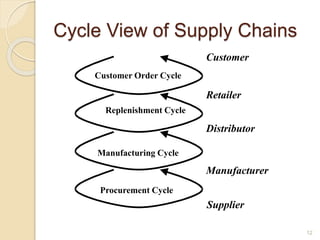
Cycle View of Supply Chains
12
Customer Order Cycle
Replenishment Cycle
Manufacturing Cycle
Procurement Cycle
Customer
Retailer
Distributor
Manufacturer
Supplier
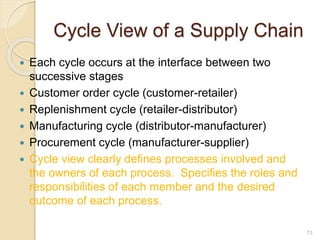
Cycle View of a Supply Chain
 Each cycle occurs at the interface between two
successive stages
 Customer order cycle (customer-retailer)
 Replenishment cycle (retailer-distributor)
 Manufacturing cycle (distributor-manufacturer)
 Procurement cycle (manufacturer-supplier)
 Cycle view clearly defines processes involved and
the owners of each process. Specifies the roles and
responsibilities of each member and the desired
outcome of each process.
13
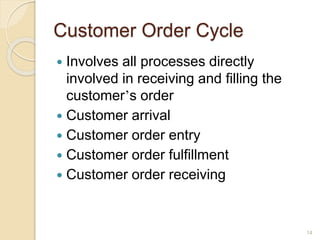
Customer Order Cycle
 Involves all processes directly
involved in receiving and filling the
customer’s order
 Customer arrival
 Customer order entry
 Customer order fulfillment
 Customer order receiving
14
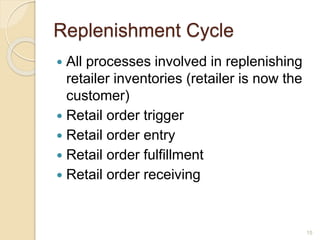
Replenishment Cycle
 All processes involved in replenishing
retailer inventories (retailer is now the
customer)
 Retail order trigger
 Retail order entry
 Retail order fulfillment
 Retail order receiving
15
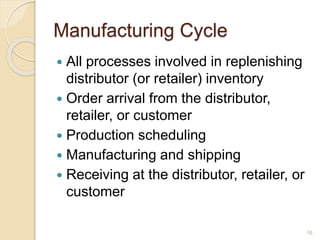
Manufacturing Cycle
 All processes involved in replenishing
distributor (or retailer) inventory
 Order arrival from the distributor,
retailer, or customer
 Production scheduling
 Manufacturing and shipping
 Receiving at the distributor, retailer, or
customer
16
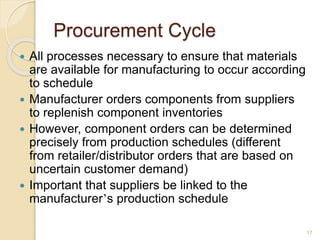
Procurement Cycle
 All processes necessary to ensure that materials
are available for manufacturing to occur according
to schedule
 Manufacturer orders components from suppliers
to replenish component inventories
 However, component orders can be determined
precisely from production schedules (different
from retailer/distributor orders that are based on
uncertain customer demand)
 Important that suppliers be linked to the
manufacturer’s production schedule
17
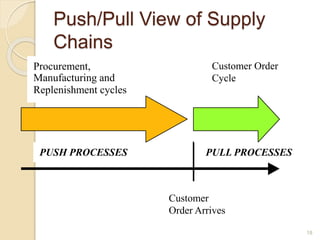
Push/Pull View of Supply
Chains
18
Procurement,
Manufacturing and
Replenishment cycles
Customer Order
Cycle
Customer
Order Arrives
PUSH PROCESSES PULL PROCESSES
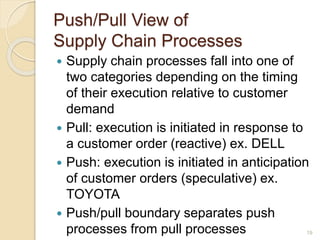
Push/Pull View of
Supply Chain Processes
 Supply chain processes fall into one of
two categories depending on the timing
of their execution relative to customer
demand
 Pull: execution is initiated in response to
a customer order (reactive) ex. DELL
 Push: execution is initiated in anticipation
of customer orders (speculative) ex.
TOYOTA
 Push/pull boundary separates push
processes from pull processes 19
Supply Chain in a Firm
 All supply chain processes can be
classified into
◦ Customer relationship management
◦ Internal supply chain management
◦ Supplier relationship management
 The three macro processes manage
the flow of information, product, and
funds required to generate, receive,
and fulfill a customer request.
20
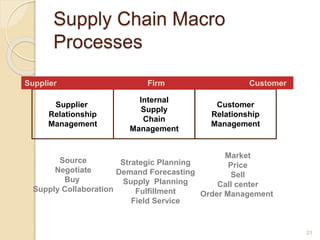
Supply Chain Macro
Processes
21
Supplier
Relationship
Management
Internal
Supply
Chain
Management
Customer
Relationship
Management
Source
Negotiate
Buy
Supply Collaboration
Strategic Planning
Demand Forecasting
Supply Planning
Fulfillment
Field Service
Market
Price
Sell
Call center
Order Management
Supplier Firm Customer
Examples of Supply Chains
 Dell / Compaq/HP
 Toyota / GM / Ford
 Amazon
 Flipkart
What are some key issues in these
supply chains?
22
Toyota
 Where should plants be located, what degree of
flexibility should each have, and what capacity
should each have?
 Should plants be able to produce for all markets?
 How should markets be allocated to plants?
 What kind of flexibility should be built into the
distribution system?
 How should this flexible investment be valued?
 What actions may be taken during product design
to facilitate this flexibility?
23
Amazon.com
 Why is Amazon building more warehouses as it grows? How
many warehouses should it have and where should they be
located?
 What advantages does selling books via the Internet provide?
Are there disadvantages?
 Why does Amazon stock bestsellers while buying other titles
from distributors?
 Does an Internet channel provide greater value to a bookseller
like Borders or to an Internet-only company like Amazon?
 Should traditional booksellers like Borders integrate e-
commerce into their current supply?
 For what products does the e-commerce channel offer the
greatest benefits? What characterizes these products?
24
25
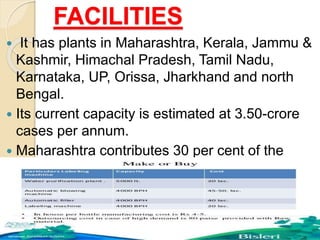
FACILITIES
 It has plants in Maharashtra, Kerala, Jammu &
Kashmir, Himachal Pradesh, Tamil Nadu,
Karnataka, UP, Orissa, Jharkhand and north
Bengal.
 Its current capacity is estimated at 3.50-crore
cases per annum.
 Maharashtra contributes 30 per cent of the
company’s total sales.
INVENTORY:
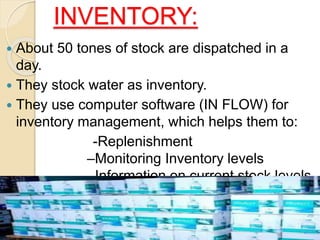
 About 50 tones of stock are dispatched in a
day.
 They stock water as inventory.
 They use computer software (IN FLOW) for
inventory management, which helps them to:
-Replenishment
–Monitoring Inventory levels
–Information on current stock levels
Sourcing
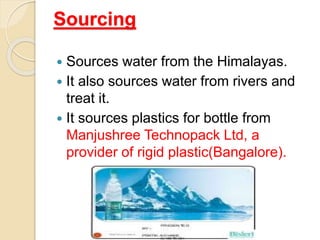
 Sources water from the Himalayas.
 It also sources water from rivers and
treat it.
 It sources plastics for bottle from
Manjushree Technopack Ltd, a
provider of rigid plastic(Bangalore).
TRANSPORTATION
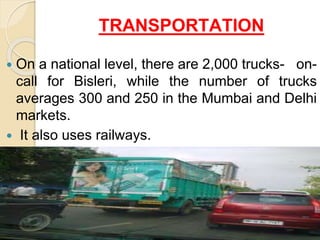
 On a national level, there are 2,000 trucks- on-
call for Bisleri, while the number of trucks
averages 300 and 250 in the Mumbai and Delhi
markets.
 It also uses railways.
PRICING
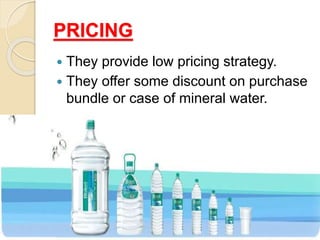
 They provide low pricing strategy.
 They offer some discount on purchase
bundle or case of mineral water.
Supply Chain Management

Supply Chain Management

  • 1.
  • 2.
    Outline  What isa Supply Chain?  The Importance of Supply Chain Flows  Process View of a Supply Chain  Examples of Supply Chains 2
  • 3.
    What is SupplyChain Mgmt. ? SCM is a business network covering from buying, making, moving, warehousing to selling Buying Selling Making Moving Ware housing
  • 4.
    What is aSupply Chain?  All stages involved, directly or indirectly, in fulfilling a customer request  Includes manufacturers, suppliers, transporters, warehouses, retailers, customers  Within each company, the supply chain includes all functions involved in fulfilling a customer request (product development, marketing, operations, distribution, finance, customer service) 4
  • 5.
    Stages of aDetergent Supply Chain 5 Timber Company Paper Manufacturer Distributor Packaging Chemical Manufacturer P&G or Other Manufacturer Wal-Mart Or Third Party distribut- or Wal-Mart Store Customer
  • 6.
    What is aSupply Chain?  Customer is an integral part of the supply chain  Includes movement of products from suppliers to manufacturers to distributors, but also includes movement of information, funds, and products in both directions  Probably more accurate to use the term “supply network” or “supply web”  Typical supply chain stages: customers, retailers, distributors, manufacturers, suppliers  All stages may not be present in all supply chains (e.g., no retailer or distributor for Dell) 6
  • 7.
    What is aSupply Chain? 7 Supplier Manufacturer Distributor Retailer Customer Supplier Manufacturer Distributor Retailer Customer Supplier Manufacturer Distributor Retailer Customer
  • 8.
    Flows in aSupply Chain 8 Customer Information Product Funds
  • 9.
    The Objective ofa Supply Chain 1. To maximize overall value generated 2. To look for Sources of Revenue and Cost 3. Improving the visibility of the demand 4. Improving the quality 5. Minimizing the time 6. Reduces the transportation cost 7. Reduces warehousing cost 8. Expanding width/depth of distribution 9. Product Life cycle support 10. Rationalize supplier base 11. Service orientation 9
  • 10.
    The Objective ofa Supply Chain  Example: Dell receives $2000 from a customer for a computer (revenue)  Supply chain incurs costs (information, storage, transportation, components, assembly, etc.)  Difference between $2000 and the sum of all of these costs is the supply chain profit  Supply chain profitability is total profit to be shared across all stages of the supply chain  Supply chain success should be measured by total supply chain profitability, not profits at an individual stage 10
  • 11.
    Process View ofa Supply Chain  Cycle view: processes in a supply chain are divided into a series of cycles, each performed at the interfaces between two successive supply chain stages  Push/pull view: processes in a supply chain are divided into two categories depending on whether they are executed in response to a customer order (pull) or in anticipation of a customer order (push) 11
  • 12.
    Cycle View ofSupply Chains 12 Customer Order Cycle Replenishment Cycle Manufacturing Cycle Procurement Cycle Customer Retailer Distributor Manufacturer Supplier
  • 13.
    Cycle View ofa Supply Chain  Each cycle occurs at the interface between two successive stages  Customer order cycle (customer-retailer)  Replenishment cycle (retailer-distributor)  Manufacturing cycle (distributor-manufacturer)  Procurement cycle (manufacturer-supplier)  Cycle view clearly defines processes involved and the owners of each process. Specifies the roles and responsibilities of each member and the desired outcome of each process. 13
  • 14.
    Customer Order Cycle Involves all processes directly involved in receiving and filling the customer’s order  Customer arrival  Customer order entry  Customer order fulfillment  Customer order receiving 14
  • 15.
    Replenishment Cycle  Allprocesses involved in replenishing retailer inventories (retailer is now the customer)  Retail order trigger  Retail order entry  Retail order fulfillment  Retail order receiving 15
  • 16.
    Manufacturing Cycle  Allprocesses involved in replenishing distributor (or retailer) inventory  Order arrival from the distributor, retailer, or customer  Production scheduling  Manufacturing and shipping  Receiving at the distributor, retailer, or customer 16
  • 17.
    Procurement Cycle  Allprocesses necessary to ensure that materials are available for manufacturing to occur according to schedule  Manufacturer orders components from suppliers to replenish component inventories  However, component orders can be determined precisely from production schedules (different from retailer/distributor orders that are based on uncertain customer demand)  Important that suppliers be linked to the manufacturer’s production schedule 17
  • 18.
    Push/Pull View ofSupply Chains 18 Procurement, Manufacturing and Replenishment cycles Customer Order Cycle Customer Order Arrives PUSH PROCESSES PULL PROCESSES
  • 19.
    Push/Pull View of SupplyChain Processes  Supply chain processes fall into one of two categories depending on the timing of their execution relative to customer demand  Pull: execution is initiated in response to a customer order (reactive) ex. DELL  Push: execution is initiated in anticipation of customer orders (speculative) ex. TOYOTA  Push/pull boundary separates push processes from pull processes 19
  • 20.
    Supply Chain ina Firm  All supply chain processes can be classified into ◦ Customer relationship management ◦ Internal supply chain management ◦ Supplier relationship management  The three macro processes manage the flow of information, product, and funds required to generate, receive, and fulfill a customer request. 20
  • 21.
    Supply Chain Macro Processes 21 Supplier Relationship Management Internal Supply Chain Management Customer Relationship Management Source Negotiate Buy SupplyCollaboration Strategic Planning Demand Forecasting Supply Planning Fulfillment Field Service Market Price Sell Call center Order Management Supplier Firm Customer
  • 22.
    Examples of SupplyChains  Dell / Compaq/HP  Toyota / GM / Ford  Amazon  Flipkart What are some key issues in these supply chains? 22
  • 23.
    Toyota  Where shouldplants be located, what degree of flexibility should each have, and what capacity should each have?  Should plants be able to produce for all markets?  How should markets be allocated to plants?  What kind of flexibility should be built into the distribution system?  How should this flexible investment be valued?  What actions may be taken during product design to facilitate this flexibility? 23
  • 24.
    Amazon.com  Why isAmazon building more warehouses as it grows? How many warehouses should it have and where should they be located?  What advantages does selling books via the Internet provide? Are there disadvantages?  Why does Amazon stock bestsellers while buying other titles from distributors?  Does an Internet channel provide greater value to a bookseller like Borders or to an Internet-only company like Amazon?  Should traditional booksellers like Borders integrate e- commerce into their current supply?  For what products does the e-commerce channel offer the greatest benefits? What characterizes these products? 24
  • 25.
  • 27.
    FACILITIES  It hasplants in Maharashtra, Kerala, Jammu & Kashmir, Himachal Pradesh, Tamil Nadu, Karnataka, UP, Orissa, Jharkhand and north Bengal.  Its current capacity is estimated at 3.50-crore cases per annum.  Maharashtra contributes 30 per cent of the company’s total sales.
  • 28.
    INVENTORY:  About 50tones of stock are dispatched in a day.  They stock water as inventory.  They use computer software (IN FLOW) for inventory management, which helps them to: -Replenishment –Monitoring Inventory levels –Information on current stock levels
  • 29.
    Sourcing  Sources waterfrom the Himalayas.  It also sources water from rivers and treat it.  It sources plastics for bottle from Manjushree Technopack Ltd, a provider of rigid plastic(Bangalore).
  • 30.
    TRANSPORTATION  On anational level, there are 2,000 trucks- on- call for Bisleri, while the number of trucks averages 300 and 250 in the Mumbai and Delhi markets.  It also uses railways.
  • 31.
    PRICING  They providelow pricing strategy.  They offer some discount on purchase bundle or case of mineral water.