Chapter 3:
Emotions and Moods
Emotions and Moods at Work
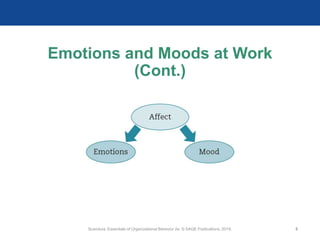
• Affect
• Refers to the range of feelings that employees
experience at work
• Comprised of emotions and moods
Scandura, Essentials of Organizational Behavior 2e. © SAGE Publications, 2019. 2
Emotions and Moods at Work
(Cont.)
• Emotions
• Triggered by specific events
• Brief but intense enough to disrupt a person’s
thinking
• Emotions can be internal (such as pride and love)
• Emotions can emerge in relationships with others
(such as shame and guilt)
Scandura, Essentials of Organizational Behavior 2e. © SAGE Publications, 2019. 3
Emotions and Moods at Work
(Cont.)
• Moods
• General feeling not related to a specific event
• Last longer than emotions
• Are not caused by a person or something that
happens to us
Scandura, Essentials of Organizational Behavior 2e. © SAGE Publications, 2019. 4
Scandura, Essentials of Organizational Behavior 2e. © SAGE Publications, 2019. 5
Emotions and Moods at Work
(Cont.)
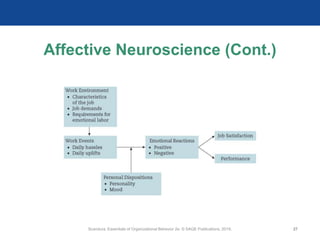
Affective Events Theory: An
Organizing Framework
• Affective Events Theory--The impact of the
work environment and events that trigger
emotional reactions (positive and negative)
• Areas in the work environment that leaders
should pay close attention to are:
• Characteristics of the job
• Job demands
• Requirements for emotional labor
Scandura, Essentials of Organizational Behavior 2e. © SAGE Publications, 2019. 6
Scandura, Essentials of Organizational Behavior 2e. © SAGE Publications, 2019. 7
Affective Events Theory: An
Organizing Framework (Cont.)
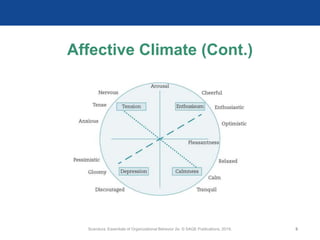
Affective Climate
• Affective climate refers to the shared affective
experience of a work group or team.
(Cropanzano, 2015)
• The climate, or tone, of the group can be
considered feelings that arise from, or in, groups
• Affective climates are typically referred to as being
affectively “positive” or “negative”
Scandura, Essentials of Organizational Behavior 2e. © SAGE Publications, 2019. 8
Affective Climate (Cont.)
Scandura, Essentials of Organizational Behavior 2e. © SAGE Publications, 2019. 9
Moods
• Moods are generally more enduring than
emotions
• Positive and negative state affect are the most
often-studied moods at the workplace (i.e.,
being happy or sad)
Scandura, Essentials of Organizational Behavior 2e. © SAGE Publications, 2019. 10
Moods (Cont.)
• Positive State Affect--extent to which a person
feels enthusiastic, active, and alert
• High energy, concentration, and pleasurable engagement
• Negative State Affect--general dimension of
subjective distress and unpleasant
engagement that subsumes a variety of
aversive mood states
• Anger, contempt, guilt, fear, and nervousness
Scandura, Essentials of Organizational Behavior 2e. © SAGE Publications, 2019. 11
Moods (Cont.)
Scandura, Essentials of Organizational Behavior 2e. © SAGE Publications, 2019. 12
Emotional Labor
• Emotional labor is defined as “the management
of feeling to create a publicly observable facial
and bodily display.” (Hochschild,1983)
• Emotional dissonance the difference between
the organizationally expected emotions and an
employee’s inner or “real” emotions
Scandura, Essentials of Organizational Behavior 2e. © SAGE Publications, 2019. 13
Emotional Labor (Cont.)
• Deep acting--happens when a desired
emotional expression is achieved by changing
one’s underlying felt emotion
• For example, a college professor may “psych himself up”
to present a lecture to students after learning of a family
member’s illness. The professor actually becomes more
enthusiastic
Scandura, Essentials of Organizational Behavior 2e. © SAGE Publications, 2019. 14
Emotional Labor (Cont.)
• Surface acting--refers to producing a desired
outward emotional expression without
modifying the underlying emotions
• For example, surface acting emotional labor (acting out
service roles such as; flight attendants) has been related
to emotional exhaustion and burnout
Scandura, Essentials of Organizational Behavior 2e. © SAGE Publications, 2019. 15
Emotional Labor (Cont.)
• Level of “faking” differs
• Deep acting--we actually try to change our
emotions
• Surface acting--we hide our emotions and feelings
Scandura, Essentials of Organizational Behavior 2e. © SAGE Publications, 2019. 16
Emotional Intelligence (EI)
• Emotion regulation
• Self-awareness
• Other-awareness
Scandura, Essentials of Organizational Behavior 2e. © SAGE Publications, 2019. 17
Emotional Intelligence (Cont.)
• Emotional Intelligence is considered to have
four aspects:
• Ability to perceive emotion in self and others
• Ability to use emotion to facilitate cognitive activities
like thinking and problem solving
• Ability to understand emotional information
• Ability to manage emotion in self and others
Scandura, Essentials of Organizational Behavior 2e. © SAGE Publications, 2019. 18
Emotional Intelligence (Cont.)
• Emotional Intelligence (EI)
• Related to job performance
• Predictor of performance and organizational
citizenship behavior (OCB)
Scandura, Essentials of Organizational Behavior 2e. © SAGE Publications, 2019. 19
Emotional Intelligence (Cont.)
Scandura, Essentials of Organizational Behavior 2e. © SAGE Publications, 2019. 20
Emotional Intelligence (Cont.)
• Emotional Intelligence has definitely impacted
the workplace through:
• Emotional intelligence training programs
• Specialized Emotional Intelligence consultants
• Articles in the business press and popular press
Scandura, Essentials of Organizational Behavior 2e. © SAGE Publications, 2019. 21
Emotional Intelligence (Cont.)
• FedEx Express emotional intelligence training
program
• Know Yourself
• Choose Yourself
• Give Yourself
• One of the key principles of Emotional
Intelligence training at FedEx is: “Emotions
drive people, people drive performance.”
(Freedman, 2014)
Scandura, Essentials of Organizational Behavior 2e. © SAGE Publications, 2019. 22
Emotional Intelligence (Cont.)
• The following summarizes what we can safely
conclude about Emotional Intelligence:
• Emotional Intelligence is distinct
• Emotional Intelligence is an individual difference
• Emotional Intelligence develops over a person’s life
span
• Emotional Intelligence involves an individual’s
abilities to identify and perceive emotion
Scandura, Essentials of Organizational Behavior 2e. © SAGE Publications, 2019. 23
Emotional Contagion
• Emotional contagion
• Emotions spread to others
• (positive or negative)
Scandura, Essentials of Organizational Behavior 2e. © SAGE Publications, 2019. 24
Emotional Contagion (Cont.)
• The degree that emotional contagions may be affecting
a work group, leaders should ask the following
questions:
• What extent are people on the same side of the table?
• What events and environmental conditions do they
face?
• What are the ‘‘hot buttons’’ to which people are
reacting?
• How do people interpret what is going on around them?
• Do people converge in their interpretation or disagree in
terms of their reactions?
Scandura, Essentials of Organizational Behavior 2e. © SAGE Publications, 2019. 25
Affective Neuroscience
• Attempts to understand what happens in the
brain when attitudes such as job satisfaction
are experienced by people in organizations
• Application: Mirror neurons
• Ethical concerns
Scandura, Essentials of Organizational Behavior 2e. © SAGE Publications, 2019. 26
Affective Neuroscience (Cont.)
Scandura, Essentials of Organizational Behavior 2e. © SAGE Publications, 2019. 27

Lead 705 ppt 3

  • 1.
  • 2.
    Emotions and Moodsat Work • Affect • Refers to the range of feelings that employees experience at work • Comprised of emotions and moods Scandura, Essentials of Organizational Behavior 2e. © SAGE Publications, 2019. 2
  • 3.
    Emotions and Moodsat Work (Cont.) • Emotions • Triggered by specific events • Brief but intense enough to disrupt a person’s thinking • Emotions can be internal (such as pride and love) • Emotions can emerge in relationships with others (such as shame and guilt) Scandura, Essentials of Organizational Behavior 2e. © SAGE Publications, 2019. 3
  • 4.
    Emotions and Moodsat Work (Cont.) • Moods • General feeling not related to a specific event • Last longer than emotions • Are not caused by a person or something that happens to us Scandura, Essentials of Organizational Behavior 2e. © SAGE Publications, 2019. 4
  • 5.
    Scandura, Essentials ofOrganizational Behavior 2e. © SAGE Publications, 2019. 5 Emotions and Moods at Work (Cont.)
  • 6.
    Affective Events Theory:An Organizing Framework • Affective Events Theory--The impact of the work environment and events that trigger emotional reactions (positive and negative) • Areas in the work environment that leaders should pay close attention to are: • Characteristics of the job • Job demands • Requirements for emotional labor Scandura, Essentials of Organizational Behavior 2e. © SAGE Publications, 2019. 6
  • 7.
    Scandura, Essentials ofOrganizational Behavior 2e. © SAGE Publications, 2019. 7 Affective Events Theory: An Organizing Framework (Cont.)
  • 8.
    Affective Climate • Affectiveclimate refers to the shared affective experience of a work group or team. (Cropanzano, 2015) • The climate, or tone, of the group can be considered feelings that arise from, or in, groups • Affective climates are typically referred to as being affectively “positive” or “negative” Scandura, Essentials of Organizational Behavior 2e. © SAGE Publications, 2019. 8
  • 9.
    Affective Climate (Cont.) Scandura,Essentials of Organizational Behavior 2e. © SAGE Publications, 2019. 9
  • 10.
    Moods • Moods aregenerally more enduring than emotions • Positive and negative state affect are the most often-studied moods at the workplace (i.e., being happy or sad) Scandura, Essentials of Organizational Behavior 2e. © SAGE Publications, 2019. 10
  • 11.
    Moods (Cont.) • PositiveState Affect--extent to which a person feels enthusiastic, active, and alert • High energy, concentration, and pleasurable engagement • Negative State Affect--general dimension of subjective distress and unpleasant engagement that subsumes a variety of aversive mood states • Anger, contempt, guilt, fear, and nervousness Scandura, Essentials of Organizational Behavior 2e. © SAGE Publications, 2019. 11
  • 12.
    Moods (Cont.) Scandura, Essentialsof Organizational Behavior 2e. © SAGE Publications, 2019. 12
  • 13.
    Emotional Labor • Emotionallabor is defined as “the management of feeling to create a publicly observable facial and bodily display.” (Hochschild,1983) • Emotional dissonance the difference between the organizationally expected emotions and an employee’s inner or “real” emotions Scandura, Essentials of Organizational Behavior 2e. © SAGE Publications, 2019. 13
  • 14.
    Emotional Labor (Cont.) •Deep acting--happens when a desired emotional expression is achieved by changing one’s underlying felt emotion • For example, a college professor may “psych himself up” to present a lecture to students after learning of a family member’s illness. The professor actually becomes more enthusiastic Scandura, Essentials of Organizational Behavior 2e. © SAGE Publications, 2019. 14
  • 15.
    Emotional Labor (Cont.) •Surface acting--refers to producing a desired outward emotional expression without modifying the underlying emotions • For example, surface acting emotional labor (acting out service roles such as; flight attendants) has been related to emotional exhaustion and burnout Scandura, Essentials of Organizational Behavior 2e. © SAGE Publications, 2019. 15
  • 16.
    Emotional Labor (Cont.) •Level of “faking” differs • Deep acting--we actually try to change our emotions • Surface acting--we hide our emotions and feelings Scandura, Essentials of Organizational Behavior 2e. © SAGE Publications, 2019. 16
  • 17.
    Emotional Intelligence (EI) •Emotion regulation • Self-awareness • Other-awareness Scandura, Essentials of Organizational Behavior 2e. © SAGE Publications, 2019. 17
  • 18.
    Emotional Intelligence (Cont.) •Emotional Intelligence is considered to have four aspects: • Ability to perceive emotion in self and others • Ability to use emotion to facilitate cognitive activities like thinking and problem solving • Ability to understand emotional information • Ability to manage emotion in self and others Scandura, Essentials of Organizational Behavior 2e. © SAGE Publications, 2019. 18
  • 19.
    Emotional Intelligence (Cont.) •Emotional Intelligence (EI) • Related to job performance • Predictor of performance and organizational citizenship behavior (OCB) Scandura, Essentials of Organizational Behavior 2e. © SAGE Publications, 2019. 19
  • 20.
    Emotional Intelligence (Cont.) Scandura,Essentials of Organizational Behavior 2e. © SAGE Publications, 2019. 20
  • 21.
    Emotional Intelligence (Cont.) •Emotional Intelligence has definitely impacted the workplace through: • Emotional intelligence training programs • Specialized Emotional Intelligence consultants • Articles in the business press and popular press Scandura, Essentials of Organizational Behavior 2e. © SAGE Publications, 2019. 21
  • 22.
    Emotional Intelligence (Cont.) •FedEx Express emotional intelligence training program • Know Yourself • Choose Yourself • Give Yourself • One of the key principles of Emotional Intelligence training at FedEx is: “Emotions drive people, people drive performance.” (Freedman, 2014) Scandura, Essentials of Organizational Behavior 2e. © SAGE Publications, 2019. 22
  • 23.
    Emotional Intelligence (Cont.) •The following summarizes what we can safely conclude about Emotional Intelligence: • Emotional Intelligence is distinct • Emotional Intelligence is an individual difference • Emotional Intelligence develops over a person’s life span • Emotional Intelligence involves an individual’s abilities to identify and perceive emotion Scandura, Essentials of Organizational Behavior 2e. © SAGE Publications, 2019. 23
  • 24.
    Emotional Contagion • Emotionalcontagion • Emotions spread to others • (positive or negative) Scandura, Essentials of Organizational Behavior 2e. © SAGE Publications, 2019. 24
  • 25.
    Emotional Contagion (Cont.) •The degree that emotional contagions may be affecting a work group, leaders should ask the following questions: • What extent are people on the same side of the table? • What events and environmental conditions do they face? • What are the ‘‘hot buttons’’ to which people are reacting? • How do people interpret what is going on around them? • Do people converge in their interpretation or disagree in terms of their reactions? Scandura, Essentials of Organizational Behavior 2e. © SAGE Publications, 2019. 25
  • 26.
    Affective Neuroscience • Attemptsto understand what happens in the brain when attitudes such as job satisfaction are experienced by people in organizations • Application: Mirror neurons • Ethical concerns Scandura, Essentials of Organizational Behavior 2e. © SAGE Publications, 2019. 26
  • 27.
    Affective Neuroscience (Cont.) Scandura,Essentials of Organizational Behavior 2e. © SAGE Publications, 2019. 27

Editor's Notes

  • #3 Learning Objective 3.1: Illustrate, with an example, the differences between emotions and moods. Affect is a general term that refers to the range of feelings that employees experience at work. Affect is comprised of emotions and moods. State affect refers to feelings experienced in the short term, and fluctuate over time, whereas trait affect refers to stable individual differences.
  • #4 Learning Objective 3.1: Illustrate, with an example, the differences between emotions and moods. Emotions are triggered by specific events and are brief but intense enough to disrupt a person’s thinking--lasting only seconds or minutes. Some emotions are internal to a person, such as pride and love. Other emotions emerge in relationships with others such as shame and guilt.
  • #5 Learning Objective 3.1: Illustrate, with an example, the differences between emotions and moods. Moods, on the other hand, are general feeling states that are not related to a specific event, but they are not intense enough to interrupt regular thought patterns or work. Emotions are more fleeting than moods. In other words, a felt emotion, such as anger at your boss, may pass. But being in a foul mood may last for hours. Moods aren’t typically caused by a person or something that happens to us. However, emotions are directed at another person or situation (e.g., we are happy to see our coworker when they come back from a vacation). Obviously, emotions and moods are related, being in a good mood can result in the experience of feeling happy (an emotion).
  • #6 Learning Objective 3.1: Illustrate, with an example, the differences between emotions and moods. Figure 3.1: The Relationship Between Affect and Emotions and Mood. Obviously, emotions and moods are related, being in a good mood can result in the experience of feeling happy (an emotion).
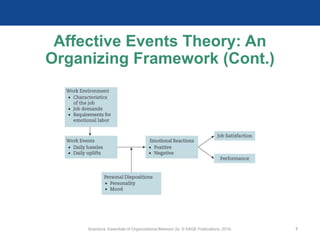
  • #7 Learning Objective 3.2: Summarize the Affective Events Theory with an example. Affective events theory integrates personality, emotions, and moods and considers the impact of the work environment and events that may trigger emotional reactions (positive and negative affect). Areas in the work environment that leaders should pay close attention to are the characteristics of the job (e.g., Is it boring or interesting?), the job demands (e.g., Is the job just too difficult for the person to handle?), and the requirements for emotional labor (e.g., Does the person have to interact with the public and be courteous to irate customers?).
  • #8 Learning Objective 3.2: Summarize the Affective Events Theory with an example. Figure 3.2. Affective Events Theory (AET). Notice that in the figure, these work environment factors lead to work events such as daily hassles and uplifts (uplifts are moments when everything is going just great). Personality and moods play a role in how people react to hassles and uplifts. For example, a person low on emotional stability may have a stronger reaction to a daily hassle. Taken together, the work environment, events, personality, and moods combine to evoke emotional responses--positive or negative. This, in turn, leads to job satisfaction and performance. Affective events explain the development of effective working relationships between leaders and followers.
  • #9 Learning Objective 3.3: Explain how affective climate (positive and negative) of a work group relates to team conflict. Affective climate refers to the shared affective experience of a work group or team. (Cropanzano, 2015) The climate, or tone, of the group can be considered feelings that arise from, or in, groups. Affective climates are typically referred to as being affectively “positive” or “negative.” For example, a positive affective climate includes “participation, warmth, social rewards, cooperation.”
  • #10 Learning Objective 3.3: Explain how affective climate (positive and negative) of a work group relates to team conflict. Figure 3.3. The Circumplex Model of Group Affective Climate. The range of emotions that may be experienced has been summarized in the circumplex model of affect shown in Figure 3.3. This model locates specific emotions in the conceptual space defined by two orthogonal primary dimensions: pleasantness (pleasure-displeasure) and arousal (low activation-high activation). Affective climate is described as having different facets as shown in the figure. Example: A study using the circumplex model examined team conflict in 156 bank branches and found that disagreements about the work (task conflict) and difficulties with other team members (relationship conflict) were significantly related to the creation of a tension affective climate. This climate is characterized as the group mood being nervous, tense, and anxious, rather than enthusiastic. Example: A study of 97 teams in a car factory in Belgium found that positive team affective climate reduced psychological distress. All team members benefited from a positive affective climate, even those workers who had a negative perception of their emotional work environment. Affective climate is related to team creativity, especially when the groups work together effectively (for example, by asking a lot of questions of one another).
  • #11 Learning Objective 3.4: Demonstrate with an example how positive and negative state affect relates to customer service. Moods are generally more enduring than emotions. Positive and negative state affect are the most often-studied moods at the workplace (i.e., being happy or sad).
  • #12 Learning Objective 3.4: Demonstrate with an example how positive and negative state affect relates to customer service. Positive State Affect is defined as the extent to which a person feels enthusiastic, active, and alert. High PA is a state of high energy, full concentration, and pleasurable engagement. Negative State Affect is defined as a general dimension of subjective distress and unpleasant engagement that subsumes a variety of aversive mood states. These states may be anger, contempt, disgust, guilt, fear, and nervousness.
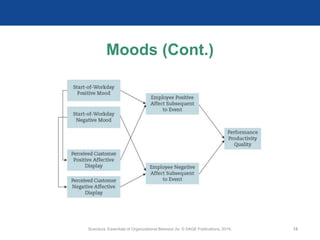
  • #13 Learning Objective 3.4: Demonstrate with an example how positive and negative state affect relates to customer service. Figure 3.4. The Effects of Mood, Work Events, and Employee Affect on Performance. Mood at the start of the workday (i.e., “waking up on the wrong side of the bed”) related to perceptions of customer emotions in a call center, and this affected the employees’ mood after the calls. Positive affect was, in turn, related to performance quality whereas negative affect was negatively related to productivity. The results of this research study are summarized in Figure 3.4.
  • #14 Learning Objective 3.5: Demonstrate understanding of emotional labor by providing examples of jobs that require “surface acting” and “deep acting.” Emotional labor is defined as “the management of feeling to create a publicly observable facial and bodily display.” In other words, it is the effort required to effectively manage emotions to be successful on the job. The concept of emotional labor was introduced by sociologist Arlie Hochschild, who investigated flight attendants and demonstrated that a significant part of their job was attending to the emotions of passengers. Emotional labor has been studied with convenience store clerks, and customers. Emotional dissonance is the result of the difference between the organizationally-expected emotions and an employee’s inner or “real” emotions. In other words, employees are told to “fake it until they make it.” All jobs have this requirement to some extent, but some have higher requirements than others (e.g., flight attendants, salespeople, customer service representatives, and nurses).
  • #15 Learning Objective 3.5: Demonstrate understanding of emotional labor by providing examples of jobs that require “surface acting” and “deep acting.” The concept of emotional labor was introduced by sociologist Arlie Hochschild, who investigated flight attendants and demonstrated that a significant part of their job was attending to the emotions of passengers. Emotional labor has been studied with convenience store clerks, and customers. Clerks had differing expectations of their roles and that clerks followed scripts (like actors in a role) to control customer service interactions. This is known as “deep acting” since the employee actually feel the emotions they are acting out. Deep acting happens when a desired emotional expression is achieved by changing one’s underlying felt emotion. For example, a college professor may “psych himself up” to present a lecture to students after learning of a family member’s illness. The professor actually becomes more enthusiastic.
  • #16 Learning Objective 3.5: Demonstrate understanding of emotional labor by providing examples of jobs that require “surface acting” and “deep acting.” Surface acting refers to producing a desired outward emotional expression without modifying the underlying emotions. Research has however, shown that surface and deep-level acting occur simultaneously. Such acting may come with costs, however. Surface acting emotional labor (acting out service roles) has been related to emotional exhaustion and burnout., The emotional exhaustion from surface acting may be reduced by team member’s positive actions.
  • #17 Learning Objective 3.5: Demonstrate understanding of emotional labor by providing examples of jobs that require “surface acting” and “deep acting.” Deep acting happens when a desired emotional expression is achieved by changing one’s underlying felt emotion. For example, a college professor may “psych himself up” to present a lecture to students after learning of a family member’s illness. The professor actually becomes more enthusiastic. Surface acting refers to producing a desired outward emotional expression without modifying the underlying emotions. Research has however, shown that surface and deep-level acting occur simultaneously. Such acting may come with costs, however. Surface acting emotional labor (acting out service roles) has been related to emotional exhaustion and burnout., The emotional exhaustion from surface acting may be reduced by team member’s positive actions.
  • #18 Learning Objective 3.6: Discuss the case for training in emotional intelligence in the workplace. Research from the field of psychology shows emotional regulation may be a form of intelligence. Emotion regulation is one of the important abilities that high EI people possess. Organizational leaders and human resource professionals find this concept, Emotional Intelligence (EI), relevant to the workplace. In fact, having EI abilities may be essential to be an effective leader.
  • #19 Learning Objective 3.6: Discuss the case for training in emotional intelligence in the workplace. EI is considered to have four aspects: Ability to perceive emotion in self and others (e.g., correctly identifying a perceived emotional expression as fear) Ability to use emotion to facilitate cognitive activities like thinking and problem solving (e.g., knowing how to capitalize on a happy mood swing to engage in a creative task) Ability to understand emotional information (e.g. understanding how two emotions can blend into a third emotion) Ability to manage emotion in self and others (e.g. detaching from fear states that interfere with one’s functioning)
  • #20 Learning Objective 3.6: Discuss the case for training in emotional intelligence in the workplace. EI is related to job performance. This is especially true in jobs that have high emotional labor requirements. EI becomes a stronger predictor of performance and organizational citizenship behavior (OCB) when intelligence is lower. This may be explained by the results of a study that found that employees with high EI are better able to control and reduce the counterproductive outcomes of challenging developmental job experiences (EI reduced the unpleasant feelings associated with demanding tasks that required new learning). Taking on these difficult tasks resulted in employees being seen as having more advancement potential. Example: a study conducted with U.S. Air Force recruiters, found that EI was related to success in meeting recruiting quotas. Example: a study of more than 300 managers at Johnson & Johnson found that managers who scored higher on a measure of EI were rated as more effective by their followers.
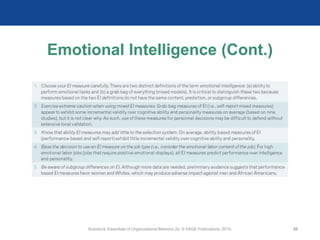
  • #21 Learning Objective 3.6: Discuss the case for training in emotional intelligence in the workplace. Table 3.1. Practical Advice for Using Emotional Intelligence Measures for Selection. Meta-analyses have shown that leaders’ EI relates to follower job satisfaction. Other benefits of EI demonstrated by research are enhanced employee creativity, teamwork effectiveness, and the ability to resolve conflict. Given the benefits of EI in the workplace, organizations are interested in whether EI measures can be used for personnel selection. In other words, can leaders be confident in using EI to decide who to hire for a job (or who to promote to higher one)? Based upon a meta-analytic review, researchers offer the evidence-based practical advice for using EI for hiring employees shown in Table 3.1.
  • #22 Learning Objective 3.6: Discuss the case for training in emotional intelligence in the workplace. EI concept has definitely impacted the workplace through EI training programs, specialized EI consultants, and articles in the business press and popular press. For example, the FedEx Global Leadership Institute is charged with continuously updating and innovating in keeping with that Fred Smith call for continuously “raising the standards.” 
  • #23 Learning Objective 3.6: Discuss the case for training in emotional intelligence in the workplace. FedEx Express implemented a training program for new managers in action-based EI that had three steps for using emotional intelligence on a day-to-day basis: Know Yourself--increase self-awareness of emotions and reactions (competencies:  Enhance Emotional Literacy and Recognize Patterns). Choose Yourself--shift from unconscious reaction to intentional response (competencies: Apply Consequential Thinking, Navigate Emotions, Engage Intrinsic Motivation, and Exercise Optimism). Give Yourself--align the moment-to-moment decisions with a larger sense of purpose (competencies:  Increase Empathy and Pursue Noble Goals). One of the key principles of the EI training at FedEx is: “Emotions drive people, people drive performance.” (Freedman, 2014)
  • #24 Learning Objective 3.6: Discuss the case for training in emotional intelligence in the workplace. The following summarizes what we can safely conclude about EI: EI is distinct from but positively related to other intelligences (such as IQ). EI is an individual difference, where some people are more endowed and others are less so. EI develops over a person’s life span and can be enhanced through training. EI involves, at least in part, individual’s abilities to effectively identify and perceive emotion (in themselves and others), as well as possession of the skills to understand and manage those emotions successfully.
  • #25 Learning Objective 3.7: Explain how positive and negative emotions can spread from one individual to a group through the emotional contagion process. The negative mood of one employee spreads to others in their group. Negativity spreads like a virus; employees “catch” the negative moods of others. Positive moods are also contagious. By adding up responses to measures of mood from individuals in groups, researchers have discovered that mood can be defined for a group and it is consistent. In other words, groups can be characterized as having a negative mood. Also, the “group mood” spreads to the moods of individuals in the group. In other words, if a group is positive, then members of the group typically experience positive mood states as well. This happens because of the linkages that emerge among group members. For example, convergent linkage occurs when individuals share the interpretations of emotional events.   Divergent linkage occurs when interpretations of emotional events differ.   Complementary linkage occurs when the other person is the stimulus.  In other words, one individual identifies with another person and this identification causes the emotions to spread as in “misery loves company.” To assess the degree that emotional contagions may be affecting a work group, leaders should ask the following questions.
  • #26 Learning Objective 3.7: Explain how positive and negative emotions can spread from one individual to a group through the emotional contagion process. To assess the degree that emotional contagions may be affecting a work group, leaders should ask the following questions. To what extent are people on the same side of the table? What events and environmental conditions do they tend to face together? What are the ‘‘hot buttons’’ to which a lot of people are reacting? Even when people share the same viewpoint, how do they interpret what is going on around them? Do people converge in their interpretation or people disagree in terms of their reactions?
  • #27 Learning Objective 3.8: Explain the affective neuroscience and provide an organizational example. Affective neuroscience is the study of the neural mechanisms of emotion. This interdisciplinary field combines neuroscience with the psychological study of personality, emotion, and mood. Understanding how networks of brain systems operate may finally allow OB researchers to enter the “black box” to understand what happens in the brain when emotions such as anger and gratitude are experienced by people in organizations. For example, “mirror neurons” (brain processes that regulate a person’s ability to imitate another person, either consciously or unconsciously) may increase understanding of role modeling, and learning through watching others at work. Experimental data suggest key roles of drive and motivation in the wanting, liking, and learning processes underlying the pleasure cycle supporting survival of individuals’ reactions to rewards they receive. Some emotions may be embedded in a deeper part of the brain, making them implicit rather than explicit. For example, being fearful of organizational change may be rooted in an older and deeper part of our brains making employees react automatically rather than logically to change.
  • #28 Learning Objective 3.8: Explain the affective neuroscience and provide an organizational example. Figure 3.2. Affective Events Theory (AET). Neuroscience will increase our understanding of the range of emotions shown in the circumplex model of affect (shown in Figure 3.2 above). For example, research has already determined that pleasure and displeasure are located in different regions of the brain.