CHAPTER 14:
ORGANIZATIONAL
CULTURE
AGENDA
• Organizational culture
• Organizational subcultures
• Socialization
• Organizational climates
Scandura, Essentials of Organizational Behavior. © 2016, SAGE Publications. 2
WHEN ELEPHANTS LEARN TO
DANCE
• IBM was hierarchical and traditional, and
facing bankruptcy
• New CEO changed the culture
• Empowered employees to act
• Focus on bringing value to customers
Scandura, Essentials of Organizational Behavior. © 2016, SAGE Publications. 3
WHAT IS ORGANIZATIONAL CULTURE?
• Pattern of assumptions developed to cope with
problems of external adaptation and internal
integration
• The group has invented, discovered, or learned these
assumptions.
• The assumptions have worked well enough to be
considered valid.
• Taught to new members as the correct way to
perceive, think, and feel in relation to problems.
Scandura, Essentials of Organizational Behavior. © 2016, SAGE Publications. 4
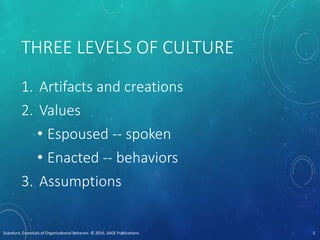
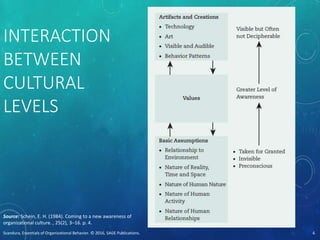
THREE LEVELS OF CULTURE
1. Artifacts and creations
2. Values
• Espoused -- spoken
• Enacted -- behaviors
3. Assumptions
Scandura, Essentials of Organizational Behavior. © 2016, SAGE Publications. 5
INTERACTION
BETWEEN
CULTURAL
LEVELS
Scandura, Essentials of Organizational Behavior. © 2016, SAGE Publications. 6
Source: Schein, E. H. (1984). Coming to a new awareness of
organizational culture. , 25(2), 3–16. p. 4.
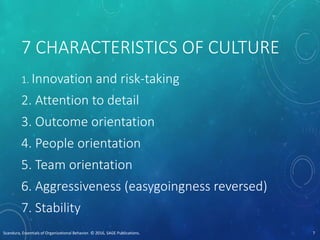
7 CHARACTERISTICS OF CULTURE
1. Innovation and risk-taking
2. Attention to detail
3. Outcome orientation
4. People orientation
5. Team orientation
6. Aggressiveness (easygoingness reversed)
7. Stability
Scandura, Essentials of Organizational Behavior. © 2016, SAGE Publications. 7
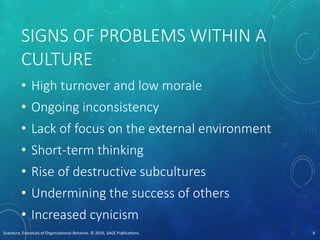
SIGNS OF PROBLEMS WITHIN A
CULTURE
• High turnover and low morale
• Ongoing inconsistency
• Lack of focus on the external environment
• Short-term thinking
• Rise of destructive subcultures
• Undermining the success of others
• Increased cynicism
Scandura, Essentials of Organizational Behavior. © 2016, SAGE Publications. 8
NATIONAL AND
ORGANIZATIONAL CULTURE
• Leader values, founder values, and national
culture influence organizational culture
• However, four consistent elements of
organizational culture found around the world:
• Adaptability
• Involvement
• Mission
• Consistency
Scandura, Essentials of Organizational Behavior. © 2016, SAGE Publications. 9
DENISON
MODEL
OF
CULTURE
Scandura, Essentials of Organizational Behavior. © 2016, SAGE Publications. 10
Source: Denison, D. R., Haaland,
S., & Goelzer, P. (2004).
Corporate culture and
organizational effectiveness: Is
Asia different from the rest of
the world? Organizational
Dynamics, 33(1), 98–109. p.
101.
ORGANIZATIONAL SUBCULTURES
• Operators
• Engineers
• Executives
Scandura, Essentials of Organizational Behavior. © 2016, SAGE Publications. 11
SOCIALIZATION
• The process an organization uses so new
members acquire necessary attitudes,
behaviors, knowledge, and skills to become
productive organizational members
Scandura, Essentials of Organizational Behavior. © 2016, SAGE Publications. 12
SOCIALIZATION
• 3-stage process:
• Anticipatory socialization
• Organizational entry and
assimilation
• Metamorphosis
Scandura, Essentials of Organizational Behavior. © 2016, SAGE Publications. 13
THE
SOCIALIZATION
PROCESS
Scandura, Essentials of Organizational Behavior. © 2016, SAGE Publications. 14
Source: Jablin, F. M. (1987). Organizational entry,
assimilation, and exit. In: L. L. Putnam, K. H. Roberts,
& L. W. Porter (eds), Handbook of organizational
communication: An interdisciplinary perspective (pp.
679–740). Beverly Hills, CA: Sage.
HOW EMPLOYEES LEARN
CULTURE: EXAMPLES
• Stories
• Ray Kroc McDonald’s story
• Rituals
• Wal-Mart cheer
• Symbols
• Papa John’s Camaro
• Language
• Disney: Guests vs. customers
Scandura, Essentials of Organizational Behavior. © 2016, SAGE Publications. 15
ORGANIZATIONAL CLIMATE
• Organizational climate -- shared
perceptions about the organization
and work environment
• The difference between culture and
climate is that culture is an evolved
context and climate is a situation that
employees are in.
Scandura, Essentials of Organizational Behavior. © 2016, SAGE Publications. 16
DIVERSITY CLIMATE
Employees’ shared perceptions of
policies, practices, and procedures that
implicitly and explicitly communicate
the extent to which fostering and
maintaining diversity and eliminating
discrimination is a priority
Scandura, Essentials of Organizational Behavior. © 2016, SAGE Publications. 17
ETHICAL CLIMATE
Aspects:
• Caring
• Law and code
• Rules
• Instrumental
• Independence
Scandura, Essentials of Organizational Behavior. © 2016, SAGE Publications. 18
LEADERSHIP IMPLICATIONS: CHANGING
ORGANIZATIONAL CULTURE
• Tool #1: Recruit and select people for
culture fit
• Tool #2: Manage culture through
socialization and training
• Tool #3: Manage culture through the
reward system
Scandura, Essentials of Organizational Behavior. © 2016, SAGE Publications. 19
Source: Chatman, J. A. & Cha, S. E. (2003). Leading by leveraging culture. California Management Review, 45(4), 20-34.
OPEN-ACCESS
STUDENT
RESOURCES
• Checklist action plan
• Learning objective summaries
• Mobile-friendly quizzes
• Mobile-friendly eFlashcards
• Video and multimedia resources
• SAGE journal articles
edge.sagepub.com/scandura
Scandura, Essentials of Organizational Behavior. © 2016, SAGE Publications. 20

Scandura ppt 14

  • 1.
  • 2.
    AGENDA • Organizational culture •Organizational subcultures • Socialization • Organizational climates Scandura, Essentials of Organizational Behavior. © 2016, SAGE Publications. 2
  • 3.
    WHEN ELEPHANTS LEARNTO DANCE • IBM was hierarchical and traditional, and facing bankruptcy • New CEO changed the culture • Empowered employees to act • Focus on bringing value to customers Scandura, Essentials of Organizational Behavior. © 2016, SAGE Publications. 3
  • 4.
    WHAT IS ORGANIZATIONALCULTURE? • Pattern of assumptions developed to cope with problems of external adaptation and internal integration • The group has invented, discovered, or learned these assumptions. • The assumptions have worked well enough to be considered valid. • Taught to new members as the correct way to perceive, think, and feel in relation to problems. Scandura, Essentials of Organizational Behavior. © 2016, SAGE Publications. 4
  • 5.
    THREE LEVELS OFCULTURE 1. Artifacts and creations 2. Values • Espoused -- spoken • Enacted -- behaviors 3. Assumptions Scandura, Essentials of Organizational Behavior. © 2016, SAGE Publications. 5
  • 6.
    INTERACTION BETWEEN CULTURAL LEVELS Scandura, Essentials ofOrganizational Behavior. © 2016, SAGE Publications. 6 Source: Schein, E. H. (1984). Coming to a new awareness of organizational culture. , 25(2), 3–16. p. 4.
  • 7.
    7 CHARACTERISTICS OFCULTURE 1. Innovation and risk-taking 2. Attention to detail 3. Outcome orientation 4. People orientation 5. Team orientation 6. Aggressiveness (easygoingness reversed) 7. Stability Scandura, Essentials of Organizational Behavior. © 2016, SAGE Publications. 7
  • 8.
    SIGNS OF PROBLEMSWITHIN A CULTURE • High turnover and low morale • Ongoing inconsistency • Lack of focus on the external environment • Short-term thinking • Rise of destructive subcultures • Undermining the success of others • Increased cynicism Scandura, Essentials of Organizational Behavior. © 2016, SAGE Publications. 8
  • 9.
    NATIONAL AND ORGANIZATIONAL CULTURE •Leader values, founder values, and national culture influence organizational culture • However, four consistent elements of organizational culture found around the world: • Adaptability • Involvement • Mission • Consistency Scandura, Essentials of Organizational Behavior. © 2016, SAGE Publications. 9
  • 10.
    DENISON MODEL OF CULTURE Scandura, Essentials ofOrganizational Behavior. © 2016, SAGE Publications. 10 Source: Denison, D. R., Haaland, S., & Goelzer, P. (2004). Corporate culture and organizational effectiveness: Is Asia different from the rest of the world? Organizational Dynamics, 33(1), 98–109. p. 101.
  • 11.
    ORGANIZATIONAL SUBCULTURES • Operators •Engineers • Executives Scandura, Essentials of Organizational Behavior. © 2016, SAGE Publications. 11
  • 12.
    SOCIALIZATION • The processan organization uses so new members acquire necessary attitudes, behaviors, knowledge, and skills to become productive organizational members Scandura, Essentials of Organizational Behavior. © 2016, SAGE Publications. 12
  • 13.
    SOCIALIZATION • 3-stage process: •Anticipatory socialization • Organizational entry and assimilation • Metamorphosis Scandura, Essentials of Organizational Behavior. © 2016, SAGE Publications. 13
  • 14.
    THE SOCIALIZATION PROCESS Scandura, Essentials ofOrganizational Behavior. © 2016, SAGE Publications. 14 Source: Jablin, F. M. (1987). Organizational entry, assimilation, and exit. In: L. L. Putnam, K. H. Roberts, & L. W. Porter (eds), Handbook of organizational communication: An interdisciplinary perspective (pp. 679–740). Beverly Hills, CA: Sage.
  • 15.
    HOW EMPLOYEES LEARN CULTURE:EXAMPLES • Stories • Ray Kroc McDonald’s story • Rituals • Wal-Mart cheer • Symbols • Papa John’s Camaro • Language • Disney: Guests vs. customers Scandura, Essentials of Organizational Behavior. © 2016, SAGE Publications. 15
  • 16.
    ORGANIZATIONAL CLIMATE • Organizationalclimate -- shared perceptions about the organization and work environment • The difference between culture and climate is that culture is an evolved context and climate is a situation that employees are in. Scandura, Essentials of Organizational Behavior. © 2016, SAGE Publications. 16
  • 17.
    DIVERSITY CLIMATE Employees’ sharedperceptions of policies, practices, and procedures that implicitly and explicitly communicate the extent to which fostering and maintaining diversity and eliminating discrimination is a priority Scandura, Essentials of Organizational Behavior. © 2016, SAGE Publications. 17
  • 18.
    ETHICAL CLIMATE Aspects: • Caring •Law and code • Rules • Instrumental • Independence Scandura, Essentials of Organizational Behavior. © 2016, SAGE Publications. 18
  • 19.
    LEADERSHIP IMPLICATIONS: CHANGING ORGANIZATIONALCULTURE • Tool #1: Recruit and select people for culture fit • Tool #2: Manage culture through socialization and training • Tool #3: Manage culture through the reward system Scandura, Essentials of Organizational Behavior. © 2016, SAGE Publications. 19 Source: Chatman, J. A. & Cha, S. E. (2003). Leading by leveraging culture. California Management Review, 45(4), 20-34.
  • 20.
    OPEN-ACCESS STUDENT RESOURCES • Checklist actionplan • Learning objective summaries • Mobile-friendly quizzes • Mobile-friendly eFlashcards • Video and multimedia resources • SAGE journal articles edge.sagepub.com/scandura Scandura, Essentials of Organizational Behavior. © 2016, SAGE Publications. 20

Editor's Notes

  • #7 Figure 14.1 on page 367
  • #11 Figure 14.2 on page 369