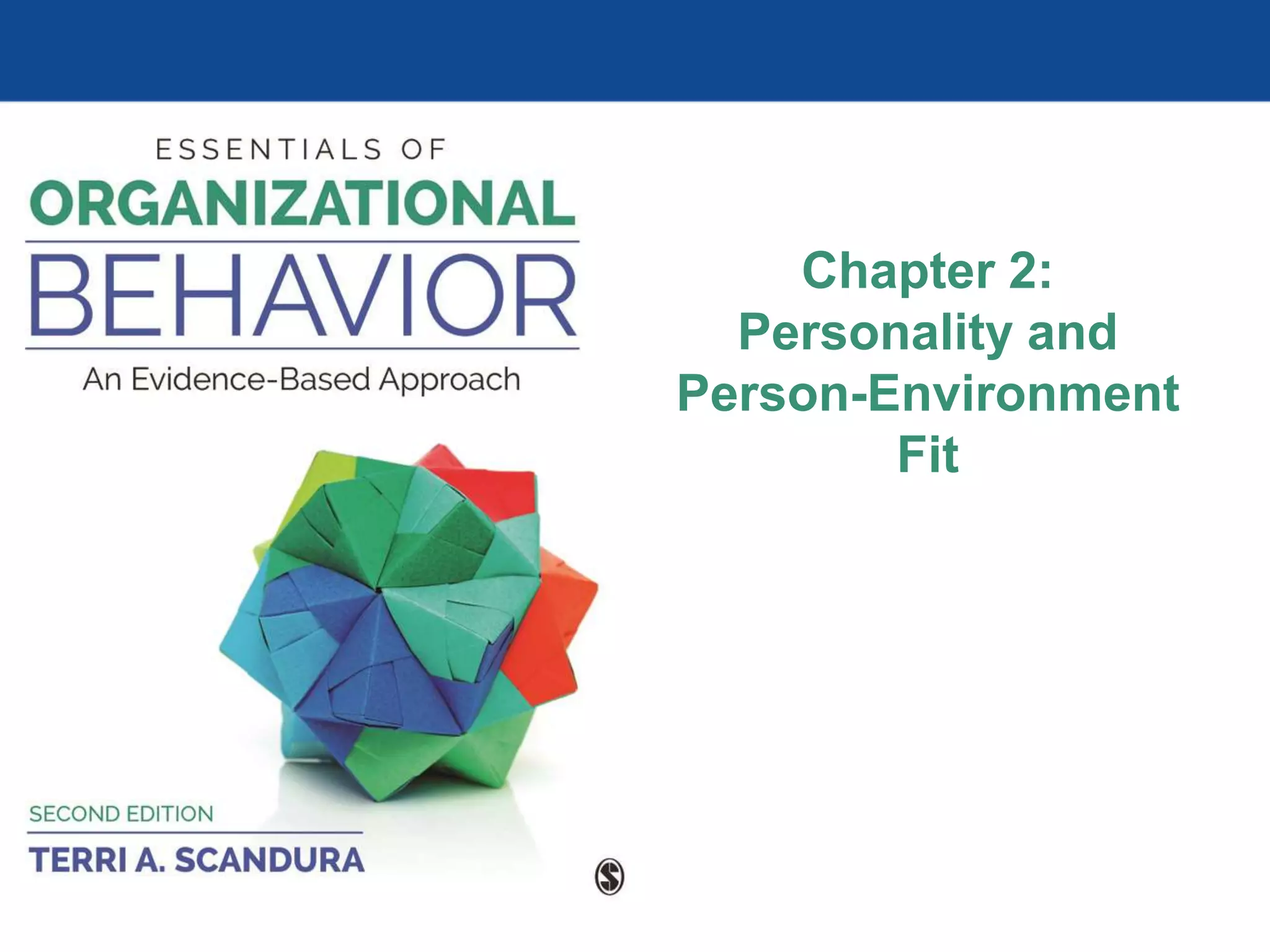
Chapter 2:
Personality and
Person-Environment
Fit
What Is Personality?
• Personality has been defined as “regularities in
feeling, thought and action that are
characteristic of an individual.” (Snyder, 1998)
Scandura, Essentials of Organizational Behavior 2e. © SAGE Publications, 2019. 2
What is Personality? (Cont.)
• Understanding your own personality and the
personalities of others is critical
• Personality and other individual differences are
relatively stable over the life course
Scandura, Essentials of Organizational Behavior 2e. © SAGE Publications, 2019. 3
What Is Personality? (Cont.)
• Personality is linked to social behavior in
organizations
• Personality may affect our work habits and how
we interact with our co-workers
• Personality and most individual differences aren’t
like other areas of organizational behavior
Scandura, Essentials of Organizational Behavior 2e. © SAGE Publications, 2019. 4
What Is Personality? (Cont.)
• Individual differences must be understood, and
leaders must work with them rather than try to
change people
• “Personality Clash”
Scandura, Essentials of Organizational Behavior 2e. © SAGE Publications, 2019. 5
What Is Personality? (Cont.)
• Role of Heredity
• Can a brilliant engineer who is introverted change
his personality and become an extraverted
visionary leader?
• Are personality traits inborn or learned?
Scandura, Essentials of Organizational Behavior 2e. © SAGE Publications, 2019. 6
What is Personality? (Cont.)
• Minnesota Twin Studies
• These twins tell us a great deal about the
contribution of heredity
• 50% of the variation in occupational choice is due
to heredity
• 40% of the variance in values related to work
motivation attributed to heredity
• 60% of the variance was due to the environment
Scandura, Essentials of Organizational Behavior 2e. © SAGE Publications, 2019. 7
What Is Personality? (Cont.)
• Implications for a leader
• Most psychologists believe that personality is a
relatively stable individual difference
• Instead of trying to change a coworker’s
personality, learn about personality differences
• Understand how different personalities operate at
work, and work effectively with different types
Scandura, Essentials of Organizational Behavior 2e. © SAGE Publications, 2019. 8
What Is Personality? (Cont.)
• Leaders: Are They Born or Made?
• One question that arises is whether leaders are
born to greatness or if leadership can be acquired
by anyone
• Leadership is most likely a combination of inborn
traits and learned behavior
Scandura, Essentials of Organizational Behavior 2e. © SAGE Publications, 2019. 9
Myers-Briggs Type Indicator
• The Myers-Briggs Type Indicator (MBTI) is the
most often administered personality test
• A popular approach with organizations and is
used by Hallmark, GE, and many other large
organizations in their leadership training and
development programs
Scandura, Essentials of Organizational Behavior 2e. © SAGE Publications, 2019. 10
Myers-Briggs Type Indicator
(Cont.)
• The MBTI is based upon four general personality
preferences:
• Introversion (I) versus extraversion (E): Extraverts tend
to be outgoing; introverts tend to be shy
• Sensing (S) versus intuition (N): Sensing types tend to
be practical; intuitive people tend to be “idea people”
• Thinking (T) versus feeling (F): Thinking types tend to
use logic; feeling types tend to use emotion
• Judging (J) versus perceiving (P): Judging types tend to
make quick decisions; perceiving types tend to be more
flexible
Scandura, Essentials of Organizational Behavior 2e. © SAGE Publications, 2019. 11
Myers-Briggs Type Indicator
(Cont.)
• Limitations of the Myers-Briggs Type Indicator
• If you take the test again, you may not receive the
same score
• Whether people are actually classifiable into the 16
categories is questionable
Scandura, Essentials of Organizational Behavior 2e. © SAGE Publications, 2019. 12
Myers-Briggs Type Indicator
(Cont.)
• How the Myers-Briggs Type Indicator Is Used
in Organizations
• For conflict resolution and team building
• In management training programs and classrooms
• It takes all types of people for teams and
organizations to be effective
Scandura, Essentials of Organizational Behavior 2e. © SAGE Publications, 2019. 13
The Big Five
• Openness
• Conscientiousness
• Extraversion
• Agreeableness
• Neuroticism
Scandura, Essentials of Organizational Behavior 2e. © SAGE Publications, 2019. 14
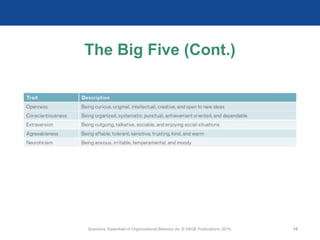
The Big Five (Cont.)
Scandura, Essentials of Organizational Behavior 2e. © SAGE Publications, 2019. 15
Personality Traits and Health
Research
• Type A--aggressive, competitive, may have
more health problems such as cardiovascular
disease
• Type B--relaxed, easy going, not likely to have
as many health problems
Scandura, Essentials of Organizational Behavior 2e. © SAGE Publications, 2019. 16
Personality Traits and Health
Research (Cont.)
• Study respondents were classified into Type A
and Type B personalities based o the following
questions:
• Do you feel guilty if you use spare time to relax?
• Do you need to win in order to derive enjoyment from
games and sports?
• Do you generally move, walk, and eat rapidly?
• Do you often try to do more than one thing at a time?
Scandura, Essentials of Organizational Behavior 2e. © SAGE Publications, 2019. 17
Personality Traits and Health
Research (Cont.)
Scandura, Essentials of Organizational Behavior 2e. © SAGE Publications, 2019. 18
Other Relevant Personality Traits
• Machiavellianism
• Ends justifies the means
• Pragmatic
• Emotional Dissonance
Scandura, Essentials of Organizational Behavior 2e. © SAGE Publications, 2019. 19
Scandura, Essentials of Organizational Behavior 2e. © SAGE Publications, 2019. 20
Other Relevant Personality Traits
(Cont.)
Other Relevant Personality Traits
(Cont.)
• Self-Monitoring
• “Self-observation and self-control guided by situational
cues to social appropriateness” (Snyder, 1974)
• Ability to adjust his/her behavior to external situational
factors
• Consistent displaying their feelings and attitudes
regardless of situation
Scandura, Essentials of Organizational Behavior 2e. © SAGE Publications, 2019. 21
Other Relevant Personality Traits
(Cont.)
• Self-Monitoring
• High self-monitors receive higher performance ratings,
and become leaders, but have lower organizational
commitment.
• High self-monitors develop better working relationships
with bosses than low self-monitors
• High self-monitors achieve more rapid career mobility
since they are able to attain central positions in the
powerful networks in the organization
Scandura, Essentials of Organizational Behavior 2e. © SAGE Publications, 2019. 22
Other Relevant Personality Traits
(Cont.)
• Risk-Taking
• “Any purposive activity that entails novelty or danger
sufficient to create anxiety in most people. Risk taking can
be either physical or social, or a combination of the two.”
(Levenson, 1990)
Scandura, Essentials of Organizational Behavior 2e. © SAGE Publications, 2019. 23
Other Relevant Personality Traits
(Cont.)
• Risk-Taking
• Taking a chance on the unknown
• Examples: rock climbers, firemen, entrepreneurs
• Risk-taking declines across the life span
• When resources are scarce, people continue to assume
risk to compete for resources
Scandura, Essentials of Organizational Behavior 2e. © SAGE Publications, 2019. 24
Psychological Capital
• Positive organizational behavior (POB) is “the
study and application of positive-oriented
human resource strengths and psychological
capacities that can be measured, developed,
and effectively managed for performance
improvement in today’s workplace.” (Luthans,
2002, p.59)
Scandura, Essentials of Organizational Behavior 2e. © SAGE Publications, 2019. 25
Psychological Capital (Cont.)
• Psychological capital (PsyCap) has been
shown to be positively related to employee
empowerment and engagement
• PsyCap is more than “what you know” or “who
you know” it is focused on “who you are” and
“who you are becoming”
• Just like we have financial capital, these state-
like qualities represent the value of individual
differences at the workplace
Scandura, Essentials of Organizational Behavior 2e. © SAGE Publications, 2019. 26
Psychological Capital (Cont.)
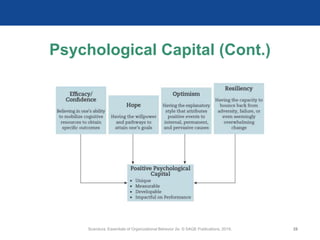
• Efficacy--belief in oneself
• Optimism--being positive
• Hope--seeing the pathways to the future
• Resiliency--ability to “bounce back”
Scandura, Essentials of Organizational Behavior 2e. © SAGE Publications, 2019. 27
Psychological Capital (Cont.)
Scandura, Essentials of Organizational Behavior 2e. © SAGE Publications, 2019. 28
Core Self-Evaluations
• Core self-evaluations (CSE) are defined as
“fundamental premises that individuals hold
about themselves and their functioning in the
world.” (Judge, 1998)
Scandura, Essentials of Organizational Behavior 2e. © SAGE Publications, 2019. 29
Core Self-Evaluations (Cont.)
• Core self-evaluations relate to job satisfaction and
job performance
• Positive core self-evaluations predicts employee
voice
• Positive relationships exist between core self-
evaluations and higher salaries
• Higher core self-evaluations are associated with
early job success
• Core self-evaluations show concept of self-worth
translate into net worth
Scandura, Essentials of Organizational Behavior 2e. © SAGE Publications, 2019. 30
Person-Environment Fit
• Person-Environment (PE) Fit--when an
individual’s personality is aligned with their
environment, it results in job satisfaction,
organizational commitment, and better
performance on the job
• Two types of Person-Environment Fit:
• Person-Organization (PO) fit
• Person-Job (PJ) fit
Scandura, Essentials of Organizational Behavior 2e. © SAGE Publications, 2019. 31
Person-Environment Fit (Cont.)
• Person-Organization (PO) fit
• Match between a person’s individual values and
those of the organization they work for
• Employees who will “fit in” with the organizational
culture
• Employees feel a sense of psychological ownership
for their work
• Good fit is the result of better communication,
increased productivity, interpersonal attraction, and
trust in the organization
Scandura, Essentials of Organizational Behavior 2e. © SAGE Publications, 2019. 32
Person-Environment Fit (Cont.)
• Person-Job (PJ) Fit
• Job characteristics are aligned with employees'
personality, motivations, and abilities
• PJ Fit is comprised of two forms:
• Demands-abilities (DA) fit
• Needs-supplies (NS) fit
Scandura, Essentials of Organizational Behavior 2e. © SAGE Publications, 2019. 33
Person-Environment Fit (Cont.)
Scandura, Essentials of Organizational Behavior 2e. © SAGE Publications, 2019. 34

Lead 705 ppt 2

  • 1.
  • 2.
    What Is Personality? •Personality has been defined as “regularities in feeling, thought and action that are characteristic of an individual.” (Snyder, 1998) Scandura, Essentials of Organizational Behavior 2e. © SAGE Publications, 2019. 2
  • 3.
    What is Personality?(Cont.) • Understanding your own personality and the personalities of others is critical • Personality and other individual differences are relatively stable over the life course Scandura, Essentials of Organizational Behavior 2e. © SAGE Publications, 2019. 3
  • 4.
    What Is Personality?(Cont.) • Personality is linked to social behavior in organizations • Personality may affect our work habits and how we interact with our co-workers • Personality and most individual differences aren’t like other areas of organizational behavior Scandura, Essentials of Organizational Behavior 2e. © SAGE Publications, 2019. 4
  • 5.
    What Is Personality?(Cont.) • Individual differences must be understood, and leaders must work with them rather than try to change people • “Personality Clash” Scandura, Essentials of Organizational Behavior 2e. © SAGE Publications, 2019. 5
  • 6.
    What Is Personality?(Cont.) • Role of Heredity • Can a brilliant engineer who is introverted change his personality and become an extraverted visionary leader? • Are personality traits inborn or learned? Scandura, Essentials of Organizational Behavior 2e. © SAGE Publications, 2019. 6
  • 7.
    What is Personality?(Cont.) • Minnesota Twin Studies • These twins tell us a great deal about the contribution of heredity • 50% of the variation in occupational choice is due to heredity • 40% of the variance in values related to work motivation attributed to heredity • 60% of the variance was due to the environment Scandura, Essentials of Organizational Behavior 2e. © SAGE Publications, 2019. 7
  • 8.
    What Is Personality?(Cont.) • Implications for a leader • Most psychologists believe that personality is a relatively stable individual difference • Instead of trying to change a coworker’s personality, learn about personality differences • Understand how different personalities operate at work, and work effectively with different types Scandura, Essentials of Organizational Behavior 2e. © SAGE Publications, 2019. 8
  • 9.
    What Is Personality?(Cont.) • Leaders: Are They Born or Made? • One question that arises is whether leaders are born to greatness or if leadership can be acquired by anyone • Leadership is most likely a combination of inborn traits and learned behavior Scandura, Essentials of Organizational Behavior 2e. © SAGE Publications, 2019. 9
  • 10.
    Myers-Briggs Type Indicator •The Myers-Briggs Type Indicator (MBTI) is the most often administered personality test • A popular approach with organizations and is used by Hallmark, GE, and many other large organizations in their leadership training and development programs Scandura, Essentials of Organizational Behavior 2e. © SAGE Publications, 2019. 10
  • 11.
    Myers-Briggs Type Indicator (Cont.) •The MBTI is based upon four general personality preferences: • Introversion (I) versus extraversion (E): Extraverts tend to be outgoing; introverts tend to be shy • Sensing (S) versus intuition (N): Sensing types tend to be practical; intuitive people tend to be “idea people” • Thinking (T) versus feeling (F): Thinking types tend to use logic; feeling types tend to use emotion • Judging (J) versus perceiving (P): Judging types tend to make quick decisions; perceiving types tend to be more flexible Scandura, Essentials of Organizational Behavior 2e. © SAGE Publications, 2019. 11
  • 12.
    Myers-Briggs Type Indicator (Cont.) •Limitations of the Myers-Briggs Type Indicator • If you take the test again, you may not receive the same score • Whether people are actually classifiable into the 16 categories is questionable Scandura, Essentials of Organizational Behavior 2e. © SAGE Publications, 2019. 12
  • 13.
    Myers-Briggs Type Indicator (Cont.) •How the Myers-Briggs Type Indicator Is Used in Organizations • For conflict resolution and team building • In management training programs and classrooms • It takes all types of people for teams and organizations to be effective Scandura, Essentials of Organizational Behavior 2e. © SAGE Publications, 2019. 13
  • 14.
    The Big Five •Openness • Conscientiousness • Extraversion • Agreeableness • Neuroticism Scandura, Essentials of Organizational Behavior 2e. © SAGE Publications, 2019. 14
  • 15.
    The Big Five(Cont.) Scandura, Essentials of Organizational Behavior 2e. © SAGE Publications, 2019. 15
  • 16.
    Personality Traits andHealth Research • Type A--aggressive, competitive, may have more health problems such as cardiovascular disease • Type B--relaxed, easy going, not likely to have as many health problems Scandura, Essentials of Organizational Behavior 2e. © SAGE Publications, 2019. 16
  • 17.
    Personality Traits andHealth Research (Cont.) • Study respondents were classified into Type A and Type B personalities based o the following questions: • Do you feel guilty if you use spare time to relax? • Do you need to win in order to derive enjoyment from games and sports? • Do you generally move, walk, and eat rapidly? • Do you often try to do more than one thing at a time? Scandura, Essentials of Organizational Behavior 2e. © SAGE Publications, 2019. 17
  • 18.
    Personality Traits andHealth Research (Cont.) Scandura, Essentials of Organizational Behavior 2e. © SAGE Publications, 2019. 18
  • 19.
    Other Relevant PersonalityTraits • Machiavellianism • Ends justifies the means • Pragmatic • Emotional Dissonance Scandura, Essentials of Organizational Behavior 2e. © SAGE Publications, 2019. 19
  • 20.
    Scandura, Essentials ofOrganizational Behavior 2e. © SAGE Publications, 2019. 20 Other Relevant Personality Traits (Cont.)
  • 21.
    Other Relevant PersonalityTraits (Cont.) • Self-Monitoring • “Self-observation and self-control guided by situational cues to social appropriateness” (Snyder, 1974) • Ability to adjust his/her behavior to external situational factors • Consistent displaying their feelings and attitudes regardless of situation Scandura, Essentials of Organizational Behavior 2e. © SAGE Publications, 2019. 21
  • 22.
    Other Relevant PersonalityTraits (Cont.) • Self-Monitoring • High self-monitors receive higher performance ratings, and become leaders, but have lower organizational commitment. • High self-monitors develop better working relationships with bosses than low self-monitors • High self-monitors achieve more rapid career mobility since they are able to attain central positions in the powerful networks in the organization Scandura, Essentials of Organizational Behavior 2e. © SAGE Publications, 2019. 22
  • 23.
    Other Relevant PersonalityTraits (Cont.) • Risk-Taking • “Any purposive activity that entails novelty or danger sufficient to create anxiety in most people. Risk taking can be either physical or social, or a combination of the two.” (Levenson, 1990) Scandura, Essentials of Organizational Behavior 2e. © SAGE Publications, 2019. 23
  • 24.
    Other Relevant PersonalityTraits (Cont.) • Risk-Taking • Taking a chance on the unknown • Examples: rock climbers, firemen, entrepreneurs • Risk-taking declines across the life span • When resources are scarce, people continue to assume risk to compete for resources Scandura, Essentials of Organizational Behavior 2e. © SAGE Publications, 2019. 24
  • 25.
    Psychological Capital • Positiveorganizational behavior (POB) is “the study and application of positive-oriented human resource strengths and psychological capacities that can be measured, developed, and effectively managed for performance improvement in today’s workplace.” (Luthans, 2002, p.59) Scandura, Essentials of Organizational Behavior 2e. © SAGE Publications, 2019. 25
  • 26.
    Psychological Capital (Cont.) •Psychological capital (PsyCap) has been shown to be positively related to employee empowerment and engagement • PsyCap is more than “what you know” or “who you know” it is focused on “who you are” and “who you are becoming” • Just like we have financial capital, these state- like qualities represent the value of individual differences at the workplace Scandura, Essentials of Organizational Behavior 2e. © SAGE Publications, 2019. 26
  • 27.
    Psychological Capital (Cont.) •Efficacy--belief in oneself • Optimism--being positive • Hope--seeing the pathways to the future • Resiliency--ability to “bounce back” Scandura, Essentials of Organizational Behavior 2e. © SAGE Publications, 2019. 27
  • 28.
    Psychological Capital (Cont.) Scandura,Essentials of Organizational Behavior 2e. © SAGE Publications, 2019. 28
  • 29.
    Core Self-Evaluations • Coreself-evaluations (CSE) are defined as “fundamental premises that individuals hold about themselves and their functioning in the world.” (Judge, 1998) Scandura, Essentials of Organizational Behavior 2e. © SAGE Publications, 2019. 29
  • 30.
    Core Self-Evaluations (Cont.) •Core self-evaluations relate to job satisfaction and job performance • Positive core self-evaluations predicts employee voice • Positive relationships exist between core self- evaluations and higher salaries • Higher core self-evaluations are associated with early job success • Core self-evaluations show concept of self-worth translate into net worth Scandura, Essentials of Organizational Behavior 2e. © SAGE Publications, 2019. 30
  • 31.
    Person-Environment Fit • Person-Environment(PE) Fit--when an individual’s personality is aligned with their environment, it results in job satisfaction, organizational commitment, and better performance on the job • Two types of Person-Environment Fit: • Person-Organization (PO) fit • Person-Job (PJ) fit Scandura, Essentials of Organizational Behavior 2e. © SAGE Publications, 2019. 31
  • 32.
    Person-Environment Fit (Cont.) •Person-Organization (PO) fit • Match between a person’s individual values and those of the organization they work for • Employees who will “fit in” with the organizational culture • Employees feel a sense of psychological ownership for their work • Good fit is the result of better communication, increased productivity, interpersonal attraction, and trust in the organization Scandura, Essentials of Organizational Behavior 2e. © SAGE Publications, 2019. 32
  • 33.
    Person-Environment Fit (Cont.) •Person-Job (PJ) Fit • Job characteristics are aligned with employees' personality, motivations, and abilities • PJ Fit is comprised of two forms: • Demands-abilities (DA) fit • Needs-supplies (NS) fit Scandura, Essentials of Organizational Behavior 2e. © SAGE Publications, 2019. 33
  • 34.
    Person-Environment Fit (Cont.) Scandura,Essentials of Organizational Behavior 2e. © SAGE Publications, 2019. 34

Editor's Notes

  • #3 Learning Objective 2.1: Define personality, and discuss the role of heredity.
  • #4 Learning Objective 2.1: Define personality, and discuss the role of heredity. Understanding your own personality and the personalities of others is critical. This is because personality and other individual differences are relatively stable over the life course. Personality may affect our work habits and how we interact with our coworkers. However, personality and most individual differences aren’t like other areas of organizational behavior (OB) where the manager can influence the outcomes by intervention. Individual differences are aspects of OB that must be understood, and leaders must often work with them rather than try to change people. This is why we often hear people speak about two people who just don’t get along as a “personality clash.”
  • #5 Learning Objective 2.1: Define personality, and discuss the role of heredity. Personality matters because it is linked to social behavior in organizations. Personality may affect our work habits and how we interact with our coworkers. However, personality and most individual differences aren’t like other areas of organizational behavior (OB) where the manager can influence the outcomes by intervention.
  • #6 Learning Objective 2.1: Define personality, and discuss the role of heredity. Individual differences are aspects of OB that must be understood, and leaders must often work with them rather than try to change people. This is why we often hear people speak about two people who just don’t get along as a “personality clash.”
  • #7 Learning Objective 2.1: Define personality, and discuss the role of heredity. Can a brilliant engineer who is introverted change his personality and become an extraverted visionary leader? In other words, are personality traits inborn or learned? This question has been addressed by the famous Minnesota twin studies.
  • #8 Learning Objective 2.1: Define personality, and discuss the role of heredity. Can a brilliant engineer who is introverted change his personality and become an extraverted visionary leader? In other words, are personality traits inborn or learned? This question has been addressed by the famous Minnesota twin studies. Minnesota twin studies--twins born in Minnesota from 1936 through 1955 were asked to join a registry. Identical twins (monozygotic and dizygotic reared apart, MZAs and DZAs, respectively) were confirmed through birth records, and 80% of the surviving, intact pairs were located and recruited for participation in various psychological studies. Some twins were reared apart for various reasons (e.g., adoption). These twins tell us a great deal about the contribution of heredity compared to the child rearing environment. A study showed that 50% of the variation in occupational choice (whether a person is a dentist or a soldier, for example) is due to heredity. Most people are surprised to learn this. Another study of MZA and DZA twins showed that 40% of the variance in values related to work motivation could be attributed to heredity whereas 60% was due to the environment (and measurement error). The implications for a leader are that while personality might change, most psychologists believe that it is a relatively stable individual difference. Instead of trying to change a coworker’s personality, it is perhaps better to learn about personality differences, understand how different personalities operate at work, and then learn to work effectively with different types. Psychologists have developed inventories (personality tests) to assess personality differences. These tests are useful in training programs on conflict resolution and team building.
  • #9 Learning Objective 2.1: Define personality, and discuss the role of heredity. The implications for a leader are that while personality might change, most psychologists believe that it is a relatively stable individual difference. Instead of trying to change a coworker’s personality, it is perhaps better to learn about personality differences, understand how different personalities operate at work, and then learn to work effectively with different types. Psychologists have developed inventories (personality tests) to assess personality differences. These tests are useful in training programs on conflict resolution and team building.
  • #10 Learning Objective 2.1: Define personality, and discuss the role of heredity. With the research on the twins reared apart and evidence from the Big Five personality theory relating personality traits to leader emergence in groups, one question that arises is whether leaders are born to greatness or if leadership can be acquired by anyone. There are arguments on both sides of this issue among scholars of OB. For example, research suggests genetic factors contribute as much as 40% to the explanation of transformational leadership. This suggests that much of charismatic, visionary leadership is an in-born trait. On the other hand, many people believe that transformational leadership can be learned, and experimental research has shown that leaders can be trained to exhibit charismatic behaviors. Followers responded positively to leaders that have been trained and their performance increased. An integrative perspective suggests that leaders have certain inborn traits that predispose them to self-select into leadership positions. For example, an employee that exhibits extraversion might be more likely to pursue a high-level position in an organization. Once hired into a leadership role, these people may respond to leadership training more than those who are not as interested in becoming leaders. The best thinking on this at present is that leadership is most likely a combination of inborn traits and learned behavior. The implications for organizations are to carefully select those hired into leadership and then provide the training needed to enhance leader effectiveness. Those with innate leadership skills have an advantage, but an individual may be able to enhance his or her leadership capabilities by learning about the behaviors that comprise effective leadership and then practicing the behavioural skills needed.
  • #11 Learning Objective 2.2: Discuss the benefits and limitations of using the MBTI in organizations. The Myers-Briggs Type Indicator (MBTI) is the most often administered personality test to non-psychiatric populations (i.e., the “well population”). The publishers of the MBTI, Consulting Psychologists Press, report that over two million people take the MBTI every year. Because it was developed and normed on “well people,” it has been a popular approach with organizations and is used by Hallmark, GE, and many other large organizations in their leadership training and development programs. The MBTI was developed by a mother and daughter team, Katherine Briggs and Isabel Myers-Briggs, following World War II and is based upon the personality theories of Carl Jung. Murray, J. B. (1990).
  • #12 Learning Objective 2.2: Discuss the benefits and limitations of using the MBTI in organizations. The MBTI is based upon four general personality preferences: 1. Introversion (I) versus extraversion (E): Extraverts tend to be outgoing; introverts tend to be shy. 2. Sensing (S) versus intuition (N): Sensing types tend to be practical; intuitive people tend to be “idea people.” 3. Thinking (T) versus feeling (F): Thinking types tend to use logic; feeling types tend to use emotion. 4. Judging (J) versus perceiving (P): Judging types tend to make quick decisions; perceiving types tend to be more flexible. People who take the MBTI are then grouped into 16 personality “types” based on these characteristics. For example, an ENTP would be extraverted, intuitive, thinking, and perceiving. This person might be attracted to starting their own business, for example. In contrast, an INTJ is introverted, intuitive, thinking, and judging and may be attracted to a scientific career. ISTJs are detail-oriented and practical, where ESTJs are organizers and may be comfortable in managerial roles.
  • #13 Learning Objective 2.2: Discuss the benefits and limitations of using the MBTI in organizations. There has been limited research support for the reliability and validity of the MBTI. If you take the test again, you may not receive the same score, and the matter of whether people are actually classifiable into the 16 categories is questionable., However, the MBTI remains the most popular personality test in use for organizations. Also, it is important to note that the MBTI has not been validated for selection; in other words, its publisher makes it clear that you should not use the MBTI to hire people for particular jobs in an organization.
  • #14 Learning Objective 2.2: Discuss the benefits and limitations of using the MBTI in organizations. The best uses for the MBTI appears to be for conflict resolution and team building, and this is where it is most often used in management training programs and classrooms. The value of the MBTI is to enable people in organizations to discuss personality differences in their approach to work in a nonjudgmental way. All of the labels in the MBTI are neutral; it is not better or worse to be judging or perceiving At the workplace, everyone has something to offer, and it takes all types of people for teams and organizations to be effective. For a leader, this underscores the importance of understanding individual differences because to build effective teams, everyone needs to feel valued to be engaged.
  • #15 Learning Objective 2.3: List and explain the five factors in the Big Five theory of personality. After much research examining personality inventories, the developers of the Big Five theory of personality concluded that personality could be summarized using five factors: openness, conscientiousness, extraversion, agreeableness, and neuroticism.
  • #16 Learning Objective 2.3: List and explain the five factors in the Big Five theory of personality. Table 2.1: The Big Five Personality Characteristics Research has shown that emotional stability relates to the ability to cope with stress, and those with higher openness adjust better to organizational change. Given the strong research support for the relationships of the Big Five personality variables and relevant performance and career outcomes, leaders need to know that instruments such as the Big Five inventories successfully predict performance and can be used as one component in making hiring decisions. For this reason, personality research has a great deal of practical utility for organizations.
  • #17 Learning Objective 2.4: Compare and contrast the Type A and Type B behavior pattern.   We have heard the phrase “stress kills,” but is there any truth to this? Some years ago, cardiologists showed a link between a personality trait called Type A behavior and cardiovascular heart disease. Their theory was based on observing patients in their waiting room; some sat patiently reading a magazine, for example. Others sat on the edge of their seats and got up frequently (they literally wore out the edges of the chairs and armrests)!
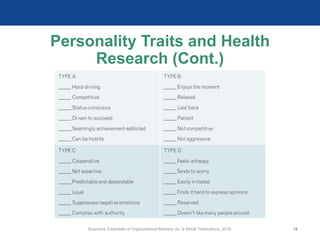
  • #18 Learning Objective 2.4: Compare and contrast the Type A and Type B behavior pattern. The doctors conducted a study over a long period of time and asked questions such as the following: 1. Do you feel guilty if you use spare time to relax? 2. Do you need to win in order to derive enjoyment from games and sports? 3. Do you generally move, walk, and eat rapidly? 4. Do you often try to do more than one thing at a time? Study respondents were then classified into one of three groups: Type A (competitive, aggressive), Type B (relaxed, easygoing), or Type C (nice, hardworking, people who try to appease others). By the end of this long-term study, 70% of the men who were classified has Type A had coronary heart disease. This study had several limitations including that it was only conducted on men who were middle-aged, and the researchers didn’t take into account other factors such as the dietary habits of the study participants. However, this study generated media interest and led to additional research. A review of this research indicated that there is an association between Type A behavior (particularly hostility) and heart disease. Examples of hostility-related questions are “Do you get irritated easily?” and “Are you bossy and domineering?” And research has shown that the Type A behavior pattern (i.e., “stress energized”) is exhibited in samples of women also.
  • #19 Learning Objective 2.4: Compare and contrast the Type A and Type B behavior pattern.   Figure 2.1 summarizes the four personality types, and you can reflect on the checklists in each cell to get a sense of whether you may fall into Type A, B, C, or D. This may be scary news if you think you may have Type A or D personality characteristics. However, there is some good news. Being able to express your emotions may also reflect a “healthy” Type A pattern. It is important for people with a Type A personality to be able to talk to another person about the stress they are experiencing. Second, research has shown that having a “hardy” personality (e.g., letting stress roll off of your back rather than ruminating on your problems) has been shown to reduce the potential for personality type to affect health., Also, social support from family, friends, and coworkers can alleviate some of the detrimental effects of personality traits on health.
  • #20 Learning Objective 2.5: Develop an example of a job that would benefit from risk-taking. The trait of Machiavellianism (sometimes abbreviated Mach) refers to a person who believes that the “ends justify the means.” In other words, such a person will do whatever it takes to win. The trait is named for Niccolo Machiavelli, who wrote a book called The Prince, which detailed his strategies for gaining and holding onto power in the sixteenth century. Hi Mach individuals believe that other people can be manipulated, and that it is permissible to do so to reach their goals. Mach--The degree to which and individual is pragmatic, maintains emotional dissonance, and believes that ends justify the means.
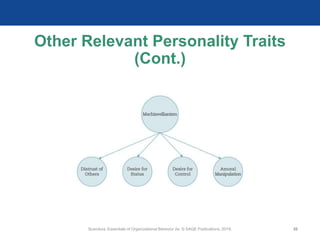
  • #21 Learning Objective 2.5: Develop an example of a job that would benefit from risk-taking. Figure 2.2 The Structure of Machiavellianism. Recent research has conceptualized Mach as being comprised of a complex set of characteristics: a tendency to distrust others, a willingness to engage in amoral manipulation, a desire to accumulate status for oneself, and a desire to maintain interpersonal control (see Figure 2.2).
  • #22 Learning Objective 2.5: Develop an example of a job that would benefit from risk-taking. Have you ever known someone who had a chameleon-like personality and adapted to the situation they are in? Such individuals who are keenly sensitive to the cues they see in every situation they are in and adapt their behavior to fit in. This is known as self-monitoring and is defined as “self-observation and self-control guided by situational cues to social appropriateness.” High self-monitors are very adaptable to situations and low self-monitors are not able to pretend that they are someone that they are not. In other words, low self-monitors are true to themselves and don’t take cues to change their behavior from social situations. They are consistent in their display of feelings and attitudes regardless of the situation.
  • #23 Learning Objective 2.5: Develop an example of a job that would benefit from risk-taking. In the workplace, high self-monitors receive higher performance ratings, and become leaders, but have lower organizational commitment. They do, however develop better working relationships with bosses than low self-monitors and this helps explain the higher performance ratings they receive. Not surprisingly, they achieve more rapid career mobility since they are able to attain central positions in the powerful networks in the organization. Despite the positive outcomes associated with self-monitoring behavior, there may be a downside to this trait. A research study found that high-self monitors may engage in counterproductive work behavior toward the organization (e.g., falsifying a receipt to get reimbursed for more money, or taking an additional or longer break than is acceptable). They may reach their goals by doing whatever it takes to win (similar to behavior of high Mach employees).
  • #24 Learning Objective 2.5: Develop an example of a job that would benefit from risk-taking. Some people are naturally prone to taking risks and others are risk-averse. Risk-taking is a personality trait defined as “any purposive activity that entails novelty or danger sufficient to create anxiety in most people. Risk taking can be either physical or social, or a combination of the two.” (Levenson, 1990)
  • #25 Learning Objective 2.5: Develop an example of a job that would benefit from risk-taking. Rock climbers are an example of people who assume the physical aspect of risk-taking. Firemen can be considered risk-takers that are both social and physical because they risk physical harm but it is to help others so it has a social component. Entrepreneurs can be considered social risk takers but not physical. Entrepreneurs have been found to have a higher risk-taking propensity than general managers. Moreover, there are larger differences between entrepreneurs whose primary goal is venture growth versus those whose focus is on producing family income. Risk-taking has been examined in the general population and across cultures and the evidence is interesting. Survey data from 77 countries (147,118 respondents) suggests that risk-taking declines across the life span – as we get older, we take fewer risks. However, there are differences across countries. In countries in which hardship (e.g., social unrest and economic strife) exists, risk does not decline as the people get older. These findings suggest that when resources are scarce, people must continue to assume risk to compete for resources, so risk-taking does not decline as they age.
  • #26 Learning Objective 2.6: Summarize the elements of psychological capital. Positive organizational behavior (POB), borrowed from Positive Organizational Scholarship is an emerging field. POB is “the study and application of positive-oriented human resource strengths and psychological capacities that can be measured, developed, and effectively managed for performance improvement in today’s workplace” (Luthans, 2002, p. 59).
  • #27 Learning Objective 2.6: Summarize the elements of psychological capital. In Positive organizational behavior (POB), only positive psychological capacities are included. Being state-like versus trait-like, these positive aspects could be developed through performance improvement solutions such as training programs and other engagement interventions. Psychological Capital (PsyCap) has been shown to be positively related to employee empowerment and engagement. Fred Luthans and his colleagues have articulated a four-part explanation of PsyCap. Just like we have financial capital, these state-like qualities represent the value of individual differences at the workplace. In other words, PsyCap is more than “what you know” or “who you know.” It is focused on “who you are” and “who you are becoming.”
  • #28 Learning Objective 2.6: Summarize the elements of psychological capital. Fred Luthans and his colleagues have articulated a four-part explanation of PsyCap. Just like we have financial capital, these state-like qualities represent the value of individual differences at the workplace. These four characteristics are as follows: Efficacy--a person’s belief that they have the ability to execute a specific task in a given context Optimism--a positive outcome outlook or attribution of events, which includes positive emotions and motivation Hope--the will to succeed and the ability to identify and pursue the path to success Resiliency--coping in the face of risk or adversity; the ability to “bounce back” after a setback
  • #29 Learning Objective 2.6: Summarize the elements of psychological capital. Figure 2.3: Dimensions of Positive Psychological Capital. Summarizes the relationships of the four PsyCap elements and organizational outcomes that relate to the competitive advantage of organizations.
  • #30 Learning Objective 2.7: Explain the effects of positive and negative core self-evaluations. Core self-evaluations (CSE) are defined as “fundamental premises that individuals hold about themselves and their functioning in the world.” (Judge, 1998) People who have a high core self-evaluation see themselves as competent and in control. An experimental study found that management students who scored high on core self-evaluations chose more complex tasks.
  • #31 Learning Objective 2.7: Explain the effects of positive and negative core self-evaluations. Core self-evaluations relate to job satisfaction and this is, in part, due to high CSE employees taking on more challenging tasks and seeing their work as personally fulfilling. Having a positive core self-evaluation predicts employee voice--in other words, such individuals are more likely to speak up and make suggestions about how to improve the work situation. Given the relationships of CSE and job performance, it is not surprising that the research evidence shows a positive relationship between CSE and higher salaries (when the manager had strong networking relationships with select mentors rather than lots of relationships). Core self-evaluations have also been strongly related to both persistence in job search behavior and success. Higher core self-evaluations are associated with early job success as well as higher career success over time. CSE shows that your concept of self-worth will likely translate into net worth.
  • #32 Learning Objective 2.8: Compare and contrast person-organization fit and person-job fit. Person-Environment (PE) fit has shown that when an individual’s personality is aligned with their environment, it results in job satisfaction, organizational commitment, and better performance on the job. Also, employees that fit their work environment are less likely to quit. There are different forms of how a person fits into their work environment and two types of PE fit are important: 1. person–organization (PO) fit, which is the match between the person and the organization and 2. person–job (PJ) fit, which is the match between the person and the job.
  • #33 Learning Objective 2.8: Compare and contrast person-organization fit and person-job fit. Person-Organization (PO) fit is viewed as the match between a person’s individual values and those of the organization they work for. PO fit is often considered in the context of recruiting employees who will “fit in” with the organizational culture. Organizations seek applicants that embrace their organizational culture and values. Job candidates are interested in working for an organization that has values similar to their own. This is because people are attracted to and trust others that they view as being similar to themselves. Good fit is the result of better communication among employees, increased predictability, interpersonal attraction, and trust in the organization, with trust being the key component that explains the positive outcomes of PO fit. Research evidence shows that good PO fit is positively related to job satisfaction, organizational commitment and job performance. Employees feel a sense of psychological ownership for their work because they feel a sense of belonging and experience the organization as a place that makes them feel comfortable, positive, and safe.
  • #34 Learning Objective 2.8: Compare and contrast person-organization fit and person-job fit. Good Person-Job (PJ) Fit occurs when job characteristics are aligned with employees' personality, motivations, and abilities. The concept of PJ Fit also includes the fit with the work group and the supervisor. PJ Fit is comprised of two forms: 1. Demands-abilities (DA) fit--which refers to the compatibility between the employee's knowledge, skills, and abilities, and the demands of the job. The job characteristics are neither too easy nor too difficult for the abilities of the employee; they match. 2. Needs-supplies (NS) fit--refers to the extent to which the job supplies the employee's needs. This form of PJ fit addresses whether the job fulfills the employee’s needs for interesting work and a sense of meaning in their work.  
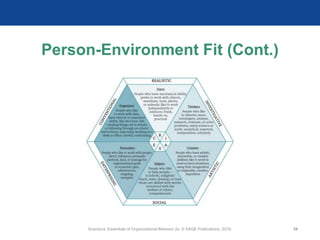
  • #35 Learning Objective 2.8: Compare and contrast person-organization fit and person-job fit. Figure 2.4 Personality-Job Fit Theory One of the best-researched theories of PJ fit is John Holland’s personality-job fit theory. He discovered six different personality types and examined occupations that match these types (see Figure 2.4 above)