CHAPTER 5:
PERCEPTION
AGENDA
• What is perception?
• Perceptual errors
• Expectations
• Impression management
Scandura, Essentials of Organizational Behavior. Š 2016, SAGE Publications. 2
WOULD YOU BE HAPPIER IF YOU
WERE RICHER?
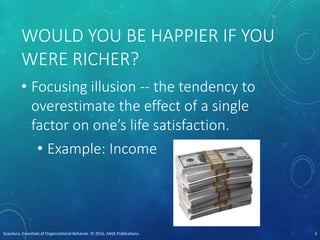
• Focusing illusion -- the tendency to
overestimate the effect of a single
factor on one’s life satisfaction.
• Example: Income
Scandura, Essentials of Organizational Behavior. Š 2016, SAGE Publications. 3
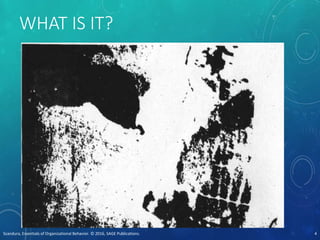
WHAT IS IT?
Scandura, Essentials of Organizational Behavior. Š 2016, SAGE Publications. 4
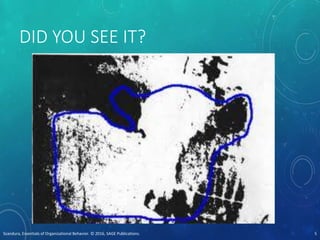
DID YOU SEE IT?
Scandura, Essentials of Organizational Behavior. Š 2016, SAGE Publications. 5
WHAT IS PERCEPTION?
• A leader must understand that each
person’s perception is their reality and
this is how they will interpret the
leader’s actions and everything else
that happens at the work place.
• Perceptions can change.
Scandura, Essentials of Organizational Behavior. Š 2016, SAGE Publications. 6
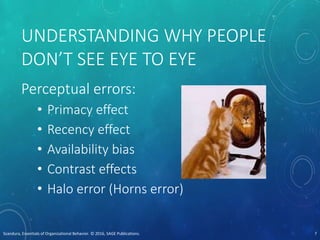
UNDERSTANDING WHY PEOPLE
DON’T SEE EYE TO EYE
Perceptual errors:
• Primacy effect
• Recency effect
• Availability bias
• Contrast effects
• Halo error (Horns error)
Scandura, Essentials of Organizational Behavior. Š 2016, SAGE Publications. 7
THE PRIMACY EFFECT
• Belief perseverance
• Once a person has formed an initial
impression, they maintain it even
when presented with concrete
evidence that it is false.
• Example: first Impressions
Scandura, Essentials of Organizational Behavior. Š 2016, SAGE Publications. 8
THE RECENCY EFFECT
• Not only do people remember what
they experience first, they also
remember the most recently
presented items or experiences.
• Example: reading misspelled words
Scandura, Essentials of Organizational Behavior. Š 2016, SAGE Publications. 9
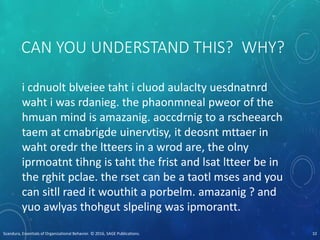
CAN YOU UNDERSTAND THIS? WHY?
i cdnuolt blveiee taht i cluod aulaclty uesdnatnrd
waht i was rdanieg. the phaonmneal pweor of the
hmuan mind is amazanig. aoccdrnig to a rscheearch
taem at cmabrigde uinervtisy, it deosnt mttaer in
waht oredr the ltteers in a wrod are, the olny
iprmoatnt tihng is taht the frist and lsat ltteer be in
the rghit pclae. the rset can be a taotl mses and you
can sitll raed it wouthit a porbelm. amazanig ? and
yuo awlyas thohgut slpeling was ipmorantt.
Scandura, Essentials of Organizational Behavior. Š 2016, SAGE Publications. 10
THE AVAILABILITY BIAS
• When a person’s judgments are based on
what most readily comes into a person’s
mind.
• Example: How many words in the English
language start with the letter R?
Scandura, Essentials of Organizational Behavior. Š 2016, SAGE Publications. 11
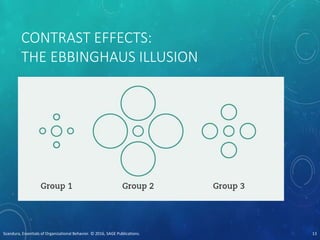
CONTRAST EFFECTS
• Comparisons based on what has happened
just before we make a decision or
judgment
• Example: interviewing job applicants
• Contrast effects are among the most
significant decision biases for a leader to
guard against.
Scandura, Essentials of Organizational Behavior. Š 2016, SAGE Publications. 12
CONTRAST EFFECTS:
THE EBBINGHAUS ILLUSION
Scandura, Essentials of Organizational Behavior. Š 2016, SAGE Publications. 13
HALO ERROR
• Halo (or its opposite, horns) error occurs
when a the rater's overall positive (or
negative) impression strongly influences
ratings of specific attributes.
• Example: performance appraisals
Scandura, Essentials of Organizational Behavior. Š 2016, SAGE Publications. 14
ATTRIBUTION THEORY
Attributions -- a person’s attempt to
assign a cause to a behavior or event.
The attributions people make about
events and behavior can be classified as
either internal or external.
Scandura, Essentials of Organizational Behavior. Š 2016, SAGE Publications. 15
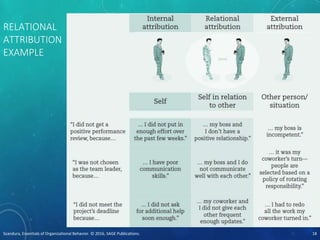
ATTRIBUTION
• An internal attribution occurs when
people infer that an event or a
person’s behavior is due to character
traits or abilities.
• If a person makes an external
attribution, they believe that a
person’s behavior is due to situational
factors.
Scandura, Essentials of Organizational Behavior. Š 2016, SAGE Publications. 16
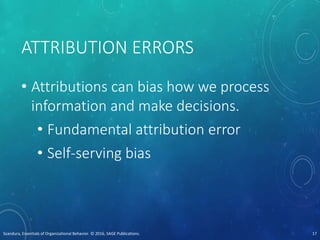
ATTRIBUTION ERRORS
• Attributions can bias how we process
information and make decisions.
• Fundamental attribution error
• Self-serving bias
Scandura, Essentials of Organizational Behavior. Š 2016, SAGE Publications. 17
RELATIONAL
ATTRIBUTION
EXAMPLE
Scandura, Essentials of Organizational Behavior. Š 2016, SAGE Publications. 18
THE ROMANCE OF LEADERSHIP
PERSPECTIVE
• challenges the portrayal of leaders as
heroes and heroines
• emphasizes the follower and the situation
• notes the halo effect for leadership: leaders
tend to get credit for positive and negative
outcomes
Scandura, Essentials of Organizational Behavior. Š 2016, SAGE Publications. 19
THE PYGMALION EFFECT
• Perceptions sometimes result in a self-
fulfilling prophecy in which high
expectations of performance by
leaders actually create conditions in
which followers succeed.
• Pygmalion effect boosts performance
by leaders raising their expectations of
followers.
Scandura, Essentials of Organizational Behavior. Š 2016, SAGE Publications. 20
LEADER-SET HIGH EXPECTATIONS
• Communicate high expectations to
followers in four ways:
• Create a warmer emotional climate
• Teach more and increase challenge
• Invite followers to ask questions
• Provide feedback on performance
Scandura, Essentials of Organizational Behavior. Š 2016, SAGE Publications. 21
INDIVIDUALLY-SET HIGH
EXPECTATIONS
Galatea Effect -- when an individual sets
high expectations for himself and then
performs to these expectations.
Scandura, Essentials of Organizational Behavior. Š 2016, SAGE Publications. 22
EXPECTATIONS AND LOW
PERFORMANCE
• Golem Effect -- Expectations may also
work in the opposite direction, where
lower expectations lead to lower
performance.
• Bosses can “kill” followers’ motivation
by having low expectations.
Scandura, Essentials of Organizational Behavior. Š 2016, SAGE Publications. 23
EMPLOYABILITY: HOW POTENTIAL
EMPLOYERS PERCEIVE YOU
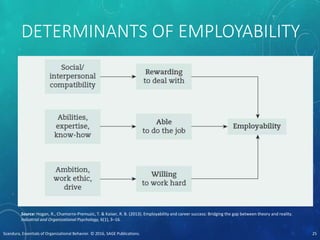
Employability -- the degree to which you
are perceived as employable, which may
determine whether or not you are hired
Employability is the ability to gain and
maintain a job in a formal organization.
Scandura, Essentials of Organizational Behavior. Š 2016, SAGE Publications. 24
DETERMINANTS OF EMPLOYABILITY
Scandura, Essentials of Organizational Behavior. Š 2016, SAGE Publications. 25
Source: Hogan, R., Chamorro‐Premuzic, T. & Kaiser, R. B. (2013). Employability and career success: Bridging the gap between theory and reality.
Industrial and Organizational Psychology, 6(1), 3–16.
IMPRESSION MANAGEMENT
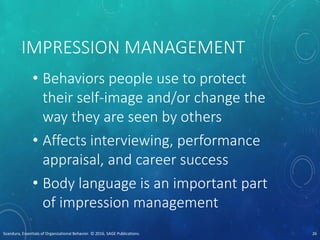
• Behaviors people use to protect
their self-image and/or change the
way they are seen by others
• Affects interviewing, performance
appraisal, and career success
• Body language is an important part
of impression management
Scandura, Essentials of Organizational Behavior. Š 2016, SAGE Publications. 26
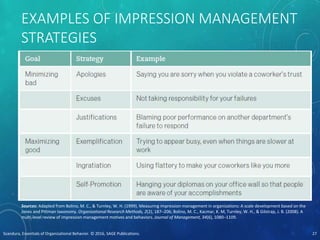
EXAMPLES OF IMPRESSION MANAGEMENT
STRATEGIES
Scandura, Essentials of Organizational Behavior. Š 2016, SAGE Publications. 27
Sources: Adapted from Bolino, M. C., & Turnley, W. H. (1999). Measuring impression management in organizations: A scale development based on the
Jones and Pittman taxonomy. Organizational Research Methods, 2(2), 187–206; Bolino, M. C., Kacmar, K. M, Turnley, W. H., & Gilstrap, J. B. (2008). A
multi-level review of impression management motives and behaviors. Journal of Management, 34(6), 1080–1109.
LEADERSHIP IMPLICATIONS:
LEADING FOLLOWERS WITH
DIFFERING PERCEPTIONS
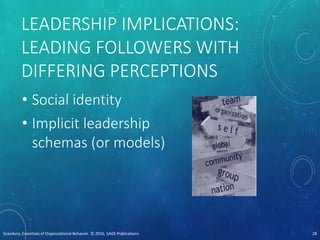
• Social identity
• Implicit leadership
schemas (or models)
Scandura, Essentials of Organizational Behavior. Š 2016, SAGE Publications. 28
OPEN-ACCESS
STUDENT
RESOURCES
• Checklist action plan
• Learning objective summaries
• Mobile-friendly quizzes
• Mobile-friendly eFlashcards
• Video and multimedia resources
• SAGE journal articles
edge.sagepub.com/scandura
Scandura, Essentials of Organizational Behavior. Š 2016, SAGE Publications. 29

Scandura ppt 05

  • 1.
  • 2.
    AGENDA • What isperception? • Perceptual errors • Expectations • Impression management Scandura, Essentials of Organizational Behavior. © 2016, SAGE Publications. 2
  • 3.
    WOULD YOU BEHAPPIER IF YOU WERE RICHER? • Focusing illusion -- the tendency to overestimate the effect of a single factor on one’s life satisfaction. • Example: Income Scandura, Essentials of Organizational Behavior. © 2016, SAGE Publications. 3
  • 4.
    WHAT IS IT? Scandura,Essentials of Organizational Behavior. Š 2016, SAGE Publications. 4
  • 5.
    DID YOU SEEIT? Scandura, Essentials of Organizational Behavior. Š 2016, SAGE Publications. 5
  • 6.
    WHAT IS PERCEPTION? •A leader must understand that each person’s perception is their reality and this is how they will interpret the leader’s actions and everything else that happens at the work place. • Perceptions can change. Scandura, Essentials of Organizational Behavior. © 2016, SAGE Publications. 6
  • 7.
    UNDERSTANDING WHY PEOPLE DON’TSEE EYE TO EYE Perceptual errors: • Primacy effect • Recency effect • Availability bias • Contrast effects • Halo error (Horns error) Scandura, Essentials of Organizational Behavior. © 2016, SAGE Publications. 7
  • 8.
    THE PRIMACY EFFECT •Belief perseverance • Once a person has formed an initial impression, they maintain it even when presented with concrete evidence that it is false. • Example: first Impressions Scandura, Essentials of Organizational Behavior. © 2016, SAGE Publications. 8
  • 9.
    THE RECENCY EFFECT •Not only do people remember what they experience first, they also remember the most recently presented items or experiences. • Example: reading misspelled words Scandura, Essentials of Organizational Behavior. © 2016, SAGE Publications. 9
  • 10.
    CAN YOU UNDERSTANDTHIS? WHY? i cdnuolt blveiee taht i cluod aulaclty uesdnatnrd waht i was rdanieg. the phaonmneal pweor of the hmuan mind is amazanig. aoccdrnig to a rscheearch taem at cmabrigde uinervtisy, it deosnt mttaer in waht oredr the ltteers in a wrod are, the olny iprmoatnt tihng is taht the frist and lsat ltteer be in the rghit pclae. the rset can be a taotl mses and you can sitll raed it wouthit a porbelm. amazanig ? and yuo awlyas thohgut slpeling was ipmorantt. Scandura, Essentials of Organizational Behavior. Š 2016, SAGE Publications. 10
  • 11.
    THE AVAILABILITY BIAS •When a person’s judgments are based on what most readily comes into a person’s mind. • Example: How many words in the English language start with the letter R? Scandura, Essentials of Organizational Behavior. © 2016, SAGE Publications. 11
  • 12.
    CONTRAST EFFECTS • Comparisonsbased on what has happened just before we make a decision or judgment • Example: interviewing job applicants • Contrast effects are among the most significant decision biases for a leader to guard against. Scandura, Essentials of Organizational Behavior. © 2016, SAGE Publications. 12
  • 13.
    CONTRAST EFFECTS: THE EBBINGHAUSILLUSION Scandura, Essentials of Organizational Behavior. Š 2016, SAGE Publications. 13
  • 14.
    HALO ERROR • Halo(or its opposite, horns) error occurs when a the rater's overall positive (or negative) impression strongly influences ratings of specific attributes. • Example: performance appraisals Scandura, Essentials of Organizational Behavior. © 2016, SAGE Publications. 14
  • 15.
    ATTRIBUTION THEORY Attributions --a person’s attempt to assign a cause to a behavior or event. The attributions people make about events and behavior can be classified as either internal or external. Scandura, Essentials of Organizational Behavior. © 2016, SAGE Publications. 15
  • 16.
    ATTRIBUTION • An internalattribution occurs when people infer that an event or a person’s behavior is due to character traits or abilities. • If a person makes an external attribution, they believe that a person’s behavior is due to situational factors. Scandura, Essentials of Organizational Behavior. © 2016, SAGE Publications. 16
  • 17.
    ATTRIBUTION ERRORS • Attributionscan bias how we process information and make decisions. • Fundamental attribution error • Self-serving bias Scandura, Essentials of Organizational Behavior. © 2016, SAGE Publications. 17
  • 18.
    RELATIONAL ATTRIBUTION EXAMPLE Scandura, Essentials ofOrganizational Behavior. Š 2016, SAGE Publications. 18
  • 19.
    THE ROMANCE OFLEADERSHIP PERSPECTIVE • challenges the portrayal of leaders as heroes and heroines • emphasizes the follower and the situation • notes the halo effect for leadership: leaders tend to get credit for positive and negative outcomes Scandura, Essentials of Organizational Behavior. © 2016, SAGE Publications. 19
  • 20.
    THE PYGMALION EFFECT •Perceptions sometimes result in a self- fulfilling prophecy in which high expectations of performance by leaders actually create conditions in which followers succeed. • Pygmalion effect boosts performance by leaders raising their expectations of followers. Scandura, Essentials of Organizational Behavior. © 2016, SAGE Publications. 20
  • 21.
    LEADER-SET HIGH EXPECTATIONS •Communicate high expectations to followers in four ways: • Create a warmer emotional climate • Teach more and increase challenge • Invite followers to ask questions • Provide feedback on performance Scandura, Essentials of Organizational Behavior. © 2016, SAGE Publications. 21
  • 22.
    INDIVIDUALLY-SET HIGH EXPECTATIONS Galatea Effect-- when an individual sets high expectations for himself and then performs to these expectations. Scandura, Essentials of Organizational Behavior. Š 2016, SAGE Publications. 22
  • 23.
    EXPECTATIONS AND LOW PERFORMANCE •Golem Effect -- Expectations may also work in the opposite direction, where lower expectations lead to lower performance. • Bosses can “kill” followers’ motivation by having low expectations. Scandura, Essentials of Organizational Behavior. © 2016, SAGE Publications. 23
  • 24.
    EMPLOYABILITY: HOW POTENTIAL EMPLOYERSPERCEIVE YOU Employability -- the degree to which you are perceived as employable, which may determine whether or not you are hired Employability is the ability to gain and maintain a job in a formal organization. Scandura, Essentials of Organizational Behavior. Š 2016, SAGE Publications. 24
  • 25.
    DETERMINANTS OF EMPLOYABILITY Scandura,Essentials of Organizational Behavior. © 2016, SAGE Publications. 25 Source: Hogan, R., Chamorro‐Premuzic, T. & Kaiser, R. B. (2013). Employability and career success: Bridging the gap between theory and reality. Industrial and Organizational Psychology, 6(1), 3–16.
  • 26.
    IMPRESSION MANAGEMENT • Behaviorspeople use to protect their self-image and/or change the way they are seen by others • Affects interviewing, performance appraisal, and career success • Body language is an important part of impression management Scandura, Essentials of Organizational Behavior. © 2016, SAGE Publications. 26
  • 27.
    EXAMPLES OF IMPRESSIONMANAGEMENT STRATEGIES Scandura, Essentials of Organizational Behavior. © 2016, SAGE Publications. 27 Sources: Adapted from Bolino, M. C., & Turnley, W. H. (1999). Measuring impression management in organizations: A scale development based on the Jones and Pittman taxonomy. Organizational Research Methods, 2(2), 187–206; Bolino, M. C., Kacmar, K. M, Turnley, W. H., & Gilstrap, J. B. (2008). A multi-level review of impression management motives and behaviors. Journal of Management, 34(6), 1080–1109.
  • 28.
    LEADERSHIP IMPLICATIONS: LEADING FOLLOWERSWITH DIFFERING PERCEPTIONS • Social identity • Implicit leadership schemas (or models) Scandura, Essentials of Organizational Behavior. © 2016, SAGE Publications. 28
  • 29.
    OPEN-ACCESS STUDENT RESOURCES • Checklist actionplan • Learning objective summaries • Mobile-friendly quizzes • Mobile-friendly eFlashcards • Video and multimedia resources • SAGE journal articles edge.sagepub.com/scandura Scandura, Essentials of Organizational Behavior. © 2016, SAGE Publications. 29