CHAPTER 10:
MANAGING
CONFLICT AND
NEGOTIATION
AGENDA
• Causes and types of conflict
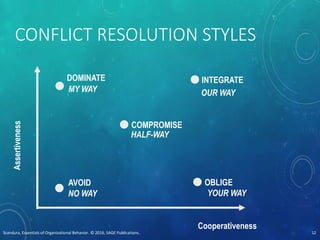
• Conflict resolution styles
• Relationship between conflict and
performance
• Conflict across cultures
• Negotiation
Scandura, Essentials of Organizational Behavior. © 2016, SAGE Publications. 2
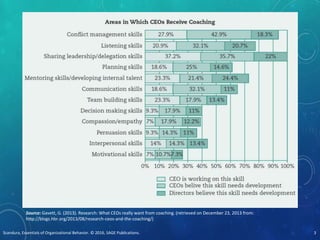
Scandura, Essentials of Organizational Behavior. © 2016, SAGE Publications. 3
Source: Gavett, G. (2013). Research: What CEOs really want from coaching. (retrieved on December 23, 2013 from:
http://blogs.hbr.org/2013/08/research-ceos-and-the-coaching/)
WHAT IS CONFLICT?
• Conflict is defined as “the process that begins when
one party perceives that the other has negatively
affected, or is about to negatively affect, something
that he or she cares about” (Thomas, 1992).
• Conflict is a perception.
• Perceptions don’t always line up with reality.
• However, they do influence behavior and they
can be changed.
Scandura, Essentials of Organizational Behavior. © 2016, SAGE Publications. 4
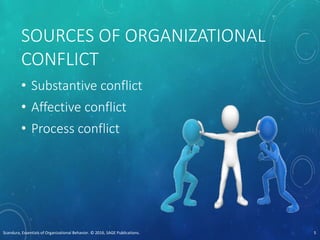
SOURCES OF ORGANIZATIONAL
CONFLICT
• Substantive conflict
• Affective conflict
• Process conflict
Scandura, Essentials of Organizational Behavior. © 2016, SAGE Publications. 5
IS CONFLICT ALWAYS BAD?
• Unproductive (dysfunctional) organizational
conflict can harm relationships between
leaders and followers and among
teammates; ultimately harms performance
• Productive (functional) conflict is
productive; improves performance if it
aligns with the goals of the organization
Scandura, Essentials of Organizational Behavior. © 2016, SAGE Publications. 6
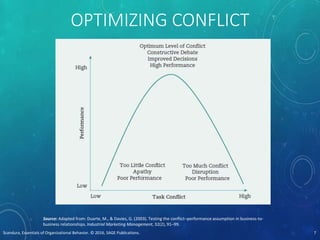
OPTIMIZING CONFLICT
Scandura, Essentials of Organizational Behavior. © 2016, SAGE Publications. 7
Source: Adapted from: Duarte, M., & Davies, G. (2003). Testing the conflict–performance assumption in business-to-
business relationships. Industrial Marketing Management, 32(2), 91–99.
TASK VS. RELATIONSHIP
CONFLICT
• Task conflict -- Disagreements about
resource allocation, policies, or even
interpretation of data
• Relationship conflict -- involves
personality clashes or differences in
values
Scandura, Essentials of Organizational Behavior. © 2016, SAGE Publications. 8
WORKPLACE INCIVILITY AND
VIOLENCE
• 2 million acts of workplace violence a year
• Employees likely face at least 1 instance of
incivility a week
• To resolve these problems leaders must
• Know their employees and what is going on
among them
• Help with conflict resolution
Scandura, Essentials of Organizational Behavior. © 2016, SAGE Publications. 9
CONFLICT RESOLUTION STYLES
• Integrating (problem solving)
• Obliging (smoothing)
• Dominating (forcing)
• Avoiding (withdrawing from conflict)
• Compromising (creating a solution that
everyone can agree on)
Scandura, Essentials of Organizational Behavior. © 2016, SAGE Publications. 10
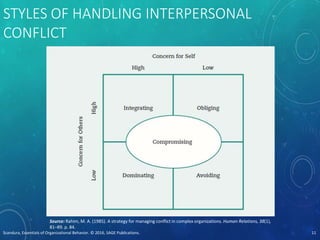
STYLES OF HANDLING INTERPERSONAL
CONFLICT
Scandura, Essentials of Organizational Behavior. © 2016, SAGE Publications. 11
Source: Rahim, M. A. (1985). A strategy for managing conflict in complex organizations. Human Relations, 38(1),
81–89. p. 84.
Cooperativeness
Assertiveness
COMPROMISE
HALF-WAY
OBLIGE
YOUR WAY
INTEGRATE
OUR WAY
AVOID
NO WAY
DOMINATE
MY WAY
CONFLICT RESOLUTION STYLES
Scandura, Essentials of Organizational Behavior. © 2016, SAGE Publications. 12
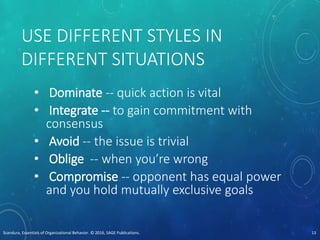
USE DIFFERENT STYLES IN
DIFFERENT SITUATIONS
• Dominate -- quick action is vital
• Integrate -- to gain commitment with
consensus
• Avoid -- the issue is trivial
• Oblige -- when you’re wrong
• Compromise -- opponent has equal power
and you hold mutually exclusive goals
Scandura, Essentials of Organizational Behavior. © 2016, SAGE Publications. 13
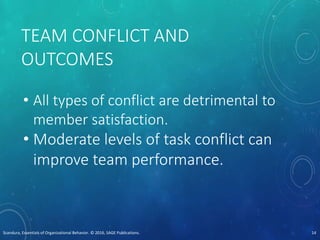
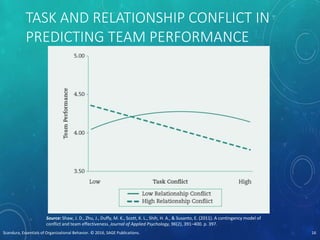
TEAM CONFLICT AND
OUTCOMES
• All types of conflict are detrimental to
member satisfaction.
• Moderate levels of task conflict can
improve team performance.
Scandura, Essentials of Organizational Behavior. © 2016, SAGE Publications. 14
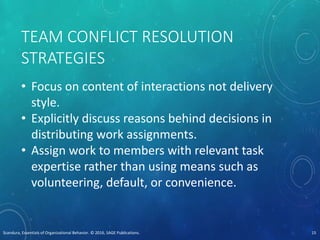
TEAM CONFLICT RESOLUTION
STRATEGIES
• Focus on content of interactions not delivery
style.
• Explicitly discuss reasons behind decisions in
distributing work assignments.
• Assign work to members with relevant task
expertise rather than using means such as
volunteering, default, or convenience.
Scandura, Essentials of Organizational Behavior. © 2016, SAGE Publications. 15
TASK AND RELATIONSHIP CONFLICT IN
PREDICTING TEAM PERFORMANCE
Scandura, Essentials of Organizational Behavior. © 2016, SAGE Publications. 16
Source: Shaw, J. D., Zhu, J., Duffy, M. K., Scott, K. L., Shih, H. A., & Susanto, E. (2011). A contingency model of
conflict and team effectiveness. Journal of Applied Psychology, 96(2), 391–400. p. 397.
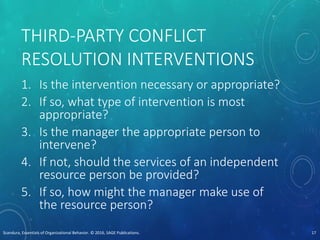
THIRD-PARTY CONFLICT
RESOLUTION INTERVENTIONS
1. Is the intervention necessary or appropriate?
2. If so, what type of intervention is most
appropriate?
3. Is the manager the appropriate person to
intervene?
4. If not, should the services of an independent
resource person be provided?
5. If so, how might the manager make use of
the resource person?
Scandura, Essentials of Organizational Behavior. © 2016, SAGE Publications. 17
TYPES OF INTERVENTIONS
• Facilitation by the leader
• Alternative dispute resolution
• Ombudsmen
• Peer review
• Mediation
• Arbitration
Scandura, Essentials of Organizational Behavior. © 2016, SAGE Publications. 18
RESOLVING CONFLICT ACROSS
CULTURES
• Be a good listener.
• Be sensitive to the needs of others.
• Be cooperative, rather than overly
competitive (equal with skill above).
• Advocate inclusive (participative)
leadership.
• Compromise rather than dominate.
Scandura, Essentials of Organizational Behavior. © 2016, SAGE Publications. 19
RESOLVING CONFLICT ACROSS
CULTURES (CONTINUED)
• Build rapport through conversations.
• Be compassionate and understanding.
• Avoid conflict by emphasizing
harmony.
• Nurture others (develop and mentor).
Scandura, Essentials of Organizational Behavior. © 2016, SAGE Publications. 20
CONFLICT RESOLUTION AND
NEGOTIATION
• Distributive bargaining
• “Fixed pie” perspective
• Hardball tactics -- leads to higher economic
outcomes
• Integrative bargaining
• Tries to reach an agreement that satisfies all
concerns -- leads to higher emotional
outcomes such as satisfaction and relationship
development
Scandura, Essentials of Organizational Behavior. © 2016, SAGE Publications. 21
NECESSARY CONDITIONS FOR
INTEGRATIVE BARGAINING
Both parties must be:
• Open with information and candid
about their concerns
• Sensitive to the other’s needs
• Able to trust each other
• Willing to be flexible
Scandura, Essentials of Organizational Behavior. © 2016, SAGE Publications. 22
PREPPING FOR YOUR
NEGOTIATION
• What are your interests? What are
theirs? How can you find out?
• Best Alternative To a Negotiated
Agreement (BATNA)
• What’s our BATNA? What’s theirs?
Scandura, Essentials of Organizational Behavior. © 2016, SAGE Publications. 23
PREPPING FOR YOUR
NEGOTIATION
• What’s your WATNA (Worst
Alternative…)? Theirs?
• What do we know about their
circumstances that might affect the
negotiations?
• What’s their negotiation style?
Scandura, Essentials of Organizational Behavior. © 2016, SAGE Publications. 24
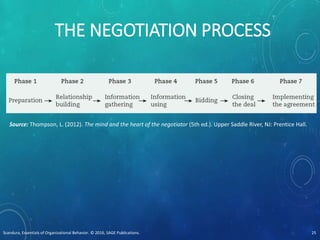
THE NEGOTIATION PROCESS
Scandura, Essentials of Organizational Behavior. © 2016, SAGE Publications. 25
Source: Thompson, L. (2012). The mind and the heart of the negotiator (5th ed.). Upper Saddle River, NJ: Prentice Hall.
LEADERSHIP IMPLICATIONS:
PERSPECTIVE TAKING
• The ability to see things from
another person’s perspective when
they hold a view that conflicts with
your own.
• Fosters empathy and more positive
attributions in conflict resolution
and negotiation
Scandura, Essentials of Organizational Behavior. © 2016, SAGE Publications. 26
OPEN-ACCESS
STUDENT
RESOURCES
• Checklist action plan
• Learning objective summaries
• Mobile-friendly quizzes
• Mobile-friendly eFlashcards
• Video and multimedia resources
• SAGE journal articles
edge.sagepub.com/scandura
Scandura, Essentials of Organizational Behavior. © 2016, SAGE Publications. 27

Scandura ppt 10

  • 1.
  • 2.
    AGENDA • Causes andtypes of conflict • Conflict resolution styles • Relationship between conflict and performance • Conflict across cultures • Negotiation Scandura, Essentials of Organizational Behavior. © 2016, SAGE Publications. 2
  • 3.
    Scandura, Essentials ofOrganizational Behavior. © 2016, SAGE Publications. 3 Source: Gavett, G. (2013). Research: What CEOs really want from coaching. (retrieved on December 23, 2013 from: http://blogs.hbr.org/2013/08/research-ceos-and-the-coaching/)
  • 4.
    WHAT IS CONFLICT? •Conflict is defined as “the process that begins when one party perceives that the other has negatively affected, or is about to negatively affect, something that he or she cares about” (Thomas, 1992). • Conflict is a perception. • Perceptions don’t always line up with reality. • However, they do influence behavior and they can be changed. Scandura, Essentials of Organizational Behavior. © 2016, SAGE Publications. 4
  • 5.
    SOURCES OF ORGANIZATIONAL CONFLICT •Substantive conflict • Affective conflict • Process conflict Scandura, Essentials of Organizational Behavior. © 2016, SAGE Publications. 5
  • 6.
    IS CONFLICT ALWAYSBAD? • Unproductive (dysfunctional) organizational conflict can harm relationships between leaders and followers and among teammates; ultimately harms performance • Productive (functional) conflict is productive; improves performance if it aligns with the goals of the organization Scandura, Essentials of Organizational Behavior. © 2016, SAGE Publications. 6
  • 7.
    OPTIMIZING CONFLICT Scandura, Essentialsof Organizational Behavior. © 2016, SAGE Publications. 7 Source: Adapted from: Duarte, M., & Davies, G. (2003). Testing the conflict–performance assumption in business-to- business relationships. Industrial Marketing Management, 32(2), 91–99.
  • 8.
    TASK VS. RELATIONSHIP CONFLICT •Task conflict -- Disagreements about resource allocation, policies, or even interpretation of data • Relationship conflict -- involves personality clashes or differences in values Scandura, Essentials of Organizational Behavior. © 2016, SAGE Publications. 8
  • 9.
    WORKPLACE INCIVILITY AND VIOLENCE •2 million acts of workplace violence a year • Employees likely face at least 1 instance of incivility a week • To resolve these problems leaders must • Know their employees and what is going on among them • Help with conflict resolution Scandura, Essentials of Organizational Behavior. © 2016, SAGE Publications. 9
  • 10.
    CONFLICT RESOLUTION STYLES •Integrating (problem solving) • Obliging (smoothing) • Dominating (forcing) • Avoiding (withdrawing from conflict) • Compromising (creating a solution that everyone can agree on) Scandura, Essentials of Organizational Behavior. © 2016, SAGE Publications. 10
  • 11.
    STYLES OF HANDLINGINTERPERSONAL CONFLICT Scandura, Essentials of Organizational Behavior. © 2016, SAGE Publications. 11 Source: Rahim, M. A. (1985). A strategy for managing conflict in complex organizations. Human Relations, 38(1), 81–89. p. 84.
  • 12.
    Cooperativeness Assertiveness COMPROMISE HALF-WAY OBLIGE YOUR WAY INTEGRATE OUR WAY AVOID NOWAY DOMINATE MY WAY CONFLICT RESOLUTION STYLES Scandura, Essentials of Organizational Behavior. © 2016, SAGE Publications. 12
  • 13.
    USE DIFFERENT STYLESIN DIFFERENT SITUATIONS • Dominate -- quick action is vital • Integrate -- to gain commitment with consensus • Avoid -- the issue is trivial • Oblige -- when you’re wrong • Compromise -- opponent has equal power and you hold mutually exclusive goals Scandura, Essentials of Organizational Behavior. © 2016, SAGE Publications. 13
  • 14.
    TEAM CONFLICT AND OUTCOMES •All types of conflict are detrimental to member satisfaction. • Moderate levels of task conflict can improve team performance. Scandura, Essentials of Organizational Behavior. © 2016, SAGE Publications. 14
  • 15.
    TEAM CONFLICT RESOLUTION STRATEGIES •Focus on content of interactions not delivery style. • Explicitly discuss reasons behind decisions in distributing work assignments. • Assign work to members with relevant task expertise rather than using means such as volunteering, default, or convenience. Scandura, Essentials of Organizational Behavior. © 2016, SAGE Publications. 15
  • 16.
    TASK AND RELATIONSHIPCONFLICT IN PREDICTING TEAM PERFORMANCE Scandura, Essentials of Organizational Behavior. © 2016, SAGE Publications. 16 Source: Shaw, J. D., Zhu, J., Duffy, M. K., Scott, K. L., Shih, H. A., & Susanto, E. (2011). A contingency model of conflict and team effectiveness. Journal of Applied Psychology, 96(2), 391–400. p. 397.
  • 17.
    THIRD-PARTY CONFLICT RESOLUTION INTERVENTIONS 1.Is the intervention necessary or appropriate? 2. If so, what type of intervention is most appropriate? 3. Is the manager the appropriate person to intervene? 4. If not, should the services of an independent resource person be provided? 5. If so, how might the manager make use of the resource person? Scandura, Essentials of Organizational Behavior. © 2016, SAGE Publications. 17
  • 18.
    TYPES OF INTERVENTIONS •Facilitation by the leader • Alternative dispute resolution • Ombudsmen • Peer review • Mediation • Arbitration Scandura, Essentials of Organizational Behavior. © 2016, SAGE Publications. 18
  • 19.
    RESOLVING CONFLICT ACROSS CULTURES •Be a good listener. • Be sensitive to the needs of others. • Be cooperative, rather than overly competitive (equal with skill above). • Advocate inclusive (participative) leadership. • Compromise rather than dominate. Scandura, Essentials of Organizational Behavior. © 2016, SAGE Publications. 19
  • 20.
    RESOLVING CONFLICT ACROSS CULTURES(CONTINUED) • Build rapport through conversations. • Be compassionate and understanding. • Avoid conflict by emphasizing harmony. • Nurture others (develop and mentor). Scandura, Essentials of Organizational Behavior. © 2016, SAGE Publications. 20
  • 21.
    CONFLICT RESOLUTION AND NEGOTIATION •Distributive bargaining • “Fixed pie” perspective • Hardball tactics -- leads to higher economic outcomes • Integrative bargaining • Tries to reach an agreement that satisfies all concerns -- leads to higher emotional outcomes such as satisfaction and relationship development Scandura, Essentials of Organizational Behavior. © 2016, SAGE Publications. 21
  • 22.
    NECESSARY CONDITIONS FOR INTEGRATIVEBARGAINING Both parties must be: • Open with information and candid about their concerns • Sensitive to the other’s needs • Able to trust each other • Willing to be flexible Scandura, Essentials of Organizational Behavior. © 2016, SAGE Publications. 22
  • 23.
    PREPPING FOR YOUR NEGOTIATION •What are your interests? What are theirs? How can you find out? • Best Alternative To a Negotiated Agreement (BATNA) • What’s our BATNA? What’s theirs? Scandura, Essentials of Organizational Behavior. © 2016, SAGE Publications. 23
  • 24.
    PREPPING FOR YOUR NEGOTIATION •What’s your WATNA (Worst Alternative…)? Theirs? • What do we know about their circumstances that might affect the negotiations? • What’s their negotiation style? Scandura, Essentials of Organizational Behavior. © 2016, SAGE Publications. 24
  • 25.
    THE NEGOTIATION PROCESS Scandura,Essentials of Organizational Behavior. © 2016, SAGE Publications. 25 Source: Thompson, L. (2012). The mind and the heart of the negotiator (5th ed.). Upper Saddle River, NJ: Prentice Hall.
  • 26.
    LEADERSHIP IMPLICATIONS: PERSPECTIVE TAKING •The ability to see things from another person’s perspective when they hold a view that conflicts with your own. • Fosters empathy and more positive attributions in conflict resolution and negotiation Scandura, Essentials of Organizational Behavior. © 2016, SAGE Publications. 26
  • 27.
    OPEN-ACCESS STUDENT RESOURCES • Checklist actionplan • Learning objective summaries • Mobile-friendly quizzes • Mobile-friendly eFlashcards • Video and multimedia resources • SAGE journal articles edge.sagepub.com/scandura Scandura, Essentials of Organizational Behavior. © 2016, SAGE Publications. 27