PROJECT REPORT ON LAYER POULTRY
Project Report on Layer Poultry by Shahvar Khan under 'Agri Clinics & Agribusiness Centers (MANAGE)' Page 2 of 16
C O N T E N T S
CHAPTER NO. PARTICULARS PAGE NO.
I. HIGHLIGHTS OF THE PROJECT REPORT
A. About the Promoter 3
B. Project Profile 4
II. PROJECT DESCRIPTION 5
III. MARKET POTENTIAL 7
IV. EXTENSION ACTIVITIES 8
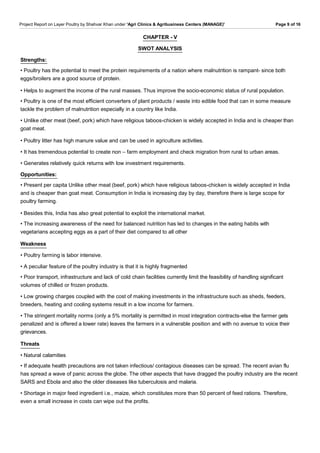
V. SWOT ANALYSIS 9
VI. ECONOMICS OF THE PROJECT
A. Basis & Presumptions 10
B. Total Cost of Project 11
C. Means of Finance 12
D. Projected Profitability
Flock Chart 13
Projected Profitability 14
E. Financial Analysis 15
F. Term Loan Repayment 16
Project Report on Layer Poultry by Shahvar Khan under 'Agri Clinics & Agribusiness Centers (MANAGE)' Page 3 of 16
CHAPTER - I
HIGHLIGHTS OF THE PROJECT REPORT
A. ABOUT THE PROMOTER
PARTICULARS ABOUT THE PROMOTER
1. Name : Shahvar Khan
2. Address : Village Jasoi Dist-Muzaffarnagar
3. Contact number : 9411032786
4. Date of birth : 07-05-1981
5. Educational qualification : M.Sc (Ag.)
6. Project location : Jasoi
7. Professional Experience : 1 Year
8. Constitution : Proprietorship
Project Report on Layer Poultry by Shahvar Khan under 'Agri Clinics & Agribusiness Centers (MANAGE)' Page 4 of 16
B. PROJECT PROFILE (FINANCIAL)
PARAMETERS VALUES
1. Propsed strain
High producing strains of birds available
in the market
2. Unit size 5,000
3. Product Eggs, Mannure etc
4. Cost of the project 2,234,346
5. Bank loan 1,675,760
6. Margin money 558,586
7. Financial Indicators
BCR at 15% DF 1.46:1
NPW 15% DF(Rs.) 2,724,086
IRR (%) 61.03
DSCR 3.0
8. Interest Rate (% per annum) 12
9. Repayment period 5 years
Project Report on Layer Poultry by Shahvar Khan under 'Agri Clinics & Agribusiness Centers (MANAGE)' Page 5 of 16
CHAPTER - II
PROJECT DESCRIPTION
1.INTRODUCTION
Poultry industry is the fastest growing sector in Indian agriculture. Egg being an excellent source of proteins is fast
becoming a favorite among urban Indians. India, today is the fourth largest egg producer in the world. The layer
segment in India is all set to grow and is currently estimated at Rs. 10,000 crores (INR 100 billion). According to the
Ministry of Agriculture, India’s egg production is estimated at 47.3 billion eggs per annum. Today, with more and
more ‘eggitarians’ on the rise, egg consumption is growing at 8% - 10% annually.
It is an important source of subsidiary income to small/marginal farmers and agricultural laborers. The manure from
birds provides a good source of organic matter for improving soil fertility and crop yields. Since agriculture is mostly
seasonal, there is a possibility of findining employment throughout the year for many persons through poultry
farming. With the adequate infrastructural facilities especially for egg production has become increasingly popular in
and around . The present demand in the area is more. It is increasing day by day & the present strength of the flock
in the area is not in a position to meet the growing demand. include increased adoption of integrated farming system,
contact farming, awareness of people about diet and health, cost effectiveness of poultry meat compared to other
meat, its low fat content, superior protein quality and change of life style of the people are also responsible for
spectacular development of Poultry Sector.
2.OBJECTIVE
To meet the growing demand of eggs, I intended to establish a layer poultry farm.
3.LOCATION
The proposed unit will be located on a piece of land which is almost leveled & is well connected to approach road.
Electricity is an essential component for poultry farming as it is required for brooding of chicks and pumps used for
water supply as well as lighting of the area. It is available near the farm site. In the absence of assured of water
supply, a tube well/ hand pump is proposed on the farm. Underground water is adequately available & is of good
quality.
4.HOUSING
Provision has been made for the construction of a brooder-cum-grower house measuring at a rate of 1 sq feet in a
case of layer. Besides it, the farm will have a small store room, office & servants quarters. Construction of house will
be pucka with asbestos roofing. Provision has also been made for the construction of built in laying nests. The
installation of a tube well & laying of pipeline is also to be done.
5.EQUIPMENT
Standard equipments are available from various equipment manufacturers located in the nearby city.
6.CHICKS
One day old commercial hybrid chicks are available from the hatcheries. In order to cover transportation, hatchery is
supplying 3 percent extra chicks. Chicks will be vaccinated against Rd & Marek’s at source. Chicks will be purchased
in lots at regular intervals.
7.FEEDS
Company will provides feeds require to birds on contract basis.
Project Report on Layer Poultry by Shahvar Khan Page 6 of 16
8.MEDICINE & VETERINARY AID
The person who will be looking after the day-to-day management of the farm is conversant with the use of medicines.
In cases of need, the sick birds will be taken to the disease investigation laboratory located in town. For various
operations like vaccination, debeaking etc. a poultry specialist visits the area at regular intervals.
Project Report on Layer Poultry by Shahvar Khan under 'Agri Clinics & Agribusiness Centers (MANAGE)' Page 7 of 16
CHAPTER - III
MARKET POTENTIAL
India is the third-largest egg producer after China and USA. The overall global demand for eggs is growing, more in
India. With rapidly changing lifestyles, affluent culture, and a conscious need for general wellness, Indian consumers
are now opting for a more protein-rich diet. The changing trends are definitely a boon for the layer sector in India.
Today, India’s per capita egg consumption is at 41 eggs per annum. Over the last couple of years, the per capita
consumption of eggs has increased at an aggregate of 4% with a majority consumption recorded in the urban areas.
Efforts to promote egg consumption are in place by layer farming community in India to achieve 180 eggs per annum
in the coming years. Keeping this target in mind, the requirement for production is estimated at 18,000 crores (180
billion) eggs, while the current rate is capable of achieving only 46.2 billion eggs. This provides for a huge opportunity
to tap into. With rapid urbanization, and increasing demand from the present 250 million economically strong,
consumer market base, the future is only bright for the layer sector in India.
Affluent lifestyles and rapid development in the retail and food service industries is expected to fuel the growth as
targeted by The National Committee on Human Nutrition in India. Adding to this is the health conscious Indian
shifting from a carbohydrate to a protein-rich diet.
In addition, the Indian consumers’ preference is increasing for clean, safe, hygienic nutritious and properly packed,
labeled and presentable food products including eggs. Introduction of modern state of-the-art technology in
processing, packaging, labeling, preservation of eggs is required to improve 'quality' for domestic and export markets.
With economic liberalization and free trade under WTO, the domestic products have to maintain 'quality' to face the
stiff competition from imported foreign poultry food products. Also, the demand for branded or specialty eggs is fast
growing at an estimated rate of 40 – 50% per annum. Branded or specialty eggs offer innovative products to the
consumer. These range from eggs that are low in cholesterol, to those fortified with vitamins, protein, iron and other
everyday essential nutrients. This category is growing steadily in large cities with a huge potential consumer base.
Project Report on Layer Poultry by Shahvar Khan under 'Agri Clinics & Agribusiness Centers (MANAGE)' Page 8 of 16
CHAPTER - IV
EXTENSION ACTIVITIES
1. Starting a Poultry farming business requires planning and preparation. Before starting a Poultry farm the
entrepreneurs/ farmers are generally advised to undergo training. They can contact Local Animal Husbandry
Department staffs/Veterinary College/agriculture university etc. for the purpose. However availability of training
facilities & resources are inadequate. Hence I will provide training on Poultry farming to farmers both onsite and off-
site. During training program special thrust feed management & birds health (medications and vaccinations used) &
kind of records to be kept in the farm will be also given.2. For the farmers of nearby locality, visits will be arranged on
my poultry farm & they will be educated on scientific lines regarding various aspects of poultry farm management. It
will help them to improve their knowledge and skill regarding scientific Poultry farming practices so as to enable them
to adopt the same.3. Consultancy will be provided for setting up of model units of poultry farm.4. I will take Initiatives
to strengthen linkages between State Departments, Poultry Development agencies, NGO’s and farmers.5. For
farmers who have decided to avail loan from bank for Poultry farming, assistance will be provided to prepare their
bankable project report.6. For the marketing of poultry birds, farmers will be provided necessary support &
guidance.7. Visits of Poultry farmers will be arranged to Poultry exhibitions with the prime objective of exposing them
the technological innovations.8. Nowadays internet has become important tool to get latest information. There are
various websites available on Poultry farm which provides useful content. This information will be shared to
farmers.9. I will organize field visits of Poultry farmers to progressive farmers & research stations which will motivate
them to adapt good poultry farm practices.
Project Report on Layer Poultry by Shahvar Khan under 'Agri Clinics & Agribusiness Centers (MANAGE)' Page 9 of 16
CHAPTER - V
SWOT ANALYSIS
Strengths:
• Poultry has the potential to meet the protein requirements of a nation where malnutrition is rampant- since both
eggs/broilers are a good source of protein.
• Helps to augment the income of the rural masses. Thus improve the socio-economic status of rural population.
• Poultry is one of the most efficient converters of plant products / waste into edible food that can in some measure
tackle the problem of malnutrition especially in a country like India.
• Unlike other meat (beef, pork) which have religious taboos-chicken is widely accepted in India and is cheaper than
goat meat.
• Poultry litter has high manure value and can be used in agriculture activities.
• It has tremendous potential to create non – farm employment and check migration from rural to urban areas.
• Generates relatively quick returns with low investment requirements.
Opportunities:
• Present per capita Unlike other meat (beef, pork) which have religious taboos-chicken is widely accepted in India
and is cheaper than goat meat. Consumption in India is increasing day by day, therefore there is large scope for
poultry farming.
• Besides this, India has also great potential to exploit the international market.
• The increasing awareness of the need for balanced nutrition has led to changes in the eating habits with
vegetarians accepting eggs as a part of their diet compared to all other
Weakness
• Poultry farming is labor intensive.
• A peculiar feature of the poultry industry is that it is highly fragmented
• Poor transport, infrastructure and lack of cold chain facilities currently limit the feasibility of handling significant
volumes of chilled or frozen products.
• Low growing charges coupled with the cost of making investments in the infrastructure such as sheds, feeders,
breeders, heating and cooling systems result in a low income for farmers.
• The stringent mortality norms (only a 5% mortality is permitted in most integration contracts-else the farmer gets
penalized and is offered a lower rate) leaves the farmers in a vulnerable position and with no avenue to voice their
grievances.
Threats
• Natural calamities
• If adequate health precautions are not taken infectious/ contagious diseases can be spread. The recent avian flu
has spread a wave of panic across the globe. The other aspects that have dragged the poultry industry are the recent
SARS and Ebola and also the older diseases like tuberculosis and malaria.
• Shortage in major feed ingredient i.e., maize, which constitutes more than 50 percent of feed rations. Therefore,
even a small increase in costs can wipe out the profits.
Project Report on Layer Poultry by Shahvar Khan under 'Agri Clinics & Agribusiness Centers (MANAGE)' Page 10 of 16
CHAPTER - VI
ECONOMIC OF THE PROJECTS
A.BASICS AND PREASUMPTIONS
PARTICULARS UNIT QUANTITY
I. Techno-economic parameters
1. Number of birds Nos. 5,000
2. Batches per year Nos. 2
3. Batch size 2,500
4. Birds considered for laying 2,500
5. Birds considered for culling 2,250
6. Brooding cum growing period (weeks) 20
7. Laying period (weeks) 52
8. Type of housing Deep Litter
9. Space require per birds in brooder cum grower house Sq.ft. 1
10. Floor space per bird in layer shed (cage system) Sq.ft. 0.8
11. Repayment period Years 5
12. Rate of interest for bank loan % 12
II. Expenditure norms
1. Cost of construction of brooder cum grower shed Rs./sq.ft 125
2. Cost of construction of Layer shed per sq.ft 140
3. Cost of construction of store room Rs./sq.ft. 250
4. Cost of cages for layers Rs./birds 90
5. Feeders, waterers and dressing equipment Rs./Chicks 20
6. Cost of day old Chicks Rs./bird 40
7. Feed requirement during laying-52 weeks laying Rs./bird 21
8. Feed requirement during growers-20 weeks Rs./bird 6
9. Chick/grower mash Rs./kg. 14
10. Cost of layer mash Rs./kg. 12
11. Medicine, vaccine, labour & misc charges Rs./bird 8
12. Insurance Rs./bird 1
III. Income norms
1. Number of eggs produced per bird Eggs per cycle 300
2. Selling price of egg Rs./egg 3
3. Selling price of culled birds Rs./bird 70
4. Income from manure & gunny bags Rs./bird 22
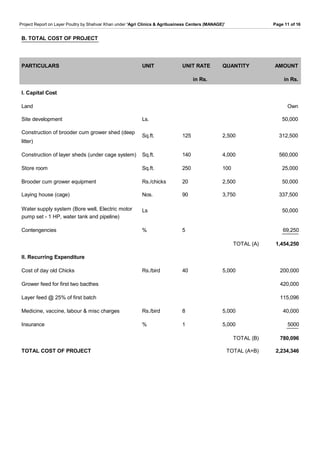
Project Report on Layer Poultry by Shahvar Khan under 'Agri Clinics & Agribusiness Centers (MANAGE)' Page 11 of 16
PARTICULARS UNIT UNIT RATE QUANTITY AMOUNT
in Rs. in Rs.
I. Capital Cost
Land Own
Site development Ls. 50,000
Construction of brooder cum grower shed (deep
Sq.ft. 125 2,500 312,500
litter)
Construction of layer sheds (under cage system) Sq.ft. 140 4,000 560,000
Store room Sq.ft. 250 100 25,000
Brooder cum grower equipment Rs./chicks 20 2,500 50,000
Laying house (cage) Nos. 90 3,750 337,500
Water supply system (Bore well, Electric motor Ls 50,000
pump set - 1 HP, water tank and pipeline)
Contengencies % 5 69,250
TOTAL (A) 1,454,250
II. Recurring Expenditure
Cost of day old Chicks Rs./bird 40 5,000 200,000
Grower feed for first two bacthes 420,000
Layer feed @ 25% of first batch 115,096
Medicine, vaccine, labour & misc charges Rs./bird 8 5,000 40,000
Insurance % 1 5,000 5000
TOTAL (B) 780,096
TOTAL COST OF PROJECT TOTAL (A+B) 2,234,346
B. TOTAL COST OF PROJECT
Project Report on Layer Poultry by Shahvar Khan under 'Agri Clinics & Agribusiness Centers (MANAGE)' Page 12 of 16
C. MEANS OF FINANCE
PARTICULARS UNIT UNIT RATE AMOUNT Rs.
1. Term loan % 75 1,675,760
2. Own contribution % 25 558,586
TOTAL 2,234,346
3. Subsidy entitlement @36% from NABARD under AC & ABC Scheme 804,365
Project Report on Layer Poultry by Shahvar Khan under 'Agri Clinics & Agribusiness Centers (MANAGE)' Page 13 of 16
D. PROJECTED PROFITABILITY
1. Flock chart
weeks
Years I Year II Year III Year IV Year V Year
Nos. of batches purchased 2 2 2 2 2
Nos. of brooder cum grower
40 40 34 34 34
Nos. of layer weeks 38 72 72 72 72
Nos. of batches culled 0 2 2 1 3
Project Report on Layer Poultry by Shahvar Khan under 'Agri Clinics & Agribusiness Centers (MANAGE)' Page 14 of 16
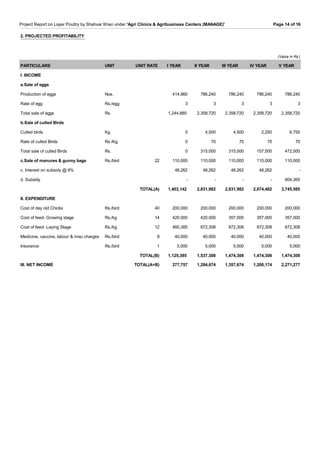
(Value in Rs.)
PARTICULARS UNIT UNIT RATE I YEAR II YEAR III YEAR IV YEAR V YEAR
I. INCOME
a.Sale of eggs
Production of eggs Nos. 414,960 786,240 786,240 786,240 786,240
Rate of egg Rs./egg 3 3 3 3 3
Total sale of eggs Rs. 1,244,880 2,358,720 2,358,720 2,358,720 2,358,720
b.Sale of culled Birds
Culled birds Kg. 0 4,500 4,500 2,250 6,750
Rate of culled Birds Rs./Kg. 0 70 70 70 70
Total sale of culled Birds Rs. 0 315,000 315,000 157,500 472,500
c.Sale of manures & gunny bags Rs./bird 22 110,000 110,000 110,000 110,000 110,000
c. Interest on subsidy @ 6% 48,262 48,262 48,262 48,262 -
d. Subsidy - - - - 804,365
TOTAL(A) 1,403,142 2,831,982 2,831,982 2,674,482 3,745,585
II. EXPENDITURE
Cost of day old Chicks Rs./bird 40 200,000 200,000 200,000 200,000 200,000
Cost of feed- Growing stage Rs./kg 14 420,000 420,000 357,000 357,000 357,000
Cost of feed- Laying Stage Rs./kg 12 460,385 872,308 872,308 872,308 872,308
Medicine, vaccine, labour & misc charges Rs./bird 8 40,000 40,000 40,000 40,000 40,000
Insurance Rs./bird 1 5,000 5,000 5,000 5,000 5,000
TOTAL(B) 1,125,385 1,537,308 1,474,308 1,474,308 1,474,308
III. NET INCOME TOTAL(A+B) 277,757 1,294,674 1,357,674 1,200,174 2,271,277
2. PROJECTED PROFITABILITY
Project Report on Layer Poultry by Shahvar Khan under 'Agri Clinics & Agribusiness Centers (MANAGE)' Page 15 of 16
PARTICULARS I YEAR II YEAR III YEAR IV YEAR V YEAR
Capital costs 1,454,250
Recurring costs 1,125,385 1,537,308 1,474,308 1,474,308 1,474,308
TOTAL COST 2,579,635 1,537,308 1,474,308 1,474,308 1,474,308
Benefit 1,403,142 2,831,982 2,831,982 2,674,482 3,745,585
Depreciated value of buildings @10% 525,486
Depreciated value of equipments @15% 187,469
TOTAL BENEFIT 1,403,142 2,831,982 2,831,982 2,674,482 4,458,540
NET BENEFIT -1,176,493 1,357,674 1,357,674 1,200,174 2,984,232
Discounting factor @15% 0.87 0.76 0.66 0.57 0.5
NPV cost at 15% DF 2,244,282 1,120,474 973,043 840,356 737,154
NPV benefits at 15% DF 1,220,734 2,152,306 1,869,108 1,524,455 1,872,793
NPW at 15% DF 2,724,086
BCR at 15% DF 1.46:1
IRR% 61.03
E. FINANCIAL ANALYSIS
(Value in Rs.)
Project Report on Layer Poultry by Shahvar Khan under 'Agri Clinics & Agribusiness Centers (MANAGE)' Page 16 of 16
F. TERM LOAN REPAYMENT
Rate of interst - % per annum : 12
Opening balance of term loan : 1,675,760
(Value in Rs.)
Year
Loan
Outstanding
Net Income Principal Interest
Total
Repayment
Net Surplus DSCR
1 1,675,760 277,757 335,152 201,091 536,243 -258,486 0.5
2 1,340,608 1,294,674 335,152 160,873 496,025 798,649 2.6
3 1,005,456 1,357,674 335,152 120,655 455,807 901,867 3.0
4 670,304 1,200,174 335,152 80,436 415,588 784,586 2.9
5 335,152 2,271,277 335,152 40,218 375,370 1,895,907 6.1
Average DSCR 3.0

Layer poultry project.pptx

  • 1.
    PROJECT REPORT ONLAYER POULTRY
  • 2.
    Project Report onLayer Poultry by Shahvar Khan under 'Agri Clinics & Agribusiness Centers (MANAGE)' Page 2 of 16 C O N T E N T S CHAPTER NO. PARTICULARS PAGE NO. I. HIGHLIGHTS OF THE PROJECT REPORT A. About the Promoter 3 B. Project Profile 4 II. PROJECT DESCRIPTION 5 III. MARKET POTENTIAL 7 IV. EXTENSION ACTIVITIES 8 V. SWOT ANALYSIS 9 VI. ECONOMICS OF THE PROJECT A. Basis & Presumptions 10 B. Total Cost of Project 11 C. Means of Finance 12 D. Projected Profitability Flock Chart 13 Projected Profitability 14 E. Financial Analysis 15 F. Term Loan Repayment 16
  • 3.
    Project Report onLayer Poultry by Shahvar Khan under 'Agri Clinics & Agribusiness Centers (MANAGE)' Page 3 of 16 CHAPTER - I HIGHLIGHTS OF THE PROJECT REPORT A. ABOUT THE PROMOTER PARTICULARS ABOUT THE PROMOTER 1. Name : Shahvar Khan 2. Address : Village Jasoi Dist-Muzaffarnagar 3. Contact number : 9411032786 4. Date of birth : 07-05-1981 5. Educational qualification : M.Sc (Ag.) 6. Project location : Jasoi 7. Professional Experience : 1 Year 8. Constitution : Proprietorship
  • 4.
    Project Report onLayer Poultry by Shahvar Khan under 'Agri Clinics & Agribusiness Centers (MANAGE)' Page 4 of 16 B. PROJECT PROFILE (FINANCIAL) PARAMETERS VALUES 1. Propsed strain High producing strains of birds available in the market 2. Unit size 5,000 3. Product Eggs, Mannure etc 4. Cost of the project 2,234,346 5. Bank loan 1,675,760 6. Margin money 558,586 7. Financial Indicators BCR at 15% DF 1.46:1 NPW 15% DF(Rs.) 2,724,086 IRR (%) 61.03 DSCR 3.0 8. Interest Rate (% per annum) 12 9. Repayment period 5 years
  • 5.
    Project Report onLayer Poultry by Shahvar Khan under 'Agri Clinics & Agribusiness Centers (MANAGE)' Page 5 of 16 CHAPTER - II PROJECT DESCRIPTION 1.INTRODUCTION Poultry industry is the fastest growing sector in Indian agriculture. Egg being an excellent source of proteins is fast becoming a favorite among urban Indians. India, today is the fourth largest egg producer in the world. The layer segment in India is all set to grow and is currently estimated at Rs. 10,000 crores (INR 100 billion). According to the Ministry of Agriculture, India’s egg production is estimated at 47.3 billion eggs per annum. Today, with more and more ‘eggitarians’ on the rise, egg consumption is growing at 8% - 10% annually. It is an important source of subsidiary income to small/marginal farmers and agricultural laborers. The manure from birds provides a good source of organic matter for improving soil fertility and crop yields. Since agriculture is mostly seasonal, there is a possibility of findining employment throughout the year for many persons through poultry farming. With the adequate infrastructural facilities especially for egg production has become increasingly popular in and around . The present demand in the area is more. It is increasing day by day & the present strength of the flock in the area is not in a position to meet the growing demand. include increased adoption of integrated farming system, contact farming, awareness of people about diet and health, cost effectiveness of poultry meat compared to other meat, its low fat content, superior protein quality and change of life style of the people are also responsible for spectacular development of Poultry Sector. 2.OBJECTIVE To meet the growing demand of eggs, I intended to establish a layer poultry farm. 3.LOCATION The proposed unit will be located on a piece of land which is almost leveled & is well connected to approach road. Electricity is an essential component for poultry farming as it is required for brooding of chicks and pumps used for water supply as well as lighting of the area. It is available near the farm site. In the absence of assured of water supply, a tube well/ hand pump is proposed on the farm. Underground water is adequately available & is of good quality. 4.HOUSING Provision has been made for the construction of a brooder-cum-grower house measuring at a rate of 1 sq feet in a case of layer. Besides it, the farm will have a small store room, office & servants quarters. Construction of house will be pucka with asbestos roofing. Provision has also been made for the construction of built in laying nests. The installation of a tube well & laying of pipeline is also to be done. 5.EQUIPMENT Standard equipments are available from various equipment manufacturers located in the nearby city. 6.CHICKS One day old commercial hybrid chicks are available from the hatcheries. In order to cover transportation, hatchery is supplying 3 percent extra chicks. Chicks will be vaccinated against Rd & Marek’s at source. Chicks will be purchased in lots at regular intervals. 7.FEEDS Company will provides feeds require to birds on contract basis.
  • 6.
    Project Report onLayer Poultry by Shahvar Khan Page 6 of 16 8.MEDICINE & VETERINARY AID The person who will be looking after the day-to-day management of the farm is conversant with the use of medicines. In cases of need, the sick birds will be taken to the disease investigation laboratory located in town. For various operations like vaccination, debeaking etc. a poultry specialist visits the area at regular intervals.
  • 7.
    Project Report onLayer Poultry by Shahvar Khan under 'Agri Clinics & Agribusiness Centers (MANAGE)' Page 7 of 16 CHAPTER - III MARKET POTENTIAL India is the third-largest egg producer after China and USA. The overall global demand for eggs is growing, more in India. With rapidly changing lifestyles, affluent culture, and a conscious need for general wellness, Indian consumers are now opting for a more protein-rich diet. The changing trends are definitely a boon for the layer sector in India. Today, India’s per capita egg consumption is at 41 eggs per annum. Over the last couple of years, the per capita consumption of eggs has increased at an aggregate of 4% with a majority consumption recorded in the urban areas. Efforts to promote egg consumption are in place by layer farming community in India to achieve 180 eggs per annum in the coming years. Keeping this target in mind, the requirement for production is estimated at 18,000 crores (180 billion) eggs, while the current rate is capable of achieving only 46.2 billion eggs. This provides for a huge opportunity to tap into. With rapid urbanization, and increasing demand from the present 250 million economically strong, consumer market base, the future is only bright for the layer sector in India. Affluent lifestyles and rapid development in the retail and food service industries is expected to fuel the growth as targeted by The National Committee on Human Nutrition in India. Adding to this is the health conscious Indian shifting from a carbohydrate to a protein-rich diet. In addition, the Indian consumers’ preference is increasing for clean, safe, hygienic nutritious and properly packed, labeled and presentable food products including eggs. Introduction of modern state of-the-art technology in processing, packaging, labeling, preservation of eggs is required to improve 'quality' for domestic and export markets. With economic liberalization and free trade under WTO, the domestic products have to maintain 'quality' to face the stiff competition from imported foreign poultry food products. Also, the demand for branded or specialty eggs is fast growing at an estimated rate of 40 – 50% per annum. Branded or specialty eggs offer innovative products to the consumer. These range from eggs that are low in cholesterol, to those fortified with vitamins, protein, iron and other everyday essential nutrients. This category is growing steadily in large cities with a huge potential consumer base.
  • 8.
    Project Report onLayer Poultry by Shahvar Khan under 'Agri Clinics & Agribusiness Centers (MANAGE)' Page 8 of 16 CHAPTER - IV EXTENSION ACTIVITIES 1. Starting a Poultry farming business requires planning and preparation. Before starting a Poultry farm the entrepreneurs/ farmers are generally advised to undergo training. They can contact Local Animal Husbandry Department staffs/Veterinary College/agriculture university etc. for the purpose. However availability of training facilities & resources are inadequate. Hence I will provide training on Poultry farming to farmers both onsite and off- site. During training program special thrust feed management & birds health (medications and vaccinations used) & kind of records to be kept in the farm will be also given.2. For the farmers of nearby locality, visits will be arranged on my poultry farm & they will be educated on scientific lines regarding various aspects of poultry farm management. It will help them to improve their knowledge and skill regarding scientific Poultry farming practices so as to enable them to adopt the same.3. Consultancy will be provided for setting up of model units of poultry farm.4. I will take Initiatives to strengthen linkages between State Departments, Poultry Development agencies, NGO’s and farmers.5. For farmers who have decided to avail loan from bank for Poultry farming, assistance will be provided to prepare their bankable project report.6. For the marketing of poultry birds, farmers will be provided necessary support & guidance.7. Visits of Poultry farmers will be arranged to Poultry exhibitions with the prime objective of exposing them the technological innovations.8. Nowadays internet has become important tool to get latest information. There are various websites available on Poultry farm which provides useful content. This information will be shared to farmers.9. I will organize field visits of Poultry farmers to progressive farmers & research stations which will motivate them to adapt good poultry farm practices.
  • 9.
    Project Report onLayer Poultry by Shahvar Khan under 'Agri Clinics & Agribusiness Centers (MANAGE)' Page 9 of 16 CHAPTER - V SWOT ANALYSIS Strengths: • Poultry has the potential to meet the protein requirements of a nation where malnutrition is rampant- since both eggs/broilers are a good source of protein. • Helps to augment the income of the rural masses. Thus improve the socio-economic status of rural population. • Poultry is one of the most efficient converters of plant products / waste into edible food that can in some measure tackle the problem of malnutrition especially in a country like India. • Unlike other meat (beef, pork) which have religious taboos-chicken is widely accepted in India and is cheaper than goat meat. • Poultry litter has high manure value and can be used in agriculture activities. • It has tremendous potential to create non – farm employment and check migration from rural to urban areas. • Generates relatively quick returns with low investment requirements. Opportunities: • Present per capita Unlike other meat (beef, pork) which have religious taboos-chicken is widely accepted in India and is cheaper than goat meat. Consumption in India is increasing day by day, therefore there is large scope for poultry farming. • Besides this, India has also great potential to exploit the international market. • The increasing awareness of the need for balanced nutrition has led to changes in the eating habits with vegetarians accepting eggs as a part of their diet compared to all other Weakness • Poultry farming is labor intensive. • A peculiar feature of the poultry industry is that it is highly fragmented • Poor transport, infrastructure and lack of cold chain facilities currently limit the feasibility of handling significant volumes of chilled or frozen products. • Low growing charges coupled with the cost of making investments in the infrastructure such as sheds, feeders, breeders, heating and cooling systems result in a low income for farmers. • The stringent mortality norms (only a 5% mortality is permitted in most integration contracts-else the farmer gets penalized and is offered a lower rate) leaves the farmers in a vulnerable position and with no avenue to voice their grievances. Threats • Natural calamities • If adequate health precautions are not taken infectious/ contagious diseases can be spread. The recent avian flu has spread a wave of panic across the globe. The other aspects that have dragged the poultry industry are the recent SARS and Ebola and also the older diseases like tuberculosis and malaria. • Shortage in major feed ingredient i.e., maize, which constitutes more than 50 percent of feed rations. Therefore, even a small increase in costs can wipe out the profits.
  • 10.
    Project Report onLayer Poultry by Shahvar Khan under 'Agri Clinics & Agribusiness Centers (MANAGE)' Page 10 of 16 CHAPTER - VI ECONOMIC OF THE PROJECTS A.BASICS AND PREASUMPTIONS PARTICULARS UNIT QUANTITY I. Techno-economic parameters 1. Number of birds Nos. 5,000 2. Batches per year Nos. 2 3. Batch size 2,500 4. Birds considered for laying 2,500 5. Birds considered for culling 2,250 6. Brooding cum growing period (weeks) 20 7. Laying period (weeks) 52 8. Type of housing Deep Litter 9. Space require per birds in brooder cum grower house Sq.ft. 1 10. Floor space per bird in layer shed (cage system) Sq.ft. 0.8 11. Repayment period Years 5 12. Rate of interest for bank loan % 12 II. Expenditure norms 1. Cost of construction of brooder cum grower shed Rs./sq.ft 125 2. Cost of construction of Layer shed per sq.ft 140 3. Cost of construction of store room Rs./sq.ft. 250 4. Cost of cages for layers Rs./birds 90 5. Feeders, waterers and dressing equipment Rs./Chicks 20 6. Cost of day old Chicks Rs./bird 40 7. Feed requirement during laying-52 weeks laying Rs./bird 21 8. Feed requirement during growers-20 weeks Rs./bird 6 9. Chick/grower mash Rs./kg. 14 10. Cost of layer mash Rs./kg. 12 11. Medicine, vaccine, labour & misc charges Rs./bird 8 12. Insurance Rs./bird 1 III. Income norms 1. Number of eggs produced per bird Eggs per cycle 300 2. Selling price of egg Rs./egg 3 3. Selling price of culled birds Rs./bird 70 4. Income from manure & gunny bags Rs./bird 22
  • 11.
    Project Report onLayer Poultry by Shahvar Khan under 'Agri Clinics & Agribusiness Centers (MANAGE)' Page 11 of 16 PARTICULARS UNIT UNIT RATE QUANTITY AMOUNT in Rs. in Rs. I. Capital Cost Land Own Site development Ls. 50,000 Construction of brooder cum grower shed (deep Sq.ft. 125 2,500 312,500 litter) Construction of layer sheds (under cage system) Sq.ft. 140 4,000 560,000 Store room Sq.ft. 250 100 25,000 Brooder cum grower equipment Rs./chicks 20 2,500 50,000 Laying house (cage) Nos. 90 3,750 337,500 Water supply system (Bore well, Electric motor Ls 50,000 pump set - 1 HP, water tank and pipeline) Contengencies % 5 69,250 TOTAL (A) 1,454,250 II. Recurring Expenditure Cost of day old Chicks Rs./bird 40 5,000 200,000 Grower feed for first two bacthes 420,000 Layer feed @ 25% of first batch 115,096 Medicine, vaccine, labour & misc charges Rs./bird 8 5,000 40,000 Insurance % 1 5,000 5000 TOTAL (B) 780,096 TOTAL COST OF PROJECT TOTAL (A+B) 2,234,346 B. TOTAL COST OF PROJECT
  • 12.
    Project Report onLayer Poultry by Shahvar Khan under 'Agri Clinics & Agribusiness Centers (MANAGE)' Page 12 of 16 C. MEANS OF FINANCE PARTICULARS UNIT UNIT RATE AMOUNT Rs. 1. Term loan % 75 1,675,760 2. Own contribution % 25 558,586 TOTAL 2,234,346 3. Subsidy entitlement @36% from NABARD under AC & ABC Scheme 804,365
  • 13.
    Project Report onLayer Poultry by Shahvar Khan under 'Agri Clinics & Agribusiness Centers (MANAGE)' Page 13 of 16 D. PROJECTED PROFITABILITY 1. Flock chart weeks Years I Year II Year III Year IV Year V Year Nos. of batches purchased 2 2 2 2 2 Nos. of brooder cum grower 40 40 34 34 34 Nos. of layer weeks 38 72 72 72 72 Nos. of batches culled 0 2 2 1 3
  • 14.
    Project Report onLayer Poultry by Shahvar Khan under 'Agri Clinics & Agribusiness Centers (MANAGE)' Page 14 of 16 (Value in Rs.) PARTICULARS UNIT UNIT RATE I YEAR II YEAR III YEAR IV YEAR V YEAR I. INCOME a.Sale of eggs Production of eggs Nos. 414,960 786,240 786,240 786,240 786,240 Rate of egg Rs./egg 3 3 3 3 3 Total sale of eggs Rs. 1,244,880 2,358,720 2,358,720 2,358,720 2,358,720 b.Sale of culled Birds Culled birds Kg. 0 4,500 4,500 2,250 6,750 Rate of culled Birds Rs./Kg. 0 70 70 70 70 Total sale of culled Birds Rs. 0 315,000 315,000 157,500 472,500 c.Sale of manures & gunny bags Rs./bird 22 110,000 110,000 110,000 110,000 110,000 c. Interest on subsidy @ 6% 48,262 48,262 48,262 48,262 - d. Subsidy - - - - 804,365 TOTAL(A) 1,403,142 2,831,982 2,831,982 2,674,482 3,745,585 II. EXPENDITURE Cost of day old Chicks Rs./bird 40 200,000 200,000 200,000 200,000 200,000 Cost of feed- Growing stage Rs./kg 14 420,000 420,000 357,000 357,000 357,000 Cost of feed- Laying Stage Rs./kg 12 460,385 872,308 872,308 872,308 872,308 Medicine, vaccine, labour & misc charges Rs./bird 8 40,000 40,000 40,000 40,000 40,000 Insurance Rs./bird 1 5,000 5,000 5,000 5,000 5,000 TOTAL(B) 1,125,385 1,537,308 1,474,308 1,474,308 1,474,308 III. NET INCOME TOTAL(A+B) 277,757 1,294,674 1,357,674 1,200,174 2,271,277 2. PROJECTED PROFITABILITY
  • 15.
    Project Report onLayer Poultry by Shahvar Khan under 'Agri Clinics & Agribusiness Centers (MANAGE)' Page 15 of 16 PARTICULARS I YEAR II YEAR III YEAR IV YEAR V YEAR Capital costs 1,454,250 Recurring costs 1,125,385 1,537,308 1,474,308 1,474,308 1,474,308 TOTAL COST 2,579,635 1,537,308 1,474,308 1,474,308 1,474,308 Benefit 1,403,142 2,831,982 2,831,982 2,674,482 3,745,585 Depreciated value of buildings @10% 525,486 Depreciated value of equipments @15% 187,469 TOTAL BENEFIT 1,403,142 2,831,982 2,831,982 2,674,482 4,458,540 NET BENEFIT -1,176,493 1,357,674 1,357,674 1,200,174 2,984,232 Discounting factor @15% 0.87 0.76 0.66 0.57 0.5 NPV cost at 15% DF 2,244,282 1,120,474 973,043 840,356 737,154 NPV benefits at 15% DF 1,220,734 2,152,306 1,869,108 1,524,455 1,872,793 NPW at 15% DF 2,724,086 BCR at 15% DF 1.46:1 IRR% 61.03 E. FINANCIAL ANALYSIS (Value in Rs.)
  • 16.
    Project Report onLayer Poultry by Shahvar Khan under 'Agri Clinics & Agribusiness Centers (MANAGE)' Page 16 of 16 F. TERM LOAN REPAYMENT Rate of interst - % per annum : 12 Opening balance of term loan : 1,675,760 (Value in Rs.) Year Loan Outstanding Net Income Principal Interest Total Repayment Net Surplus DSCR 1 1,675,760 277,757 335,152 201,091 536,243 -258,486 0.5 2 1,340,608 1,294,674 335,152 160,873 496,025 798,649 2.6 3 1,005,456 1,357,674 335,152 120,655 455,807 901,867 3.0 4 670,304 1,200,174 335,152 80,436 415,588 784,586 2.9 5 335,152 2,271,277 335,152 40,218 375,370 1,895,907 6.1 Average DSCR 3.0