DAIRY FARMING
Dairy Farming Report1
SCOPE OF PRESENTATION
• Objective
• Industry Situationer
• Major Dairy Breeds
• Production Cycle of a Cow
• Land Requirement
• Housing Requirement
• Equipment for Small/Medium Scale Farm
• Financial Analysis
Dairy Farming Report2
OBJECTIVE
To apprise the Board of Directors re Dairy Industry
Dairy Farming Report3
INDUSTRY SITUATIONER
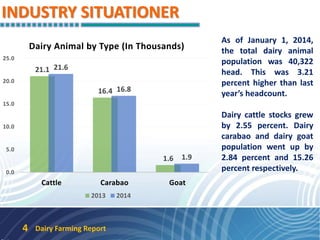
21.1
16.4
1.6
21.6
16.8
1.9
0.0
5.0
10.0
15.0
20.0
25.0
Cattle Carabao Goat
Dairy Animal by Type (In Thousands)
2013 2014
As of January 1, 2014,
the total dairy animal
population was 40,322
head. This was 3.21
percent higher than last
year’s headcount.
Dairy cattle stocks grew
by 2.55 percent. Dairy
carabao and dairy goat
population went up by
2.84 percent and 15.26
percent respectively.
Dairy Farming Report4
INDUSTRY SITUATIONER
Dairy Farming Report5
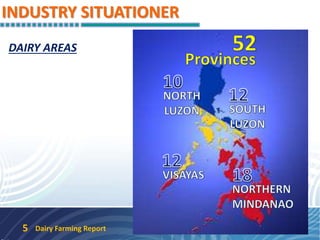
DAIRY AREAS
INDUSTRY SITUATIONER
Dairy Farming Report6
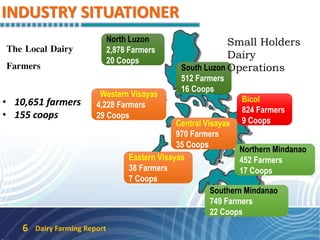
North Luzon
2,878 Farmers
20 Coops
Central Visayas
970 Farmers
35 Coops
Eastern Visayas
38 Farmers
7 Coops
Bicol
824 Farmers
9 Coops
Northern Mindanao
452 Farmers
17 Coops
Southern Mindanao
749 Farmers
22 Coops
South Luzon
512 Farmers
16 Coops
Western Visayas
4,228 Farmers
29 Coops
Small Holders
Dairy
Operations
The Local Dairy
Farmers
• 10,651 farmers
• 155 coops
INDUSTRY SITUATIONER
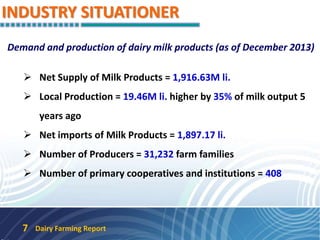
Demand and production of dairy milk products (as of December 2013)
 Net Supply of Milk Products = 1,916.63M li.
 Local Production = 19.46M li. higher by 35% of milk output 5
years ago
 Net imports of Milk Products = 1,897.17 li.
 Number of Producers = 31,232 farm families
 Number of primary cooperatives and institutions = 408
Dairy Farming Report7
MAJOR DAIRY BREEDS IN THE PHILIPPINES
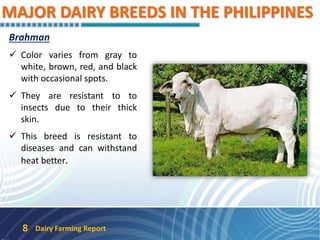
Brahman
 Color varies from gray to
white, brown, red, and black
with occasional spots.
 They are resistant to to
insects due to their thick
skin.
 This breed is resistant to
diseases and can withstand
heat better.
Dairy Farming Report8
MAJOR DAIRY BREEDS IN THE PHILIPPINES
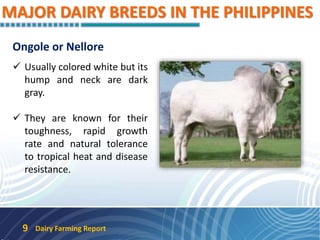
Ongole or Nellore
 Usually colored white but its
hump and neck are dark
gray.
 They are known for their
toughness, rapid growth
rate and natural tolerance
to tropical heat and disease
resistance.
Dairy Farming Report9
MAJOR DAIRY BREEDS IN THE PHILIPPINES
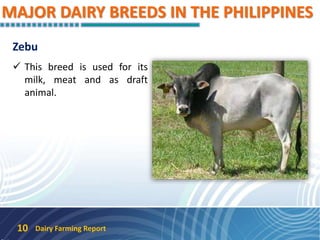
Zebu
 This breed is used for its
milk, meat and as draft
animal.
Dairy Farming Report10
MAJOR DAIRY BREEDS IN THE PHILIPPINES
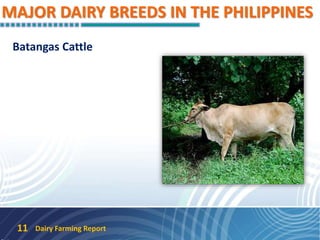
Batangas Cattle
Dairy Farming Report11
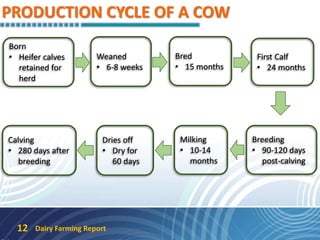
PRODUCTION CYCLE OF A COW
Dairy Farming Report12
Born
• Heifer calves
retained for
herd
Weaned
• 6-8 weeks
Bred
• 15 months
First Calf
• 24 months
Calving
• 280 days after
breeding
Dries off
• Dry for
60 days
Milking
• 10-14
months
Breeding
• 90-120 days
post-calving
PRODUCTION CYCLE OF A COW
Dairy Farming Report13
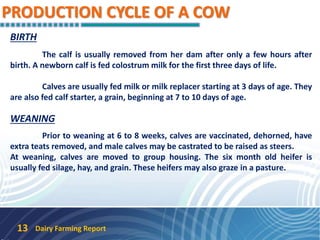
BIRTH
The calf is usually removed from her dam after only a few hours after
birth. A newborn calf is fed colostrum milk for the first three days of life.
Calves are usually fed milk or milk replacer starting at 3 days of age. They
are also fed calf starter, a grain, beginning at 7 to 10 days of age.
WEANING
Prior to weaning at 6 to 8 weeks, calves are vaccinated, dehorned, have
extra teats removed, and male calves may be castrated to be raised as steers.
At weaning, calves are moved to group housing. The six month old heifer is
usually fed silage, hay, and grain. These heifers may also graze in a pasture.
PRODUCTION CYCLE OF A COW
Dairy Farming Report14
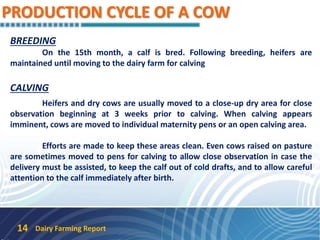
BREEDING
On the 15th month, a calf is bred. Following breeding, heifers are
maintained until moving to the dairy farm for calving
CALVING
Heifers and dry cows are usually moved to a close-up dry area for close
observation beginning at 3 weeks prior to calving. When calving appears
imminent, cows are moved to individual maternity pens or an open calving area.
Efforts are made to keep these areas clean. Even cows raised on pasture
are sometimes moved to pens for calving to allow close observation in case the
delivery must be assisted, to keep the calf out of cold drafts, and to allow careful
attention to the calf immediately after birth.
PRODUCTION CYCLE OF A COW
Dairy Farming Report15
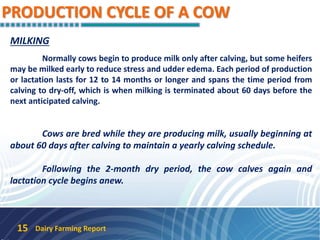
MILKING
Normally cows begin to produce milk only after calving, but some heifers
may be milked early to reduce stress and udder edema. Each period of production
or lactation lasts for 12 to 14 months or longer and spans the time period from
calving to dry-off, which is when milking is terminated about 60 days before the
next anticipated calving.
Cows are bred while they are producing milk, usually beginning at
about 60 days after calving to maintain a yearly calving schedule.
Following the 2-month dry period, the cow calves again and
lactation cycle begins anew.
LAND REQUIREMENT
Dairy Farming Report16
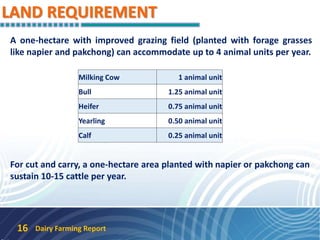
A one-hectare with improved grazing field (planted with forage grasses
like napier and pakchong) can accommodate up to 4 animal units per year.
Milking Cow 1 animal unit
Bull 1.25 animal unit
Heifer 0.75 animal unit
Yearling 0.50 animal unit
Calf 0.25 animal unit
For cut and carry, a one-hectare area planted with napier or pakchong can
sustain 10-15 cattle per year.
LAND REQUIREMENT
Dairy Farming Report17
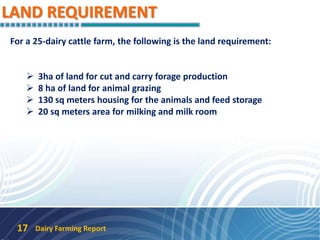
For a 25-dairy cattle farm, the following is the land requirement:
 3ha of land for cut and carry forage production
 8 ha of land for animal grazing
 130 sq meters housing for the animals and feed storage
 20 sq meters area for milking and milk room
HOUSING REQUIREMENT
Dairy Farming Report18
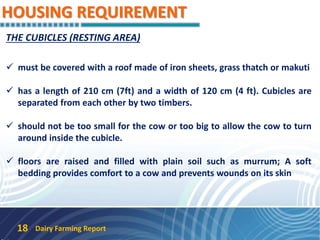
THE CUBICLES (RESTING AREA)
 must be covered with a roof made of iron sheets, grass thatch or makuti
 has a length of 210 cm (7ft) and a width of 120 cm (4 ft). Cubicles are
separated from each other by two timbers.
 should not be too small for the cow or too big to allow the cow to turn
around inside the cubicle.
 floors are raised and filled with plain soil such as murrum; A soft
bedding provides comfort to a cow and prevents wounds on its skin
HOUSING REQUIREMENT
Dairy Farming Report19
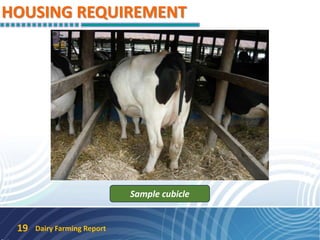
Sample cubicle
HOUSING REQUIREMENT
Dairy Farming Report20
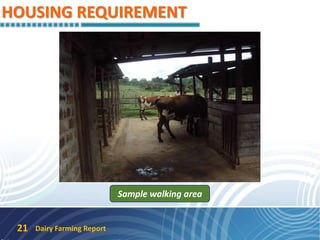
THE WALKING AREA
 about 3 meters wide i.e. between the resting area
 where the feed and water troughs are located. No roofing is required
for this area except under very hot conditions.
 Floor is made of concrete; for possible collection of urine and
manure.
 surface of the floor should be rough so that animals cannot slip on it
HOUSING REQUIREMENT
Dairy Farming Report21
Sample walking area
HOUSING REQUIREMENT
Dairy Farming Report22
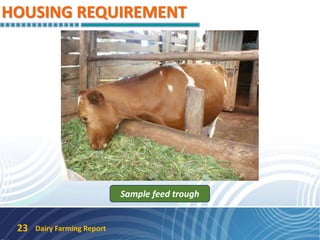
THE FEED AND WATER TROUGHS
 Feed troughs should run along the length of the walking area with a water
trough in the middle
 Total length of the feed trough should be such that each animal has 2.5-3 feet
to itself
 inside measurements of the feed trough should be 60 cm (2 ft) wide at the
bottom and should be raised at least 15 cm (1/2 ft) above the ground level of
the walking area
 water trough should be placed such that both the young stock and the mature
cows have access to it instead of constructing separate trough for each side
HOUSING REQUIREMENT
Dairy Farming Report23
Sample feed trough
HOUSING REQUIREMENT
Dairy Farming Report24
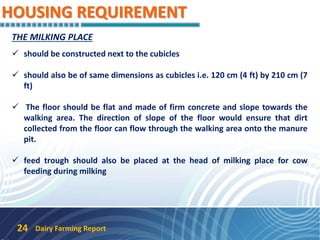
THE MILKING PLACE
 should be constructed next to the cubicles
 should also be of same dimensions as cubicles i.e. 120 cm (4 ft) by 210 cm (7
ft)
 The floor should be flat and made of firm concrete and slope towards the
walking area. The direction of slope of the floor would ensure that dirt
collected from the floor can flow through the walking area onto the manure
pit.
 feed trough should also be placed at the head of milking place for cow
feeding during milking
HOUSING REQUIREMENT
Dairy Farming Report25
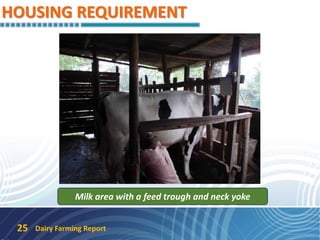
Milk area with a feed trough and neck yoke
HOUSING REQUIREMENT
Dairy Farming Report26
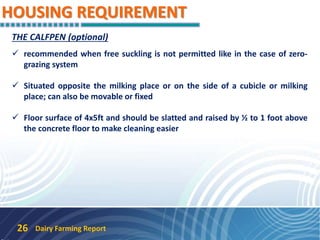
THE CALFPEN (optional)
 recommended when free suckling is not permitted like in the case of zero-
grazing system
 Situated opposite the milking place or on the side of a cubicle or milking
place; can also be movable or fixed
 Floor surface of 4x5ft and should be slatted and raised by ½ to 1 foot above
the concrete floor to make cleaning easier
HOUSING REQUIREMENT
Dairy Farming Report27
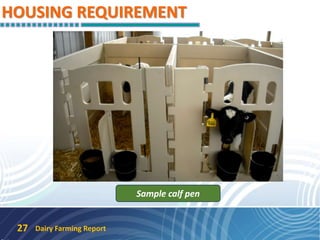
Sample calf pen
HOUSING REQUIREMENT
Dairy Farming Report28
THE MANURE STORAGE
 Manure can be stored in a small pit dug out of the soil. The pit mayor may
not be cemented.
 Manure can also be stored as compost made from dung, urine and plant
materials. In this case the compost is heaped next to the unit. Compost may
be covered with soil or plastic.
EQUIPMENT FOR SMALL/MEDIUM SCALE
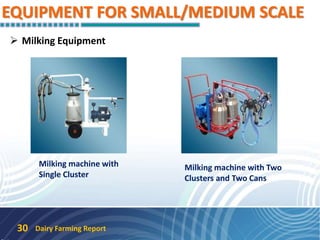
 Milking Equipment
Milking machine with
Single Cluster
Milking machine with Two
Clusters and Two Cans
Dairy Farming Report30
EQUIPMENT FOR SMALL/MEDIUM SCALE
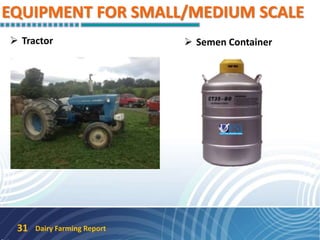
 Tractor
Dairy Farming Report31
 Semen Container
EQUIPMENT FOR SMALL/MEDIUM SCALE
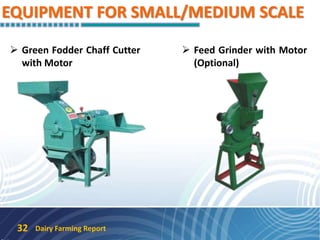
 Green Fodder Chaff Cutter
with Motor
 Feed Grinder with Motor
(Optional)
Dairy Farming Report32
EQUIPMENT FOR SMALL/MEDIUM SCALE
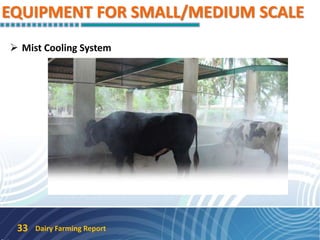
 Mist Cooling System
Dairy Farming Report33
EQUIPMENT FOR SMALL/MEDIUM SCALE
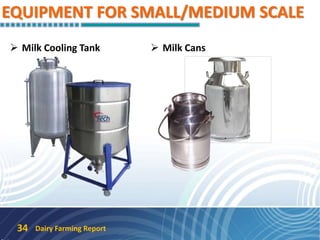
 Milk Cooling Tank  Milk Cans
Dairy Farming Report34
EQUIPMENT FOR SMALL/MEDIUM SCALE
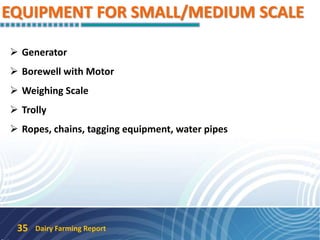
 Generator
 Borewell with Motor
 Weighing Scale
 Trolly
 Ropes, chains, tagging equipment, water pipes
Dairy Farming Report35
FINANCIAL ANALYSIS
Dairy Farming Report36
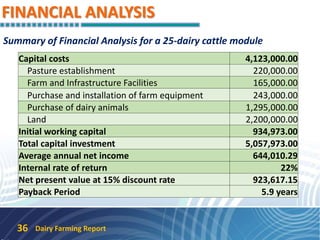
Capital costs 4,123,000.00
Pasture establishment 220,000.00
Farm and Infrastructure Facilities 165,000.00
Purchase and installation of farm equipment 243,000.00
Purchase of dairy animals 1,295,000.00
Land 2,200,000.00
Initial working capital 934,973.00
Total capital investment 5,057,973.00
Average annual net income 644,010.29
Internal rate of return 22%
Net present value at 15% discount rate 923,617.15
Payback Period 5.9 years
Summary of Financial Analysis for a 25-dairy cattle module
THANK YOU
Dairy Farming Report38

Dairy farming presentation

  • 1.
  • 2.
    SCOPE OF PRESENTATION •Objective • Industry Situationer • Major Dairy Breeds • Production Cycle of a Cow • Land Requirement • Housing Requirement • Equipment for Small/Medium Scale Farm • Financial Analysis Dairy Farming Report2
  • 3.
    OBJECTIVE To apprise theBoard of Directors re Dairy Industry Dairy Farming Report3
  • 4.
    INDUSTRY SITUATIONER 21.1 16.4 1.6 21.6 16.8 1.9 0.0 5.0 10.0 15.0 20.0 25.0 Cattle CarabaoGoat Dairy Animal by Type (In Thousands) 2013 2014 As of January 1, 2014, the total dairy animal population was 40,322 head. This was 3.21 percent higher than last year’s headcount. Dairy cattle stocks grew by 2.55 percent. Dairy carabao and dairy goat population went up by 2.84 percent and 15.26 percent respectively. Dairy Farming Report4
  • 5.
  • 6.
    INDUSTRY SITUATIONER Dairy FarmingReport6 North Luzon 2,878 Farmers 20 Coops Central Visayas 970 Farmers 35 Coops Eastern Visayas 38 Farmers 7 Coops Bicol 824 Farmers 9 Coops Northern Mindanao 452 Farmers 17 Coops Southern Mindanao 749 Farmers 22 Coops South Luzon 512 Farmers 16 Coops Western Visayas 4,228 Farmers 29 Coops Small Holders Dairy Operations The Local Dairy Farmers • 10,651 farmers • 155 coops
  • 7.
    INDUSTRY SITUATIONER Demand andproduction of dairy milk products (as of December 2013)  Net Supply of Milk Products = 1,916.63M li.  Local Production = 19.46M li. higher by 35% of milk output 5 years ago  Net imports of Milk Products = 1,897.17 li.  Number of Producers = 31,232 farm families  Number of primary cooperatives and institutions = 408 Dairy Farming Report7
  • 8.
    MAJOR DAIRY BREEDSIN THE PHILIPPINES Brahman  Color varies from gray to white, brown, red, and black with occasional spots.  They are resistant to to insects due to their thick skin.  This breed is resistant to diseases and can withstand heat better. Dairy Farming Report8
  • 9.
    MAJOR DAIRY BREEDSIN THE PHILIPPINES Ongole or Nellore  Usually colored white but its hump and neck are dark gray.  They are known for their toughness, rapid growth rate and natural tolerance to tropical heat and disease resistance. Dairy Farming Report9
  • 10.
    MAJOR DAIRY BREEDSIN THE PHILIPPINES Zebu  This breed is used for its milk, meat and as draft animal. Dairy Farming Report10
  • 11.
    MAJOR DAIRY BREEDSIN THE PHILIPPINES Batangas Cattle Dairy Farming Report11
  • 12.
    PRODUCTION CYCLE OFA COW Dairy Farming Report12 Born • Heifer calves retained for herd Weaned • 6-8 weeks Bred • 15 months First Calf • 24 months Calving • 280 days after breeding Dries off • Dry for 60 days Milking • 10-14 months Breeding • 90-120 days post-calving
  • 13.
    PRODUCTION CYCLE OFA COW Dairy Farming Report13 BIRTH The calf is usually removed from her dam after only a few hours after birth. A newborn calf is fed colostrum milk for the first three days of life. Calves are usually fed milk or milk replacer starting at 3 days of age. They are also fed calf starter, a grain, beginning at 7 to 10 days of age. WEANING Prior to weaning at 6 to 8 weeks, calves are vaccinated, dehorned, have extra teats removed, and male calves may be castrated to be raised as steers. At weaning, calves are moved to group housing. The six month old heifer is usually fed silage, hay, and grain. These heifers may also graze in a pasture.
  • 14.
    PRODUCTION CYCLE OFA COW Dairy Farming Report14 BREEDING On the 15th month, a calf is bred. Following breeding, heifers are maintained until moving to the dairy farm for calving CALVING Heifers and dry cows are usually moved to a close-up dry area for close observation beginning at 3 weeks prior to calving. When calving appears imminent, cows are moved to individual maternity pens or an open calving area. Efforts are made to keep these areas clean. Even cows raised on pasture are sometimes moved to pens for calving to allow close observation in case the delivery must be assisted, to keep the calf out of cold drafts, and to allow careful attention to the calf immediately after birth.
  • 15.
    PRODUCTION CYCLE OFA COW Dairy Farming Report15 MILKING Normally cows begin to produce milk only after calving, but some heifers may be milked early to reduce stress and udder edema. Each period of production or lactation lasts for 12 to 14 months or longer and spans the time period from calving to dry-off, which is when milking is terminated about 60 days before the next anticipated calving. Cows are bred while they are producing milk, usually beginning at about 60 days after calving to maintain a yearly calving schedule. Following the 2-month dry period, the cow calves again and lactation cycle begins anew.
  • 16.
    LAND REQUIREMENT Dairy FarmingReport16 A one-hectare with improved grazing field (planted with forage grasses like napier and pakchong) can accommodate up to 4 animal units per year. Milking Cow 1 animal unit Bull 1.25 animal unit Heifer 0.75 animal unit Yearling 0.50 animal unit Calf 0.25 animal unit For cut and carry, a one-hectare area planted with napier or pakchong can sustain 10-15 cattle per year.
  • 17.
    LAND REQUIREMENT Dairy FarmingReport17 For a 25-dairy cattle farm, the following is the land requirement:  3ha of land for cut and carry forage production  8 ha of land for animal grazing  130 sq meters housing for the animals and feed storage  20 sq meters area for milking and milk room
  • 18.
    HOUSING REQUIREMENT Dairy FarmingReport18 THE CUBICLES (RESTING AREA)  must be covered with a roof made of iron sheets, grass thatch or makuti  has a length of 210 cm (7ft) and a width of 120 cm (4 ft). Cubicles are separated from each other by two timbers.  should not be too small for the cow or too big to allow the cow to turn around inside the cubicle.  floors are raised and filled with plain soil such as murrum; A soft bedding provides comfort to a cow and prevents wounds on its skin
  • 19.
    HOUSING REQUIREMENT Dairy FarmingReport19 Sample cubicle
  • 20.
    HOUSING REQUIREMENT Dairy FarmingReport20 THE WALKING AREA  about 3 meters wide i.e. between the resting area  where the feed and water troughs are located. No roofing is required for this area except under very hot conditions.  Floor is made of concrete; for possible collection of urine and manure.  surface of the floor should be rough so that animals cannot slip on it
  • 21.
    HOUSING REQUIREMENT Dairy FarmingReport21 Sample walking area
  • 22.
    HOUSING REQUIREMENT Dairy FarmingReport22 THE FEED AND WATER TROUGHS  Feed troughs should run along the length of the walking area with a water trough in the middle  Total length of the feed trough should be such that each animal has 2.5-3 feet to itself  inside measurements of the feed trough should be 60 cm (2 ft) wide at the bottom and should be raised at least 15 cm (1/2 ft) above the ground level of the walking area  water trough should be placed such that both the young stock and the mature cows have access to it instead of constructing separate trough for each side
  • 23.
    HOUSING REQUIREMENT Dairy FarmingReport23 Sample feed trough
  • 24.
    HOUSING REQUIREMENT Dairy FarmingReport24 THE MILKING PLACE  should be constructed next to the cubicles  should also be of same dimensions as cubicles i.e. 120 cm (4 ft) by 210 cm (7 ft)  The floor should be flat and made of firm concrete and slope towards the walking area. The direction of slope of the floor would ensure that dirt collected from the floor can flow through the walking area onto the manure pit.  feed trough should also be placed at the head of milking place for cow feeding during milking
  • 25.
    HOUSING REQUIREMENT Dairy FarmingReport25 Milk area with a feed trough and neck yoke
  • 26.
    HOUSING REQUIREMENT Dairy FarmingReport26 THE CALFPEN (optional)  recommended when free suckling is not permitted like in the case of zero- grazing system  Situated opposite the milking place or on the side of a cubicle or milking place; can also be movable or fixed  Floor surface of 4x5ft and should be slatted and raised by ½ to 1 foot above the concrete floor to make cleaning easier
  • 27.
    HOUSING REQUIREMENT Dairy FarmingReport27 Sample calf pen
  • 28.
    HOUSING REQUIREMENT Dairy FarmingReport28 THE MANURE STORAGE  Manure can be stored in a small pit dug out of the soil. The pit mayor may not be cemented.  Manure can also be stored as compost made from dung, urine and plant materials. In this case the compost is heaped next to the unit. Compost may be covered with soil or plastic.
  • 29.
    EQUIPMENT FOR SMALL/MEDIUMSCALE  Milking Equipment Milking machine with Single Cluster Milking machine with Two Clusters and Two Cans Dairy Farming Report30
  • 30.
    EQUIPMENT FOR SMALL/MEDIUMSCALE  Tractor Dairy Farming Report31  Semen Container
  • 31.
    EQUIPMENT FOR SMALL/MEDIUMSCALE  Green Fodder Chaff Cutter with Motor  Feed Grinder with Motor (Optional) Dairy Farming Report32
  • 32.
    EQUIPMENT FOR SMALL/MEDIUMSCALE  Mist Cooling System Dairy Farming Report33
  • 33.
    EQUIPMENT FOR SMALL/MEDIUMSCALE  Milk Cooling Tank  Milk Cans Dairy Farming Report34
  • 34.
    EQUIPMENT FOR SMALL/MEDIUMSCALE  Generator  Borewell with Motor  Weighing Scale  Trolly  Ropes, chains, tagging equipment, water pipes Dairy Farming Report35
  • 35.
    FINANCIAL ANALYSIS Dairy FarmingReport36 Capital costs 4,123,000.00 Pasture establishment 220,000.00 Farm and Infrastructure Facilities 165,000.00 Purchase and installation of farm equipment 243,000.00 Purchase of dairy animals 1,295,000.00 Land 2,200,000.00 Initial working capital 934,973.00 Total capital investment 5,057,973.00 Average annual net income 644,010.29 Internal rate of return 22% Net present value at 15% discount rate 923,617.15 Payback Period 5.9 years Summary of Financial Analysis for a 25-dairy cattle module
  • 36.

Editor's Notes

  • #14 Calf - A young male or female bovine. Usually referred to as calves until reaching sexual maturity. Dam - Mother or female parent in a pedigree. Teat - The appendage on the udder through which milk from the udder flows.
  • #15 Dry Cow - A cow that is not lactating or secreting milk after it has completed a lactation period following calving.
  • #16 Edema - The presence of abnormally large amounts of fluid in the intercellular tissue spaces of the body, as in a swelling of mammary glands commonly accompanying the initiation of the birthing process in many farm animals.
  • #17 According to AAR re 2nd South Luzon Dairy Fair attended by Ms Fae Rodriguez
  • #18 According to PCAARRD Investment Brief No 10/2012 re Invest in Dairy Cattle Farming
  • #19 http://www.ruaf.org/sites/default/files/Zero%20Grazing%20Housing_1.pdf
  • #20 http://www.ruaf.org/sites/default/files/Zero%20Grazing%20Housing_1.pdf
  • #21 http://www.ruaf.org/sites/default/files/Zero%20Grazing%20Housing_1.pdf
  • #22 http://www.ruaf.org/sites/default/files/Zero%20Grazing%20Housing_1.pdf
  • #23 http://www.ruaf.org/sites/default/files/Zero%20Grazing%20Housing_1.pdf
  • #24 http://www.ruaf.org/sites/default/files/Zero%20Grazing%20Housing_1.pdf
  • #25 http://www.ruaf.org/sites/default/files/Zero%20Grazing%20Housing_1.pdf
  • #26 http://www.ruaf.org/sites/default/files/Zero%20Grazing%20Housing_1.pdf
  • #27 http://www.ruaf.org/sites/default/files/Zero%20Grazing%20Housing_1.pdf
  • #28 http://www.ruaf.org/sites/default/files/Zero%20Grazing%20Housing_1.pdf
  • #29 http://www.ruaf.org/sites/default/files/Zero%20Grazing%20Housing_1.pdf
  • #30 http://www.ruaf.org/sites/default/files/Zero%20Grazing%20Housing_1.pdf
  • #37 According to PCAARRD Investment Brief No 10/2012 re Invest in Dairy Cattle Farming
  • #38 According to PCAARRD Investment Brief No 10/2012 re Invest in Dairy Cattle Farming