LAY OUT
CALCULATIONS
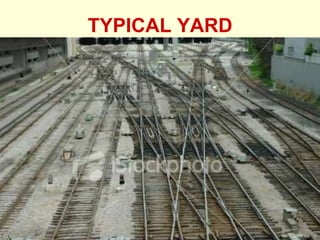
TYPICAL YARD
Why Layout Calculations?
• To fix correct position of T/out wrt existing track in
case of yard remodeling
• To avoid kinks & sharp curvatures
• To design new layouts in case of new construction
• To ensure safety
• For space economization
When needed ?
• Open Line engineers
 To rectify defective layouts
 For yard remodeling works
• Construction Engineers
 For Gauge conversion works
 For doubling works
 For yard remodeling works
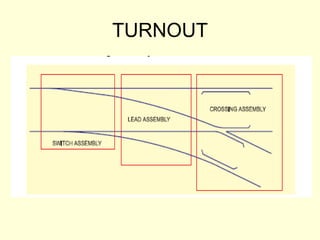
TURNOUT
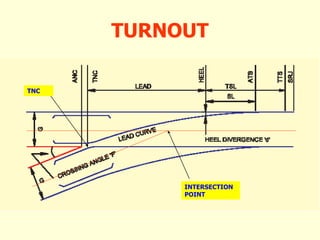
TURNOUT
INTERSECTION
POINT
TNC
Provisions of IRPWM
• Para 410(2)
 Turn outs in passenger running lines over which
passenger trains are received & dispatched
should be laid with crossing, not sharper than 1
in 12 for straight switch.
 In exceptional circumstances, 1 in 8 1/2 curved
switch may be laid; due to space constraint.
 Sharper crossings may also be used when T/O
is taking off from outside of a curve keeping
radius of lead curve within 350m (BG) (D=5)
Provisions of IRPWM
• Turn in curve may be allowed up to 220m (BG)
(D=8) subject to
- Turn in curve on PSC or ST sleepers only, with
sleeper spacing same as for main line.
- Full ballast profile as for main line track.
• Emergency X - overs between double or multiple
lines which are laid only in the trailing direction
may be laid with 1 in 8.5 crossings.
Provisions of IRPWM
In case of
- 1 in 8.5 T/Os with straight switches on passenger
lines, speed restricted to 10 Kmph
- 1 in 8.5 T/Os with straight swithes on non-
passenger lines, speed restricted to 15 Kmph
• Para 410(3)
Permissible speed for T/Os taking off from inside
of the curve shall be decided by taking resultant
radius of lead curve
1 in 8.5 T/Os not to be laid on inside of curves
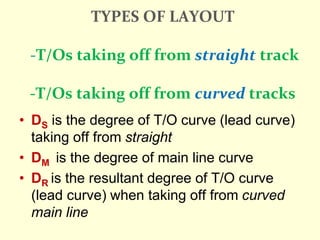
TYPES OF LAYOUT
-T/Os taking off from straight track
-T/Os taking off from curved tracks
• DS is the degree of T/O curve (lead curve)
taking off from straight
• DM is the degree of main line curve
• DR is the resultant degree of T/O curve
(lead curve) when taking off from curved
main line
12
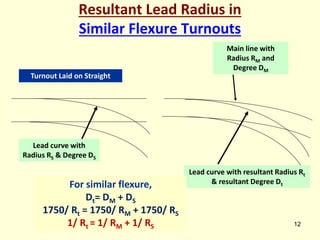
Resultant Lead Radius in
Similar Flexure Turnouts
Main line with
Radius RM and
Degree DM
Lead curve with resultant Radius Rt
& resultant Degree Dt
Lead curve with
Radius RS & Degree DS
Turnout Laid on Straight
For similar flexure,
Dt= DM + DS
1750/ Rt = 1750/ RM + 1750/ RS
1/ Rt = 1/ RM + 1/ RS
Resultant Lead Radius in
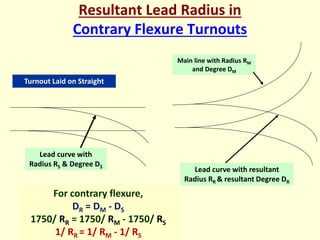
Contrary Flexure Turnouts
Lead curve with
Radius RS & Degree DS
Turnout Laid on Straight
Main line with Radius RM
and Degree DM
Lead curve with resultant
Radius RR & resultant Degree DR
For contrary flexure,
DR = DM - DS
1750/ RR = 1750/ RM - 1750/ RS
1/ RR = 1/ RM - 1/ RS
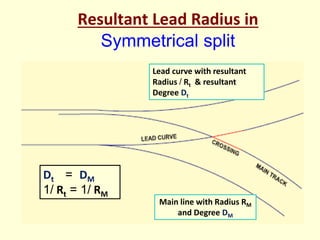
Resultant Lead Radius in
Symmetrical split
Dt = DM
1/ Rt = 1/ RM
Main line with Radius RM
and Degree DM
Lead curve with resultant
Radius / Rt & resultant
Degree Dt
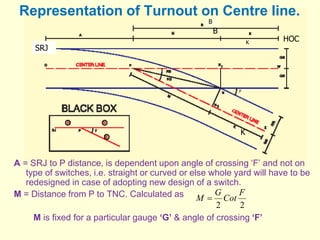
Representation of Turnout on Centre line.
A = SRJ to P distance, is dependent upon angle of crossing ‘F’ and not on
type of switches, i.e. straight or curved or else whole yard will have to be
redesigned in case of adopting new design of a switch.
M = Distance from P to TNC. Calculated as
M is fixed for a particular gauge ‘G’ & angle of crossing ‘F’
B
B
B
K
K
SRJ
HOC
2
2
F
Cot
G
M 
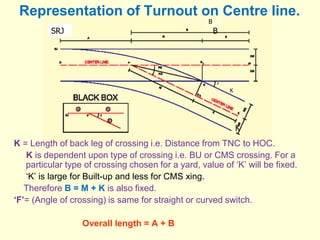
Representation of Turnout on Centre line.
K = Length of back leg of crossing i.e. Distance from TNC to HOC.
K is dependent upon type of crossing i.e. BU or CMS crossing. For a
particular type of crossing chosen for a yard, value of ‘K’ will be fixed.
‘K’ is large for Built-up and less for CMS xing.
Therefore B = M + K is also fixed.
‘F’= (Angle of crossing) is same for straight or curved switch.
Overall length = A + B
B
B
B
K
K
SRJ
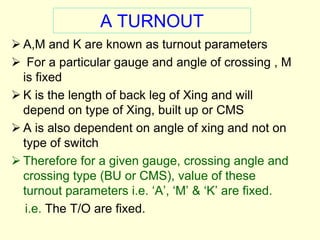
A TURNOUT
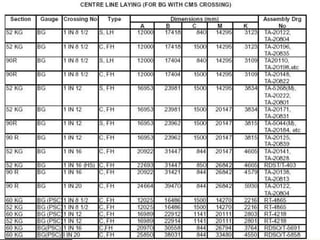
 A,M and K are known as turnout parameters
 For a particular gauge and angle of crossing , M
is fixed
 K is the length of back leg of Xing and will
depend on type of Xing, built up or CMS
 A is also dependent on angle of xing and not on
type of switch
 Therefore for a given gauge, crossing angle and
crossing type (BU or CMS), value of these
turnout parameters i.e. ‘A’, ‘M’ & ‘K’ are fixed.
i.e. The T/O are fixed.
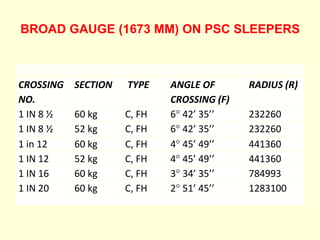
BROAD GAUGE (1673 MM) ON PSC SLEEPERS
CROSSING
NO.
SECTION TYPE ANGLE OF
CROSSING (F)
RADIUS (R)
1 IN 8 ½ 60 kg C, FH 6° 42’ 35’’ 232260
1 IN 8 ½ 52 kg C, FH 6° 42’ 35’’ 232260
1 in 12 60 kg C, FH 4° 45’ 49’’ 441360
1 IN 12 52 kg C, FH 4° 45’ 49’’ 441360
1 IN 16 60 kg C, FH 3° 34’ 35’’ 784993
1 IN 20 60 kg C, FH 2° 51’ 45’’ 1283100
TYPE OF CONNECTIONS
• Connection to non parallel tracks
(divergent)
• Connection to parallel tracks
SJ A
P
B
DIVERGENT TRACK
= F
B
Connection to Divergent Track
Three different situations, as discussed below may emerge –
i) When  = F
This is the simplest problem. The point P
can be located as the intersection point. After measuring
A from point P, SJ can be located and the layout can be
done.
-
F
SJ
A
B
T
P
F
TP
DIVERGENT TRACK
T
B
Y
X
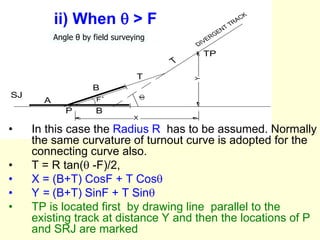
• In this case the Radius R has to be assumed. Normally
the same curvature of turnout curve is adopted for the
connecting curve also.
• T = R tan( -F)/2,
• X = (B+T) CosF + T Cos
• Y = (B+T) SinF + T Sin
• TP is located first by drawing line parallel to the
existing track at distance Y and then the locations of P
and SRJ are marked
ii) When  > F
Angle θ by field surveying
l SJ P
F
Z
TP
T
B
DIVERGENT TRACK
A
X
Y
T
B
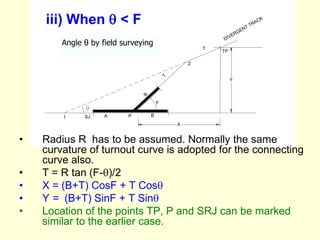
iii) When  < F
• Radius R has to be assumed. Normally the same
curvature of turnout curve is adopted for the connecting
curve also.
• T = R tan (F-)/2
• X = (B+T) CosF + T Cos
• Y = (B+T) SinF + T Sin
• Location of the points TP, P and SRJ can be marked
similar to the earlier case.
Angle θ by field surveying
Connections To Straight Parallel
Tracks
• Type of Layout connections between
straight parallel tracks depends upon the
distance between them & space availability
in the Yard.
• Accordingly distance between the two
tracks may be treated as NORMAL or
LARGE distance.
Connections To Straight Parallel
Tracks
1. With normal distance between tracks
2. With large distance between tracks
(I) with no straight between reverse curves
(II) with a straight between reverse curves
Connections To Straight Parallel
Tracks
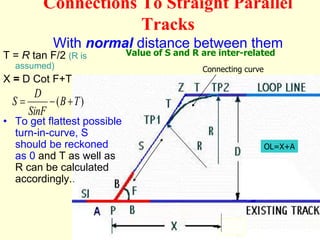
With normal distance between them
T = R tan F/2 (R is
assumed)
X = D Cot F+T
• To get flattest possible
turn-in-curve, S
should be reckoned
as 0 and T as well as
R can be calculated
accordingly..
)
( T
B
SinF
D
S 


Value of S and R are inter-related
OL=X+A
Connecting curve
Connections To Straight Parallel Tracks
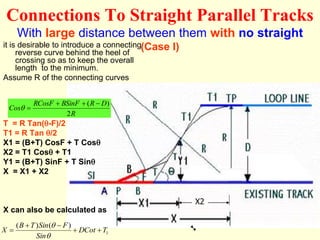
With large distance between them with no straight
(Case I)
it is desirable to introduce a connecting
reverse curve behind the heel of
crossing so as to keep the overall
length to the minimum.
Assume R of the connecting curves
T = R Tan(-F)/2
T1 = R Tan /2
X1 = (B+T) CosF + T Cos
X2 = T1 Cos + T1
Y1 = (B+T) SinF + T Sin
X = X1 + X2
X can also be calculated as
R
D
R
BSinF
RCosF
Cos
2
)
( 




1
)
(
)
(
T
DCot
Sin
F
Sin
T
B
X 






X2
Connections To Straight Parallel Tracks
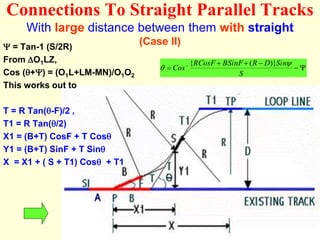
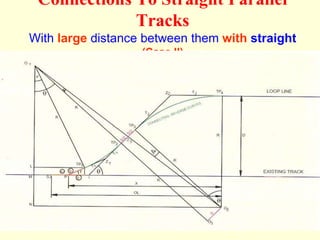
With large distance between them with straight
(Case II)
 = Tan-1 (S/2R)
From O1LZ,
Cos (+) = (O1L+LM-MN)/O1O2
This works out to
T = R Tan(-F)/2 ,
T1 = R Tan(/2)
X1 = (B+T) CosF + T Cos
Y1 = (B+T) SinF + T Sin
X = X1 + ( S + T1) Cos + T1





 
S
Sin
D
R
BSinF
RCosF
Cos


)}
(
{
1
Connections To Straight Parallel
Tracks
With large distance between them with straight
(Case II)
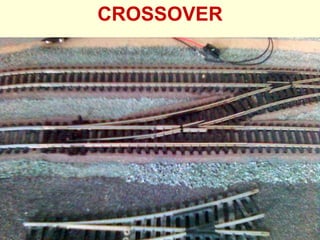
CROSSOVER
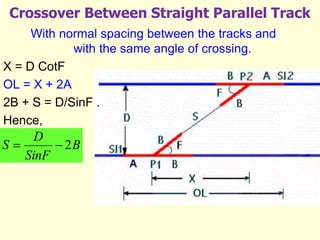
Crossover Between Straight Parallel Track
With normal spacing between the tracks and
with the same angle of crossing.
X = D CotF
OL = X + 2A
2B + S = D/SinF .
Hence,
B
SinF
D
S 2


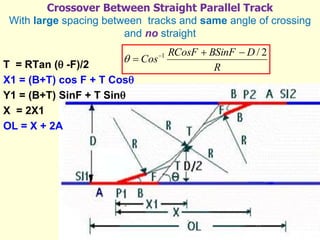
Crossover Between Straight Parallel Track
With large spacing between tracks and same angle of crossing
and no straight
T = RTan ( -F)/2
X1 = (B+T) cos F + T Cos
Y1 = (B+T) SinF + T Sin
X = 2X1
OL = X + 2A
R
D
BSinF
RCosF
Cos
2
/
1 

 

Crossover Between Straight Parallel Track
With large spacing between tracks and same angle
of crossing and no straight
- ‘R’ is assumed same as that lead curve radius of
T/out.
- D’ is known from actual field measurement.
- Type of T/out is decided. Accordingly value of
T/out parameters A,B will be known.
- Ө, T, X1, Y1 is calculated from expressions.
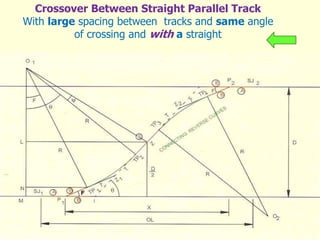
- One of the point P1 or P2 is to be fixed on field
considering obligatory points if any.
- other points can be fixed w.r.t. P1 or P2.
Crossover Between Straight Parallel Track
With large spacing between tracks and same angle of
crossing and with a straight
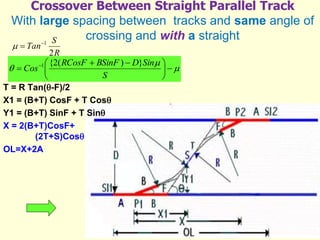
T = R Tan(-F)/2
X1 = (B+T) CosF + T Cos
Y1 = (B+T) SinF + T Sin
X = 2(B+T)CosF+
(2T+S)Cos
OL=X+2A
R
S
Tan
2
1





 





 

 
S
Sin
D
BSinF
RCosF
Cos
}
)
(
2
{
1
Crossover Between Straight Parallel Track
With large spacing between tracks and same angle
of crossing and with a straight
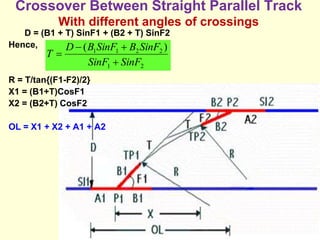
Crossover Between Straight Parallel Track
With different angles of crossings
D = (B1 + T) SinF1 + (B2 + T) SinF2
Hence,
R = T/tan{(F1-F2)/2}
X1 = (B1+T)CosF1
X2 = (B2+T) CosF2
OL = X1 + X2 + A1 + A2
2
1
2
2
1
1 )
(
SinF
SinF
SinF
B
SinF
B
D
T




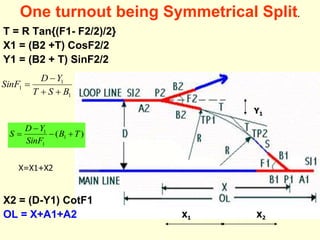
One turnout being Symmetrical Split.
T = R Tan{(F1- F2/2)/2}
X1 = (B2 +T) CosF2/2
Y1 = (B2 + T) SinF2/2
X2 = (D-Y1) CotF1
OL = X+A1+A2
1
1
1
B
S
T
Y
D
SinF




)
( 1
1
1
T
B
SinF
Y
D
S 



X1
Y1
X2
X=X1+X2
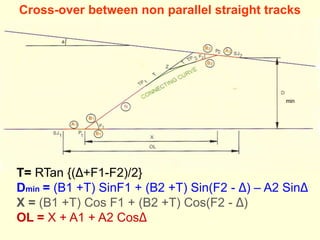
Cross-over between non parallel straight tracks
T= RTan {(Δ+F1-F2)/2}
Dmin = (B1 +T) SinF1 + (B2 +T) Sin(F2 - Δ) – A2 SinΔ
X = (B1 +T) Cos F1 + (B2 +T) Cos(F2 - Δ)
OL = X + A1 + A2 CosΔ
min
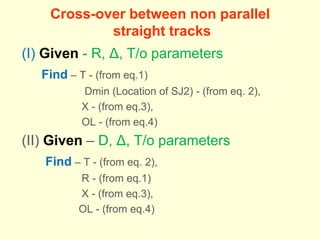
Cross-over between non parallel
straight tracks
(I) Given - R, Δ, T/o parameters
Find – T - (from eq.1)
Dmin (Location of SJ2) - (from eq. 2),
X - (from eq.3),
OL - (from eq.4)
(II) Given – D, Δ, T/o parameters
Find – T - (from eq. 2),
R - (from eq.1)
X - (from eq.3),
OL - (from eq.4)
CONNECTION BETWEEN CURVED TRACK TO
PARALLEL CURVED TRACK OR DIVERGENT
STRAIGHT TRACK
o Connection between two curved parallel tracks
- connection on outside of main line curve
without straight
- connection on outside of main line curve
with a straight
- connection on inside of main line curve
o Connection between a curved track to straight
track
- connection on inside of main line curve
- connection on outside of main line
N
K
C
A
K
H
K tan F/2
K tan F/2
F
Rm
Rc
O
Rm
1
O2
N
X
Rc
MAINLINE
LOOP
D
E
B
L
F
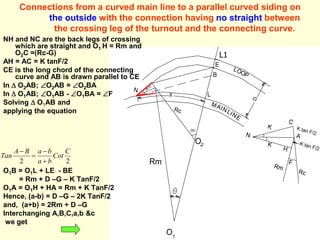
Connections from a curved main line to a parallel curved siding on
the outside with the connection having no straight between
the crossing leg of the turnout and the connecting curve.
NH and NC are the back legs of crossing
which are straight and O1 H = Rm and
O2C =(Rc-G)
AH = AC = K tanF/2
CE is the long chord of the connecting
curve and AB is drawn parallel to CE
In  O2AB; O2AB = O2BA
In  O1AB; O1AB - O1BA = F
Solving  O1AB and
applying the equation
O1B = O1L + LE - BE
= Rm + D –G – K TanF/2
O1A = O1H + HA = Rm + K TanF/2
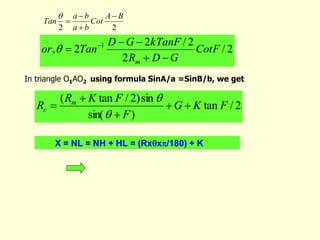
Hence, (a-b) = D –G – 2K TanF/2
and, (a+b) = 2Rm + D –G
Interchanging A,B,C,a,b &c
we get
2
2
C
Cot
b
a
b
a
B
A
Tan




L1
X = NL = NH + HL = (Rxx/180) + K
2
2
B
A
Cot
b
a
b
a
Tan





2
/
2
2
/
2
2
, 1
CotF
G
D
R
kTanF
G
D
Tan
or
m 



 

2
/
tan
)
sin(
sin
)
2
/
tan
(
F
K
G
F
F
K
R
R m
c 






In triangle O1AO2 using formula SinA/a =SinB/b, we get
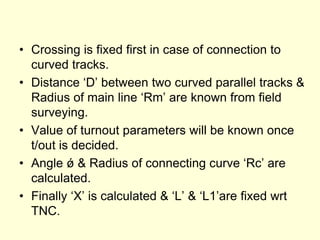
• Crossing is fixed first in case of connection to
curved tracks.
• Distance ‘D’ between two curved parallel tracks &
Radius of main line ‘Rm’ are known from field
surveying.
• Value of turnout parameters will be known once
t/out is decided.
• Angle ǿ & Radius of connecting curve ‘Rc’ are
calculated.
• Finally ‘X’ is calculated & ‘L’ & ‘L1’are fixed wrt
TNC.
Rm
B
E
Rc
Rm
N
K
C
F
K
H
A
D
X
Rc
O2
O 1
-F
K
K
N
C
A
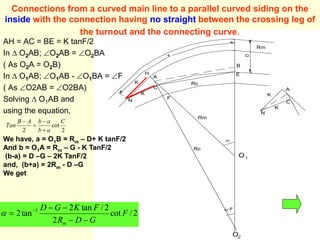
Connections from a curved main line to a parallel curved siding on the
inside with the connection having no straight between the crossing leg of
the turnout and the connecting curve.
AH = AC = BE = K tanF/2
In  O2AB; O2AB = O2BA
( As O2A = O2B)
In  O1AB; O1AB - O1BA = F
( As O2AB = O2BA)
Solving  O1AB and
using the equation,
2
cot
2
C
a
b
a
b
A
B
Tan




2
/
cot
2
2
/
tan
2
tan
2 1
F
G
D
R
F
K
G
D
m 



 

We have, a = O1B = Rm – D+ K tanF/2
And b = O1A = Rm – G - K TanF/2
(b-a) = D –G – 2K TanF/2
and, (b+a) = 2Rm - D –G
We get
C
c
B
b
A
a
sin
sin
sin


)
sin(
sin
)
2
/
tan
(
sin
2
/
F
F
K
G
R
KTanF
R m
c








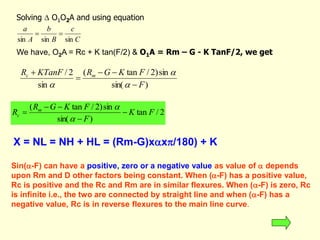
We have, O2A = Rc + K tan(F/2) & O1A = Rm – G - K TanF/2, we get
2
/
tan
)
sin(
sin
)
2
/
tan
(
F
K
F
F
K
G
R
R m
c 






X = NL = NH + HL = (Rm-G)xx/180) + K
Sin(-F) can have a positive, zero or a negative value as value of  depends
upon Rm and D other factors being constant. When (-F) has a positive value,
Rc is positive and the Rc and Rm are in similar flexures. When (-F) is zero, Rc
is infinite i.e., the two are connected by straight line and when (-F) has a
negative value, Rc is in reverse flexures to the main line curve.
Solving  O1O2A and using equation
Cross-over between curved parallel tracks
• In O1O2A, O1A = Rm + K Tan F/2
• O2A = Rc –G - K Tan F/2
• (O1O2)2 = (O1A)2 + (O2A)2 - 2 O1A xO2A Cos F
• = (Rm+KTanF/2) 2+ (Rc-G-KtanF/2) 2 -2(Rm+KTanF/2)
(Rc-G-KtanF/2)CosF ………..(1)
• In O1O2B, O1B = Rc + K Tan F/2
• O2B = Rm –D-G - K Tan F/2
• (O1O2) 2 = O1B2 + O2B2 - 2 O1Bx O2B Cos F
• = (Rc+KTanF/2) 2 +(Rm-D-G-KtanF/2) 2 -
2(Rc+KTanF/2) (Rm-D-G-KtanF/2)CosF ………..(2)
•
Equating equations (1) & (2), We can have,
)]
1
)}(
2
/
(
2
{
[
2
}]
)
2
/
(
){
2
(
2
)}
2
/
(
2
{
)}
2
/
(
2
}{
2
[{
CosF
F
KTan
G
DCosF
G
R
F
KTan
D
R
CosF
F
KTan
G
G
F
KTan
G
D
G
D
R
R m
m
m
c













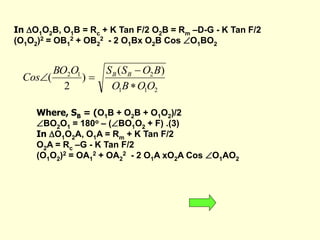
In O1O2B, O1B = Rc + K Tan F/2 O2B = Rm –D-G - K Tan F/2
(O1O2)2 = OB1
2 + OB2
2 - 2 O1Bx O2B Cos O1BO2
2
1
1
2
1
2 )
(
)
2
(
O
O
B
O
B
O
S
S
O
BO
Cos B
B




Where, SB = (O1B + O2B + O1O2)/2
BO2O1 = 180o – (BO1O2 + F) .(3)
In O1O2A, O1A = Rm + K Tan F/2
O2A = Rc –G - K Tan F/2
(O1O2)2 = OA1
2 + OA2
2 - 2 O1A xO2A Cos O1AO2


/
180

 c
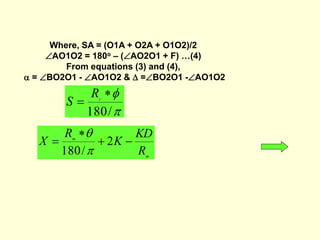
R
S
Where, SA = (O1A + O2A + O1O2)/2
AO1O2 = 180o – (AO2O1 + F) …(4)
From equations (3) and (4),
 = BO2O1 - AO1O2 &  =BO2O1 -AO1O2
m
m
R
KD
K
R
X 


 2
/
180 

GATHERING
LINES
OR
LADDER
Y
Y
Y
1
2
3
LL
LL
LL
D
D
D
X X X
SJ
A
P
0
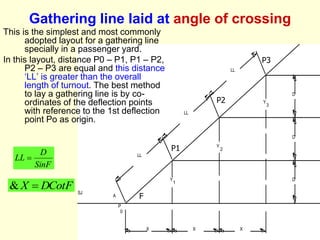
Gathering line laid at angle of crossing
This is the simplest and most commonly
adopted layout for a gathering line
specially in a passenger yard.
In this layout, distance P0 – P1, P1 – P2,
P2 – P3 are equal and this distance
‘LL’ is greater than the overall
length of turnout. The best method
to lay a gathering line is by co-
ordinates of the deflection points
with reference to the 1st deflection
point Po as origin.
SinF
D
LL 
DCotF
X 
&
P1
P3
P2
F
Y
Y
Y
1
2
3
D
D
D
X
X
X
A
P
0
D
2D
F Q
1
2
3
P
1
P
2
3
P
T T
S
B
A
B
A
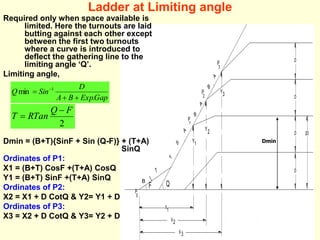
Ladder at Limiting angle
Required only when space available is
limited. Here the turnouts are laid
butting against each other except
between the first two turnouts
where a curve is introduced to
deflect the gathering line to the
limiting angle ‘Q’.
Limiting angle,
Dmin = (B+T){SinF + Sin (Q-F)} + (T+A)
SinQ
Ordinates of P1:
X1 = (B+T) CosF +(T+A) CosQ
Y1 = (B+T) SinF +(T+A) SinQ
Ordinates of P2:
X2 = X1 + D CotQ & Y2= Y1 + D
Ordinates of P3:
X3 = X2 + D CotQ & Y3= Y2 + D
Gap
Exp
B
A
D
Sin
Q
.
min 1


 
2
F
Q
RTan
T


Dmin
B
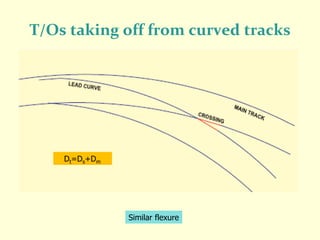
T/Os taking off from curved tracks
Similar flexure
Dt=Ds+Dm
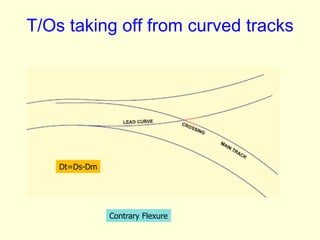
T/Os taking off from curved tracks
Contrary Flexure
Dt=Ds-Dm
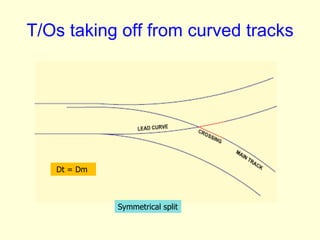
T/Os taking off from curved tracks
Symmetrical split
Dt = Dm

LAY OUT CALCULATIONS (1).pptx

  • 1.
  • 2.
  • 4.
    Why Layout Calculations? •To fix correct position of T/out wrt existing track in case of yard remodeling • To avoid kinks & sharp curvatures • To design new layouts in case of new construction • To ensure safety • For space economization
  • 5.
    When needed ? •Open Line engineers  To rectify defective layouts  For yard remodeling works • Construction Engineers  For Gauge conversion works  For doubling works  For yard remodeling works
  • 6.
  • 7.
  • 8.
    Provisions of IRPWM •Para 410(2)  Turn outs in passenger running lines over which passenger trains are received & dispatched should be laid with crossing, not sharper than 1 in 12 for straight switch.  In exceptional circumstances, 1 in 8 1/2 curved switch may be laid; due to space constraint.  Sharper crossings may also be used when T/O is taking off from outside of a curve keeping radius of lead curve within 350m (BG) (D=5)
  • 9.
    Provisions of IRPWM •Turn in curve may be allowed up to 220m (BG) (D=8) subject to - Turn in curve on PSC or ST sleepers only, with sleeper spacing same as for main line. - Full ballast profile as for main line track. • Emergency X - overs between double or multiple lines which are laid only in the trailing direction may be laid with 1 in 8.5 crossings.
  • 10.
    Provisions of IRPWM Incase of - 1 in 8.5 T/Os with straight switches on passenger lines, speed restricted to 10 Kmph - 1 in 8.5 T/Os with straight swithes on non- passenger lines, speed restricted to 15 Kmph • Para 410(3) Permissible speed for T/Os taking off from inside of the curve shall be decided by taking resultant radius of lead curve 1 in 8.5 T/Os not to be laid on inside of curves
  • 11.
    TYPES OF LAYOUT -T/Ostaking off from straight track -T/Os taking off from curved tracks • DS is the degree of T/O curve (lead curve) taking off from straight • DM is the degree of main line curve • DR is the resultant degree of T/O curve (lead curve) when taking off from curved main line
  • 12.
    12 Resultant Lead Radiusin Similar Flexure Turnouts Main line with Radius RM and Degree DM Lead curve with resultant Radius Rt & resultant Degree Dt Lead curve with Radius RS & Degree DS Turnout Laid on Straight For similar flexure, Dt= DM + DS 1750/ Rt = 1750/ RM + 1750/ RS 1/ Rt = 1/ RM + 1/ RS
  • 13.
    Resultant Lead Radiusin Contrary Flexure Turnouts Lead curve with Radius RS & Degree DS Turnout Laid on Straight Main line with Radius RM and Degree DM Lead curve with resultant Radius RR & resultant Degree DR For contrary flexure, DR = DM - DS 1750/ RR = 1750/ RM - 1750/ RS 1/ RR = 1/ RM - 1/ RS
  • 14.
    Resultant Lead Radiusin Symmetrical split Dt = DM 1/ Rt = 1/ RM Main line with Radius RM and Degree DM Lead curve with resultant Radius / Rt & resultant Degree Dt
  • 15.
    Representation of Turnouton Centre line. A = SRJ to P distance, is dependent upon angle of crossing ‘F’ and not on type of switches, i.e. straight or curved or else whole yard will have to be redesigned in case of adopting new design of a switch. M = Distance from P to TNC. Calculated as M is fixed for a particular gauge ‘G’ & angle of crossing ‘F’ B B B K K SRJ HOC 2 2 F Cot G M 
  • 16.
    Representation of Turnouton Centre line. K = Length of back leg of crossing i.e. Distance from TNC to HOC. K is dependent upon type of crossing i.e. BU or CMS crossing. For a particular type of crossing chosen for a yard, value of ‘K’ will be fixed. ‘K’ is large for Built-up and less for CMS xing. Therefore B = M + K is also fixed. ‘F’= (Angle of crossing) is same for straight or curved switch. Overall length = A + B B B B K K SRJ
  • 17.
    A TURNOUT  A,Mand K are known as turnout parameters  For a particular gauge and angle of crossing , M is fixed  K is the length of back leg of Xing and will depend on type of Xing, built up or CMS  A is also dependent on angle of xing and not on type of switch  Therefore for a given gauge, crossing angle and crossing type (BU or CMS), value of these turnout parameters i.e. ‘A’, ‘M’ & ‘K’ are fixed. i.e. The T/O are fixed.
  • 19.
    BROAD GAUGE (1673MM) ON PSC SLEEPERS CROSSING NO. SECTION TYPE ANGLE OF CROSSING (F) RADIUS (R) 1 IN 8 ½ 60 kg C, FH 6° 42’ 35’’ 232260 1 IN 8 ½ 52 kg C, FH 6° 42’ 35’’ 232260 1 in 12 60 kg C, FH 4° 45’ 49’’ 441360 1 IN 12 52 kg C, FH 4° 45’ 49’’ 441360 1 IN 16 60 kg C, FH 3° 34’ 35’’ 784993 1 IN 20 60 kg C, FH 2° 51’ 45’’ 1283100
  • 20.
    TYPE OF CONNECTIONS •Connection to non parallel tracks (divergent) • Connection to parallel tracks
  • 21.
    SJ A P B DIVERGENT TRACK =F B Connection to Divergent Track Three different situations, as discussed below may emerge – i) When  = F This is the simplest problem. The point P can be located as the intersection point. After measuring A from point P, SJ can be located and the layout can be done. - F
  • 22.
    SJ A B T P F TP DIVERGENT TRACK T B Y X • Inthis case the Radius R has to be assumed. Normally the same curvature of turnout curve is adopted for the connecting curve also. • T = R tan( -F)/2, • X = (B+T) CosF + T Cos • Y = (B+T) SinF + T Sin • TP is located first by drawing line parallel to the existing track at distance Y and then the locations of P and SRJ are marked ii) When  > F Angle θ by field surveying
  • 23.
    l SJ P F Z TP T B DIVERGENTTRACK A X Y T B iii) When  < F • Radius R has to be assumed. Normally the same curvature of turnout curve is adopted for the connecting curve also. • T = R tan (F-)/2 • X = (B+T) CosF + T Cos • Y = (B+T) SinF + T Sin • Location of the points TP, P and SRJ can be marked similar to the earlier case. Angle θ by field surveying
  • 24.
    Connections To StraightParallel Tracks • Type of Layout connections between straight parallel tracks depends upon the distance between them & space availability in the Yard. • Accordingly distance between the two tracks may be treated as NORMAL or LARGE distance.
  • 25.
    Connections To StraightParallel Tracks 1. With normal distance between tracks 2. With large distance between tracks (I) with no straight between reverse curves (II) with a straight between reverse curves
  • 26.
    Connections To StraightParallel Tracks With normal distance between them T = R tan F/2 (R is assumed) X = D Cot F+T • To get flattest possible turn-in-curve, S should be reckoned as 0 and T as well as R can be calculated accordingly.. ) ( T B SinF D S    Value of S and R are inter-related OL=X+A Connecting curve
  • 27.
    Connections To StraightParallel Tracks With large distance between them with no straight (Case I) it is desirable to introduce a connecting reverse curve behind the heel of crossing so as to keep the overall length to the minimum. Assume R of the connecting curves T = R Tan(-F)/2 T1 = R Tan /2 X1 = (B+T) CosF + T Cos X2 = T1 Cos + T1 Y1 = (B+T) SinF + T Sin X = X1 + X2 X can also be calculated as R D R BSinF RCosF Cos 2 ) (      1 ) ( ) ( T DCot Sin F Sin T B X        X2
  • 28.
    Connections To StraightParallel Tracks With large distance between them with straight (Case II)  = Tan-1 (S/2R) From O1LZ, Cos (+) = (O1L+LM-MN)/O1O2 This works out to T = R Tan(-F)/2 , T1 = R Tan(/2) X1 = (B+T) CosF + T Cos Y1 = (B+T) SinF + T Sin X = X1 + ( S + T1) Cos + T1        S Sin D R BSinF RCosF Cos   )} ( { 1
  • 29.
    Connections To StraightParallel Tracks With large distance between them with straight (Case II)
  • 30.
  • 31.
    Crossover Between StraightParallel Track With normal spacing between the tracks and with the same angle of crossing. X = D CotF OL = X + 2A 2B + S = D/SinF . Hence, B SinF D S 2  
  • 32.
    Crossover Between StraightParallel Track With large spacing between tracks and same angle of crossing and no straight T = RTan ( -F)/2 X1 = (B+T) cos F + T Cos Y1 = (B+T) SinF + T Sin X = 2X1 OL = X + 2A R D BSinF RCosF Cos 2 / 1     
  • 33.
    Crossover Between StraightParallel Track With large spacing between tracks and same angle of crossing and no straight - ‘R’ is assumed same as that lead curve radius of T/out. - D’ is known from actual field measurement. - Type of T/out is decided. Accordingly value of T/out parameters A,B will be known. - Ө, T, X1, Y1 is calculated from expressions. - One of the point P1 or P2 is to be fixed on field considering obligatory points if any. - other points can be fixed w.r.t. P1 or P2.
  • 34.
    Crossover Between StraightParallel Track With large spacing between tracks and same angle of crossing and with a straight T = R Tan(-F)/2 X1 = (B+T) CosF + T Cos Y1 = (B+T) SinF + T Sin X = 2(B+T)CosF+ (2T+S)Cos OL=X+2A R S Tan 2 1                  S Sin D BSinF RCosF Cos } ) ( 2 { 1
  • 35.
    Crossover Between StraightParallel Track With large spacing between tracks and same angle of crossing and with a straight
  • 36.
    Crossover Between StraightParallel Track With different angles of crossings D = (B1 + T) SinF1 + (B2 + T) SinF2 Hence, R = T/tan{(F1-F2)/2} X1 = (B1+T)CosF1 X2 = (B2+T) CosF2 OL = X1 + X2 + A1 + A2 2 1 2 2 1 1 ) ( SinF SinF SinF B SinF B D T    
  • 37.
    One turnout beingSymmetrical Split. T = R Tan{(F1- F2/2)/2} X1 = (B2 +T) CosF2/2 Y1 = (B2 + T) SinF2/2 X2 = (D-Y1) CotF1 OL = X+A1+A2 1 1 1 B S T Y D SinF     ) ( 1 1 1 T B SinF Y D S     X1 Y1 X2 X=X1+X2
  • 38.
    Cross-over between nonparallel straight tracks T= RTan {(Δ+F1-F2)/2} Dmin = (B1 +T) SinF1 + (B2 +T) Sin(F2 - Δ) – A2 SinΔ X = (B1 +T) Cos F1 + (B2 +T) Cos(F2 - Δ) OL = X + A1 + A2 CosΔ min
  • 39.
    Cross-over between nonparallel straight tracks (I) Given - R, Δ, T/o parameters Find – T - (from eq.1) Dmin (Location of SJ2) - (from eq. 2), X - (from eq.3), OL - (from eq.4) (II) Given – D, Δ, T/o parameters Find – T - (from eq. 2), R - (from eq.1) X - (from eq.3), OL - (from eq.4)
  • 40.
    CONNECTION BETWEEN CURVEDTRACK TO PARALLEL CURVED TRACK OR DIVERGENT STRAIGHT TRACK o Connection between two curved parallel tracks - connection on outside of main line curve without straight - connection on outside of main line curve with a straight - connection on inside of main line curve o Connection between a curved track to straight track - connection on inside of main line curve - connection on outside of main line
  • 41.
    N K C A K H K tan F/2 Ktan F/2 F Rm Rc O Rm 1 O2 N X Rc MAINLINE LOOP D E B L F Connections from a curved main line to a parallel curved siding on the outside with the connection having no straight between the crossing leg of the turnout and the connecting curve. NH and NC are the back legs of crossing which are straight and O1 H = Rm and O2C =(Rc-G) AH = AC = K tanF/2 CE is the long chord of the connecting curve and AB is drawn parallel to CE In  O2AB; O2AB = O2BA In  O1AB; O1AB - O1BA = F Solving  O1AB and applying the equation O1B = O1L + LE - BE = Rm + D –G – K TanF/2 O1A = O1H + HA = Rm + K TanF/2 Hence, (a-b) = D –G – 2K TanF/2 and, (a+b) = 2Rm + D –G Interchanging A,B,C,a,b &c we get 2 2 C Cot b a b a B A Tan     L1
  • 42.
    X = NL= NH + HL = (Rxx/180) + K 2 2 B A Cot b a b a Tan      2 / 2 2 / 2 2 , 1 CotF G D R kTanF G D Tan or m        2 / tan ) sin( sin ) 2 / tan ( F K G F F K R R m c        In triangle O1AO2 using formula SinA/a =SinB/b, we get
  • 43.
    • Crossing isfixed first in case of connection to curved tracks. • Distance ‘D’ between two curved parallel tracks & Radius of main line ‘Rm’ are known from field surveying. • Value of turnout parameters will be known once t/out is decided. • Angle ǿ & Radius of connecting curve ‘Rc’ are calculated. • Finally ‘X’ is calculated & ‘L’ & ‘L1’are fixed wrt TNC.
  • 44.
    Rm B E Rc Rm N K C F K H A D X Rc O2 O 1 -F K K N C A Connections froma curved main line to a parallel curved siding on the inside with the connection having no straight between the crossing leg of the turnout and the connecting curve. AH = AC = BE = K tanF/2 In  O2AB; O2AB = O2BA ( As O2A = O2B) In  O1AB; O1AB - O1BA = F ( As O2AB = O2BA) Solving  O1AB and using the equation, 2 cot 2 C a b a b A B Tan     2 / cot 2 2 / tan 2 tan 2 1 F G D R F K G D m        We have, a = O1B = Rm – D+ K tanF/2 And b = O1A = Rm – G - K TanF/2 (b-a) = D –G – 2K TanF/2 and, (b+a) = 2Rm - D –G We get
  • 45.
    C c B b A a sin sin sin   ) sin( sin ) 2 / tan ( sin 2 / F F K G R KTanF R m c         We have,O2A = Rc + K tan(F/2) & O1A = Rm – G - K TanF/2, we get 2 / tan ) sin( sin ) 2 / tan ( F K F F K G R R m c        X = NL = NH + HL = (Rm-G)xx/180) + K Sin(-F) can have a positive, zero or a negative value as value of  depends upon Rm and D other factors being constant. When (-F) has a positive value, Rc is positive and the Rc and Rm are in similar flexures. When (-F) is zero, Rc is infinite i.e., the two are connected by straight line and when (-F) has a negative value, Rc is in reverse flexures to the main line curve. Solving  O1O2A and using equation
  • 46.
    Cross-over between curvedparallel tracks • In O1O2A, O1A = Rm + K Tan F/2 • O2A = Rc –G - K Tan F/2 • (O1O2)2 = (O1A)2 + (O2A)2 - 2 O1A xO2A Cos F • = (Rm+KTanF/2) 2+ (Rc-G-KtanF/2) 2 -2(Rm+KTanF/2) (Rc-G-KtanF/2)CosF ………..(1) • In O1O2B, O1B = Rc + K Tan F/2 • O2B = Rm –D-G - K Tan F/2 • (O1O2) 2 = O1B2 + O2B2 - 2 O1Bx O2B Cos F • = (Rc+KTanF/2) 2 +(Rm-D-G-KtanF/2) 2 - 2(Rc+KTanF/2) (Rm-D-G-KtanF/2)CosF ………..(2) • Equating equations (1) & (2), We can have, )] 1 )}( 2 / ( 2 { [ 2 }] ) 2 / ( ){ 2 ( 2 )} 2 / ( 2 { )} 2 / ( 2 }{ 2 [{ CosF F KTan G DCosF G R F KTan D R CosF F KTan G G F KTan G D G D R R m m m c             
  • 47.
    In O1O2B, O1B= Rc + K Tan F/2 O2B = Rm –D-G - K Tan F/2 (O1O2)2 = OB1 2 + OB2 2 - 2 O1Bx O2B Cos O1BO2 2 1 1 2 1 2 ) ( ) 2 ( O O B O B O S S O BO Cos B B     Where, SB = (O1B + O2B + O1O2)/2 BO2O1 = 180o – (BO1O2 + F) .(3) In O1O2A, O1A = Rm + K Tan F/2 O2A = Rc –G - K Tan F/2 (O1O2)2 = OA1 2 + OA2 2 - 2 O1A xO2A Cos O1AO2
  • 48.
      / 180   c R S Where, SA= (O1A + O2A + O1O2)/2 AO1O2 = 180o – (AO2O1 + F) …(4) From equations (3) and (4),  = BO2O1 - AO1O2 &  =BO2O1 -AO1O2 m m R KD K R X     2 / 180  
  • 49.
  • 50.
    Y Y Y 1 2 3 LL LL LL D D D X X X SJ A P 0 Gatheringline laid at angle of crossing This is the simplest and most commonly adopted layout for a gathering line specially in a passenger yard. In this layout, distance P0 – P1, P1 – P2, P2 – P3 are equal and this distance ‘LL’ is greater than the overall length of turnout. The best method to lay a gathering line is by co- ordinates of the deflection points with reference to the 1st deflection point Po as origin. SinF D LL  DCotF X  & P1 P3 P2 F
  • 51.
    Y Y Y 1 2 3 D D D X X X A P 0 D 2D F Q 1 2 3 P 1 P 2 3 P T T S B A B A Ladderat Limiting angle Required only when space available is limited. Here the turnouts are laid butting against each other except between the first two turnouts where a curve is introduced to deflect the gathering line to the limiting angle ‘Q’. Limiting angle, Dmin = (B+T){SinF + Sin (Q-F)} + (T+A) SinQ Ordinates of P1: X1 = (B+T) CosF +(T+A) CosQ Y1 = (B+T) SinF +(T+A) SinQ Ordinates of P2: X2 = X1 + D CotQ & Y2= Y1 + D Ordinates of P3: X3 = X2 + D CotQ & Y3= Y2 + D Gap Exp B A D Sin Q . min 1     2 F Q RTan T   Dmin B
  • 53.
    T/Os taking offfrom curved tracks Similar flexure Dt=Ds+Dm
  • 54.
    T/Os taking offfrom curved tracks Contrary Flexure Dt=Ds-Dm
  • 55.
    T/Os taking offfrom curved tracks Symmetrical split Dt = Dm