LEVEL CROSSINGS
L P Srivastava
Assistant Professor Track
M No.7420041149
General Location
• In view of the safety no new level crossing to be provided
on any line.
• In case of new line on socio-economic consideration where
RoR is < 10%, manned LCs may be considered with Board’s
approval.
• Should be located on outside the outermost facing points.
• LCs at cuttings or near cuttings should be avoided.
• LCs affecting operation and causing detention should be
replaced by ROB/RUB or shift them outside the outermost
facing point.
Classification of LCs
• TVU > 50000 Special class
• TVU 50000 – 30000 or line capacity ‘A’ class
utilization 80% (on single line) and number
of road vehicles > 1000.
• TVU < 30000 and up to 20000 and ‘B’ class
and number of road vehicles > 750
‘B’ class is further subdivided as
• TVU < 30000 and up to 25000 B 1 class
• TVU < 25000 and up to 20000 B 2 class
• All other LCs ‘C’ class
Categories of roads
• NHs, SHs, Important roads Class ‘I’ roads
and where road and rail traffic is heavy
• Major and district roads, unimportant roads Class ‘II’ roads
and all surfaced roads
• Earth roads and cart roads Class ‘III’ roads
Locking arrangements
• Gates shall be in the form of lifting barrier or swing gates. Albeit,
swing gates should be replaced by lifting barriers.
• In the event of any damage chain or sliding boom may be used.
• Separate rail posts should be erected for fixing of chains.
• Lifting barrier should be provided as close as feasible to gate post.
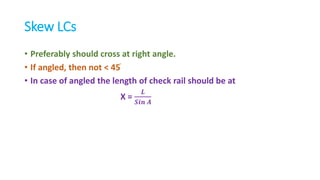
Skew LCs
• Preferably should cross at right angle.
• If angled, then not < 45֯
• In case of angled the length of check rail should be at
X =
𝑳
𝑺𝒊𝒏 𝑨
Normal position of gate
• Closed to road traffic
• Open to road traffic.
Traffic and engineering gates
• Within the outermost stop signals Traffic LC
• Beyond THE outer most stop signal Engineering LC
Height gauge
• Should be at a distance of 8 m from gate post.
• In exceptional cases at a distance of 8 m from center of track.
• Traction wire on LC at a height of 5.5 m.
• Height of height gauge should be at 4.78 m from ground level.
Inspection
• JE/SSE should inspect once in a month by rotation.
• AEN once in six months.
• During inspection all tools should be checked, gateman should be
examined in safety rules.
Speed breaker and speed breaker boards
• Should have rumble strips provided by the road authorities.
• Should be at a distance 20 M.
• Warning sign boards at a distance of:
Class I 120 m
Class II 60-90 m
Class III 40 m
Census
• Once in three years.
• Should be carried out by multi disciplinary inspectorial team.
• The mechanism shall be setup by DRM by laying down advance
timetable.
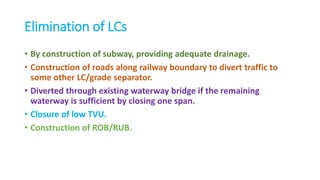
Elimination of LCs
• By construction of subway, providing adequate drainage.
• Construction of roads along railway boundary to divert traffic to
some other LC/grade separator.
• Diverted through existing waterway bridge if the remaining
waterway is sufficient by closing one span.
• Closure of low TVU.
• Construction of ROB/RUB.
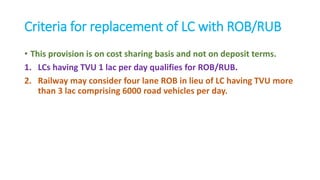
Criteria for replacement of LC with ROB/RUB
• This provision is on cost sharing basis and not on deposit terms.
1. LCs having TVU 1 lac per day qualifies for ROB/RUB.
2. Railway may consider four lane ROB in lieu of LC having TVU more
than 3 lac comprising 6000 road vehicles per day.
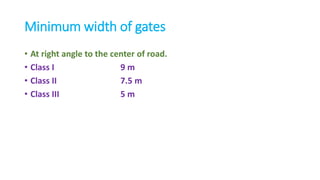
Minimum width of gates
• At right angle to the center of road.
• Class I 9 m
• Class II 7.5 m
• Class III 5 m
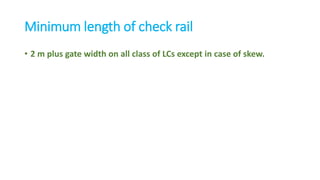
Minimum length of check rail
• 2 m plus gate width on all class of LCs except in case of skew.
Provision of wicket gate
• To be provided except where FOBs are provided on ‘Spl.’, ‘A’, & ‘B’
class LCs.
• On ‘C’ class to be provided on need basis after assessing the
requirement by a committee.
Provision of lifting barrier
• Should be provided on all gates.
• Should be provided as close as feasible to gate posts.
Distance of gate post
• Minimum 3 m from center line of nearest track.
• Distance of gate post 3 m + 30 cm (tolerance).
• May further be increased with the approval of the PCE.
Gate lodge
• 6 m from the center of the track for all class of LCs.
• 6 m from the edge of the road for all class of LCs.
Fencing where track is not fenced
• 15 m on all sides from gate post parallel to track on all LCs.
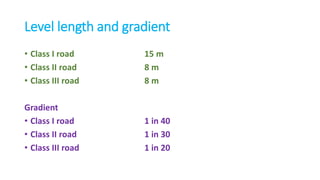
Level length and gradient
• Class I road 15 m
• Class II road 8 m
• Class III road 8 m
Gradient
• Class I road 1 in 40
• Class II road 1 in 30
• Class III road 1 in 20
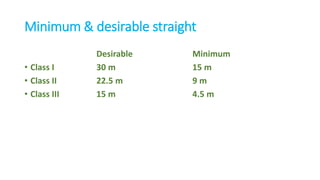
Minimum & desirable straight
Desirable Minimum
• Class I 30 m 15 m
• Class II 22.5 m 9 m
• Class III 15 m 4.5 m
Whistle board
• To be provided at a distance of 600 m on all LCs to enjoin the drivers
of approaching trains to give audible warning to road users.
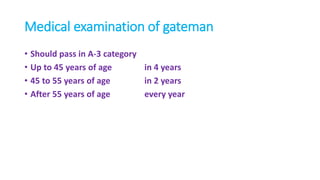
Medical examination of gateman
• Should pass in A-3 category
• Up to 45 years of age in 4 years
• 45 to 55 years of age in 2 years
• After 55 years of age every year
Competency certificate
• To be issued once in five years.
Thank you

Level crossing Check rail Indian railways material

  • 1.
    LEVEL CROSSINGS L PSrivastava Assistant Professor Track M No.7420041149
  • 2.
    General Location • Inview of the safety no new level crossing to be provided on any line. • In case of new line on socio-economic consideration where RoR is < 10%, manned LCs may be considered with Board’s approval. • Should be located on outside the outermost facing points. • LCs at cuttings or near cuttings should be avoided. • LCs affecting operation and causing detention should be replaced by ROB/RUB or shift them outside the outermost facing point.
  • 3.
    Classification of LCs •TVU > 50000 Special class • TVU 50000 – 30000 or line capacity ‘A’ class utilization 80% (on single line) and number of road vehicles > 1000. • TVU < 30000 and up to 20000 and ‘B’ class and number of road vehicles > 750 ‘B’ class is further subdivided as • TVU < 30000 and up to 25000 B 1 class • TVU < 25000 and up to 20000 B 2 class • All other LCs ‘C’ class
  • 4.
    Categories of roads •NHs, SHs, Important roads Class ‘I’ roads and where road and rail traffic is heavy • Major and district roads, unimportant roads Class ‘II’ roads and all surfaced roads • Earth roads and cart roads Class ‘III’ roads
  • 5.
    Locking arrangements • Gatesshall be in the form of lifting barrier or swing gates. Albeit, swing gates should be replaced by lifting barriers. • In the event of any damage chain or sliding boom may be used. • Separate rail posts should be erected for fixing of chains. • Lifting barrier should be provided as close as feasible to gate post.
  • 6.
    Skew LCs • Preferablyshould cross at right angle. • If angled, then not < 45֯ • In case of angled the length of check rail should be at X = 𝑳 𝑺𝒊𝒏 𝑨
  • 7.
    Normal position ofgate • Closed to road traffic • Open to road traffic.
  • 8.
    Traffic and engineeringgates • Within the outermost stop signals Traffic LC • Beyond THE outer most stop signal Engineering LC
  • 9.
    Height gauge • Shouldbe at a distance of 8 m from gate post. • In exceptional cases at a distance of 8 m from center of track. • Traction wire on LC at a height of 5.5 m. • Height of height gauge should be at 4.78 m from ground level.
  • 10.
    Inspection • JE/SSE shouldinspect once in a month by rotation. • AEN once in six months. • During inspection all tools should be checked, gateman should be examined in safety rules.
  • 11.
    Speed breaker andspeed breaker boards • Should have rumble strips provided by the road authorities. • Should be at a distance 20 M. • Warning sign boards at a distance of: Class I 120 m Class II 60-90 m Class III 40 m
  • 12.
    Census • Once inthree years. • Should be carried out by multi disciplinary inspectorial team. • The mechanism shall be setup by DRM by laying down advance timetable.
  • 13.
    Elimination of LCs •By construction of subway, providing adequate drainage. • Construction of roads along railway boundary to divert traffic to some other LC/grade separator. • Diverted through existing waterway bridge if the remaining waterway is sufficient by closing one span. • Closure of low TVU. • Construction of ROB/RUB.
  • 14.
    Criteria for replacementof LC with ROB/RUB • This provision is on cost sharing basis and not on deposit terms. 1. LCs having TVU 1 lac per day qualifies for ROB/RUB. 2. Railway may consider four lane ROB in lieu of LC having TVU more than 3 lac comprising 6000 road vehicles per day.
  • 15.
    Minimum width ofgates • At right angle to the center of road. • Class I 9 m • Class II 7.5 m • Class III 5 m
  • 16.
    Minimum length ofcheck rail • 2 m plus gate width on all class of LCs except in case of skew.
  • 17.
    Provision of wicketgate • To be provided except where FOBs are provided on ‘Spl.’, ‘A’, & ‘B’ class LCs. • On ‘C’ class to be provided on need basis after assessing the requirement by a committee.
  • 18.
    Provision of liftingbarrier • Should be provided on all gates. • Should be provided as close as feasible to gate posts.
  • 19.
    Distance of gatepost • Minimum 3 m from center line of nearest track. • Distance of gate post 3 m + 30 cm (tolerance). • May further be increased with the approval of the PCE.
  • 20.
    Gate lodge • 6m from the center of the track for all class of LCs. • 6 m from the edge of the road for all class of LCs.
  • 21.
    Fencing where trackis not fenced • 15 m on all sides from gate post parallel to track on all LCs.
  • 22.
    Level length andgradient • Class I road 15 m • Class II road 8 m • Class III road 8 m Gradient • Class I road 1 in 40 • Class II road 1 in 30 • Class III road 1 in 20
  • 23.
    Minimum & desirablestraight Desirable Minimum • Class I 30 m 15 m • Class II 22.5 m 9 m • Class III 15 m 4.5 m
  • 24.
    Whistle board • Tobe provided at a distance of 600 m on all LCs to enjoin the drivers of approaching trains to give audible warning to road users.
  • 25.
    Medical examination ofgateman • Should pass in A-3 category • Up to 45 years of age in 4 years • 45 to 55 years of age in 2 years • After 55 years of age every year
  • 26.
    Competency certificate • Tobe issued once in five years.
  • 27.