Domina Petric, MD
Intermittent constipation is best
prevented with a high-fiber diet,
adequate fluid intake, regular exercise
and the heeding of nature´s call.
Patients not responding to dietary
changes or fiber supplements should
undergo medical evaluation before
initiating long-term laxative treatment.
• Indigestible, hydrophilic colloids that
absorb water, forming a bulky, emollient
gel that distends the colon and promotes
peristalsis.
• Natural plant products: psyllium,
methylcellulose.
• Synthetic fibers: polycarbophil.
• Bacterial digestion of plant fibers within
the colon may lead to increased bloating
and flatus.
• These agents soften stool material, permitting water
and lipids to penetrate.
• They may be administered orally or rectally.
• Examples: docusate (oral, enema), glycerin
suppository.
• Docusate is used in hospitalized patients to prevent
constipation and minimize straining.
• Mineral oil is a clear, viscous oil that lubricates fecal
material, retarding water absorption from the stool.
• It is used to prevent and treat fecal impaction in
young children and debilitated adults.
• Long-term use can impair absorption of fat-soluble
vitamins (K, A, D, E).
• The colon can neither concentrate nor dilute fecal
fluid.
• Fecal water is isotonic throughout the colon.
• Osmotic laxatives are soluble, but nonabsorbable
compounds that result in increased stool liquidity
due to an obligate increase in fecal fluid.
Osmotic laxatives are:
• NONABSORBABLE SUGARS OR SALTS
• BALANCED POLYETHYLENE GLYCOL
• These agents may be used for the treatment of acute
constipation or the prevention of chronic
constipation.
• Magnesium hydroxide (milk of magnesia) is a
commonly used osmotic laxative.
• It should not be used for prolonged periods in
pateints with renal insufficiency due to the risk of
hypermagnesemia.
• Sorbitol and lactulose are nonabsorbable sugars that
can be used to prevent or treat chronic constipation.
• These sugars are metabolized by colonic bacteria,
producing severe flatus and cramps.
• High doses of osmotically active agents produce
prompt bowel evacuation (purgation) within 1-3
hours.
• The rapid movement of water into the distal small
bowel and colon leads to a high volume of liquid
stool followed by rapid relief of constipation.
• Magnesium cistrate, sodium phosphate: it is very
important that patients maintain adequate hydration
by taking increased oral liquids to compensate for
fecal fluid loss.
• Sodium phosphate frequently causes
hyperphosphatemia, hypocalcemia, hypernatremia
and hypokalemia, which can lead to cardiac
• Acute renal failure may happen due to tubular
deposition of calcium phosphate
(nephrocalcinosis).
Sodium phosphate preparations should not be
used in patients who:
• are frail or elderly
• have renal insufficiency
• have significant cardiac disease
• are unable to maintain adequate hydration
during bowel preparation
• Large solutions containing PEG are used for
complete colonic cleansing before gastrointestinal
endoscopic procedures.
• These balanced, isotonic solutions contain an inert,
nonabsorbable, osmotically active sugar (PEG) with
sodium sulfate, sodium chloride, sodium bicarbonate
and potassium chloride.
• PEG is safe: no significant intravascular fluid or
electrolyte shifts occur and does not produce
significant cramps or flatus.
• Bowel cleansing: 2-4 L over 2-4 hours.
• Treatment or prevention of chronic constipation: 17
g/8 oz (powder mixed with water or juices, daily use).
• Also called cathartics.
• Induce bowel movements through a direct
stimulation of the enteric nervous system
and colonic electrolyte and fluid secretion.
Cathartics are:
• ANTHRAQUINONE DERIVATIVES
• DIPHENYLMETHANE
DERIVATIVES
• Aloe, senna and cascara: poorly
absorbed, after hydrolysis in the colon,
produce a bowel movement in 6-12
hours when given orally and within 2
hours when given rectally.
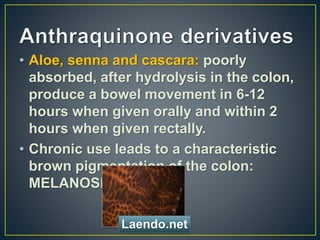
• Chronic use leads to a characteristic
brown pigmentation of the colon:
MELANOSIS COLI.
Laendo.net
• Bisacodyl is available in tablet and
suppository formulations for the treatment of
acute and chronic constipation.
• It is also used in conjunction with PEG
solutions for colonic cleansing prior to
colonoscopy.
• It induces a bowel movement within 6-10
hours when given orally and 30-60 minutes
when taken rectally.
• It has minimal systemic absorption and it is
safe for acute and long-term use.
• Lubiprostone is a prostanoic acid derivative labeled
for use in chronic constipation and irritable bowel
syndrome (IBS) with predominant constipation.
• It acts by stimulating the type 2 chloride channel
(ClC-2) in the small intestine.
• This increases chloride-rich fluid secretion into the
intestine, which stimulates intestinal motility and
shortens intestinal transit time.
• Lubiprostone has minimal systemic absorption, but it
is not recommended for pregnant women (category
C).
• It may cause nausea (30%) due to delayed gastric
emptying.
• Acute and chronic opioids therapy may cause
constipation by decreasing intestinal motility, which
results in prolonged transit time and increased
absorption of fecal water.
• Use of opioids after surgery (pain treatment) and
endogenous opioids released after surgery may
prolong the duration of postoperative ileus: intestinal
μ-opioid receptors.
• Selective antagonists of the μ-opioid receptors are:
METHYLNALTREXONE and ALVIMOPAN.
• These agents do not readily cross the blood-brain barrier and
inhibit peripheral μ-opioid receptors without impacting
analgesic effects within the CNS.
• Methylnaltrexone is approved for the treatment of
opioid-induced constipation in patients receiving
palliative care for advanced illness who have had
inadequate response to other agents.
• It is administered as a subcutaneous injection 0,15
mg/kg every 2 days.
• Alvimopan is approved for short-term use to shorten
the period of postoperative ileus in hospitalized
patients who have undergone small or large bowel
resection.
• It is administered orally 12 mg capsule 5 hours
before surgery and twice daily after surgery (no more
than 7 days).
• Stimulation of 5-HT4 receptors on the
presynaptic terminal of submucosal intrinsic
primary afferent nerves enhances the release of
neurotransmitters, including calcitonin gene-
related peptide (CGRP).
• CGRP stimulates second-order enteric neurons
to promote the peristaltic reflex.
• These enteric neurons stimulate proximal bowel
contraction (acetylcholine, substance P) and
distal bowel relaxation (nitric oxide, vasoactive
intestinal peptide).
• Agents are tegaserod, cisapride and
Tegaserod is serotonin 5-HT4 partial agonist that has
high affinity for 5-HT4 receptors, but no appreciable
binding to 5-HT3 or dopamine receptors.
It was approved for the patients with chronic
constipation and IBS with predominant constipation.
Both tegaserod (removed from general market) and
cisapride can cause serious cardiovascular events.
Prucalopride is high-affinity 5-HT4
agonist available for the treatment of
chronic constipation in women.
It does not have significant affinities for
hERG channels and 5-HT1B receptors (in
constrast to tegaserod and cisaprid).
Linaclotide is a poorly absorbed 14-
amino-acid peptide that binds to the
guanylate cyclase C receptor on the
luminal surface of intestinal enterocytes.
It activates the cystic fibrosis
transmembrane conductance channels
and stimulates intestinal fluid secretion.
•Katzung, Masters, Trevor.
Basic and clinical
pharmacology.
•Laendo.net

Laxatives

  • 1.
  • 2.
    Intermittent constipation isbest prevented with a high-fiber diet, adequate fluid intake, regular exercise and the heeding of nature´s call. Patients not responding to dietary changes or fiber supplements should undergo medical evaluation before initiating long-term laxative treatment.
  • 3.
    • Indigestible, hydrophiliccolloids that absorb water, forming a bulky, emollient gel that distends the colon and promotes peristalsis. • Natural plant products: psyllium, methylcellulose. • Synthetic fibers: polycarbophil. • Bacterial digestion of plant fibers within the colon may lead to increased bloating and flatus.
  • 4.
    • These agentssoften stool material, permitting water and lipids to penetrate. • They may be administered orally or rectally. • Examples: docusate (oral, enema), glycerin suppository. • Docusate is used in hospitalized patients to prevent constipation and minimize straining. • Mineral oil is a clear, viscous oil that lubricates fecal material, retarding water absorption from the stool. • It is used to prevent and treat fecal impaction in young children and debilitated adults. • Long-term use can impair absorption of fat-soluble vitamins (K, A, D, E).
  • 5.
    • The coloncan neither concentrate nor dilute fecal fluid. • Fecal water is isotonic throughout the colon. • Osmotic laxatives are soluble, but nonabsorbable compounds that result in increased stool liquidity due to an obligate increase in fecal fluid. Osmotic laxatives are: • NONABSORBABLE SUGARS OR SALTS • BALANCED POLYETHYLENE GLYCOL
  • 6.
    • These agentsmay be used for the treatment of acute constipation or the prevention of chronic constipation. • Magnesium hydroxide (milk of magnesia) is a commonly used osmotic laxative. • It should not be used for prolonged periods in pateints with renal insufficiency due to the risk of hypermagnesemia. • Sorbitol and lactulose are nonabsorbable sugars that can be used to prevent or treat chronic constipation. • These sugars are metabolized by colonic bacteria, producing severe flatus and cramps.
  • 7.
    • High dosesof osmotically active agents produce prompt bowel evacuation (purgation) within 1-3 hours. • The rapid movement of water into the distal small bowel and colon leads to a high volume of liquid stool followed by rapid relief of constipation. • Magnesium cistrate, sodium phosphate: it is very important that patients maintain adequate hydration by taking increased oral liquids to compensate for fecal fluid loss. • Sodium phosphate frequently causes hyperphosphatemia, hypocalcemia, hypernatremia and hypokalemia, which can lead to cardiac
  • 8.
    • Acute renalfailure may happen due to tubular deposition of calcium phosphate (nephrocalcinosis). Sodium phosphate preparations should not be used in patients who: • are frail or elderly • have renal insufficiency • have significant cardiac disease • are unable to maintain adequate hydration during bowel preparation
  • 9.
    • Large solutionscontaining PEG are used for complete colonic cleansing before gastrointestinal endoscopic procedures. • These balanced, isotonic solutions contain an inert, nonabsorbable, osmotically active sugar (PEG) with sodium sulfate, sodium chloride, sodium bicarbonate and potassium chloride. • PEG is safe: no significant intravascular fluid or electrolyte shifts occur and does not produce significant cramps or flatus. • Bowel cleansing: 2-4 L over 2-4 hours. • Treatment or prevention of chronic constipation: 17 g/8 oz (powder mixed with water or juices, daily use).
  • 10.
    • Also calledcathartics. • Induce bowel movements through a direct stimulation of the enteric nervous system and colonic electrolyte and fluid secretion. Cathartics are: • ANTHRAQUINONE DERIVATIVES • DIPHENYLMETHANE DERIVATIVES
  • 11.
    • Aloe, sennaand cascara: poorly absorbed, after hydrolysis in the colon, produce a bowel movement in 6-12 hours when given orally and within 2 hours when given rectally. • Chronic use leads to a characteristic brown pigmentation of the colon: MELANOSIS COLI. Laendo.net
  • 12.
    • Bisacodyl isavailable in tablet and suppository formulations for the treatment of acute and chronic constipation. • It is also used in conjunction with PEG solutions for colonic cleansing prior to colonoscopy. • It induces a bowel movement within 6-10 hours when given orally and 30-60 minutes when taken rectally. • It has minimal systemic absorption and it is safe for acute and long-term use.
  • 13.
    • Lubiprostone isa prostanoic acid derivative labeled for use in chronic constipation and irritable bowel syndrome (IBS) with predominant constipation. • It acts by stimulating the type 2 chloride channel (ClC-2) in the small intestine. • This increases chloride-rich fluid secretion into the intestine, which stimulates intestinal motility and shortens intestinal transit time. • Lubiprostone has minimal systemic absorption, but it is not recommended for pregnant women (category C). • It may cause nausea (30%) due to delayed gastric emptying.
  • 14.
    • Acute andchronic opioids therapy may cause constipation by decreasing intestinal motility, which results in prolonged transit time and increased absorption of fecal water. • Use of opioids after surgery (pain treatment) and endogenous opioids released after surgery may prolong the duration of postoperative ileus: intestinal μ-opioid receptors. • Selective antagonists of the μ-opioid receptors are: METHYLNALTREXONE and ALVIMOPAN. • These agents do not readily cross the blood-brain barrier and inhibit peripheral μ-opioid receptors without impacting analgesic effects within the CNS.
  • 15.
    • Methylnaltrexone isapproved for the treatment of opioid-induced constipation in patients receiving palliative care for advanced illness who have had inadequate response to other agents. • It is administered as a subcutaneous injection 0,15 mg/kg every 2 days. • Alvimopan is approved for short-term use to shorten the period of postoperative ileus in hospitalized patients who have undergone small or large bowel resection. • It is administered orally 12 mg capsule 5 hours before surgery and twice daily after surgery (no more than 7 days).
  • 16.
    • Stimulation of5-HT4 receptors on the presynaptic terminal of submucosal intrinsic primary afferent nerves enhances the release of neurotransmitters, including calcitonin gene- related peptide (CGRP). • CGRP stimulates second-order enteric neurons to promote the peristaltic reflex. • These enteric neurons stimulate proximal bowel contraction (acetylcholine, substance P) and distal bowel relaxation (nitric oxide, vasoactive intestinal peptide). • Agents are tegaserod, cisapride and
  • 17.
    Tegaserod is serotonin5-HT4 partial agonist that has high affinity for 5-HT4 receptors, but no appreciable binding to 5-HT3 or dopamine receptors. It was approved for the patients with chronic constipation and IBS with predominant constipation. Both tegaserod (removed from general market) and cisapride can cause serious cardiovascular events.
  • 18.
    Prucalopride is high-affinity5-HT4 agonist available for the treatment of chronic constipation in women. It does not have significant affinities for hERG channels and 5-HT1B receptors (in constrast to tegaserod and cisaprid).
  • 19.
    Linaclotide is apoorly absorbed 14- amino-acid peptide that binds to the guanylate cyclase C receptor on the luminal surface of intestinal enterocytes. It activates the cystic fibrosis transmembrane conductance channels and stimulates intestinal fluid secretion.
  • 20.
    •Katzung, Masters, Trevor. Basicand clinical pharmacology. •Laendo.net