Pharmacology
By-
Dr. Mrunal R. Akre
Antidiarrhoeals
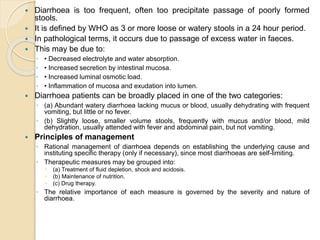
 Diarrhoea is too frequent, often too precipitate passage of poorly formed
stools.
 It is defined by WHO as 3 or more loose or watery stools in a 24 hour period.
 In pathological terms, it occurs due to passage of excess water in faeces.
 This may be due to:
◦ • Decreased electrolyte and water absorption.
◦ • Increased secretion by intestinal mucosa.
◦ • Increased luminal osmotic load.
◦ • Inflammation of mucosa and exudation into lumen.
 Diarrhoea patients can be broadly placed in one of the two categories:
◦ (a) Abundant watery diarrhoea lacking mucus or blood, usually dehydrating with frequent
vomiting, but little or no fever.
◦ (b) Slightly loose, smaller volume stools, frequently with mucus and/or blood, mild
dehydration, usually attended with fever and abdominal pain, but not vomiting.
 Principles of management
◦ Rational management of diarrhoea depends on establishing the underlying cause and
instituting specific therapy (only if necessary), since most diarrhoeas are self-limiting.
◦ Therapeutic measures may be grouped into:
 (a) Treatment of fluid depletion, shock and acidosis.
 (b) Maintenance of nutrition.
 (c) Drug therapy.
◦ The relative importance of each measure is governed by the severity and nature of
diarrhoea.
 REHYDRATION
◦ In majority of cases, this is the only measure needed.
◦ Rehydration can be done orally or i.v.
◦ Intravenous rehydration
 It is needed only when fluid loss is severe, i.e. > 10% body weight,
(if not promptly corrected, it will lead to shock and death) or if
patient is losing > 10 ml/kg/ hr, or is unable to take enough oral
fluids due to weakness, stupor or vomiting.
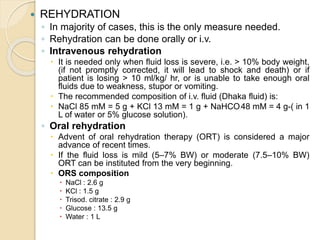
 The recommended composition of i.v. fluid (Dhaka fluid) is:
 NaCl 85 mM = 5 g + KCl 13 mM = 1 g + NaHCO3 48 mM = 4 g-( in 1
L of water or 5% glucose solution).
◦ Oral rehydration
 Advent of oral rehydration therapy (ORT) is considered a major
advance of recent times.
 If the fluid loss is mild (5–7% BW) or moderate (7.5–10% BW)
ORT can be instituted from the very beginning.
 ORS composition
 NaCl : 2.6 g
 KCl : 1.5 g
 Trisod. citrate : 2.9 g
 Glucose : 13.5 g
 Water : 1 L
 DRUG THERAPY
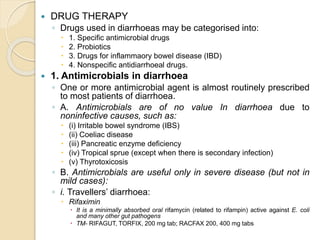
◦ Drugs used in diarrhoeas may be categorised into:
 1. Specific antimicrobial drugs
 2. Probiotics
 3. Drugs for inflammaory bowel disease (IBD)
 4. Nonspecific antidiarrhoeal drugs.
 1. Antimicrobials in diarrhoea
◦ One or more antimicrobial agent is almost routinely prescribed
to most patients of diarrhoea.
◦ A. Antimicrobials are of no value In diarrhoea due to
noninfective causes, such as:
 (i) Irritable bowel syndrome (IBS)
 (ii) Coeliac disease
 (iii) Pancreatic enzyme deficiency
 (iv) Tropical sprue (except when there is secondary infection)
 (v) Thyrotoxicosis
◦ B. Antimicrobials are useful only in severe disease (but not in
mild cases):
◦ i. Travellers’ diarrhoea:
 Rifaximin
 It is a minimally absorbed oral rifamycin (related to rifampin) active against E. coli
and many other gut pathogens
 TM- RIFAGUT, TORFIX, 200 mg tab; RACFAX 200, 400 mg tabs
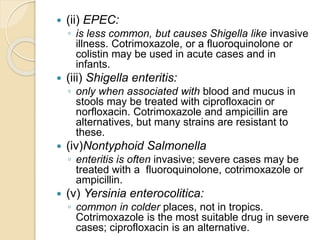
 (ii) EPEC:
◦ is less common, but causes Shigella like invasive
illness. Cotrimoxazole, or a fluoroquinolone or
colistin may be used in acute cases and in
infants.
 (iii) Shigella enteritis:
◦ only when associated with blood and mucus in
stools may be treated with ciprofloxacin or
norfloxacin. Cotrimoxazole and ampicillin are
alternatives, but many strains are resistant to
these.
 (iv)Nontyphoid Salmonella
◦ enteritis is often invasive; severe cases may be
treated with a fluoroquinolone, cotrimoxazole or
ampicillin.
 (v) Yersinia enterocolitica:
◦ common in colder places, not in tropics.
Cotrimoxazole is the most suitable drug in severe
cases; ciprofloxacin is an alternative.
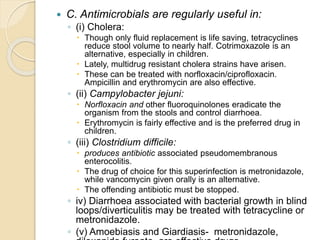
 C. Antimicrobials are regularly useful in:
◦ (i) Cholera:
 Though only fluid replacement is life saving, tetracyclines
reduce stool volume to nearly half. Cotrimoxazole is an
alternative, especially in children.
 Lately, multidrug resistant cholera strains have arisen.
 These can be treated with norfloxacin/ciprofloxacin.
Ampicillin and erythromycin are also effective.
◦ (ii) Campylobacter jejuni:
 Norfloxacin and other fluoroquinolones eradicate the
organism from the stools and control diarrhoea.
 Erythromycin is fairly effective and is the preferred drug in
children.
◦ (iii) Clostridium difficile:
 produces antibiotic associated pseudomembranous
enterocolitis.
 The drug of choice for this superinfection is metronidazole,
while vancomycin given orally is an alternative.
 The offending antibiotic must be stopped.
◦ iv) Diarrhoea associated with bacterial growth in blind
loops/diverticulitis may be treated with tetracycline or
metronidazole.
◦ (v) Amoebiasis and Giardiasis- metronidazole,
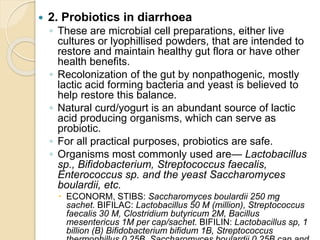
 2. Probiotics in diarrhoea
◦ These are microbial cell preparations, either live
cultures or lyophillised powders, that are intended to
restore and maintain healthy gut flora or have other
health benefits.
◦ Recolonization of the gut by nonpathogenic, mostly
lactic acid forming bacteria and yeast is believed to
help restore this balance.
◦ Natural curd/yogurt is an abundant source of lactic
acid producing organisms, which can serve as
probiotic.
◦ For all practical purposes, probiotics are safe.
◦ Organisms most commonly used are— Lactobacillus
sp., Bifidobacterium, Streptococcus faecalis,
Enterococcus sp. and the yeast Saccharomyces
boulardii, etc.
 ECONORM, STIBS: Saccharomyces boulardii 250 mg
sachet. BIFILAC: Lactobacillus 50 M (million), Streptococcus
faecalis 30 M, Clostridium butyricum 2M, Bacillus
mesentericus 1M per cap/sachet. BIFILIN: Lactobacillus sp, 1
billion (B) Bifidobacterium bifidum 1B, Streptococcus
 3. Drugs for inflammatory bowel disease (IBD)
◦ IBD is a chronic relapsing inflammatory disease of the ileum, colon, or
both, that may be associated with systemic manifestations.
◦ It is idiopathic, but appears to have an important immune component
triggered by a variety of factors.
◦ The two major types of IBD are ulcerative colitis (UC) and Crohn’s
disease (CrD).
◦ Ulcerative colitis
 It involves only the colon starting from the anal canal. It may remain restricted to
the rectum or extend proximally in a contiguous manner to variable extent upto
caecum. The lesions are mucosal and may be diffuse or confluent.
◦ Crohn’s disease
 In CrD lesions are patchy and transmural; may involve any part of the g.i.t. from
mouth to the anus.
◦ Sulfasalazine (Salicylazosulfapyridine)
 The beneficial effect of sulfasalazine is clearly not due to any antibacterial action
(bowel flora remains largely unaffected).
 TM- SALAZOPYRIN, SAZO-EN 0.5 g tab.
◦ Mesalazine (Mesalamine) - MESACOL 400 mg, 800 mg tab, 0.5 g
suppository; ASACOL, TIDOCOL 400 mg tab; ETISA 500 mg sachet.
◦ 5-ASA enema- MESACOL ENEMA 4 g/60 ml.
◦ Balsalazide- Dose: 1.5 g BD to 2.25 g TDS. COLOREX 750 mg cap
and per 5 ml syr., INTAZIDE 750 mg tab.
◦ Corticosteroids - Prednisolone (40–60 mg/day)
 Immunosuppressants-
Immunosuppressants have now come
to play an important role in the long-
term management of IBD, especially
CrD.
 Azathioprine
◦ This purine antimetabolite is the most
effective and most commonly used
immunosuppressant in IBD.
◦ Dose: Azathioprine 1.5–2.5 mg/kg/day, 6-
MP 1–1.5 mg/kg/ day for IBD.
 4. Nonspecific antidiarrhoeal drugs
◦ These drugs can be grouped into:
 A. Absorbants and adsorbants
 B. Antisecretory drugs
 C. Antimotility drugs
◦ A. Absorbants
 These are colloidal bulk forming substances like ispaghula, methyl cellulose,
carboxy methyl cellulose which absorb water and swell
◦ B. Antisecretory drugs
 Racecadotril
 This recently introduced prodrug is rapidly converted to thiorphan, The elimination t½ as
thiorphan is 3 hr. Side effects are nausea, vomiting, drowsiness, flatulence.
 Dose: 100 mg (children 1.5 mg/kg) TDS for not more than 7 days.
 TM- CADOTRIL, RACIGYL 100 mg cap, 15 mg sachet; REDOTIL 100 mg cap. ZEDOTT,
ZOMATRIL 100 mg tab, 10 mg and 30 mg sachet and dispersible tab.
◦ C. Antimotility drugs
 These are opioid drugs which increase small bowel tone and segmenting activity,
reduce propulsive movements and diminish intestinal secretions while enhancing
absorption.
 Codeine
 This opium alkaloid has prominent constipating action at a dose of 60 mg TDS. The
antidiarrhoeal effect is attributed primarily to its peripheral action on small intestine and colon.
 Diphenoxylate (2.5 mg) + atropine (0.025 mg):
 LOMOTIL tab and in 5 ml liquid.
 Dose: 5–10 mg, followed by 2.5–5 mg 6 hourly.
 It is a synthetic opioid, chemically related to pethidine; used exclusively as constipating agent;
action is similar to codeine.
 Loperamide
 It is an opiate analogue with major peripheral μ opioid and additional weak anticholinergic
property. In addition to its opiate like action on motility, loperamide also inhibits secretion
 Dose: 4 mg followed by 2 mg after each motion (max. 10 mg in a day); 2 mg BD for chronic
diarrhoea.
To be continued…………..

Antidiarrhoeals Drugs

  • 1.
  • 2.
  • 3.
     Diarrhoea istoo frequent, often too precipitate passage of poorly formed stools.  It is defined by WHO as 3 or more loose or watery stools in a 24 hour period.  In pathological terms, it occurs due to passage of excess water in faeces.  This may be due to: ◦ • Decreased electrolyte and water absorption. ◦ • Increased secretion by intestinal mucosa. ◦ • Increased luminal osmotic load. ◦ • Inflammation of mucosa and exudation into lumen.  Diarrhoea patients can be broadly placed in one of the two categories: ◦ (a) Abundant watery diarrhoea lacking mucus or blood, usually dehydrating with frequent vomiting, but little or no fever. ◦ (b) Slightly loose, smaller volume stools, frequently with mucus and/or blood, mild dehydration, usually attended with fever and abdominal pain, but not vomiting.  Principles of management ◦ Rational management of diarrhoea depends on establishing the underlying cause and instituting specific therapy (only if necessary), since most diarrhoeas are self-limiting. ◦ Therapeutic measures may be grouped into:  (a) Treatment of fluid depletion, shock and acidosis.  (b) Maintenance of nutrition.  (c) Drug therapy. ◦ The relative importance of each measure is governed by the severity and nature of diarrhoea.
  • 4.
     REHYDRATION ◦ Inmajority of cases, this is the only measure needed. ◦ Rehydration can be done orally or i.v. ◦ Intravenous rehydration  It is needed only when fluid loss is severe, i.e. > 10% body weight, (if not promptly corrected, it will lead to shock and death) or if patient is losing > 10 ml/kg/ hr, or is unable to take enough oral fluids due to weakness, stupor or vomiting.  The recommended composition of i.v. fluid (Dhaka fluid) is:  NaCl 85 mM = 5 g + KCl 13 mM = 1 g + NaHCO3 48 mM = 4 g-( in 1 L of water or 5% glucose solution). ◦ Oral rehydration  Advent of oral rehydration therapy (ORT) is considered a major advance of recent times.  If the fluid loss is mild (5–7% BW) or moderate (7.5–10% BW) ORT can be instituted from the very beginning.  ORS composition  NaCl : 2.6 g  KCl : 1.5 g  Trisod. citrate : 2.9 g  Glucose : 13.5 g  Water : 1 L
  • 5.
     DRUG THERAPY ◦Drugs used in diarrhoeas may be categorised into:  1. Specific antimicrobial drugs  2. Probiotics  3. Drugs for inflammaory bowel disease (IBD)  4. Nonspecific antidiarrhoeal drugs.  1. Antimicrobials in diarrhoea ◦ One or more antimicrobial agent is almost routinely prescribed to most patients of diarrhoea. ◦ A. Antimicrobials are of no value In diarrhoea due to noninfective causes, such as:  (i) Irritable bowel syndrome (IBS)  (ii) Coeliac disease  (iii) Pancreatic enzyme deficiency  (iv) Tropical sprue (except when there is secondary infection)  (v) Thyrotoxicosis ◦ B. Antimicrobials are useful only in severe disease (but not in mild cases): ◦ i. Travellers’ diarrhoea:  Rifaximin  It is a minimally absorbed oral rifamycin (related to rifampin) active against E. coli and many other gut pathogens  TM- RIFAGUT, TORFIX, 200 mg tab; RACFAX 200, 400 mg tabs
  • 6.
     (ii) EPEC: ◦is less common, but causes Shigella like invasive illness. Cotrimoxazole, or a fluoroquinolone or colistin may be used in acute cases and in infants.  (iii) Shigella enteritis: ◦ only when associated with blood and mucus in stools may be treated with ciprofloxacin or norfloxacin. Cotrimoxazole and ampicillin are alternatives, but many strains are resistant to these.  (iv)Nontyphoid Salmonella ◦ enteritis is often invasive; severe cases may be treated with a fluoroquinolone, cotrimoxazole or ampicillin.  (v) Yersinia enterocolitica: ◦ common in colder places, not in tropics. Cotrimoxazole is the most suitable drug in severe cases; ciprofloxacin is an alternative.
  • 7.
     C. Antimicrobialsare regularly useful in: ◦ (i) Cholera:  Though only fluid replacement is life saving, tetracyclines reduce stool volume to nearly half. Cotrimoxazole is an alternative, especially in children.  Lately, multidrug resistant cholera strains have arisen.  These can be treated with norfloxacin/ciprofloxacin. Ampicillin and erythromycin are also effective. ◦ (ii) Campylobacter jejuni:  Norfloxacin and other fluoroquinolones eradicate the organism from the stools and control diarrhoea.  Erythromycin is fairly effective and is the preferred drug in children. ◦ (iii) Clostridium difficile:  produces antibiotic associated pseudomembranous enterocolitis.  The drug of choice for this superinfection is metronidazole, while vancomycin given orally is an alternative.  The offending antibiotic must be stopped. ◦ iv) Diarrhoea associated with bacterial growth in blind loops/diverticulitis may be treated with tetracycline or metronidazole. ◦ (v) Amoebiasis and Giardiasis- metronidazole,
  • 8.
     2. Probioticsin diarrhoea ◦ These are microbial cell preparations, either live cultures or lyophillised powders, that are intended to restore and maintain healthy gut flora or have other health benefits. ◦ Recolonization of the gut by nonpathogenic, mostly lactic acid forming bacteria and yeast is believed to help restore this balance. ◦ Natural curd/yogurt is an abundant source of lactic acid producing organisms, which can serve as probiotic. ◦ For all practical purposes, probiotics are safe. ◦ Organisms most commonly used are— Lactobacillus sp., Bifidobacterium, Streptococcus faecalis, Enterococcus sp. and the yeast Saccharomyces boulardii, etc.  ECONORM, STIBS: Saccharomyces boulardii 250 mg sachet. BIFILAC: Lactobacillus 50 M (million), Streptococcus faecalis 30 M, Clostridium butyricum 2M, Bacillus mesentericus 1M per cap/sachet. BIFILIN: Lactobacillus sp, 1 billion (B) Bifidobacterium bifidum 1B, Streptococcus
  • 9.
     3. Drugsfor inflammatory bowel disease (IBD) ◦ IBD is a chronic relapsing inflammatory disease of the ileum, colon, or both, that may be associated with systemic manifestations. ◦ It is idiopathic, but appears to have an important immune component triggered by a variety of factors. ◦ The two major types of IBD are ulcerative colitis (UC) and Crohn’s disease (CrD). ◦ Ulcerative colitis  It involves only the colon starting from the anal canal. It may remain restricted to the rectum or extend proximally in a contiguous manner to variable extent upto caecum. The lesions are mucosal and may be diffuse or confluent. ◦ Crohn’s disease  In CrD lesions are patchy and transmural; may involve any part of the g.i.t. from mouth to the anus. ◦ Sulfasalazine (Salicylazosulfapyridine)  The beneficial effect of sulfasalazine is clearly not due to any antibacterial action (bowel flora remains largely unaffected).  TM- SALAZOPYRIN, SAZO-EN 0.5 g tab. ◦ Mesalazine (Mesalamine) - MESACOL 400 mg, 800 mg tab, 0.5 g suppository; ASACOL, TIDOCOL 400 mg tab; ETISA 500 mg sachet. ◦ 5-ASA enema- MESACOL ENEMA 4 g/60 ml. ◦ Balsalazide- Dose: 1.5 g BD to 2.25 g TDS. COLOREX 750 mg cap and per 5 ml syr., INTAZIDE 750 mg tab. ◦ Corticosteroids - Prednisolone (40–60 mg/day)
  • 10.
     Immunosuppressants- Immunosuppressants havenow come to play an important role in the long- term management of IBD, especially CrD.  Azathioprine ◦ This purine antimetabolite is the most effective and most commonly used immunosuppressant in IBD. ◦ Dose: Azathioprine 1.5–2.5 mg/kg/day, 6- MP 1–1.5 mg/kg/ day for IBD.
  • 11.
     4. Nonspecificantidiarrhoeal drugs ◦ These drugs can be grouped into:  A. Absorbants and adsorbants  B. Antisecretory drugs  C. Antimotility drugs ◦ A. Absorbants  These are colloidal bulk forming substances like ispaghula, methyl cellulose, carboxy methyl cellulose which absorb water and swell ◦ B. Antisecretory drugs  Racecadotril  This recently introduced prodrug is rapidly converted to thiorphan, The elimination t½ as thiorphan is 3 hr. Side effects are nausea, vomiting, drowsiness, flatulence.  Dose: 100 mg (children 1.5 mg/kg) TDS for not more than 7 days.  TM- CADOTRIL, RACIGYL 100 mg cap, 15 mg sachet; REDOTIL 100 mg cap. ZEDOTT, ZOMATRIL 100 mg tab, 10 mg and 30 mg sachet and dispersible tab. ◦ C. Antimotility drugs  These are opioid drugs which increase small bowel tone and segmenting activity, reduce propulsive movements and diminish intestinal secretions while enhancing absorption.  Codeine  This opium alkaloid has prominent constipating action at a dose of 60 mg TDS. The antidiarrhoeal effect is attributed primarily to its peripheral action on small intestine and colon.  Diphenoxylate (2.5 mg) + atropine (0.025 mg):  LOMOTIL tab and in 5 ml liquid.  Dose: 5–10 mg, followed by 2.5–5 mg 6 hourly.  It is a synthetic opioid, chemically related to pethidine; used exclusively as constipating agent; action is similar to codeine.  Loperamide  It is an opiate analogue with major peripheral μ opioid and additional weak anticholinergic property. In addition to its opiate like action on motility, loperamide also inhibits secretion  Dose: 4 mg followed by 2 mg after each motion (max. 10 mg in a day); 2 mg BD for chronic diarrhoea.
  • 12.