What is Design for Delight?
Intuit’s #1 Core Capability
“Design for Delight” is about evoking
positive emotion throughout the customer
journey, by going beyond customer
expectations in delivering awesome product
experiences that people want to tell the
world about. Design for Delight principles
are practiced throughout the company, and
have become Intuit’s #1 core capability.
Customer-Driven Innovation
Intuit’s Innovation Framework
We afford our employees the autonomy to
tap into their own passions to delight
customers and grow the company. We
encourage our employees to know our
customers - watch them, listen to them, visit
their homes and workplaces - so they can
discover and solve important problems for
our customers.
with durable
advantage
find an
important
problem
that we and
those we enable
can solve well
Your
Challenge
“Make New York Happy”
Learn the principles of rapid
experimentation by running
experiments on the streets of
New York City.
Why Experiments?
We use rapid experiments to quickly test the
merit of our ideas, and generate new insights
about our customers. By testing ideas using
real customer behavior, we quickly separate
what customers say, from what they actually
do in the real world.
Experiment to learn, not validate
• Change opinions into facts
• Prove or disprove our assumptions
• Discover surprises about our customer
• Make more informed decisions
• Use data to help tell our story
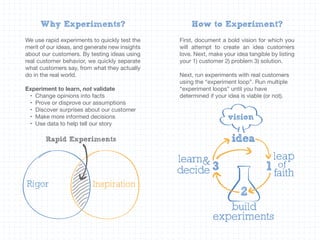
How to Experiment?
First, document a bold vision for which you
will attempt to create an idea customers
love. Next, make your idea tangible by listing
your 1) customer 2) problem 3) solution.
Next, run experiments with real customers
using the “experiment loop”. Run multiple
“experiment loops” until you have
determined if your idea is viable (or not).
Rigor Inspiration
Rapid Experiments idea
13
2
vision
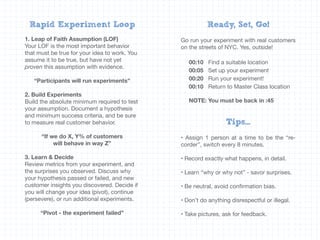
Rapid Experiment Loop
1. Leap of Faith Assumption (LOF)
Your LOF is the most important behavior
that must be true for your idea to work. You
assume it to be true, but have not yet
proven this assumption with evidence.
“Participants will run experiments”
2. Build Experiments
Build the absolute minimum required to test
your assumption. Document a hypothesis
and minimum success criteria, and be sure
to measure real customer behavior.
“If we do X, Y% of customers
will behave in way Z”
3. Learn & Decide
Review metrics from your experiment, and
the surprises you observed. Discuss why
your hypothesis passed or failed, and new
customer insights you discovered. Decide if
you will change your idea (pivot), continue
(persevere), or run additional experiments.
“Pivot - the experiment failed”
Ready, Set, Go!
Go run your experiment with real customers
on the streets of NYC. Yes, outside!
00:10 Find a suitable location
00:05 Set up your experiment
00:20 Run your experiment!
00:10 Return to Master Class location
NOTE: You must be back in :45
Tips...
• Assign 1 person at a time to be the “re-
corder”, switch every 8 minutes.
• Record exactly what happens, in detail.
• Learn “why or why not” - savor surprises.
• Be neutral, avoid confirmation bias.
• Don’t do anything disrespectful or illegal.
• Take pictures, ask for feedback.
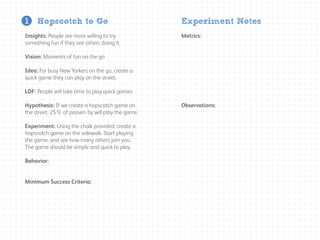
1 Hopscotch to Go
Insights: People are more willing to try
something fun if they see others doing it.
Vision: Moments of fun on the go
Idea: For busy New Yorkers on the go, create a
quick game they can play on the street.
LOF: People will take time to play quick games
Hypothesis: If we create a hopscotch game on
the street, 25% of passers by will play the game.
Experiment: Using the chalk provided, create a
hopscotch game on the sidewalk. Start playing
the game, and see how many others join you.
The game should be simple and quick to play.
Behavior:
Minimum Success Criteria:
Experiment Notes
Metrics:
Observations:
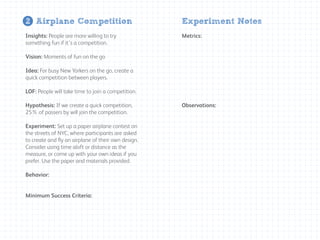
2 Airplane Competition
Insights: People are more willing to try
something fun if it’s a competition.
Vision: Moments of fun on the go
Idea: For busy New Yorkers on the go, create a
quick competition between players.
LOF: People will take time to join a competition.
Hypothesis: If we create a quick competition,
25% of passers by will join the competition.
Experiment: Set up a paper airplane contest on
the streets of NYC, where participants are asked
to create and fly an airplane of their own design.
Consider using time aloft or distance as the
measure, or come up with your own ideas if you
prefer. Use the paper and materials provided.
Behavior:
Minimum Success Criteria:
Experiment Notes
Metrics:
Observations:
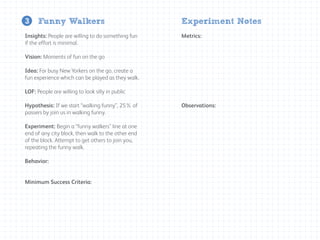
3 Funny Walkers
Insights: People are willing to do something fun
if the effort is minimal.
Vision: Moments of fun on the go
Idea: For busy New Yorkers on the go, create a
fun experience which can be played as they walk.
LOF: People are willing to look silly in public
Hypothesis: If we start “walking funny”, 25% of
passers by join us in walking funny.
Experiment: Begin a “funny walkers” line at one
end of any city block, then walk to the other end
of the block. Attempt to get others to join you,
repeating the funny walk.
Behavior:
Minimum Success Criteria:
Experiment Notes
Metrics:
Observations:
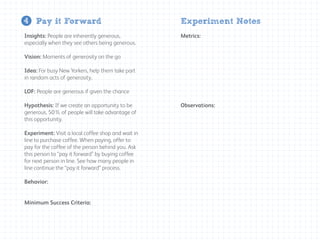
Pay it Forward
Insights: People are inherently generous,
especially when they see others being generous.
Vision: Moments of generosity on the go
Idea: For busy New Yorkers, help them take part
in random acts of generosity.
LOF: People are generous if given the chance
Hypothesis: If we create an opportunity to be
generous, 50% of people will take advantage of
this opportunity.
Experiment: Visit a local coffee shop and wait in
line to purchase coffee. When paying, offer to
pay for the coffee of the person behind you. Ask
this person to “pay it forward” by buying coffee
for next person in line. See how many people in
line continue the “pay it forward” process.
Behavior:
Minimum Success Criteria:
Experiment Notes
Metrics:
Observations:
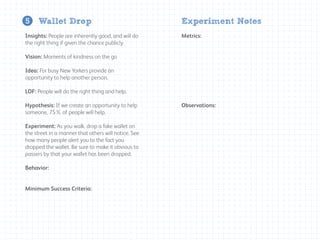
4
5 Wallet Drop
Insights: People are inherently good, and will do
the right thing if given the chance publicly.
Vision: Moments of kindness on the go
Idea: For busy New Yorkers provide an
opportunity to help another person.
LOF: People will do the right thing and help.
Hypothesis: If we create an opportunity to help
someone, 75% of people will help.
Experiment: As you walk, drop a fake wallet on
the street in a manner that others will notice. See
how many people alert you to the fact you
dropped the wallet. Be sure to make it obvious to
passers by that your wallet has been dropped.
Behavior:
Minimum Success Criteria:
Experiment Notes
Metrics:
Observations:
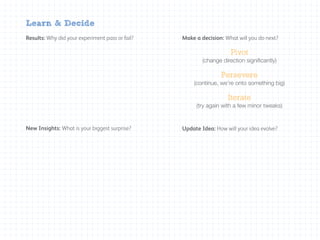
Learn & Decide
Results: Why did your experiment pass or fail?
New Insights: What is your biggest surprise?
Make a decision: What will you do next?
Pivot
(change direction significantly)
Persevere
(continue, we’re onto something big)
Iterate
(try again with a few minor tweaks)
Update Idea: How will your idea evolve?
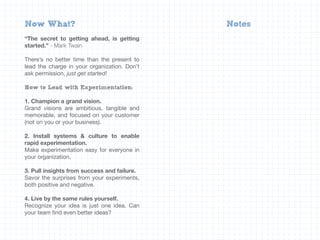
NotesNow What?
“The secret to getting ahead, is getting
started.” - Mark Twain
There’s no better time than the present to
lead the charge in your organization. Don’t
ask permission, just get started!
How to Lead with Experimentation:
1. Champion a grand vision.
Grand visions are ambitious, tangible and
memorable, and focused on your customer
(not on you or your business).
2. Install systems & culture to enable
rapid experimentation.
Make experimentation easy for everyone in
your organization.
3. Pull insights from success and failure.
Savor the surprises from your experiments,
both positive and negative.
4. Live by the same rules yourself.
Recognize your idea is just one idea. Can
your team find even better ideas?
Thank You!
Thanks for joining us today, and
your willingness to get outside
your comfort zone.
For more information regarding Intuit, or to
search for design related career
opportunities, please visit us at:
http://careers.intuit.com

Field Guide to Rapid Experimentation

  • 2.
    What is Designfor Delight? Intuit’s #1 Core Capability “Design for Delight” is about evoking positive emotion throughout the customer journey, by going beyond customer expectations in delivering awesome product experiences that people want to tell the world about. Design for Delight principles are practiced throughout the company, and have become Intuit’s #1 core capability. Customer-Driven Innovation Intuit’s Innovation Framework We afford our employees the autonomy to tap into their own passions to delight customers and grow the company. We encourage our employees to know our customers - watch them, listen to them, visit their homes and workplaces - so they can discover and solve important problems for our customers. with durable advantage find an important problem that we and those we enable can solve well
  • 3.
    Your Challenge “Make New YorkHappy” Learn the principles of rapid experimentation by running experiments on the streets of New York City.
  • 4.
    Why Experiments? We userapid experiments to quickly test the merit of our ideas, and generate new insights about our customers. By testing ideas using real customer behavior, we quickly separate what customers say, from what they actually do in the real world. Experiment to learn, not validate • Change opinions into facts • Prove or disprove our assumptions • Discover surprises about our customer • Make more informed decisions • Use data to help tell our story How to Experiment? First, document a bold vision for which you will attempt to create an idea customers love. Next, make your idea tangible by listing your 1) customer 2) problem 3) solution. Next, run experiments with real customers using the “experiment loop”. Run multiple “experiment loops” until you have determined if your idea is viable (or not). Rigor Inspiration Rapid Experiments idea 13 2 vision
  • 5.
    Rapid Experiment Loop 1.Leap of Faith Assumption (LOF) Your LOF is the most important behavior that must be true for your idea to work. You assume it to be true, but have not yet proven this assumption with evidence. “Participants will run experiments” 2. Build Experiments Build the absolute minimum required to test your assumption. Document a hypothesis and minimum success criteria, and be sure to measure real customer behavior. “If we do X, Y% of customers will behave in way Z” 3. Learn & Decide Review metrics from your experiment, and the surprises you observed. Discuss why your hypothesis passed or failed, and new customer insights you discovered. Decide if you will change your idea (pivot), continue (persevere), or run additional experiments. “Pivot - the experiment failed” Ready, Set, Go! Go run your experiment with real customers on the streets of NYC. Yes, outside! 00:10 Find a suitable location 00:05 Set up your experiment 00:20 Run your experiment! 00:10 Return to Master Class location NOTE: You must be back in :45 Tips... • Assign 1 person at a time to be the “re- corder”, switch every 8 minutes. • Record exactly what happens, in detail. • Learn “why or why not” - savor surprises. • Be neutral, avoid confirmation bias. • Don’t do anything disrespectful or illegal. • Take pictures, ask for feedback.
  • 6.
    1 Hopscotch toGo Insights: People are more willing to try something fun if they see others doing it. Vision: Moments of fun on the go Idea: For busy New Yorkers on the go, create a quick game they can play on the street. LOF: People will take time to play quick games Hypothesis: If we create a hopscotch game on the street, 25% of passers by will play the game. Experiment: Using the chalk provided, create a hopscotch game on the sidewalk. Start playing the game, and see how many others join you. The game should be simple and quick to play. Behavior: Minimum Success Criteria: Experiment Notes Metrics: Observations:
  • 7.
    2 Airplane Competition Insights:People are more willing to try something fun if it’s a competition. Vision: Moments of fun on the go Idea: For busy New Yorkers on the go, create a quick competition between players. LOF: People will take time to join a competition. Hypothesis: If we create a quick competition, 25% of passers by will join the competition. Experiment: Set up a paper airplane contest on the streets of NYC, where participants are asked to create and fly an airplane of their own design. Consider using time aloft or distance as the measure, or come up with your own ideas if you prefer. Use the paper and materials provided. Behavior: Minimum Success Criteria: Experiment Notes Metrics: Observations:
  • 8.
    3 Funny Walkers Insights:People are willing to do something fun if the effort is minimal. Vision: Moments of fun on the go Idea: For busy New Yorkers on the go, create a fun experience which can be played as they walk. LOF: People are willing to look silly in public Hypothesis: If we start “walking funny”, 25% of passers by join us in walking funny. Experiment: Begin a “funny walkers” line at one end of any city block, then walk to the other end of the block. Attempt to get others to join you, repeating the funny walk. Behavior: Minimum Success Criteria: Experiment Notes Metrics: Observations:
  • 9.
    Pay it Forward Insights:People are inherently generous, especially when they see others being generous. Vision: Moments of generosity on the go Idea: For busy New Yorkers, help them take part in random acts of generosity. LOF: People are generous if given the chance Hypothesis: If we create an opportunity to be generous, 50% of people will take advantage of this opportunity. Experiment: Visit a local coffee shop and wait in line to purchase coffee. When paying, offer to pay for the coffee of the person behind you. Ask this person to “pay it forward” by buying coffee for next person in line. See how many people in line continue the “pay it forward” process. Behavior: Minimum Success Criteria: Experiment Notes Metrics: Observations: 4
  • 10.
    5 Wallet Drop Insights:People are inherently good, and will do the right thing if given the chance publicly. Vision: Moments of kindness on the go Idea: For busy New Yorkers provide an opportunity to help another person. LOF: People will do the right thing and help. Hypothesis: If we create an opportunity to help someone, 75% of people will help. Experiment: As you walk, drop a fake wallet on the street in a manner that others will notice. See how many people alert you to the fact you dropped the wallet. Be sure to make it obvious to passers by that your wallet has been dropped. Behavior: Minimum Success Criteria: Experiment Notes Metrics: Observations:
  • 11.
    Learn & Decide Results:Why did your experiment pass or fail? New Insights: What is your biggest surprise? Make a decision: What will you do next? Pivot (change direction significantly) Persevere (continue, we’re onto something big) Iterate (try again with a few minor tweaks) Update Idea: How will your idea evolve?
  • 12.
    NotesNow What? “The secretto getting ahead, is getting started.” - Mark Twain There’s no better time than the present to lead the charge in your organization. Don’t ask permission, just get started! How to Lead with Experimentation: 1. Champion a grand vision. Grand visions are ambitious, tangible and memorable, and focused on your customer (not on you or your business). 2. Install systems & culture to enable rapid experimentation. Make experimentation easy for everyone in your organization. 3. Pull insights from success and failure. Savor the surprises from your experiments, both positive and negative. 4. Live by the same rules yourself. Recognize your idea is just one idea. Can your team find even better ideas?
  • 13.
    Thank You! Thanks forjoining us today, and your willingness to get outside your comfort zone. For more information regarding Intuit, or to search for design related career opportunities, please visit us at: http://careers.intuit.com