Design Sprint Workshop
Chris Tucker
HELLO
my name is
problem
solving addict
project
manager
design sprint
facilitator chris.tucker@freshtilledsoil.com
Challenge 1
High five everyone in the room.
IN 60 SECONDS
Challenge 2
Make everyone happy.
IN 60 SECONDS
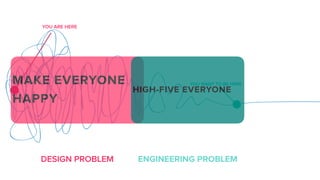
YOU ARE HERE
YOU WANT TO BE HEREMAKE EVERYONE
HAPPY
HIGH-FIVE EVERYONE
DESIGN PROBLEM ENGINEERING PROBLEM
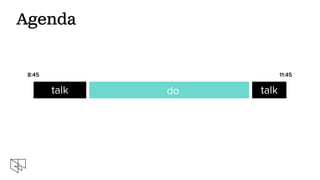
talk do talk
8:45 11:45
Agenda
○Write BIG and with a Sharpie/marker
○Everybody participates
○All voices equal
○Be timely
○Be comfortable
○Have fun!
Rules of Conduct
DS101
A Design Sprint is a flexible design
framework that increases the chances
of making something people want.
What is a Design Sprint?
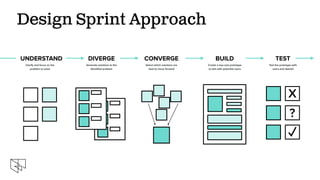
Design Sprint Approach
UNDERSTAND
Clarify and focus on the
problem to solve
DIVERGE
Generate solutions to the
identified problem
CONVERGE
Select which solutions are
best to move forward
BUILD
Create a low-cost prototype
to test with potential users
TEST
Test the prototype with
users and debrief
✓
X
?
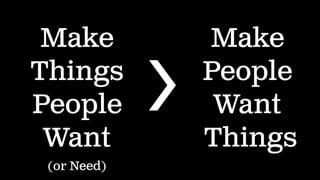
Make
Things
People
Want
Make
People
Want
Things
>
(or Need)
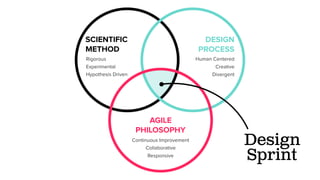
Design
Sprint
SCIENTIFIC
METHOD
DESIGN
PROCESS
AGILE
PHILOSOPHY
Rigorous
Experimental
Hypothesis Driven
Continuous Improvement
Collaborative
Responsive
Human Centered
Creative
Divergent
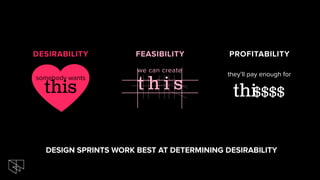
DESIRABILITY FEASIBILITY PROFITABILITY
we can create
they’ll pay enough for
thi$$$$
DESIGN SPRINTS WORK BEST AT DETERMINING DESIRABILITY
t h i sthis
somebody wants
BIG (SOMETIMES SCARY) IDEAS ARE BEST FOR TESTING IN DESIGN SPRINTS
DATA CAN BE USEFUL BUT OFTEN TIMES ONLY LOOKS BACK AND
DOESN’T TELL THE WHOLE STORY
EVIDENCE-BASED DECISION MAKING OVER HIGHEST PAID PERSON’S OPINION
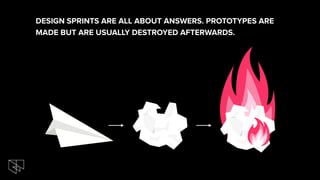
DESIGN SPRINTS ARE ALL ABOUT ANSWERS. PROTOTYPES ARE
MADE BUT ARE USUALLY DESTROYED AFTERWARDS.
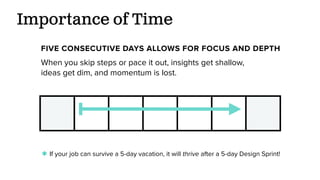
When you skip steps or pace it out, insights get shallow,
ideas get dim, and momentum is lost.
FIVE CONSECUTIVE DAYS ALLOWS FOR FOCUS AND DEPTH
If your job can survive a 5-day vacation, it will thrive after a 5-day Design Sprint!
*
Importance of Time
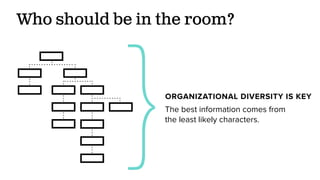
Who should be in the room?
The best information comes from
the least likely characters.
ORGANIZATIONAL DIVERSITY IS KEY
}
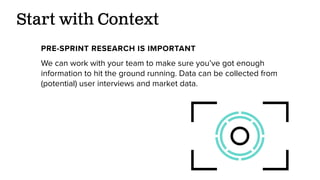
Start with Context
We can work with your team to make sure you’ve got enough
information to hit the ground running. Data can be collected from
(potential) user interviews and market data.
PRE-SPRINT RESEARCH IS IMPORTANT
Questions?
Southwest Airlines has found that customer satisfaction is
significantly higher on flights leaving from top rated airports like
Phoenix or Portland. Boston is ranked 18 out of 30 (best to worst).
Southwest has hired the fresh tilled soil extension team (you!) to
create fresh new ideas for improving the experience of flying out of
Boston Logan, from the moment passengers leave their home/
hotel to the moment the plane takes off.
Their hypothesis is that if a passenger is already unhappy from the pre-flight
experience, it is more difficult for them to achieve high satisfaction rating.
Team Challenge
Day 1: Understand
Who are you designing for?
What is know vs. a guess?
What is the problem?
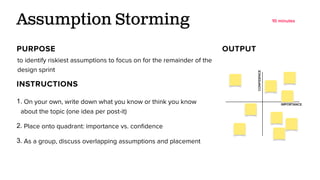
to identify riskiest assumptions to focus on for the remainder of the
design sprint
Assumption Storming
PURPOSE OUTPUT
INSTRUCTIONS
1. On your own, write down what you know or think you know
about the topic (one idea per post-it)
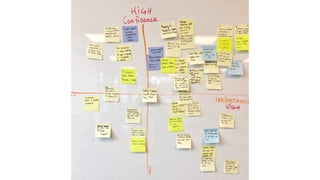
2. Place onto quadrant: importance vs. confidence
3. As a group, discuss overlapping assumptions and placement
IMPORTANCE
CONFIDENCE
10 minutes
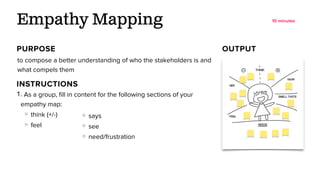
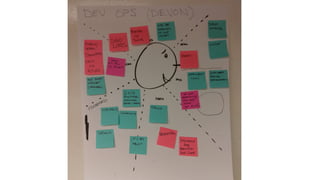
to compose a better understanding of who the stakeholders is and
what compels them
Empathy Mapping
1. As a group, fill in content for the following sections of your
empathy map:
○ think (+/-)
○ feel
PURPOSE OUTPUT
INSTRUCTIONS
○ says
○ see
○ need/frustration
10 minutes
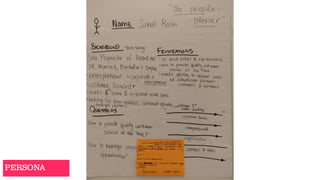
PERSONA
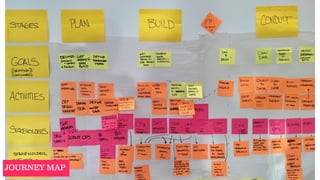
JOURNEY MAP
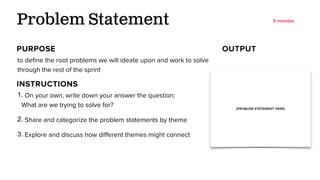
to define the root problems we will ideate upon and work to solve
through the rest of the sprint
Problem Statement
PURPOSE OUTPUT
5 minutes
INSTRUCTIONS
1. On your own, write down your answer the question:
What are we trying to solve for?
2. Share and categorize the problem statements by theme
3. Explore and discuss how different themes might connect
(PROBLEM STATEMENT HERE)
Title (H1)
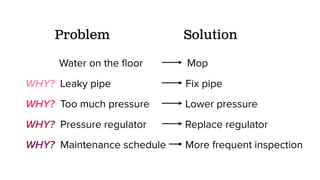
Problem Solution
Water on the floor Mop
WHY? Leaky pipe Fix pipe
WHY? Too much pressure Lower pressure
WHY? Pressure regulator Replace regulator
WHY? Maintenance schedule More frequent inspection
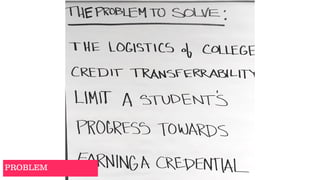
PROBLEM
Day 2: Diverge
How many different
ideas can we create?
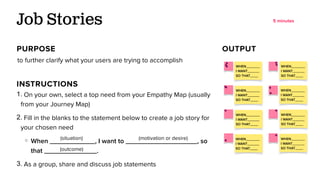
to further clarify what your users are trying to accomplish
Job Stories
PURPOSE OUTPUT
1. On your own, select a top need from your Empathy Map (usually
from your Journey Map)
2. Fill in the blanks to the statement below to create a job story for
your chosen need
○ When ____________, I want to ___________________, so
that ______________.
3. As a group, share and discuss job statements
INSTRUCTIONS
(situation) (motivation or desire)
(outcome)
WHEN_______
I WANT______
SO THAT____
WHEN_______
I WANT______
SO THAT____
WHEN_______
I WANT______
SO THAT____
WHEN_______
I WANT______
SO THAT____
WHEN_______
I WANT______
SO THAT____
WHEN_______
I WANT______
SO THAT____
WHEN_______
I WANT______
SO THAT____
WHEN_______
I WANT______
SO THAT____
5 minutes
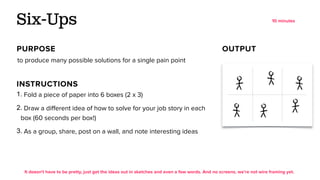
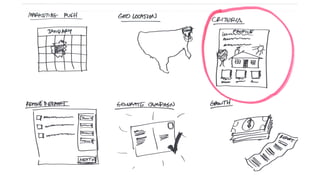
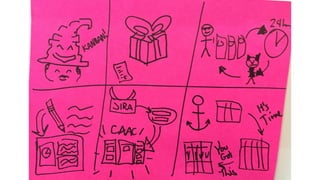
1. Fold a piece of paper into 6 boxes (2 x 3)
2. Draw a different idea of how to solve for your job story in each
box (60 seconds per box!)
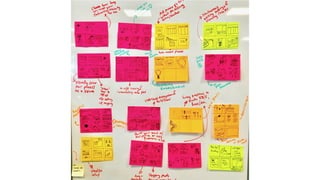
3. As a group, share, post on a wall, and note interesting ideas
to produce many possible solutions for a single pain point
Six-Ups
PURPOSE OUTPUT
INSTRUCTIONS
It doesn't have to be pretty, just get the ideas out in sketches and even a few words. And no screens, we’re not wire framing yet.
10 minutes
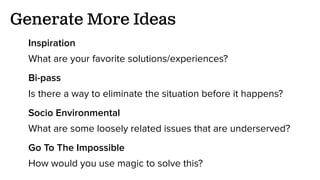
Generate More Ideas
Inspiration
What are your favorite solutions/experiences?
Bi-pass
Is there a way to eliminate the situation before it happens?
Socio Environmental
What are some loosely related issues that are underserved?
Go To The Impossible
How would you use magic to solve this?
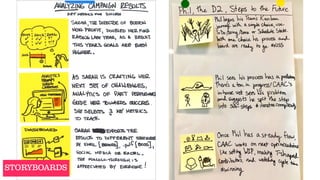
STORYBOARDS
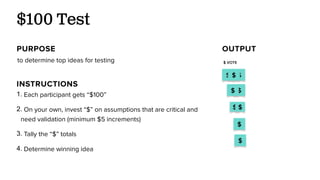
to determine top ideas for testing
$100 Test
PURPOSE OUTPUT
1. Each participant gets “$100”
2. On your own, invest “$” on assumptions that are critical and
need validation (minimum $5 increments)
3. Tally the “$” totals
4. Determine winning idea
INSTRUCTIONS
$ $
$
$
$
$
$
$
$
$ VOTE
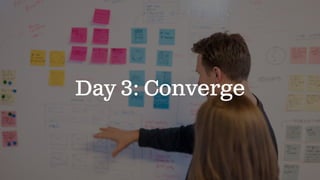
Day 3: Converge
Which idea is best to
test?
tough
on
people
*ideas
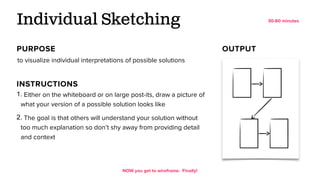
to visualize individual interpretations of possible solutions
Individual Sketching
PURPOSE OUTPUT
1. Either on the whiteboard or on large post-its, draw a picture of
what your version of a possible solution looks like
2. The goal is that others will understand your solution without
too much explanation so don’t shy away from providing detail
and context
INSTRUCTIONS
30-60 minutes
NOW you get to wireframe. Finally!
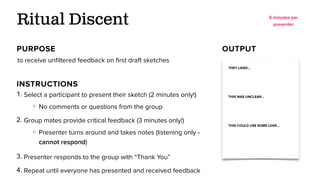
to receive unfiltered feedback on first draft sketches
Ritual Discent
PURPOSE OUTPUT
1. Select a participant to present their sketch (2 minutes only!)
○ No comments or questions from the group
2. Group mates provide critical feedback (3 minutes only!)
○ Presenter turns around and takes notes (listening only -
cannot respond)
3. Presenter responds to the group with “Thank You”
4. Repeat until everyone has presented and received feedback
INSTRUCTIONS
5 minutes per
presenter
THEY LIKED…
THIS WAS UNCLEAR…
THIS COULD USE SOME LOVE…
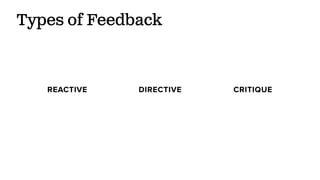
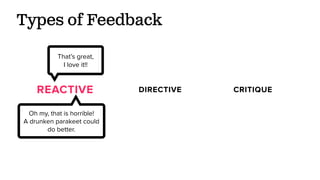
Types of Feedback
REACTIVE DIRECTIVE CRITIQUE
Types of Feedback
REACTIVE DIRECTIVE CRITIQUE
Oh my, that is horrible!
A drunken parakeet could
do better.
That’s great,
I love it!!
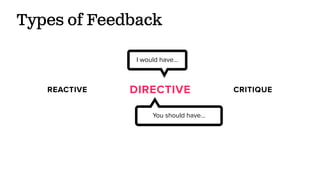
Types of Feedback
REACTIVE DIRECTIVE CRITIQUE
You should have…
I would have…
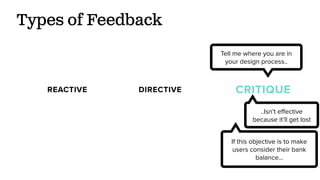
Types of Feedback
REACTIVE DIRECTIVE CRITIQUE
If this objective is to make
users consider their bank
balance…
Tell me where you are in
your design process..
..Isn’t effective
because it’ll get lost
Day 4: Prototype
Create a sharable
version of your idea.
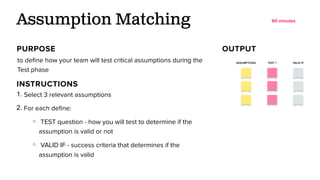
to define how your team will test critical assumptions during the
Test phase
Assumption Matching
PURPOSE OUTPUT
1. Select 3 relevant assumptions
2. For each define:
○ TEST question - how you will test to determine if the
assumption is valid or not
○ VALID IF - success criteria that determines if the
assumption is valid
INSTRUCTIONS
60 minutes
ASSUMPTIONS TEST ? VALID IF
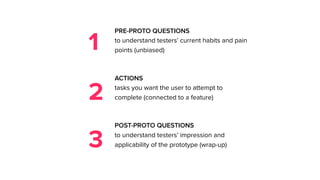
PRE-PROTO QUESTIONS
to understand testers’ current habits and pain
points (unbiased)
ACTIONS
tasks you want the user to attempt to
complete (connected to a feature)
POST-PROTO QUESTIONS
to understand testers’ impression and
applicability of the prototype (wrap-up)
1
2
3
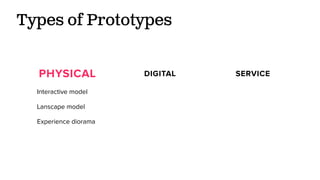
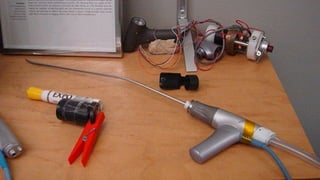
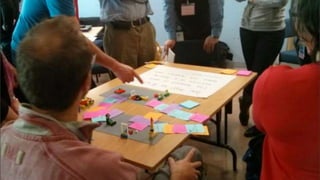
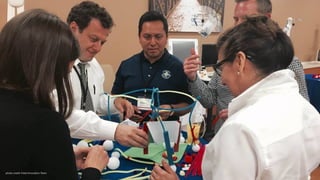
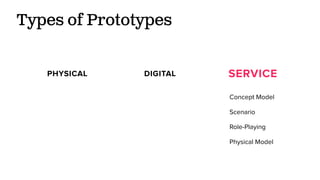
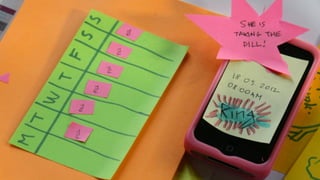
Types of Prototypes
PHYSICAL DIGITAL SERVICE
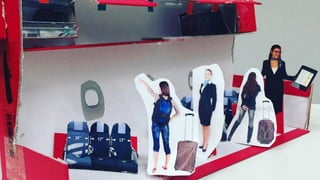
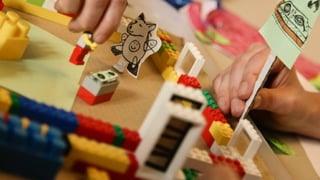
Interactive model
Lanscape model
Experience diorama
photo credit: Field Innovation Team
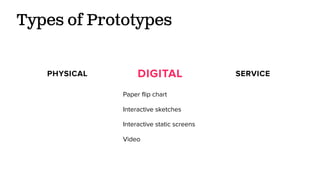
Types of Prototypes
PHYSICAL DIGITAL SERVICE
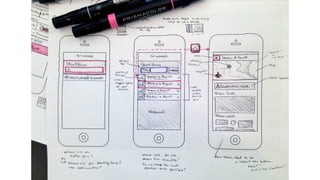
Paper flip chart
Interactive sketches
Interactive static screens
Video
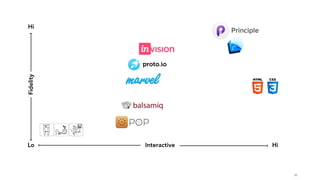
65
Lo
Hi
Interactive
Fidelity
Hi
Types of Prototypes
PHYSICAL SERVICEDIGITAL
Concept Model
Scenario
Role-Playing
Physical Model
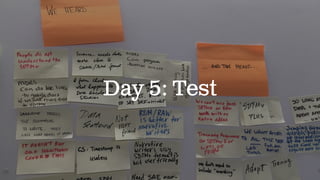
Day 5: Test
Get (in)validation.
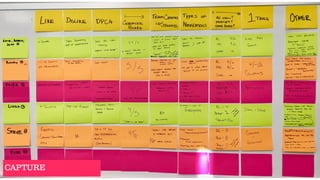
CAPTURE
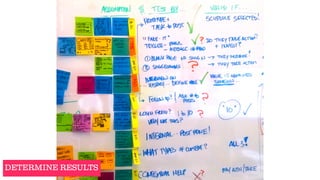
DETERMINE RESULTS
Interviewing 101
○ Let them describe what they see. DON’T explain.
○ Embrace awkward silence. Let them break before you do.
○ It’s not about you. This is not a promotional opportunity.
○ Be interested, not interesting.
○ Wear a poker face. Don’t express emotion to responses.
Listening Principles
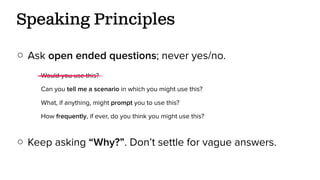
○ Ask open ended questions; never yes/no.
Would you use this?
Can you tell me a scenario in which you might use this?
What, if anything, might prompt you to use this?
How frequently, if ever, do you think you might use this?
○ Keep asking “Why?”. Don’t settle for vague answers.
Speaking Principles
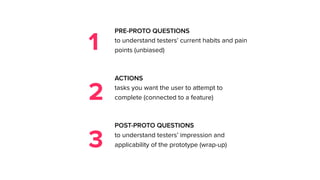
PRE-PROTO QUESTIONS
to understand testers’ current habits and pain
points (unbiased)
ACTIONS
tasks you want the user to attempt to
complete (connected to a feature)
POST-PROTO QUESTIONS
to understand testers’ impression and
applicability of the prototype (wrap-up)
1
2
3
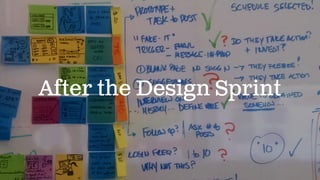
After the Design Sprint
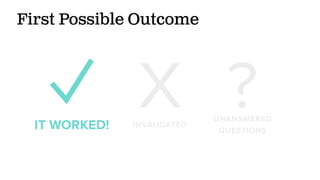
X ?IT WORKED! INVALIDATED
UNANSWERED
QUESTIONS
First Possible Outcome
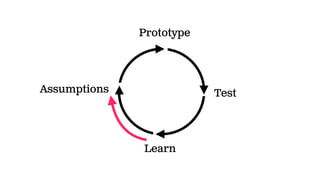
Assumptions
Prototype
Test
Learn
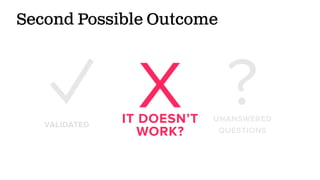
X ?VALIDATED
UNANSWERED
QUESTIONS
Second Possible Outcome
IT DOESN’T
WORK?
DON’T PANIC
YOU JUST SAVED TIME, FACE, MONEY
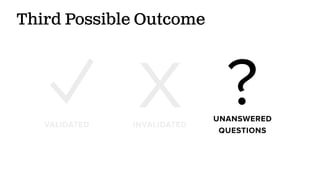
?VALIDATED
UNANSWERED
QUESTIONS
Third Possible Outcome
XINVALIDATED
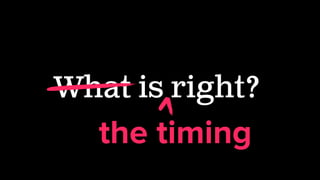
What is right?
*Who
What is right?
the timing
}
}
}
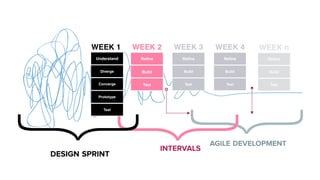
DESIGN SPRINT
INTERVALS
AGILE DEVELOPMENT
WEEK 1
Refine
Build
Test
WEEK 2
Refine
Build
Test
WEEK 3
Refine
Build
Test
WEEK 4
Refine
Build
Test
WEEK n
Understand
Diverge
Prototype
Test
Converge
freshtilledsoil.com/blog
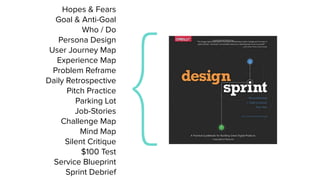
Hopes & Fears
Goal & Anti-Goal
Who / Do
Persona Design
User Journey Map
Experience Map
Problem Reframe
Daily Retrospective
Pitch Practice
Parking Lot
Job-Stories
Challenge Map
Mind Map
Silent Critique
$100 Test
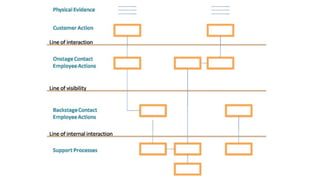
Service Blueprint
Sprint Debrief
{
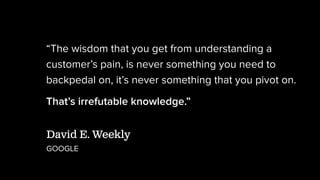
“The wisdom that you get from understanding a
customer’s pain, is never something you need to
backpedal on, it’s never something that you pivot on.
That’s irrefutable knowledge.”
David E. Weekly
GOOGLE
Design Sprint Workshop

Design Sprint Workshop

  • 1.
  • 2.
    Chris Tucker HELLO my nameis problem solving addict project manager design sprint facilitator chris.tucker@freshtilledsoil.com
  • 3.
    Challenge 1 High fiveeveryone in the room. IN 60 SECONDS
  • 4.
    Challenge 2 Make everyonehappy. IN 60 SECONDS
  • 5.
    YOU ARE HERE YOUWANT TO BE HEREMAKE EVERYONE HAPPY HIGH-FIVE EVERYONE DESIGN PROBLEM ENGINEERING PROBLEM
  • 6.
    talk do talk 8:4511:45 Agenda
  • 7.
    ○Write BIG andwith a Sharpie/marker ○Everybody participates ○All voices equal ○Be timely ○Be comfortable ○Have fun! Rules of Conduct
  • 8.
  • 9.
    A Design Sprintis a flexible design framework that increases the chances of making something people want. What is a Design Sprint?
  • 10.
    Design Sprint Approach UNDERSTAND Clarifyand focus on the problem to solve DIVERGE Generate solutions to the identified problem CONVERGE Select which solutions are best to move forward BUILD Create a low-cost prototype to test with potential users TEST Test the prototype with users and debrief ✓ X ?
  • 11.
  • 12.
  • 13.
    DESIRABILITY FEASIBILITY PROFITABILITY wecan create they’ll pay enough for thi$$$$ DESIGN SPRINTS WORK BEST AT DETERMINING DESIRABILITY t h i sthis somebody wants
  • 14.
    BIG (SOMETIMES SCARY)IDEAS ARE BEST FOR TESTING IN DESIGN SPRINTS
  • 15.
    DATA CAN BEUSEFUL BUT OFTEN TIMES ONLY LOOKS BACK AND DOESN’T TELL THE WHOLE STORY
  • 16.
    EVIDENCE-BASED DECISION MAKINGOVER HIGHEST PAID PERSON’S OPINION
  • 17.
    DESIGN SPRINTS AREALL ABOUT ANSWERS. PROTOTYPES ARE MADE BUT ARE USUALLY DESTROYED AFTERWARDS.
  • 18.
    When you skipsteps or pace it out, insights get shallow, ideas get dim, and momentum is lost. FIVE CONSECUTIVE DAYS ALLOWS FOR FOCUS AND DEPTH If your job can survive a 5-day vacation, it will thrive after a 5-day Design Sprint! * Importance of Time
  • 19.
    Who should bein the room? The best information comes from the least likely characters. ORGANIZATIONAL DIVERSITY IS KEY }
  • 20.
    Start with Context Wecan work with your team to make sure you’ve got enough information to hit the ground running. Data can be collected from (potential) user interviews and market data. PRE-SPRINT RESEARCH IS IMPORTANT
  • 21.
  • 22.
    Southwest Airlines hasfound that customer satisfaction is significantly higher on flights leaving from top rated airports like Phoenix or Portland. Boston is ranked 18 out of 30 (best to worst). Southwest has hired the fresh tilled soil extension team (you!) to create fresh new ideas for improving the experience of flying out of Boston Logan, from the moment passengers leave their home/ hotel to the moment the plane takes off. Their hypothesis is that if a passenger is already unhappy from the pre-flight experience, it is more difficult for them to achieve high satisfaction rating. Team Challenge
  • 23.
  • 24.
    Who are youdesigning for? What is know vs. a guess? What is the problem?
  • 25.
    to identify riskiestassumptions to focus on for the remainder of the design sprint Assumption Storming PURPOSE OUTPUT INSTRUCTIONS 1. On your own, write down what you know or think you know about the topic (one idea per post-it) 2. Place onto quadrant: importance vs. confidence 3. As a group, discuss overlapping assumptions and placement IMPORTANCE CONFIDENCE 10 minutes
  • 27.
    to compose abetter understanding of who the stakeholders is and what compels them Empathy Mapping 1. As a group, fill in content for the following sections of your empathy map: ○ think (+/-) ○ feel PURPOSE OUTPUT INSTRUCTIONS ○ says ○ see ○ need/frustration 10 minutes
  • 29.
  • 30.
  • 31.
    to define theroot problems we will ideate upon and work to solve through the rest of the sprint Problem Statement PURPOSE OUTPUT 5 minutes INSTRUCTIONS 1. On your own, write down your answer the question: What are we trying to solve for? 2. Share and categorize the problem statements by theme 3. Explore and discuss how different themes might connect (PROBLEM STATEMENT HERE)
  • 32.
    Title (H1) Problem Solution Wateron the floor Mop WHY? Leaky pipe Fix pipe WHY? Too much pressure Lower pressure WHY? Pressure regulator Replace regulator WHY? Maintenance schedule More frequent inspection
  • 33.
  • 34.
  • 35.
  • 36.
    to further clarifywhat your users are trying to accomplish Job Stories PURPOSE OUTPUT 1. On your own, select a top need from your Empathy Map (usually from your Journey Map) 2. Fill in the blanks to the statement below to create a job story for your chosen need ○ When ____________, I want to ___________________, so that ______________. 3. As a group, share and discuss job statements INSTRUCTIONS (situation) (motivation or desire) (outcome) WHEN_______ I WANT______ SO THAT____ WHEN_______ I WANT______ SO THAT____ WHEN_______ I WANT______ SO THAT____ WHEN_______ I WANT______ SO THAT____ WHEN_______ I WANT______ SO THAT____ WHEN_______ I WANT______ SO THAT____ WHEN_______ I WANT______ SO THAT____ WHEN_______ I WANT______ SO THAT____ 5 minutes
  • 37.
    1. Fold apiece of paper into 6 boxes (2 x 3) 2. Draw a different idea of how to solve for your job story in each box (60 seconds per box!) 3. As a group, share, post on a wall, and note interesting ideas to produce many possible solutions for a single pain point Six-Ups PURPOSE OUTPUT INSTRUCTIONS It doesn't have to be pretty, just get the ideas out in sketches and even a few words. And no screens, we’re not wire framing yet. 10 minutes
  • 41.
    Generate More Ideas Inspiration Whatare your favorite solutions/experiences? Bi-pass Is there a way to eliminate the situation before it happens? Socio Environmental What are some loosely related issues that are underserved? Go To The Impossible How would you use magic to solve this?
  • 42.
  • 43.
    to determine topideas for testing $100 Test PURPOSE OUTPUT 1. Each participant gets “$100” 2. On your own, invest “$” on assumptions that are critical and need validation (minimum $5 increments) 3. Tally the “$” totals 4. Determine winning idea INSTRUCTIONS $ $ $ $ $ $ $ $ $ $ VOTE
  • 44.
  • 45.
    Which idea isbest to test?
  • 46.
  • 47.
    to visualize individualinterpretations of possible solutions Individual Sketching PURPOSE OUTPUT 1. Either on the whiteboard or on large post-its, draw a picture of what your version of a possible solution looks like 2. The goal is that others will understand your solution without too much explanation so don’t shy away from providing detail and context INSTRUCTIONS 30-60 minutes NOW you get to wireframe. Finally!
  • 48.
    to receive unfilteredfeedback on first draft sketches Ritual Discent PURPOSE OUTPUT 1. Select a participant to present their sketch (2 minutes only!) ○ No comments or questions from the group 2. Group mates provide critical feedback (3 minutes only!) ○ Presenter turns around and takes notes (listening only - cannot respond) 3. Presenter responds to the group with “Thank You” 4. Repeat until everyone has presented and received feedback INSTRUCTIONS 5 minutes per presenter THEY LIKED… THIS WAS UNCLEAR… THIS COULD USE SOME LOVE…
  • 49.
    Types of Feedback REACTIVEDIRECTIVE CRITIQUE
  • 50.
    Types of Feedback REACTIVEDIRECTIVE CRITIQUE Oh my, that is horrible! A drunken parakeet could do better. That’s great, I love it!!
  • 51.
    Types of Feedback REACTIVEDIRECTIVE CRITIQUE You should have… I would have…
  • 52.
    Types of Feedback REACTIVEDIRECTIVE CRITIQUE If this objective is to make users consider their bank balance… Tell me where you are in your design process.. ..Isn’t effective because it’ll get lost
  • 53.
  • 54.
  • 55.
    to define howyour team will test critical assumptions during the Test phase Assumption Matching PURPOSE OUTPUT 1. Select 3 relevant assumptions 2. For each define: ○ TEST question - how you will test to determine if the assumption is valid or not ○ VALID IF - success criteria that determines if the assumption is valid INSTRUCTIONS 60 minutes ASSUMPTIONS TEST ? VALID IF
  • 57.
    PRE-PROTO QUESTIONS to understandtesters’ current habits and pain points (unbiased) ACTIONS tasks you want the user to attempt to complete (connected to a feature) POST-PROTO QUESTIONS to understand testers’ impression and applicability of the prototype (wrap-up) 1 2 3
  • 58.
    Types of Prototypes PHYSICALDIGITAL SERVICE Interactive model Lanscape model Experience diorama
  • 62.
    photo credit: FieldInnovation Team
  • 64.
    Types of Prototypes PHYSICALDIGITAL SERVICE Paper flip chart Interactive sketches Interactive static screens Video
  • 65.
  • 71.
    Types of Prototypes PHYSICALSERVICEDIGITAL Concept Model Scenario Role-Playing Physical Model
  • 76.
  • 77.
  • 78.
  • 79.
  • 80.
  • 81.
    ○ Let themdescribe what they see. DON’T explain. ○ Embrace awkward silence. Let them break before you do. ○ It’s not about you. This is not a promotional opportunity. ○ Be interested, not interesting. ○ Wear a poker face. Don’t express emotion to responses. Listening Principles
  • 82.
    ○ Ask openended questions; never yes/no. Would you use this? Can you tell me a scenario in which you might use this? What, if anything, might prompt you to use this? How frequently, if ever, do you think you might use this? ○ Keep asking “Why?”. Don’t settle for vague answers. Speaking Principles
  • 83.
    PRE-PROTO QUESTIONS to understandtesters’ current habits and pain points (unbiased) ACTIONS tasks you want the user to attempt to complete (connected to a feature) POST-PROTO QUESTIONS to understand testers’ impression and applicability of the prototype (wrap-up) 1 2 3
  • 84.
  • 85.
    X ?IT WORKED!INVALIDATED UNANSWERED QUESTIONS First Possible Outcome
  • 86.
  • 87.
  • 88.
    DON’T PANIC YOU JUSTSAVED TIME, FACE, MONEY
  • 89.
  • 90.
  • 91.
  • 92.
    } } } DESIGN SPRINT INTERVALS AGILE DEVELOPMENT WEEK1 Refine Build Test WEEK 2 Refine Build Test WEEK 3 Refine Build Test WEEK 4 Refine Build Test WEEK n Understand Diverge Prototype Test Converge
  • 93.
  • 94.
    Hopes & Fears Goal& Anti-Goal Who / Do Persona Design User Journey Map Experience Map Problem Reframe Daily Retrospective Pitch Practice Parking Lot Job-Stories Challenge Map Mind Map Silent Critique $100 Test Service Blueprint Sprint Debrief {
  • 95.
    “The wisdom thatyou get from understanding a customer’s pain, is never something you need to backpedal on, it’s never something that you pivot on. That’s irrefutable knowledge.” David E. Weekly GOOGLE