1
Day 2 course
Satellite Economics: Satellite Design, Satellite Manufacture, Launch,
Insurance, In-Orbit Performance, Monitoring Stations
Satellite Acquisition, Lease, Joint Ventures, Condo-sat, Pre-purchase
2
1- Satellite Design
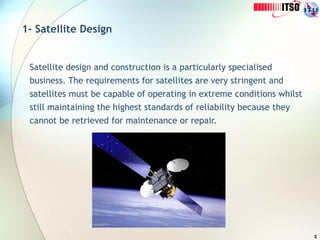
Satellite design and construction is a particularly specialised
business. The requirements for satellites are very stringent and
satellites must be capable of operating in extreme conditions whilst
still maintaining the highest standards of reliability because they
cannot be retrieved for maintenance or repair.
3
1- Satellite Design
Apart from the general factors relating to satellite design, the
circuitry required for their operation such as the transmitters and
receivers, satellites also contain a number of systems used for what
is called station keeping. All of these functions, whether for
performing the primary role of the satellite, or for ensuring that it
reliably maintains its position and function are all important and
must be included in the design of the satellite.
4
2- Launching the satellite
A satellite may be launched into orbit by either a multi-stage
expendable launch vehicle or a manned or unmanned reusable
launcher. Additional rocket motors (perigee(point nearest to
orbited object) and apogee (culmination: greatest point)kick
motors) may also be required. The process of launching a satellite is
based mainly on launching into equatorial circular orbits, and in
particular the GSO, but broadly similar processes are used for other
orbits.
There are two techniques for launching a satellite into an orbit of
the desired altitude, namely by :
• direct ascent
• or by a Hohmann transfer ellipse .
5
2- Launching the satellite
The Direct ascent method
In the direct ascent method, the thrust of the launch vehicle is used
to place the satellite in a trajectory, the turning point of which is
marginally above the altitude of the desired orbit.
The initial phase of the ascent trajectory, the boost phase, is
powered by the various stages of the launch vehicle. This is followed
by a coasting (landing) phase along the ballistic(relating to
projectiles) trajectory, the spacecraft at this point consisting of the
last launcher stage and the satellite. As the velocity required to
sustain an orbit will not have been attained at this point, the
spacecraft falls back from the highest point of the ballistic
trajectory.
6
2- Launching the satellite
The Direct ascent method
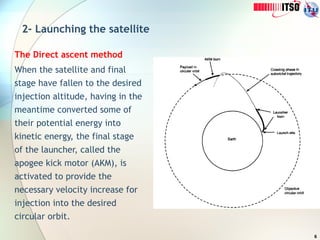
When the satellite and final
stage have fallen to the desired
injection altitude, having in the
meantime converted some of
their potential energy into
kinetic energy, the final stage
of the launcher, called the
apogee kick motor (AKM), is
activated to provide the
necessary velocity increase for
injection into the desired
circular orbit.
7
2- Launching the satellite
The Hohmann transfer ellipse method
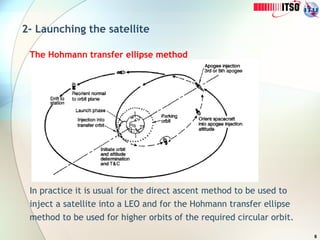
The Hohmann transfer ellipse method enables a satellite to be
placed in an orbit at the desired altitude using the trajectory that
requires the least energy.
First the launch vehicle propels the satellite into a low parking orbit
by the direct ascent method. Then, the satellite is injected into an
elliptical transfer orbit, the apogee of which is at the altitude of the
desired circular orbit. Finally, at the apogee, additional thrust is
applied by an AKM to provide the velocity increment necessary for
the attainment of the required circular orbit
8
2- Launching the satellite
The Hohmann transfer ellipse method
In practice it is usual for the direct ascent method to be used to
inject a satellite into a LEO and for the Hohmann transfer ellipse
method to be used for higher orbits of the required circular orbit.
9
2- Launching the satellite
Launch Vehicles
Launch vehicles and their nose firings impose mass and dimensional
constraints on the satellites that can be launched. However, a
number of different types of launcher are available for commercial
use and the satellite designer ensures that the satellite will meet
the constraints and capabilities of one of them, or preferably more
than one.
10
2- Launching the satellite
Some types of Launch Vehicles
All of these vehicles consist of several stages, mostly fuelled by
bipropellant liquids, and some of them are assisted by solid rocket
boosters strapped on to the first stage.
The dimensional constraint on the launcher payload, consisting of
one or more satellites, is determined by the size and shape of the
nose fairing which protects the payload while the launcher is within
the atmosphere. Several different fairings are available for most
launchers, accommodating satellites of different sizes and shapes
after they have been prepared for launching by folding back such
structures as solar arrays and large antennas..
11
2- Launching the satellite
Some types of Launch Vehicles
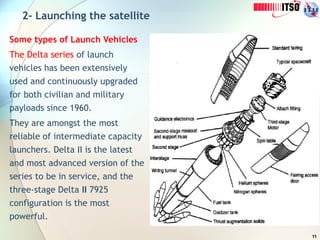
The Delta series of launch
vehicles has been extensively
used and continuously upgraded
for both civilian and military
payloads since 1960.
They are amongst the most
reliable of intermediate capacity
launchers. Delta II is the latest
and most advanced version of the
series to be in service, and the
three-stage Delta II 7925
configuration is the most
powerful.
12
2- Launching the satellite
Some types of Launch Vehicles
Delta Series
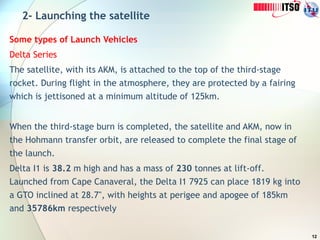
The satellite, with its AKM, is attached to the top of the third-stage
rocket. During flight in the atmosphere, they are protected by a fairing
which is jettisoned at a minimum altitude of 125km.
When the third-stage burn is completed, the satellite and AKM, now in
the Hohmann transfer orbit, are released to complete the final stage of
the launch.
Delta I1 is 38.2 m high and has a mass of 230 tonnes at lift-off.
Launched from Cape Canaveral, the Delta I1 7925 can place 1819 kg into
a GTO inclined at 28.7", with heights at perigee and apogee of 185km
and 35786km respectively
13
2- Launching the satellite
Some types of Launch Vehicles
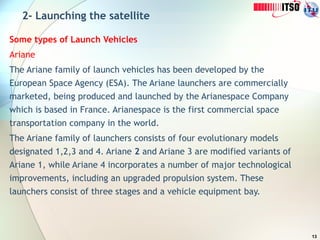
Ariane
The Ariane family of launch vehicles has been developed by the
European Space Agency (ESA). The Ariane launchers are commercially
marketed, being produced and launched by the Arianespace Company
which is based in France. Arianespace is the first commercial space
transportation company in the world.
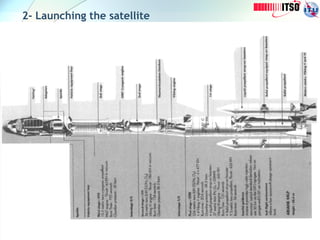
The Ariane family of launchers consists of four evolutionary models
designated 1,2,3 and 4. Ariane 2 and Ariane 3 are modified variants of
Ariane 1, while Ariane 4 incorporates a number of major technological
improvements, including an upgraded propulsion system. These
launchers consist of three stages and a vehicle equipment bay.
14
2- Launching the satellite
Some types of Launch Vehicles
Ariane
15
3- Satellite Position Maintenance
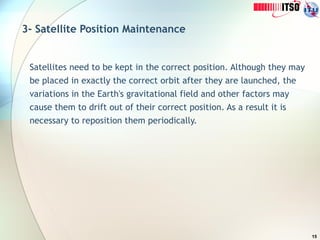
Satellites need to be kept in the correct position. Although they may
be placed in exactly the correct orbit after they are launched, the
variations in the Earth's gravitational field and other factors may
cause them to drift out of their correct position. As a result it is
necessary to reposition them periodically.
16
3- Satellite Position Maintenance
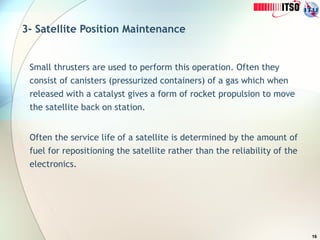
Small thrusters are used to perform this operation. Often they
consist of canisters (pressurized containers) of a gas which when
released with a catalyst gives a form of rocket propulsion to move
the satellite back on station.
Often the service life of a satellite is determined by the amount of
fuel for repositioning the satellite rather than the reliability of the
electronics.
17
4- Satellite Power
Electrical power is also required by the satellite for its electronic
circuitry and other electrical systems. Although the power
requirements for some satellites may be relatively modest, this is
certainly not the case for satellites such as direct broadcast (DBS) or
satellite television broadcasting satellites.
Although they do not transmit the same levels of power that are
used for terrestrial broadcasting, they still consume considerable
amounts of power.
18
4- Satellite Power
The power is supplied by the large arrays of photo or solar cells.
Some cylindrical satellites have them positioned around the outer
area on the cylinder so that some part of the body is always exposed
to sunlight.
Others have large extending panels that are orientated to collect
the maximum amount of light.
Today these panels are capable of producing the many kilowatts of
power required for the high power output stages used in many
transponders.
19
4- Satellite Power
Batteries are also needed for the periods when the satellite is in
darkness. These need to charged by the solar cells so that when the
satellite passes out of the sunlight it can still remain operational.
This naturally places an additional burden on the solar cells because
they need to be able to power not only the satellite itself, but also
charge the batteries.
This may double the power they have to supply during periods of
sunlight.
20
5- Satellite antennas
The antennas used on satellites are particularly important. They are
the only means through which communication can take place with
the ground. For geostationary satellites directional antennas are
generally used. These are used because power consumption on the
satellite has to be minimised wherever possible. Directional
antennas provide gain and enable the best use to be made of the
available transmitted power. Additionally they enable the signals
from the earth to be received with the best signal to noise ratio. In
view of the long path lengths required for geostationary satellites,
there is a considerable path loss and the antenna gain is used to
improve the received signal strength.
21
5- Satellite antennas
The antennas used on satellites are particularly important. They are
the only means through which communication can take place with
the ground. For geostationary satellites directional antennas are
generally used. These are used because power consumption on the
satellite has to be minimized wherever possible. Directional
antennas provide gain and enable the best use to be made of the
available transmitted power. Additionally they enable the signals
from the earth to be received with the best signal to noise ratio. In
view of the long path lengths required for geostationary satellites,
there is a considerable path loss and the antenna gain is used to
improve the received signal strength.
22
5- Satellite antennas
The situation is different for low earth orbit or LEO satellites. These
satellites are not in geostationary orbit and they move across the
sky. Additionally they may need to be received by several users at
any time and this means that they cannot use directive antennas.
Additionally the earth subtends around half the celestial sphere and
as a result users may be separated by angles ranging from zero to
almost 180 degrees. Fortunately the satellites are much closer to
the earth and path losses are very significantly less, reducing the
need to high gain antennas.
23
6- Ground stations
Ground stations also need an effective antenna system. For
communication with satellites in geostationary orbit the antenna
remains fixed, except if there is a need to change to another
satellite. Accordingly parabolic reflectors are often used. This can
be seen from the number of satellite TV antennas that are in use.
These are a form of parabolic reflector. This type of antenna is
widely used for example with direct broadcast satellite TV. The
antennas seen on the sides of houses are almost exclusively
parabolic reflectors.
24
6- Ground stations
For some low earth orbit satellites the ground station antenna
systems are designed to be able to track the satellite in azimuth and
elevation. This is typically achieved by automatically tracking the
satellite as it moves across the sky. This is normally achieved by
taking a signal level output from the receiver. By ensuring that it is
maintained at its peak level the satellite will be tracked.
25
7- Satellite in-orbit performance
Satellite in-orbit testing is carried out for a variety of reasons. For a
communications satellite its basic form is to verify the integrity of
the communications payload and the antenna platform following
satellite launch, and prior to release of the satellite to Operations.
Also, regular in-orbit performance checks are usually carried out.
Achieving verifiable, high accuracy test results places demands on
the testing earth station far in excess of the requirements imposed
by the specifications for normal traffic earth stations.
26
8- Satellite insurance
Satellite insurance is a specialized branch of aviation insurance
which is underwritten by very few insurers in world. In 1965 the first
satellite insurance was placed with Lloyds of London to cover
physical damages on pre-launch for the "Early Bird" satellite Intelsat
I. In 1968 coverage was arranged for pre-launch and launch perils
for the Intelsat III satellite. Satellites are very complex machines
which are manufactured and used by governments and a few larger
companies. The budget for a typical satellite project can be in
excess of billions of dollars and can run 5–10 years including the
planning, manufacturing, testing, and launch.
Insurance available for satellites is divided into two sections:
• satellite coverage
• ground risk coverage.
27
8- Satellite insurance
Satellite risk coverage is insurance against damage to the satellite
itself.
There are five basic types of coverage available in this section :
• Pre-launch insurance
• Launch insurance
• Coverage while in orbit
• Third party liability (Required by Regulations agencies)
• Loss of revenue coverage (not often used)
28
8- Ground risk insurance
As many ground stations are run by large government entities such
as NASA, failure on the part of the insured is rare. In cases where
failure occurs due to events which are beyond the control of the
insured (such as an earthquake), coverage provides for the cost of
hiring premises, replacing computer systems, software backup, and
other items necessary to resume operations.
29
End of Day 2 course
Satellite Economics: Satellite Design, Satellite Manufacture, Launch,
Insurance, In-Orbit Performance, Monitoring Stations
Satellite Acquisition, Lease, Joint Ventures, Condo-sat, Pre-purchase

Day2 Course. power point presentation 2024

  • 1.
    1 Day 2 course SatelliteEconomics: Satellite Design, Satellite Manufacture, Launch, Insurance, In-Orbit Performance, Monitoring Stations Satellite Acquisition, Lease, Joint Ventures, Condo-sat, Pre-purchase
  • 2.
    2 1- Satellite Design Satellitedesign and construction is a particularly specialised business. The requirements for satellites are very stringent and satellites must be capable of operating in extreme conditions whilst still maintaining the highest standards of reliability because they cannot be retrieved for maintenance or repair.
  • 3.
    3 1- Satellite Design Apartfrom the general factors relating to satellite design, the circuitry required for their operation such as the transmitters and receivers, satellites also contain a number of systems used for what is called station keeping. All of these functions, whether for performing the primary role of the satellite, or for ensuring that it reliably maintains its position and function are all important and must be included in the design of the satellite.
  • 4.
    4 2- Launching thesatellite A satellite may be launched into orbit by either a multi-stage expendable launch vehicle or a manned or unmanned reusable launcher. Additional rocket motors (perigee(point nearest to orbited object) and apogee (culmination: greatest point)kick motors) may also be required. The process of launching a satellite is based mainly on launching into equatorial circular orbits, and in particular the GSO, but broadly similar processes are used for other orbits. There are two techniques for launching a satellite into an orbit of the desired altitude, namely by : • direct ascent • or by a Hohmann transfer ellipse .
  • 5.
    5 2- Launching thesatellite The Direct ascent method In the direct ascent method, the thrust of the launch vehicle is used to place the satellite in a trajectory, the turning point of which is marginally above the altitude of the desired orbit. The initial phase of the ascent trajectory, the boost phase, is powered by the various stages of the launch vehicle. This is followed by a coasting (landing) phase along the ballistic(relating to projectiles) trajectory, the spacecraft at this point consisting of the last launcher stage and the satellite. As the velocity required to sustain an orbit will not have been attained at this point, the spacecraft falls back from the highest point of the ballistic trajectory.
  • 6.
    6 2- Launching thesatellite The Direct ascent method When the satellite and final stage have fallen to the desired injection altitude, having in the meantime converted some of their potential energy into kinetic energy, the final stage of the launcher, called the apogee kick motor (AKM), is activated to provide the necessary velocity increase for injection into the desired circular orbit.
  • 7.
    7 2- Launching thesatellite The Hohmann transfer ellipse method The Hohmann transfer ellipse method enables a satellite to be placed in an orbit at the desired altitude using the trajectory that requires the least energy. First the launch vehicle propels the satellite into a low parking orbit by the direct ascent method. Then, the satellite is injected into an elliptical transfer orbit, the apogee of which is at the altitude of the desired circular orbit. Finally, at the apogee, additional thrust is applied by an AKM to provide the velocity increment necessary for the attainment of the required circular orbit
  • 8.
    8 2- Launching thesatellite The Hohmann transfer ellipse method In practice it is usual for the direct ascent method to be used to inject a satellite into a LEO and for the Hohmann transfer ellipse method to be used for higher orbits of the required circular orbit.
  • 9.
    9 2- Launching thesatellite Launch Vehicles Launch vehicles and their nose firings impose mass and dimensional constraints on the satellites that can be launched. However, a number of different types of launcher are available for commercial use and the satellite designer ensures that the satellite will meet the constraints and capabilities of one of them, or preferably more than one.
  • 10.
    10 2- Launching thesatellite Some types of Launch Vehicles All of these vehicles consist of several stages, mostly fuelled by bipropellant liquids, and some of them are assisted by solid rocket boosters strapped on to the first stage. The dimensional constraint on the launcher payload, consisting of one or more satellites, is determined by the size and shape of the nose fairing which protects the payload while the launcher is within the atmosphere. Several different fairings are available for most launchers, accommodating satellites of different sizes and shapes after they have been prepared for launching by folding back such structures as solar arrays and large antennas..
  • 11.
    11 2- Launching thesatellite Some types of Launch Vehicles The Delta series of launch vehicles has been extensively used and continuously upgraded for both civilian and military payloads since 1960. They are amongst the most reliable of intermediate capacity launchers. Delta II is the latest and most advanced version of the series to be in service, and the three-stage Delta II 7925 configuration is the most powerful.
  • 12.
    12 2- Launching thesatellite Some types of Launch Vehicles Delta Series The satellite, with its AKM, is attached to the top of the third-stage rocket. During flight in the atmosphere, they are protected by a fairing which is jettisoned at a minimum altitude of 125km. When the third-stage burn is completed, the satellite and AKM, now in the Hohmann transfer orbit, are released to complete the final stage of the launch. Delta I1 is 38.2 m high and has a mass of 230 tonnes at lift-off. Launched from Cape Canaveral, the Delta I1 7925 can place 1819 kg into a GTO inclined at 28.7", with heights at perigee and apogee of 185km and 35786km respectively
  • 13.
    13 2- Launching thesatellite Some types of Launch Vehicles Ariane The Ariane family of launch vehicles has been developed by the European Space Agency (ESA). The Ariane launchers are commercially marketed, being produced and launched by the Arianespace Company which is based in France. Arianespace is the first commercial space transportation company in the world. The Ariane family of launchers consists of four evolutionary models designated 1,2,3 and 4. Ariane 2 and Ariane 3 are modified variants of Ariane 1, while Ariane 4 incorporates a number of major technological improvements, including an upgraded propulsion system. These launchers consist of three stages and a vehicle equipment bay.
  • 14.
    14 2- Launching thesatellite Some types of Launch Vehicles Ariane
  • 15.
    15 3- Satellite PositionMaintenance Satellites need to be kept in the correct position. Although they may be placed in exactly the correct orbit after they are launched, the variations in the Earth's gravitational field and other factors may cause them to drift out of their correct position. As a result it is necessary to reposition them periodically.
  • 16.
    16 3- Satellite PositionMaintenance Small thrusters are used to perform this operation. Often they consist of canisters (pressurized containers) of a gas which when released with a catalyst gives a form of rocket propulsion to move the satellite back on station. Often the service life of a satellite is determined by the amount of fuel for repositioning the satellite rather than the reliability of the electronics.
  • 17.
    17 4- Satellite Power Electricalpower is also required by the satellite for its electronic circuitry and other electrical systems. Although the power requirements for some satellites may be relatively modest, this is certainly not the case for satellites such as direct broadcast (DBS) or satellite television broadcasting satellites. Although they do not transmit the same levels of power that are used for terrestrial broadcasting, they still consume considerable amounts of power.
  • 18.
    18 4- Satellite Power Thepower is supplied by the large arrays of photo or solar cells. Some cylindrical satellites have them positioned around the outer area on the cylinder so that some part of the body is always exposed to sunlight. Others have large extending panels that are orientated to collect the maximum amount of light. Today these panels are capable of producing the many kilowatts of power required for the high power output stages used in many transponders.
  • 19.
    19 4- Satellite Power Batteriesare also needed for the periods when the satellite is in darkness. These need to charged by the solar cells so that when the satellite passes out of the sunlight it can still remain operational. This naturally places an additional burden on the solar cells because they need to be able to power not only the satellite itself, but also charge the batteries. This may double the power they have to supply during periods of sunlight.
  • 20.
    20 5- Satellite antennas Theantennas used on satellites are particularly important. They are the only means through which communication can take place with the ground. For geostationary satellites directional antennas are generally used. These are used because power consumption on the satellite has to be minimised wherever possible. Directional antennas provide gain and enable the best use to be made of the available transmitted power. Additionally they enable the signals from the earth to be received with the best signal to noise ratio. In view of the long path lengths required for geostationary satellites, there is a considerable path loss and the antenna gain is used to improve the received signal strength.
  • 21.
    21 5- Satellite antennas Theantennas used on satellites are particularly important. They are the only means through which communication can take place with the ground. For geostationary satellites directional antennas are generally used. These are used because power consumption on the satellite has to be minimized wherever possible. Directional antennas provide gain and enable the best use to be made of the available transmitted power. Additionally they enable the signals from the earth to be received with the best signal to noise ratio. In view of the long path lengths required for geostationary satellites, there is a considerable path loss and the antenna gain is used to improve the received signal strength.
  • 22.
    22 5- Satellite antennas Thesituation is different for low earth orbit or LEO satellites. These satellites are not in geostationary orbit and they move across the sky. Additionally they may need to be received by several users at any time and this means that they cannot use directive antennas. Additionally the earth subtends around half the celestial sphere and as a result users may be separated by angles ranging from zero to almost 180 degrees. Fortunately the satellites are much closer to the earth and path losses are very significantly less, reducing the need to high gain antennas.
  • 23.
    23 6- Ground stations Groundstations also need an effective antenna system. For communication with satellites in geostationary orbit the antenna remains fixed, except if there is a need to change to another satellite. Accordingly parabolic reflectors are often used. This can be seen from the number of satellite TV antennas that are in use. These are a form of parabolic reflector. This type of antenna is widely used for example with direct broadcast satellite TV. The antennas seen on the sides of houses are almost exclusively parabolic reflectors.
  • 24.
    24 6- Ground stations Forsome low earth orbit satellites the ground station antenna systems are designed to be able to track the satellite in azimuth and elevation. This is typically achieved by automatically tracking the satellite as it moves across the sky. This is normally achieved by taking a signal level output from the receiver. By ensuring that it is maintained at its peak level the satellite will be tracked.
  • 25.
    25 7- Satellite in-orbitperformance Satellite in-orbit testing is carried out for a variety of reasons. For a communications satellite its basic form is to verify the integrity of the communications payload and the antenna platform following satellite launch, and prior to release of the satellite to Operations. Also, regular in-orbit performance checks are usually carried out. Achieving verifiable, high accuracy test results places demands on the testing earth station far in excess of the requirements imposed by the specifications for normal traffic earth stations.
  • 26.
    26 8- Satellite insurance Satelliteinsurance is a specialized branch of aviation insurance which is underwritten by very few insurers in world. In 1965 the first satellite insurance was placed with Lloyds of London to cover physical damages on pre-launch for the "Early Bird" satellite Intelsat I. In 1968 coverage was arranged for pre-launch and launch perils for the Intelsat III satellite. Satellites are very complex machines which are manufactured and used by governments and a few larger companies. The budget for a typical satellite project can be in excess of billions of dollars and can run 5–10 years including the planning, manufacturing, testing, and launch. Insurance available for satellites is divided into two sections: • satellite coverage • ground risk coverage.
  • 27.
    27 8- Satellite insurance Satelliterisk coverage is insurance against damage to the satellite itself. There are five basic types of coverage available in this section : • Pre-launch insurance • Launch insurance • Coverage while in orbit • Third party liability (Required by Regulations agencies) • Loss of revenue coverage (not often used)
  • 28.
    28 8- Ground riskinsurance As many ground stations are run by large government entities such as NASA, failure on the part of the insured is rare. In cases where failure occurs due to events which are beyond the control of the insured (such as an earthquake), coverage provides for the cost of hiring premises, replacing computer systems, software backup, and other items necessary to resume operations.
  • 29.
    29 End of Day2 course Satellite Economics: Satellite Design, Satellite Manufacture, Launch, Insurance, In-Orbit Performance, Monitoring Stations Satellite Acquisition, Lease, Joint Ventures, Condo-sat, Pre-purchase