Agile Software Project Management
Lateral Thinking
Registration#: FA14-MS-0005
Name: Syed Iqtedar Ahmed Taqvi
Semester: Fall 2016
Submitted To: Sir Ansar Muhammad
1
What does the word “Lateral” Means?
• Lateral
–of, at, towards, or from the side or sides
–a side part of something, especially a shoot
or branch growing out from the side of a
stem.
2
Lateral thinking
• “ Thinking that is Outside the Box! ”
• in 1967
• by Edward de Bono
3
Can You Solve this Puzzle?
4
5
Dr. Edward de Bono
M.D., Ph.D., (philosophy,
medicine & psychology),
Rhodes scholar
World-renowned
consultant to business,
governments, schools
and industry
Author of 70 books
in 47 languages
Originator of Lateral
Thinking, Six Thinking
Hats, and Direct
Attention Thinking Tools
6
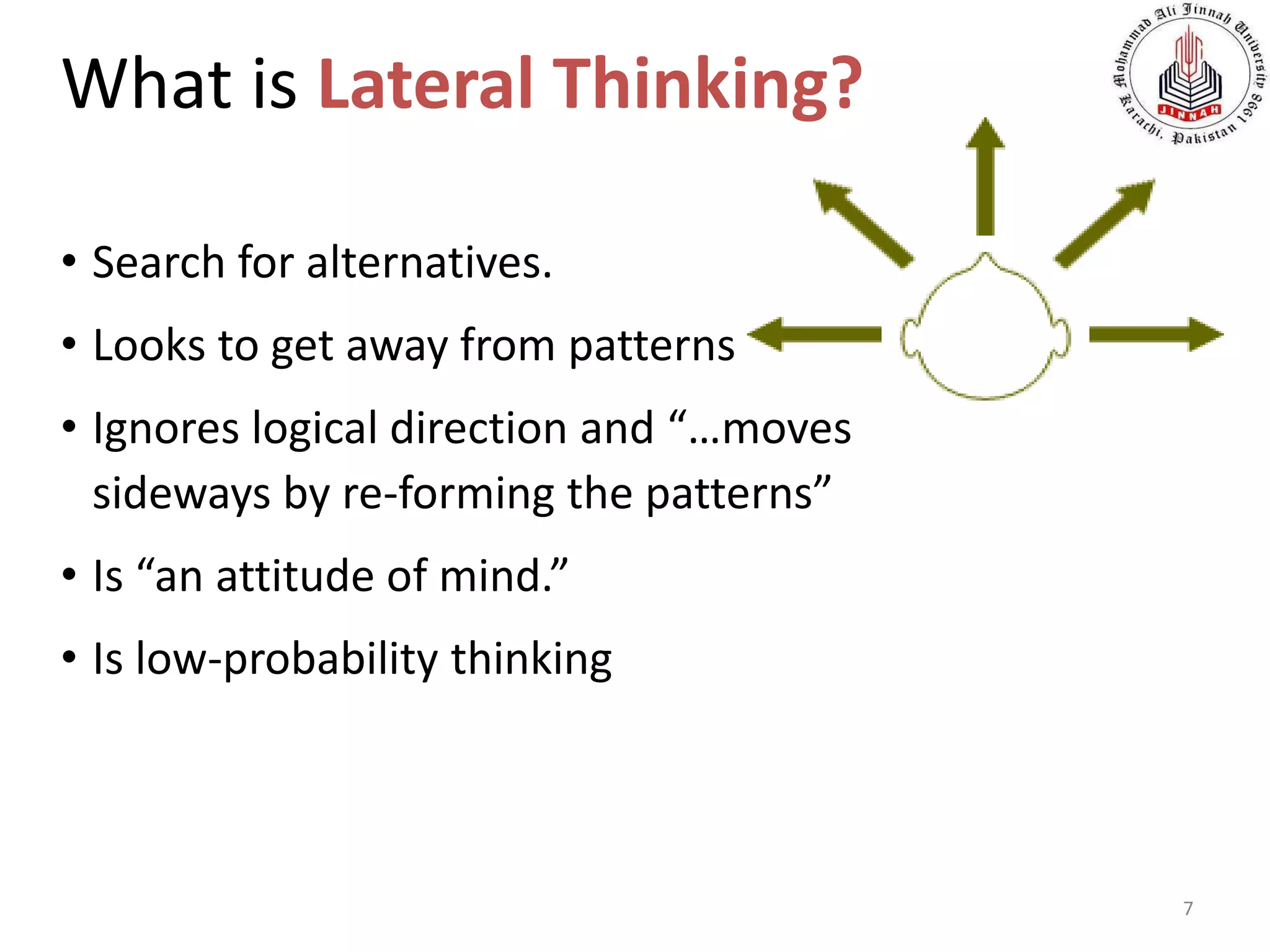
What is Lateral Thinking?
• Search for alternatives.
• Looks to get away from patterns
• Ignores logical direction and “…moves
sideways by re-forming the patterns”
• Is “an attitude of mind.”
• Is low-probability thinking
7
8
SO,
LATERAL THINKING IS:
VISION
INSIGHT THINKING
CREATIVITY
INNOVATION
IMAGINATION
 Relaxation of rigid control of
vertical thinking.
 Use of chance
 Search for different ways of
looking at things
Principle of
9
VERTICAL THINKING LATERAL THINKING
selective generative
moves only if there is a
direction in which to move
moves in order to generate a
direction
analytical provocative
sequential makes jumps
one has to be correct at every
step
one does not have to be
one uses the negative in
order to block off certain
pathways
there is no negative
one concentrates and
excludes what is irrelevant
one welcomes chance
intrusions
(categories) classifications
and labels are fixed
they are not fixed
follows the most likely paths explores the least likely
a finite process probablistic one
Difference between lateral and vertical thinking
10
DIFFERENCE BETWEEN
LATERAL AND VERTICAL THINKING
alternatives alternatives
vertical
lateral
11
12
VERTICAL THINKING IS SELECTIVE
&
LATERAL THINKING IS GENERATIVE
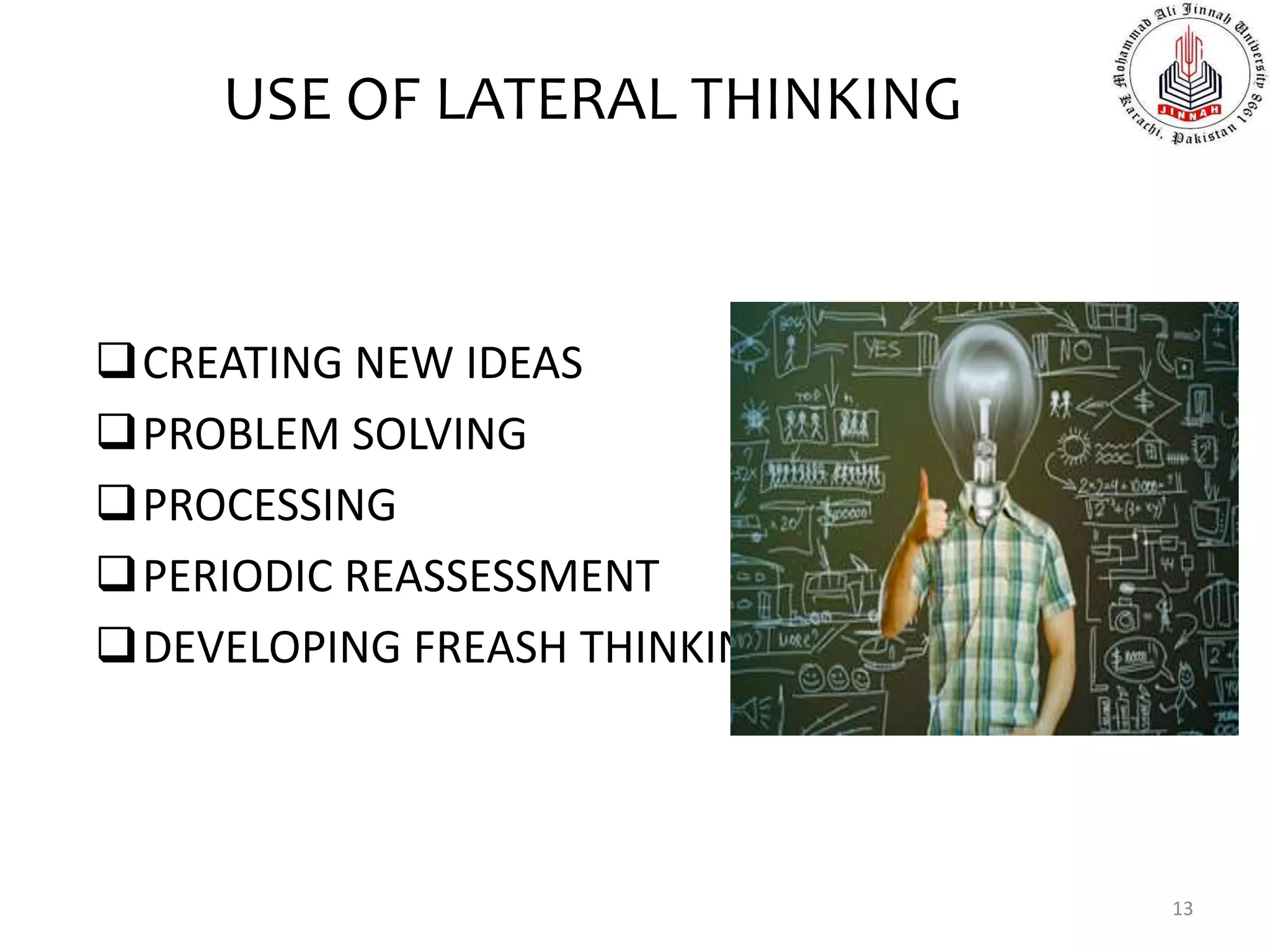
USE OF LATERAL THINKING
CREATING NEW IDEAS
PROBLEM SOLVING
PROCESSING
PERIODIC REASSESSMENT
DEVELOPING FREASH THINKING
13
Basic nature of lateral thinking
14
TECHNIQUES USED
TRIMMING
SPLITTING COMBINING
15
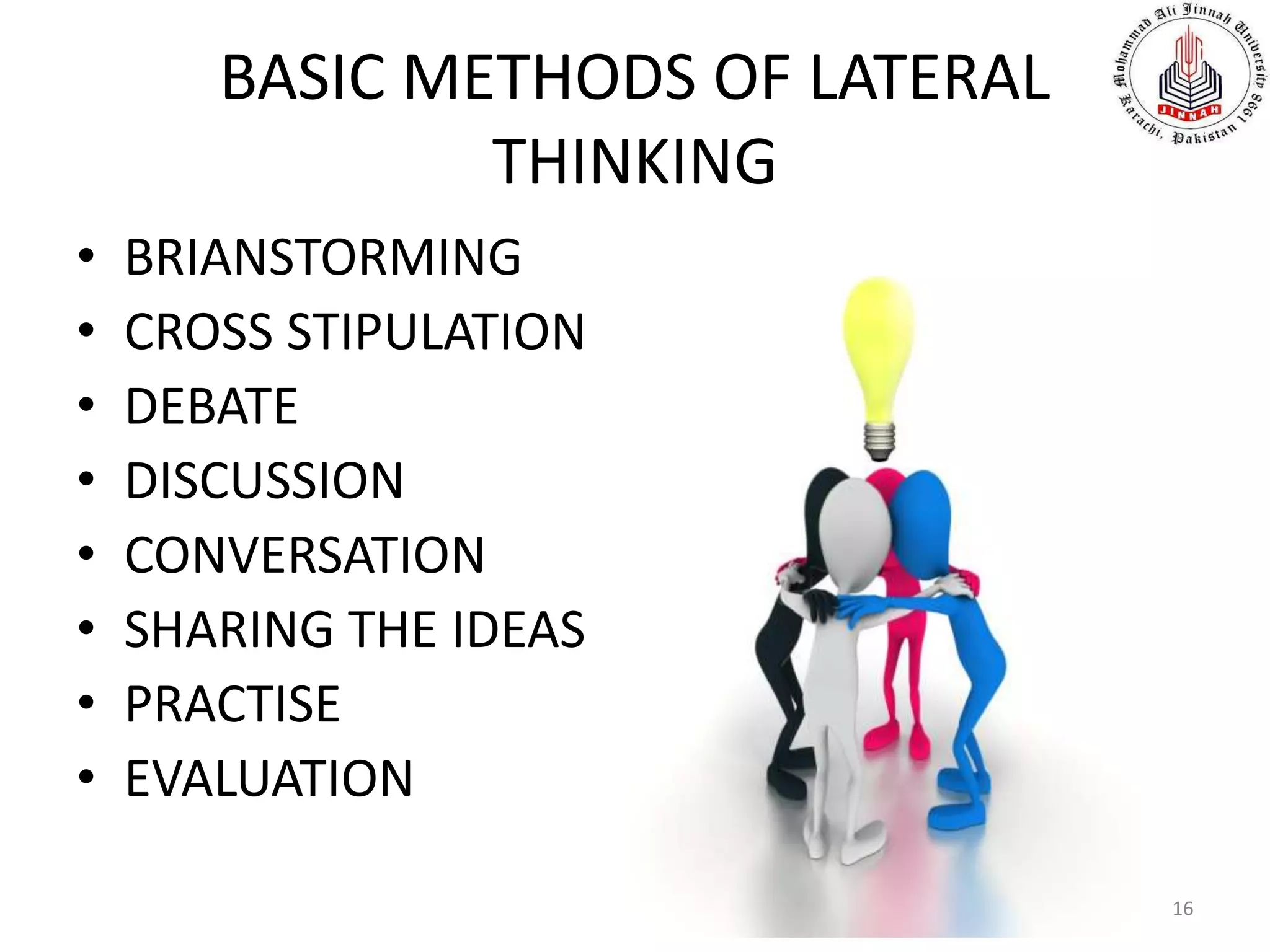
BASIC METHODS OF LATERAL
THINKING
• BRIANSTORMING
• CROSS STIPULATION
• DEBATE
• DISCUSSION
• CONVERSATION
• SHARING THE IDEAS
• PRACTISE
• EVALUATION
16
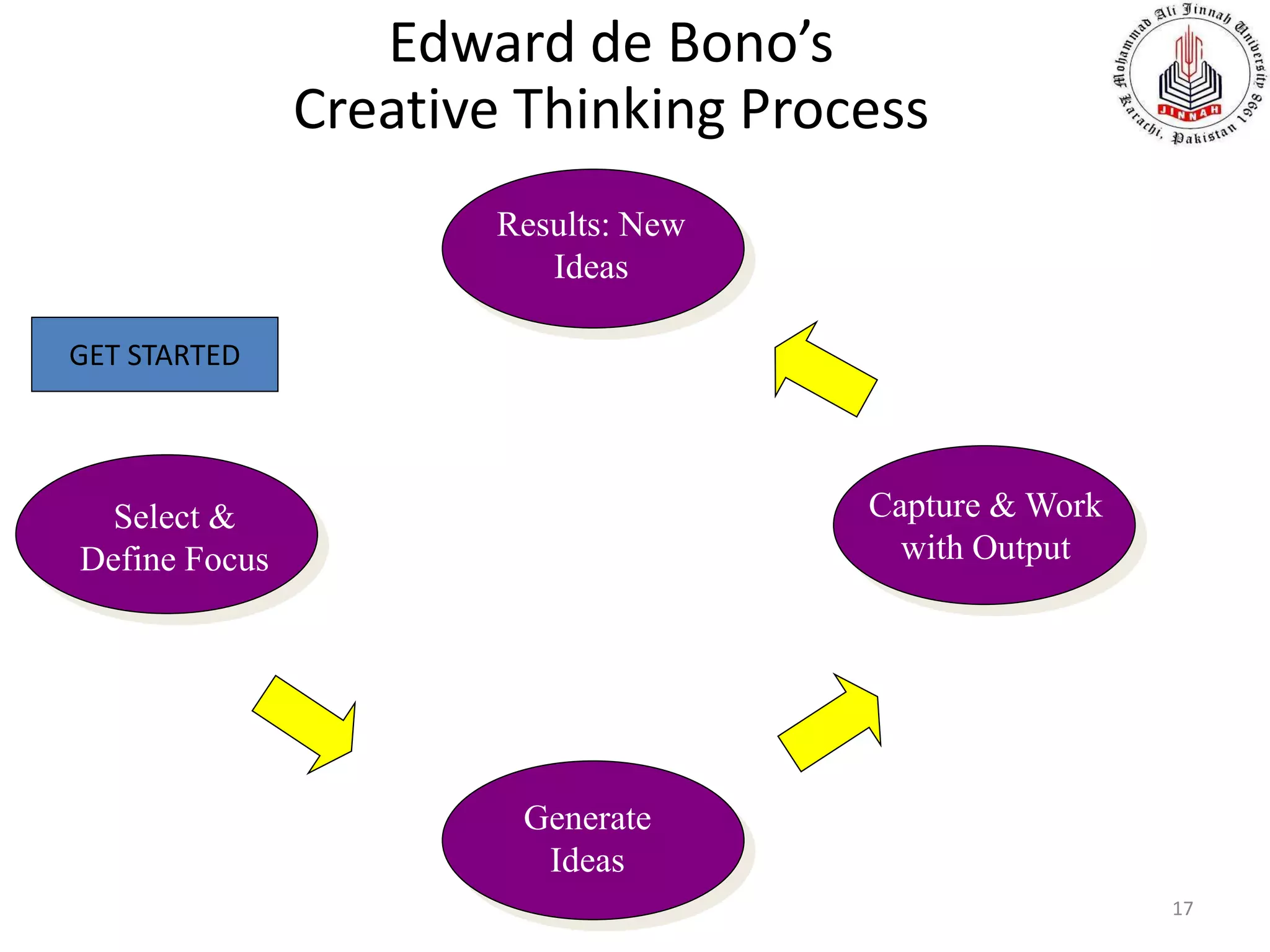
Edward de Bono’s
Creative Thinking Process
Results: New
Ideas
Select &
Define Focus
Capture & Work
with Output
Generate
Ideas
GET STARTED
17
THE WORD PO
NO vs PO
• Logic could be said to be the
management of NO.
• PO is language tool defining the
rearrangement process which is
the basis of lateral thinking.
The function of PO:
• Creating new patterns
• Challenging old patterns
• Stated differently
• Provocative and permissive
• Liberating
PO IS BASICALY A ALTERNATIVE FINDING ,A NEW WAY 18
Summary
Lateral thinking:
“…is not a magic formula”
Is an attitude
Is a habit of mind
Aims for simplicity and effectiveness
Seeks escape from dominant order
Seeks simpler order and not disorder
19
20
Thank You….

Lateral thinking by edward de bono

  • 1.
    Agile Software ProjectManagement Lateral Thinking Registration#: FA14-MS-0005 Name: Syed Iqtedar Ahmed Taqvi Semester: Fall 2016 Submitted To: Sir Ansar Muhammad 1
  • 2.
    What does theword “Lateral” Means? • Lateral –of, at, towards, or from the side or sides –a side part of something, especially a shoot or branch growing out from the side of a stem. 2
  • 3.
    Lateral thinking • “Thinking that is Outside the Box! ” • in 1967 • by Edward de Bono 3
  • 4.
    Can You Solvethis Puzzle? 4
  • 5.
  • 6.
    Dr. Edward deBono M.D., Ph.D., (philosophy, medicine & psychology), Rhodes scholar World-renowned consultant to business, governments, schools and industry Author of 70 books in 47 languages Originator of Lateral Thinking, Six Thinking Hats, and Direct Attention Thinking Tools 6
  • 7.
    What is LateralThinking? • Search for alternatives. • Looks to get away from patterns • Ignores logical direction and “…moves sideways by re-forming the patterns” • Is “an attitude of mind.” • Is low-probability thinking 7
  • 8.
    8 SO, LATERAL THINKING IS: VISION INSIGHTTHINKING CREATIVITY INNOVATION IMAGINATION
  • 9.
     Relaxation ofrigid control of vertical thinking.  Use of chance  Search for different ways of looking at things Principle of 9
  • 10.
    VERTICAL THINKING LATERALTHINKING selective generative moves only if there is a direction in which to move moves in order to generate a direction analytical provocative sequential makes jumps one has to be correct at every step one does not have to be one uses the negative in order to block off certain pathways there is no negative one concentrates and excludes what is irrelevant one welcomes chance intrusions (categories) classifications and labels are fixed they are not fixed follows the most likely paths explores the least likely a finite process probablistic one Difference between lateral and vertical thinking 10
  • 11.
    DIFFERENCE BETWEEN LATERAL ANDVERTICAL THINKING alternatives alternatives vertical lateral 11
  • 12.
    12 VERTICAL THINKING ISSELECTIVE & LATERAL THINKING IS GENERATIVE
  • 13.
    USE OF LATERALTHINKING CREATING NEW IDEAS PROBLEM SOLVING PROCESSING PERIODIC REASSESSMENT DEVELOPING FREASH THINKING 13
  • 14.
    Basic nature oflateral thinking 14
  • 15.
  • 16.
    BASIC METHODS OFLATERAL THINKING • BRIANSTORMING • CROSS STIPULATION • DEBATE • DISCUSSION • CONVERSATION • SHARING THE IDEAS • PRACTISE • EVALUATION 16
  • 17.
    Edward de Bono’s CreativeThinking Process Results: New Ideas Select & Define Focus Capture & Work with Output Generate Ideas GET STARTED 17
  • 18.
    THE WORD PO NOvs PO • Logic could be said to be the management of NO. • PO is language tool defining the rearrangement process which is the basis of lateral thinking. The function of PO: • Creating new patterns • Challenging old patterns • Stated differently • Provocative and permissive • Liberating PO IS BASICALY A ALTERNATIVE FINDING ,A NEW WAY 18
  • 19.
    Summary Lateral thinking: “…is nota magic formula” Is an attitude Is a habit of mind Aims for simplicity and effectiveness Seeks escape from dominant order Seeks simpler order and not disorder 19
  • 20.