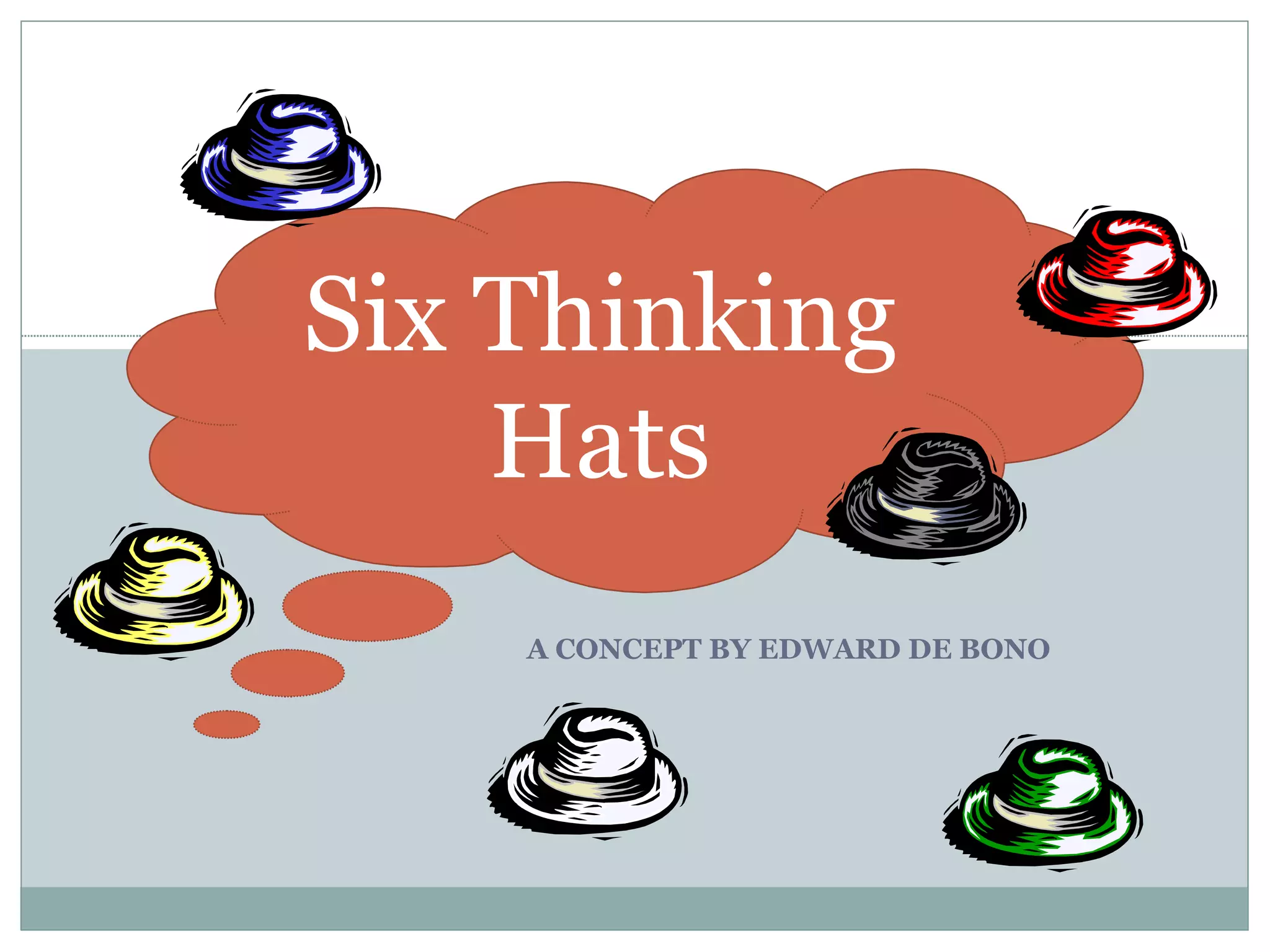
A CONCEPT BY EDWARD DE BONO Six Thinking Hats
About Six Thinking Hats 'This technique developed by Edward De Bono --  early in the 1980s  -- will help you experiment with different ways of thinking and to see your idea from different angles. This forces you to move outside your habitual thinking style, and helps you to get a more rounded view of a situation.
Why Six Thinking Hats? Many people think from a very rational, positive viewpoint.  Often, though, they may fail to look at a problem from an emotional, intuitive, creative or negative viewpoint. The six hats represent six types of thinking. You 'wear' one of these hats to help you think about an idea in a particular way.
What is Six Thinking Hats? Each 'Thinking Hat' is a different style of thinking. White Hat – neutral and objective Red Hat – realm of the emotional view and feelings. Black Hat – caution. It points out weaknesses in an idea. Yellow Hat – positive, sunny and optimistic. Green Hat – creativity and new ideas. Blue Hat – cool, concerned with control, organization of the thinking process, and use the other hats
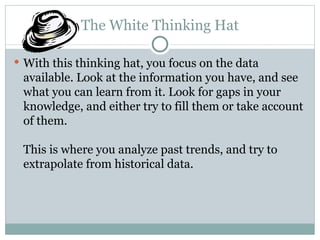
The White Thinking Hat With this thinking hat, you focus on the data available. Look at the information you have, and see what you can learn from it. Look for gaps in your knowledge, and either try to fill them or take account of them. This is where you analyze past trends, and try to extrapolate from historical data.
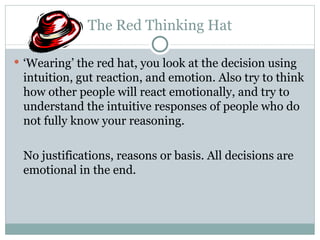
The Red Thinking Hat ‘ Wearing’ the red hat, you look at the decision using intuition, gut reaction, and emotion. Also try to think how other people will react emotionally, and try to understand the intuitive responses of people who do not fully know your reasoning. No justifications, reasons or basis. All decisions are emotional in the end.
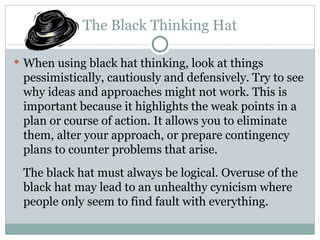
The Black Thinking Hat When using black hat thinking, look at things pessimistically, cautiously and defensively. Try to see why ideas and approaches might not work. This is important because it highlights the weak points in a plan or course of action. It allows you to eliminate them, alter your approach, or prepare contingency plans to counter problems that arise. The black hat must always be logical. Overuse of the black hat may lead to an unhealthy cynicism where people only seem to find fault with everything.
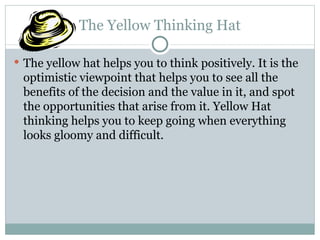
The Yellow Thinking Hat The yellow hat helps you to think positively. It is the optimistic viewpoint that helps you to see all the benefits of the decision and the value in it, and spot the opportunities that arise from it. Yellow Hat thinking helps you to keep going when everything looks gloomy and difficult.
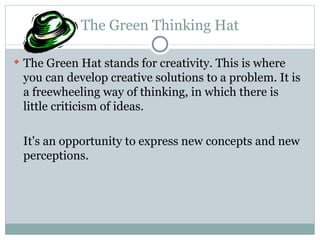
The Green Thinking Hat The Green Hat stands for creativity. This is where you can develop creative solutions to a problem. It is a freewheeling way of thinking, in which there is little criticism of ideas. It's an opportunity to express new concepts and new perceptions.
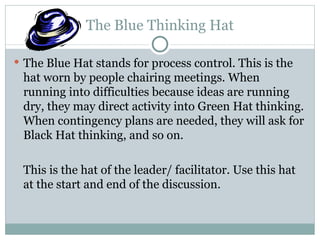
The Blue Thinking Hat The Blue Hat stands for process control. This is the hat worn by people chairing meetings. When running into difficulties because ideas are running dry, they may direct activity into Green Hat thinking. When contingency plans are needed, they will ask for Black Hat thinking, and so on. This is the hat of the leader/ facilitator. Use this hat at the start and end of the discussion.
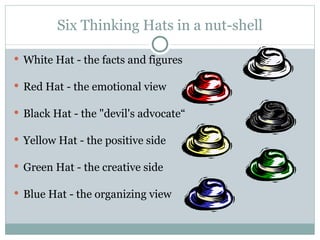
Six Thinking Hats in a nut-shell White Hat - the facts and figures Red Hat - the emotional view Black Hat - the "devil's advocate“ Yellow Hat - the positive side Green Hat - the creative side Blue Hat - the organizing view
Using the Hats Use any hat, as often as needed It can be used in any sequence Not necessary to use every hat Have a time under each hat: generally, short Requires discipline from each person (e.g. While using it, stay in the idiom) Can be used by individuals and groups
Some Structured Sequence to use the hats White Hat Present the facts of the case  Green Hat Generate ideas on how the case could be handled  Yellow Hat Evaluate the merits of the ideas - List the benefits Black Hat List the drawbacks Red Hat Get everybody’s gut feelings about the alternatives Blue Hat Summarize and adjourn the meeting
Some Structured Sequence to use the hats Blue hat Organize the process Red hat Emotional issues & feelings White hat What do we know, need to know Yellow hat Proposals & suggestions; what ifs, why nots
Some Structured Sequence to use the hats Blue hat Focus on the areas that need new ideas Green hat Generate new ideas & concepts Blue hat Organize ideas & process for evaluation White, yellow & green hats Constructive thinking
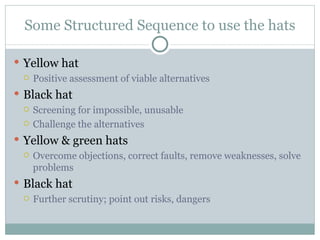
Some Structured Sequence to use the hats Yellow hat Positive assessment of viable alternatives Black hat Screening for impossible, unusable Challenge the alternatives Yellow & green hats Overcome objections, correct faults, remove weaknesses, solve problems Black hat Further scrutiny; point out risks, dangers
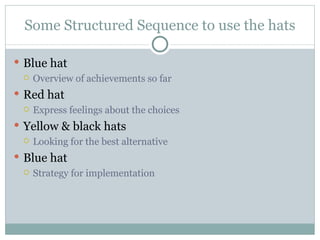
Some Structured Sequence to use the hats Blue hat Overview of achievements so far Red hat Express feelings about the choices Yellow & black hats Looking for the best alternative Blue hat Strategy for implementation
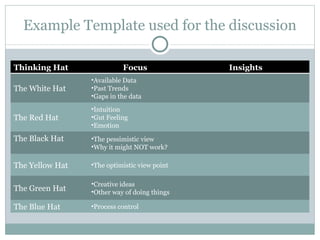
Example Template used for the discussion Thinking Hat Focus Insights The White Hat Available Data Past Trends Gaps in the data The Red Hat Intuition Gut Feeling Emotion The Black Hat The pessimistic view Why it might NOT work? The Yellow Hat The optimistic view point The Green Hat Creative ideas Other way of doing things The Blue Hat Process control
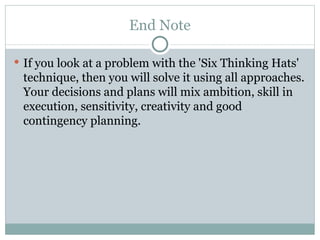
End Note If you look at a problem with the 'Six Thinking Hats' technique, then you will solve it using all approaches. Your decisions and plans will mix ambition, skill in execution, sensitivity, creativity and good contingency planning.
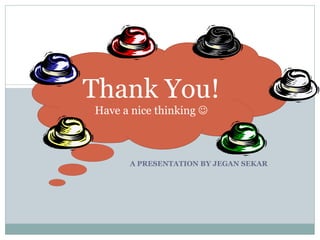
A PRESENTATION BY JEGAN SEKAR Thank You! Have a nice thinking  

Six Thinking Hats

  • 1.
    A CONCEPT BYEDWARD DE BONO Six Thinking Hats
  • 2.
    About Six ThinkingHats 'This technique developed by Edward De Bono -- early in the 1980s -- will help you experiment with different ways of thinking and to see your idea from different angles. This forces you to move outside your habitual thinking style, and helps you to get a more rounded view of a situation.
  • 3.
    Why Six ThinkingHats? Many people think from a very rational, positive viewpoint. Often, though, they may fail to look at a problem from an emotional, intuitive, creative or negative viewpoint. The six hats represent six types of thinking. You 'wear' one of these hats to help you think about an idea in a particular way.
  • 4.
    What is SixThinking Hats? Each 'Thinking Hat' is a different style of thinking. White Hat – neutral and objective Red Hat – realm of the emotional view and feelings. Black Hat – caution. It points out weaknesses in an idea. Yellow Hat – positive, sunny and optimistic. Green Hat – creativity and new ideas. Blue Hat – cool, concerned with control, organization of the thinking process, and use the other hats
  • 5.
    The White ThinkingHat With this thinking hat, you focus on the data available. Look at the information you have, and see what you can learn from it. Look for gaps in your knowledge, and either try to fill them or take account of them. This is where you analyze past trends, and try to extrapolate from historical data.
  • 6.
    The Red ThinkingHat ‘ Wearing’ the red hat, you look at the decision using intuition, gut reaction, and emotion. Also try to think how other people will react emotionally, and try to understand the intuitive responses of people who do not fully know your reasoning. No justifications, reasons or basis. All decisions are emotional in the end.
  • 7.
    The Black ThinkingHat When using black hat thinking, look at things pessimistically, cautiously and defensively. Try to see why ideas and approaches might not work. This is important because it highlights the weak points in a plan or course of action. It allows you to eliminate them, alter your approach, or prepare contingency plans to counter problems that arise. The black hat must always be logical. Overuse of the black hat may lead to an unhealthy cynicism where people only seem to find fault with everything.
  • 8.
    The Yellow ThinkingHat The yellow hat helps you to think positively. It is the optimistic viewpoint that helps you to see all the benefits of the decision and the value in it, and spot the opportunities that arise from it. Yellow Hat thinking helps you to keep going when everything looks gloomy and difficult.
  • 9.
    The Green ThinkingHat The Green Hat stands for creativity. This is where you can develop creative solutions to a problem. It is a freewheeling way of thinking, in which there is little criticism of ideas. It's an opportunity to express new concepts and new perceptions.
  • 10.
    The Blue ThinkingHat The Blue Hat stands for process control. This is the hat worn by people chairing meetings. When running into difficulties because ideas are running dry, they may direct activity into Green Hat thinking. When contingency plans are needed, they will ask for Black Hat thinking, and so on. This is the hat of the leader/ facilitator. Use this hat at the start and end of the discussion.
  • 11.
    Six Thinking Hatsin a nut-shell White Hat - the facts and figures Red Hat - the emotional view Black Hat - the "devil's advocate“ Yellow Hat - the positive side Green Hat - the creative side Blue Hat - the organizing view
  • 12.
    Using the HatsUse any hat, as often as needed It can be used in any sequence Not necessary to use every hat Have a time under each hat: generally, short Requires discipline from each person (e.g. While using it, stay in the idiom) Can be used by individuals and groups
  • 13.
    Some Structured Sequenceto use the hats White Hat Present the facts of the case Green Hat Generate ideas on how the case could be handled Yellow Hat Evaluate the merits of the ideas - List the benefits Black Hat List the drawbacks Red Hat Get everybody’s gut feelings about the alternatives Blue Hat Summarize and adjourn the meeting
  • 14.
    Some Structured Sequenceto use the hats Blue hat Organize the process Red hat Emotional issues & feelings White hat What do we know, need to know Yellow hat Proposals & suggestions; what ifs, why nots
  • 15.
    Some Structured Sequenceto use the hats Blue hat Focus on the areas that need new ideas Green hat Generate new ideas & concepts Blue hat Organize ideas & process for evaluation White, yellow & green hats Constructive thinking
  • 16.
    Some Structured Sequenceto use the hats Yellow hat Positive assessment of viable alternatives Black hat Screening for impossible, unusable Challenge the alternatives Yellow & green hats Overcome objections, correct faults, remove weaknesses, solve problems Black hat Further scrutiny; point out risks, dangers
  • 17.
    Some Structured Sequenceto use the hats Blue hat Overview of achievements so far Red hat Express feelings about the choices Yellow & black hats Looking for the best alternative Blue hat Strategy for implementation
  • 18.
    Example Template usedfor the discussion Thinking Hat Focus Insights The White Hat Available Data Past Trends Gaps in the data The Red Hat Intuition Gut Feeling Emotion The Black Hat The pessimistic view Why it might NOT work? The Yellow Hat The optimistic view point The Green Hat Creative ideas Other way of doing things The Blue Hat Process control
  • 19.
    End Note Ifyou look at a problem with the 'Six Thinking Hats' technique, then you will solve it using all approaches. Your decisions and plans will mix ambition, skill in execution, sensitivity, creativity and good contingency planning.
  • 20.
    A PRESENTATION BYJEGAN SEKAR Thank You! Have a nice thinking 