 Thank You Mr. Sameer Tungare for giving us the

opportunity to work on this project.
 Lateral thinking is a term coined by Edward de Bono.
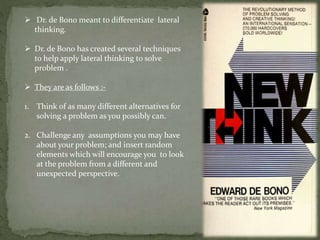
 First appeared in the title of de Bono’s book New

Think: The Use of Lateral Thinking , in year 1967
 It is about reasoning that is not immediately obvious.
 “You cannot dig a hole in

a different place by
digging the same hole
deeper”

 “Lateral thinking is for

changing concepts and
perceptions”
Edward De Bono
 Edward de Bono was born in Malta on 19 May 1933.
 He is a physician, author, inventor and consultant.
 He has had a major impact on the way we think and particularly

in the field of creativity.

 Edward de Bono coined the phrase lateral thinking.
 According to him lateral thinking is, “creativity involves braking

out of established patters in order to look at things in a different
way”
 Dr. de Bono meant to differentiate lateral
thinking.
 Dr. de Bono has created several techniques
to help apply lateral thinking to solve
problem .
 They are as follows :1. Think of as many different alternatives for
solving a problem as you possibly can.
2. Challenge any assumptions you may have
about your problem; and insert random
elements which will encourage you to look
at the problem from a different and
unexpected perspective.
 Assumptions are mental shortcuts.
 In order to challenge your assumptions, write down all

of the dominant ideas.
 Apply to a particular situation and then deliberately

challenge them.
Random
word

False rule
Idea
generating
tools

Provocation idea
generation tool.
Radom entry idea
generating tool.

Challenge idea
generation tool.
1.

A trip in car.

2.

Concept combination.

3.

Change of perspective.
 Six Thinking Hats' is an important and powerful

technique.
 This forces you to move outside your habitual thinking

style, and helps you to get a more rounded view of a
situation.
 It has the benefit of blocking the confrontations that

happen when people with different thinking styles
discuss the same problem.
 Each 'Thinking Hat' is a different style of thinking.
White hat
• Focus on data available
• Look at the information you have.

Red hat
• Look at the decision using intuition, gut reaction,
emotion.
• Also try to think how other people will react
emotionally.

Black hat
• Look at all the bad points of the decision.
• Look at it cautiously and defensively.
Yellow hat
• Helps you to think positively.
• It is the optimistic viewpoint that helps you to see
all the benefits of the decision and the value in it.

Green hat
• The Green Hat stands for creativity.
• This is where you can develop creative solutions
to a problem.

Blue hat
• The Blue Hat stands for process control.
• This is the hat worn by people chairing meetings.
 Six hats can be used in meetings or for oneself.
 In meetings it has the benefits of defusing the

disagreements that can happen when people with
different thinking styles discuss the same problem
 Looks at problems from the point of view of different

professionals.
Lateral thinking

Lateral thinking

  • 2.
     Thank YouMr. Sameer Tungare for giving us the opportunity to work on this project.
  • 3.
     Lateral thinkingis a term coined by Edward de Bono.  First appeared in the title of de Bono’s book New Think: The Use of Lateral Thinking , in year 1967  It is about reasoning that is not immediately obvious.
  • 4.
     “You cannotdig a hole in a different place by digging the same hole deeper”  “Lateral thinking is for changing concepts and perceptions”
  • 5.
    Edward De Bono Edward de Bono was born in Malta on 19 May 1933.  He is a physician, author, inventor and consultant.  He has had a major impact on the way we think and particularly in the field of creativity.  Edward de Bono coined the phrase lateral thinking.  According to him lateral thinking is, “creativity involves braking out of established patters in order to look at things in a different way”
  • 6.
     Dr. deBono meant to differentiate lateral thinking.  Dr. de Bono has created several techniques to help apply lateral thinking to solve problem .  They are as follows :1. Think of as many different alternatives for solving a problem as you possibly can. 2. Challenge any assumptions you may have about your problem; and insert random elements which will encourage you to look at the problem from a different and unexpected perspective.
  • 7.
     Assumptions aremental shortcuts.  In order to challenge your assumptions, write down all of the dominant ideas.  Apply to a particular situation and then deliberately challenge them.
  • 8.
  • 9.
    Idea generating tools Provocation idea generation tool. Radomentry idea generating tool. Challenge idea generation tool.
  • 10.
    1. A trip incar. 2. Concept combination. 3. Change of perspective.
  • 14.
     Six ThinkingHats' is an important and powerful technique.  This forces you to move outside your habitual thinking style, and helps you to get a more rounded view of a situation.  It has the benefit of blocking the confrontations that happen when people with different thinking styles discuss the same problem.  Each 'Thinking Hat' is a different style of thinking.
  • 15.
    White hat • Focuson data available • Look at the information you have. Red hat • Look at the decision using intuition, gut reaction, emotion. • Also try to think how other people will react emotionally. Black hat • Look at all the bad points of the decision. • Look at it cautiously and defensively.
  • 16.
    Yellow hat • Helpsyou to think positively. • It is the optimistic viewpoint that helps you to see all the benefits of the decision and the value in it. Green hat • The Green Hat stands for creativity. • This is where you can develop creative solutions to a problem. Blue hat • The Blue Hat stands for process control. • This is the hat worn by people chairing meetings.
  • 17.
     Six hatscan be used in meetings or for oneself.  In meetings it has the benefits of defusing the disagreements that can happen when people with different thinking styles discuss the same problem  Looks at problems from the point of view of different professionals.