How to apply  6 Thinking Hats Presentation By:  Bijoy Viswanadhan Ref : Six Thinking Hats  by  Edward de Bono Submitted on : Feb 2010
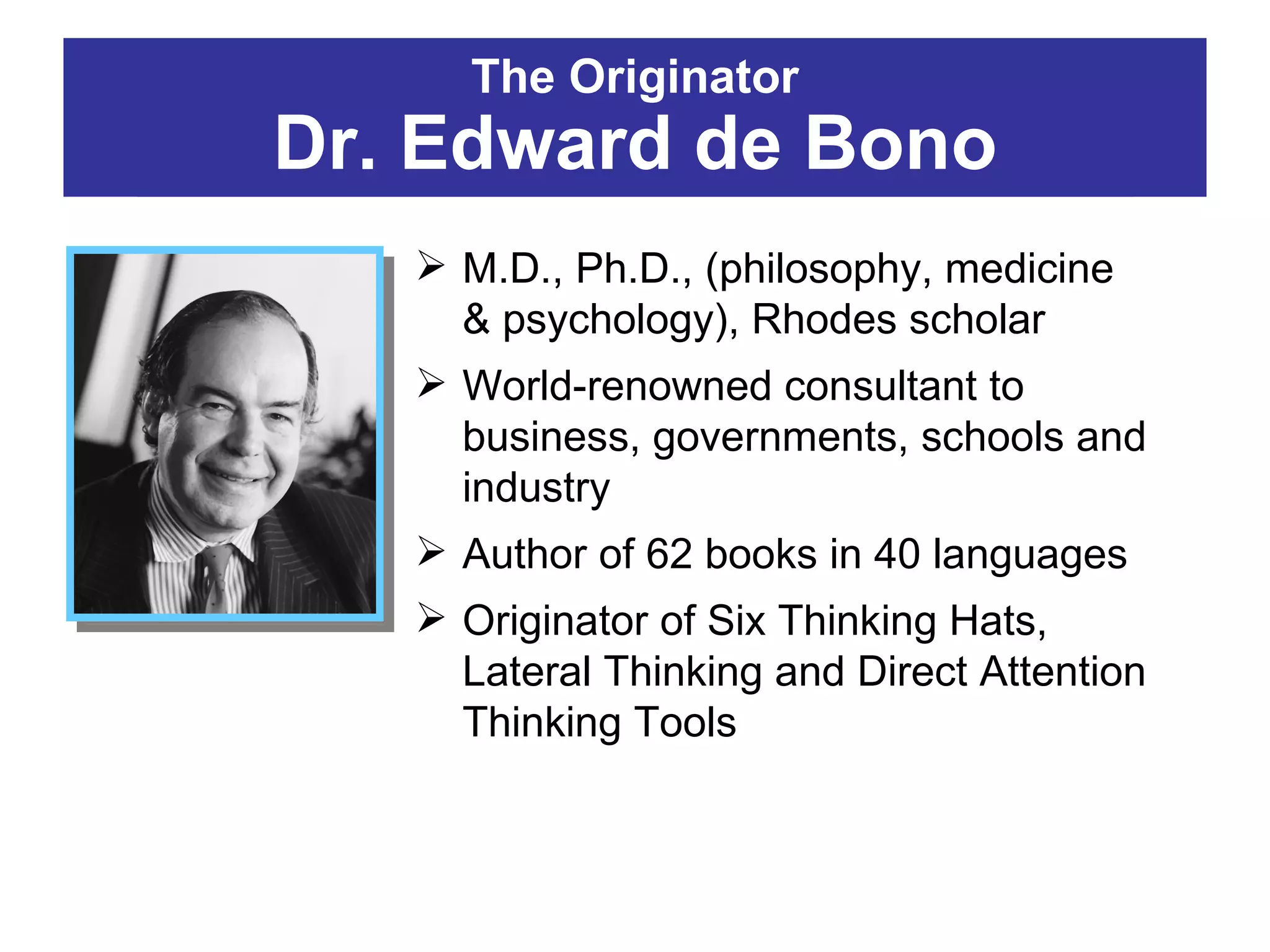
The Originator Dr. Edward de Bono M.D., Ph.D., (philosophy, medicine & psychology), Rhodes scholar World-renowned consultant to business, governments, schools and industry Author of 62 books in 40 languages Originator of Six Thinking Hats, Lateral Thinking and Direct Attention Thinking Tools
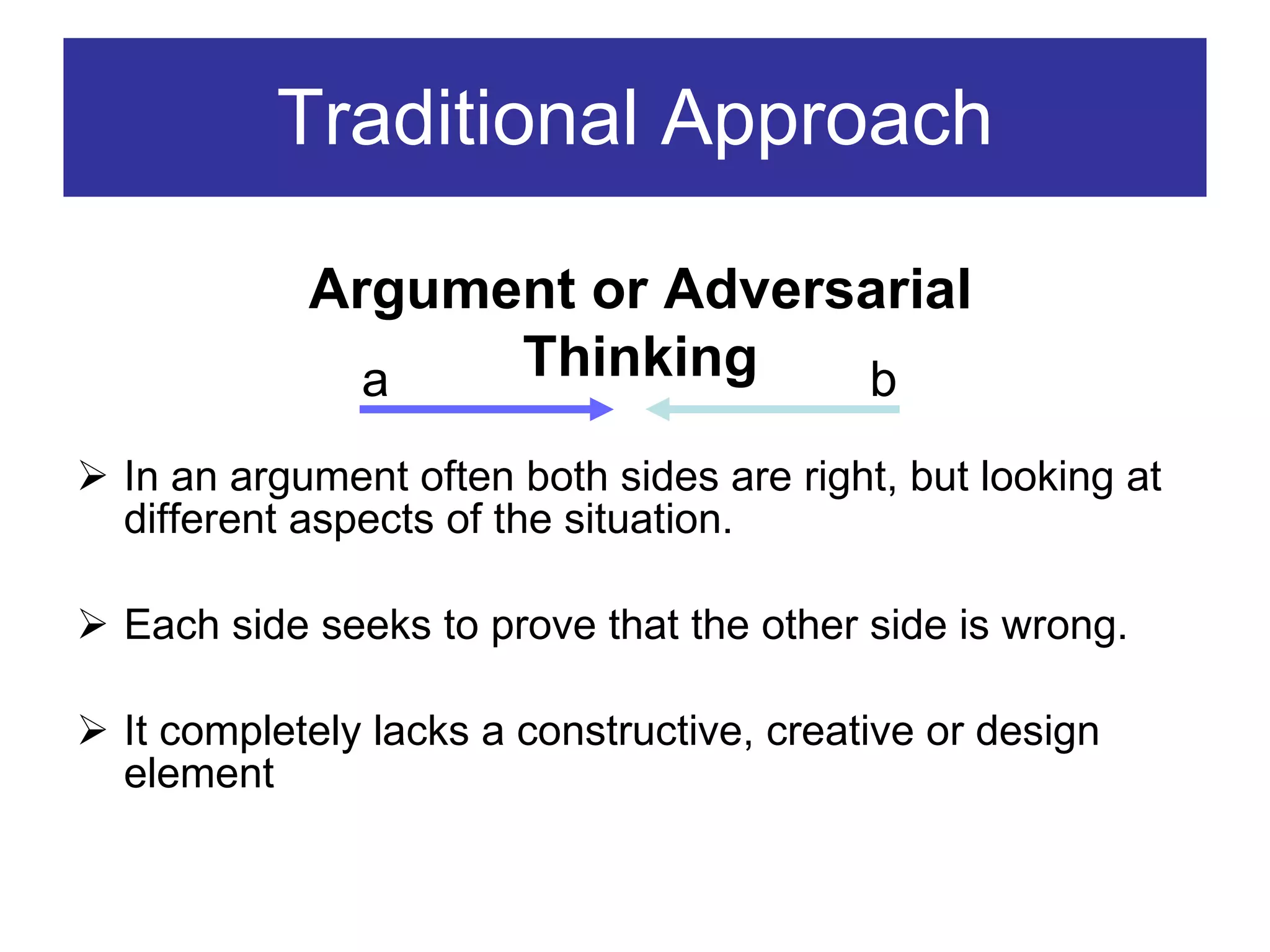
Traditional Approach In an argument often both sides are right, but looking at different aspects of the situation. Each side seeks to prove that the other side is wrong. It completely lacks a constructive, creative or design element Argument or Adversarial Thinking a b
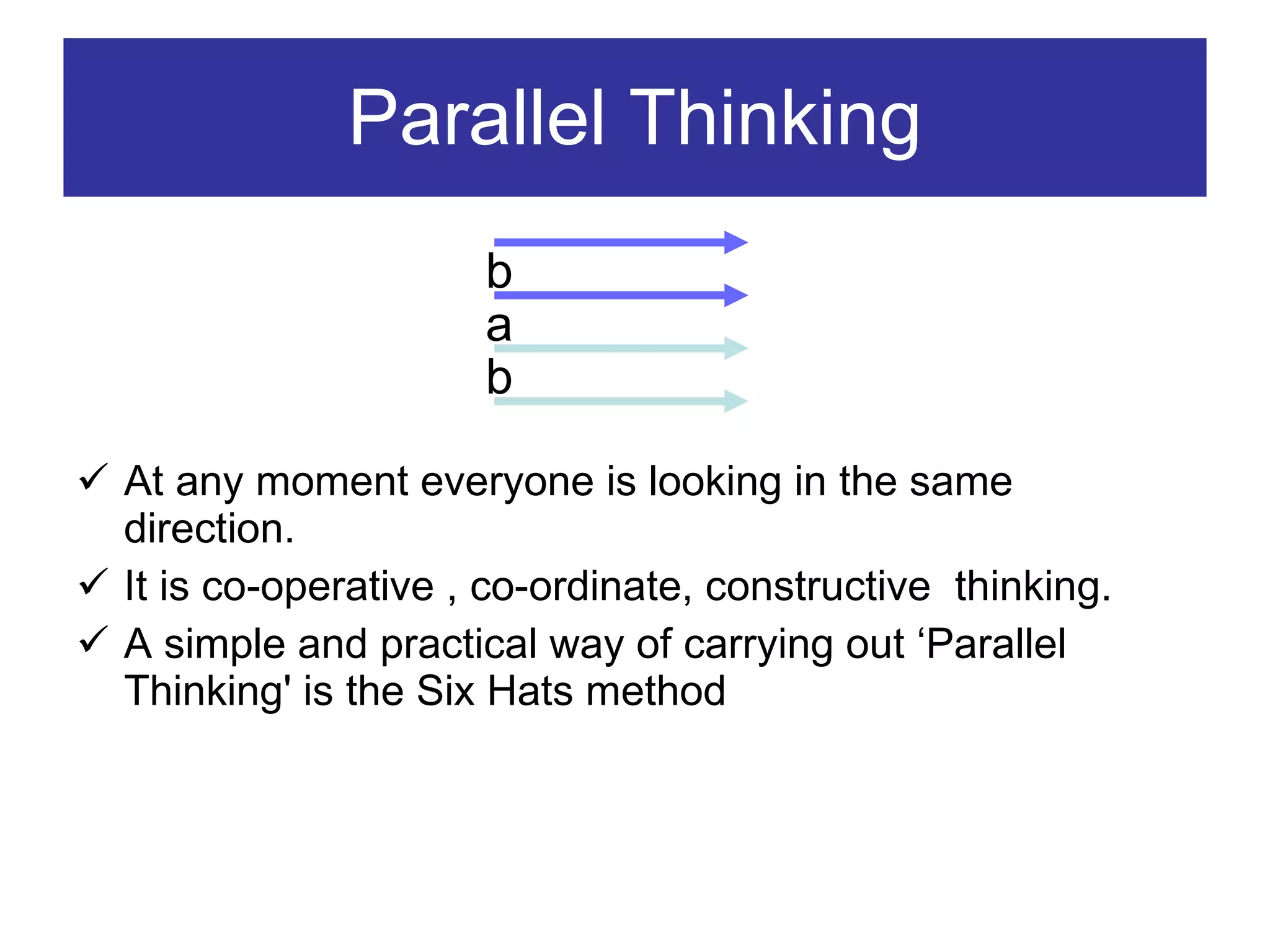
Parallel Thinking At any moment everyone is looking in the same direction. It is co-operative , co-ordinate, constructive  thinking. A simple and practical way of carrying out ‘Parallel Thinking' is the Six Hats method b a b
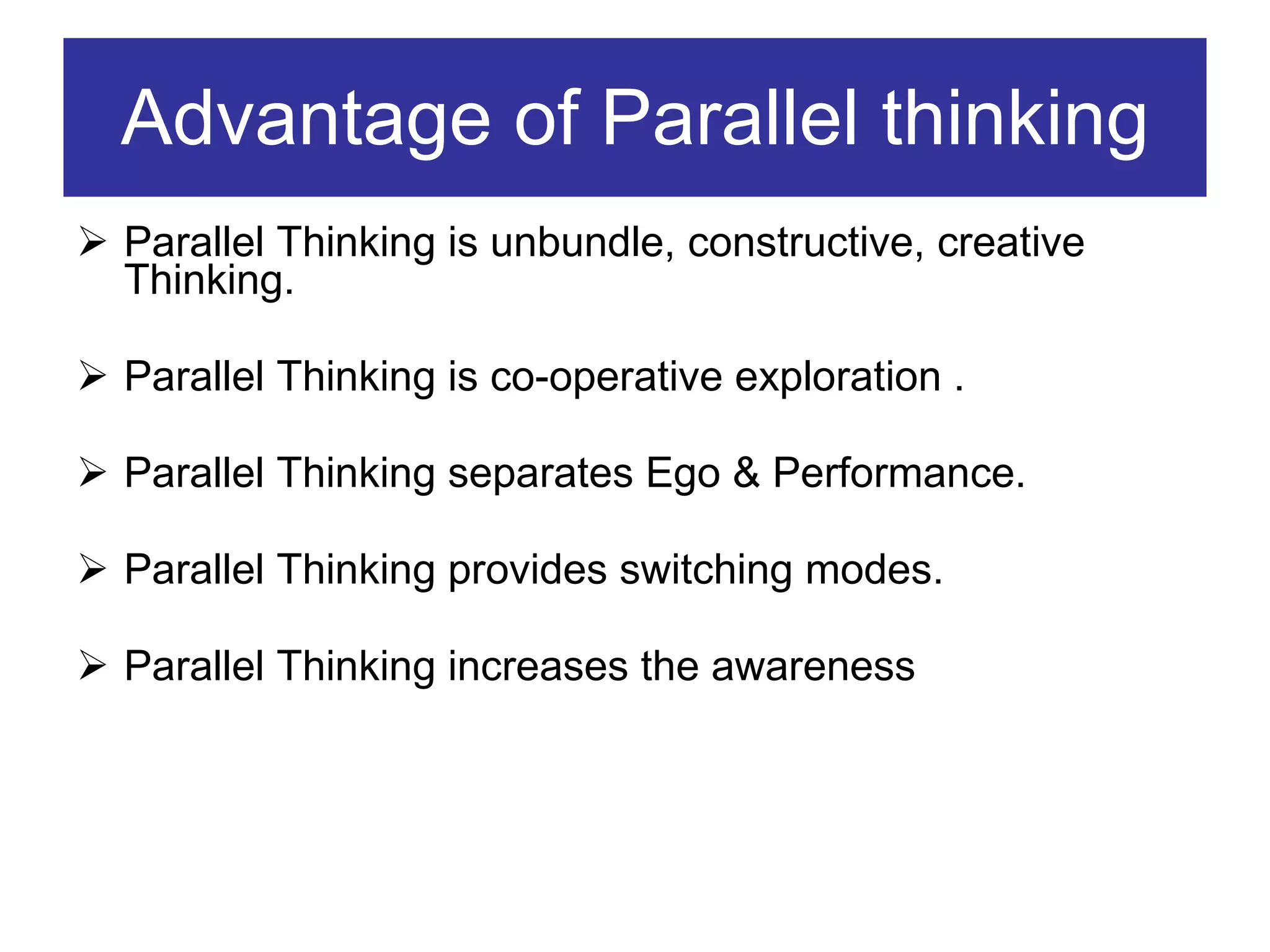
Advantage of Parallel thinking Parallel Thinking is unbundle, constructive, creative Thinking. Parallel Thinking is co-operative exploration . Parallel Thinking separates Ego & Performance. Parallel Thinking provides switching modes. Parallel Thinking increases the awareness
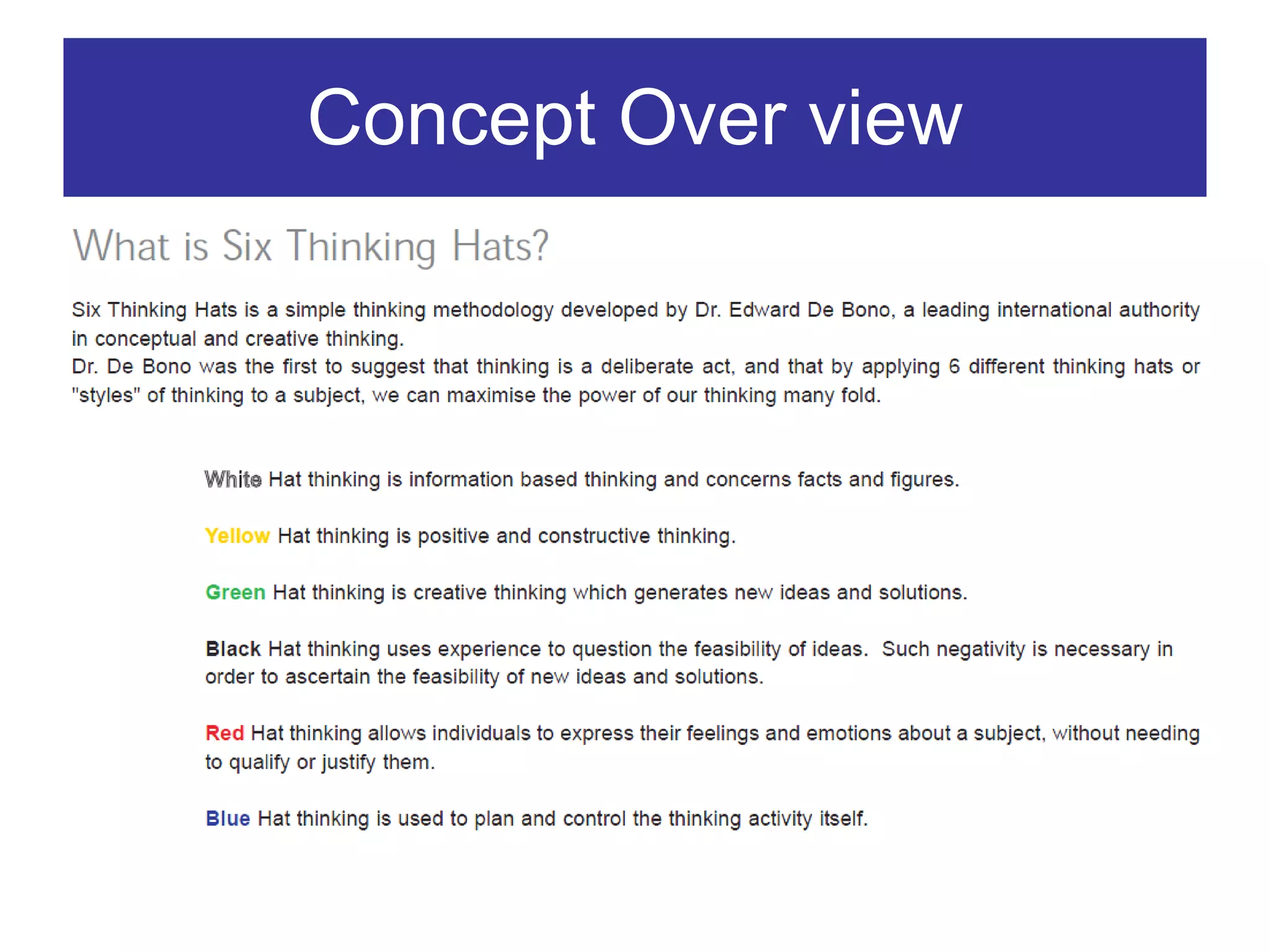
Concept Over view
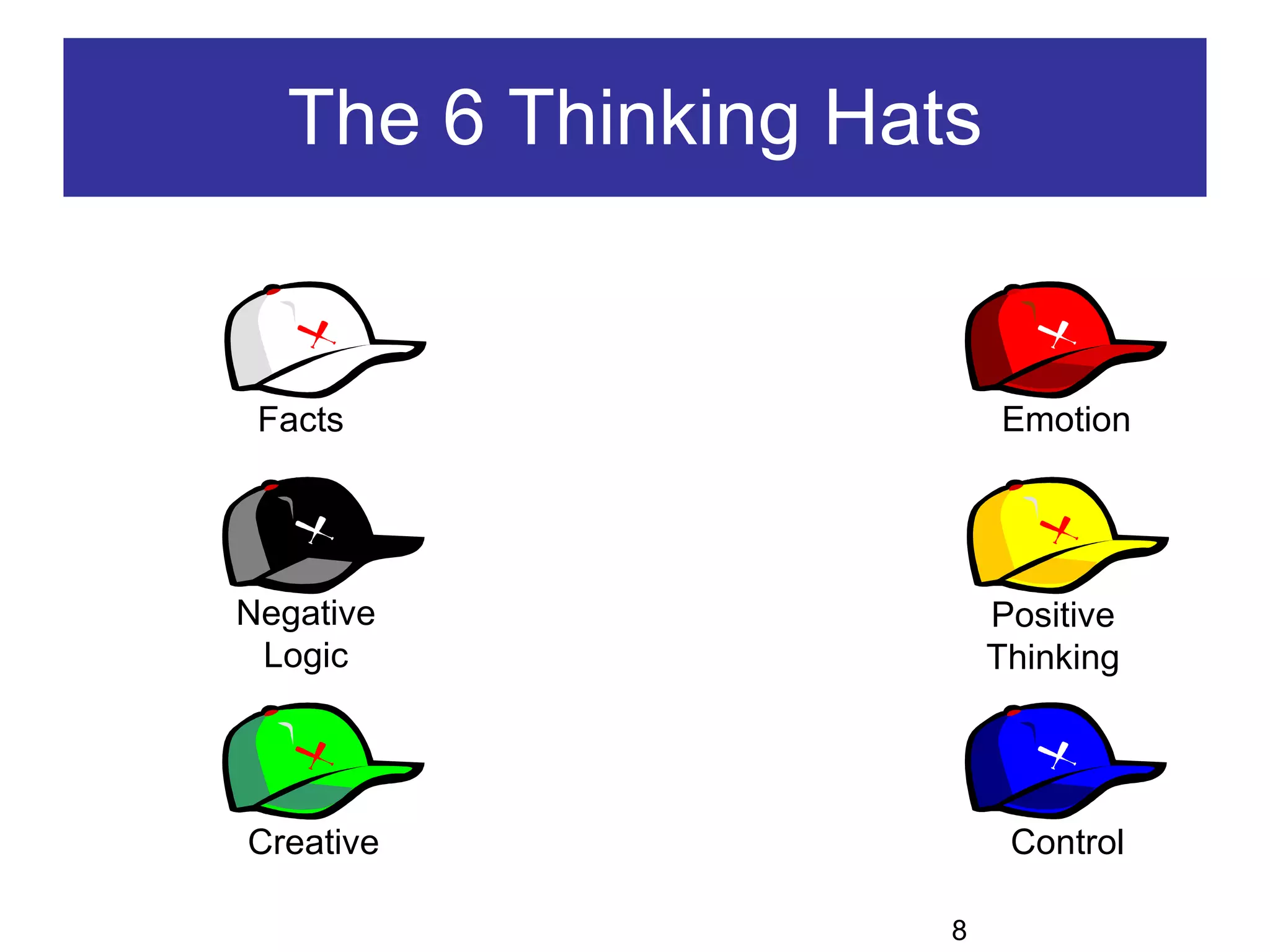
The 6 Thinking Hats 8 Creative Facts Emotion Negative Logic Positive Thinking Control
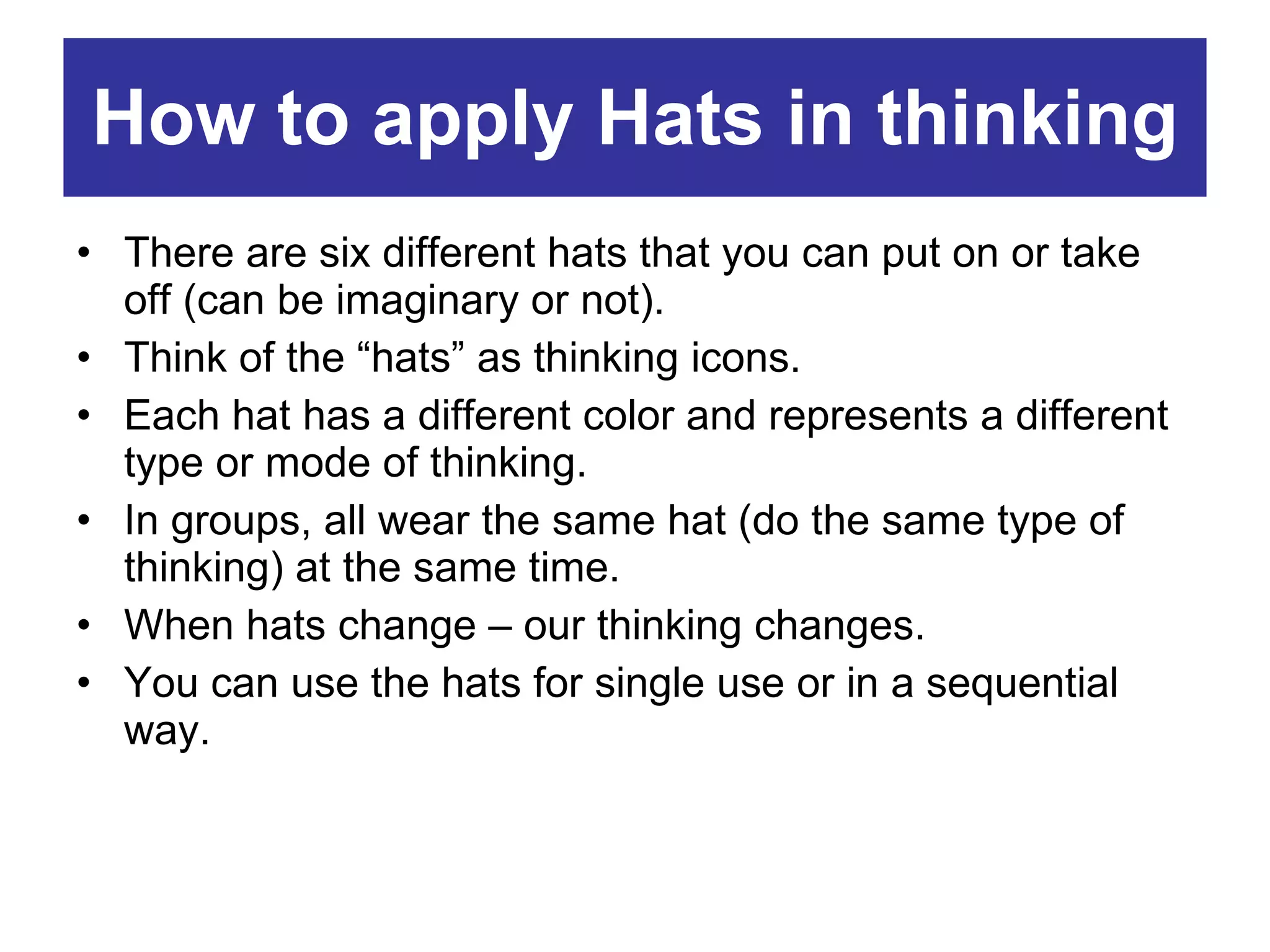
How to apply Hats in thinking There are six different hats that you can put on or take off (can be imaginary or not). Think of the “hats” as thinking icons. Each hat has a different color and represents a different type or mode of thinking. In groups, all wear the same hat (do the same type of thinking) at the same time. When hats change – our thinking changes. You can use the hats for single use or in a sequential way.
Power The intelligence, experience and knowledge of all members is fully used. Time Saving In U.S. managers spend nearly 40% of their time in meetings. Thoughts are laid out in parallel. Removal of Ego People tend to use thinking to parade their egos… Neutral and objective exploration of a subject. One Thing at a Time You cannot be sensitized in different directions at the same time. Results
Ways to use this method Individually (i.e., thinking alone)  In conversation In meetings Reports and presentations
Organizational Advantage It helps organization in following ways Explore a subject Make Decisions Save Time
Applied 6 hat thinking Steps to drive a Six Hat thinking session Agree on the Focus Subject Prepare for the discussion Collate information by using hats on sequence Understand gathered information Decide the best way
Applied 6 hat thinking (cont.) 1.Agree on the Subject Focus Need to declare the derails of Subject matter before the meeting  Helps participant’s subject Matter focus Helps to prevent loss of focus Helps participants to collect all the data about it
Applied 6 hat thinking (cont.) 2. Prepare for the discussion Participants should have organize facts & figures. Prepare to present data and information (white hat session) in meeting. Avoid the need for a break-out for collection of data
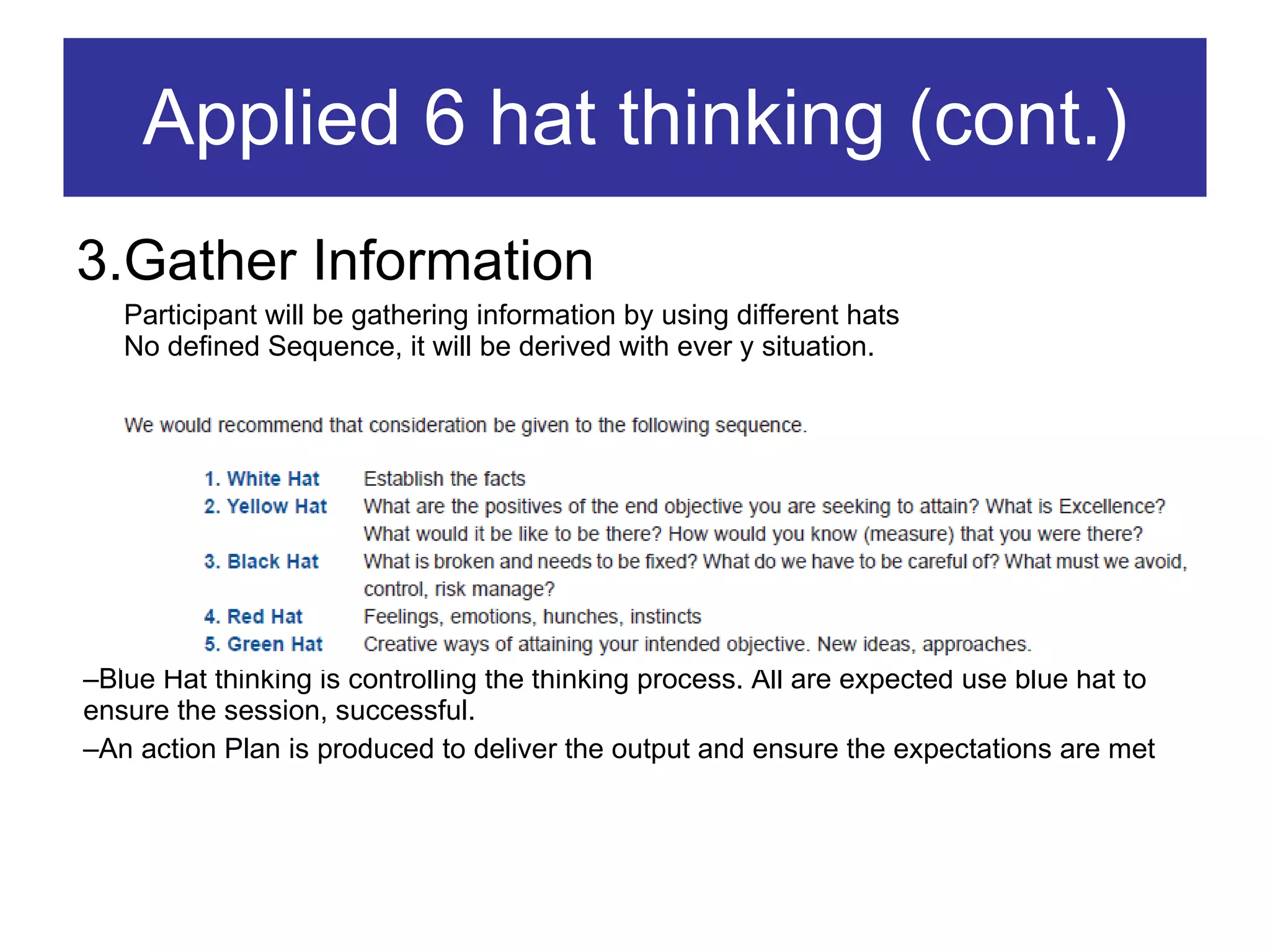
Applied 6 hat thinking (cont.) 3.Gather Information Participant will be gathering information by using different hats No defined Sequence, it will be derived with ever y situation.  Blue Hat thinking is controlling the thinking process. All are expected use blue hat to ensure the session, successful. An action Plan is produced to deliver the output and ensure the expectations are met
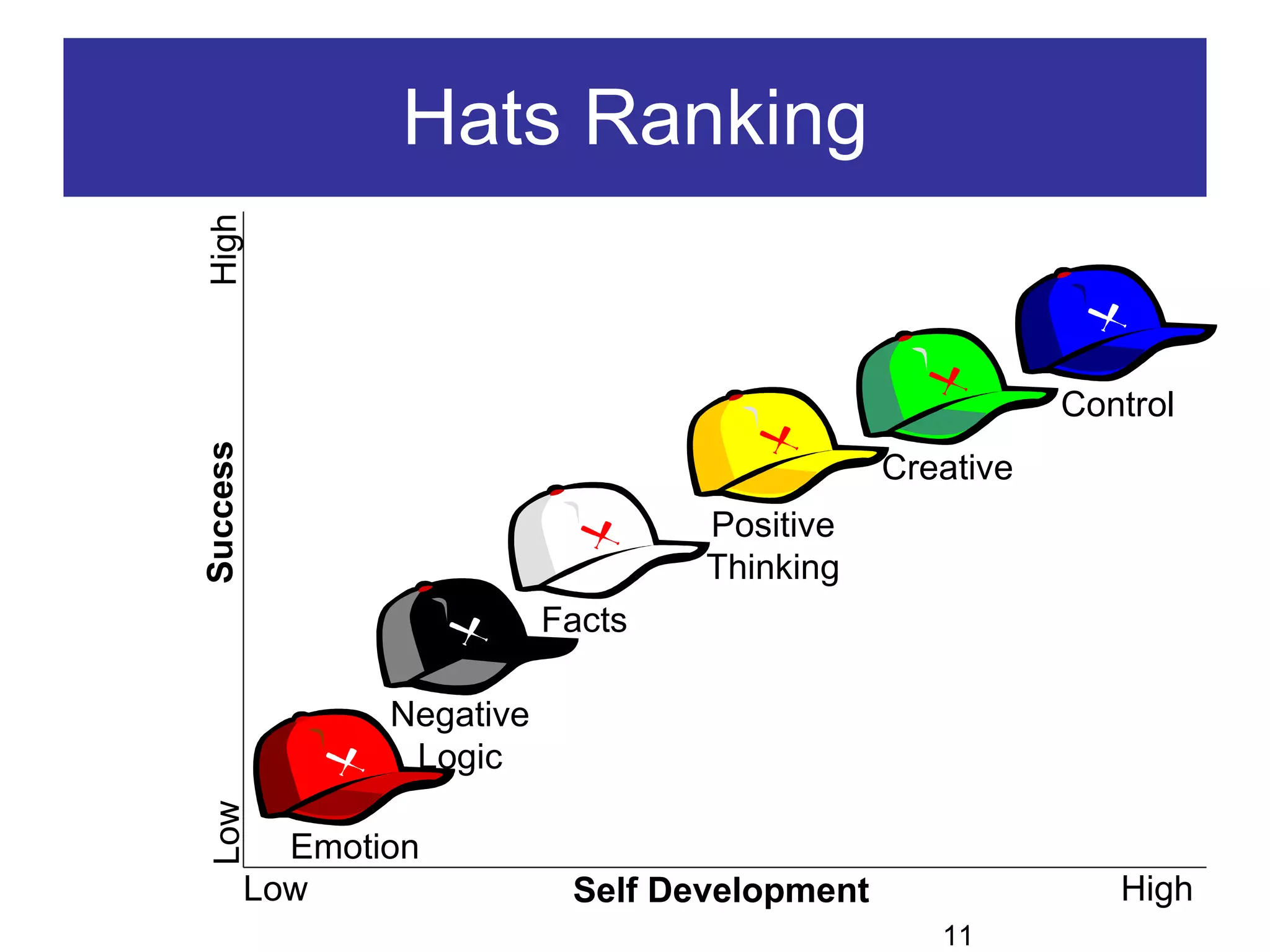
Hats Ranking Self Development Success High Low Low High 11 Control Creative Positive Thinking Facts Negative Logic Emotion
Applied 6 hat thinking (cont.) 4.Understand the information gathered Proper understanding the information gathered thru the discussion Structure the information by categories & filter. This will help the out come of discussion to derive the details like risk, alternatives options etc.
Applied 6 hat thinking (cont.) 5. Decide the best Quick & Easly. Collection and organization of information will provide the insight to decide the best way forward.
Thank You I hear and I forget.  I see and I remember.  I do and I understand.    --Confucius

How to apply 6 Hat Thinking `

  • 1.
    How to apply 6 Thinking Hats Presentation By: Bijoy Viswanadhan Ref : Six Thinking Hats by Edward de Bono Submitted on : Feb 2010
  • 2.
    The Originator Dr.Edward de Bono M.D., Ph.D., (philosophy, medicine & psychology), Rhodes scholar World-renowned consultant to business, governments, schools and industry Author of 62 books in 40 languages Originator of Six Thinking Hats, Lateral Thinking and Direct Attention Thinking Tools
  • 3.
    Traditional Approach Inan argument often both sides are right, but looking at different aspects of the situation. Each side seeks to prove that the other side is wrong. It completely lacks a constructive, creative or design element Argument or Adversarial Thinking a b
  • 4.
    Parallel Thinking Atany moment everyone is looking in the same direction. It is co-operative , co-ordinate, constructive thinking. A simple and practical way of carrying out ‘Parallel Thinking' is the Six Hats method b a b
  • 5.
    Advantage of Parallelthinking Parallel Thinking is unbundle, constructive, creative Thinking. Parallel Thinking is co-operative exploration . Parallel Thinking separates Ego & Performance. Parallel Thinking provides switching modes. Parallel Thinking increases the awareness
  • 6.
  • 7.
    The 6 ThinkingHats 8 Creative Facts Emotion Negative Logic Positive Thinking Control
  • 8.
    How to applyHats in thinking There are six different hats that you can put on or take off (can be imaginary or not). Think of the “hats” as thinking icons. Each hat has a different color and represents a different type or mode of thinking. In groups, all wear the same hat (do the same type of thinking) at the same time. When hats change – our thinking changes. You can use the hats for single use or in a sequential way.
  • 9.
    Power The intelligence,experience and knowledge of all members is fully used. Time Saving In U.S. managers spend nearly 40% of their time in meetings. Thoughts are laid out in parallel. Removal of Ego People tend to use thinking to parade their egos… Neutral and objective exploration of a subject. One Thing at a Time You cannot be sensitized in different directions at the same time. Results
  • 10.
    Ways to usethis method Individually (i.e., thinking alone) In conversation In meetings Reports and presentations
  • 11.
    Organizational Advantage Ithelps organization in following ways Explore a subject Make Decisions Save Time
  • 12.
    Applied 6 hatthinking Steps to drive a Six Hat thinking session Agree on the Focus Subject Prepare for the discussion Collate information by using hats on sequence Understand gathered information Decide the best way
  • 13.
    Applied 6 hatthinking (cont.) 1.Agree on the Subject Focus Need to declare the derails of Subject matter before the meeting Helps participant’s subject Matter focus Helps to prevent loss of focus Helps participants to collect all the data about it
  • 14.
    Applied 6 hatthinking (cont.) 2. Prepare for the discussion Participants should have organize facts & figures. Prepare to present data and information (white hat session) in meeting. Avoid the need for a break-out for collection of data
  • 15.
    Applied 6 hatthinking (cont.) 3.Gather Information Participant will be gathering information by using different hats No defined Sequence, it will be derived with ever y situation. Blue Hat thinking is controlling the thinking process. All are expected use blue hat to ensure the session, successful. An action Plan is produced to deliver the output and ensure the expectations are met
  • 16.
    Hats Ranking SelfDevelopment Success High Low Low High 11 Control Creative Positive Thinking Facts Negative Logic Emotion
  • 17.
    Applied 6 hatthinking (cont.) 4.Understand the information gathered Proper understanding the information gathered thru the discussion Structure the information by categories & filter. This will help the out come of discussion to derive the details like risk, alternatives options etc.
  • 18.
    Applied 6 hatthinking (cont.) 5. Decide the best Quick & Easly. Collection and organization of information will provide the insight to decide the best way forward.
  • 19.
    Thank You Ihear and I forget. I see and I remember. I do and I understand. --Confucius

Editor's Notes

  • #4 Argument or Adversarial Thinking:- In Argument or adversarial thinking each side takes a different position and then seeks to attack the other side. Each side seeks to prove that the other side is wrong. This is the type of thinking established by the Greek Gang of Three (Socrates, Plato and Aristotle) two thousand four hundred years ago. Adversarial thinking completely lacks a constructive, creative or design element. It was intended only to discover the 'truth' not to build anything. In family arguments, in business discussions,. courts, and in governing assemblies are widely use this thinking.
  • #5 Parallel Thinking:- In Parallel thinking' both sides or all parties are thinking in parallel in the same direction. There is co-operative and co-ordinate thinking. The direction itself can be changed in order to give a full scan of the situation. But at every moment each thinker is thinking in parallel with all the other thinkers. There does not have to be agreement. Statements or thoughts which are indeed contradictory are not argued out but laid down in parallel. In the final stage the way forward is 'designed' from the parallel thought that have been laid out. The Six Thinking Hats method is a practical way of carrying out Parallel Thinking.
  • #6 The Six Thinking Hats method allows us to unbundle thinking. Instead of trying to do everything at once, we separate out the different aspects of thinking. This way we can pay full attention to each aspect in turn. Six Thinking Hats system quickly becomes a neutral game, the method provides a very convenient way to switch thinking or to ask for a certain type of thinking. The Six Thinking Hats method allows an increased awareness of what thinking is actually being used on any occasion. So we say that parallel thinking is completely different than argument or Advesarial thinking.
  • #12 How Six Thinking hat method helps organization to explore a subject,Make decisions,reduce the time taken for project discussions. This methods consist of six different imaginary hats like White, Red, Black, Yellow,Green & Blue. We can put on or take off these hats during project discussions. Each hat is a different colors and represents a different style of thinking. When we change hats, we change our thinking. It can minimize the confrontations that happen when people with different thinking styles discuss the same problem. The thinker wears one hat at a time and only uses the mode of thinking which goes with that particular colour. It allows us to unbundle thinking instead of trying to do everything at once, we separate out the different aspects of thinking. This way we can pay full attention to each aspect in turn. Separate out facts from emotions; the positive from the negative; critical thinking from creative thinking. Help individuals focus on what is important rather what is irrelevant. Put quiet employees on an equal playing field with those who are more talkative or monopolize meetings. Sidestep egos which get in the way of performance. Make better decisions based on thorough and clear thinking. Be better prepared to implement change. Develop action plans to minimize risk. Break the idea killer habit that shuts down the creative process.