Lateral Earth Pressures 
Duration: 18 min N. Sivakugan
SIVA Copyright©2001 
2 
Contents 
• Geotechnical applications 
• K0, active & passive states 
• Rankine’s earth pressure theory 
A 2-minute break 
• Design of retaining walls 
• A Mini Quiz
SIVA Copyright©2001 
3 
Lateral Support 
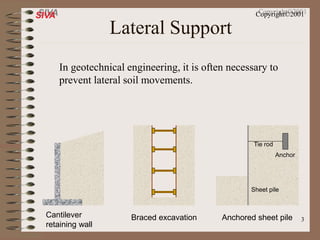
In geotechnical engineering, it is often necessary to 
prevent lateral soil movements. 
Cantilever 
retaining wall 
Tie rod 
Anchor 
Sheet pile 
Braced excavation Anchored sheet pile
SIVA Copyright©2001 
4 
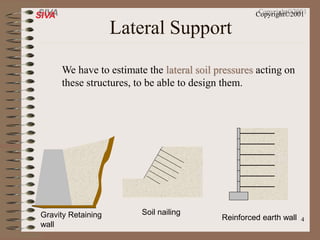
Lateral Support 
We have to estimate the lateral soil pressures acting on 
these structures, to be able to design them. 
Gravity Retaining 
wall 
Soil nailing 
Reinforced earth wall
SIVA Copyright©2001 
5 
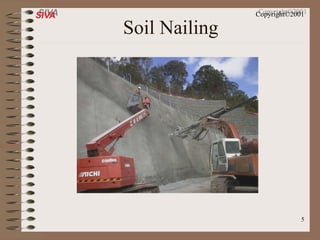
Soil Nailing
SIVA Copyright©2001 
6 
Sheet Pile 
Sheet piles marked for driving
SIVA Copyright©2001 
7 
Sheet Pile 
Sheet pile wall
SIVA Copyright©2001 
8 
Sheet Pile 
During installation Sheet pile wall
SIVA Copyright©2001 
9 
Lateral Support 
Reinforced earth walls are increasingly becoming popular. 
geosynthetics
SIVA Copyright©2001 
10 
Lateral Support 
Crib walls have been used in Queensland. 
Interlocking 
stretchers 
and headers 
filled with 
soil 
Good drainage & allow plant growth. 
Looks good.
SIVA Copyright©2001 
11 
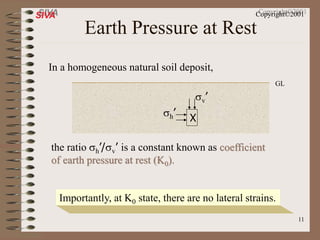
Earth Pressure at Rest 
GL 
In a homogeneous natural soil deposit, 
v’ 
X h’ 
the ratio h’/v’ is a constant known as coefficient 
of earth pressure at rest (K0). 
Importantly, at K0 state, there are no lateral strains.
SIVA Copyright©2001 
12 
Estimating K0 
For normally consolidated clays and granular soils, 
K0 = 1 – sin ’ 
For overconsolidated clays, 
K0,overconsolidated = K0,normally consolidated OCR0.5 
From elastic analysis, 
 
 
K  
Poisson’s 
0 1  
ratio
SIVA Copyright©2001 
13 
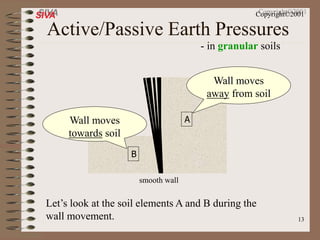
Active/Passive Earth Pressures 
- in granular soils 
smooth wall 
Wall moves 
away from soil 
Wall moves 
towards soil 
A 
B 
Let’s look at the soil elements A and B during the 
wall movement.
SIVA Copyright©2001 
14 
Active Earth Pressure 
- in granular soils 
v’ 
A 
h’ 
z 
v’ = z 
Initially, there is no lateral movement. 
h’ = K0 v’ = K0 z 
As the wall moves away from the soil, 
v’ remains the same; and 
h’ decreases till failure occurs. 
Active state
SIVA Copyright©2001 
15 
Active Earth Pressure 
- in granular soils 
 
As the wall moves away from the soil, 
  v’ 
decreasing h’ 
Initially (K0 state) 
Failure (Active state) 
active earth 
pressure
SIVA Copyright©2001 
WJM Rankine 
(1820-1872) 
16 
Active Earth Pressure 
- in granular soils 
[ v’ h’]active 
 
 
 
[ ' ] ' h active A v   K  
1 sin 2  
tan (45 / 2) 
 
 
1 sin 
 
  
 
 A K 
Rankine’s coefficient of 
active earth pressure
SIVA Copyright©2001 
17 
Active Earth Pressure 
- in granular soils 
[ v’ h’]active 
 
v’ 
 
 
A 
h’ 
45 + /2 
90+ 
Failure plane is at 
45 + /2 to horizontal
SIVA Copyright©2001 
18 
Active Earth Pressure 
- in granular soils 
v’ 
A 
h’ 
z 
As the wall moves away from the soil, 
h’ decreases till failure occurs. 
wall movement 
h’ 
Active 
state 
K0 state
SIVA Copyright©2001 
19 
Active Earth Pressure 
- in cohesive soils 
Follow the same steps as 
for granular soils. Only 
difference is that c  0. 
h active A v A [ ' ]  K  '2c K 
Everything else the same 
as for granular soils.
SIVA Copyright©2001 
20 
Passive Earth Pressure 
- in granular soils 
v’ 
B 
h’ 
Initially, soil is in K0 state. 
As the wall moves towards the soil, 
v’ remains the same, and 
h’ increases till failure occurs. 
Passive state
SIVA Copyright©2001 
21 
Passive Earth Pressure 
- in granular soils 
 
As the wall moves towards the soil, 
Initially (K0 state) 
Failure (Passive state) 
  v’ 
increasing h’ 
passive earth 
pressure
SIVA Copyright©2001 
22 
Passive Earth Pressure 
- in granular soils 
v’ [h’]passive 
 
 
 
[ ' ] ' h passive P v   K  
1 sin 2  
tan (45 / 2) 
 
1 sin 
 
 
  
 
 P K 
Rankine’s coefficient of 
passive earth pressure
SIVA Copyright©2001 
23 
Passive Earth Pressure 
- in granular soils 
v’ [h’]passive 
 
v’ 
 
 
A 
h’ 
90+ 
Failure plane is at 
45 - /2 to horizontal 
45 - /2
SIVA Copyright©2001 
24 
Passive Earth Pressure 
- in granular soils 
v’ 
B 
h’ 
As the wall moves towards the soil, 
h’ increases till failure occurs. 
wall movement 
h’ 
K0 state 
Passive state
SIVA Copyright©2001 
25 
Passive Earth Pressure 
- in cohesive soils 
Follow the same steps as 
for granular soils. Only 
difference is that c  0. 
h passive P v P [ ' ]  K  '2c K 
Everything else the same 
as for granular soils.
SIVA Copyright©2001 
26 
Earth Pressure Distribution 
- in granular soils 
PA and PP are the 
resultant active and 
passive thrusts on 
the wall 
[h’]passive 
[h’]active 
H 
h 
PA=0.5 KAH2 
PP=0.5 KPh2 
K KAH Ph
Wall movement 
(not to scale) 
h’ 
Passive state 
Active state 
K0 state
SIVA Copyright©2001 
28 
Rankine’s Earth Pressure Theory 
h active A v A [ ' ]  K  '2c K 
h passive P v P [ ' ]  K  '2c K 
 Assumes smooth wall 
 Applicable only on vertical walls
SIVA Copyright©2001 
29 
Retaining Walls - Applications 
Road 
Train
SIVA Copyright©2001 
30 
Retaining Walls - Applications 
highway
SIVA Copyright©2001 
31 
Retaining Walls - Applications 
basement wall 
High-rise building
SIVA Copyright©2001 
32 
Gravity Retaining Walls 
cobbles 
cement mortar 
plain concrete or 
stone masonry 
They rely on their self weight to 
support the backfill
SIVA Copyright©2001 
33 
Cantilever Retaining Walls 
Reinforced; 
smaller section 
than gravity 
walls 
They act like vertical cantilever, 
fixed to the ground
SIVA Copyright©2001 
34 
Design of Retaining Wall 
1 
- in granular soils 
2 2 
3 3 
1 
Block no. 
toe 
toe 
Wi = weight of block i 
xi = horizontal distance of centroid of block i from toe 
Analyse the stability of this rigid body with 
vertical walls (Rankine theory valid)
P W 
sliding P 
1 
P i 
2 2 
3 3 
1 
PA 
PA 
PP 
PP 
S 
toe S 
toe 
R 
y R 
y 
Safety against sliding along the base 
{ }. tan 
A 
F  
 
 
H 
h 
soil-concrete friction 
angle  0.5 – 0.7  
to be greater 
than 1.5 
PP= 0.5 KPh2 PA= 0.5 KAH2
F  
P h Wx 
overturning P 
1 
/ 3 { } 
P i i 
2 2 
3 3 
1 
PA 
PA 
PP 
PP 
S 
toe S 
toe 
R 
y R 
y 
Safety against overturning about toe 
H/3 
A 
 
H 
h 
to be greater 
than 2.0
SIVA Copyright©2001 
37 
Points to Ponder 
How does the key help in improving the stability 
against sliding? 
Shouldn’t we design retaining walls to resist at-rest 
(than active) earth pressures since the thrust on the 
wall is greater in K0 state (K0 > KA)?

Lateral stability (Complete Soil Mech. Undestanding Pakage: ABHAY)

  • 1.
    Lateral Earth Pressures Duration: 18 min N. Sivakugan
  • 2.
    SIVA Copyright©2001 2 Contents • Geotechnical applications • K0, active & passive states • Rankine’s earth pressure theory A 2-minute break • Design of retaining walls • A Mini Quiz
  • 3.
    SIVA Copyright©2001 3 Lateral Support In geotechnical engineering, it is often necessary to prevent lateral soil movements. Cantilever retaining wall Tie rod Anchor Sheet pile Braced excavation Anchored sheet pile
  • 4.
    SIVA Copyright©2001 4 Lateral Support We have to estimate the lateral soil pressures acting on these structures, to be able to design them. Gravity Retaining wall Soil nailing Reinforced earth wall
  • 5.
  • 6.
    SIVA Copyright©2001 6 Sheet Pile Sheet piles marked for driving
  • 7.
    SIVA Copyright©2001 7 Sheet Pile Sheet pile wall
  • 8.
    SIVA Copyright©2001 8 Sheet Pile During installation Sheet pile wall
  • 9.
    SIVA Copyright©2001 9 Lateral Support Reinforced earth walls are increasingly becoming popular. geosynthetics
  • 10.
    SIVA Copyright©2001 10 Lateral Support Crib walls have been used in Queensland. Interlocking stretchers and headers filled with soil Good drainage & allow plant growth. Looks good.
  • 11.
    SIVA Copyright©2001 11 Earth Pressure at Rest GL In a homogeneous natural soil deposit, v’ X h’ the ratio h’/v’ is a constant known as coefficient of earth pressure at rest (K0). Importantly, at K0 state, there are no lateral strains.
  • 12.
    SIVA Copyright©2001 12 Estimating K0 For normally consolidated clays and granular soils, K0 = 1 – sin ’ For overconsolidated clays, K0,overconsolidated = K0,normally consolidated OCR0.5 From elastic analysis,   K  Poisson’s 0 1  ratio
  • 13.
    SIVA Copyright©2001 13 Active/Passive Earth Pressures - in granular soils smooth wall Wall moves away from soil Wall moves towards soil A B Let’s look at the soil elements A and B during the wall movement.
  • 14.
    SIVA Copyright©2001 14 Active Earth Pressure - in granular soils v’ A h’ z v’ = z Initially, there is no lateral movement. h’ = K0 v’ = K0 z As the wall moves away from the soil, v’ remains the same; and h’ decreases till failure occurs. Active state
  • 15.
    SIVA Copyright©2001 15 Active Earth Pressure - in granular soils  As the wall moves away from the soil,   v’ decreasing h’ Initially (K0 state) Failure (Active state) active earth pressure
  • 16.
    SIVA Copyright©2001 WJMRankine (1820-1872) 16 Active Earth Pressure - in granular soils [ v’ h’]active    [ ' ] ' h active A v   K  1 sin 2  tan (45 / 2)   1 sin      A K Rankine’s coefficient of active earth pressure
  • 17.
    SIVA Copyright©2001 17 Active Earth Pressure - in granular soils [ v’ h’]active  v’   A h’ 45 + /2 90+ Failure plane is at 45 + /2 to horizontal
  • 18.
    SIVA Copyright©2001 18 Active Earth Pressure - in granular soils v’ A h’ z As the wall moves away from the soil, h’ decreases till failure occurs. wall movement h’ Active state K0 state
  • 19.
    SIVA Copyright©2001 19 Active Earth Pressure - in cohesive soils Follow the same steps as for granular soils. Only difference is that c  0. h active A v A [ ' ]  K  '2c K Everything else the same as for granular soils.
  • 20.
    SIVA Copyright©2001 20 Passive Earth Pressure - in granular soils v’ B h’ Initially, soil is in K0 state. As the wall moves towards the soil, v’ remains the same, and h’ increases till failure occurs. Passive state
  • 21.
    SIVA Copyright©2001 21 Passive Earth Pressure - in granular soils  As the wall moves towards the soil, Initially (K0 state) Failure (Passive state)   v’ increasing h’ passive earth pressure
  • 22.
    SIVA Copyright©2001 22 Passive Earth Pressure - in granular soils v’ [h’]passive    [ ' ] ' h passive P v   K  1 sin 2  tan (45 / 2)  1 sin       P K Rankine’s coefficient of passive earth pressure
  • 23.
    SIVA Copyright©2001 23 Passive Earth Pressure - in granular soils v’ [h’]passive  v’   A h’ 90+ Failure plane is at 45 - /2 to horizontal 45 - /2
  • 24.
    SIVA Copyright©2001 24 Passive Earth Pressure - in granular soils v’ B h’ As the wall moves towards the soil, h’ increases till failure occurs. wall movement h’ K0 state Passive state
  • 25.
    SIVA Copyright©2001 25 Passive Earth Pressure - in cohesive soils Follow the same steps as for granular soils. Only difference is that c  0. h passive P v P [ ' ]  K  '2c K Everything else the same as for granular soils.
  • 26.
    SIVA Copyright©2001 26 Earth Pressure Distribution - in granular soils PA and PP are the resultant active and passive thrusts on the wall [h’]passive [h’]active H h PA=0.5 KAH2 PP=0.5 KPh2 K KAH Ph
  • 27.
    Wall movement (notto scale) h’ Passive state Active state K0 state
  • 28.
    SIVA Copyright©2001 28 Rankine’s Earth Pressure Theory h active A v A [ ' ]  K  '2c K h passive P v P [ ' ]  K  '2c K  Assumes smooth wall  Applicable only on vertical walls
  • 29.
    SIVA Copyright©2001 29 Retaining Walls - Applications Road Train
  • 30.
    SIVA Copyright©2001 30 Retaining Walls - Applications highway
  • 31.
    SIVA Copyright©2001 31 Retaining Walls - Applications basement wall High-rise building
  • 32.
    SIVA Copyright©2001 32 Gravity Retaining Walls cobbles cement mortar plain concrete or stone masonry They rely on their self weight to support the backfill
  • 33.
    SIVA Copyright©2001 33 Cantilever Retaining Walls Reinforced; smaller section than gravity walls They act like vertical cantilever, fixed to the ground
  • 34.
    SIVA Copyright©2001 34 Design of Retaining Wall 1 - in granular soils 2 2 3 3 1 Block no. toe toe Wi = weight of block i xi = horizontal distance of centroid of block i from toe Analyse the stability of this rigid body with vertical walls (Rankine theory valid)
  • 35.
    P W slidingP 1 P i 2 2 3 3 1 PA PA PP PP S toe S toe R y R y Safety against sliding along the base { }. tan A F    H h soil-concrete friction angle  0.5 – 0.7  to be greater than 1.5 PP= 0.5 KPh2 PA= 0.5 KAH2
  • 36.
    F  Ph Wx overturning P 1 / 3 { } P i i 2 2 3 3 1 PA PA PP PP S toe S toe R y R y Safety against overturning about toe H/3 A  H h to be greater than 2.0
  • 37.
    SIVA Copyright©2001 37 Points to Ponder How does the key help in improving the stability against sliding? Shouldn’t we design retaining walls to resist at-rest (than active) earth pressures since the thrust on the wall is greater in K0 state (K0 > KA)?