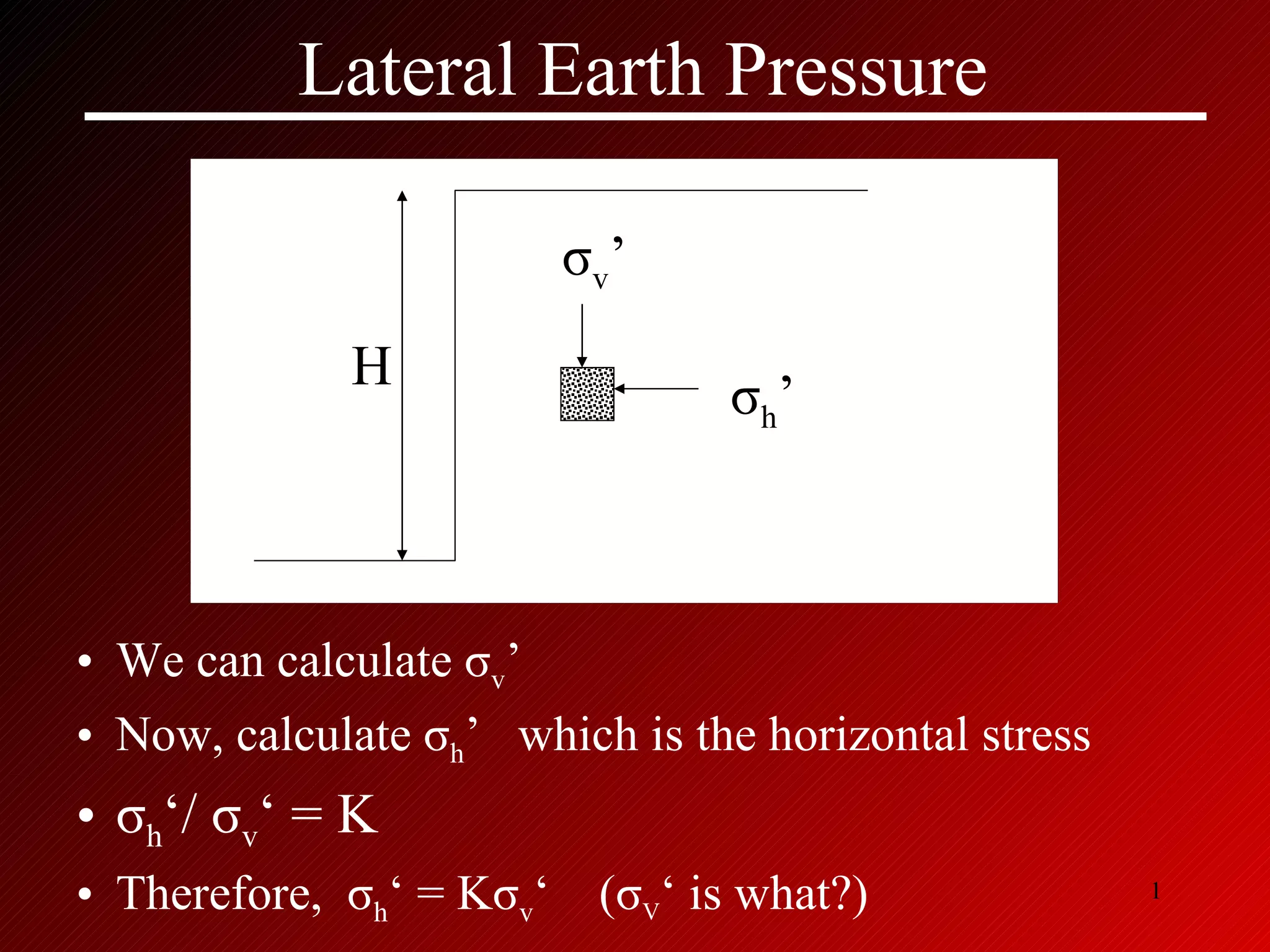
Lateral Earth Pressure We can calculate  σ v ’ Now, calculate  σ h ’  which is the horizontal stress σ h ‘/  σ v ‘ = K Therefore,  σ h ‘ =  K σ v ‘  ( σ V ‘ is what?) σ v ’ σ h ’ H
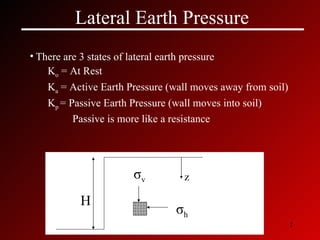
Lateral Earth Pressure There are 3 states of lateral earth pressure K o  = At Rest K a  = Active Earth Pressure (wall moves away from soil) K p  = Passive Earth Pressure (wall moves into soil) Passive is more like a resistance σ v σ h z H
At Rest Earth Pressure At rest earth pressure occur when there is no wall rotation such as in a braced wall (basement wall for example) K o  can be calculated as follows: K o  = 1 – sin  φ   for coarse grained soils K o  = .44 + .42 [PI / 100]  for NC soils K o   (oc)  = K o   (NC)  (OCR) 1/2 for OC soils σ v σ h z H
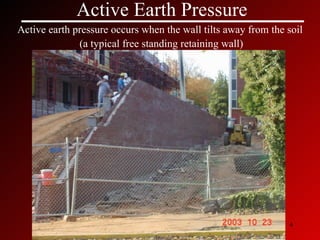
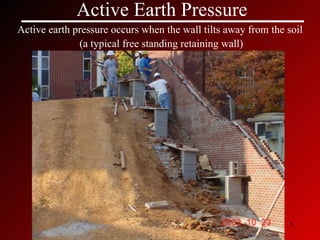
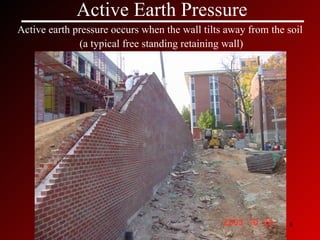
Active Earth Pressure Active earth pressure occurs when the wall tilts away from the soil  (a typical free standing retaining wall)
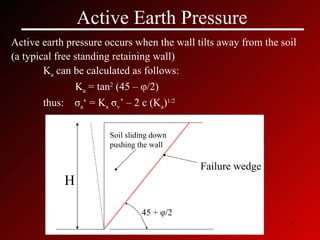
Active Earth Pressure Active earth pressure occurs when the wall tilts away from the soil  (a typical free standing retaining wall) K a  can be calculated as follows: K a  = tan 2  (45 –  φ /2) thus:  σ a ‘ = K a   σ v ’ – 2 c (K a ) 1/2 45 +  φ /2 Failure wedge H Soil sliding down pushing the wall
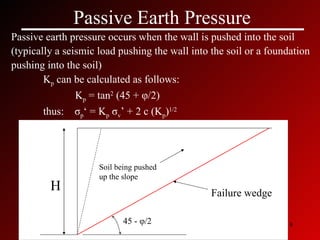
Passive Earth Pressure Passive earth pressure occurs when the wall is pushed into the soil  (typically a seismic load pushing the wall into the soil or a foundation pushing into the soil) K p  can be calculated as follows: K p  = tan 2  (45 +  φ /2) thus:  σ p ‘ = K p   σ v ’ + 2 c (K p ) 1/2 45 -  φ /2 Failure wedge H Soil being pushed up the slope
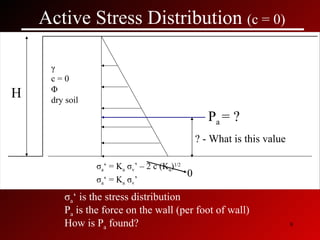
Active Stress Distribution  (c = 0) γ c = 0 Φ dry soil H σ a ‘ = K a   σ v ’ – 2 c (K a ) 1/2 σ a ‘ = K a   σ v ’ 0 σ a ‘ is the stress distribution  P a  is the force on the wall (per foot of wall) How is P a  found?  P a  = ? ? - What is this value
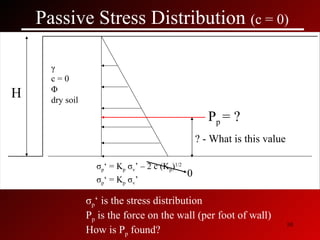
Passive Stress Distribution  (c = 0) γ c = 0 Φ dry soil H 0 σ p ‘ is the stress distribution  P p  is the force on the wall (per foot of wall) How is P p  found?  P p  = ? ? - What is this value σ p ‘ = K p   σ v ’ – 2 c (K p ) 1/2 σ p ‘ = K p   σ v ’
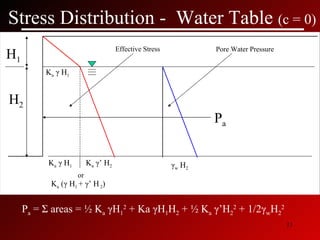
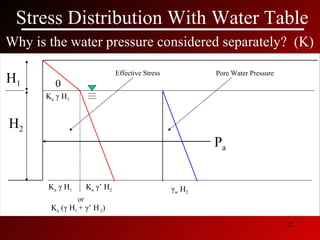
Stress Distribution -  Water Table  (c = 0) H 1 K a   γ  H 1 or P a  =  Σ  areas = ½ K a   γ H 1 2  +  Ka  γ H 1 H 2  + ½ K a   γ ’H 2 2  + 1/2 γ w H 2 2  H 2 K a   γ  H 1 K a   γ ’ H 2 K a  ( γ  H 1  +  γ ’ H  2 ) Effective Stress Pore Water Pressure P a γ w  H 2
Stress Distribution With Water Table H 1 K a   γ  H 1 or H 2 0 K a   γ  H 1 K a   γ ’ H 2 K a  ( γ  H 1  +  γ ’ H  2 ) Effective Stress Pore Water Pressure P a γ w  H 2 Why is the water pressure considered separately?  (K)
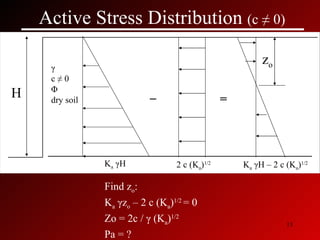
Active Stress Distribution  (c ≠ 0) - γ c ≠ 0 Φ dry soil H K a   γ H z o 2 c (K a ) 1/2 K a   γ H – 2 c (K a ) 1/2 = Find z o : K a   γ z o  – 2 c (K a ) 1/2  = 0 Zo = 2c /  γ  (K a ) 1/2 Pa = ? _
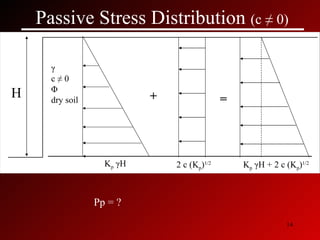
Passive Stress Distribution  (c ≠ 0) - γ c ≠ 0 Φ dry soil H K p   γ H 2 c (K p ) 1/2 K p   γ H + 2 c (K p ) 1/2 = Pp = ? +
Practice Problems Chapter 12 – Problems: 13 15 (part c is using equation 12.47 and part  d uses equation 12.49) 25 13 and 25 are the same problem just one is active calcs and the other is  passive calcs

Lateral earth pressure

  • 1.
    Lateral Earth PressureWe can calculate σ v ’ Now, calculate σ h ’ which is the horizontal stress σ h ‘/ σ v ‘ = K Therefore, σ h ‘ = K σ v ‘ ( σ V ‘ is what?) σ v ’ σ h ’ H
  • 2.
    Lateral Earth PressureThere are 3 states of lateral earth pressure K o = At Rest K a = Active Earth Pressure (wall moves away from soil) K p = Passive Earth Pressure (wall moves into soil) Passive is more like a resistance σ v σ h z H
  • 3.
    At Rest EarthPressure At rest earth pressure occur when there is no wall rotation such as in a braced wall (basement wall for example) K o can be calculated as follows: K o = 1 – sin φ for coarse grained soils K o = .44 + .42 [PI / 100] for NC soils K o (oc) = K o (NC) (OCR) 1/2 for OC soils σ v σ h z H
  • 4.
    Active Earth PressureActive earth pressure occurs when the wall tilts away from the soil (a typical free standing retaining wall)
  • 5.
    Active Earth PressureActive earth pressure occurs when the wall tilts away from the soil (a typical free standing retaining wall)
  • 6.
    Active Earth PressureActive earth pressure occurs when the wall tilts away from the soil (a typical free standing retaining wall)
  • 7.
    Active Earth PressureActive earth pressure occurs when the wall tilts away from the soil (a typical free standing retaining wall) K a can be calculated as follows: K a = tan 2 (45 – φ /2) thus: σ a ‘ = K a σ v ’ – 2 c (K a ) 1/2 45 + φ /2 Failure wedge H Soil sliding down pushing the wall
  • 8.
    Passive Earth PressurePassive earth pressure occurs when the wall is pushed into the soil (typically a seismic load pushing the wall into the soil or a foundation pushing into the soil) K p can be calculated as follows: K p = tan 2 (45 + φ /2) thus: σ p ‘ = K p σ v ’ + 2 c (K p ) 1/2 45 - φ /2 Failure wedge H Soil being pushed up the slope
  • 9.
    Active Stress Distribution (c = 0) γ c = 0 Φ dry soil H σ a ‘ = K a σ v ’ – 2 c (K a ) 1/2 σ a ‘ = K a σ v ’ 0 σ a ‘ is the stress distribution P a is the force on the wall (per foot of wall) How is P a found? P a = ? ? - What is this value
  • 10.
    Passive Stress Distribution (c = 0) γ c = 0 Φ dry soil H 0 σ p ‘ is the stress distribution P p is the force on the wall (per foot of wall) How is P p found? P p = ? ? - What is this value σ p ‘ = K p σ v ’ – 2 c (K p ) 1/2 σ p ‘ = K p σ v ’
  • 11.
    Stress Distribution - Water Table (c = 0) H 1 K a γ H 1 or P a = Σ areas = ½ K a γ H 1 2 + Ka γ H 1 H 2 + ½ K a γ ’H 2 2 + 1/2 γ w H 2 2 H 2 K a γ H 1 K a γ ’ H 2 K a ( γ H 1 + γ ’ H 2 ) Effective Stress Pore Water Pressure P a γ w H 2
  • 12.
    Stress Distribution WithWater Table H 1 K a γ H 1 or H 2 0 K a γ H 1 K a γ ’ H 2 K a ( γ H 1 + γ ’ H 2 ) Effective Stress Pore Water Pressure P a γ w H 2 Why is the water pressure considered separately? (K)
  • 13.
    Active Stress Distribution (c ≠ 0) - γ c ≠ 0 Φ dry soil H K a γ H z o 2 c (K a ) 1/2 K a γ H – 2 c (K a ) 1/2 = Find z o : K a γ z o – 2 c (K a ) 1/2 = 0 Zo = 2c / γ (K a ) 1/2 Pa = ? _
  • 14.
    Passive Stress Distribution (c ≠ 0) - γ c ≠ 0 Φ dry soil H K p γ H 2 c (K p ) 1/2 K p γ H + 2 c (K p ) 1/2 = Pp = ? +
  • 15.
    Practice Problems Chapter12 – Problems: 13 15 (part c is using equation 12.47 and part d uses equation 12.49) 25 13 and 25 are the same problem just one is active calcs and the other is passive calcs