usefulsearch.org 
 
BE VII Sem Geo­Technical Engg. ­ I 
Each topic of course content of syllabus is 
hyperlinked to ppt. 
 Please​ double click Left mouse button​ ​on any of 
following topic to see  pp​t 
   
Unit - I
Basic Definitions & Index Properties:  
 
Definition and scope of soil mechanics​,  
 
Historical development. 
 
Formation of soils​.​Soil composition​. ​Minerals​, ​Influence of clay minerals on                   
engineering behaviour​.  
 
Soil structure.  
 
Three phase system. Index properties and their determination. Consistency                 
limits​.  
 
Classification systems based on particle size and consistency limits 
Unit - II
Soil Water and Consolidation: ​Soil water, Permeability Determination of                 
permeability in laboratory and in field​.  
 
Seepage and seepage pressure. Flownets, uses of a flownet​, 
 
Effective, neutral and total stresses.  
 
Compressibility and consolidation, Relationship between pressure and void               
ratio, Theory of one dimensional consolidation. Consolidation test, Fitting                 
Time curves. Normally and overconsolidated clays. Determination of               
preconsolidation pressure, settlement analysis.  
 
Calculation of total settlement.  
Unit - III
Stress Distribution in Soils and Shear Strength of Soils: Stress distribution                     
beneath loaded areas by Boussinesq  
 
and water gaurd’s analysis. Newmark’s influence chart. Contact pressure                 
distribution. 
 
​Mohr ­ Coulomb’s theory of shear failure of soils, Mohr’s stress circle,                         
Measurement of shear strength, Shear box test, Triaxial compression test,,                   
Measurement of pore pressure, pore pressure parameters​,  
 
critical void ratio, Liquefaction. unconfined compression test, Vane shear                 
test 
Unit ­ IV  
Stability of Slopes: Infinite and finite slopes. Types of slope failures,                     
Rotational slips. Stability number. Effect of ground water. Selection of shear                     
strength parameters in slope stability analysis. Analytical and graphical                 
methods of stability analysis. Stability of Earth dams.  
Unit - V
Lateral Earth Pressure: Active, passive and earth pressure at rest​. 
 
​Rankine, Coulomb, Terzaghi and Culmann’s theories. Effect of surcharge,                   
water table and wall friction. Analytical and of determination of earth                     
pressures on cohesionless and cohesive soils​.   
 
Graphical methods. Arching in soils. Reinforced earth retaining walls. 
 
 
LABORATORY WORK : Laboratory work will be based on the above                       
course as required for soil investigators of engineering projects. List of                     
Experiments: 
 1. Determination of Hygroscopic water content 
 2. Particle ­ size analysis  
 3. Determination of Specific gravity of soil particles 
 4. Determination of plastic limit  
 5. Determination of liquid limit 
 6. Determination of shrinkage limit  
 7. Permeability tests 8. Direct shear test  
 9. Consolidation test 


Geo technical Geotech. Soil Mechanics : Download above File and Click on each topic to view PPT

  • 1.
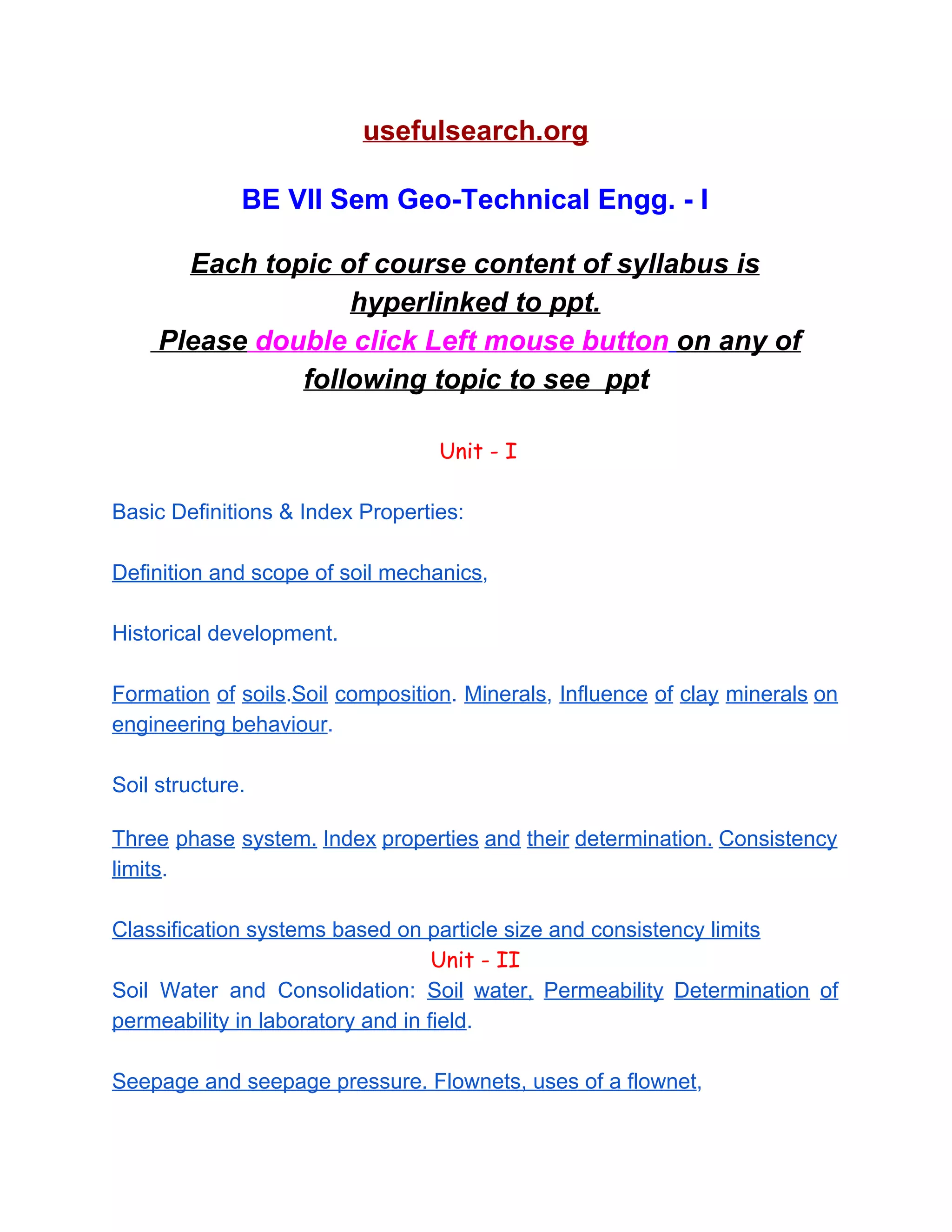
    usefulsearch.org    BE VII Sem Geo­Technical Engg. ­ I  Each topic of course content of syllabus is  hyperlinked to ppt.   Please​ double click Left mouse button​ ​on any of  following topic to see  pp​t      Unit -I Basic Definitions & Index Properties:     Definition and scope of soil mechanics​,     Historical development.    Formation of soils​.​Soil composition​. ​Minerals​, ​Influence of clay minerals on                    engineering behaviour​.     Soil structure.     Three phase system. Index properties and their determination. Consistency                  limits​.     Classification systems based on particle size and consistency limits  Unit - II Soil Water and Consolidation: ​Soil water, Permeability Determination of                  permeability in laboratory and in field​.     Seepage and seepage pressure. Flownets, uses of a flownet​, 
  • 2.
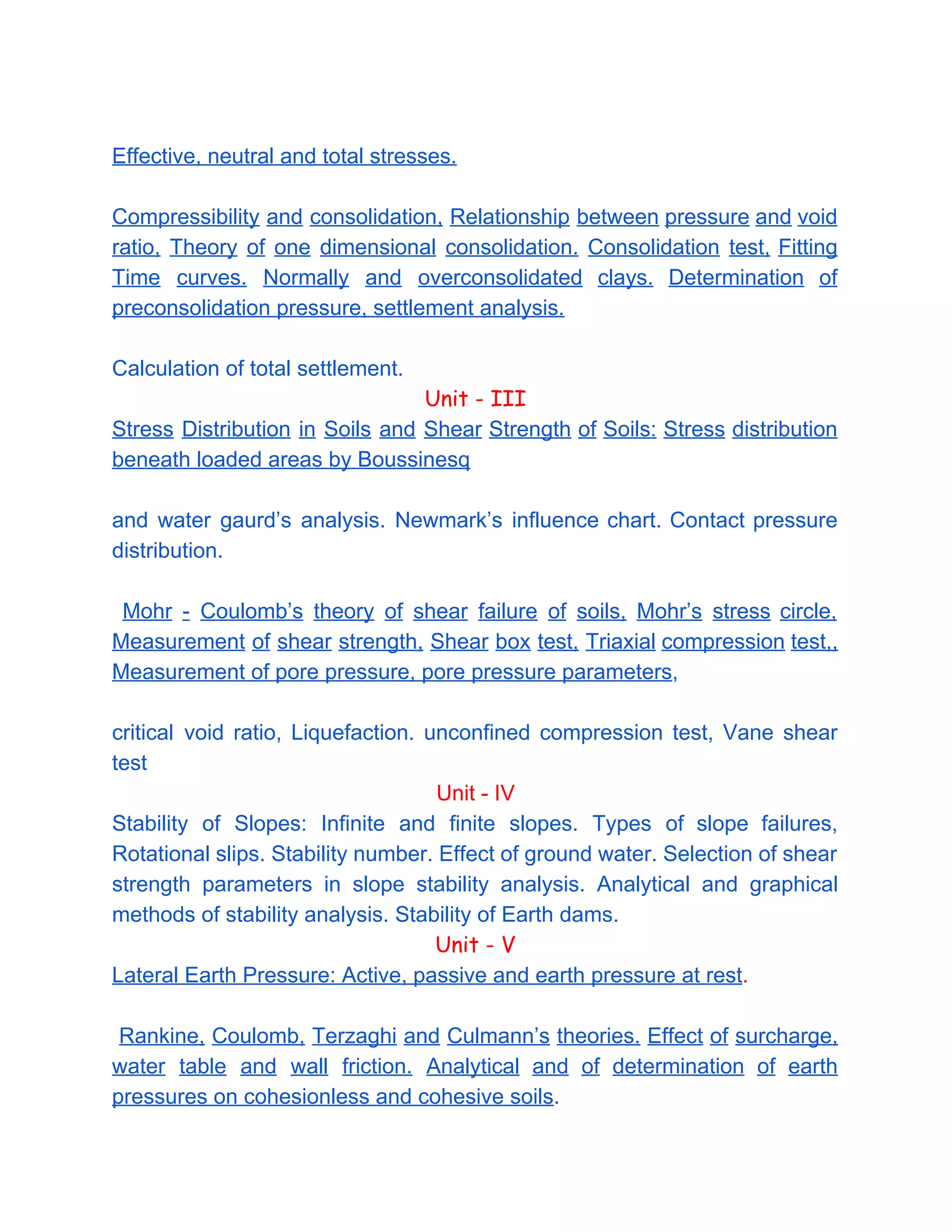
      Effective, neutral and total stresses.     Compressibility and consolidation,Relationship between pressure and void                ratio, Theory of one dimensional consolidation. Consolidation test, Fitting                  Time curves. Normally and overconsolidated clays. Determination of                preconsolidation pressure, settlement analysis.     Calculation of total settlement.   Unit - III Stress Distribution in Soils and Shear Strength of Soils: Stress distribution                      beneath loaded areas by Boussinesq     and water gaurd’s analysis. Newmark’s influence chart. Contact pressure                  distribution.    ​Mohr ­ Coulomb’s theory of shear failure of soils, Mohr’s stress circle,                          Measurement of shear strength, Shear box test, Triaxial compression test,,                    Measurement of pore pressure, pore pressure parameters​,     critical void ratio, Liquefaction. unconfined compression test, Vane shear                  test  Unit ­ IV   Stability of Slopes: Infinite and finite slopes. Types of slope failures,                      Rotational slips. Stability number. Effect of ground water. Selection of shear                      strength parameters in slope stability analysis. Analytical and graphical                  methods of stability analysis. Stability of Earth dams.   Unit - V Lateral Earth Pressure: Active, passive and earth pressure at rest​.    ​Rankine, Coulomb, Terzaghi and Culmann’s theories. Effect of surcharge,                    water table and wall friction. Analytical and of determination of earth                      pressures on cohesionless and cohesive soils​.   
  • 3.
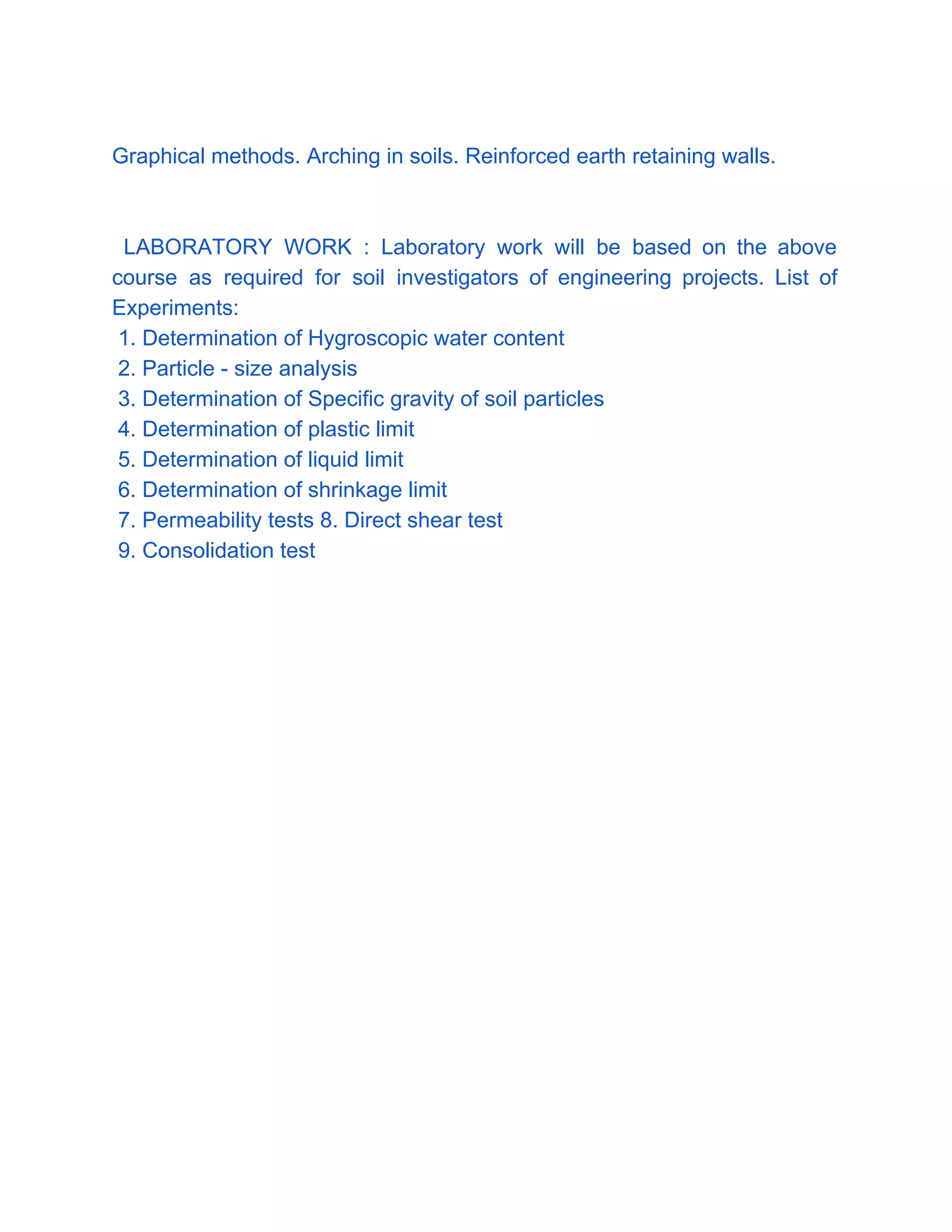
      Graphical methods. Arching in soils. Reinforced earth retaining walls.      LABORATORY WORK :Laboratory work will be based on the above                        course as required for soil investigators of engineering projects. List of                      Experiments:   1. Determination of Hygroscopic water content   2. Particle ­ size analysis    3. Determination of Specific gravity of soil particles   4. Determination of plastic limit    5. Determination of liquid limit   6. Determination of shrinkage limit    7. Permeability tests 8. Direct shear test    9. Consolidation test