Emergencies After Bariatric Surgery AI Sarela MD FRCS Consultant Surgeon St James โ€™s University Hospital
Agenda Laparoscopic Bariatric Procedures Roux-en-Y gastric bypass Adjustable gastric band Sleeve gastrectomy Technical/mechanical complications Early Late Case-scenarios
Difficulties in the Bariatric Patient The classical symptoms and signs of peritonitis are usually absent in the bariatric patient Problematic venous access Cuff measurement of BP is often inaccurate May not fit into CT scanner Unfamiliarity with anatomy of the operation Immobile โ€“ patient transfer is not easy!
Complications of Laparoscopic Roux-en-Y gastric bypass Early (< 30 days after operation) Leakage โ€“ peritonitis Acute distention of the gastric remnant Bleeding Early or Late Intestinal obstruction Stomal stenosis Stomal ulceration Gallstones
Roux-en-Y Gastric Bypass Case Scenarios POD#1 Laparoscopic Bypass: Fresh rectal bleeding, tachycardia, hypotension POD#4 Laparoscopic Bypass: A&E admission. Abdominal pain, tachycardia, not well.  POD#7 Laparoscopic Bypass: A&E admission. Vomiting.  POD#20 Laparoscopic Bypass. Abdominal pain, fever, tachycardia.  2 years after Laparoscopic Bypass. Abdominal pain.
GI Luminal Bleeding after Bypass Endoscopy โ€“ clipping of bleeder Laparoscopy Bleeding from the J-J anastomosis? Open anastomosis to inspect staple-line Evacuate blood clots โ€“ may obstruct bowel Bleeding from the gastric remanant? Gastrotomy - Evacuate blood Oversew staple-lines
Acute Abdomen in the Bypass Patient Leakage โ€“ Peritonitis Intra-peritoneal bleeding Intestinal obstruction
Sites of Leakage after Gastric Bypass Gastrojejunal anastomosis Jejuno-jejunal anastomosis Staple line on the residual stomach Gastrotomy for insertion of anvil Missed enterotomy
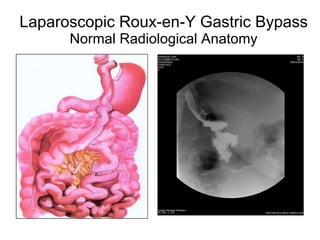
Laparoscopic Roux-en-Y Gastric Bypass Normal Radiological Anatomy
Suspected Leak:  Radiology or Re-Laparoscopy? Contrast swallow examination โ€“ beware the false-negative! CT scan โ€“ timing of oral contrast; limited enhancement with IV contrast Consider re-exploration for all patients with suspected GI leak โ€“ radiology may delay intervention
Causes of Obstruction after Gastric Bypass Internal hernia โ€“ Peterson โ€™s space Internal hernia โ€“ small bowel mesenteric defect Incorrect identification of small intestine Closed loop Twisted loop Narrow/occluded jejuno-jejunal anastomosis Blood clot at jejuno-jejunal anastomosis Port-site hernia Abdominal wall hernia
Anatomy of Intestinal Obstruction in the Bypass Patient Isolated obstruction of the biliopancreatic limb Upper abdominal pain Deranged liver function tests Distention of the gastric remanant Isolated obstruction of the alimentary limb Inability to tolerate oral intake Obstruction of the common channel Bilious vomiting
Massively Dilated Gastric Remnant Acute Dilatation Obstruction at J-J, BP limb or CC Clot due to staple-line bleeding. Technical error in construction of the anastomosis. CT guided or operative decompression of remnant. Chronic Dilatation Peptic ulcer, vagotomy, cancer, gastroparesis- in all these cases duodenum will remain collapsed
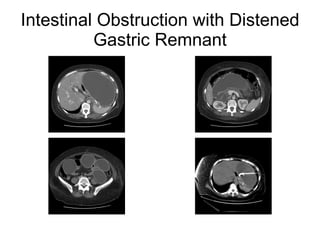
Intestinal Obstruction with Distened Gastric Remnant
Dysphagia with Bypass Stomal stenosis Early post-operative presentation Dilatation Routine post-operative PPI therapy Smoking cessation
Marginal Ulcer Incidence up to 15% Barium study โ€“ gastro-gastric fistula Non-operative management Smoking cessation NSAID cessation Endoscopic removal of retained sutures PPI Operation Excision and revision of anastomosis
Gallstone & Biliary Sepsis Risk of gallstones may double during rapid weight loss (from 15 to 30%) Combined cholecystectomy is controversial Post-bypass โ€“ how to manage choledocholithiasis? Laparoscopic bile duct exploration Trans-gastric ERCP Percutaneous trans-hepatic biliary drainage
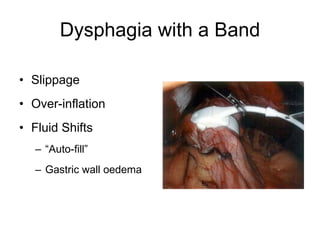
Dysphagia with a Band Slippage Over-inflation Fluid Shifts โ€œ Auto-fillโ€ Gastric wall oedema
Band Slippage Cephalad migration of the gastric wall such that band is displaced Symptoms Pain Dysphagia  Gastric outlet obstruction Danger: Gastric wall necrosis
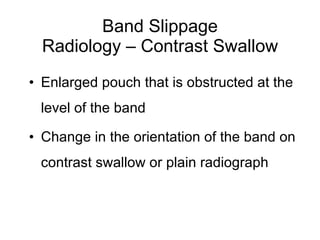
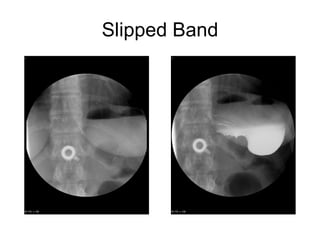
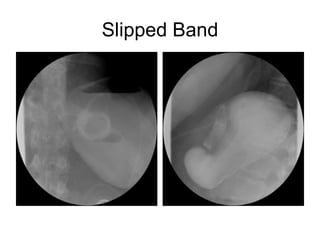
Band Slippage Radiology โ€“ Contrast Swallow Enlarged pouch that is obstructed at the level of the band Change in the orientation of the band on contrast swallow or plain radiograph
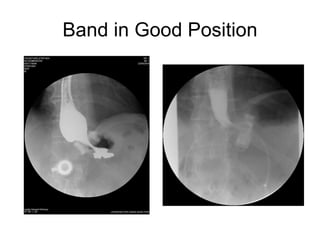
Band in Good Position
Slipped Band
Slipped Band
Operations for Band Slippage Reduction of prolapsed stomach without opening the band Opening the band, reduction of prolapsed stomach, repositioning of the band. Removal of the band Avoid cutting โ€“ expensive! If opened, can leave it in the tunnel โ€“ do not have to remove.
Band Erosion Inadequate weight loss or weight regain Intra-abdominal abscess Port-site infection
Re-operation on the Bariatric Patient  Positioning Abduction of both thighs on  โ€œsplit legโ€ table Foot supports No chest straps Arms  โ€œtucked inโ€ at sides Extension arm-boards for retraction clamps Maximum head-up incline
Re-operation on the Bariatric Patient Equipment Extra-long laparoscopic ports and instruments Liver retractor with Fastclamp Methylene blue solution (two ampoules in 1 litre of sterile water/NS) NG tube โ€“ introduce under laparoscopic vision
Bariatric Surgery Emergencies Scary!! Try to contact the operating surgeon Determine the anatomy of the procedure Radiology is not usually helpful Very low threshold for RE-LAPAROSCOPY Ensure availability of correct equipment LAVAGE & DRAIN

Emergencies after bariatric surgery

  • 1.
    Emergencies After BariatricSurgery AI Sarela MD FRCS Consultant Surgeon St James โ€™s University Hospital
  • 2.
    Agenda Laparoscopic BariatricProcedures Roux-en-Y gastric bypass Adjustable gastric band Sleeve gastrectomy Technical/mechanical complications Early Late Case-scenarios
  • 3.
    Difficulties in theBariatric Patient The classical symptoms and signs of peritonitis are usually absent in the bariatric patient Problematic venous access Cuff measurement of BP is often inaccurate May not fit into CT scanner Unfamiliarity with anatomy of the operation Immobile โ€“ patient transfer is not easy!
  • 4.
    Complications of LaparoscopicRoux-en-Y gastric bypass Early (< 30 days after operation) Leakage โ€“ peritonitis Acute distention of the gastric remnant Bleeding Early or Late Intestinal obstruction Stomal stenosis Stomal ulceration Gallstones
  • 5.
    Roux-en-Y Gastric BypassCase Scenarios POD#1 Laparoscopic Bypass: Fresh rectal bleeding, tachycardia, hypotension POD#4 Laparoscopic Bypass: A&E admission. Abdominal pain, tachycardia, not well. POD#7 Laparoscopic Bypass: A&E admission. Vomiting. POD#20 Laparoscopic Bypass. Abdominal pain, fever, tachycardia. 2 years after Laparoscopic Bypass. Abdominal pain.
  • 6.
    GI Luminal Bleedingafter Bypass Endoscopy โ€“ clipping of bleeder Laparoscopy Bleeding from the J-J anastomosis? Open anastomosis to inspect staple-line Evacuate blood clots โ€“ may obstruct bowel Bleeding from the gastric remanant? Gastrotomy - Evacuate blood Oversew staple-lines
  • 7.
    Acute Abdomen inthe Bypass Patient Leakage โ€“ Peritonitis Intra-peritoneal bleeding Intestinal obstruction
  • 8.
    Sites of Leakageafter Gastric Bypass Gastrojejunal anastomosis Jejuno-jejunal anastomosis Staple line on the residual stomach Gastrotomy for insertion of anvil Missed enterotomy
  • 9.
    Laparoscopic Roux-en-Y GastricBypass Normal Radiological Anatomy
  • 10.
    Suspected Leak: Radiology or Re-Laparoscopy? Contrast swallow examination โ€“ beware the false-negative! CT scan โ€“ timing of oral contrast; limited enhancement with IV contrast Consider re-exploration for all patients with suspected GI leak โ€“ radiology may delay intervention
  • 11.
    Causes of Obstructionafter Gastric Bypass Internal hernia โ€“ Peterson โ€™s space Internal hernia โ€“ small bowel mesenteric defect Incorrect identification of small intestine Closed loop Twisted loop Narrow/occluded jejuno-jejunal anastomosis Blood clot at jejuno-jejunal anastomosis Port-site hernia Abdominal wall hernia
  • 12.
    Anatomy of IntestinalObstruction in the Bypass Patient Isolated obstruction of the biliopancreatic limb Upper abdominal pain Deranged liver function tests Distention of the gastric remanant Isolated obstruction of the alimentary limb Inability to tolerate oral intake Obstruction of the common channel Bilious vomiting
  • 13.
    Massively Dilated GastricRemnant Acute Dilatation Obstruction at J-J, BP limb or CC Clot due to staple-line bleeding. Technical error in construction of the anastomosis. CT guided or operative decompression of remnant. Chronic Dilatation Peptic ulcer, vagotomy, cancer, gastroparesis- in all these cases duodenum will remain collapsed
  • 14.
    Intestinal Obstruction withDistened Gastric Remnant
  • 15.
    Dysphagia with BypassStomal stenosis Early post-operative presentation Dilatation Routine post-operative PPI therapy Smoking cessation
  • 16.
    Marginal Ulcer Incidenceup to 15% Barium study โ€“ gastro-gastric fistula Non-operative management Smoking cessation NSAID cessation Endoscopic removal of retained sutures PPI Operation Excision and revision of anastomosis
  • 17.
    Gallstone & BiliarySepsis Risk of gallstones may double during rapid weight loss (from 15 to 30%) Combined cholecystectomy is controversial Post-bypass โ€“ how to manage choledocholithiasis? Laparoscopic bile duct exploration Trans-gastric ERCP Percutaneous trans-hepatic biliary drainage
  • 18.
    Dysphagia with aBand Slippage Over-inflation Fluid Shifts โ€œ Auto-fillโ€ Gastric wall oedema
  • 19.
    Band Slippage Cephaladmigration of the gastric wall such that band is displaced Symptoms Pain Dysphagia Gastric outlet obstruction Danger: Gastric wall necrosis
  • 20.
    Band Slippage Radiologyโ€“ Contrast Swallow Enlarged pouch that is obstructed at the level of the band Change in the orientation of the band on contrast swallow or plain radiograph
  • 21.
    Band in GoodPosition
  • 22.
  • 23.
  • 24.
    Operations for BandSlippage Reduction of prolapsed stomach without opening the band Opening the band, reduction of prolapsed stomach, repositioning of the band. Removal of the band Avoid cutting โ€“ expensive! If opened, can leave it in the tunnel โ€“ do not have to remove.
  • 25.
    Band Erosion Inadequateweight loss or weight regain Intra-abdominal abscess Port-site infection
  • 26.
    Re-operation on theBariatric Patient Positioning Abduction of both thighs on โ€œsplit legโ€ table Foot supports No chest straps Arms โ€œtucked inโ€ at sides Extension arm-boards for retraction clamps Maximum head-up incline
  • 27.
    Re-operation on theBariatric Patient Equipment Extra-long laparoscopic ports and instruments Liver retractor with Fastclamp Methylene blue solution (two ampoules in 1 litre of sterile water/NS) NG tube โ€“ introduce under laparoscopic vision
  • 28.
    Bariatric Surgery EmergenciesScary!! Try to contact the operating surgeon Determine the anatomy of the procedure Radiology is not usually helpful Very low threshold for RE-LAPAROSCOPY Ensure availability of correct equipment LAVAGE & DRAIN