
Gastric Bypass: Does Length of Roux Limb Matter?Samer G. Mattar, MD, FRCS, FACSAssociate Professor of SurgeryIndiana University
Outline	Incidence of Revisional and Reoperative Bariatric SurgeryCauses of failed primary operationsEvaluation of the patient with failed primary operationRole of Roux limb length.Outcomes
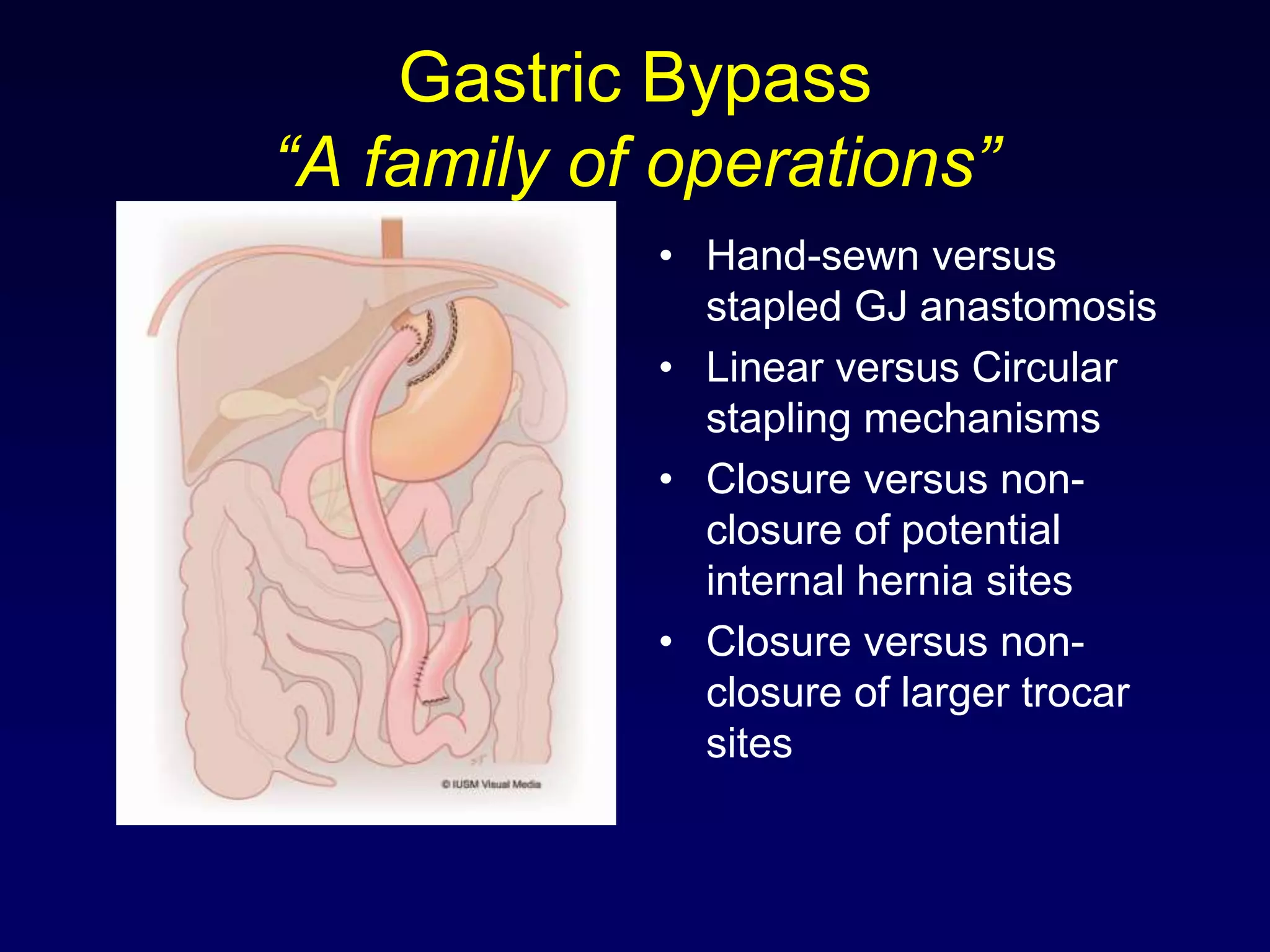
Gastric Bypass“A family of operations”Hand-sewn versus stapled GJ anastomosisLinear versus Circular stapling mechanismsClosure versus non-closure of potential internal hernia sitesClosure versus non-closure of larger trocar sites
Gastric Bypass“A family of operations”According to Dr. Pories, the potential number of gastric bypasses is 29, or at least 512 different operations.
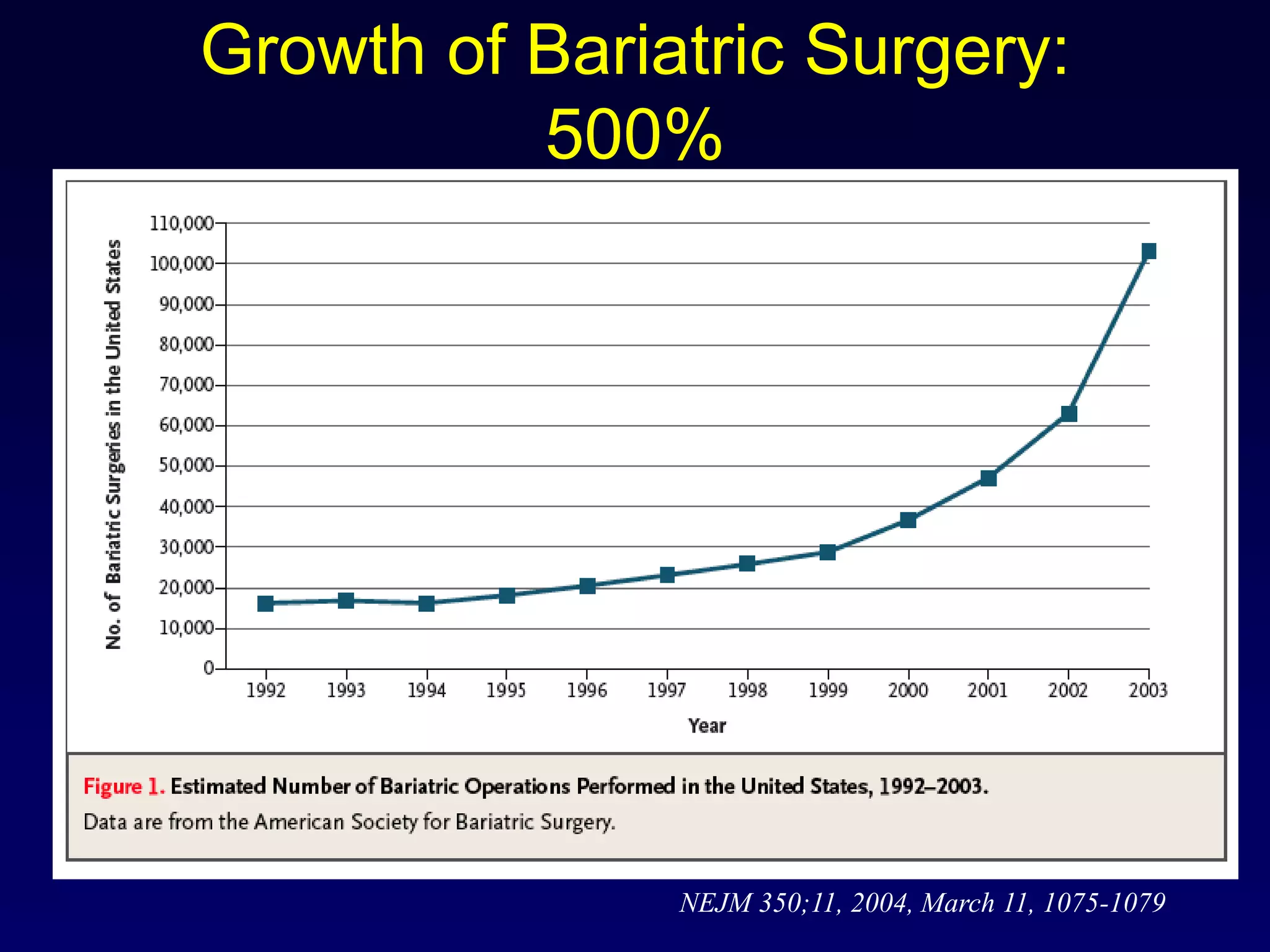
Growth of Bariatric Surgery: 500%NEJM 350;11, 2004, March 11, 1075-1079
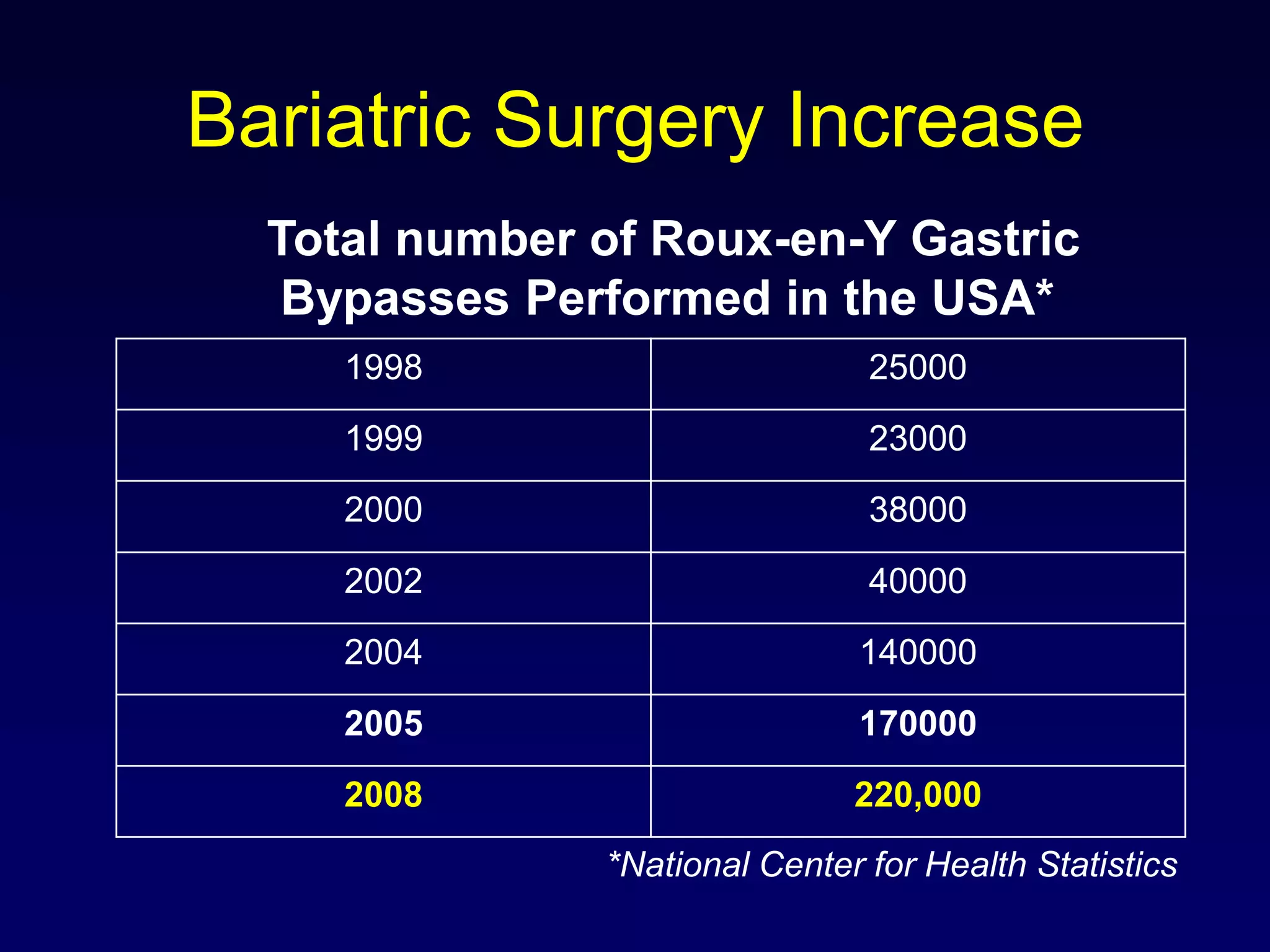
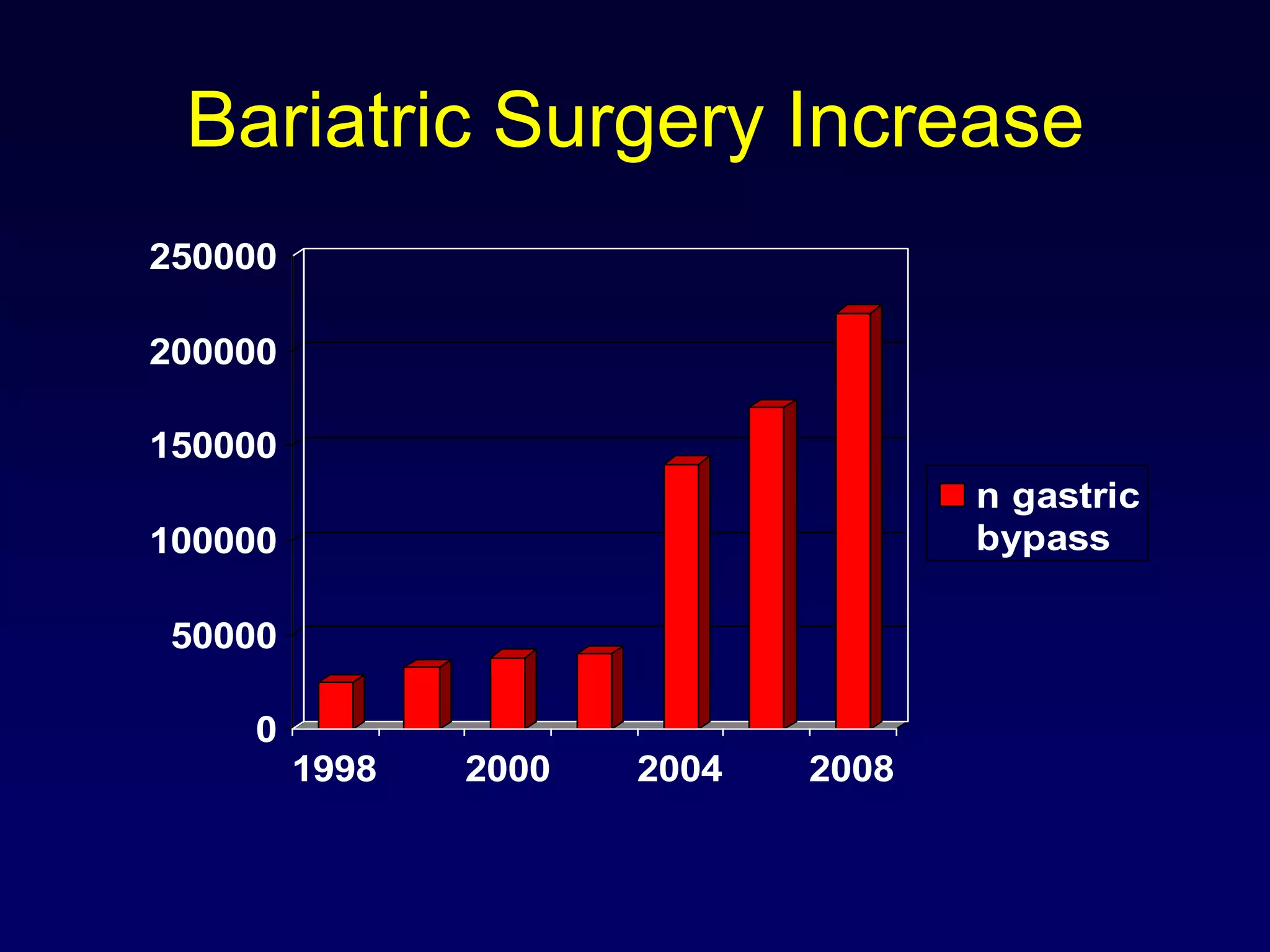
Bariatric Surgery IncreaseTotal number of Roux-en-Y Gastric Bypasses Performed in the USA**National Center for Health Statistics
Bariatric Surgery Increase
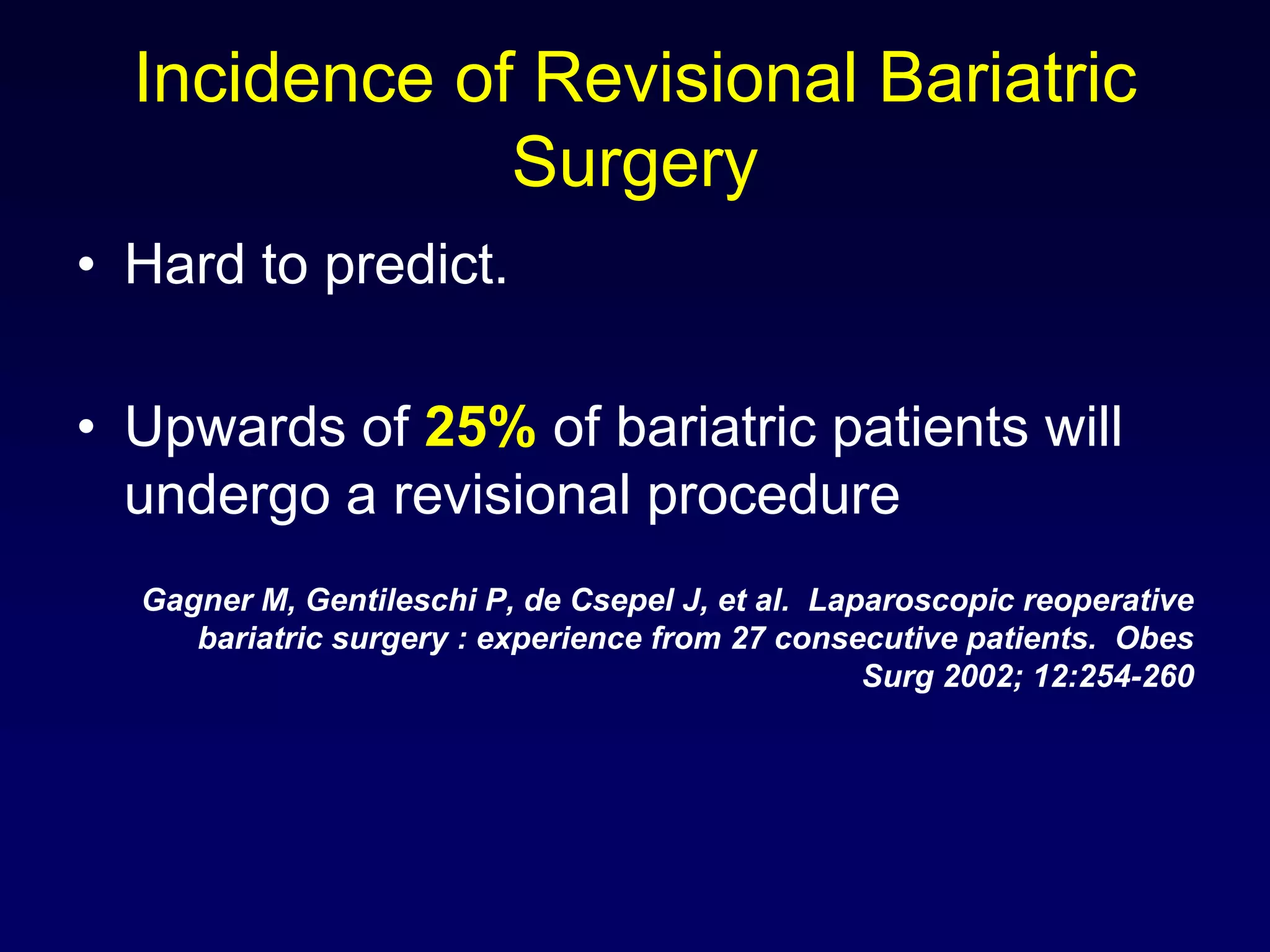
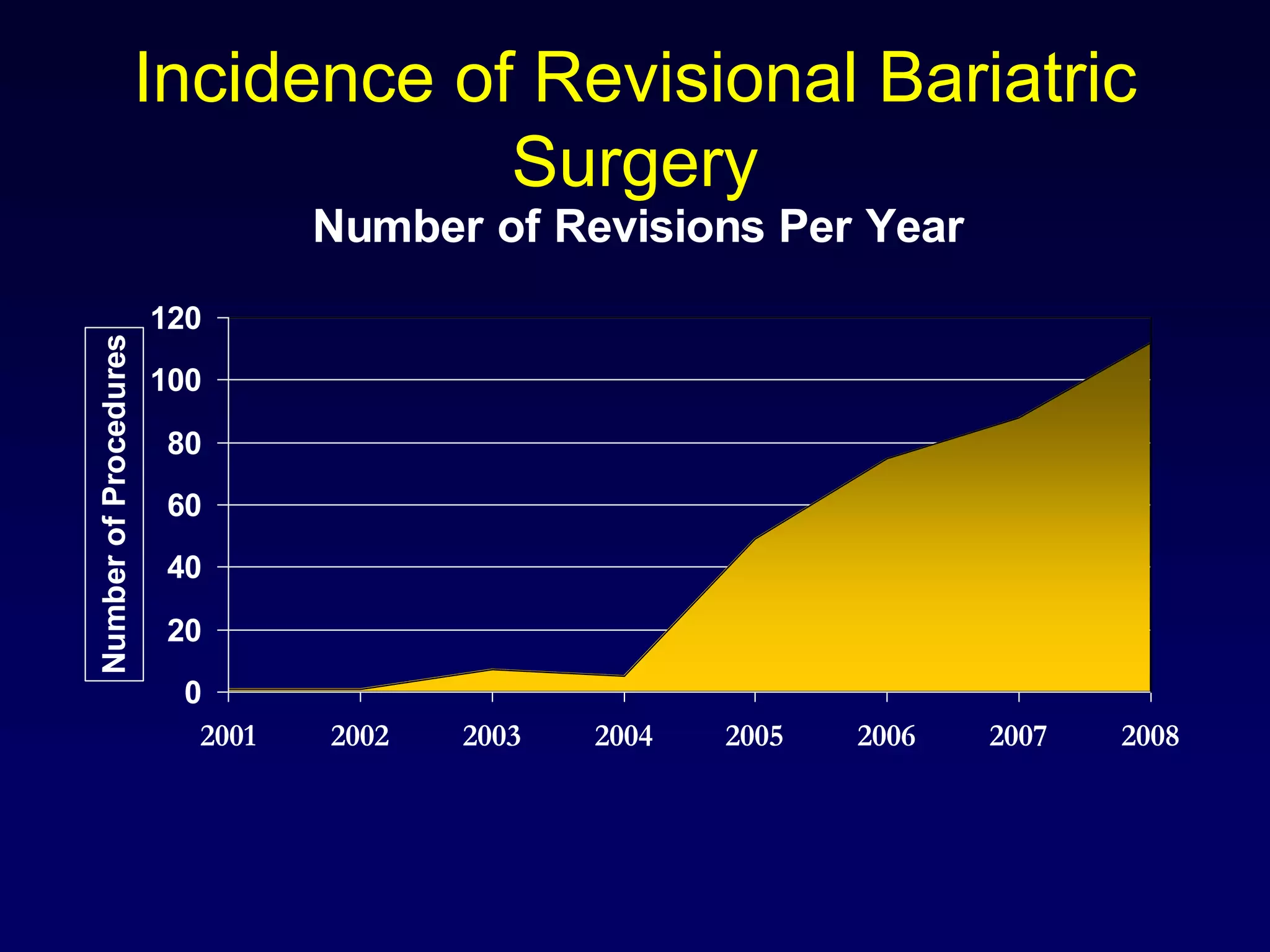
Incidence of Revisional Bariatric SurgeryHard to predict.Upwards of 25% of bariatric patients will undergo a revisional procedureGagner M, Gentileschi P, de Csepel J, et al.  Laparoscopic reoperative bariatric surgery : experience from 27 consecutive patients.  Obes Surg 2002; 12:254-260
Incidence of Revisional Bariatric Surgery
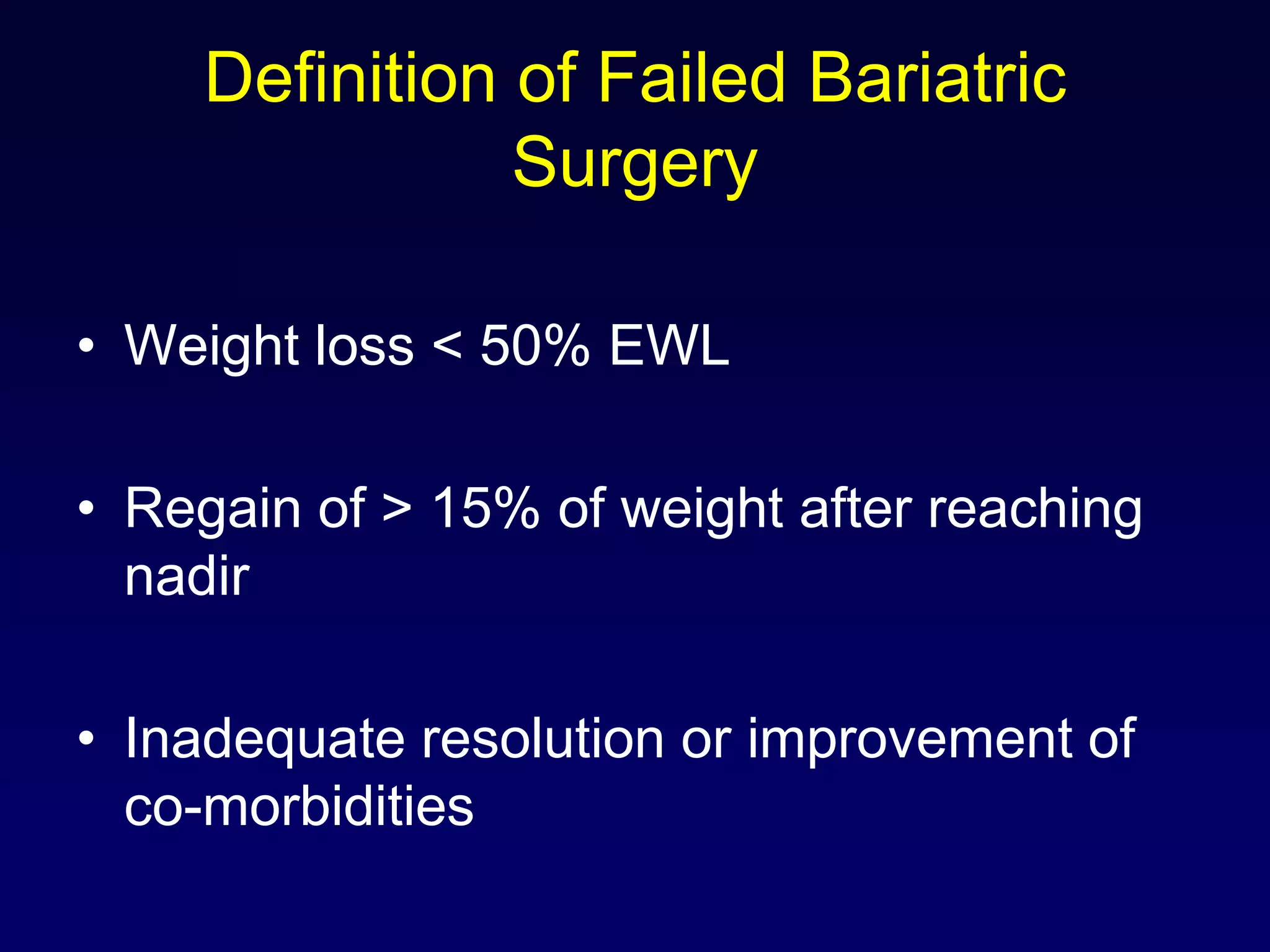
Definition of Failed Bariatric SurgeryWeight loss < 50% EWLRegain of > 15% of weight after reaching nadirInadequate resolution or improvement of co-morbidities
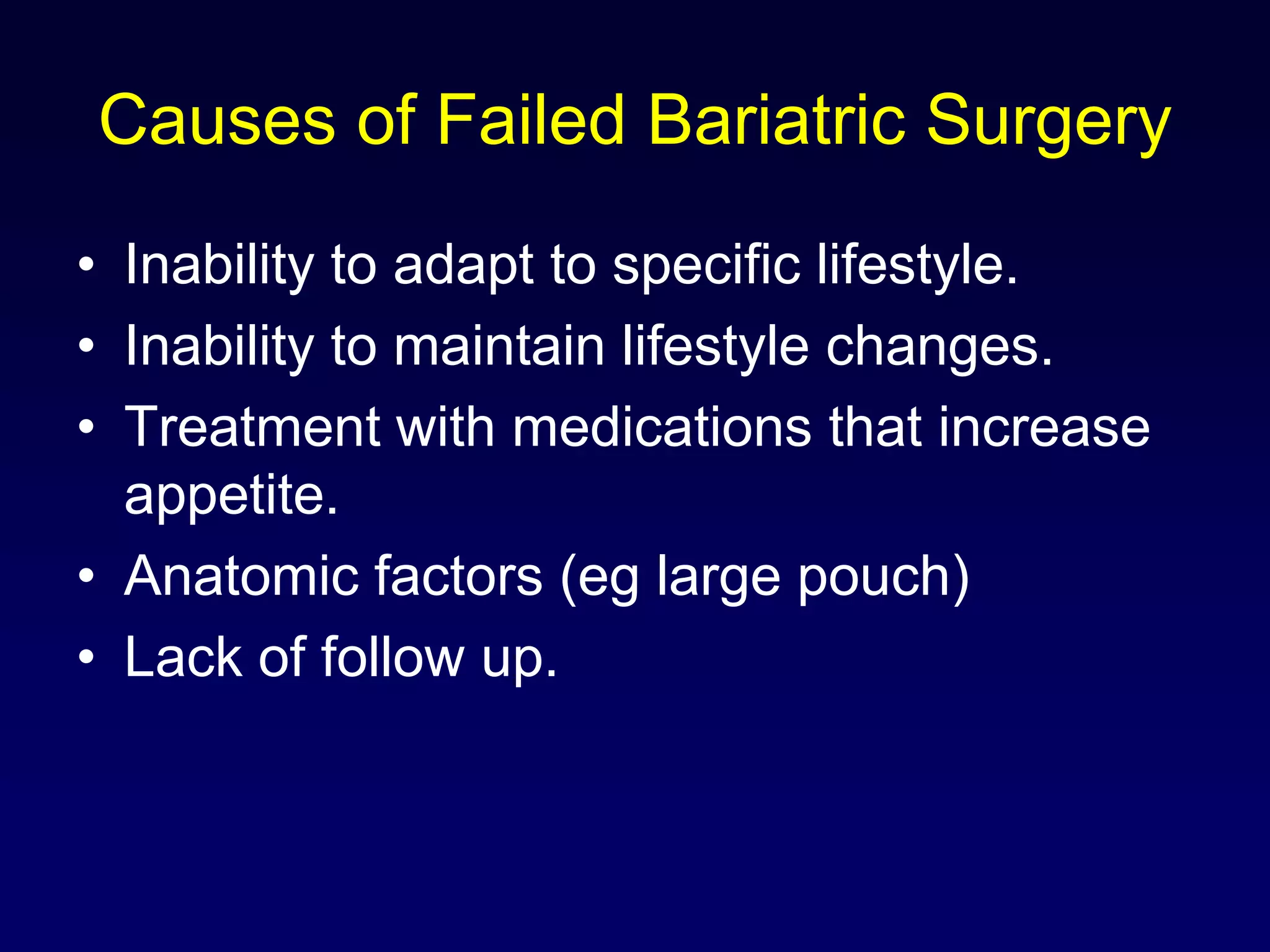
Causes of Failed Bariatric SurgeryInability to adapt to specific lifestyle.Inability to maintain lifestyle changes.Treatment with medications that increase appetite.Anatomic factors (eg large pouch)Lack of follow up.
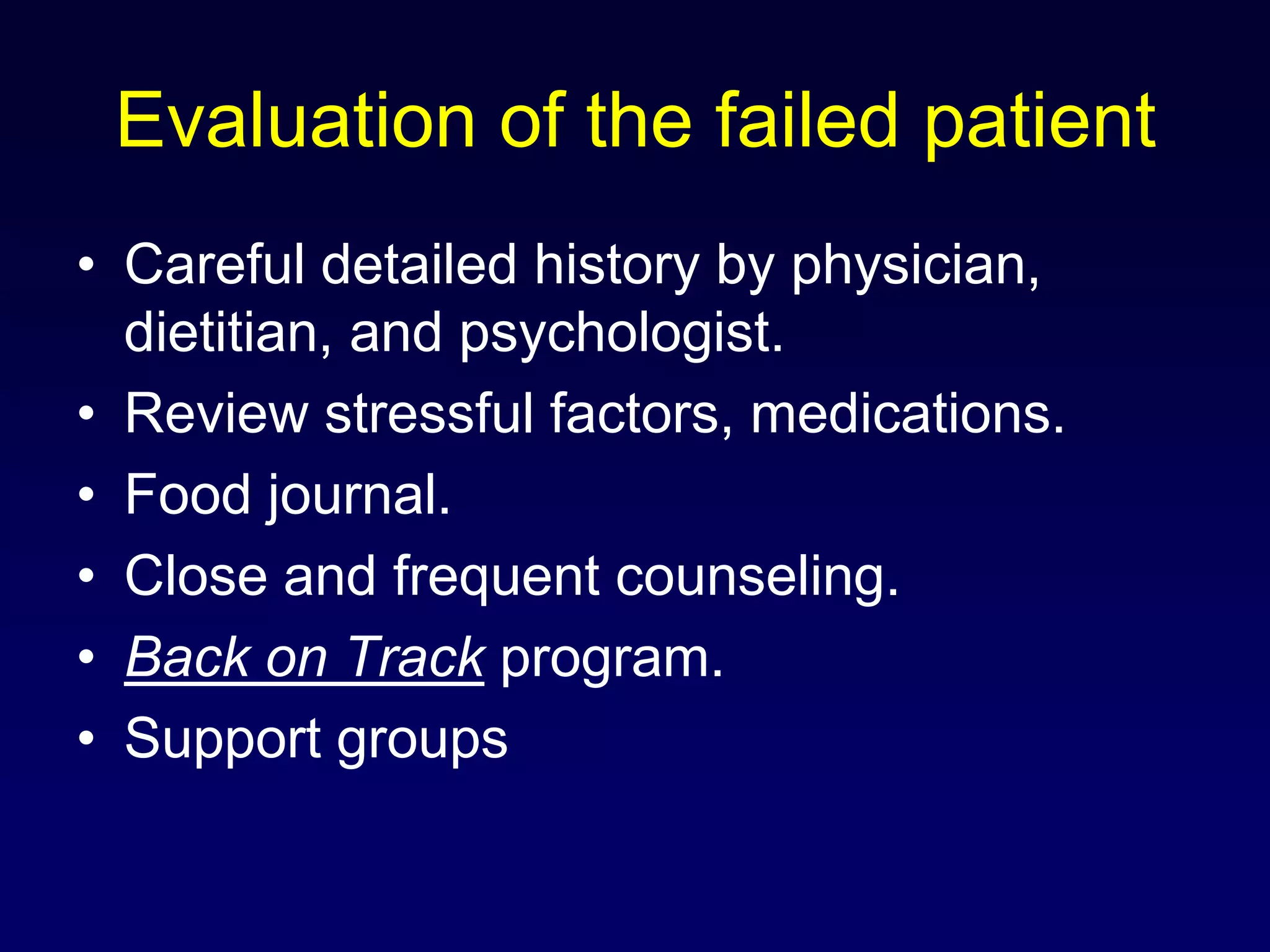
Evaluation of the failed patientCareful detailed history by physician, dietitian, and psychologist.Review stressful factors, medications.Food journal.Close and frequent counseling.Back on Track program.Support groups
Evaluation of the failed patientUpper GI endoscopy to assess pouch size, anatomy, staple line breakdown.Upper GI films to assess pouch size, band position, esophageal dilatation, hiatus hernia, etc.These studies are essential for planning revisional surgery.Review operative notes (if available).
Who should not be converted?Substance users.Patients with GERD who have not had medical therapy.Patients with maladaptive eating who fail to comply, in spite of normal anatomy.
The Failed Patient with Normal AnatomyClinical Dilemma.Limited options.
Variations “Lengthening the Roux”Rationale:The more distal the Roux, the more profound the weight loss.
Variations “Lengthening the Roux”Brolin in 1992:Prospective randomized study compared weight loss in patients with Roux length of 75cm to patients with Roux of 150cmConcluded that patients with longer Roux lost more weight at 2-3 years.No significant difference in nutritional changes.Brolin et al. Ann Surg 1992:215: 387
Variations “Lengthening the Roux”Distal RYGBOccasionally done for super obese patientsOccasionally done for patients with weight regain and normal pouches.
Variations “Lengthening the Roux”Distal RYGBNutritional issuesEssentially a malabsorptive operationDanger for protein calorie malnutritonFat soluble vitamin deficienciesDiarrheaHigh incidence of anemia
Variations “Lengthening the Roux”Sugerman in 1997:Compared standard Roux length with distal (common channel only 50 cm long)Distal group had more weight loss. But, > 50% serious complications, including 2 liver deaths. Sugerman et al J Gastrointest Surg 1997;1:517
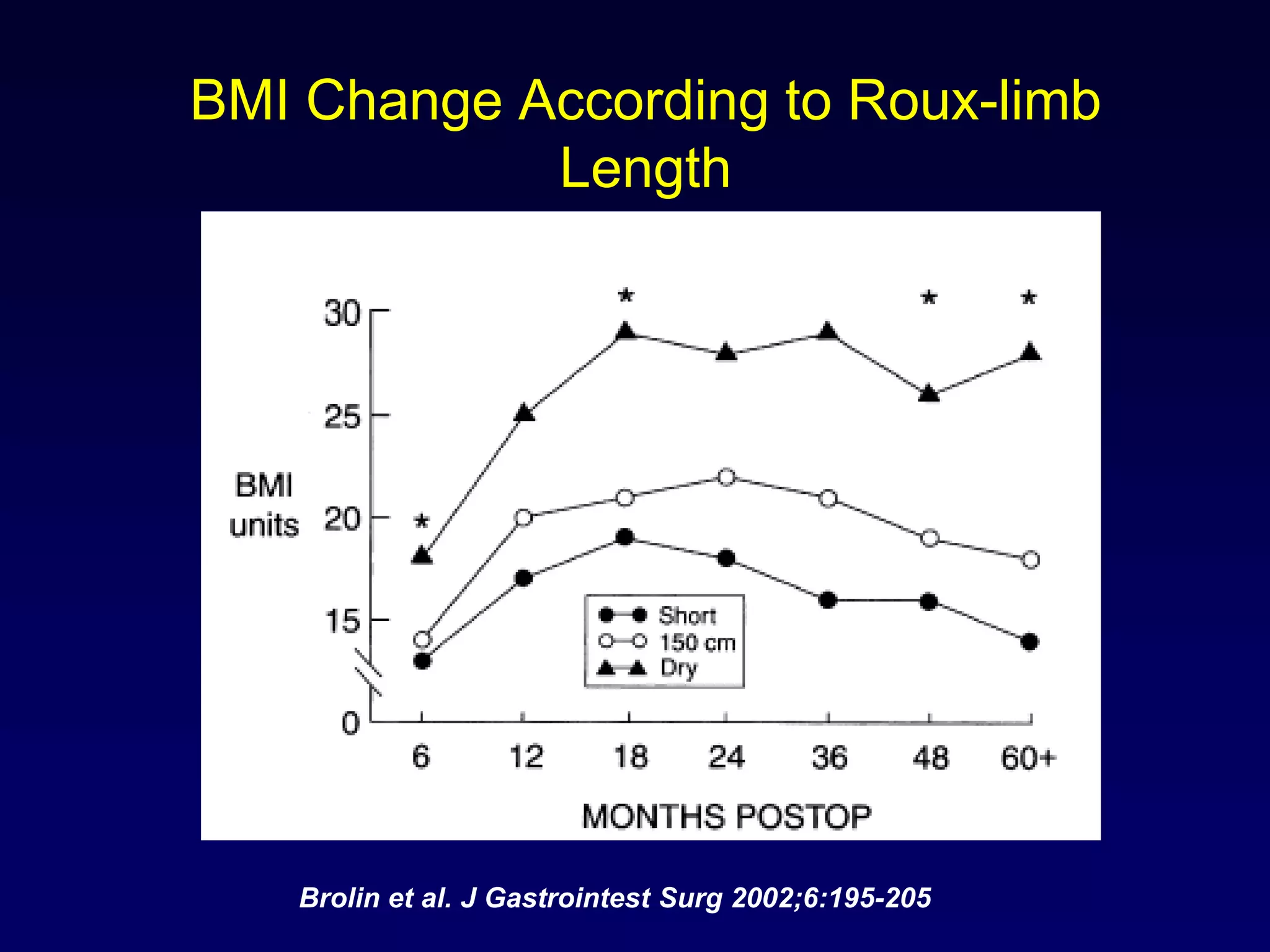
Variations “Lengthening the Roux”Brolin in 2002:Compared patients with standard RYGB to patients with distal RYGB (75 cm from cecum).Distal Gastric Bypass produced better weight loss.But, had significantly greater metabolic problemsBrolin et al J Gastrointest Surg 2002;6:201
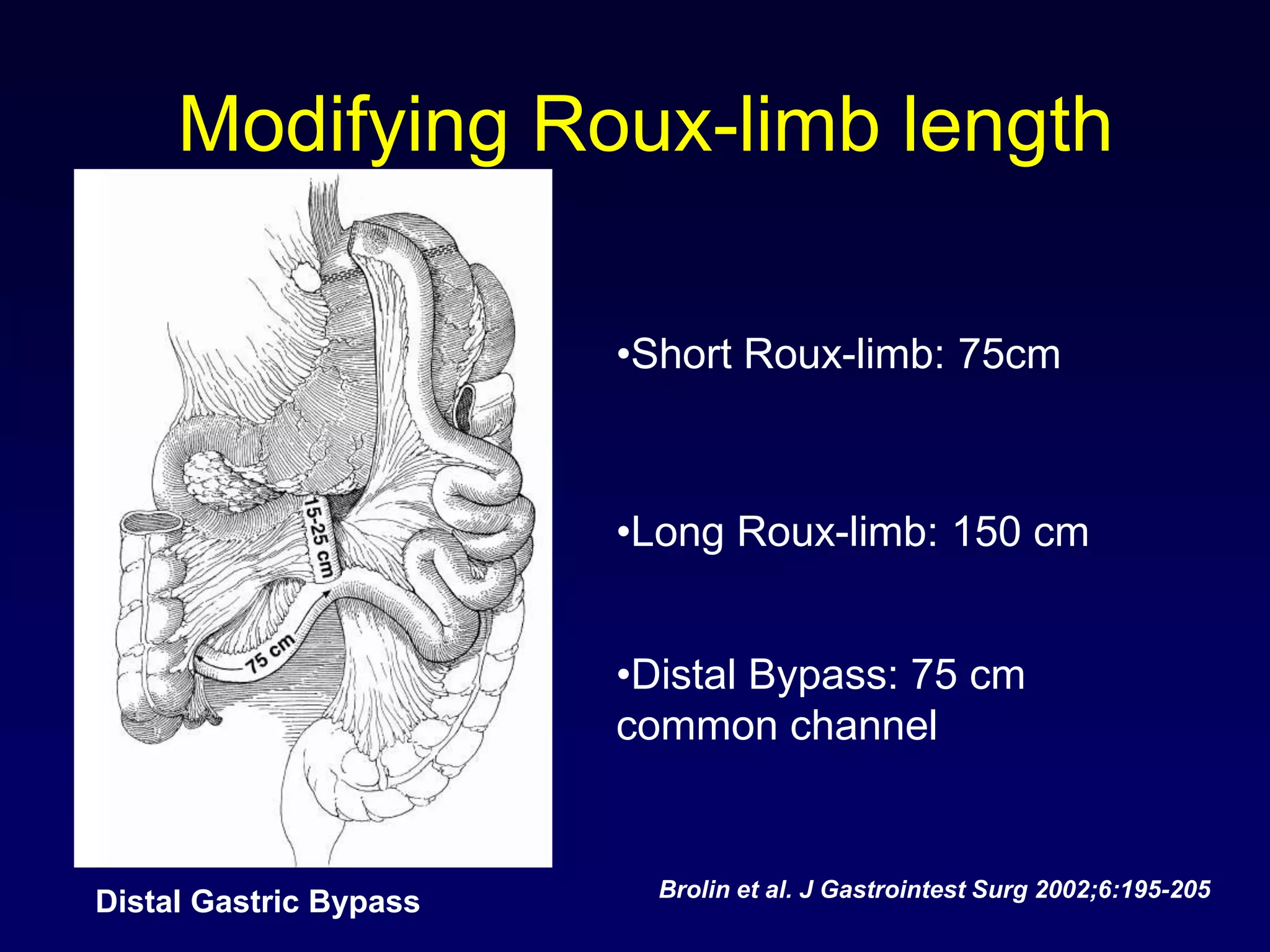
Modifying Roux-limb lengthShort Roux-limb: 75cm
Long Roux-limb: 150 cm
Distal Bypass: 75 cm common channelBrolin et al. J Gastrointest Surg 2002;6:195-205Distal Gastric Bypass
BMI Change According to Roux-limb LengthBrolin et al. J Gastrointest Surg 2002;6:195-205
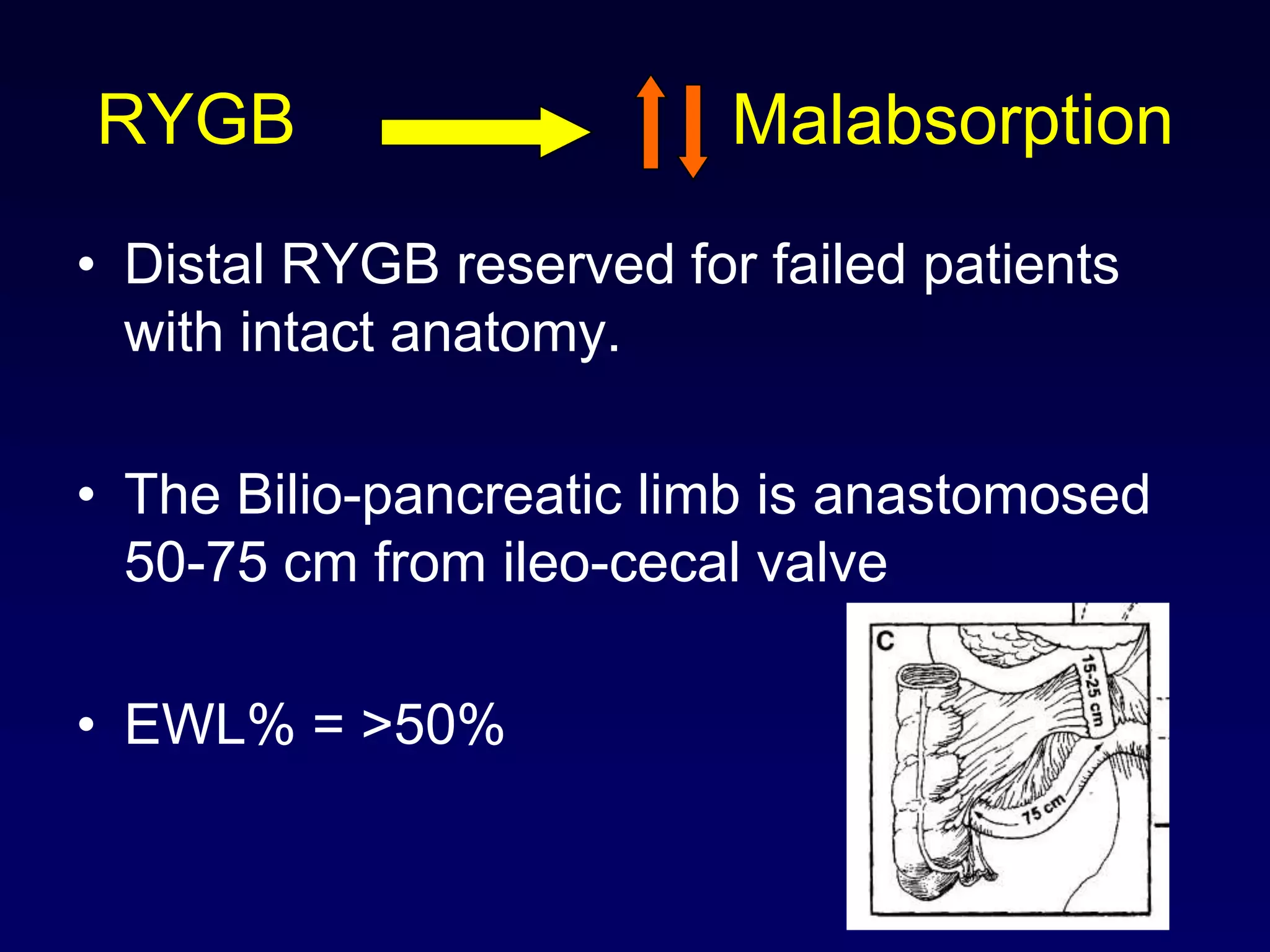
RYGB				MalabsorptionDistal RYGB reserved for failed patients with intact anatomy.The Bilio-pancreatic limb is anastomosed 50-75 cm from ileo-cecal valveEWL% = >50%
RYGB				MalabsorptionBut Complications include:Fat soluble vitamin deficiencyLiver dysfunctionNormocytic normochromic anemiaProtein calorie malnutrition
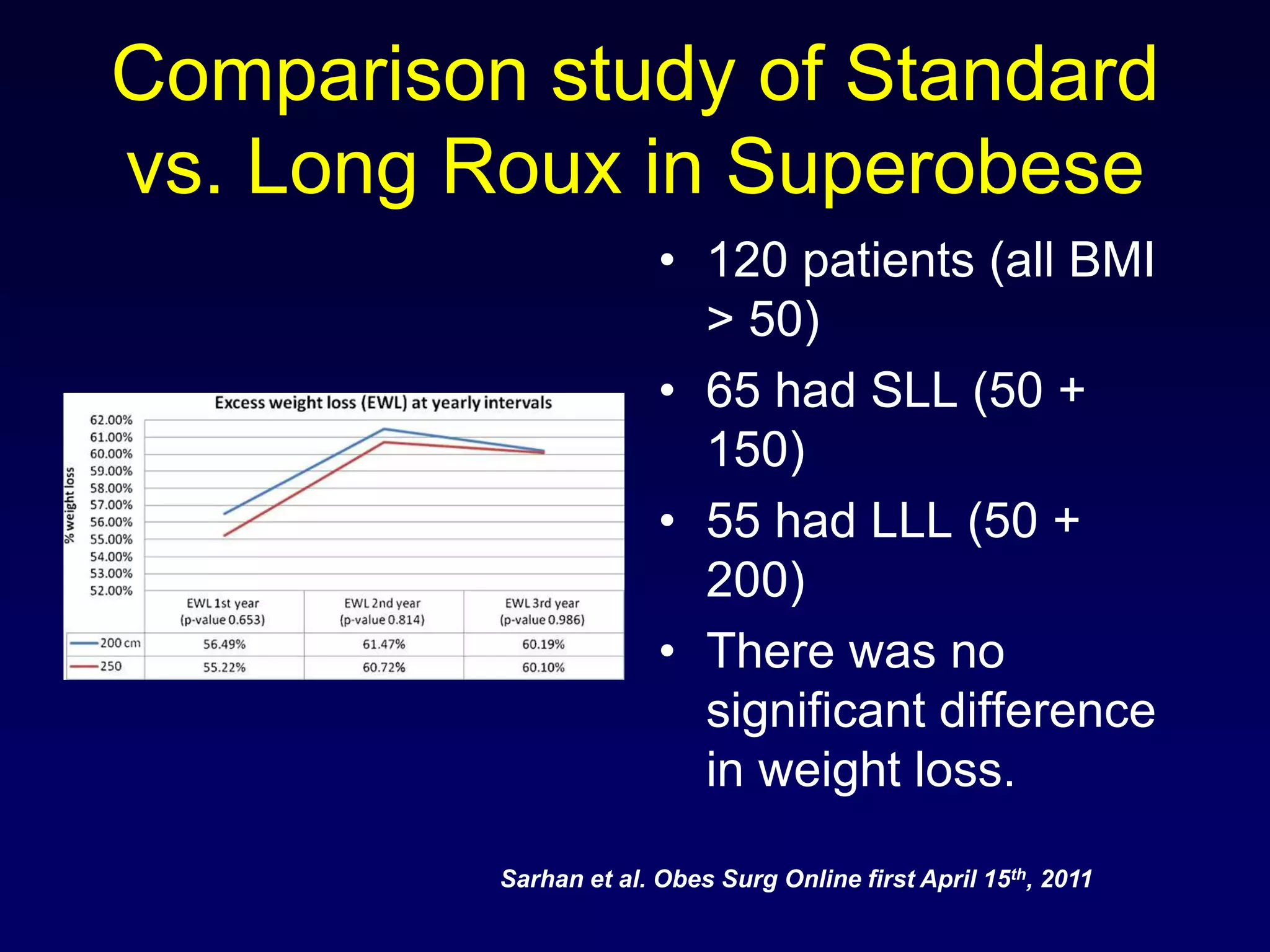
Comparison study of Standard vs. Long Roux in Superobese120 patients (all BMI > 50)65 had SLL (50 + 150)55 had LLL (50 + 200)There was no significant difference in weight loss.Sarhan et al. ObesSurg Online first April 15th, 2011

Length of roux

  • 1.
    Gastric Bypass: DoesLength of Roux Limb Matter?Samer G. Mattar, MD, FRCS, FACSAssociate Professor of SurgeryIndiana University
  • 2.
    Outline Incidence of Revisionaland Reoperative Bariatric SurgeryCauses of failed primary operationsEvaluation of the patient with failed primary operationRole of Roux limb length.Outcomes
  • 3.
    Gastric Bypass“A familyof operations”Hand-sewn versus stapled GJ anastomosisLinear versus Circular stapling mechanismsClosure versus non-closure of potential internal hernia sitesClosure versus non-closure of larger trocar sites
  • 4.
    Gastric Bypass“A familyof operations”According to Dr. Pories, the potential number of gastric bypasses is 29, or at least 512 different operations.
  • 5.
    Growth of BariatricSurgery: 500%NEJM 350;11, 2004, March 11, 1075-1079
  • 6.
    Bariatric Surgery IncreaseTotalnumber of Roux-en-Y Gastric Bypasses Performed in the USA**National Center for Health Statistics
  • 7.
  • 8.
    Incidence of RevisionalBariatric SurgeryHard to predict.Upwards of 25% of bariatric patients will undergo a revisional procedureGagner M, Gentileschi P, de Csepel J, et al. Laparoscopic reoperative bariatric surgery : experience from 27 consecutive patients. Obes Surg 2002; 12:254-260
  • 9.
    Incidence of RevisionalBariatric Surgery
  • 10.
    Definition of FailedBariatric SurgeryWeight loss < 50% EWLRegain of > 15% of weight after reaching nadirInadequate resolution or improvement of co-morbidities
  • 11.
    Causes of FailedBariatric SurgeryInability to adapt to specific lifestyle.Inability to maintain lifestyle changes.Treatment with medications that increase appetite.Anatomic factors (eg large pouch)Lack of follow up.
  • 12.
    Evaluation of thefailed patientCareful detailed history by physician, dietitian, and psychologist.Review stressful factors, medications.Food journal.Close and frequent counseling.Back on Track program.Support groups
  • 13.
    Evaluation of thefailed patientUpper GI endoscopy to assess pouch size, anatomy, staple line breakdown.Upper GI films to assess pouch size, band position, esophageal dilatation, hiatus hernia, etc.These studies are essential for planning revisional surgery.Review operative notes (if available).
  • 14.
    Who should notbe converted?Substance users.Patients with GERD who have not had medical therapy.Patients with maladaptive eating who fail to comply, in spite of normal anatomy.
  • 15.
    The Failed Patientwith Normal AnatomyClinical Dilemma.Limited options.
  • 16.
    Variations “Lengthening theRoux”Rationale:The more distal the Roux, the more profound the weight loss.
  • 17.
    Variations “Lengthening theRoux”Brolin in 1992:Prospective randomized study compared weight loss in patients with Roux length of 75cm to patients with Roux of 150cmConcluded that patients with longer Roux lost more weight at 2-3 years.No significant difference in nutritional changes.Brolin et al. Ann Surg 1992:215: 387
  • 18.
    Variations “Lengthening theRoux”Distal RYGBOccasionally done for super obese patientsOccasionally done for patients with weight regain and normal pouches.
  • 19.
    Variations “Lengthening theRoux”Distal RYGBNutritional issuesEssentially a malabsorptive operationDanger for protein calorie malnutritonFat soluble vitamin deficienciesDiarrheaHigh incidence of anemia
  • 20.
    Variations “Lengthening theRoux”Sugerman in 1997:Compared standard Roux length with distal (common channel only 50 cm long)Distal group had more weight loss. But, > 50% serious complications, including 2 liver deaths. Sugerman et al J Gastrointest Surg 1997;1:517
  • 21.
    Variations “Lengthening theRoux”Brolin in 2002:Compared patients with standard RYGB to patients with distal RYGB (75 cm from cecum).Distal Gastric Bypass produced better weight loss.But, had significantly greater metabolic problemsBrolin et al J Gastrointest Surg 2002;6:201
  • 22.
  • 23.
  • 24.
    Distal Bypass: 75cm common channelBrolin et al. J Gastrointest Surg 2002;6:195-205Distal Gastric Bypass
  • 25.
    BMI Change Accordingto Roux-limb LengthBrolin et al. J Gastrointest Surg 2002;6:195-205
  • 26.
    RYGB MalabsorptionDistal RYGB reservedfor failed patients with intact anatomy.The Bilio-pancreatic limb is anastomosed 50-75 cm from ileo-cecal valveEWL% = >50%
  • 27.
    RYGB MalabsorptionBut Complications include:Fatsoluble vitamin deficiencyLiver dysfunctionNormocytic normochromic anemiaProtein calorie malnutrition
  • 28.
    Comparison study ofStandard vs. Long Roux in Superobese120 patients (all BMI > 50)65 had SLL (50 + 150)55 had LLL (50 + 200)There was no significant difference in weight loss.Sarhan et al. ObesSurg Online first April 15th, 2011
  • 29.
    ConclusionsThere are manyvariations of gastric bypass.The length of Roux limb between 150 – 200 cms. will not significantly impact weight loss.Distal RYGB (50 – 75cc from IC) will cause significant weight loss but will increase risk of nutritional deficiencies.
  • 30.