Laparoscopic Gastric Bypass: Addressing Potential Complications George S. Ferzli, MD, FACS New York, NY
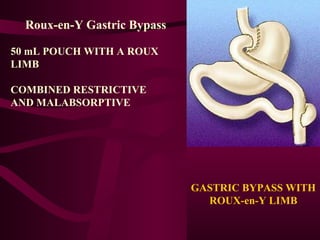
GASTRIC BYPASS WITH ROUX-en-Y LIMB Roux-en-Y Gastric Bypass 50 mL POUCH WITH A ROUX LIMB COMBINED RESTRICTIVE AND MALABSORPTIVE
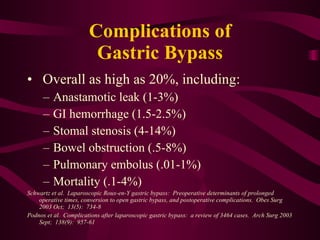
Complications of Gastric Bypass Overall as high as 20%, including: Anastamotic leak (1-3%) GI hemorrhage (1.5-2.5%) Stomal stenosis (4-14%) Bowel obstruction (.5-8%) Pulmonary embolus (.01-1%) Mortality (.1-4%) Schwartz et al.  Laparoscopic Roux-en-Y gastric bypass:  Preoperative determinants of prolonged operative times, conversion to open gastric bypass, and postoperative complications.  Obes Surg 2003 Oct;  13(5):  734-8 Podnos et al.  Complications after laparoscopic gastric bypass:  a review of 3464 cases.  Arch Surg 2003 Sept;  138(9):  957-61
Laparoscopic Gastric Bypass Identifying potential sources of complications Jejunal division, mesenteric division Ischemia, bleeding Jejuno-jejunostomy Leak, stenosis
Laparoscopic Gastric Bypass Mesenteric defect at jejuno-jejunostomy Internal herniation/bowel obstruction Gastric pouch Improper size, bleeding Gastro-jejunostomy Leak, stenosis
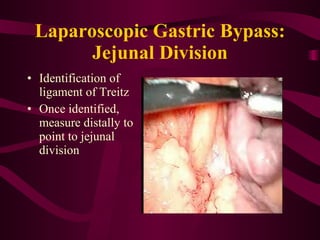
Laparoscopic Gastric Bypass: Jejunal Division Identification of ligament of Treitz Once identified, measure distally to point to jejunal division
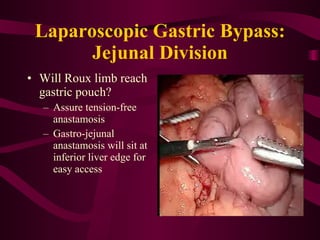
Laparoscopic Gastric Bypass: Jejunal Division Will Roux limb reach gastric pouch? Assure tension-free anastamosis Gastro-jejunal anastamosis will sit at inferior liver edge for easy access
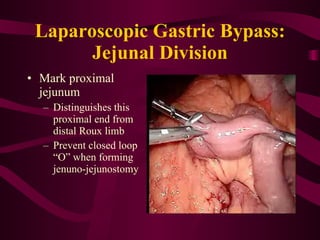
Laparoscopic Gastric Bypass: Jejunal Division Mark proximal jejunum Distinguishes this proximal end from distal Roux limb Prevent closed loop “O” when forming jenuno-jejunostomy
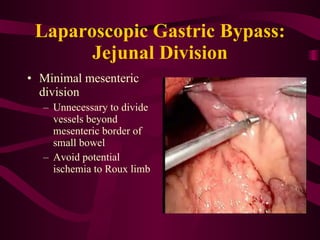
Laparoscopic Gastric Bypass: Jejunal Division Minimal mesenteric division Unnecessary to divide vessels beyond mesenteric border of small bowel Avoid potential ischemia to Roux limb
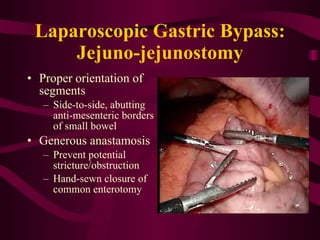
Laparoscopic Gastric Bypass: Jejuno-jejunostomy Proper orientation of segments Side-to-side, abutting anti-mesenteric borders of small bowel Generous anastamosis Prevent potential stricture/obstruction Hand-sewn closure of common enterotomy
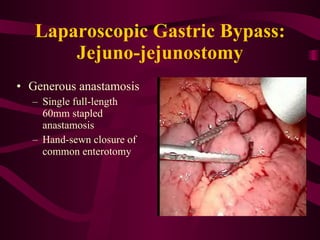
Laparoscopic Gastric Bypass: Jejuno-jejunostomy Generous anastamosis Single full-length 60mm stapled anastamosis Hand-sewn closure of common enterotomy
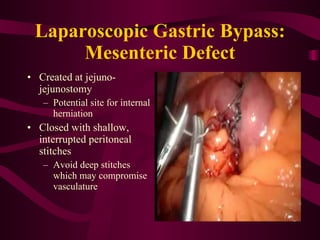
Laparoscopic Gastric Bypass: Mesenteric Defect Created at jejuno-jejunostomy Potential site for internal herniation Closed with shallow, interrupted peritoneal stitches Avoid deep stitches which may compromise vasculature
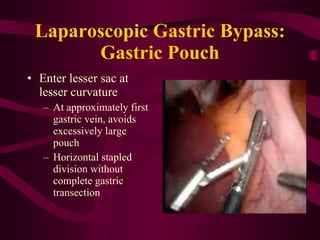
Laparoscopic Gastric Bypass: Gastric Pouch Enter lesser sac at lesser curvature At approximately first gastric vein, avoids excessively large pouch Horizontal stapled division without complete gastric transection
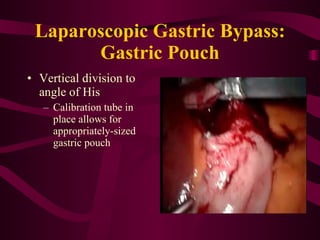
Laparoscopic Gastric Bypass: Gastric Pouch Vertical division to angle of His Calibration tube in place allows for appropriately-sized gastric pouch
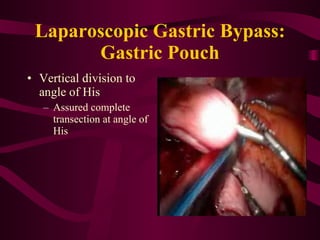
Laparoscopic Gastric Bypass: Gastric Pouch Vertical division to angle of His Assured complete transection at angle of His
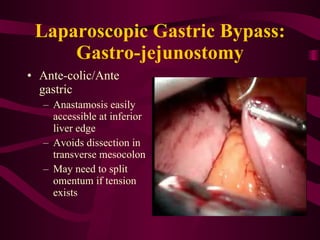
Laparoscopic Gastric Bypass: Gastro-jejunostomy Ante-colic/Ante gastric Anastamosis easily accessible at inferior liver edge Avoids dissection in transverse mesocolon May need to split omentum if tension exists
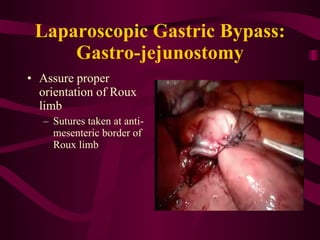
Laparoscopic Gastric Bypass: Gastro-jejunostomy Assure proper orientation of Roux limb Sutures taken at anti-mesenteric border of Roux limb
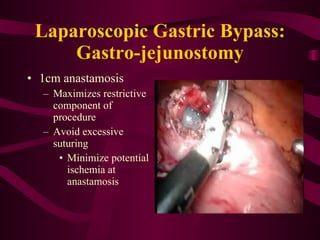
Laparoscopic Gastric Bypass: Gastro-jejunostomy 1cm anastamosis Maximizes restrictive component of procedure Avoid excessive suturing Minimize potential ischemia at anastamosis
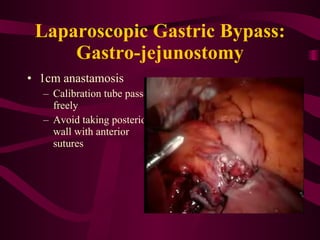
Laparoscopic Gastric Bypass: Gastro-jejunostomy 1cm anastamosis Calibration tube passes freely Avoid taking posterior wall with anterior sutures
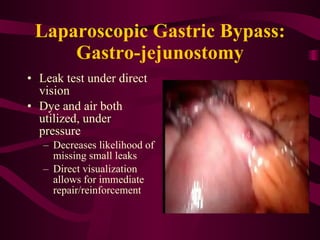
Laparoscopic Gastric Bypass: Gastro-jejunostomy Leak test under direct vision Dye and air both utilized, under pressure Decreases likelihood of missing small leaks Direct visualization allows for immediate repair/reinforcement
Laparoscopic Gastric Bypass: Addressing Potential Complications Systematic, step-wise approach Rigorous adherence to surgical principles Avoid excessive dissection Avoid tension at anastamoses Avoid excessive suturing The best way to avoid complications is to think about them!

Laparoscopic Gastric Bypass: Addressing Potential Complications

  • 1.
    Laparoscopic Gastric Bypass:Addressing Potential Complications George S. Ferzli, MD, FACS New York, NY
  • 2.
    GASTRIC BYPASS WITHROUX-en-Y LIMB Roux-en-Y Gastric Bypass 50 mL POUCH WITH A ROUX LIMB COMBINED RESTRICTIVE AND MALABSORPTIVE
  • 3.
    Complications of GastricBypass Overall as high as 20%, including: Anastamotic leak (1-3%) GI hemorrhage (1.5-2.5%) Stomal stenosis (4-14%) Bowel obstruction (.5-8%) Pulmonary embolus (.01-1%) Mortality (.1-4%) Schwartz et al. Laparoscopic Roux-en-Y gastric bypass: Preoperative determinants of prolonged operative times, conversion to open gastric bypass, and postoperative complications. Obes Surg 2003 Oct; 13(5): 734-8 Podnos et al. Complications after laparoscopic gastric bypass: a review of 3464 cases. Arch Surg 2003 Sept; 138(9): 957-61
  • 4.
    Laparoscopic Gastric BypassIdentifying potential sources of complications Jejunal division, mesenteric division Ischemia, bleeding Jejuno-jejunostomy Leak, stenosis
  • 5.
    Laparoscopic Gastric BypassMesenteric defect at jejuno-jejunostomy Internal herniation/bowel obstruction Gastric pouch Improper size, bleeding Gastro-jejunostomy Leak, stenosis
  • 6.
    Laparoscopic Gastric Bypass:Jejunal Division Identification of ligament of Treitz Once identified, measure distally to point to jejunal division
  • 7.
    Laparoscopic Gastric Bypass:Jejunal Division Will Roux limb reach gastric pouch? Assure tension-free anastamosis Gastro-jejunal anastamosis will sit at inferior liver edge for easy access
  • 8.
    Laparoscopic Gastric Bypass:Jejunal Division Mark proximal jejunum Distinguishes this proximal end from distal Roux limb Prevent closed loop “O” when forming jenuno-jejunostomy
  • 9.
    Laparoscopic Gastric Bypass:Jejunal Division Minimal mesenteric division Unnecessary to divide vessels beyond mesenteric border of small bowel Avoid potential ischemia to Roux limb
  • 10.
    Laparoscopic Gastric Bypass:Jejuno-jejunostomy Proper orientation of segments Side-to-side, abutting anti-mesenteric borders of small bowel Generous anastamosis Prevent potential stricture/obstruction Hand-sewn closure of common enterotomy
  • 11.
    Laparoscopic Gastric Bypass:Jejuno-jejunostomy Generous anastamosis Single full-length 60mm stapled anastamosis Hand-sewn closure of common enterotomy
  • 12.
    Laparoscopic Gastric Bypass:Mesenteric Defect Created at jejuno-jejunostomy Potential site for internal herniation Closed with shallow, interrupted peritoneal stitches Avoid deep stitches which may compromise vasculature
  • 13.
    Laparoscopic Gastric Bypass:Gastric Pouch Enter lesser sac at lesser curvature At approximately first gastric vein, avoids excessively large pouch Horizontal stapled division without complete gastric transection
  • 14.
    Laparoscopic Gastric Bypass:Gastric Pouch Vertical division to angle of His Calibration tube in place allows for appropriately-sized gastric pouch
  • 15.
    Laparoscopic Gastric Bypass:Gastric Pouch Vertical division to angle of His Assured complete transection at angle of His
  • 16.
    Laparoscopic Gastric Bypass:Gastro-jejunostomy Ante-colic/Ante gastric Anastamosis easily accessible at inferior liver edge Avoids dissection in transverse mesocolon May need to split omentum if tension exists
  • 17.
    Laparoscopic Gastric Bypass:Gastro-jejunostomy Assure proper orientation of Roux limb Sutures taken at anti-mesenteric border of Roux limb
  • 18.
    Laparoscopic Gastric Bypass:Gastro-jejunostomy 1cm anastamosis Maximizes restrictive component of procedure Avoid excessive suturing Minimize potential ischemia at anastamosis
  • 19.
    Laparoscopic Gastric Bypass:Gastro-jejunostomy 1cm anastamosis Calibration tube passes freely Avoid taking posterior wall with anterior sutures
  • 20.
    Laparoscopic Gastric Bypass:Gastro-jejunostomy Leak test under direct vision Dye and air both utilized, under pressure Decreases likelihood of missing small leaks Direct visualization allows for immediate repair/reinforcement
  • 21.
    Laparoscopic Gastric Bypass:Addressing Potential Complications Systematic, step-wise approach Rigorous adherence to surgical principles Avoid excessive dissection Avoid tension at anastamoses Avoid excessive suturing The best way to avoid complications is to think about them!

Editor's Notes

  • #3 The technique was modified to obtain a 50 mL pouch and a Roux-en-Y limb to minimize bile reflux from the loop gastrojejunostomy. The roux limb was lengthened to 100-150 cm in order to increase malabsorption and improve weight loss. The technique has been modified throughout the years with regard to the gastric pouch and retrocolic position of the roux limb. This procedure has stood the test of time, with one series of 500 patients followed for 14 years with patients maintaining 50% excess weight loss.