Overview on bariatric surgery
By
Dr Alas ElSewefy
Assistant prof. of general surgery & laparoendoscopy
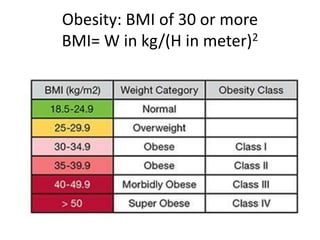
Obesity: BMI of 30 or more
BMI= W in kg/(H in meter)2
Epidemiology
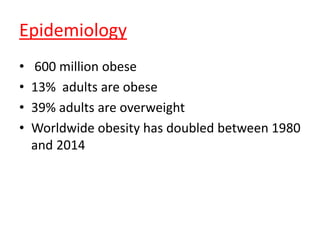
• 600 million obese
• 13% adults are obese
• 39% adults are overweight
• Worldwide obesity has doubled between 1980
and 2014
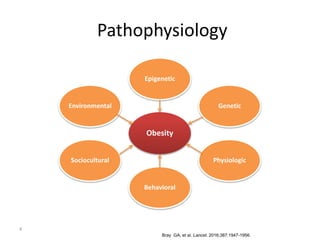
Pathophysiology
4
Bray GA, et al. Lancet. 2016;387:1947-1956.
Obesity
Epigenetic
Genetic
Physiologic
Behavioral
Sociocultural
Environmental
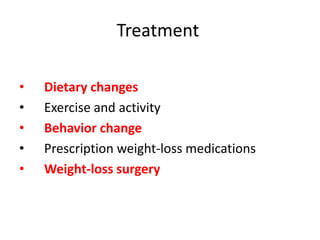
Treatment
• Dietary changes
• Exercise and activity
• Behavior change
• Prescription weight-loss medications
• Weight-loss surgery
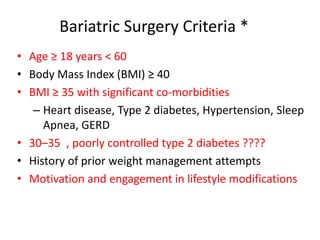
Bariatric Surgery Criteria *
• Age ≥ 18 years < 60
• Body Mass Index (BMI) ≥ 40
• BMI ≥ 35 with significant co-morbidities
– Heart disease, Type 2 diabetes, Hypertension, Sleep
Apnea, GERD
• 30–35 , poorly controlled type 2 diabetes ????
• History of prior weight management attempts
• Motivation and engagement in lifestyle modifications
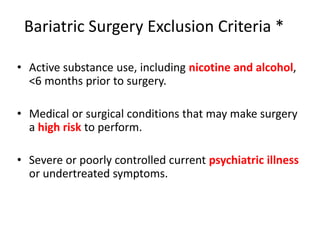
Bariatric Surgery Exclusion Criteria *
• Active substance use, including nicotine and alcohol,
<6 months prior to surgery.
• Medical or surgical conditions that may make surgery
a high risk to perform.
• Severe or poorly controlled current psychiatric illness
or undertreated symptoms.
Other Lifelong Criteria and Guidelines
• NSAIDS are contraindicated for gastric bypass
– Significantly increased risk of GI bleeding
• Avoidance (pre / post op) : nicotine, caffeine
– Potential ulceration
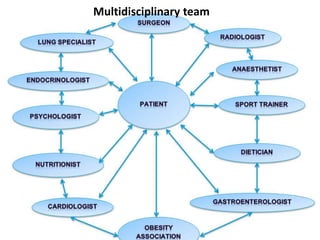
Multidisciplinary team
Complete H & P
Routine labs (FBS , kidney function, liver
profile, lipid profile, prothrombin time/INR,
blood type, CBC)
Nutrient screening with iron studies, B12 and
folic acid and vitamin D
Cardiopulmonary evaluation with sleep apnea
screening (ECG, CXR, echocardiography)
Preoperative Checklist for Bariatric Surgery
GI evaluation (H pylori screening ; gallbladder
evaluation and upper endoscopy if clinically
indicated)
Endocrine evaluation (Hb A1c; TSH with,
screening for Cushing’s syndrome if clinically
suspected
Clinical nutrition evaluation
Psychosocial-behavioral evaluation
Informed consent
Provide relevant financial information
Optimize glycemic control
Pregnancy counseling
Smoking cessation
Bariatric surgery history and
evolutions
Restrictive procedures are:
 Sleeve gastrectomy surgery
 Gastric band surgery
 VBG
Malabsorptive procedures:
 Jejunoileal bypass
Restrictive and malabsorptive weight loss surgeries are:
 Roux-en-Y gastric bypass surgery
 Duodenal switch surgery
 Sleeve bipartition
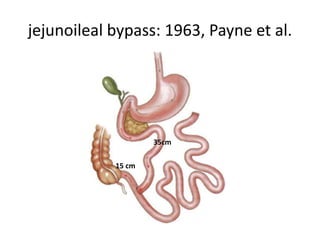
jejunoileal bypass: 1963, Payne et al.
35cm
15 cm
Advantages
Simple and easy
Rapid weight loss
Disadvantage:
Sever malnutrition
Diarrhea
Electrolyte imbalances
Renal failure
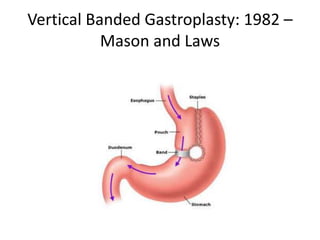
Vertical Banded Gastroplasty: 1982 –
Mason and Laws
Advantage:
• No dumping syndrome.
• No nutritional deficiencies/malabsorption.
Disadvantage:
• Reversal of a VBG requires a much more
complex
• Vomiting and severe discomfort.
• Not adjustable
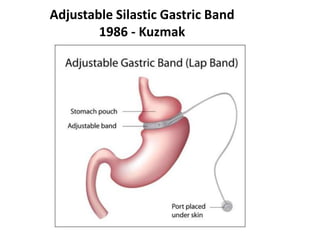
Adjustable Silastic Gastric Band
1986 - Kuzmak
Advantages
Weight loss of approximately 40 – 50 percent
 No cutting of the stomach or rerouting of the
intestines
 Shorter hospital stay,
Reversible and adjustable
 Lowe complications and mortality
 Has the lowest risk for vitamin/mineral deficiencies
Disadvantages
Slower and less weight loss
Foreign device to remain in the body
Slippage or erosion
Dilation of the esophagus
Requires strict adherence to the postoperative
diet and to postoperative follow-up visits
Highest rate of re-operation
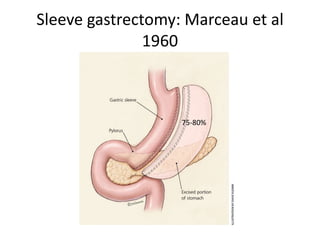
Sleeve gastrectomy: Marceau et al
1960
75-80%
Advantages
Weight loss similar to that of the RNGB >50%
No foreign objects (AGB), and no bypass or
Short hospital stay
Changes in gut hormones improve satiety
Disadvantages
 Is a non-reversible procedure
 Vitamin deficiencies
leaks
Refluxogenic
 potential weight regain
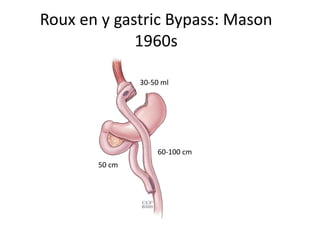
Roux en y gastric Bypass: Mason
1960s
60-100 cm
50 cm
30-50 ml
Advantages
long-term weight loss (60 to 80 %)
Changes in gut hormones that reduce appetite and
enhance satiety
Typical maintenance of >50% excess weight loss
Disadvantages
Technically complex →greater complication rates
Vitamin/mineral deficiencies
Longer hospital stay than the AGB
Internal hernia
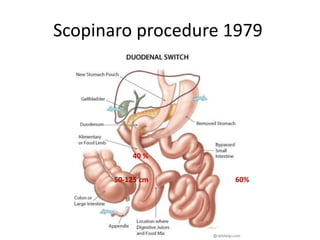
Scopinaro procedure 1979
50-125 cm 60%
40 %
Advantages
 Greater weight loss than. 60 – 70%
 Allows patients to eat near “normal” meals
 Changes in gut hormones to reduce appetite and improve
satiety
 The most effective against diabetes compared to RYGB, LSG,
and AGB
Disadvantages
 Has higher complication rates and risk for mortality
 Requires a longer hospital stay
 Malnutrition
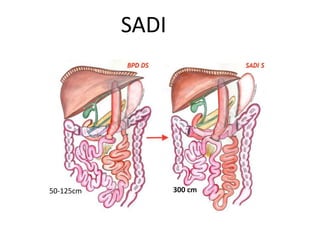
Modification of duodenal switch
•Min gastric bypass
•SADI
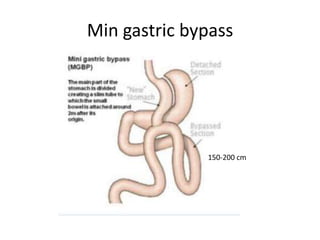
Min gastric bypass
150-200 cm
Advantages
 Reversible.
 Simple, lower cost .
 early recovery
 The weight loss ranges from 50% to 80% .
 Short operative time
 Metabolic effect
Disadvantages
 There are no long-term studies available
 biliary reflux → ulceration, inflammation or erosion around
the stomach walls.
 Malnutrition
SADI
300 cm50-125cm
Advantages
There is no at-risk gastric remnant.
No dumping .
↓ Calcium and iron deficiency, since 1st part of
duodenum is preserved.
Reduces risk of internal hernias.
Malabsorption is much less compared to
duodenal switch
Disadvantages
Dissection around duodenum is technically
difficult, and so the learning curve is prolonged.
Novel techniques
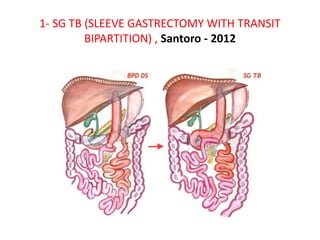
1- SG TB (SLEEVE GASTRECTOMY WITH TRANSIT
BIPARTITION) , Santoro - 2012
Advantages
duodenum is not transected.
the sleeve has two outlets.
induce hormonal changes and diabetes
resolution.
minimises malabsorption.
Disadvantages :
higher risk of internal herniation as the
anastomosis is a Roux-en-Y type,
higher risk of marginal ulcers
Technically difficult
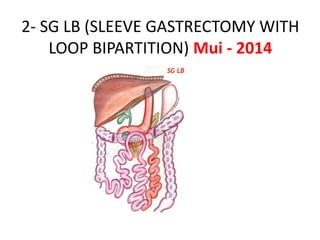
2- SG LB (SLEEVE GASTRECTOMY WITH
LOOP BIPARTITION) Mui - 2014
Advantages
Endoscopic access to biliary tract
↓ sleeve leaks and gastroesophageal reflux.
Hormonal changes are high.
Malabsorption is less.
Diarrhoea and steatorrhoea risks are rare .
Disadvantages:
Biliary reflux
No long-term results
How to choose your procedure
RNGB:
The standard procedure up till now, Technically
demanding, the best for GERD
Sleeve:
Easy, contraindicated in sweat eater & GERD,
durability weight regain ? leaks
 MBG:
Simple, effective metabolic control, but reflux and
malnutrition
SASI: reflux , long-term??? may by the future
Follow up
Thrombophylaxis:
Respiratory care:
Diet:
 1st week: Clear fluid
 2nd week: liquid diet
 3rd week: soft diet
 4th week →: ordinary high protein low calorie diet
Ppi: 1 year
Post-operative lab work
Lab work is done at 4, 12, 18, and 24 month visits after surgery, and
then yearly:
CBC
Ferritin, iron
parathyroid hormone
RBC folate
Vitamins A, B1 (thiamine), B12, and 25 hydroxy Vitamin D

Overview on bariatric surgery

  • 1.
    Overview on bariatricsurgery By Dr Alas ElSewefy Assistant prof. of general surgery & laparoendoscopy
  • 2.
    Obesity: BMI of30 or more BMI= W in kg/(H in meter)2
  • 3.
    Epidemiology • 600 millionobese • 13% adults are obese • 39% adults are overweight • Worldwide obesity has doubled between 1980 and 2014
  • 4.
    Pathophysiology 4 Bray GA, etal. Lancet. 2016;387:1947-1956. Obesity Epigenetic Genetic Physiologic Behavioral Sociocultural Environmental
  • 6.
    Treatment • Dietary changes •Exercise and activity • Behavior change • Prescription weight-loss medications • Weight-loss surgery
  • 7.
    Bariatric Surgery Criteria* • Age ≥ 18 years < 60 • Body Mass Index (BMI) ≥ 40 • BMI ≥ 35 with significant co-morbidities – Heart disease, Type 2 diabetes, Hypertension, Sleep Apnea, GERD • 30–35 , poorly controlled type 2 diabetes ???? • History of prior weight management attempts • Motivation and engagement in lifestyle modifications
  • 8.
    Bariatric Surgery ExclusionCriteria * • Active substance use, including nicotine and alcohol, <6 months prior to surgery. • Medical or surgical conditions that may make surgery a high risk to perform. • Severe or poorly controlled current psychiatric illness or undertreated symptoms.
  • 9.
    Other Lifelong Criteriaand Guidelines • NSAIDS are contraindicated for gastric bypass – Significantly increased risk of GI bleeding • Avoidance (pre / post op) : nicotine, caffeine – Potential ulceration
  • 10.
  • 11.
    Complete H &P Routine labs (FBS , kidney function, liver profile, lipid profile, prothrombin time/INR, blood type, CBC) Nutrient screening with iron studies, B12 and folic acid and vitamin D Cardiopulmonary evaluation with sleep apnea screening (ECG, CXR, echocardiography) Preoperative Checklist for Bariatric Surgery
  • 12.
    GI evaluation (Hpylori screening ; gallbladder evaluation and upper endoscopy if clinically indicated) Endocrine evaluation (Hb A1c; TSH with, screening for Cushing’s syndrome if clinically suspected Clinical nutrition evaluation Psychosocial-behavioral evaluation
  • 13.
    Informed consent Provide relevantfinancial information Optimize glycemic control Pregnancy counseling Smoking cessation
  • 14.
  • 15.
    Restrictive procedures are: Sleeve gastrectomy surgery  Gastric band surgery  VBG Malabsorptive procedures:  Jejunoileal bypass Restrictive and malabsorptive weight loss surgeries are:  Roux-en-Y gastric bypass surgery  Duodenal switch surgery  Sleeve bipartition
  • 16.
    jejunoileal bypass: 1963,Payne et al. 35cm 15 cm
  • 17.
    Advantages Simple and easy Rapidweight loss Disadvantage: Sever malnutrition Diarrhea Electrolyte imbalances Renal failure
  • 18.
    Vertical Banded Gastroplasty:1982 – Mason and Laws
  • 19.
    Advantage: • No dumpingsyndrome. • No nutritional deficiencies/malabsorption. Disadvantage: • Reversal of a VBG requires a much more complex • Vomiting and severe discomfort. • Not adjustable
  • 20.
    Adjustable Silastic GastricBand 1986 - Kuzmak
  • 21.
    Advantages Weight loss ofapproximately 40 – 50 percent  No cutting of the stomach or rerouting of the intestines  Shorter hospital stay, Reversible and adjustable  Lowe complications and mortality  Has the lowest risk for vitamin/mineral deficiencies
  • 22.
    Disadvantages Slower and lessweight loss Foreign device to remain in the body Slippage or erosion Dilation of the esophagus Requires strict adherence to the postoperative diet and to postoperative follow-up visits Highest rate of re-operation
  • 23.
    Sleeve gastrectomy: Marceauet al 1960 75-80%
  • 24.
    Advantages Weight loss similarto that of the RNGB >50% No foreign objects (AGB), and no bypass or Short hospital stay Changes in gut hormones improve satiety Disadvantages  Is a non-reversible procedure  Vitamin deficiencies leaks Refluxogenic  potential weight regain
  • 25.
    Roux en ygastric Bypass: Mason 1960s 60-100 cm 50 cm 30-50 ml
  • 26.
    Advantages long-term weight loss(60 to 80 %) Changes in gut hormones that reduce appetite and enhance satiety Typical maintenance of >50% excess weight loss Disadvantages Technically complex →greater complication rates Vitamin/mineral deficiencies Longer hospital stay than the AGB Internal hernia
  • 27.
  • 28.
    Advantages  Greater weightloss than. 60 – 70%  Allows patients to eat near “normal” meals  Changes in gut hormones to reduce appetite and improve satiety  The most effective against diabetes compared to RYGB, LSG, and AGB Disadvantages  Has higher complication rates and risk for mortality  Requires a longer hospital stay  Malnutrition
  • 29.
    Modification of duodenalswitch •Min gastric bypass •SADI
  • 30.
  • 31.
    Advantages  Reversible.  Simple,lower cost .  early recovery  The weight loss ranges from 50% to 80% .  Short operative time  Metabolic effect Disadvantages  There are no long-term studies available  biliary reflux → ulceration, inflammation or erosion around the stomach walls.  Malnutrition
  • 32.
  • 33.
    Advantages There is noat-risk gastric remnant. No dumping . ↓ Calcium and iron deficiency, since 1st part of duodenum is preserved. Reduces risk of internal hernias. Malabsorption is much less compared to duodenal switch Disadvantages Dissection around duodenum is technically difficult, and so the learning curve is prolonged.
  • 34.
  • 35.
    1- SG TB(SLEEVE GASTRECTOMY WITH TRANSIT BIPARTITION) , Santoro - 2012
  • 36.
    Advantages duodenum is nottransected. the sleeve has two outlets. induce hormonal changes and diabetes resolution. minimises malabsorption. Disadvantages : higher risk of internal herniation as the anastomosis is a Roux-en-Y type, higher risk of marginal ulcers Technically difficult
  • 37.
    2- SG LB(SLEEVE GASTRECTOMY WITH LOOP BIPARTITION) Mui - 2014
  • 38.
    Advantages Endoscopic access tobiliary tract ↓ sleeve leaks and gastroesophageal reflux. Hormonal changes are high. Malabsorption is less. Diarrhoea and steatorrhoea risks are rare . Disadvantages: Biliary reflux No long-term results
  • 39.
    How to chooseyour procedure RNGB: The standard procedure up till now, Technically demanding, the best for GERD Sleeve: Easy, contraindicated in sweat eater & GERD, durability weight regain ? leaks  MBG: Simple, effective metabolic control, but reflux and malnutrition SASI: reflux , long-term??? may by the future
  • 40.
  • 41.
    Thrombophylaxis: Respiratory care: Diet:  1stweek: Clear fluid  2nd week: liquid diet  3rd week: soft diet  4th week →: ordinary high protein low calorie diet Ppi: 1 year Post-operative lab work Lab work is done at 4, 12, 18, and 24 month visits after surgery, and then yearly: CBC Ferritin, iron parathyroid hormone RBC folate Vitamins A, B1 (thiamine), B12, and 25 hydroxy Vitamin D