PRINCIPLES OF
LANGUAGE
ASSESSMENT
DEFINING LANGUAGE ASSESSMENT
Language assessment is the process of
evaluating a person's language proficiency
or ability in a given language. It is an
essential component of language learning
as it helps learners and educators identify
strengths and areas for improvement, set
goals, and track progress.
Effective language assessment should be
aligned with the goals of language learning,
reflect the complexity of language use, and be
fair and reliable. It can take many forms,
including formative assessments that are
integrated into the learning process and
summative assessments that evaluate learning
outcomes at the end of a course or program
The importance of language assessment lies in its ability to
provide learners and educators with valuable feedback on
language proficiency, inform instructional decision-making,
and support the development of language policies and
programs. It also plays a critical role in promoting equity and
access in language learning by ensuring that assessments are
fair, valid, and reliable for all learners, regardless of their
backgrounds or circumstances.
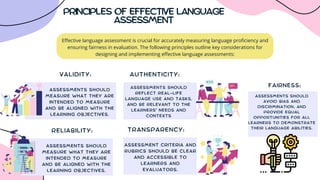
PRINCIPLES OF EFFECTIVE LANGUAGE
ASSESSMENT
VALIDITY:
ASSESSMENTS SHOULD
MEASURE WHAT THEY ARE
INTENDED TO MEASURE
AND BE ALIGNED WITH THE
LEARNING OBJECTIVES.
RELIABILITY:
ASSESSMENTS SHOULD
MEASURE WHAT THEY ARE
INTENDED TO MEASURE
AND BE ALIGNED WITH THE
LEARNING OBJECTIVES.
AUTHENTICITY:
ASSESSMENTS SHOULD
REFLECT REAL-LIFE
LANGUAGE USE AND TASKS,
AND BE RELEVANT TO THE
LEARNERS' NEEDS AND
CONTEXTS
TRANSPARENCY:
ASSESSMENT CRITERIA AND
RUBRICS SHOULD BE CLEAR
AND ACCESSIBLE TO
LEARNERS AND
EVALUATORS.
FAIRNESS:
ASSESSMENTS SHOULD
AVOID BIAS AND
DISCRIMINATION, AND
PROVIDE EQUAL
OPPORTUNITIES FOR ALL
LEARNERS TO DEMONSTRATE
THEIR LANGUAGE ABILITIES.
Effective language assessment is crucial for accurately measuring language proficiency and
ensuring fairness in evaluation. The following principles outline key considerations for
designing and implementing effective language assessments:
TYPES OF LANGUAGE ASSESSMENT
FORMATIVE
ASSESSMENT
SUMMATIVE ASSESSMENT
DIAGNOSTIC
ASSESSMENT
FORMATIVE
ASSESSMENT IS AN
ONGOING PROCESS
THAT PROVIDES
FEEDBACK TO
LEARNERS ON THEIR
PROGRESS AND HELPS
THEM IDENTIFY AREAS
FOR IMPROVEMENT. IT
IS OFTEN USED DURING
INSTRUCTION TO GUIDE
TEACHING AND
LEARNING.
SUMMATIVE ASSESSMENT IS
TYPICALLY USED AT THE END
OF A UNIT OR COURSE TO
EVALUATE WHAT A LEARNER
HAS LEARNED. IT IS OFTEN
USED FOR GRADING OR
CERTIFICATION PURPOSES AND
IS DESIGNED TO MEASURE
OVERALL ACHIEVEMENT OR
MASTERY OF A SUBJECT.
DIAGNOSTIC ASSESSMENT IS
USED TO IDENTIFY A
LEARNER'S STRENGTHS AND
WEAKNESSES IN A
PARTICULAR AREA. IT IS
OFTEN USED AT THE
BEGINNING OF INSTRUCTION
TO HELP TEACHERS TAILOR
THEIR INSTRUCTION TO MEET
THE NEEDS OF INDIVIDUAL
LEARNERS.
ASSESSMENT
FOR LEARNING
ASSESSMENT OF
LEARNING
VS.
Assessment for learning, also known
as formative assessment, is designed
to help learners identify their
strengths and weaknesses and make
progress toward their learning goals. It
is used during the learning process to
provide feedback, guide instruction,
and support student growth.
Examples of assessment for learning
include classroom assessments, self-
assessments, and peer assessments.
Assessment of learning, also known
as summative assessment, is
designed to evaluate what learners
have learned at the end of a unit,
course, or program. It is used to
assign grades, make decisions about
student progress, and communicate
student achievement to others.
Examples of assessment of learning
include final exams, standardized
tests, and certification exams.
ASSESSMENT FOR LEARNING VS. ASSESSMENT OF
LEARNING
VALIDITY AND RELIABILITY IN LANGUAGE
ASSESSMENT
In language assessment, validity refers to the extent to which a test
measures what it is intended to measure. A test is considered valid if it
accurately assesses the language skills it is designed to measure. For
example, a reading test that is intended to measure a student's ability
to comprehend written English should not include questions that
require knowledge of a specific cultural reference that is unfamiliar to
the student.
Reliability, on the other hand, refers to the consistency of a test's
results. A test is considered reliable if it produces consistent scores
across different administrations and different raters. For example, if a
speaking test is administered to the same student twice and the scores
are vastly different each time, the test is not considered reliable.
Both validity and reliability are important considerations in language
assessment. A test that is not valid or reliable cannot accurately
measure a student's language proficiency, which can have negative
consequences for the student's academic and professional
opportunities.
TYPES OF LANGUAGE ASSESSMENT
Language assessment is a process used to measure a person's ability to communicate
effectively. There are several types of language assessment, each with its own focus and
purpose.
Expressive Language Assessment: This assessment focuses on a person's ability to
express themselves verbally.
Receptive language assessment: This assessment focuses on a person's ability to
understand spoken or written language.
Pragmatics Assessment: This assessment focuses on a person's ability to use language
effectively in social situations. Skills such as turn-taking in conversation, understanding of
social norms, and the ability to adapt language to different social situations can be assessed.
Auditory Processing Assessment: This assessment focuses on a person's ability to process
and understand spoken language.
Visual Processing Assessment: This assessment focuses on a person's ability to process
and understand written language.
LANGUAGE ASSESSMENT
TESTS
LANGUAGE ASSESSMENT IN CHILDREN
Language evaluation in children is essential to identify possible language delays or
disorders and provide appropriate intervention.
The evaluation must be performed by a trained professional and may include a
variety of tests and observations.
Standardized tests: These tests are administered
uniformly to all children and are used to compare the
child's performance with that of other children of the
same age.
Examples of standardized tests include the Peabody
Picture Vocabulary Test (PPVT) and the Preschool
Language Scale (PLS) Early Language Test.
Baseline tests: These tests are used to
assess specific language skills, such as
listening comprehension or speaking.
Examples of reference tests include the Test
of Listening Comprehension of Language
(TACL) and the Test of Oral Expression of
Language (TOAL).
Observing language in natural contexts, such as home or school, can provide valuable information about a child's
language use in everyday situations. Professionals can use questionnaires or interviews with parents and teachers to
obtain information about the child's language use in different contexts.
Observation of Language in Context
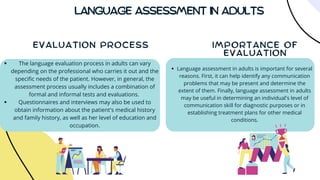
LANGUAGE ASSESSMENT IN ADULTS
IMPORTANCE OF
EVALUATION
EVALUATION PROCESS
The language evaluation process in adults can vary
depending on the professional who carries it out and the
specific needs of the patient. However, in general, the
assessment process usually includes a combination of
formal and informal tests and evaluations.
Questionnaires and interviews may also be used to
obtain information about the patient's medical history
and family history, as well as her level of education and
occupation.
Language assessment in adults is important for several
reasons. First, it can help identify any communication
problems that may be present and determine the
extent of them. Finally, language assessment in adults
may be useful in determining an individual's level of
communication skill for diagnostic purposes or in
establishing treatment plans for other medical
conditions.
SAEHU, A. 2012. TESTING AND ITS POTENTIAL WASHBACK.IN
BAMBANG Y. CAHYONO.AND ROHMANI N. INDAH (EDS.),
BROWN, A. (2014). PRONUNCIATION AND PHONETICS: A
PRACTICAL GUIDE FOR ENGLISH LANGUAGE TEACHERS.
ROUTLEDGE.
SAUKAH, A. 2013. PENILAIAN PEMBELAJARAN BAHASA. MALANG: UM
PRESS.
BROWN, H.D. AND ABEYWICKRAMA, P. 2010. LANGUAGE ASSESSMENT:
PRINCIPLES AND CLASSROOM PRACTICES (2ND EDITION). WHITE
PLAINS, NY: PEARSON EDUCATION.
SECOND LANGUAGE RESEARCH AND PEDAGOGY
(PP. 119-132). MALANG: STATE UNIVERSITY OF MALANG PRESS.
REFERENCE:

Learning_activity1_Erick_Mora.pdf

  • 1.
  • 2.
    DEFINING LANGUAGE ASSESSMENT Languageassessment is the process of evaluating a person's language proficiency or ability in a given language. It is an essential component of language learning as it helps learners and educators identify strengths and areas for improvement, set goals, and track progress. Effective language assessment should be aligned with the goals of language learning, reflect the complexity of language use, and be fair and reliable. It can take many forms, including formative assessments that are integrated into the learning process and summative assessments that evaluate learning outcomes at the end of a course or program The importance of language assessment lies in its ability to provide learners and educators with valuable feedback on language proficiency, inform instructional decision-making, and support the development of language policies and programs. It also plays a critical role in promoting equity and access in language learning by ensuring that assessments are fair, valid, and reliable for all learners, regardless of their backgrounds or circumstances.
  • 3.
    PRINCIPLES OF EFFECTIVELANGUAGE ASSESSMENT VALIDITY: ASSESSMENTS SHOULD MEASURE WHAT THEY ARE INTENDED TO MEASURE AND BE ALIGNED WITH THE LEARNING OBJECTIVES. RELIABILITY: ASSESSMENTS SHOULD MEASURE WHAT THEY ARE INTENDED TO MEASURE AND BE ALIGNED WITH THE LEARNING OBJECTIVES. AUTHENTICITY: ASSESSMENTS SHOULD REFLECT REAL-LIFE LANGUAGE USE AND TASKS, AND BE RELEVANT TO THE LEARNERS' NEEDS AND CONTEXTS TRANSPARENCY: ASSESSMENT CRITERIA AND RUBRICS SHOULD BE CLEAR AND ACCESSIBLE TO LEARNERS AND EVALUATORS. FAIRNESS: ASSESSMENTS SHOULD AVOID BIAS AND DISCRIMINATION, AND PROVIDE EQUAL OPPORTUNITIES FOR ALL LEARNERS TO DEMONSTRATE THEIR LANGUAGE ABILITIES. Effective language assessment is crucial for accurately measuring language proficiency and ensuring fairness in evaluation. The following principles outline key considerations for designing and implementing effective language assessments:
  • 4.
    TYPES OF LANGUAGEASSESSMENT FORMATIVE ASSESSMENT SUMMATIVE ASSESSMENT DIAGNOSTIC ASSESSMENT FORMATIVE ASSESSMENT IS AN ONGOING PROCESS THAT PROVIDES FEEDBACK TO LEARNERS ON THEIR PROGRESS AND HELPS THEM IDENTIFY AREAS FOR IMPROVEMENT. IT IS OFTEN USED DURING INSTRUCTION TO GUIDE TEACHING AND LEARNING. SUMMATIVE ASSESSMENT IS TYPICALLY USED AT THE END OF A UNIT OR COURSE TO EVALUATE WHAT A LEARNER HAS LEARNED. IT IS OFTEN USED FOR GRADING OR CERTIFICATION PURPOSES AND IS DESIGNED TO MEASURE OVERALL ACHIEVEMENT OR MASTERY OF A SUBJECT. DIAGNOSTIC ASSESSMENT IS USED TO IDENTIFY A LEARNER'S STRENGTHS AND WEAKNESSES IN A PARTICULAR AREA. IT IS OFTEN USED AT THE BEGINNING OF INSTRUCTION TO HELP TEACHERS TAILOR THEIR INSTRUCTION TO MEET THE NEEDS OF INDIVIDUAL LEARNERS.
  • 5.
    ASSESSMENT FOR LEARNING ASSESSMENT OF LEARNING VS. Assessmentfor learning, also known as formative assessment, is designed to help learners identify their strengths and weaknesses and make progress toward their learning goals. It is used during the learning process to provide feedback, guide instruction, and support student growth. Examples of assessment for learning include classroom assessments, self- assessments, and peer assessments. Assessment of learning, also known as summative assessment, is designed to evaluate what learners have learned at the end of a unit, course, or program. It is used to assign grades, make decisions about student progress, and communicate student achievement to others. Examples of assessment of learning include final exams, standardized tests, and certification exams. ASSESSMENT FOR LEARNING VS. ASSESSMENT OF LEARNING
  • 6.
    VALIDITY AND RELIABILITYIN LANGUAGE ASSESSMENT In language assessment, validity refers to the extent to which a test measures what it is intended to measure. A test is considered valid if it accurately assesses the language skills it is designed to measure. For example, a reading test that is intended to measure a student's ability to comprehend written English should not include questions that require knowledge of a specific cultural reference that is unfamiliar to the student. Reliability, on the other hand, refers to the consistency of a test's results. A test is considered reliable if it produces consistent scores across different administrations and different raters. For example, if a speaking test is administered to the same student twice and the scores are vastly different each time, the test is not considered reliable. Both validity and reliability are important considerations in language assessment. A test that is not valid or reliable cannot accurately measure a student's language proficiency, which can have negative consequences for the student's academic and professional opportunities.
  • 7.
    TYPES OF LANGUAGEASSESSMENT Language assessment is a process used to measure a person's ability to communicate effectively. There are several types of language assessment, each with its own focus and purpose. Expressive Language Assessment: This assessment focuses on a person's ability to express themselves verbally. Receptive language assessment: This assessment focuses on a person's ability to understand spoken or written language. Pragmatics Assessment: This assessment focuses on a person's ability to use language effectively in social situations. Skills such as turn-taking in conversation, understanding of social norms, and the ability to adapt language to different social situations can be assessed. Auditory Processing Assessment: This assessment focuses on a person's ability to process and understand spoken language. Visual Processing Assessment: This assessment focuses on a person's ability to process and understand written language.
  • 8.
    LANGUAGE ASSESSMENT TESTS LANGUAGE ASSESSMENTIN CHILDREN Language evaluation in children is essential to identify possible language delays or disorders and provide appropriate intervention. The evaluation must be performed by a trained professional and may include a variety of tests and observations. Standardized tests: These tests are administered uniformly to all children and are used to compare the child's performance with that of other children of the same age. Examples of standardized tests include the Peabody Picture Vocabulary Test (PPVT) and the Preschool Language Scale (PLS) Early Language Test. Baseline tests: These tests are used to assess specific language skills, such as listening comprehension or speaking. Examples of reference tests include the Test of Listening Comprehension of Language (TACL) and the Test of Oral Expression of Language (TOAL). Observing language in natural contexts, such as home or school, can provide valuable information about a child's language use in everyday situations. Professionals can use questionnaires or interviews with parents and teachers to obtain information about the child's language use in different contexts. Observation of Language in Context
  • 9.
    LANGUAGE ASSESSMENT INADULTS IMPORTANCE OF EVALUATION EVALUATION PROCESS The language evaluation process in adults can vary depending on the professional who carries it out and the specific needs of the patient. However, in general, the assessment process usually includes a combination of formal and informal tests and evaluations. Questionnaires and interviews may also be used to obtain information about the patient's medical history and family history, as well as her level of education and occupation. Language assessment in adults is important for several reasons. First, it can help identify any communication problems that may be present and determine the extent of them. Finally, language assessment in adults may be useful in determining an individual's level of communication skill for diagnostic purposes or in establishing treatment plans for other medical conditions.
  • 10.
    SAEHU, A. 2012.TESTING AND ITS POTENTIAL WASHBACK.IN BAMBANG Y. CAHYONO.AND ROHMANI N. INDAH (EDS.), BROWN, A. (2014). PRONUNCIATION AND PHONETICS: A PRACTICAL GUIDE FOR ENGLISH LANGUAGE TEACHERS. ROUTLEDGE. SAUKAH, A. 2013. PENILAIAN PEMBELAJARAN BAHASA. MALANG: UM PRESS. BROWN, H.D. AND ABEYWICKRAMA, P. 2010. LANGUAGE ASSESSMENT: PRINCIPLES AND CLASSROOM PRACTICES (2ND EDITION). WHITE PLAINS, NY: PEARSON EDUCATION. SECOND LANGUAGE RESEARCH AND PEDAGOGY (PP. 119-132). MALANG: STATE UNIVERSITY OF MALANG PRESS. REFERENCE: