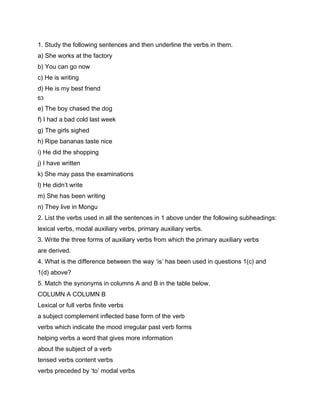
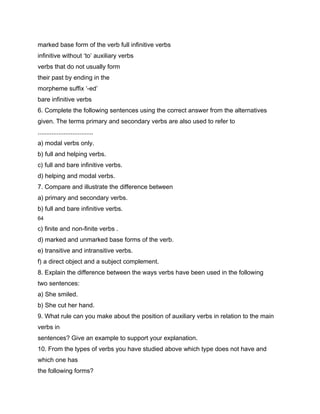
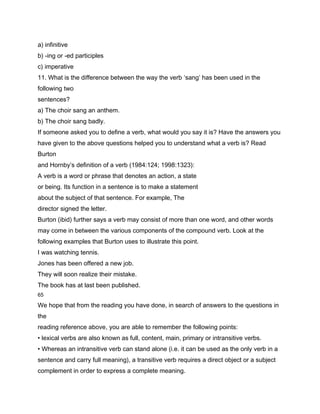
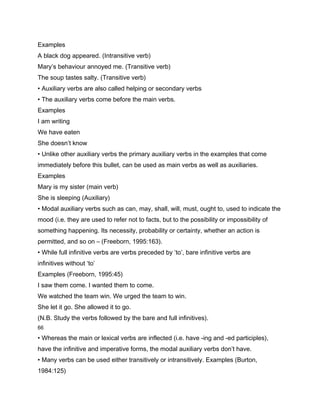
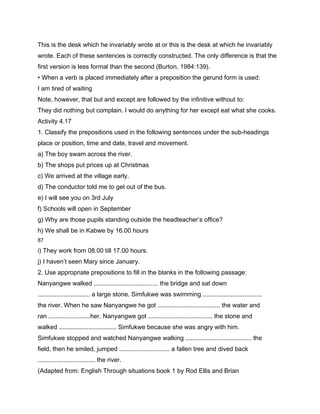
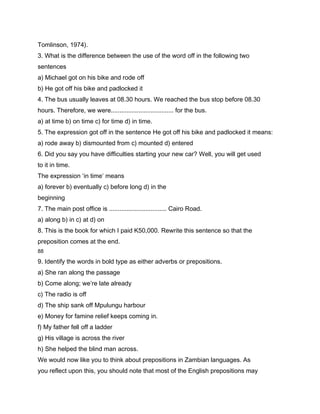
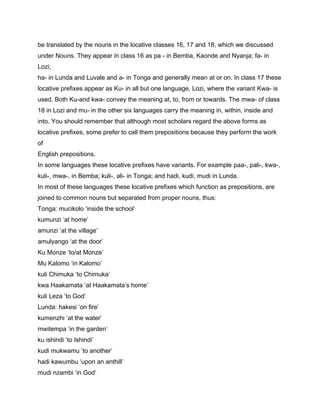
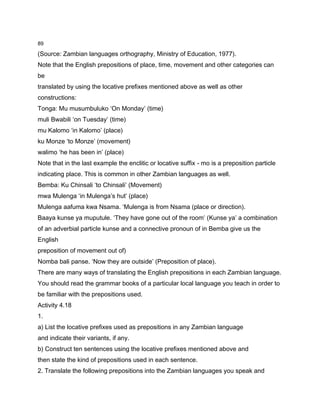
1

UNIT1: SELECTED APPROACHES, METHODS AND
TECHNIQUES
OF LANGUAGE TEACHING
Introduction
In this unit we will try and look at the theories and approaches to teaching and
learning. I am sure you are not meeting this topic for the first time. This is a
revision of what you did at pre-service training. We are briefly going to remind ourselves
on the historical aspects of these approaches and methods.
Learning Outcomes
Having successfully completed this unit the teacher should be able to:
• Use appropriate approaches, methods and techniques of language teaching.
A brief history of language Teaching
Refresh your mind by reviewing what language teaching means? (Read ZATEC literacy
and language module 1 page 83 to help you.)
Do you realise that for centuries Latin was being studied as a foreign language all over
the world? The reason given for its study was that, it was the only language of
education,
commerce, religion and government in the western world. However in the sixteen
century, French, Italian, and English gained in importance because of the political
changes in Europe, and so Latin gradually became displaced as a language of spoken
and
written communication. Do you have any idea what the children who entered "grammar
school" in the sixteenth and eighteenth centuries in England were taught?
Well! They were initially and rigorously introduced to Latin grammar, which was taught
through rote learning of grammar rules, study of conjugation and translation of written
sentences and dialogues. An attempt to promote an alternative approach to grammar
translation method completely failed because everyone believed that Latin developed
intellectual abilities.
Can you imagine what happened when modern languages began to enter the
curriculum
of European schools in the eighteenth century? The same basic procedures that were
used
for teaching Latin were applied. You may ask, what were these procedures? Their
textbooks consisted of statements of abstract grammar rules, lists of vocabulary, and
sentences for translation. In fact speaking a foreign language was not the goal, which is
why those grammar sentences bore no relationship to the language of real
communication.
2

By the nineteenth century, this approach based on the study of Latin had become the
standard way of studying foreign languages in schools. A typical textbook consisted of
chapters or lessons organised around grammar points. Each grammar point was listed,
rules on its use were explained, and it was illustrated by sample sentences. This
approach
to foreign language teaching became known as the Grammar-Translation Method.
(Read
page 3 and 4 of Approaches and methods in language teaching to get the principal
characteristics of the Grammar-Translation Method). In the mid- and late nineteenth
century opposition to the Grammar –Translation Method developed in several European
countries. Communication among Europeans demanded for oral proficiency in foreign
languages. Controversies emerged about the best way to teach foreign languages and
ideas were discussed and defended by different linguists. The linguists shared many
beliefs about the principles on which a new approach to teaching foreign languages
should be based. The natural language learning principles brought about the ‘Direct
Method’. (Read pages 5 to 11 of Approaches and methods in language teaching.)
Although the direct method was popular not everyone embraced it enthusiastically. It
offered innovations at the level of teaching procedures but lacked a thorough
methodological basis. Because of the short comings of the methods discussed above
the
linguists and language specialists sought to improve the quality of language teaching in
the late nineteenth century, and did this by referring to general principles and theories
concerning how languages are learned, how knowledge of language is represented and
organised in memory, or how language itself is structured.
Approaches, Methods and Techniques
Activity 1.1
As a teacher you have already studied some of the approaches and methods used in
language teaching.
• Write a list of some of these approaches and methods that are used in language
teaching.
• For each of these approaches try to give a brief description and some of the features
that distinguish it from the others.
• Which one do you often use and why?
• Do your learners benefit a lot because of using that method? Is there any evidence to
show that truly your learners benefit?
• If your manager or supervisor walked into your classroom unexpectedly to monitor
you, would you proceed comfortably in your work using the chosen approach or
method?
3

Your answer to activity 1.1 may have included the following approaches/methods,
descriptions and features.
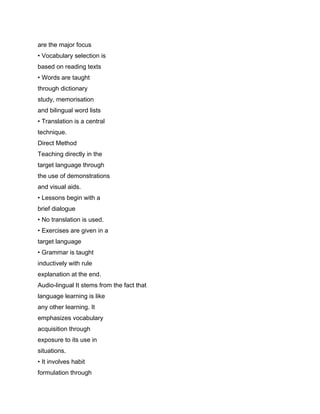
Approaches and methods Brief description Features
Grammar translation Translation of grammar
rules from the language
familiar to the learners to
the target language or vice
versa.
• Learning language
through detailed
analysis of grammar
rules
• Reading and writing
are the major focus
• Vocabulary selection is
based on reading texts
• Words are taught
through dictionary
study, memorisation
and bilingual word lists
• Translation is a central
technique.
Direct Method
Teaching directly in the
target language through
the use of demonstrations
and visual aids.
• Lessons begin with a
brief dialogue
• No translation is used.
• Exercises are given in a
target language
• Grammar is taught
inductively with rule
explanation at the end.
Audio-lingual It stems from the fact that
language learning is like
any other learning. It
emphasizes vocabulary
acquisition through
exposure to its use in
situations.
• It involves habit
formulation through
repetition and
memorization in order
to avoid errors at all
costs
• It gives learners
numerous opportunities
to speak
• Provides opportunity
for quick reinforcement
• Attends to structure
and form more than
meaning
• Native-speaker-like
pronunciation is sought
4

• Linguistic competence
is the desired goal
• The teacher is expected
to specify the language
that students are to use.
Cognitive Code An approach to language
teaching which stresses
the learners mastery of the
rules of the target
language
• It refers to mental
processes
• It emphasizes linguistic
competence and
performance
• Speaker learns
language through
mastery of its rules.
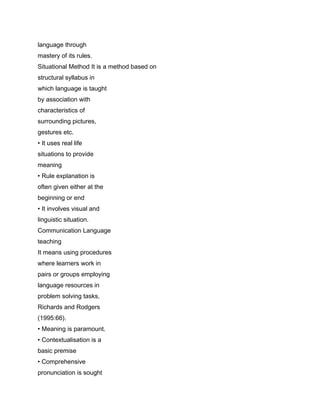
Situational Method It is a method based on
structural syllabus in
which language is taught
by association with
characteristics of
surrounding pictures,
gestures etc.
• It uses real life
situations to provide
meaning
• Rule explanation is
often given either at the
beginning or end
• It involves visual and
linguistic situation.
Communication Language
teaching
It means using procedures
where learners work in
pairs or groups employing
language resources in
problem solving tasks,
Richards and Rodgers
(1995:66).
• Meaning is paramount.
• Contextualisation is a
basic premise
• Comprehensive
pronunciation is sought
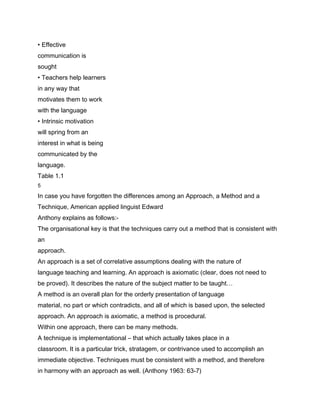
• Effective
communication is
sought
• Teachers help learners
in any way that
motivates them to work
with the language
• Intrinsic motivation
will spring from an
interest in what is being
communicated by the
language.
Table 1.1
5

In case you have forgotten the differences among an Approach, a Method and a
Technique, American applied linguist Edward
Anthony explains as follows:-
The organisational key is that the techniques carry out a method that is consistent with
an
approach.
An approach is a set of correlative assumptions dealing with the nature of
language teaching and learning. An approach is axiomatic (clear, does not need to
be proved). It describes the nature of the subject matter to be taught…
A method is an overall plan for the orderly presentation of language
material, no part or which contradicts, and all of which is based upon, the selected
approach. An approach is axiomatic, a method is procedural.
Within one approach, there can be many methods.
A technique is implementational – that which actually takes place in a
classroom. It is a particular trick, stratagem, or contrivance used to accomplish an
immediate objective. Techniques must be consistent with a method, and therefore
in harmony with an approach as well. (Anthony 1963: 63-7)
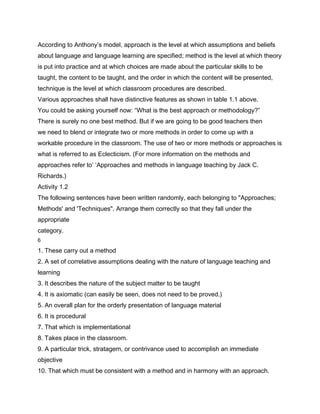
According to Anthony’s model, approach is the level at which assumptions and beliefs
about language and language learning are specified; method is the level at which theory
is put into practice and at which choices are made about the particular skills to be
taught, the content to be taught, and the order in which the content will be presented,
technique is the level at which classroom procedures are described.
Various approaches shall have distinctive features as shown in table 1.1 above.
You could be asking yourself now: “What is the best approach or methodology?”
There is surely no one best method. But if we are going to be good teachers then
we need to blend or integrate two or more methods in order to come up with a
workable procedure in the classroom. The use of two or more methods or approaches is
what is referred to as Eclecticism. (For more information on the methods and
approaches refer to’ ‘Approaches and methods in language teaching by Jack C.
Richards.)
Activity 1.2
The following sentences have been written randomly, each belonging to "Approaches;
Methods' and 'Techniques". Arrange them correctly so that they fall under the
appropriate
category.
6

1. These carry out a method
2. A set of correlative assumptions dealing with the nature of language teaching and
learning
3. It describes the nature of the subject matter to be taught
4. It is axiomatic (can easily be seen, does not need to be proved.)
5. An overall plan for the orderly presentation of language material
6. It is procedural
7. That which is implementational
8. Takes place in the classroom.
9. A particular trick, stratagem, or contrivance used to accomplish an immediate
objective
10. That which must be consistent with a method and in harmony with an approach.
From the exercise you can see that the organisational key is that techniques carry out a
method that is consistent with an approach. Within one approach, there can be many
methods. A technique is implementational. It must be consistent with an approach.
Summary
• There are different approaches, methods and techniques in language teaching.
• To be effective in teaching one needs to be eclectic i.e. integrate two or more
methods.
• An approach describes the nature of the subject matter to be taught.
• A method is an overall plan. It is procedural.
• A technique is implementational- that which takes place in the classroom.
• Grammar-Translation. A method of teaching grammar rules which learner use to
illustrate.
7

UNIT 2: LISTENING AND SPEAKING
Introduction.
What is listening? It is the activity of paying attention to and trying to get
meaning from something we hear. To listen successfully to spoken language, we need
to
be able to work out what speakers mean when they use particular words in particular
ways on particular occasions and not simply to understand the words themselves.
Listening is a skill that many find difficult even in the mother tongue. The amount of
concentration one can bring to a listening activity depends on one’s attention span, and
the stimulus given. Listening is not a passive skill. We cannot discuss listening in
isolation from the other language skill of speaking for the two make up what is termed
as
oral communication. Look at Figure 2.1 illustrating the four language skills and how
they are related.
Figure 2.1:(Byrne 1992: 8)
What do you think receptive implies? You need to understand that receptive in this case
does not imply passive. But that both in listening and reading, language users are
actively involved in the process of interpreting and negotiating meaning. Both listener
and speaker have a function to perform. In simple terms, the speaker has to encode,
while the listener has to decode (or interpret a message).
Learning outcomes
Having successfully completed this unit the teacher should be able to:
• Teach purposes of listening
• Teach good listening habits
• Teach the tips for listening and speaking
• Teach the purpose of speaking
8

Activity 2.1
Answer all of the following questions.
• What is your understanding of successful listening?
• Do you always take in everything when you are listening?
• When a friend is speaking to you, what helps you to comprehend their message?
Write your answers somewhere because you will need to refer to them later.
Effective Listening:
What do you think is effective listening? Donn Byrne (Teaching Oral English) explains
that effective listening involves a number of skills that are deployed simultaneously and
these are:
• The spoken signals which have to be identified from the midst of the surrounding
sounds.
• The continuous stream of speech that has to be segmented into units, which have to
be recognised as known words.
• The syntax of the utterances that has to be grasped and the speaker’s intended
meaning which has to be understood.
• The application of the linguistic knowledge to formulating a correct and appropriate
response to what has been said.
We know that the active nature of listening means that the listener must be motivated by
a communicative purpose.
Reflect
Reflect upon what happens when you are listening to the:
• News bulletin
• Songs
• Poems or the doctor’s instructions.
• Do you maintain the same degree of attention in the above three instances of
listening?
• Give reasons for your answer.
People have various reasons for listening. You too, have your own reasons. Sometimes
we listen for pleasure, sometimes we listen for total comprehension and yet, other times
for the retention of main ideas or points. The different purposes help us maintain the
degree of attention.
9

Activity 2.2
Complete the table below to illustrate the purpose of listening.
Situation Purposes
Football commentaries
Speech by your local counsellor
Oral comprehension passage
Sermon in the church
Giving directions
Football match
Narration of family history
Watching a video
Many people find themselves in a variety of situations where they need to listen for
different purposes. The following are some of the main reasons for listening:
• Improving the listening attitude where you listen for pleasure e.g. listening to music
playing on radio, stories plays etc.
• Developing aspects of language where listeners include listening to improve the
pronunciation of sounds, stress and rhythm and intonation in language as well as
becoming familiar with new words and structural patterns.
• Reinforcing conceptual development where some spoken texts, such as stories can
act
as useful revision for reinforcing concepts.
Providing support for literacy where listeners get encouraged to make connections
between spoken and written language by picking out written words or statements which
are part of a spoken message. (Reading File: Volume 4: 1994)
10

Now look at what Byrne (1992:15) says on purpose and nature of listening
comprehension programme:
• To give the learners experience of listening to a wide variety of samples of spoken
language. The purpose therefore is exposure (as in the mother tongue) to:
- different varieties of language (standard/regional, formal/informal) etc.
- different text types (conversational, narrative, informative etc.). The motivation for
the learner should be pleasure, interest, and a growing confidence at being able to
understand the spoken language without reference to the written form.
• To train the learners to listen flexibly, e.g. for specific information, for the main
ideas or to react to instructions (i.e. by doing something).
• To provide, through listening, a stimulus for other activities e.g. discussion, reading
and writing.
• To give the learners opportunities to interact while listening, e.g. in a classroom this
must be done largely through discussion – type activities and games, where listening
forms a natural part of the activity.
Steps to active listening
The steps to be followed in order to enhance active listening are outlined below:
• Be prepared to listen. This is done by turning out all distractions and make
yourself comfortable. As a listener, look at the speaker to pick up sable messages
which could be conveyed by body language.
• Decide the purpose of listening for each occasion. These can be attained through:
(i) Information gathering
(ii) Mentally stimulated or challenged
(iii) Help in forming opinion
(iv) Broaden your understanding
(v) Develop closeness.
• Plan your fulfilment for the purpose of listening. This can be attained through:
(i) Listening to gather information
(ii) Forming an opinion
(iii) Listening to develop closeness to a friend.
Authentic listening situation:
So far we have been discussing listening theoretically. I suggest that we now try to look
at listening in more practical terms by looking at situations that we find our selves in
regularly.
1. Listening to announcements: Imagine you are at a bus station, airport or railway
station waiting for a friend. What do you hear? A baby crying; noise of a train
pulling out; shuffling of feet as people rush to go and board? What are you listening
for? In a situation like this you are probably listening for the voice of your friend.
11

Do you realise that you are almost exclusively interested in extracting the relevant
information from that of your friend’s voice while more or less ignoring the rest of
the utterances.
2. Listening to the radio: Do you sometimes find it difficult to listen to the radio?
Have you ever thought why? In this situation as a listener you have very limited
knowledge of what is going to be said or who is going to say it. Therefore the
language of entertainment programmes on radio does certainly require a high level of
listening skill.
3. Watching live performance: Have you ever watched a play at your school or
perhaps in a theatre? What was your objective of watching that play?
4. Listening on the telephone: You have probably done this simply to take a message
or have a conversation. Again like listening to the radio you are unable to see the
speaker and in addition have had problems in distinguishing the spoken sounds
because of interference and distortion.
5. Listening to instruction: Do you remember your sports lessons at school where you
listened to instructions from your sports teacher? You probably found that your
immediate response to the task was often made easier by the visual support of the
teacher.
6. Listening to public speaking: What makes you listen to a speech, for example?
When people attend rallies they are often as interested in the views and attitudes of
the speaker as they are in the actual topic being spoken about.
Can you now suggest some more authentic listening situations in addition to the above
list?
7……………………………………………………………………………………………
8…………………………………………………………………………………………….
9…………………………………………………………………………………………….
10…………………………………………………………………………………………...
Activity 2.3
You and I have discussed some of the authentic listening situations. I believe you and
your pupils at one time have found yourselves in such situations. Can you try and
design
tasks that you can engage your pupils in to help them practise and develop their
listening
skills, especially in the classroom. Share what you have written with your friends in the
12

Teachers’ Group. Try out one task with your friends before you can do it with your
pupils.
Authentic listening tasks
Have you ever exposed your pupils to listening to a variety of authentic texts so that
they
practise and develop their listening skills? As teachers it is important that we make our
pupils hear samples of un-simplified language from the earliest stages. The objective of
this is not to discourage them but to demonstrate to them that they can interpret quite a
lot of the situational features even if they do not understand what is being said. The
material for the exposure as Byrne (1992: 16) puts it could include the following:
1." Stories, anecdotes, jokes, talks, commentaries.
How do we make these interesting and mind capturing? We may have these materials
recorded or improvised by us. If we are giving a story or a talk we should try to be as
spontaneous as possible. It may be better to use outline notes rather than read a script.
2." Conversation, discussions, plays.
In this case it is important to give pupils background e.g. about the speakers
3. Songs (modern, western)
Do you think this would provide a good form of listening? Well, it would because the
pupils are generally very much concerned to make out the words. I am sure this could
be
combined with some task especially that of ‘ear-training’, where learners could be asked
to distinguish between key sounds, stress and intonation patterns.
4." Videos and films.
Can you imagine what a great advantage it would be in using wherever possible
recorded
material, where the pupils can see what is happening as well as listening.
Note that these items should be followed by related tasks like asking pupils to write
down the words of a song for example which could begin as an individual task and then
lead on to class or group discussion or writing. However the main aim is to provide
pleasurable listening as an end in itself.
Strategies for teaching listening skills
1." Stories:
Do you remember the times you listened to stories from your mother, father, and grand
parents or indeed from brothers and sisters? Did you have an idea why those stories
were being told to you? Really, stories are a rich source of listening practice. In order to
develop listening skills, there are a number of different strategies that you can use in the
context of listening to a story. For instance:
13

Getting the general picture:
Think for a minute; remember an occasion when you were at school or at college. Draw
your mind to that lesson when your teacher/lecturer told a story. Why do you think
he/she made you listen to that story? Could it have been that he/she encouraged you to
listen to the story simply for pleasure? I believe your teacher’s intention was not for you
to remember details but to get the general idea of what the story was about.
Predicting:
Your teacher/lecturer should have encouraged you to predict events in a story and then
to
check whether what you heard matched your expectations.
2. Physical response:
Instructions:
This can either be done from instructions recorded on tape or instructions from you the
teacher or perhaps more interestingly, between the learners themselves in the
classroom.
Some of the well-known activities involving instructions are:
Putting pictures in order.
This is a very good while-listening activity. Present your learners with a number of
pictures. (See Figure 2.2 below). When re-arranged, the pictures form a logical story.
The learners’ task is to listen to you narrating the story as shown in the transcript below,
and then re-arrange the pictures in a logical order by merely putting letters A, B, C etc.
against the Arabic numerals 1,2,3 etc.
14
Figure 2.2

Transcript.
Bwalya was out for a walk one day when she came to a gate in a wooden fence. ‘I
wonder,’ she said to herself, ‘where this leads to?’ She went through it and immediately
came face to face with a very big fierce looking dog. It made her nervous. ‘Does your
dog bite?’ She asked the boy who was standing beside the dog. ‘No. it doesn’t, he
replied. Bwalya leaned forward to pat the dog on the head. ‘Nice doggie,’ she said. But
the dog immediately jumped at her and, she ran for safety towards a tree, it ran after
her,
growling, and tore a piece of cloth from her coat. ‘I thought you said your dog didn’t
bite,’ she said to the boy as she hung from a branch of the tree. ‘That is right,’ he
replied. ‘It doesn’t. But this isn’t my dog.’
Picture dictation:
Unlike the traditional dictation in which you ask learners to remember large chunks of
language, picture dictation is an active process in which you ask learners to draw a
picture that you the teacher (or another learner) talks about without showing them. It
can
be any picture, but the description has to be entirely visual and simple, so that even
those
learners that are not gifted in drawing can draw intelligibly. For example, you may say
something like this:
‘I want you to listen to what I am going to say to you about a certain village in Luapula
Province. While you are listening, draw your impression about this village.’ So here we
go.
15

‘There is a village in Luapula near lake Mweru. The huts are built close together. The
roofs are made of grass. There are palm trees all round this village. Just outside this
village there is a cemetery.’
It is obvious that there will be a variety of versions for the above description depending
on how much an individual understood from the dictation.
For more activities read Tutors’ Guide module 3 and 4 of literacy and language,
Teaching
Oral English by Donn Byrne, Young Learners by Sara Phillips, Teacher Training
Reading File Chipata and Mansa. (Icon 8)
Summary
Listening is a skill that we acquire first in childhood. We have also learnt that there are
various reasons why people listen and that some of these reasons are:
• Pleasure
• Total comprehension
• Retention of main ideas or points and that to be good listeners people need to:
• Choose what to listen to
• Attend from the beginning
• Maintain the degree of attention relevant to the purpose of listening
• Look at the speaker in order to interpret verbal and non-verbal cues accurately.
16

Speaking
Introduction:
Unlike listening, talking is something most people need little encouragement to
do. But promoting free speaking in our pupils in our classrooms and especially
in the second language can be difficult. What then should we do? As teachers we need
to provide pupils with an interesting stimulus that will give them a natural purpose for
speaking. Can you remember what we said about oral communication in unit 2? We
said
that oral communication is a two way process, between the speaker and the listener.
We
also saw how communication could not take place unless the two skills were developed.
Learning outcomes
Having successfully completed this unit the teacher should be able to: -
• Teach purposes of speaking
• Teach good speaking habits
Reflect
• Reflect on a situation when you were spoken to, and you failed to respond.
• Reflect on a situation when you wanted to say something or give instructions and the
listeners could not respond.
In both instances say why you think it was difficult to respond and suggest what should
have been done.
Have you ever thought of why we speak? We speak in order to:
• Express personal feelings From page 16-17
• Convey messages
• Get things done e.g.
Persuading
Commanding,
Instructing,
Apologising and
Teaching.
17

Effective speaking
What do we mean when we say, “Jane is a good speaker”? As you may be aware, a
good
speaker uses: -
• Appropriate words
• Appropriate gestures
• Good pronunciation, stress and rhythm and pauses in order to get a feedback or check
the effect of what they are saying. Good speakers avoid the use of unnecessary
fillers. They vary the pitch of their voices according to the situation.
What is the purpose for teaching speaking?
One of the main goals in teaching the productive skill of speaking is oral fluency. We
can define this as the ability to express oneself intelligibly, reasonably accurately and
without too much hesitation (otherwise communication may break down because the
listener loses interest or gets impatient). To attain this goal, we need to bring the
learners
from the stage where they are mainly imitating a model of some kind, or responding to
cues, to the point where they can use the language freely to express their own ideas.
Byrne (1992:9)
We know that oral communication is a two-way process between speaker and listener.
Study the Figure 2.3 (Byrne: 1992:10) below and see what happens in a speech
situation
and what is involved in oral ability.
Figure 2.3
What do you learn from the diagram? You have noticed that one person may do all the
speaking e.g. in a lecture. In this situation the speaker initiates and simply keeps up the
flow of speech. This can also happen sometimes when a person is giving instructions or
directions. However in a conversation although one person initiates, the speaker and
the
listener are constantly changing roles, and consequently speaking involves responding
to
what has been heard. We can, therefore, say speaking is an integral part of listening.
How then do we ensure that the skills are integrated especially in our classroom? Do we
integrate through situations that permit and encourage authentic communication? (e.g.
18

especially through talk and discussion in small groups) or do we teach learners how to
keep the channel of communication open in such situations? (e.g. by asking for
repetition
and clarification ; by interrupting; by signalling agreement or disagreement etc.). Think
about it! (Byrne: 1992:11)
Communicative activities:
Take a minute or two to think about communicative activities. You often use
communicative activities in your class, in your Teachers’ Groups. and you did some at
college. What then do we mean by communicative activities? We may say that
language
teaching practice places considerable emphasis on introducing communicative tasks or
activities in the classroom in order to promote language use. We need to think of a
communicative activity as a piece of work that involves learners in using language in
order to get something done. We need to call upon learners to: -
• Gather information in English or Zambian language
• Exchange information
• Work together in order to produce information in English or Zambian language.
Activity 2.4
Study the following points and use them to design task-based activities.
• Let the activity be exciting, interesting and motivating for the learners.
• Let it provide a suitable challenge for the age group. It should stretch them a little
without being too difficult.
• Learners should focus on getting the task done rather than practising a language item.
• Learners need to use both receptive and productive skills to complete the activity.
• The activity should be within the conceptual ability of the learners. (Promat:
Language Methodology: Unit 1: 48)
Summary
We have learnt about:
• Purposes of speaking
• Effective speaking
• Purpose of teaching speaking
We have also learnt that: -
Oral communication is a two-way process
• In real life situations we integrate the skills of listening and speaking.
19

UNIT 3: TEACHING / LEARNING RESOURCES AND THE USE
OF
AUTHENTIC MATERIALS.
3.1. TEACHING AND LEARNING RESOURCES.
Introduction
In this unit we are going to discuss teaching and learning materials you have used
in the classroom. It is important to know the difference between teaching and
learning resources.
Learning Outcomes
At the end of the unit teachers should be able to:
• distinguish between teaching and learning resources and
• use the learning resources appropriately.
Teaching resources are materials used by the teacher in order to enhance the
teaching process. The learning resources usually refer to textbooks that are
sources of information for the learner. In most of the cases, it is difficult to draw a
distinction between teaching and learning resources because they complement each
other.
Both of them create an environment for teaching and learning.
A learning resource is an object that may serve as a medium of teaching on the part of
a
teacher, and learning on the part of a pupil. Experience has shown that the use of
learning
aids can greatly increase and reinforce learning.
Research evidence has shown that we learn and retain:
10% of what we hear
15% of what we see
20% of what we both see and hear
40% of what we discuss with others
80% of what we experience directly or practice
90% of what we attempt to teach others
Figure 3.1
20

You may, as a teacher, have experienced that teaching can become more effective if
appropriate resources; human and physical are available. Language teachers should be
resourceful and not only depend on already made or written teaching/learning materials.
Being resourceful and improvising materials means that a language teacher should
exploit the surrounding environment and make use of materials that can enable learners
to understand the lesson.
What kind of learning resources do you use in your school? Do you know that it is
important to use appropriate and suitable learning resources? Below are important
considerations for the use of learning resources:
- How much information the T/L aid conveys.
- The age level of pupils
- The number of pupils
- The characteristics of the learning aid itself.
As a teacher you should use learning aids as a means of extending your ability to
communicate and make instructions more effectively. You should create learning
resources that will make your classroom interesting and challenging. Because
commercially made learning resources are usually difficult to find, they should be
improvised by using locally available materials.
Some of the locally available materials that a teacher can use to assist learners to learn
effectively and efficiently are: textbooks, teacher’s guides, work books, models,
collection of plants, insects, artefacts, magazines and newspapers.
It is important to remember the points below as we make teaching and learning aids:
• Learning aids are an additional source of information and not a complete method
of teaching.
• Learning aids should be relevant to the subject of the lesson.
• Real objects or specimens are the best learning aids
• Models are better than charts, pictures and maps. Let pupils handle models
• Too many learning aids can distract learner attention from the main subject of the
lesson
• You must encourage pupils to collect and make learning aids
• Use locally available materials for aids as much as possible
• Aids should not be left in the classroom for too long.
Activity 3.1
Make a list of the kind of materials you would use in the classroom to help your pupils
develop their listening skills. For each material write the instructions you would give and
the activities the pupils would be involved in. Refer to unit 2 of this module on Listening
and Speaking for more information.
21

How often do you allow your learners in your class to improvise? Improvisation
is a way of encouraging general confidence and fluency in language use by allowing the
learners to explore and exploit their communicative repertoire in any ways they wish. It
also encourages them to express their own imagination and individuality through the
language. This in turn helps them to relate the new language to their own personality.
Her is an example of how you can allow improvisation in a language lesson. The
starting
point to make an improvisation may be to come up with a simple everyday situation into
which the learners are asked to project themselves. For example, they should be asked
to
improvise (in pairs) a scene of a meeting between old friends who have not seen each
other for several years. Other examples are to role-play or dramatise a scene.
Activity 3.2:
Why do you use teaching/learning resources in a lesson? Explain.
Compare your answer with Macharia & Wario (1989:67) reasons for using teaching and
learning resources in a lesson:
• stimulate pupils’ interest
• capture pupils’ attention
• evoke responses from the pupils
• clarify abstract concepts by giving them concrete dimensions
• provide variety in learning
• encourage discussion in a language lesson
• improve the classroom environment by providing excellent materials for display.
Reflect
Look around your classroom and answer the following questions:
1. What teaching/learning materials do you use for teaching reading?
2. How many of these materials have you improvised?
3. Do you use improvised situations in order to teach reading? Give an example.
Activity 3.3:
What teaching/learning materials would you use to teach writing in Lower and Middle
Basic grades?
22

Summary
• Teaching / learning materials are texts and aids used by the teacher and
learners in order to help the learner grasp the content.
• These are prescribed or created by the teacher.
3.2. USE OF AUTHENTIC MATERIALS
Introduction
In the previous section, we discussed the importance of improvising T/L
materials. The materials you improvise are often those you use in real life situations.
These materials are real or genuine. They are therefore called authentic materials.
Authentic materials are any materials that are not originally produced for use in the
classroom, but that could be used as a focus for all or part of a lesson.
Examples of these might include: photographs, newspapers, advertisements, crossword
puzzles, brochures, pamphlets, games, jokes, diaries, real objects, films, video, receipts
and many more.
Learning Outcomes
• To encourage teachers to be creative and improvise or produce their own materials.
Activity 3.4:
In your school discuss the various authentic materials that could be used with
Grades 1 – 7. Then complete the table below:
Grade
Source of Authentic
Materials
Type of Activity
How it could be used
1
2
3
23

4
5
6
7
Table 3.2.
Modern thinking in language teaching stresses the importance of authentic
materials, because they are samples of language in use – they are
communicative. As a teacher you should ensure that language is used in real life to
perform certain tasks in the classroom because language has functions.
You may have observed that authentic texts such as newspapers are created to
communicate something, while many typical classroom texts are teacher generated in
order to focus on particular teaching point, for example, the past simple tense. These
teacher-generated texts will be quite unnatural in that the frequency of instances of the
teaching point will be far greater than would be found in the real world of authentic texts.
While teacher-generated texts can be useful, it is more useful if something like the past
simple tense can be taught in the context in which it is found in the real world, say in the
newspaper report.
Activity 3.5:
Make a survey in your school and explain how different authentic materials are stored.
Reflect
1. Do you use authentic materials in your class?
2. Have you thought of categorising them in terms of topic and theme? Give
examples.
Activity 3.6
Make any teaching material that you would use for authentic teaching. Explain how you
would use it.
24

Summary
• Authentic materials are used in language learning because they are:
appropriate, unique, true, holistic, everywhere, natural, textual, interesting and
communicative = AUTHENTIC.
• Authentic materials ensure that language is used in real life situations.
25

UNIT 4: GRAMMAR
Introduction
You are now going to look at one of the most interesting aspects of language study. You
will spend time examining major parts of the grammar of English and Zambian
Languages. As you read on you will discover that this unit is dealing with the structure
of words, the rules of arranging words into sentences in both English and Zambian
Languages and word classes. We can assure you that the knowledge of major aspects
of
English and Zambian Languages grammar, which you will gain from reading this unit,
will give you enough confidence to be an effective teacher of both languages.
Learning Outcomes
At the end of your reading we expect you to:
• Demonstrate ability to understand the structure of both English and Zambian
Languages.
• Use your knowledge of the way English and Zambian Languages work to
determine which aspects of language structure need emphasing in your
lessons.
• Determine which aspects of language structure cause less learning difficulties
for pupils.
• Do a contrastive analysis of grammatical elements and Zambian Languages in
order to identify similarities and differences between the former and the latter.
• Use the knowledge of contrastive analysis to both predict Zambian pupils
learning difficulties in English and find remedies before you present your
lessons.
The structure of words
We assume that before you began reading this sentence you had read the title of this
unit.
Look at it again. What ideas do you form in your mind when you read this title ‘The
Structure of Words’? Pause for a moment and write a sentence explaining the meaning
of this title.
Did it occur to you, while you were thinking about the meaning of the title of this unit,
that you were actually getting ready to study parts of words?
26

Activity 4.1.
Look at the following words and divide them into their constituent parts.
English Zambian Languages
playful basankwa (Tonga)
mucikolo (Tonga)
tulamuyanda (Tonga)
unkindness adzabweranso (Nyanja)
anamangidwa (Nyanja)
helpless meeno (Kaonde)
lilepe (Lozi)
unfaithfulness kulobala (Lozi)
jumping tatulaabamona (Bemba)
ducks balapeelana (Bemba)
If you have problems in dividing the words given above into parts, ask for assistance
from fellow teachers or, in the case of Zambian languages, people who know the
languages we have drawn examples from.
The exercise you have done above is a test for you to judge whether or not you know
the
structure of words in English or, indeed, Zambian languages. What was your division of
words into parts like? Check if you divided the words properly.
The word playful has two parts, the stem play and the suffix - ful which marks this word
as a member of a particular class of words called adjectives. Note, however, that not all
adjectives end in -ful. Unkindness has three parts, un- a prefix which carries a negative
meaning, - kind is the stem, - ness is a suffix which- expresses a state or quality and/or
often marks an item as a noun (Quirk, et al, 1985:69; Crystal, 1987:90). There are two
parts in helpless, the stem help and the suffix - less which marks an item as an
adjective.
Unfaithfulness has even more parts, un - which carries a negative meaning, - faith - as a
stem, - ful - the adjective suffix and - ness which marks the item as a noun (Langacker,
1967:74 - 75). In jumping, jump is the stem while the - ing suffix helps to convey a
sense of duration (Crystal, 1987:90). The word ducks consists of duck and the suffix - s
which expresses plural (Ibid).
We hope you found the above analysis fascinating. We also hope you noticed that the
structure of each word indicated what class or part of speech it belonged to. Quirk, et al
(1985:69) summarizes this phenomenon thus:
Such indicators enable a speaker of English to recognize
implicitly the word class of an item, even if he has not met
that item before, purely on the basis of its form.
27

Were you able to recognize the word class of each linguistic item you came across in
English before you read this unit? Let’s now turn to the Zambian languages words you
were asked to divide into parts. Was it easier for you to divide Zambian languages
words
into parts than the English ones? Here are the words in the five of the local official
languages.
Tonga
The word basankwa, young men or boys, in Tonga belongs to class two nouns. It has
two parts, ba - is a prefix which expresses plural while - sankwa is the stem which
carries the meaning youngman or boy. The singular is musankwa (class 1), young man
or boy, from mu - - sankwa. Mucikolo, inside the school, has three parts, the extra
prefix of the locative class (i.e. class 18) mu - carries the meaning ‘inside’; - ci - is a
class
7 prefix which expresses singular and - kolo, as a stem, carries the meaning school.
Tulamuyanda, we want him or her, is a verb which consists of five parts: tu - carries the
meaning ‘we’; - la - is part of the tense marker (ie. the present simple) - mu - is the
object
personal pronoun ‘him’ or ‘her’; - yand - is the stem of the verb ‘want’ and - a, as a
suffix, is tense marker two.
Nyanja
Adzabweranso, he/she will come again, is a verb with five parts: the prefix a -
represents
the subject pronoun ‘He’ or ‘She’; - dza - is a tense marker which carries the meaning
‘future’ or ‘will’; - bwer -, carries the meaning of the verb ‘come’; - a - is a second tense
marker and -nso expresses the meaning ‘again’. In anamangidwa, they/she/he was
arrested, there are equally five parts: the prefix a - expresses the subject pronoun ‘he’,
‘she’ or ‘they’; - na - helps to convey the notion ‘in the past’; - mang - is the stem for the
verb ‘arrest’; - idw- is the suffix for the passive extension ‘be arrested’ and - a is part of
the tense marker.
Kaonde.
If you had problems in dividing these words when you looked at them for the first time, it
must be much easier now for you to do so. To identify the parts in the word ‘meeno’,
‘teeth’, you need to know that in this language, ‘tooth’ is called jiino from ji - which
expresses singular and -ino, the stem which carries the meaning ‘tooth’. Therefore, in
‘meeno’, ‘teeth’, there are two parts: ma -, the class 6 noun prefix which expresses
plural
in most Zambian languages, and -ino which carries the meaning ‘tooth’. You may ask
what happens to the vowels ‘a’ and ‘i’ in the prefix and the stem, respectively, in order
for us to have the ‘ee’ we see in ‘meeno’, ‘teeth’. Well, this is a result of vowel
coalescence or fusion of vowels within a word. In most Zambian languages vowel ‘a’
fuses with ‘i’ to form a long vowel ‘ee’. Can you think of other examples? Please write
them down.
Lozi
In this language the noun lilepe means ‘axes’. It has two parts: the prefix li - which
carries the meaning plural and the stem - lepe which conveys the meaning ‘axe’.
28

Kulobala, to sleep, is an infinitive verb with three parts: ku - expresses ‘to’; - lobal -
carries the meaning ‘sleep’ and the suffix - a denotes the present simple tense.
Bemba
The word tatulaabamona, we have not yet seen them, has six parts: ta-, -tu-, - laa -,
-ba-, - mon - and - a. The prefix ta - carries a negative meaning; - tu - stands for the
subject pronoun ‘we’; - laa - conveys a sense of duration or the notion ‘have ... yet’; - ba
- represents the object pronoun ‘them’; - mon - carries the meaning ‘see’ and the suffix -
a is part of the tense marker - laa -. In balapeelana, they give each other, there are five
parts: the verb prefix ba - stands for ‘they’; - la - is part of the tense marker (ie. present
simple tense); - peel - is the verb stem which carries the meaning ‘give’; - a - is tense
marker two and - na carries the reciprocal extension meaning ‘each other’.
Reflect
Reflect upon what we have said so far in this unit and answer the following
questions.
1. What have we been talking about so far in this unit?
2. From the examples given in both English and Zambian languages, give similarities and/or differences between the forms of
words.

3. Do you think the knowledge obtained from this unit will be more relevant to the
pupils than the teacher? Give reasons for your answer.
4. What term is used to describe the study of the structure of words?
5. Give examples of words in English and a particular Zambian language you speak
which do not have an internal grammatical structure we have identified in the
examples given so far.
If you have read books that talk about the structure of words, you probably know that
this
study deals with the minimum meaningful grammatical units of a language and how they
are combined to make words. It is called morphology. Dixon (1991:4) says morphology
deals with the structure of words. We hope you have now understood that in this unit we
are learning about morphology or the internal grammatical structure of words.
We are very sure that if we asked you to divide the word unfriendliness into parts, you
would know that it consists of four parts: un-friend-li-ness and that each of these parts
has a meaning. The parts of a word are the elements we refer to as minimum
meaningful
grammatical units. Do you know what these parts are called? They are known as
morphemes.
Do you know that morphology is one of the components of the aspect of the scientific
study of language that is usually called Grammar? Read what Crystal (1987:90) says:
Morphology: This branch of grammar studies the structure of words.
29

Activity 4.2
Answer the following questions
1. What is morphology?
2. With the help of examples from both English and Zambian languages explain
what a morpheme is.
3. In your Teacher Group discuss what you think grammar is and give examples.

4. Give examples of nouns and verbs that have between two and six parts in the
Zambian language you know very well and explain the meaning of each part.
5. Prepare a forty minute lesson plan in which you teach pupils nouns that begin
with the prefix un - and end in the suffix - ness.
Let’s go back to the term morpheme. Linguists sometimes distinguish between
free and bound morphemes. Look at the following words in English and identify
free and bound morphemes.
boy, quickly, unable, sadness, dogs, sad, rapidly
Free morphemes are those that can stand alone as independent words (e.g. tie, sad;
bwera, ‘come’ in Nyanja and ine, ‘me’ in Bemba). All the others that cannot stand alone
as independent words are said to be bound morphemes as is the case with the plural
morpheme s in dogs, the -ness of sadness, the -ly of rapidly (Langacker, 1967:75 - 77),
and the prefix a - as well as infix or tense marker - dza - ‘will’ in adzabwera, He/she
will come, in Nyanja. In the Bemba word nkaya, I will go, the personal pronoun n - ‘I’
and the tense marker - ka -, ‘will’ are bound morphemes while - ya, ‘go’ is a free
morpheme.
Are you aware that morphology is linked to the concepts of derivation and inflection?
What do these terms mean? Dixon (1991:4) provides the answer to this question:
If a morpheme is added to a word and yields a word of a
different kind, this is called a derivation, e.g. the formation
of adjective beautiful from the noun beauty, noun decision
from verb decide ...
If a morpheme just adds some extra element of meaning to a
word, which is required by the grammar of the language,
then it is called an inflection, e.g. the verb kill inflects for
past tense, becoming killed, and the noun horse inflects for
plural number, becoming horses.
Does the above explanation help you to understand the difference between derivation
and
inflection? Can you give examples of derivation and inflection in your local language?
30

Activity 4.3
Look at each of the following examples and state whether it is a case of inflection or
derivation:
• manga, arrest, - mangidwa, be arrested.
• saka, want, - sakilwa, be wanted
• bomba, work, - umubomfi, a worker
• butuka, run, - butukisha, run hard (ie.faster).
• konka, follow, - umukonshi, a follower or disciple
• lata, love, - mulatiwa, one who is loved
• yanda, want, - yandwa, be wanted
• tuma, send, - intumi, a messenger.
Activity 4.4
Go over the work starting immediately below the questions in Activity 4.2 and then
answer the following questions:
1. Explain and illustrate the difference between:
(a) free and bound morphemes
(b) inflection and derivation.
2. Prepare a lesson plan in which you teach pupils how to form nouns from verbs in
a particular Zambian language that is offered to learners at your school.
3. In your Teacher Group compile a list of derivatives and another one of inflected
words in both English and at least two Zambian languages.
4. After discussing with fellow teachers, write a short paper stating the similarities
and differences between inflection in English and Zambian languages.
5. Conduct an action research aimed at establishing the extent to which pupils in
your class use derivations and inflections in their written and spoken discourse in
both English and Zambian languages.
Getting it right
As a teacher of either English or a particular Zambian language that is offered to
learners
at your school, you are most of the time engaged in correcting pupils’ work. The extract
given below is an example of such work. The teacher had asked her pupils to write a
composition about what they did last weekend and the people they met.
I last weekend was enjoy myself. Me and my friend Lufoma go for
shopping. On way to a shops my friend ask me if I has money enough.
31

I telling her that I has not many money. After walk for ten minutes we
meet a friend of ours, Chansa. My friend Lufoma ask me if I see
Chansa. I tell her that I have. She asks as were we going. When we
tell him she decides to follow.
Activity 4.5
Imagine that you have been asked to correct the above excerpt from a pupil’s
composition and then answer the following questions:
1. Name the prominent tense pupils were supposed to use in this composition.
2. Did the pupil who wrote the above extract know how to use this tense? Give
reasons for your answer.
3. Identify and list the errors in the above extract.
4. Classify the nature of the problems this pupil had in writing this composition.
5. Examine each of the sentences in the above extract and correct the error or errors
6. Discuss the whole exercise you have been doing with a fellow teacher and
confirm the correctness of your re-written sentences.
We hope that in this Activity you were able to identify that the pupil who wrote the
extract did not know how to use the past simple tense. We also hope that you identified,
listed and corrected the following errors.
No. Errors Corrections
1. I last weekend ... Last weekend I ...
2. ... was enjoy myself ... enjoyed myself
3. Me and my friend Lufoma go for
shopping.
My friend Lufoma and I went
shopping ...
4. On way to a shops .... On our way to the shops ...
5. ... my friend ask me ... ... my friend asked me...
6. ... if I has money enough. .... if I had enough money.
7. I telling her ... I told her ...
8. ... that I has not many money ... that I didn’t have much money
9. After walk for ten minutes .... After walking for ten minutes ....
10. ... we meet a friend of ours, Chansa. ... we met our friend, Chansa.
11. My friend Lufoma ask me if I see
Chansa
My friend Lufoma asked me if I had
seen Chansa.
12. I tell her that I have I told her that I had.
13. She asks as were we going. she asked us where we were going.
14. When we tell him.... When we told her ....
15. ... She decides to follow .... She decided to follow.
Were you able to explain the nature of the problems this pupil had in writing this
composition? Compare the answers you wrote in Activity 1, question 4 with the ones
below:
32

1. Failure to use the past simple and past perfect tenses, e.g.
(a) .... ‘was enjoy myself’ instead of ‘I enjoyed myself.’
(b) ‘My friend ask me’ instead of ‘My friend asked me.’
(c) ‘... we meet ...’ instead of ‘... we met ...’
(d) ‘My friend Lufoma ask me if I see Chansa’ instead of ‘My friend Lufoma
asked me if I had seen Chansa’.
(e) ‘I tell her that I have’ instead of ‘I told her that I had’.
(f) ‘She asks ...’ instead of ‘She asked ...’
(g) ‘When we tell ...’ instead of ‘When we told ...’
(h) ‘... she decides to follow.’ instead of ‘... she decided to follow.’
2. Wrong position of the adverb of time ‘last weekend’; ‘I last weekend ...’ instead
of ‘Last weekend I ...’
3. Using the object pronoun ‘me’ instead of the subject or personal pronoun ‘I’.
4. Failure to use the first person with other nouns and pronouns in the correct order,
e.g. ‘Me and my friend ...’ instead of ‘My friend and I ...’
5. Wrong use of the preposition ‘for’ to express purpose, e.g. ‘... go for shopping’
instead of ‘...go shopping’.
6. Omission of the adjective ‘our’ and use of the indefinite instead of the definite
article, e.g. ‘On way to a shops’ instead of ‘On our way to the shops.’
7. Using a wrong auxiliary verb ‘has’ instead of ‘have’ after ‘I’, e.g. ‘... if I has ..’
instead of ‘.... if I have ...’
8. Wrong position of adjective ‘enough’, e.g. ‘... money enough,’ instead of ‘...
enough money.’
9. Use of the determiner or adjective of quantity ‘many’ with an uncountable noun,
e.g. ‘... many money’ instead of ‘... much money.’
10. Failure to use the - ing form of the verb after ‘after’ e.g. ‘After walk for ten
minutes ...’ instead of ‘After walking for ten minutes ...’
11. Using the possessive pronoun ‘ours’ instead of the adjective ‘our’ e.g. ‘... a friend
of ours ...’ instead of ‘... our friend...’
12. Use of wrong words ‘as’ instead of the object pronoun ‘us’; and the auxiliary verb
‘were’ instead of the adverb ‘where’
13. Use of the masculine object pronoun ‘him’ instead of the feminine ‘her’ to refer to
a female, e.g. ‘When we tell him...’ instead of ‘When we tell her ...’
Did you get everything right? Can you identify what we have been doing in trying to
identify, classify and correct the errors? You probably think this is a good exercise in
error analysis, don’t you? Well, you could be right. In our analysis of the extract from
the composition written by a pupil, we have been doing the following things:
• discussing the rules for the combination or arrangement of words into sentences.
• pointing out how the English language arranges its words in sentences.
• talking about the rules people use when speaking or writing English.
33

The three bullets above we are talking about the same thing which we are going to
mention later.
Reflect
Reflect upon what you have been reading and answer the following questions.
1. What name is given to the study of the way in which words are combined
together?
2. The study of the way in which words are combined together is one of the two
components of this aspect of the scientific study of language.
What term is used to refer to this aspect of the scientific study of language?
3. As a teacher of English, how does this knowledge of the rules people use when
speaking or writing English help you to teach your subject?
4. In your Teachers’ Group examine pupils’ written work or spoken discourse,
identify their common errors and discuss the nature of the problems they have in
writing or speaking English.
5. Using the information obtained in question 4 above, suggest the aspects of
language structure which should be taught in order to address the pupils’ learning
difficulties.
In the previous section, we said that morphology is a component of grammar.
We hope by now you know that when we talk about the way in which words are
combined together within (and sometimes between) sentences, we are referring to the
syntax (Dixon, 1991:4, Crystal, 1987:94). For example: In English an adjective comes
before a noun (e.g. a big house) and not ‘big a house’.
We also assume that from the Reflection exercise, question 2, you know that syntax is
another component of the aspect of the scientific study of language, which is usually
called grammar.
Now, if grammar consists of syntax and morphology, what definition can we give it?
Mcathur (1983:38) says grammar is the rules people use when speaking or writing a
language. Compare this to Stevick’s definition of grammar (1988:187):
Grammar is a way of telling, as accurately and clearly as
possible, just how a particular language arranges its
smaller forms - its word stems, prefixes, suffixes,
intonations and the like - within its larger constructions
such as words, clauses and sentences.
We have said so many things about the way the English language arranges its words in
sentences. Are you aware that even in Zambian languages the arrangement of words is
not arbitrary? Do you know that when you speak or write Bemba, Kaonde, Lozi, Lunda,
Luvale, Nyanja or Tonga, you combine words together in a particular way? The exercise
below will help you observe this phenomenon.
34

Activity 4.6
1. Translate the following sentences into a particular Zambian language you speak
and answer the questions that follow:
a) The tall young man is eating an orange.
b) My big tooth is shaking.
c) That small turtle dove is flying
d) Those white rabbits are sleeping.
e) The strong axes are lost.
2. Look at the translated version of each sentence and write down at least two rules
explaining the arrangement of words and the emerging pattern.
3. Compare the original sentences in English with the ones you have translated into a
Zambian language and state the difference(s) between the arrangement of words
in the former and the latter.
4. Identify and state the similarities, if any, between the English and Zambian
languages sets of sentences.
5. In your Teacher Group, discuss how the difference you have identified in question
above would affect pupils’ learning of English and suggest remedies.
6. Using the knowledge gained from your comparison in questions 3 and 5, go back
to the extract of the pupil’s composition under the section marked Getting it right
and explain why she made such errors.
There may be some similarities between the sentence patterns in English and
Zambian languages. For example, the pattern ‘Noun phrase + verb phrase’ is
reflected in both cases as in My big tooth/ is shaking, and Iliino lyandi ilikulu/ lileetenta
(Bemba); Liino laka lelituna/ lashekesha (Lozi); Lino lyangu lipati/ lilazungaana
(Tonga).
There are many differences between the arrangement of words in English and Zambian
Languages. You will notice, for example, that in Zambian Languages the noun ‘tooth’
(iliino, liino or lino) precedes the possessive adjective ‘my’ (lyandi, laka, lyangu) and is
rendered as a possessive pronoun ‘mine’ and that the adjective ‘big’ (ilikulu, lelituna,
lipati) comes after the noun it modifies and is rendered as a relativized verb (i.e. a verb
used in a relative clause) ‘which is big’. We hope you can also see that just as the noun
‘tooth’ in English requires the auxiliary verb ‘is’ in its concord and ‘teeth’ will demand
that we use ‘are’, iliino, tooth, in Bemba, requires the agreement lya- (in lyandi, mine)
and ili - (in ilikulu, which is big). In this language (Bemba) the plural ‘teeth’ is rendered
as ‘ameeno’. The plural form of the noun automatically calls for a different pattern of
agreement in Zambian languages. For example, Ameeno yandi ayakulu yaleetenta, My
big teeth are shaking.
Have you seen that when you speak or write a Zambian language you arrange words in
a
certain order in the same way you observe rules, consciously or unconsciously, when
you
combine English words together to form sentences? Are you aware that if you were to
35

maintain the word order used in the English sentence My big tooth is shaking, you
would
come up with a very awkward sentence Lyandi ilikulu iliino lileetenta, Mine which is big
tooth is shaking, in Zambian languages? Conversely, the permitted word order in
Zambian languages is unacceptable in English, Tooth mine which is big is shaking .
We hope you have seen that both the English language and Zambian languages
arrange
their words in sentences in a particular way. This is what we call syntax - the way in
which words are combined together. The various sentence patterns you can think of in
either English or a particular Zambian language you speak are also part of syntax
because
the principle of arranging words and clauses into the acceptable simple, complex as
well
as compound sentences is the same.
Word Classes
Introduction
As a teacher you would probably like to know the way your friends present their
lessons. Please read the following passage!
It is exactly 08.00 hours. Mrs. J.C., as the pupils affectionately referred to their teacher,
enters her Grade 6 class. She greets the pupils and waits for them to settle down before
she presents her lesson. “Now class,” she begins, “today we are going to discuss parts
of
speech in both English and Bemba. At the end of this lesson, you will be able to identify
and classify words into their categories.”
The pupils look puzzled because most of them do not know what the term ‘parts of
speech’ means. “What does that mean?” one pupil whispers to his friend.
“Well,” says the other pupil, “I think it is a machine with many parts.”
The other pupils who are near these two burst into laughter. “Shut up and listen!”
Shrieks Mrs. J.C., “I’m telling you that today’s lesson is about parts of speech or sets of
words which are in different categories. Some are called nouns; others are verbs,
adjectives and so on. Now, what is a noun? What is a verb? What is an adjective?” Up
to this time the pupils are just looking at the teacher. After the teacher’s sharp
reprimand
to those who laughed, all the pupils are too scared to say anything. Besides, it appears
they are not following the lesson. The teacher also seems to notice that the pupils are at
a
loss. “Now, listen,” she says, “a noun is a name of something; a verb is a doing word; an
adjective is a word that describes a noun.”
At this point Bwika, one of the intelligent girls plucks up enough courage to say
something. “Madam,” she begins, “can you give us an example of a noun?”
The teacher is surprised at the pupil asking such a question. She thinks for a moment,
looks at the class and says, “Well, I have told you that a noun is a name of something. A
chair is a noun; a desk is a noun; a book is a noun. Your name, Bwika, is a noun; and in
Bemba there are nouns such as ukuulu ‘a leg’, umumana ‘a river’, and ulupili ‘a hill’.
36

Most of the pupils brighten up now and, during this excitement, Buupe, another clever
girl, says, “Madam, you have said a noun is a name of something, and you have given
us
examples, but is ubusuma ‘beauty’ also a ‘thing’?”
Mrs. J.C. is again surprised at a Grade 6 pupil asking such a challenging question. She
rubs her nose and says, “Yes, beauty is also a noun, a name of something. Now, repeat
these definitions after me: A noun is a name of something; ‘doer’ is a noun; a verb is a
doing word or an action word; jump’ is a verb; an adjective is a word that describes a
noun; ‘big’ is an adjective; ...”
For some time the lesson goes on like this. Then the teacher says, “Don’t ask me if ‘is’
is
an action word; you know it is a helping verb, so it is an action word. Now, I want you to
write down examples of nouns, verbs and adjectives in your exercise books.”
Reflect
1. What was good about the way this lesson began?
2. What kind of teacher was Mrs. J.C.? Give reasons for your answer.
3. Did pupils in this class like their teacher? Support your answer by citing evidence
from information given in the lesson procedure.
4. In your Teacher’s Group look at the lesson procedure again and then discuss
whether the teacher used a traditional or a modern approach to teach these
categories of words. Give reasons to support your arguments.
5. Why did some pupils in this class burst into laughter?
6. Name the categories of words that the teacher mentioned in her lesson and the
examples she gave.
7. In your opinion, why were the pupils in this class ‘at a loss?’
8. Look at the lesson procedure again and discuss with your mentor whether this is
an example of a teacher or learner - centred lesson. Give reasons for your answer.
9. Did Mrs. J.C. answer Buupe’s question satisfactorily? Give reasons for your
answer.
10. From this lesson, what do you consider to be the major weaknesses in giving
definitions of groups of words based on meaning?
37

11. What, do you think, should be the alternative to giving definitions of words based
on meaning?
12. Explain and illustrate the teacher’s failure to distinguish between an ‘action word’
and a ‘being word’ in this lesson.
13. In your Teacher Group discuss whether the above categories of words are part of
the grammar of English or any other language one is studying. Give reasons for
your answers.
14. Do you think the teacher achieved the objective of this lesson? Why?
We hope you have learnt something from the lesson procedure given at the beginning
of
this unit and the subsequent questions in the reflection part. Do you remember the term
used to refer to word classes in the old grammar books? Don’t look back at Mrs. J.C.’s
lesson. Search your memory and write down this term. Did you get it right? The term is
parts of speech.
Activity 4.7
We are now going to ask you questions related to what you studied in the section
about the structure of words. Do you remember parts of the words that indicate the
classes they belong to? Is it the prefixes or suffixes? Do you still remember words in
English that end in -ly, -ness, -ion, -less, etc? Give examples of these words and
indicate
their class or, in traditional grammar, what part of speech each one of them is.
By now you ought to be getting familiar with the concept of word classes. Do you know
that when we talk about word classes we are still discussing grammar? Read the
following quotation from crystal (1987:91):
Since the early days of grammatical study, words have been
grouped into word classes, traditionally labelled the ‘parts of
speech’.
Dixon (1991:7) also echoes crystal’s words when he says that at the level of grammar
words can be arranged in word classes (traditionally called ‘parts of speech’), with
common morphological and syntactic properties.
As crystal (1987:91) and Burton (1984:22) state, in most grammars, there are eight
word
classes, illustrated here from English:
Nouns e.g. boy, machine, beauty
Pronouns e.g. she, it, who
Adjectives e.g. happy, three, both
38

Verbs e.g. go, frighten, be
Adverbs e.g. happily, soon, often
Prepositions e.g. in, under, with
Conjunctions e.g. and, because, if
Interjections e.g. gosh, alas, coo
Reflect
Reflect upon what we have said so far about word classes and the examples we
have drawn from English, and then answer the following questions.
1. Do such word classes exist in the Zambian language you speak?
2. Write at least two examples for each of the eight word classes from the Zambian
language that is offered to learners at your school.
3. In your Teacher’s group examine a two-paragraph text from any piece of written
literature in a local language and identify as well as group the words in it (i.e. the
text) into their classes.
4. Discuss with your mentor the difference between the examples of words given in
each word class in English and a local language.
We hope you did well in the above exercise. What answer did you give to
question 1? Were you aware that word classes exist in every language? Read
what Dixon (1991:7) says:
For every language we can recognize word classes, sets of
words that have the same grammatical properties, although
the nature of these properties will vary, depending on the
grammatical profile of the language.
The above quotation should have cleared your doubts, if you had any, about the
existence
of word classes in Zambian languages.
In this unit we have repeatedly used the terms ‘parts of speech’ and ‘word classes’ inter
changeably. Do these terms mean the same thing? Think for a while and share your
answer with your fellow teachers. Now, let us read what crystal (1987:91) says about
this:
39

Modern approaches classify words, too, but the use of the
label ‘word class’ rather than ‘part of speech’ represents a
change in emphasis. Modern linguists are reluctant to use
the notional definitions found in traditional grammar - such
as a noun being the ‘name of something’. The eagerness of
these definitions has often been criticized...
Does this quotation remind you of Mrs. J.C.’s lesson at the beginning of this unit? Do
you remember, specifically, why one of the pupils, Buupe, asked whether ubusuma
‘beauty’ was also a ‘thing’? Can you now understand why pupils in Mrs. J.C. ‘s class
found it difficult to comprehend what she was teaching?
Perhaps we should examine the notional definitions Mrs. J.C. used and identify their
weakness. When she said, “... a noun is a name of something,” Buupe, one of the
pupils,
asked if ‘beauty’ was also a ‘thing’. Indeed, would we say sweetness, justice, speed,
compassion, happiness, etc. are names of ‘things’? Aren’t these non-material ‘things’ or
qualities, states and concepts that exist only in our minds (Burton, 1984: 23, 116)? Isn’t
it vague to refer to intangible states of mind, qualities and feelings (ibid) as ‘names of
things’? Isn’t the adjective red also a ‘name’ of a colour? Would we therefore, say red
is also a ‘name of something’? Have you noticed the vagueness and/or inadequacies of
notional definitions? Having pointed out the above shortcomings, crystal (1987:91)
summarizes the argument as follows:
In place of definitions based on meaning, there is now
a focus on the structural features that signal the way in
which groups of words behave in a language. In English,
for example, the definite or indefinite article is one
criterion that can be used to signal the presence of a
following noun (the car) ... Above all, the modern aim is to
establish word classes that are coherent: all the words
within a class should behave in the same way. For
example, jump, walk and cook form a coherent class
because all the grammatical operations that apply to one
of these words apply to the others also: they all take a
third person singular form in the present tense (he
jumps/walks/cooks), they all have a past tense ending in
-ed (jumped/walked/cooked), and so on.
Crystal (ibid) further says many other words display the same (or closely similar)
behaviour and that this would lead us to establish the important class of ‘verbs’ in
English.
Let us look at another good argument for classifying words according to the way they
‘behave’ in a language instead of definitions based on meaning. Are you aware that you
cannot tell what class a word belongs to simply by looking at it? Crystal (1987:92) says
everything depends on how the word ‘behaves’ in a sentence. According to Crystal
(ibid)
40

round is a good illustration of this principle in action, for it can belong to any of the five
word classes, depending on the grammatical context.
Adjective
Mary bought a round table.
Preposition
The car went round the corner.
Verb
The boat will round the small island soon.
Adverb
We walked round to the shop.
Noun
It’s your round. I’ll have a whiskey.
Do you know other words in English, which can ‘behave’ like round in different
sentences? Look at these two sentences:
1 (a) Aikayo will record the minutes of tomorrow’s meeting.
(b) Aikayo will keep a record of his expenses.
Have you seen that the word record in sentences 1(a) and 1(b) behaves in different
ways? Can you identify that in these sentences it belongs to two word classes (i.e. verb
and noun, respectively)? We hope you’ve noticed that the same word can belong to
more
than one word class (Freeborn, 1995:37). Does this phenomenon exist in Zambian
Languages? Look at these examples:
BEMBA
1 (a) Mpeela akapanga nteme icilu. ‘Give me a small sword so
I can cut a pole.
(b) Ponde akapanga umupando mailo, ‘Ponde will make a chair
tomorrow.’
2 (a) Ubula ubu buutali ‘This intestine is long’
41

(b) Ubula amapaapa yamuti ‘Strip bark from a tree’
3 (a) Akanwa ubwalwa mailo ‘He/she will drink beer tomorrow
(b) Akanwa kandi kaakulu ‘My mouth is big’
4 (a) Kabilo wa mfumu aleebila imbila ‘The Chief’s councillor is making a
public announcement’
(b) Bwembya, imbila imfumu “Bwembya sing for the chief’
LOZI
1 (a) Sibeso ukula lila
‘Sibeso is suffering from intestine pain’
(b) Lila bulilo
‘Smear the floor’
(c) Nikenezwi ki lila,
‘Enemies entered my premises
2 (a) Nibata kupata mali
‘I want to hide money’
(b) Mwana una ni pata yebunolo
‘The child has a smooth face’
(c) Mundia una ni pata
‘Mundia has good luck’
(d) Poto yapata
‘The pot is boiling’
3 (a) Bona Zaezize Mwendabayi
‘See what Mwendabayi has done’
(b) Bona baziba
‘Them they know’
(c) Ndu ki yabona
‘This house is theirs’
4 (a) Taha Kwanu
‘Come here’
42

(b) Taha ieza sialeto
‘The weaver bird is making a nest’
NYANJA
1 (a) Yangana bala lija
‘Look at that scar’
(b) Bala mwana
‘Bear a child’
2 (a) Ng’amba nsalu iyo
‘Tear that cloth’
(b) Chaka cino kuli ng’amba
‘This year there is a drought’
3 (a) Phula poto pa moto
‘Take the pot off the fire’
(b) Anadya phula cifukwa cosafunsa
“He ate wax because he didn’t bother to find out what it was’
4 (a) Kamba ndi mnyamata uja
‘Talk to that boy’
(b) Anyamata paulendo ananyamula kamba wambiri
‘The boys carried a lot of food for their journey’
We hope you have understood the significance of identifying the way a word
‘behaves’ in a sentence before you can tell the class it belongs to. We also
assume that you know that the shift from using the notional definitions as a basis for
classifying words to a focus on the structural features that signal the way in which
groups
of words ‘behave’ in language has led to the use of the label ‘word class’ instead of ‘part
of speech’
Now that you have covered enough groundwork on word classes, we should talk about
the two sorts of word classes, namely minor and major word classes. The minor word
classes consist of structure or function words (Freeborn, 1995:36) such as articles,
prepositions, pronouns, conjunctions and interjections. The minor classes have limited
membership and cannot readily be added to. For example there are just seven personal
pronouns in English - I, we, you, he, she, it, they (Dixon, 1991:7; Burton, 1984:119). Do
you know the other term used to refer to minor word classes? They are also known as
closed word classes because no new words can be added; they are constant in
number.
43

Major word classes comprise content or lexical words such as nouns, verbs, adverbs
and
adjectives. As Dixon (1991:7) and Freeborn (1995:36) observe, these classes have a
large and potentially unlimited membership. Open word classes is another term used to
refer to these classes of words. They are called open because new words can be added
to
these classes. Dixon (1991:8) aptly describes this phenomenon thus:
It is impossible to give an exhaustive list of the many
thousands of nouns, since new ones are being coined all
the time (and others will gradually be dropping out of
use).
If you read more grammar books, you will discover that some linguists use the terms
closed and open sets of words to refer to what we have discussed above.
Reflect
Reflect upon what you have just read above and then answer the following
questions.
1. List the terms used to describe the two main categories of words.
2. With the help of examples, explain the difference between the two main
categories of words you have stated in question 1 above.
3. Justify the use of all the terminologies mentioned in question 1.
4. In your Teacher’s Group compile examples of the two main categories of words
in both English and a Zambian language that is offered to learners at your school.
5. Write a short essay in which you explain how knowledge of word classes and the
two sorts of word classes can help you teach English and Zambian languages
more effectively.
Bearing in mind that the parts of speech are the classes into which words are placed
according to the work that they do in a sentence (Burton, 1984:22), we shall proceed to
look at each of the eight word classes.
NOUNS
Are you aware that there are basically four kinds of nouns in English? Here are the four
main groups (Burton, 1984:116; Thomson and Martinet, 1979:6; Freeborn, 1995:39).
Common nouns name members of a class of people or things who share the name in
common with all the other members of their class, for example woman, farmer, book,
dog, table.
44

Proper nouns name particular people, places, things, for example Tom, Lubinda,
France,
Kasama, Africa, the United Nations.
Abstract nouns name non-material things, i.e. qualities, states, concepts that exist only
in our minds, e.g. charity, beauty, fear, courage, joy, sorrow.
Collective nouns name groups or collections of people or things, regarded as a whole,
for
example swarm, team, crowd, flock, group, class.
Do you know that there are two other terminologies used to refer to types of nouns?
Have you heard of count and mass nouns? Read the following definitions:
Count nouns: nouns that refer to people and things that can be counted (i.e. those that
can take plurals), e.g. asses, houses, lambs, knives, skies.
Mass nouns: those nouns that cannot take plurals, e.g. sheep, deer, cattle, music.
Note that most scholars prefer the term mass to non-count or uncountable which are
ambiguous: they can refer to mass or may include words that are plurals only.
Remember also that whereas abstract nouns tend to be mass nouns, concrete nouns
tend
to be count nouns (Freeborn, 1995:39).
Activity 4.8
1. Pick out each noun, in each of the following sentences, and say what kind it is
(Burton, 1984:23 - 25).
(a) Helen wrote to Jean.
(b) Justice need not exclude mercy.
(c) A crowd gathered to watch the fleet sail.
(d) His father bought him a bicycle.
(e) When Mr. Banda was in the bush he saw a pride of lions chasing a herd of
antelopes.
(f) My birthday falls on a Tuesday this year.
(g) He had no friends or relations and lived-in solitude.
(h) As a player, his sportsmanship was outstanding.
(I) We were rivals, but I felt no enmity for her.
(j) My friend Smith was a member of the team that played with such courage
to win the cup.
2. Prepare a thirty-minute lesson plan in which you teach your Grade five (5) class
common and proper nouns.
3. Explain and illustrate the difference between the following:
45

(a) abstract and concrete nouns
(b) count and mass nouns
4. In your Teacher’s Group list collective nouns and discuss
(a) the contexts in which they can be used.
(b) the strategies you can use in class to teach such nouns.
5. Look at the types of nouns in English again and then give two examples of each
type in at least two Zambian languages.
6. Write a short seminar paper in which you contrast and illustrate the four types of
nouns in English and Zambian languages.
7. Complete the following table of types of nouns in the Zambian languages
indicated. Give two examples in each case.
Language Common
Nouns
Proper Nouns Abstract
Nouns
Collective
Nouns
Bemba
Kaonde
Lozi
Lunda
Luvale
Nyanja
Tonga
We hope that from the examples you have given in the exercise above you are now
aware
that the four types of nouns you studied in English exist in Zambian languages as well.
Let us now look at the plural forms of nouns in English. First of all read what
Burton (1984:116) says:
A noun is either singular or plural, according to whether
it names one or more than one person, place, idea or
thing.
From the aforesaid we can conclude that number plays a big role in determining the
form
of the noun. However, before we cover this in more detail, let us look at the type of
plurals that Freeborn (1995:40) refers to:
Most plural nouns in English are marked with the suffix -
s. This is the regular form. There is a small number of
other, mostly very familiar, irregular plurals, which have
kept their form of old English...
46

Activity 4.9
1. Explain and illustrate the concepts of singular and plural as well as regular and
irregular in reference to nouns.
2. At this level of your education you are probably aware that in making the plural
forms of nouns we follow certain rules. Look at the following examples of the
singular and plural forms of nouns and then write down the rules followed in
making the plurals in each case (Freeborn, 1995:40 - 41). Thomson and Martinet,
1979:7 - 9).
(a) boy boys
place places
mistake mistakes
(b) tomato tomatoes
kiss kisses
brush brushes
watch watches
box boxes
photo photos
piano pianos
hippo hippos
(c) baby babies
lady ladies
country countries
fly flies
butchery butcheries
donkey donkeys
day days
valley valleys
monkey monkeys
(d) wife wives
life lives
knife knives
leaf leaves
loaf loaves
thief thieves
scarf scarfs or scarves
hoof hoofs or hooves
chief chiefs
cliff cliffs
handkerchief handkerchiefs
belief beliefs
47

(e) foot feet
man men
woman women
mouse mice
louse lice
goose geese
child children
ox oxen
brother brethren or brothers
(f) fish fish
fruit fruit
sheep sheep
deer deer
cattle cattle
music music
(g) oasis oases
radius radii
appendix appendices
medium media
formula formulae or formulas
syllabus syllabi or syllabuses
stadium stadia or stadiums
agendum agenda
criterion criteria
memorandum memoranda
(h) armchair armchairs
bookcase bookcases
grown-up grown-ups
boy-friend boy-friends
break-in break-ins
lorry driver lorry drivers
passer-by passers - by
head of department heads of department
brother - in - law brothers - in - law
head of state heads of state
manservant menservants
(I) ..................................... clothes
..................................... trousers
..................................... underpants
..................................... knickers
..................................... scissors
3. From the examples given above there is a group of nouns that have what linguists
call zero plural. Identify and list these nouns and then explain what linguists
mean when they say such nouns have zero plural.
48

4. What learning difficulties are the pupils likely to face with the plural forms of
nouns? Suggest remedies for these learning difficulties.
5. In your Teacher Groups examine the singular and plural forms of nouns in
Zambian languages and English and then discuss similarities (if any) as well as
differences. After this discussion, write a short report highlighting and illustrating
your findings.
6. Prepare a thirty - minute lesson plan in which you teach pupils how to make
plurals of nouns in the Zambian Language offered at your school.
As a teacher of English you need to acquaint yourself with all the spelling rules
you have studied in the plural forms of nouns. We hope you are also aware that
whereas the plural form of a noun in English is obtained by adding ‘s’ to the singular
form, the prefixes in Zambian languages indicate whether the noun is in singular or
plural
form. Look at the following examples:
Bemba: umumana, river; imimana, rivers
Kaonde: muzhi, village; mizhi, villages
Lozi: mulikani, friend; balikani, friends
Tonga: musimbi, girl; basimbi, girls.
There is another important thing you need to know about the concept of zero plural we
talked about earlier on. This is that there is a very common zero plural which is used
with nouns of measurement which follow numerals of determiners expressing quantity
(Freeborn, 1995:41; Thomson and Martinet, 1979:8, 251, 253). Look at the following
examples.
1. He bought a ten-ton lorry.
2. She has just come back from her two-month holiday.
3. I met Mr. Mundia’s ten-year - old daughter.
4. Her nine-month pregnancy does not stop her from cleaning her house.
Activity 4.10
1. Write five sentences to illustrate the use of zero plural as indicated in the
examples that precede this exercise.
2. Most speakers of English as a second language make the errors illustrated below
when they use nouns in sentences.
49

(i) Identify and underline the error or errors in each sentence.
(ii) Explain the type of error
(iii) Rewrite each sentence and correct the error or errors in it.
(a) A cat have four legs
(b) The tomatoes are many in my garden
(c) That criteria is wrong
(d) Neither Lubinda nor Moonde are here.
(e) Some of the girls in my class speaks good French
(f) Most of the business men has cars.
(g) The childrens’ shoes are clean.
(h) The wife of Mr. Bwalya has come
(I) The chair’s legs are broken
(j) The tail of the black cat is long
(k) Mr. Mumpanga’s house is five minutes walk from here.
(l) We bought a two-month’s - old dog
(m) I saw my father’s - in - law farm
(n) This is a days’ work
(o) Either Banda or Silumesii are coming
(p) English is used as a media of instruction in our schools.
(q) I will buy a scissors
3. Give five examples of nouns of non-English origin and write their plural forms.
4. As you are aware count nouns such as house, knife, boy can take plurals (i.e. they
can be counted). For example, we can say many houses, three houses, two
knives, etc
(a) With the help of examples explain how you would qualify or count mass
nouns such as milk, sand, ink, hair, grass, dust, sugar, oil, furniture and
luggage.
(b) Give at least six examples of expressions used to count mass nouns in any
Zambian language
We hope you still remember us referring to noun prefixes in Zambian languages
indicating whether the noun is in singular or plural form. It is important at this
point to state that the morphological structure of nouns in Zambian languages, just like
other Bantu languages, is basically of two types:
(i) Noun prefix + stem, e.g.
Kaonde: muzhi village
mizhi villages
50

Lozi: mutu person
batu persons
Tonga: musamu tree
misamu trees
Masamu
(ii) Augment + Noun Prefix + stem, e.g.
Bemba: umushi village
imishi villages
umuntu person
abantu persons
You should remember that an augment is simply defined as any morpheme that
normally
precedes a Noun prefix. However, some grammar books refer to all the morphemes that
precede the stem in a noun as a Noun prefix, thus:
Umushi village instead of
u - + - mu - + shi - umushi
Note also that as is characteristic of all Bantu languages, every noun in any Zambian
language belongs to a class. Most nouns show what class they belong to by a prefix;
that
is by the way they begin. There are between 18 and 20 noun classes in most Zambian
official languages, as indicated in the list of noun prefixes below.
Class
Number
Bemba Kaonde Lozi Lunda Luvale Nyanja Tonga
1 umu- mu- mu- mu- mu- mu-,m- mu-
2 aba- ba- ba- a- a- a- ba-
3 umu- mu- mu- mu- mu- mu-, m- mu-
4 imi- mi- mi- nyi- mi- mi- mi-
5 ili-, I- ji- li- di-, I- li- dzi-, li- li-, I-
6 ama- ma- ma- ma- ma- ma- ma-
7. ici- ki- si- chi- chi- ci- ci
8. ifi- bi- li- yi- vi- zi- zi
9. in- n- n- n- n- n- n-
10. in- n- li- n- zhi- n- n-
11. ulu- lu- lu- lu- lu- lu- lu-
12. aka- ka- ka- ka- ka- ka- ka-
13. utu- tu- tu- tu- tu- ti- tu-
14. ubu- bu- bu- u- u- u- bu-
15. uku- ku- ku- ku- ku- ku- ku-
16. pa- pa- fa- ha- ha- pa- a-
17. ku- ku- kwa- ku- ku- ku- ku-
18. mu- mu- mwa- mu- mu- mu- mu51
19 si-
20 bi-
Can you identify all the noun prefixes used in each of the seven official Zambian
languages? Try to add stems to each prefix in every language and see how many
nouns
you can form. Note that while the stem of a noun may remain constant, the prefix can
change. For example, munzi, village and minzi, villages in Tonga. You should also
remember that the prefix of every noun shows not only the noun class but also the kind
of
agreements the noun requires in verbs, adjectives demonstratives and other words
used
with it, say, in a sentence. For instance in icipeele cilya icikulu naacimwene cileeliisha
akaana kaaciko ‘that big turtle dove I saw it (yesterday) feeding its chick’ the noun
icipeele ‘turtle dove’ has class 7 prefix ici (ici - + - peele) agreeing with it a
demonstrative adjective cilya ‘that’, an adjective icikulu ‘big’, a verbal subjective
pronoun cileeliisha ‘it is feeding’, a verbal object pronoun naacimwene ‘I saw it’ and a
special (or diminutive) possessive form kaaciko ‘its’, while the prefix of the possessive
form agrees with akaana ‘young’ (Mann, et al, 1977:19; Mann and Carter, 1975:37).
Note the changes that would take place if you changed ‘turtle dove’ to ‘turtle doves’
thus:
ifipeele filya ifikulu naafimwene fileeliisha utwana twafiko ‘those big turtle doves I saw
them (yesterday) feeding their chicks’. We hope you have seen that the noun class is
treated as a system of concordial agreement.
Read Reference
1. Study the list of noun prefixes given in the seven official Zambian languages, as
well as other information on noun classes, and then answer the following
questions:
(a) With the help of examples explain the concept of noun classes.
(b) Identify and list the nouns which occur in two classes and then explain the
difference between them.
(c) What is the difference between the way nouns in Bantu languages are
classified now and the way they were classified when grammars of these
languages were written in the nineteenth century?
(d) In your Teacher Group discuss and list similarities and differences
between the shapes of the prefixes in Zambian languages
(e) What are the similarities and differences between nouns in classes 9 and
10 in most Zambian languages?
(f) Identify and illustrate prefixes that give nouns diminutive, augmentative,
pejorative and abstract meaning.
52

(g) What is the difference between class 1 and class 3 nouns?
(h) Illustrate cases of nouns that change their classes when they form their
plural.
(i) List three noun prefixes which can give you mass or uncountable nouns in
any Zambian language and give examples.
(j) What is peculiar to class 15 nouns in most Zambian languages?
(k) List all the locative classes in any Zambian Language and illustrate the
way they are used.
(l) Explain and illustrate the three different meanings of each of Lozi prefixes
in classes 19 and 20.
2. Explain and illustrate how your awareness of the concept of noun classes in Bantu
languages can help you to both understand the way Zambian languages work and
teach pupils plurals, special use or function of nouns in classes 11, 12, 13, 14, 19
and 20 and how to construct correct sentences in Zambian languages.
3. Design a filling in exercise, with very clear instructions, for a Grade 3 class, in
which you test pupils’ ability to identify and use correct noun, verb and adjective
prefixes in at least eight noun classes.
4. Translate the following nouns into any Zambian language and indicate the class
each noun belongs to:
a) poverty
b) an egg
c) elephants
d) a hill
e) a girl
f) trees
g) boys
h) oil
PRONOUNS
We hope you still remember that pronouns belong to a closed word class (i.e. they are
constant in number). What are pronouns? Do you remember examples of pronouns?
Think about these questions.
Read Reference
53

1. Read the following passage and then state what kind of pronouns the words in
bold type are.
Mr. Kwandangala was annoyed. He looked at the pupils who
were still chatting excitedly and said, “Shut up and look at me!”
All the pupils sat quietly. They were afraid of telling Mr.
Kwandangala what had happened. He was a very strict
teacher.
“Why were you making noise?” asked Mr. Kwandangala.
Mary, who was the youngest girl in class, stood up. She
coughed lightly and said, “John is to blame for the uproar in
this class. He grabbed a book from Cynthia and threw it onto
the floor. Cynthia grabbed him by the collar and slapped him.
Then the rest of the pupils became excited. They clapped and
cheered.”
“Did you also clap and cheer, Mary?” Mr. Kwandangala
asked.
“No, sir. I remained silent throughout this period,” answered
Mary.
“Sit down, Mary,” said Mr. Kwandangala, “I will punish all of
you except Mary because she has been honest.”
2. With the help of examples from the above passage explain why pronouns are
referred to as words that can replace nouns or noun phrases.
3. Why are pronouns such as I, you, he, she, it and we called personal pronouns?
4. Study the following table of personal pronouns in English and then answer the
questions below (Freeborn, 1995:76; Burton, 1984:119).
Personal Pronouns in Standard English
Person Subjective Objective Possessive
Singular
1st person 1 me mine
2nd person you you yours
3rd person masculine he him his
3rd person feminine she her hers
impersonal one one one’s
Plural
54

1st person we us ours
2nd person you you yours
3rd person they them theirs
(a) Write and explain the terms used to refer to changes of word-form
that personal pronouns make to signal person; number and
function.
(b) Write three words that describe personal pronouns in terms of
gender.
(c) Form the possessive adjective from each of the following personal
pronouns:
I, you, he, she, it, we and they
(d) Explain and illustrate the similarities and differences between possessive
adjectives and possessive pronouns.
(e) State two important things about the use of you as a personal pronoun, as
illustrated in the table.
(f) What is the difference between subjective and objective pronouns? Give
examples to support your explanation.
(g) Write a statement about the use of it as a personal pronoun, as shown in
the table.
5. Translate each of the following sentences into any Zambian language and then
identify and underline personal pronouns used in this particular language.
(a) I will go to Choma tomorrow
(b) We are eating oranges
(c) James gave me a banana, too.
(d) They will give you an umbrella
(e) You are working very well
(f) He will marry her
(g) She is looking at him
(h) Look at that flower. It will wither if you don’t put it in water soon
(I) One ought to help one’s parents.
(j) The teachers have seen us
(k) Boys, I will give you the books tomorrow
(l) I want to give them an orange each
(m) You have been making noise, so I will punish all of you.
(n) Ponde will send me money
(o) This book is hers
(p) This is her book
(q) That is my umbrella
(r) That umbrella is mine
55

6. From the examples of personal pronouns in Zambian languages given above list
the similarities and differences between personal pronouns in English and
Zambian languages.
7. Look at sentences 5 (o), (p), (q) and (r) in English and Zambian languages and
then explain whether there is a difference between possessive adjectives and
possessive pronouns in Zambian languages.
8. Why are all subjective personal pronouns in Zambian languages called dependent
pronouns and some objective personal pronouns independent pronouns?
9. Which of the following phrases accurately describes the parts of the words in
Zambian languages, which represent the English objective personal pronouns?
a) verbal affix
b) verbal infix
c) verbal prefix
d) verbal suffix
10. Why is it wrong in English but correct in Zambian languages to say Me I will go
to Mpika?
11. Is it possible to use the impersonal pronoun, one, in the Zambian languages?
Give reasons for your answer. Explain the use of this pronoun in English
(Freeborn, 1995:72).
12. Discuss and list in your Teacher Group, pupils’ learning difficulties that may arise
from the differences between personal pronouns in English and Zambian
languages. Suggest remedies.
13. Having discussed at length personal and possessive pronouns in English and
Zambian languages, we would like you to look at the other kinds of pronouns in
English in the table below and match from the right column. Where no examples
have been given provide your own.
Kinds of Pronouns Examples
relative pronouns themselves
herself
reflexive pronouns .....................................
.....................................
impersonal pronouns .....................................
.....................................
Interrogative pronouns .....................................
56

.....................................
demonstrative pronouns one
myself
emphasizing pronouns ourselves
yourself
yourselves
himself
herself
itself
themselves
this
......................................
.....................................
……………………….
who
.....................................
.....................................
.....................................
………………………
Which
.....................................
.....................................
.....................................
.....................................
14. Study the table below question 13 again and then answer the following questions:
(a) Explain the difference between
(i) ‘this’ and ‘these’
(ii) ‘this’ and ‘that’
(b) Why are ‘this’, ‘these’ and ‘those’ called demonstrative pronouns?
(c) State and illustrate the similarities and differences between reflexive and
emphasizing pronouns
(d) What is the function of interrogative pronouns?
(e) Why are words such as ‘who’, ‘whom’, ‘that’ also called relative
pronouns?
(f) Illustrate the difference between interrogative and relative pronouns.
(g) Write relative pronouns that relate to
(i) persons
(ii) things
(iii) either persons or things
57

15. Give examples of each of the following types of pronouns in the Zambian
language offered to pupils at your school.
(a) possessive pronouns.
(b) independent objective personal pronouns.
(c) demonstrative pronouns.
(d) relative pronouns.
(e) interrogative pronouns.
(f) reflexive pronouns.
(g) emphasizing pronouns.
16. Illustrate the influence of the noun class system on the form of the possessive,
demonstrative as well as independent objective personal pronouns in any Zambian
language.
17. Prepare a thirty -minute lesson plan in which you teach a Grade 3 class the form
and function of demonstrative pronouns that are used with classes 1 and 2 nouns.
ADJECTIVES
Do you remember that when we were discussing possessive pronouns we also talked
about possessive adjectives? Can you still recall that while ‘yours’ in ‘These oranges
are
yours’ is a possessive pronoun, ‘your’ in ‘these are your oranges’ is a possessive
adjective?
You should not confuse possessive adjectives with possessive pronouns. Possessive
adjectives always qualify a noun or pronoun (i.e. they tell us more about a noun or
pronoun). Possessive pronouns do not qualify; they stand for or in place of (Burton,
1984:121, 122).
We have already identified one type of adjectives - possessive adjectives: my, your, his,
her, its, our, your, their. Look at the other kinds of adjectives below.
Descriptive adjectives - These qualify nouns by describing some quality or attribute
attached to the person or thing denoted by the noun (Burton, 1984:121). For example,
He
gave me a ripe mango.
Activity 4.11
1. Why, do you think, the descriptive adjective ripe is also called an adjective of
quality and an attributive adjective?
2. What can you say about the position of the adjective ripe in the following
sentence?
58

The mango is ripe.
3. Why is the adjective ripe in question 2 above also called a predicative adjective?
4. Underline demonstrative adjectives in the following sentences.
a) I should like one of the same shape.
b) This novel is very interesting.
c) Are those melons ripe?
d) Such stories are frightening
e) That girl speaks good English.
f) I would like to buy these onions.
5. Relative adjectives introduce relative classes (Burton, 1984:122). Underline
relative adjectives.
a) You can take which route you like.
b) I gave him what money I could spare
6. In the following sentences interrogative adjectives have been used. Identify and
underline them.
a) Which suit shall I wear?
b) What choice have I?
c) Whose tie is this?
7. Quantitative adjectives. Some grammar books call them adjectives of number
or quantity. They include all the numerals (cardinal and ordinal) as well as
words that can also be pronouns (Burton, 1984: 122, 123). Underline examples of
these adjectives in the following sentences.
a) You will not have much food to spare.
b) Four other horses finished the race.
c) The third horse was my choice.
d) John wrote many letters yesterday.
e) She did not eat any nuts.
f) Give me some milk.
g) I have no apples.
h) Both books are interesting.
8. Distributive adjectives. Examples of these adjectives are used in the sentences
below. Underline them.
a) Each player looked happy.
b) Every woman carried a bucket.
c) I will take either book.
59

d) Neither candidate was suitable for the job.
9. Are you aware that verb participles have the property of functioning like
adjectives? (Freeborn, 1995:53). Look at the following sentences and then
underline verb participles that have been used as adjectives.
a) That was an exciting match
b) She bought a very interesting novel.
c) The astonished host vowed never to entertain strangers.
d) You should throw away all the broken eggs.
e) Our swimming pool is very deep.
10. Identify and name or classify the words which are functioning like adjectives in
the sentences below.
a) She has bought a Japanese Car.
b) My history book is lost.
c) Mr. Banda does not like English food.
d) I will buy a transistor radio.
e) Give her a French book.
f) Your correction fluid is here.
We hope you answered question 10 above well. Did you indicate that the adjectives that
come next to the nouns in the six sentences in question 10 are nouns? Remember that
nouns can also function as adjectives.
If you want to revise the form of adjectives, look at the examples given in the section of
‘The structure of words’. Can you remember the common suffixes in adjectives? Look
at these and then give examples of such adjectives: -ful, -ness, -ion, -less.
We have already said adjectives in English usually come before the nouns they
modify. Have you thought about the order or position of adjectives when there
are two or more before a noun? This can sometimes cause problems. Read what
Thomson and Martinet say about this (1979:12):
Adjectives in English usually come before their nouns: a big
town, a blue car, an interesting book
When there are two or more adjectives before a noun they
are not usually separated by ‘and’ except when the last two
are adjectives of colour:
a big, square box
a tall young man
six yellow roses
but a black and white cap
a red, white and blue flag
60

Adjectives of quality, however, can be placed after the verbs
be, seem, appear, look (=seem, appear);’ and’ is then placed
between the last two adjectives:
The house looked large and inconvenient. It was cold, wet
and windy.
What have you learnt from the above explanation? You should remember that the
position of the adjective depends on how closely it is related in idea to the noun
(Forrest,
1979:110). Forrest (ibid) summarizes this explanation in table form, thus:
Other adjective Adjective of size,
shape or weight
Adjective of
colour
Adjective
from noun
or gerund
NOUN
Look at the following examples of the order of adjectives represented in the table above.
an old, square, brown, wooden box
a new, rectangular, grey, washing machine
Before we continue let us look at adjectives in Zambian languages more closely. You
should bear in mind that compared to Indo - European languages (i.e. languages
spoken
over the greater part of Europe and parts of Western Asia), Zambian languages, like
other
Bantu languages, have very few qualificative adjectives (i.e. those which qualify or
describe nouns). You should also note that the adjectives in Zambian languages as
well as in most other Bantu languages are nominal forms since they do not only have
the
same structure (i.e. prefix + stem) but they also take the same prefixes as nouns. In
other
words the prefixes of adjectives correspond to the prefixes of nouns in various classes.
For instance, in muntu mubotu ‘a good person’ the prefix of the adjective mu- in mubotu
‘good’ corresponds to the prefix of class 1 noun in Tonga muntu ‘person’. You will
notice that although the stems themselves cannot be used alone, it is the stems which
both
remain constant, as was the case noted in our discussion on nouns, and give us the
meaning equivalent to the English adjectives. Look at the way these points are
illustrated
in the following examples drawn from Bemba.
umuntu umusuma ‘a good person’ (Class 1)
abantu abasuma ‘good people’ (Class 2)
umuti uusuma ‘a good tree’ (Class 3)
imiti iisuma ‘good trees’ (Class 4)
isako ilisuma ‘a good feather’ (Class 5)
amasako ayasuma ‘good feathers’ (Class 6)
icisansaala icisuma ‘a good nest (birds)’ (Class 7)
61

ifisansaala ifisuma ‘good nests’ (Class 8)
Now, look at the way Indo-European adjectives are translated in Zambian Languages.
(i) By an adjective
Bemba: umulumendo mutali ‘a tall young man’
Tonga: basankwa babotu ‘ good boys’
(ii) By a verb in the relative form
Bemba: ilini ilyabuuta ‘a white egg’ (Literally: “egg which is white”, from
-buuta ‘be white’
Lozi: muna yatata ‘strong man’ (Literally: “man who is strong”)
(iii) By a noun preceded by a connective pronoun
Bemba: umuntu uwamaka ‘a strong person’ (Literally: ‘a person of
strength’)
Lozi: mushimani wamaata ‘a strong young man’ (Literally: “a young
man of strength”)
(iv) By an infinitive preceded by a connective pronoun
Bemba: umucinshi uwakupapa ‘it is surprising respect’ (Literally: “it is
respect of to be surprised,” i.e. “it is respect to be surprised
about”).
(v) By an adverb preceded by a connective pronoun
Bemba: ifumo lyakale ‘ancient spear’ (Literally: “spear of ancient days”)
Lunda: Ambanda aleelu ‘modern women’ (Literally: “women of today”).
(vi) By a noun
Bemba: umwana mwaume ‘male child’ (Literally: “child man”)
Activity 4.12
1. What do the following terms mean?
(a) Indo-European
(b) Qualificative adjectives
62

2. With the help of examples explain two ways in which the nouns and adjectives in
Bantu languages are similar.
3. Explain and illustrate the function of the parts of any adjective in any Zambian
language.
4. Write brief notes on and illustrate the significant difference between adjectives in
English and Zambian languages.
5. Illustrate the use of genuine adjectives (in the Indo-European sense) in any
Zambian language.
6. Give examples of five other ways English adjectives are translated in the Zambian
language offered to pupils at your school.
7. Conduct a survey on pupils’ use of adjectives in the Zambian language used in
your area and write a two page seminar paper highlighting the most frequently
used adjectives and pupils’ difficulties in using them.
8. Is it possible to use the base comparative and superlative forms of adjectives as
degrees of comparison, in Zambian languages? Give examples to support your
answer.
9. In your Teacher Group, identify and list other ways of translating the comparative
and superlative forms of the Indo-European adjectives in Zambian languages.
10. Design a thirty - minute lesson plan in which you teach Grade seven (7) pupils the
form and function of four qualificative adjectives in the Zambian language
offered to pupils at your school.
VERBS
You probably also know that it is not possible to cover all that one needs to know about
verbs in this module. Therefore, we shall only attempt to highlight the salient aspects of
verbs in order for you to both deepen your knowledge of and competently teach verbal
forms in English and Zambian languages.
Read Reference
1. Study the following sentences and then underline the verbs in them.
a) She works at the factory
b) You can go now
c) He is writing
d) He is my best friend
63

e) The boy chased the dog
f) I had a bad cold last week
g) The girls sighed
h) Ripe bananas taste nice
i) He did the shopping
j) I have written
k) She may pass the examinations
l) He didn’t write
m) She has been writing
n) They live in Mongu
2. List the verbs used in all the sentences in 1 above under the following subheadings:
lexical verbs, modal auxiliary verbs, primary auxiliary verbs.
3. Write the three forms of auxiliary verbs from which the primary auxiliary verbs
are derived.
4. What is the difference between the way ‘is’ has been used in questions 1(c) and
1(d) above?
5. Match the synonyms in columns A and B in the table below.
COLUMN A COLUMN B
Lexical or full verbs finite verbs
a subject complement inflected base form of the verb
verbs which indicate the mood irregular past verb forms
helping verbs a word that gives more information
about the subject of a verb
tensed verbs content verbs
verbs preceded by ‘to’ modal verbs
marked base form of the verb full infinitive verbs
infinitive without ‘to’ auxiliary verbs
verbs that do not usually form
their past by ending in the
morpheme suffix ‘-ed’
bare infinitive verbs
6. Complete the following sentences using the correct answer from the alternatives
given. The terms primary and secondary verbs are also used to refer to
................................
a) modal verbs only.
b) full and helping verbs.
c) full and bare infinitive verbs.
d) helping and modal verbs.
7. Compare and illustrate the difference between
a) primary and secondary verbs.
b) full and bare infinitive verbs.
64

c) finite and non-finite verbs .
d) marked and unmarked base forms of the verb.
e) transitive and intransitive verbs.
f) a direct object and a subject complement.
8. Explain the difference between the ways verbs have been used in the following
two sentences:
a) She smiled.
b) She cut her hand.
9. What rule can you make about the position of auxiliary verbs in relation to the main
verbs in
sentences? Give an example to support your explanation.
10. From the types of verbs you have studied above which type does not have and
which one has
the following forms?
a) infinitive
b) -ing or -ed participles
c) imperative
11. What is the difference between the way the verb ‘sang’ has been used in the
following two
sentences?
a) The choir sang an anthem.
b) The choir sang badly.
If someone asked you to define a verb, what would you say it is? Have the answers you
have given to the above questions helped you to understand what a verb is? Read
Burton
and Hornby’s definition of a verb (1984:124; 1998:1323):
A verb is a word or phrase that denotes an action, a state
or being. Its function in a sentence is to make a statement
about the subject of that sentence. For example, The
director signed the letter.
Burton (ibid) further says a verb may consist of more than one word, and other words
may come in between the various components of the compound verb. Look at the
following examples that Burton uses to illustrate this point.
I was watching tennis.
Jones has been offered a new job.
They will soon realize their mistake.
The book has at last been published.
65

We hope that from the reading you have done, in search of answers to the questions in
the
reading reference above, you are able to remember the following points:
• lexical verbs are also known as full, content, main, primary or intransitive verbs.
• Whereas an intransitive verb can stand alone (i.e. it can be used as the only verb in a
sentence and carry full meaning), a transitive verb requires a direct object or a subject
complement in order to express a complete meaning.
Examples
A black dog appeared. (Intransitive verb)
Mary’s behaviour annoyed me. (Transitive verb)
The soup tastes salty. (Transitive verb)
• Auxiliary verbs are also called helping or secondary verbs
• The auxiliary verbs come before the main verbs.
Examples
I am writing
We have eaten
She doesn’t know
• Unlike other auxiliary verbs the primary auxiliary verbs in the examples that come
immediately before this bullet, can be used as main verbs as well as auxiliaries.
Examples
Mary is my sister (main verb)
She is sleeping (Auxiliary)
• Modal auxiliary verbs such as can, may, shall, will, must, ought to, used to indicate the
mood (i.e. they are used to refer not to facts, but to the possibility or impossibility of
something happening. Its necessity, probability or certainty, whether an action is
permitted, and so on – (Freeborn, 1995:163).
• While full infinitive verbs are verbs preceded by ‘to’, bare infinitive verbs are
infinitives without ‘to’
Examples (Freeborn, 1995:45)
I saw them come. I wanted them to come.
We watched the team win. We urged the team to win.
She let it go. She allowed it to go.
(N.B. Study the verbs followed by the bare and full infinitives).
66

• Whereas the main or lexical verbs are inflected (i.e. have -ing and -ed participles),
have the infinitive and imperative forms, the modal auxiliary verbs don’t have.
• Many verbs can be used either transitively or intransitively. Examples (Burton,
1984:125)
He hit his opponent hard in the second round. (‘hit’ is used transitively)
He hit hard in the second round. (‘hit’ is used intransitively).
• Some intransitive verbs are often used with a prepositional phrase, an adverb or an
adverbial particle. Examples
He doesn’t care about other people’s feelings.
Well done, you guessed right!
Sit down and tell me all about it.
• Like intransitive verbs, some transitive verbs are often used with a prepositional
phrase, an adverb or an adverbial particle that is closely connected with the verb.
Examples
Peter drove me to the airport.
That skirt fits you very well.
He gathered up his papers and left.
• Some transitive verbs can be used with two objects, as in the following examples
I sold Jim a car.
I bought Mary a book.
(N.B. Indicate the direct and indirect objects in the above examples).
• You can often express the same idea in the bullet above by using the verb as an
ordinary transitive verb and adding a prepositional phrase starting with to or for (ibid):
I sold a car to Jim.
I bought a book for Mary.
• A verb agrees with its subject in person and in number (Burton, 1984:124 - 125).
Examples
I drive to the station.
She drives to the station.
They drive to the station.
I was driving to the station.
67

We were driving to the station.
• There are regular and irregular forms of verbs
(N.B. Study the various forms of regular and irregular verbs, in relation to the concepts
of
tense and aspect, in Freeborn, 1995:46 and other grammar books).
So far we have been discussing verbs in English. Have you thought about verbs in
Zambian languages? Do you know the different types of verbs in any local language
and
how they are formed? If you have not thought about these questions before, your
starting
point is that the distinguishing characteristic of verbals in Zambian languages, like in
other Bantu languages, is that they are built up by affixation round a core or verbal root
or radical (Carter and Mann, 1975: 36). In other words affixes such as prefixes, infixes
and suffixes are built up around a verbal core or root or radical to form verbs.
As Carter and Mann indicate (1975:52) the simplest kind of verbal structure consists of
the radical followed by a suffixed vowel as tense marker. For example:
Bemba: capa (from cap-+-a) ‘wash’
Kaonde: leeta (from leet-+-a) ‘bring’
Lozi: tusa (from tus-+-a) ‘help’
Lunda: tala (from tal-+-a) ‘look’
Luvale: kasa (from kas-+-a) ‘tie’
Nyanja: funsa (from funs-+-a) ‘ask’
Tonga: boola (from bool-+-a) ‘come’
The above structure occurs as the imperative (i.e. command) to a single person in most
of
Bantu languages. You should bear in mind, however, that this is the absolute minimum
number of morphemes for a verbal form. It is not unusual to find six or even more
morphemes in a Bantu verb. Look at the following examples.
i) Bemba: baisa (from ba- + -is - +-a) ‘they have come’
Nyanja: abwera (from a-+-bwer-+-a) ‘He/she/They have come’
ii) Bemba: tulabomba (from tu-+-la-+-bomb-+-a) ‘We work’
Tonga: ulayanda (from u-+-la-+-yand-+-a) ‘She/he likes/wants’
iii) Bemba: tatubomba (from ta-+-tu-+-bomb-+-a) ‘We don’t work’
Tonga: tatuyandi (from ta-+-tu-+-yand-+-i) ‘We don’t like/want’
iv) Bemba: nshibomba (from n-+-shi-+-bomb-+-a) ‘I don’t work’
Lozi: hanizamayi (from ha-+-ni-+zamay-+-i) ‘I am not walking’
68

v) Nyanja: ndidzakumenyani (from ndi-+-dza-+-ku-+-meny-+-a-+-ni)
‘I shall hit you (plural)’
vi) Bemba: tatuleebabombela (from ta-+-tu-+-lee-+-ba-+-bomb-+-il-+-a)
‘We are not working for them’
vii) Lunda: nukumuinkadu (from nu-+-ku-+-mu-+-ink-+-a-+-du) ‘I shall give him/her’
viii) Tonga: ndakalikulima (from nd-+-aka-+-li-+-ku-+-lim-+-a) ‘I used to
cultivate, was cultivating’
We hope you have seen, from the examples given above, that all the verbal morphemes
such as verb stems or roots as well as their pre-prefixes, prefixes, post-prefixes, tense
and
negative markers, post - markers, infixes and suffixes are considered as constituting
one
word and are, therefore, written conjunctively. Remember that the verbal structure is
one
of the main features of the Bantu languages which characterizes them as agglutinative
languages (i.e. languages in which the constituent morphemes of each word are strung
together).
Activity 4.13
1. From the examples of Zambian languages verbs given above, identify and label
the following verbal elements or morphemes in at least two Zambian languages.
a) radical
b) pre-prefix
c) prefix
d) post-prefix
e) tense markers
f) negative markers
g) infix
h) suffix
2. Name and indicate verbal morphemes in any Zambian language which correspond
to the English:
a) subject pronouns ‘I’, ‘you’, ‘we’, ‘he’, ‘she’ and ‘they’.
b) object pronouns ‘me’, ‘you’, ‘him’, ‘them’ and ‘us’.
3. Why are the verbal morphemes mentioned in question 2 above called dependent
or bound morphemes? (Refer to the section on ‘The structure of words’ and the
section on pronouns of this module).
4. Which morpheme in the following verbal form is a post-marker?
baacilaabomba ‘They were working’
69

(a/ -aci- (b) ba- (c) -a (d) -laa-
5. Explain and illustrate why imperatives in Zambian languages are said to have
simplex radicals
6. Which morpheme in the verbal form below is a post-ending (i.e. post-suffix)
element?
tidzabweranso ‘We shall come again’
(a) -nso (b) - a - (c) ti- (d) -dza-
7. Why is the verbal element -a (i.e the suffix) in adzabwera ‘They/he/she will
come’ called a discontinuous tense marker?
8. Explain and illustrate why Zambian languages, like other Bantu languages, are
called agglutinative languages.
9. There are three positions for tense signs in most Zambian languages: before the
subject prefix (sp), immediately after the sp., and following the radical. Give
examples in the Zambian language to illustrate the three positions for tense signs.
10. Illustrate how reciprocal and intensive verbal extension can add to the number of
morphemes in a verb.
11. Why is the radical referred to as the nucleus of the verb in Zambian languages?
12. Translate the following sentences into any Zambian language and then identify
and indicate the Zambian language lexical and auxiliary verbs used.
a) They are still working
b) She has been writing
13. Intransitive and transitive verbs exist in Zambian languages. For example, in
Bemba the verb pela in the sentence Iinshila yaapela pano ‘This road ends here’
is intransitive. Similarly, in this language the word pipa in the sentence Bwalya
aleepipa umwana ‘Bwalya is cleaning or wiping the child after stool’ is transitive.
In your Teacher Group compile a list of intransitive and transitive verbs in the
Zambian language offered to pupils at your school.
14. Indicate the position of auxiliary verbs in relation to the main verbs in any
Zambian language.
15. Establish the case in which some verbs can be used either transitively or
intransitively in any Zambian language. For example:
70

Bemba: Abakashaana baleepela amale ‘The girls are grinding millet’ pela
is used transitively)
Abakashaana baleepela pano ‘The girls will end here’ (pela is
used intransitively)
16. Illustrate the use of transitive verbs with two objects (i.e. direct and indirect) in
any Zambian Languages and label the verbs as well as the objects.
17. Show how a verb agrees with its subject in person in number in any Zambian
language.
18. Write a short seminar paper on tenses in a particular Zambian language you
speak.
19. a) List the major differences between verbal forms in English and Zambian
languages.
b) Indicate pupils’ learning difficulties, in their English lessons, arising from
these differences and suggest remedies.
You need to read more about verbal forms in Zambian languages. Remember,
however,
that not everything that we have said about English verbs apply to verbs in Zambian
languages. For example, the conceptions of the European grammatical use of verbs
and
tenses are quite different from the notions used in Bantu languages where the
timereference
of verbs is classified into such familiar terms as present, future and past tenses,
etc. Moreover, what may be auxiliary verbs in a Zambian language may mean
something
else in English. For instance, the verb -suka ‘finish/end by’ in Bemba can be used as an
auxiliary, as in Abaice baali baleumana baasuka baalwa. The young ones (i.e. children)
were wrangling and ended by fighting, while the corresponding word in English is the
conjunction ‘until’ or adverbs such as ‘finally’, ‘at last’.
ADVERBS
Do you still remember the concept of minor and major word classes? Can you recall
that
the adverb belongs to major word classes that comprise content or lexical words? Well,
we would like to remind you that the fourth category of lexical words we are going to
discuss in this unit is the adverb. Can you remember the other three categories of
lexical
words, which we have already discussed? Well, these are: nouns, adjectives and verbs.
What is the main function of adverbs? Freeborn (1995:56) says that like adjectives,
adverbs are ‘modifying’ words. We know that adjectives modify nouns, but what do
adverbs modify? Both Burton (1984:137) and Freeborn (1995:56, 58) say that an
adverb
modifies a verb, an adjective, another adverb, a sentence or a clause.
Activity 4.14
71

1. Identify and underline the adverbs in each of the sentences below and then state
what they are modifying.
a) Mr. Banda arrived early.
b) These flowers are almost dead.
c) John talks so fast that I cannot understand him.
d) Indeed, he was so bright he made us uncomfortable.
e) They often come here.
f) Besides, it was too early to start work.
g) I began to feel vaguely uneasy.
h) Unfortunately, they didn’t find anybody at home.
i) The place had decayed even further.
j) We certainly didn’t understand why she left school.
k) She cannot stand in front of the class for forty minutes.
2. There are eight kinds of adverbs (Thomson and Martinent, 1979:38; Burton,
1984:137 - 138):
a) of manner
b) of place
c) of time
d) of frequency
e) of degree
f) of duration
g) interrogative
h) relative
3. Now, identify the adverbs in the following sentences, and then classify them.
a) The plane landed late.
b) It touched down there.
c) It came in slowly.
d) The weather was extremely bad.
e) The pilot twice tried to land.
f) When are you going to Nyimba.
g) I have been to Mutintwa village where Chishimba lived.
h) Where shall we go?
i) November is the month when showers are most likely.
j) Mary still dislikes her step daughter.
k) He waited for an hour and then went away.
We hope the exercise you have been doing has helped you to understand the adverbs
better. We shall give you more information about this category of lexical words.
72
The form of Adverbs
We want to draw your attention to the following points:
• Most adverbs of manner and some adverbs of degree are formed by adding -ly to the
corresponding adjectives (Thomson and Martinent, 1979:38; Freeborn, 1995:60):
grave, gravely
slow, slowly
immediate, immediately
certain, certainly
happy, happily
sure, surely, etc
Note that with the exception of leisurely and kindly, adjectives ending in -ly e.g.
friendly, lovely, lonely, likely, lowly, have no adverb form
• Some adverbs are created from -en/-ed and -ing participles:
supposed, supposedly
admitted, admittedly
surprising, surprisingly
annoying, annoyingly
• Another less common adverb - forming suffix (i.e. besides -ly) is -wards. For
example:
backwards from back (adverb)
downwards from down (adverb)
seawards from sea (noun)
heavenwards from heaven (noun)
• Many adverbs have no marker in their structure by which they can be identified,
including some of the most common e.g.
almost, always, down, fast, perhaps, rather, then, too, very, yet, etc.
• Like adjectives, most adverbs are gradable and form comparative and superlative
forms with -er and -est, or more and most (Freeborn, 1995:59; Burton, 1984:138).
With adverbs of two or more syllables the comparative is formed by putting more
before the adverbs, and the superlative by putting most before the adverb (Thomson
and Martinent, 1979:39) e.g. quick, more quickly, most quickly
single - syllable adverbs, however, and the adverb early, add -er, -est (ibid) e.g.
73

hard, harder, hardest
high, higher, highest
• The chief irregular forms of comparisons are:
Bad(ly) worse worst
Far farther farthest (of distance
only)
further furthest (used of
distance, time and in
an abstract sense)
Late later last
Little less least
much more most
well better best
The position of adverbs
Now, we would like you to pay special attention to the positions that various categories
of adverbs may take.
• Adverbs of place, time and duration
These usually come at the end of a sentence or clause (Forrest, 1979:104):
He met with an accident at the crossroads.
She joined our class last week
We listened to the radio for half an hour
Adverbs of time and duration may be placed at the beginning of a sentence or clause,
or immediately after a link word:
Last week he joined our class.
My sister, who last year got married, now lives in Lagos
For half an hour we listened to the radio.
Adverbs of place occasionally come at the beginning of a sentence or clause. This is
especially the case with here and there (Forrest, 1979:104):
Here is the book you are looking for.
I opened the door and there was my brother.
• Adverbs of Frequency
74

Like the adverbs of time, the frequency adverbs are normally placed at the very
beginning or at the very end of a clause or sentence, the end position being the more
usual (Thomson and Martinent, 1979:41):
I have been there three times.
Rarely do pupils eat good meals.
For further information on the position of frequency adverbs read Forrest, 1979:105 -
106; Thomson and Martinent, 1979:41 - 42.
• Adverbs of Manner
These answer the question ‘How?’ They are usually placed after the direct object if
there
is one, otherwise after the verb (Thomson and Martinent, 1979:66)
He spoke English well.
They walk quickly.
Adverbs of manner must never be placed between a verb and its direct object (ibid).
In a sentence with the verb in the active form an adverb of manner comes at the end
(Forrest, 1979:107):
He painted the house very badly
She made the curtains very well
We have packed the goods carefully
If the verb is in the passive form, it is more usual to put the adverb of manner before the
participle (ibid):
The house was very badly painted
The curtains were very well made
The goods have been carefully packed
• Adverbs of Degree
An adverb of degree modifies an adjective or another adverb. It is placed before the
adjective or adverb (Thomson and Martinet, 1979:70).
It was too hot to work.
I know him quite well.
The film was fairly good.
They played extremely badly.
The following adverbs of degree can also modify verbs: almost, nearly, quite, hardly,
scarcely, barely, and just. They are then placed before the main verb (ibid):
I quite understand.
75

He can nearly swim.
I am just going
enough follows its adjective or adverb (ibid):
He didn’t work quickly enough.
The box isn’t big enough
Only is supposed to be placed next to the word to which it applies, preceding verbs,
adjectives, and adverbs and preceding or following nouns and pronouns (ibid):
He had only six apples (i.e. not more than six).
He only lent the car (i.e. he didn’t give it).
He lent the car to me only (i.e. not to anyone else).
It is important for you to remember that certain adverbs and adverb phrases, mostly with
a restrictive or negative sense, can for emphasis be placed first in a sentence and are
then
followed by the inverted (i.e. interrogative or question order - auxiliary + subject + verb)
form of the verb (Thomson and Martinet, 1979:43; Forrest, 1979:106):
Never have I met such a foolish person
= I have never met such a foolish person
On no account must this switch be touched. = This switch must not be touched
on any account.
Only by shouting at the top of his voice was he able to make himself heard. = He
was only able to make himself heard by shouting at the top of his voice.
Scarcely had she entered the room when the phone rang. = She had scarcely
entered the room when the phone rang.
Note also that the other adverbs and adverb phrases that can be placed first in a
sentence
are as follows:
seldom, ever, hardly/scarcely ... when, no sooner ... than,
nowhere, in no circumstances, only by, only then, only when,
only in this way, not only, so, neither, nor.
Perhaps you have been wondering whether adverbs do exist in Zambian languages.
Well,
they do. Note, however, that although the English adverbs cannot be translated into
Zambian languages in the same ways, there are few adverbs in these languages that
can
be classified like the English ones. As the following examples of Bemba adverbs show,
it is also possible in Zambian languages to come up with the eight categories of English
adverbs we have discussed.
• Adverbs of manner
76

Tuleenda panoono. ‘We are walking slowly’.
Pyanga bwangu. ‘Sweep quickly’
Ikala bwino ‘Sit well/properly’
Ikala tondolo ‘Sit quietly’
Aiminiine shilili ‘He/she stood still/silently (i.e. never a word)’
Baamuuma icibi ‘They have beaten him/her badly, (i.e. He/she is
badly beaten).’
Aawile cimfutya-numa ‘He/she fell backwards’.
• Adverbs of time
Elyo twasanga umumana ‘Then we found (i.e. came to) a river.’
Umunoobe aleekwita nomba ‘Your friend is calling you now.’
Bakabomba mailo ‘They will work tomorrow.’
Baabombele mailo ‘They worked yesterday.’
(N.B. If the verbal form is in the past, mailo can mean yesterday, and
tomorrow if the verbal form refers to a future action).
Kale abantu baaleefwala impapa shanama ‘Long ago people used to wear
hides (i.e. skins of animals).’
Bakeesa icungulo - bushiku ‘They will come at nightfall/dusk’.
Imfula ileeloka ileelo ‘It will rain today’
• Adverbs of place
Biika umushipi palya ‘put the belt there’.
Ndi pano/kuno ‘I am here’.
Ameenshi yali konse ‘Water is everywhere’
Tuli mupeepi na pamushi ‘We are near the village.’
Biika icitabo panshi ya cipuna ‘Put the book under the seat/stool’.
Isembe lili mwisamba lyamuti ‘The axe is underneath/under the tree’
• Adverbs of frequency
Mutale eesa kuno lyonse ‘Mutale comes here often’.
Cinshi wishila kuno libili-libili? ‘Why do you come here frequently/often?’
Tubomba cila-bushiku ‘We work everyday’
Abomba limo-limo ‘He/she works sometimes/occasionally’
Naamucimfishe libili ‘I defeated him twice’.
• Adverbs of degree
77

Imilimo naikosa nganshi ‘The work is very difficult.’
Aamutemwa icibi ‘He loves her very much/she loves him very much’
Baamuuma apakalamba, ‘They have beaten him/her very much’.
• Adverbs of duration
Twabombele, umweshi umo ‘We worked for one month’
Naendele insa shibili ‘I walked for two hours’
Note that you need a noun and a numerical adjective to form a phrase that will express
duration as is the case in umweshi ‘month’, umo ‘one’ and insa ‘hour’ shibili ‘two’, in
the examples given above.
• Interrogative adverbs
Ni liilali baishile? ‘When did they come?’
Baishile liilali? ‘When did they come? (or literally: They came when?’)
Ni kwi baawiso beele? or Baawiso beele kwi? ‘Where has your father gone?’
Cinshi or muulandushi ushiiliile ku sukulu? ‘Why haven’t you gone to
school?’
• Relative adverbs
Ku Lusaka uko baile baalicuulile nganshi ‘Lusaka, where they went/had gone,
they suffered a lot’.
Pa mushi apo baaleikala baalifumapo ‘The village, where they used to live,
they have left (i.e. They have left the village where they used to live).
Cinshi - kubili eemweshi ilyo imfula iloboka (i.e. itampa) ‘November is the
month when the rain starts again.’
Ilyo/lintu twaciya ku mushiika twacisanga Mubanga aleeshitisha amacungwa
‘When we went to the market we found Mubanga selling oranges’
Nga aisa tuleeya ku Mumbwa ‘When he comes we shall go to Mumbwa’.
Ico eeshiile kuno tacishibiikwe ‘The reason why he has come here is
unknown’ or Umulandu eeshiile kuno tawishibiikwe.
Having looked at the above examples of adverbs in a Zambian language, you should be
able to think of examples in other local languages. You should bear in mind, however,
78

that English adverbs are translated into Zambian languages in other ways, as the
following examples drawn from Bemba again indicate:
• by the verb extensions:
Kaba ‘be hot’ kabisha ‘be very hot’ as in ileelo kwakaba ‘Today it is hot’ and
ileelo kwakabisha ‘Today it is very hot’.
Kalumba aleebutukisha ‘Kalumba is running very fast’ (from aleebutuka
‘he/she is running).
• by the use of verb phrases
Naalya fyafula ‘I have eaten enough,’
Tacaaseeka ‘That doesn’t often happen’.
• by the use of nouns
Aandoleeshe luse-luse ‘He looked at me sympathetically’ (from uluse
‘mercy’, ‘pity’, compassion ‘kindness’or ‘sympathy’ ).
Twaimine ubushiku ‘We set out at night’ (from ubushiku ‘night’)
Aisa ulubilo ‘He/she came quickly (from ulubilo ‘speed’ or ‘rapidity’).
• by the use of a verb and an enclitic
Aandoleeshefye ‘He/she only/just looked at me’ (from Aandoleeshe ‘he/she
looked at me’).
Ameenshi naayakabako ‘The water is slightly/a little warm’ (from naayakaba
‘it is warm’)
Aleesekafye ‘He/she is just/only laughing (from aleeseka ‘he/she is laughing’).
• by the use of a verb, an enclitic and an adverb
Umukashi wakwe alifye bwino. His wife is just fine’ (from ali bwino ‘She is
fine’).
Abalumendo balifye mupeepi ‘The boys are very near/just near (from bali
mupeepi ‘they are near’).
• by the use of a verb, an enclitic and infinitive
Aishibafye ukwangala ‘She/he just/only knows to play (i.e. ‘She/he knows
nothing else but play’) from ‘aishiba uku - angala ‘she/he knows to play’)
• by the use of a verb, an enclitic and an adjective
79

Tulifye abeengi ‘We are very numerous/many (i.e. there are many of us’)
(from tuli aba - ingi’, literally: ‘We are many’).
• by the use of a verb and an adverb
Ameenshi naayakaba panoono ‘The water is slightly/a little warm’ (from
Kaba panoono ‘be slightly/a little warm’).
• by the use of a noun, an enclitic and a numerical adjective
Ubushikufye bumo ‘Literally: day only/just one; i.e. one day only or only/just
one day’ (from ubushi bumo ‘day one’ or ‘one day’).
We are certain that the form or structure of the expressions used to render the English
adverbs into Zambian languages is quite apparent from the examples under English
adverbs are translated into Zambian languages in other ways. When you compare
the English adverbs we discussed earlier with their Zambian languages equivalents you
will notice that almost all the latter (i.e. Zambian languages adverbs) have no marker in
their structure by which they can be identified. For example, while it is easy to tell that it
is the addition of the suffix -ly to the adjective slow which changes it (i.e. slow) to an
adverb slowly, there is no marker in the structure of panoono or paniini by which they
can be identified as adverbs of manner.
You also need to know that the comparative and superlative forms of the English
adverbs
are rendered by either verbal extension and verbal or other forms of word reduplication
in
Zambian languages. For example:
Run faster
(From Butuka ‘run’ ‘Butukisha’ and ‘-sha ‘very much’ or ‘fast’)
Mary is the fastest runner
‘Maliya eubutukisha
Walk more slowly
‘Enda panoono - panoono’ (from enda ‘walk’ and panoono - panoono more slowly’
Literally: slowly slowly’)
Musonda comes here more frequently ‘Musonda eesa kuno libili - libili’ (from eesa
‘he/she comes and libili - libili ‘more frequently’ or literally: twice - twice’).
80

Note that the suffix -isha, which usually indicates the intensive verbal extension, marks
both the comparative and superlative forms of the adverb quickly.
Mary runs more quickly than her sister
‘Maliya alabutukisha ukucila nkashi naankwe’.
Of all the girls in the village, Mary runs the most quickly ‘Pabakashaana bonse mumushi
Maliya eubutukisha’
We hope you can make three other observations from the above examples:
(i) that in the comparative form, the verb that we are extending to express the
English adverb more quickly many maintain its positive or base form e.g. Maliya
eubutuka (instead of alabutukisha) ukucila nkashi-naankwe’ = Mary runs more
quickly than her sister.
ii) that the same construction can express both the comparative and superlative forms
of the English adverb e.g.
Maliya eubutuka ukucila nkashi - naankwe = Mary is the one who runs more
(quickly) than her sister.’
Maliya eubutuka ukucila abakashaana bonse mu mushi = Literally: Mary is the
one who runs the most (quickly) than the girls all in the village (i.e. of all the
girls in the village, Mary runs the most quickly).
iii) Sometimes the comparative and the superlative forms of adverbs in Zambian
languages can be the same
iv) that the comparative expression or term ukucila ‘to surpass/to go beyond/to
outstrip’ is equivalent to than.
Have you thought about the position of adverbs in Zambian languages? This cannot
cause any problem because the rules are the same as those for English adverbs. For
example:
We read for one hour.
= Twacibelenga insa imo
(The adverb of duration comes at the end of a sentence or clause)
Then we came to a river.
= Elyo twasanga umumana
(The adverb of time is at the beginning of a sentence or clause)
They worked well.
= Baabombele bwino
(The adverb of manner comes after the verb)
81

She put the belt there
= Aacibiika umushipi palya.
(The adverb of place is placed after the direct object).
When he comes we shall dance or we shall dance when he comes.
= Nga aisa tuleecinda or Tuleecinda nga aisa.
(The adverbial clause, which is infact the relative adverb, may be placed at the
beginning
or at the end of a sentence or clause).
Activity 4.15
1. Which of the following statements are true?
a) All the English adverbs end in suffix -ly.
b) A lot of adverbs of manner and some adverbs of degree in English are formed by
adding -ly to the corresponding adjectives.
c) ‘admittedly’ ‘clearly’, ‘luckily’, ‘indeed’, ‘personally’, ‘surprisingly’ and
‘unfortunately’ are examples of words which are commonly used to modify
sentences or clauses (i.e. used as sentence or clause adverbs).
d) The word friendly in the sentence She is a friendly person is an adverb
e) Whereas the word leisurely has been used as an adverb in the sentence
John walked to the shop leisurely, it has been used as an adjective in John
enjoyed a leisurely drink.
f) Adverbs in Zambian languages and many English adverbs such as very,
down, too, rather, almost, and so on have no marker in their structure by
which they can be identified as adverbs
g) All the adverbs are gradable and form comparative and superlative forms
with -er and -est.
h) Adverbs in Zambian languages don’t take the same positions as English
adverbs
2. a) Which of the following sentences has the adverb neatly in a more usual
position?
i) His hair was trimmed neatly.
ii) His hair was neatly trimmed.
b) Give reasons for your answer in question 2(a) above
3. Translate the following sentences into the Zambian language offered to pupils at
your school and then:
i) identify and underline the adverbs
82

ii) classify the adverbs
iii) state and comment on the position of adverbs in each sentence
a) My shoes are under the chair.
b) I saw her last month.
c) He played football for thirty minutes.
d) For one hour we were looking at the picture.
e) John, your brother is waiting for you now.
f) Last week they came here twice.
g) They always visit us.
h) We ate rice very quickly.
i) My husband is very intelligent.
j) The books were carefully packed.
k) She brought only five oranges.
l) When did you go to Mongu?
m) I have been to Musangu village where President Chiluba lived.
n) I don’t know why he left home early.
4. Establish whether these words of expressing adverbs (page 74-79) exist in any
other local language you are familiar with.
5. Give examples of other ways of translating the English adverbs into Kaonde,
Lozi, Lunda, Luvale, Nyanja or Tonga apart from the ones used in the sentences
in question 3 above.
6. Rewrite the following sentences according to the instructions given.
a) The pupils stopped making noise as soon as the teacher entered the
classroom
Begin: No sooner .................................................................................................
b) The effect of government policy is more apparent in agriculture than
anywhere else.
Rewrite this sentence to end ............................................... than in agriculture.
7. Explain the difference between the following sentences:
a) Mr. Banda only bought an orange.
b) Only Mr. Banda bought an orange.
8.
a) Prepare a table in which you summarize similarities and differences
between English adverbs and Zambian languages adverbs.
83

b) Predict and list the difficulties which Zambian pupils learning English
adverbs are likely to face.
9.
a) Prepare a monthly forecast or scheme of work for a Grade 3 class in which
you write the items from the adverbs in the Zambian language offered to
pupils at your school.
b) Choose an item from the forecast you have prepared and then design a
thirty-minute lesson plan for your class.
PREPOSITIONS
We hope you still remember that while nouns, adjectives, verbs and adverbs are
content
or lexical words, prepositions, like pronouns, conjunctions and interjections, are
structure
or function words. Now, what do you think a preposition is? Look at Burton’s definition
of a preposition (1984:139):
A preposition is a ‘relating’ word. It relates either a noun
or a pronoun or a noun equivalent to another word. That
other word may be: (i) a noun; (ii) a verb; (iii) an adjective.
Burton (ibid) gives the following examples:
We had a room at the old hotel. (Preposition at relates noun room to noun
hotel)
We stayed there for a week. (Preposition for relates verb stayed to noun week)
The place was full of visitors. (Preposition of relates adjective full to noun
visitors)
Everyone was very kind to us. (Preposition to relates adjective kind to
pronoun us)
You will notice, as Burton indicates (ibid), that the noun, pronoun or noun equivalent
‘governed by’ a preposition is the object of that preposition.
Are you aware that prepositions can be simple or complex? What is the difference
between simple and complex prepositions? Well, simple prepositions are single words
such as at, in, on, under, over, to, off, by, from, for, since, onto and into. Complex
prepositions consist of more than one word (Freeborn, 1995:66). For example, out of,
84

away from, because of, instead of, in common with, by means of, on behalf of, with
regard to and in spite of.
You should pay particular attention to the way a preposition or prepositional phrase has
been used in a sentence in order for you to know whether it implies place, time or
movement.
Activity 4.16
1. Identify and underline the prepositions in each of the sentences below and then
state whether they refer to place, time or movement.
a) I didn’t see the teacher enter into the classroom.
b) The students are in the library.
c) She folded the letter and put it into an envelope.
d) Some money dropped out of your pocket when you stood up.
e) The teacher found pupils standing outside the classroom.
f) At the end of the first period the teacher walked out of the room
g) The coat has a detachable lining inside
h) His watch is inside the brown box
I) ‘Take your bag off the table,’ the teacher told the pupil. ‘You are not supposed to
put your bag onto the teacher’s table,’ continued the teacher.
j) The book you are looking for is on my desk
k) There was pandemonium in the Grade 1 classroom. Some pupils were climbing
over the desks while others were crawling under their desks.
l) Our dog is under the dining table.
m) Let’s walk towards the river.
n) A large insect is flying across the living room.
o) When I disagreed with Mary she walked away from me towards the bookshop.
p) He will fly to Nairobi tomorrow.
q) We spent the night at a small village near the river.
r) I have been living in Lusaka for ten years.
s) She woke up at 06.00 hours.
t) He has been a wealthy man since the day he inherited his father’s money.
u) We arrived in the evening and went straight to the Bandas.
v) We shall go to Livingstone on Wednesday.
w) I will see you at Easter.
x) We refused to travel on Christmas Day.
y) You should bring the book to the office by 10.00 hours.
We hope you were able to identify and put the prepositions into the three categories:
place or
position, time and date, travel and movement. We shall come to this later.
85

As a teacher of English as a second language (ESL) you are probably aware of the
difficulties associated with learning prepositions. Some of these problems are as
follows:
• Some prepositions can be used in two or three categories. For example, at, in, on can
indicate both time and place while over and across can denote either place or
movement, thus:
The museum will be closed in August. (Preposition in refers to period of time).
The plates are in the cupboard. (Preposition in suggests ‘within the shape of
something’, ‘enclosed by’; can also denote ‘at a point within the area or space of
something).
The bell rang at 14.00 hours. (Preposition at refers to an exact point in time).
We shall meet at the station. (Preposition at denotes a point in space).
They are arriving on Sunday. (Preposition on indicates ‘a time when something
happens’, ‘used with days and with dates which include the day’)
Leave the glasses on the table. (Preposition on suggests in or into a position covering,
touching or forming part of a surface’).
My house is just across the street (i.e. ‘on the other side of the street’, thus indicating a
point in space).
He walked across the street (i.e. ‘from one side to the other side of the street’.
Preposition across ‘used with words of motion to indicate the process of moving’)
She held a large umbrella over her sick child. (Preposition over denotes position or
place’)
The boy jumped over the table. (The preposition over ‘suggest movement’).
• We can have two or more prepositions denoting time or place but giving different
meanings. For example:
Mary is at the swimming - pool. (Preposition at indicates place and it suggests that
Mary is sitting or standing ‘beside’ the swimming - pool).
Mary is in the swimming - pool. (Preposition in also indicates place but suggests that
Mary is ‘actually in the water’).
• Some words can be used as either prepositions or adverbs. For example:
He climbed up the rope (Preposition)
He went up in the lift (adverb)
Don’t leave the toothpaste with the top off. (adverb)
86

You should keep off the grass. (Preposition).
Can you come up with guidelines or clues from the examples above, to help you
determine whether a word has been used as an adverb or a preposition? Look at the
examples again. You should remember that a preposition is followed by a noun phrase
(NP) to form a prepositional phrase (Prep) (Freeborn, 1995:66). In other words, a
preposition can be followed immediately by a noun, pronoun or gerund while adverbs
can
even be used alone (Thomson and Martinent, 1979:52). In the prepositional phrase the
NP is the complement of the preposition - it completes the phrase (Freeborn, 1995:66).
• A preposition can sometimes come at the end of a phrase, clause or sentence (Burton,
1984:139).
You probably know that preposition means ‘placed before’. This is so because a
preposition often precedes the noun, pronoun or noun equivalent that is its object.
However, when a preposition has as its object an ‘understood’ relative pronoun, the
preposition can come at the end of a phrase, clause or sentence, hereby breaking the
‘general rule’. For example:
That is the room we stayed in. (That is the room in which we stayed). Therefore, we say
This is the desk which he invariably wrote at or this is the desk at which he invariably
wrote. Each of these sentences is correctly constructed. The only difference is that the
first version is less formal than the second (Burton, 1984:139).
• When a verb is placed immediately after a preposition the gerund form is used:
I am tired of waiting
Note, however, that but and except are followed by the infinitive without to:
They did nothing but complain. I would do anything for her except eat what she cooks.
Activity 4.17
1. Classify the prepositions used in the following sentences under the sub-headings
place or position, time and date, travel and movement.
a) The boy swam across the river.
b) The shops put prices up at Christmas
c) We arrived at the village early.
d) The conductor told me to get out of the bus.
e) I will see you on 3rd July
f) Schools will open in September
g) Why are those pupils standing outside the headteacher’s office?
h) We shall be in Kabwe by 16.00 hours
87

i) They work from 08.00 till 17.00 hours.
j) I haven’t seen Mary since January.
2. Use appropriate prepositions to fill in the blanks in the following passage:
Nanyangwe walked ..................................... the bridge and sat down
.............................. a large stone. Simfukwe was swimming ..................................
the river. When he saw Nanyangwe he got .................................... the water and
ran ........................her. Nanyangwe got ..................................... the stone and
walked ................................. Simfukwe because she was angry with him.
Simfukwe stopped and watched Nanyangwe walking ...................................... the
field, then he smiled, jumped ............................. a fallen tree and dived back
................................. the river.
(Adapted from: English Through situations book 1 by Rod Ellis and Brian
Tomlinson, 1974).
3. What is the difference between the use of the word off in the following two
sentences
a) Michael got on his bike and rode off
b) He got off his bike and padlocked it
4. The bus usually leaves at 08.30 hours. We reached the bus stop before 08.30
hours. Therefore, we were.................................... for the bus.
a) at time b) on time c) for time d) in time.
5. The expression got off in the sentence He got off his bike and padlocked it means:
a) rode away b) dismounted from c) mounted d) entered
6. Did you say you have difficulties starting your new car? Well, you will get used
to it in time.
The expression ‘in time’ means
a) forever b) eventually c) before long d) in the
beginning
7. The main post office is ................................. Cairo Road.
a) along b) in c) at d) on
8. This is the book for which I paid K50,000. Rewrite this sentence so that the
preposition comes at the end.
88

9. Identify the words in bold type as either adverbs or prepositions.
a) She ran along the passage
b) Come along; we’re late already
c) The radio is off
d) The ship sank off Mpulungu harbour
e) Money for famine relief keeps coming in.
f) My father fell off a ladder
g) His village is across the river
h) She helped the blind man across.
We would now like you to think about prepositions in Zambian languages. As
you reflect upon this, you should note that most of the English prepositions may
be translated by the nouns in the locative classes 16, 17 and 18, which we discussed
under Nouns. They appear in class 16 as pa - in Bemba, Kaonde and Nyanja; fa- in
Lozi;
ha- in Lunda and Luvale and a- in Tonga and generally mean at or on. In class 17 these
locative prefixes appear as Ku- in all but one language, Lozi, where the variant Kwa- is
used. Both Ku-and kwa- convey the meaning at, to, from or towards. The mwa- of class
18 in Lozi and mu- in the other six languages carry the meaning in, within, inside and
into. You should remember that although most scholars regard the above forms as
locative prefixes, some prefer to call them prepositions because they perform the work
of
English prepositions.
In some languages these locative prefixes have variants. For example paa-, pali-, kwa-,
kuli-, mwa-, in Bemba; kuli-, ali- in Tonga; and hadi, kudi, mudi in Lunda.
In most of these languages these locative prefixes which function as prepositions, are
joined to common nouns but separated from proper nouns, thus:
Tonga: mucikolo ‘inside the school’
kumunzi ‘at home’
amunzi ‘at the village’
amulyango ‘at the door’
Ku Monze ‘to/at Monze’
Mu Kalomo ‘in Kalomo’
kuli Chimuka ‘to Chimuka’
kwa Haakamata ‘at Haakamata’s home’
kuli Leza ‘to God’
Lunda: hakesi ‘on fire’
kumenzhi ‘at the water’
mwitempa ‘in the garden’
ku ishindi ‘to Ishindi’
kudi mukwamu ‘to another’
hadi kawumbu ‘upon an anthill’
mudi nzambi ‘in God’
89

(Source: Zambian languages orthography, Ministry of Education, 1977).
Note that the English prepositions of place, time, movement and other categories can
be
translated by using the locative prefixes mentioned above as well as other
constructions:
Tonga: Mu musumbuluko ‘On Monday’ (time)
muli Bwabili ‘on Tuesday’ (time)
mu Kalomo ‘in Kalomo’ (place)
ku Monze ‘to Monze’ (movement)
walimo ‘he has been in’ (place)
Note that in the last example the enclitic or locative suffix - mo is a preposition particle
indicating place. This is common in other Zambian languages as well.
Bemba: Ku Chinsali ‘to Chinsali’ (Movement)
mwa Mulenga ‘in Mulenga’s hut’ (place)
Mulenga aafuma kwa Nsama. ‘Mulenga is from Nsama (place or direction).
Baaya kunse ya muputule. ‘They have gone out of the room’ (Kunse ya’ a combination
of an adverbial particle kunse and a connective pronoun of in Bemba give us the
English
preposition of movement out of)
Nomba bali panse. ‘Now they are outside’ (Preposition of place).
There are many ways of translating the English prepositions in each Zambian language.
You should read the grammar books of a particular local language you teach in order to
be familiar with the prepositions used.
Activity 4.18
1.
a) List the locative prefixes used as prepositions in any Zambian language
and indicate their variants, if any.
b) Construct ten sentences using the locative prefixes mentioned above and
then state the kind of prepositions used in each sentence.
2. Translate the following prepositions into the Zambian languages you speak and
then classify them.
a) from (i) above
b) towards (j) under
c) on the log (k) outside
d) into (l) out of
e) in (m) in front of
90

f) inside (n) between
g) within (p) in the evening
3. Use four examples of words in any Zambian language that can be used as either
adverbs or prepositions. Make sentences to support your answers.
4. Illustrate how enclitics or locative suffixes can be used to denote prepositions in
any Zambian language.
5. Explain and illustrate the rules for the use of prepositions before
a) names of places
b) names of persons
c) the days of the week
d) independent personal, demonstrative and interrogative pronouns in any
Zambian language.
6. Establish the case of simple and complex prepositions in Kaonde, Lozi, Lunda,
Luvale, Nyanja or Tonga. For example:
Bemba: Simple prepositions
na as in Aile na Bwalya
‘He went with Bwalya’
mpaka as in uleelinda mpaka mailo
‘(You) wait here till tomorrow.’
ukwabula as in Aangumine ukwabula umulandu
‘He/she beat me without a reason’
Complex prepositions
Pamuulu wa as in Biika icitabo pamuulu wa mupando
‘Put the book on top of the chair’
Kuntanshi ya as in Bali kuntanshi ya mulongo
‘They are in front of the queue’
Pakati ka as in Imbwa ili pakati ka musebo
‘The dog is at/in the centre of the road’.
CONJUNCTIONS
Have you thought about the meaning of conjunctions? We know you use conjunctions
quite often in your written and spoken English or Zambian languages. Before we
discuss
this sub-topic we would like you to begin with an exercise.
91

Activity 4.19
The two passages below do not read the same. Read them carefully and then:
1. Identify the passage in which ideas flow more smoothly
2. Explain why they do not read the same
3. Identify and list features that make one passage different from the other.
A. I woke up at mid-night. I realized that it was raining heavily. I stretched my arm.
I tried to lift the curtain of my bedroom window. It was not within my reach. I
jumped out of bed. I lifted the curtain. I wanted to see what it looked like outside.
It was very dark. I didn’t see anything. I stood near the window. I wondered
what had happened to the security lights I had switched on. I heard a loud bang
on the living-room door. I was terrified. I didn’t panic. I didn’t shout for help. I
crept quietly into my bed. I covered myself from toes to my head. I lay there. I
was thinking about what that noise could be. I fell asleep.
B. When I woke up at mid-night I realized that it was raining heavily. I stretched my
arm and tried to lift the curtain of my bedroom window but it was not within my
reach. I jumped out of bed and lifted the curtain so that I could see what it looked
like outside. Because it was very dark I didn’t see anything. As I stood near the
window wondering what had happened to the security lights I had switched on
before I went to bed, I heard a loud bang on the living-room door. Although I
was terrified, I neither panicked nor shouted for help. However, I crept quietly
into my bed and covered myself from toes to my head. While I lay there thinking
about what that noise could be, I fell asleep.
We hope you have noticed that the difference between these two passages does
not only lie in the style or variety of sentences but also in the absence or
presence of certain words in either passage. You must have seen that there are types
of
function words in passage B that are not in the other passage. You must also have seen
that it is these words (i.e. these which are not found in passage A) which link and relate
words within phrases, phrases within clauses, clauses within sentences and sentences
with other sentences in passage B (Freeborn, 1995:85). These words are called
conjunctions because they join words, phrases or sentences. Did you identify examples
of these words in passage B? Check your answers and see if you had identified when,
and, but, so, because, as, before, although, neither, nor, however and while. Can you
give other examples of conjunctions?
Now look at Burton’s explanation and illustration of these ‘joining’ words (1984:140):
• They link single words together: A parent and child can travel on one ticket.
• They link phrases together: A bad journey by rail or road.
92

• They link two main clauses together to form a double sentence: I have written but I
have not had a reply.
• They link more than two main clauses together to form a multiple sentence: As I was
walking along Cairo road, I met a blind man who was asking for alms but I neither
gave him anything nor paid attention to him because I had very little money.
• A co-ordinating conjunction links co-ordinate clauses: that is, clauses of equal rank. it
may link two or more main clauses, as in the example just given. It may link two or
more subordinate clauses of equal rank and identical function: for example, two
coordinate
adjective - clauses.
• A subordinating conjunction links a subordinate clause to a main clause: When the
orchestra stopped, the audience was silent.
The crowd grew restless as the speaker droned on.
You need to read more on conjunctions. Check the following list of examples and
ensure
that you study them carefully in order to understand the way they are used:
or, though/although, nevertheless, however, like, as, for,
because, both, either, neither, so, nor, when, while, etc.
You should remember that these conjunctions have different functions. In other words,
they do not always convey the same meaning. For example (Thomson and Martinent,
1979:53 - 56):
• Whereas though, although, nevertheless, however, but and the phrase in spite of
can be used to combine two opposing or contrasting statements, as can be used when
the second action occurs before the first is finished:
He was angry, but he listened to me patiently.
Although he was angry, he listened to me.
As I left the house I remembered the key.
• Although as can also be used with a noun alone, in the same way as like, there is
some
difference in meaning:
I worked as a slave (i.e. I was a slave)
I worked like a slave (i.e. I worked very hard (but I was a free man))
Note, however, that sometimes some conjunctions can convey the same meaning:
We had to walk all the way as/because/since we had no money for fares.
Now think of examples of conjunctions used in the Zambian language you speak.
93

Do you know that even Zambian languages conjunctions function like the English ones
we have looked at? Look at the following examples:
Bemba:
• Abalumendo na bakashaana baleebomba ‘The boys and girls are working’
• Akatutumina ulupiya nangu ifyakufwala ‘He/she will send us money or clothes’
• Akeesa kuno nangu akaya ku Chingola ‘He/she will either come here or go to
Chingola’
• Naalibatumina ulupiya nomba tabaisa ‘I have sent them money but they haven’t
come.’
• Nga wafika pamasansa uye upaasukile ku kabanga ‘When you arrive at the
crossroads you should turn to the east’.
• Ilyo Chishimba na Kasongo baaleeya baamwene inkalamo iilume na iikota shaciluka
umusebo leelo tabaatiinine iyo pantu baali abalumendo abaashipa nganshi ‘As/while
Chishimba and Kasongo were going they saw a male lion and a female lion cross the
road but hey were not frightened at all because they were very brave young men’.
The other examples of conjunctions in Bemba are:
Lintu, when; kanshi, but/therefore; na, both; neelyo, or;
apo, since/as/because; awe, and so; aatemwa,
perhaps/or/either; eico/ecalenga, therefore.
Can you think of examples of conjunctions in other Zambian languages? Look at the
following:
Kaonde: ne, and, even
nangwa, either ... or
ponkapo, thereon, thereupon
kabiji, and so, as well as
Lunda: na/ni/nawa, and, with
hela, or
Luvale: na, with, and
shikaho, because
oleze, but
mwomu, because.
Lozi: ni, and, with
kabakala, because of
nihakulicwalo, nevertheless
kabakaleo, wherefore, therefore.
94

We hope the examples of conjunctions given above will help you to think of more
conjunctions used in the local language you speak.
Activity 4.20
1. What is a conjunction?
2. With the help of examples from both English and Zambian languages, explain
how conjunctions link:
a) single words together
b) phrases together
c) two main clauses together or form a double sentence
d) and relate words both within a sentence and one sentence with another
e) the two main clauses together to form a multiple sentence.
3. Illustrate
a) the use of two different conjunctions to convey the same meaning in both English
and Zambian languages.
b) the use of one conjunction to convey different meanings in both English and
Zambian languages.
4. Prepare two lesson plans, one in English and the other one in the Zambian language
offered to pupils at your school, in which you teach conjunctions.
5. Write a two-page seminar paper in which you discuss the significance of conjunctions
in
maintaining coherence and smooth flow of ideas in written work
INTERJECTIONS
As we come to the end of our discussion on word classes, we would like to look at
interjections. We hope you still remember that interjections belong to minor word
classes. But what are interjections?
Read Reference
Read the passage below and answer the questions that follow.
As Mrs. Elizabeth Chishala was busy knitting in the livingroom,
she heard a loud sound of a dropping tray and other
kitchen utensils. She sprang to her feet and rushed to the
95

kitchen. Lo and behold, a tray, spoons, forks, cups and
plates - some of them broken - were on the floor.
Kalangila, Mrs. Chishala’s daughter, stood astride the
scattered utensils motionless, but terrified.
“Oh dear! You have broken more plates and cups again?”
gasped Mrs. Chishala. “My! Look at her! Why are you so
careless?” continued Mrs. Chishala.
“Hm! Well ...,” Kalangila tried to speak.
“Damn it! Have you suddenly become dumb?” Her
mother screamed. “Poor thing! What happened?” She
snarled at her daughter.
“But mum, it was just an accident. I was just trying to ...”
“Stop it, I say! Start tidying up the kitchen,” shrieked Mrs.
Chishala.
Upon hearing his wife scolding the dumbfounded girl, Mr.
Kapeepa Chishala came to see what had happened.
“What a sight!” He exclaimed. “Now ... Gosh! You have
broken my favourite teacups!” He roared.
“Dad, I ... you know ...,” Kalangila mumbled.
“Shut up!” her father shouted, “You are such a careless
girl!”
1. What was Mrs. Chishala doing in the living - room?
2. What was Kalangila doing while her mother was in the living room?
3. How many people are mentioned in this story?
4. Explain each person’s reaction to what had happened in this story.
5. Identify and write down the words or phrases that depict the kind of emotion each
person expressed.
6. State the function of each word or phrase used to express each emotion in the
above passage
What kind of ideas were passing through your mind when you were reading the
passage
about Mrs. Chishala and her daughter? Did you realize that you were actually looking at
96

the way some interjections are used? Did you identify the interjections used? Did you
identify the interjections in the passage when you read it for the first time or after
answering questions 5 and 6 above? We hope you identified the following interjections:
lo, oh dear, hm, well, my, look at her, damn it, poor thing, I say,
what a sight, gosh, you know.
You must have seen from the passage that interjections express feelings or
attitudes. They do not play any part in the grammar of a sentence (Burton,
1984:140). They may take the form of sounds (‘Hm!’); of single words (‘well!’); of
phrases (‘Oh dear!’); of sentences (‘I say!’; ‘you know’) (ibid).
Perhaps you can now answer the question: What is an interjection? Explain this to your
fellow teacher. The dictionary defines it as a word or phrase used to express sudden
surprise, pleasure, annoyance, etc. What do you think is expressed in: oh! Hurry! Damn!
Ah! Aha! Hello! Hey! Phew! Okay, Oh! Oh well,. We hope you have seen that
interjections can be used to show surprise, pleasure, annoyance, frustration, etc.
However, you should bear in mind that sometimes an interjection can be used to
express
more than one meaning. For example:
Oh yes I will (used for emphasis or when reacting to something that has been said).
Oh well, never mind (as above)
Oh look! (expressing surprise or fear)
Oh, how horrible! (expressing surprise or disgust)
Oh John, can you come over here for a minute? (Used to attract somebody’s attention)
(Source: Hornby, 1995:804 - 805 Oxford Advanced Learner’s Dictionary).
Are you aware that there are similar interjections in Zambian languages? Look at the
following examples:
Nyanja: Ha! Apita? Ah! Is he gone? Oo! Wagwa! Alas! He has fallen?
Tonga: Akaka! (exclamation of surprise)
Yawee! (exclamation of surprise, etc.)
Aa! Ncili? (exclamation expressing disapproval)
Bemba: Yaba! ndeefwaya ukulya! ‘Gosh! I want to eat!’ (expressing
impatience)
Ata see! Ee nkonde wampeela ii? ‘Rubbish! Is this the banana you have
given me?’ (expressing disgust or disapproval).
Yangu! Naabafwa? ‘Oh dear! Are they dead?’ (expressing great
surprise, grief, or wonder)
Kalulu baabiikeene icibusa na cisongo. Awe bushiku bumo ... ‘Mr. Hare
was on friendly terms with Mr. Bushbuck. Well, one day ...’ (used to gain
time for thought).
97

Since you have had time to look at examples of interjections in both English and some
Zambian languages, you should be able to think of your own examples. It is important
for you to identify both the words and phrases used as interjections in any language and
the various functions each interjection performs.
A c t i v i t y 4 . 21
1. With the help of examples from both English and any Zambian language, explain
what an interjection is.
2. Give two examples of interjections which may take the form of: a) sounds b)
single words c) phrases
3. Explain and illustrate the meaning of the following statement: Interjections do
not play any part in the grammar of a sentence.
4. From the possible answers given below each of the following sentences choose
the one that expresses the meaning of the interjection used.
a) Ah, what a lovely baby!
i) sympathy ii) anger iii) admiration iv) envy
b) Aha, so that’s where you hide your money!
i) satisfaction ii) disappointment iii) disagreement iv) admiration
c) Ah, but that may not be true.
i) surprise ii) disagreement iii) understanding iv) delight
d) Well, what a thing to say!
i) anger ii) sympathy iii) surprise iv) timidity
e) Well, here we are at last!
i) agreement ii) defeat iii) impatience iv) relief
f) I think they came, well, towards the end of last year.
i) gaining time for thought
ii) showing ignorance
iii) exhibiting confidence
iv) showing uncertainty
5. Give examples of interjections used to express pleasure, annoyance,
disapproval, impatience, admiration, satisfaction and disagreement in both
English and a Zambian language.
6. Using examples, one from English and the other from the Zambian language you
speak, show how an interjection can be used to express more than one meaning.
98

6. Prepare two lesson plans, one in English and the other one in the Zambian language
offered to pupils at your school, in which you teach a Grade 4 class a simpler function of
interjections that they can easily understand.
Summary
• Word classes exist in every language.
• Word classes are part of the grammar of both English and Zambian languages.
• The change of terminology from parts of speech to word classes indicates that there
has been a shift in emphasis from notional definitions to the structural features that
signal the way in which groups of words behave in a language or, put simply, in a
sentence.
• Words belong to two categories: the major word classes which consist of content or
lexical words such as nouns, adjectives, verbs and adverbs; and the minor word classes
which comprise structural or functional words such as articles, pronouns, prepositions,
conjunctions and interjections.
• Whereas the major word classes (Which are also referred to as open word classes)
have an unlimited number of words (i.e. new words can be added to them), minor or
closed word classes have a limited number of words (i.e. no new words can be added;
they are constant in number).
• Although words can be put in categories called word classes, some words can qualify
to be in two or more classes depending on the way they have been used in sentences.
• There are similarities and differences between various categories of words in English
and Zambian languages.
• There aren’t as many similarities between English and any Zambian language as there
are between Zambian languages, as the structure of words and their arrangement into
bigger units such as phrases and sentences indicate.
• The morphological and syntactical features that may be accepted in English may not
be accepted in Zambian languages, and vice versa.
In each language there could be different ways of expressing what has been stated in
99

UNIT 5: PHONOLOGY
Language Background
Introduction
Have you never wondered what you are doing when you are speaking? Do you ever
think
of the fact that your words are organised sounds? Have you never marvelled at the fact
that those to whom you direct these organised sounds actually respond to your
utterances? These utterances and organised sounds that you produce make up a
language.
Let us now look closely at what language is.
The Oxford Advanced Learner’s Dictionary defines language as:
‘a system of sounds and words used by humans to express their thoughts and feelings’.
We can deduce from the definition that humans use a structured system of sounds and
words to convey messages. What then is this structure? Read this unit to find out more.
Learning outcomes
The teacher should be able to:
• Demonstrate knowledge of phonological features.
• Teach pupils how to produce sounds first in their mother tongue and then English.
Read Reference
In the conversation below, we meet two ladies - Chintu and Munzya. They both work at
the Ministry of Education offices situated in Longacres. Working with them are two
Chinese experts who like Chintu and Munzya share an office directly opposite them.
Chintu: Chinese! Oh, what a language! No one can make out what they say
(taps on her desk to attract Munzya’s attention while pointing to their
neighbour’s door). I wonder, can anyone in the world understand their
language?
Munzya: It’s all noise, that’s what I can say. Their language sounds so
disorganised that it is difficult to believe that they understand each
other. As for learning, yes, why shouldn’t anybody learn Chinese?
Chintu: Of course Munzya, you are right, anybody can learn it
100

Munzya: But the language is disorganised, right? It is a mass of confusion.
Chintu: I don’t quite agree with that. Chinese is as good a language as any other.
If it is a mass of confusion, how then do Chinese men propose love to their
women?
C and M: (laughter)
Chintu: ... and how did they make such technological advancements? I hear Hong
Kong is splendid! (Briefly roles and shuts her eyes as if day dreaming).
How else did they reach such levels of development if they did not have
an organised and common language?
Munzya: Chintu, there are other factors that are important in development, but I see
your point. The construction of the ‘Tower of Babel’ in the Bible is a good
example. They say that people were able to build because of unity in
speech and language. What does it say - that God confused them so that
they could no longer understand each other?
Chintu: What a tragedy, but language is such a powerful tool. The ‘Tower of
Babel’ case is really very interesting. Tell me, does our lack of
understanding Chinese point to that confusion? All that we hear are
disorganised and meaningless sounds. I bet they think the same of our
Citonga too! Linguists talk about phonemic differences - whatever they
mean by that. You know, the other day I bought a music system and
believe it or not, all the operating instructions were in Chinese!
C and M (laughter with chorus response) ... spoken and written Chinese!
Munzya: ... and how did you manage to read that? Chintu, I must get this report
ready before sunset (flipping the papers and beginning to write).
Activity 5.1
1. The conversation above brings out important aspects of communication. What are
they?
2. Speech and writing are two different systems of communication. State the differences
between them.
Speech Writing
1. ................................................ 1. ...................................................................
2. ................................................ 2. ..................................................................
101

3. ................................................ 3. ..................................................................
4. ................................................ 4. ..................................................................
3. Read the story about the ‘Tower of Babel’ in Genesis 11:1-12 from the Bible and
analyse the experiences of the people and the result of the confusion. State whether a
linguistic analysis of language is important in determining its importance in
communication.
In the conversation above, Chintu refers to ‘phonemic differences’. In order to
understand what this is, it is important to be certain about how language
operates.
Gleason, 1955 writes: “Language operates with two kinds of material. One of these is
sound. Almost any sort of noise that the human vocal apparatus can produce is used in
some way in some language. The other is ideas, social situations, meanings, the facts
or
fantasies about man’s existence, the things man reacts to and tries to convey to his
fellows.”
Chintu and Munzya always heard a ‘jumble of sounds’ from their colleagues. They
never
really understood the language. They only heard sounds, which are the material that
language uses to carry its message.
We can hence say that speech is an orderly sequence of specific kinds of sounds and
of
sequences of sounds. In English, sounds are grouped into consonants and vowels
(which
we shall discuss in detail later). Within these sounds, there are certain features that are
common to all speakers of a given speech and are produced in repetition. These
features
are called phonemes. Phonemes are individual sounds of a language that may be
represented by a single written letter or by a combination of letters . (Sesnan, 1997:39)
Different languages have different phonemes and this is the reason why Chintu and
Munzya heard only a ‘jumble’ they could not repeat. The sounds of the unfamiliar
language could not fit into their phonemic system.
Let us now look at how humans produce sound.
In this part of the unit, we want you to think in great detail about how sounds are
produced. It is important that you practice making sounds and it also may be helpful to
find the differences between them. Use a mirror when practising if you are alone or look
at your neighbour if you are in a Teachers’ Group Meeting.
Humans produce meaningful sound to communicate with each other. This is done
through various organs of the body called articulatory organs or organs of speech. Their
main purpose as the name suggests is to produce speech or sound. Where are these
organs
of speech located? Let us carefully examine figure 5.1.
102

NC: Nasal Cavity
TR: Teeth Ridge (alveolum)
HP: Hard Palate
OC: Oral Cavity (mouth)
SP: Soft Palate (velum)
L: Lips
T: Teeth
F: Front of tongue
C: Centre of tongue
B: Back of tongue
U: Uvula
EG: Epiglottis
LJ: Lower jaw
P: Pharynx (throat)
VC: Vocal Cords
G: Glottis
LX: Larynx
FP: Food passage
W: Windpipe (trachea)
Figure 5.1
A careful study of the diagram above gives us indications about the location of these
organs of speech. The chart below gives us a list of the organs of speech and their
specific functions. There are other parts of the mouth that are important in speech
production such as the teeth and the palate. They do not move but they form the place
or
the point of articulation. In the production of sound, the active articulators move towards
the articulators that are inactive.
The organs of speech
Organ Function
Lungs -Control volume, pitch
-We use more air from the lungs when we shout
Voice box -Controls pitch, voice
-Otherwise known as larynx or Adam’s apple
-It contains the vocal cords – two cords of skin which vibrate and
add voice to sounds. A man’s voice box is bigger than that of a boy
or woman. This is why his voice is deeper
-A whisper is speech that is not affected at all by the voice box,
or affected only by a kind of friction
-In some languages and in some dialects of English, there is a brief
103

closure of the voice box known al glottal stop. E.g. The
pronunciation of ‘wa’er’ for ‘water’
Nose -Affects nasality
-The consonants /n/, /m/, and /_/
are made through the nose
Mouth composed of different parts including the
lips and tongue whose functions are
shown in Figure 5.2.
Tongue Used to create differences between
vowels: produces
many stop consonants
Lips: Used to shape certain ‘round’
vowels such as /o/ and /u/
labial consonants: /b/, /m/, /p/, /f/, /v/
Figure 5.2
The key word inherent in attaining correct and clear pronunciations of words in both
English and Zambian languages is practice.
Activity 5.2
• Try practising the activity below. Use a mirror or ask a colleague to help you with
the sounds.
• Use the chart below to record where the sounds of the letters of the English
alphabet are produced.
• Tick the appropriate box where the point of articulation originates.
• Compare the sounds of the English alphabet with the Zambian sounds. What
differences do you notice? (The Revised alphabet for the seven Zambian
languages at the end of the Topic will be very helpful at this stage)
point of
articulation

abcdefghijklmnopqrstuvwxyz
two lips
teeth ridge
hard palate
soft palate
nasal cavity
Glottis
Now let us look at these words:
104

basket, bag, bend,
bbalika, bbendeka, blind.
The /b/ sound in all these words is a bilabial stop. What can you say about the /b/ sound
in the following Zambian languages words?
beleka, baboola, bababona
kubeja, ubulanda, bataha.
Is ‘b’ in the words above also a stop? Now, do the same with other sounds like /p/,
/k/, /t/
and compare them with the ZL. What does this exercise reveal? The example below
from
Gleason 1969: 23 defines some of the articulators used in English.
Lower articulator Upper articulator
Bilabial (lower) lip
upper lip
Labiodental (lower) lip (upper) teeth
Dental tip of tongue (upper) teeth
Alveolar tip of tongue upper gums
Alveopalatal front of tongue far front of palate
Velar back of tongue velum (soft palate)
Glottal the two vocal cords
Figure 5.3: English articulations
105

Vowels and Consonants
Let us begin with phonological acquisition and sound patterns, which have to be
associated with the letters of the Roman alphabet. These letters represent the symbols
by
which spoken language is translated into written language. They are first acquired in a
one-to-one relationship - one phoneme, one grapheme (one sound, one letter). This is
gradually built up to encompass all the possible combinations of letters required to
produce phonemes from the 26 available letters. (Hornsby, 1980: 4)
Activity 5.3
Below is a list of the alphabet. Identify the vowels and consonants in both the
Zambian languages and English?
Circle the vowels and underline the consonants.

abcdefghijklmnopqrstuvwxyz
How many consonants? ...................
How many vowels? ...................
Now look at these words:

Mufulira, kitchen, mwana, companion, dog, Silozi, alphabet,
teacher, education, great, cheap, munkoyo, cikanda, delele
Fill in the missing words:
The words above are written in ........................... and ..................................
They are all made up of ..................................... and ....................................
From this exercise you should have noted that both the Zambian and English language
use:
• vowels
• consonants
There are no recognisable words without these in either language.
106

Even though both languages share such common aspects, the phonetics of each
possess
some major and important differences. These differences must be addressed in order to
help children communicate effectively both in their own language and English.
Speech Sounds of the Letters with ‘Key’ word or ‘Key’ words
Speech sounds are realised by the use of consonants and vowels. Every language uses
a
selection of speech sounds. Activity 5.4 and the table below it will help you to
understand
this point.
Activity 5.4
Use the key words below to help you determine the correct sounds of the letters
of the alphabet in the English language. Compare these to their corresponding sounds
in
your local language? (Use the revised alphabet for the seven approved languages)
Discuss your findings in your ‘Teacher’s Group’ and prepare a lesson for your class.
(Note that the name of a letter is emphasised by the use of inverted commas ‘ ‘ and that
the sound of a letter is emphasised by parallel lines / / ).
Name Key word Sound Name Key word Sound
‘a’ Apple /a/ ‘n’ Net /n/
‘b’ Ball /b/ ‘o’ Octopus /o/
‘c’ Cat /k/ ‘p’ Pipe /p/
‘d’ Dog /d/ ‘q’ Queen /kw/
‘e’ Egg /e/ ‘r’ Rock /r/
‘f’ Fish /f/ ‘s’ Saw /s/, /z/
‘g’ Gun /g/ ‘t’ Tree /t/
‘h’ House /h/ ‘u’ Umbrella /u/
‘i’ Inn /i/ ‘v’ Violet /v/
‘j’ Jug /dz/ ‘w’ Watch /w/
‘k’ Kite /k/ ‘x’ Locks /ks/, /gz/
‘l’ Log /l/ ‘y’ Boy /y/
‘m’ Mouse /m/ ‘z’ Zip /z/
Table 5.1: Sounds of the letters with ‘key’ words (Hornsby 1980: 16)
Vowels
aeiou
Without vowels no word can be made,
But if the word ends in an ‘ i’
Then you must change that ‘i’ to ‘y’ (Hornsby, 1980: 18)
In activity 3, you noted that all words used in the Zambian and English language are a
combination of vowels and consonants. Look at these words again. Can you read
them?
What is missing?
107

M-f-l-r-, k-tch-n, mw-n-, c-mp-n--n, d-g, S-l-z-, -lph-b-t
t--ch-r, -d-c-t--n, gr--t, ch--p, m-nk-y-, ch-k-nd-, d-l-l-.
You are right! ... the vowels.
Their names are:-

aeiou
and their sounds are:-
Vowels are very important letters because we cannot have a word or syllable
without them.
We have now discovered the importance of vowels. Let us take a look at them in
greater
depth.
1. In the English Language, a vowel followed by a consonant in a short word usually has
the short sound, thus:
a = /a/ as in hat
e = /e/ as in red
i = /i/ as in sit
o = /o/ as in not
u = /u/ as in run
2. In short words with two vowels, one of which is the final `e’ in the pattern Consonant,
Vowel, Consonant, Vowel (CVCV), the first Vowel has the sound as in the example
given below:
cake / keik /
name / neim /
like / laik /
nine / nain /
3. In two letter words where `e’ is the last letter, e.g. `me’, `he’, or in short words where
there are two `e’s together, `ee’, the letters are read with the long sound, i.e. the name
of
the letter /i: /, e.g. `green, `see’, me’.
Below is a list of the 12 English ‘Pure vowels’ and 8 ‘Diphthongs’ (sounds that consist of
a movement or glide from one vowel to another).
108
Table 5.2: Pure vowels and Diphthongs (Sesnan 1997: 38)

In most Zambian languages too there are short and long vowels. Look at the examples
below:
short vowel long vowel
koka (be thin) kooka (bend)
cela (graze) ceela (it is fitting)
kwela (pull) kweela (caught up with)
tata (exclamation) taata (father)
lula (bitter) luula (narrate)
yuma (dry) yuuma (shake)
bina (dance) biina (big men
pepa (pray) peepa (smoke)
kula (pull) kuula (build)
The examples given above are all in Citonga, Silozi and Cibemba. Try listing short and
long vowels in the other approved languages and compare them with English. What are
your observations?
Consonants
Earlier, we said that sounds of speech are divided into vowels and consonants.
There are 24 Consonant sounds in English. There are also many more consonant
clusters, that is, two or more consonants together, each of which is pronounced
separately. What then is a consonant?
109

A consonant is a sound made when the airflow is interrupted or slowed down. Some
consonants stop the air completely while others allow a certain amount of air to pass. A
consonant can also be described by saying where in the mouth the air is stopped or
slowed down and how this takes place. The chart below shows how consonants can be
described by the features outlined above.
Points of
articulation
Phonetic
term
Voiced Voiceless Nasal Other
Two lips Bilabial b P m w
Top teeth/bottom
lip
Labio-dental v F
Tip of the tongue/
Between the teeth
Dental dh(_) th (_) N
Tongue/
Behind the teeth
Alveolar d T s, z, l
Tongue/Tooth ridge
Palate
Alveopalatal sh ( _ ) zh (3)
Tongue/ Top of the
mouth
Palatal r
Tongue/Back of the
mouth
Velar g K ng (_)
Glottal h
Table 5.3: Features describing consonants (Sesnan 1997)
The sounds above are the sounds of English. Refer to the Zambian languages revised
alphabet. Are there sounds in your language that are not on this chart?
Digraphs, represent some of these sounds that is, where one sound is represented by
two
letters in ordinary script as in Table 5.4 below:
Name Key word Sound
‘sh’ Shirt /sh/
‘ch’ Church /ch/
‘th’ (voiced) The /dh/ (_)
‘th’ (voiceless) Thumb /th/ (_)
‘wh’ Wheel /w/ /hw/
‘ph’ Telephone /f/
‘gh’ Cough /f/
Table 5.4: Digraphs
110

Consonant Blends
Consonant blends are two or more letters that are blended or run together, when the
word
is pronounced. In the following example, the / t / sound in `ten’ and the / r / sound in
`ran’ are run together to sound / tr / in words like `train’, ‘tread’, ‘treat’.
There are many groups of letter blends to consider as can be seen from the key
pictures
below. It is important to master these blend sounds but, regardless of the methods you
will use in teaching them, the objective is to help children:
• hear the sound and distinguish it from other blend sounds
• see the letter combinations involved
• realise that in every case the letters combine into a blend sound.
• to discriminate between the blend sound and the sound of the individual letters, i.e.
`pay’, `lay’, `play’.
Sounds of the Consonant Blend with ‘Key’ words
Activity 5.5 will help you to learn more about consonant sounds.
Activity 5.5.
Use the key words below to help you determine the correct sounds of the
consonant blends in the English language. Compare these to their corresponding
sounds
in your local language and record your observations in your teaching file.
Discuss your findings in your ‘Teacher’s Group’.
Prepare your own ‘Key’ picture with consonant blends in a local language and use it to
teach consonant blends to your class.
(Note that the name of the blend is emphasised by the use of inverted commas ‘ ‘ and
that the sound of the blend is emphasised by parallel lines / / ).
Name Word Sound Name Word Sound
‘sp’ Spoon /sp/ ‘bl’ Blow /bl/
‘st’ Star /st/ ‘cl’ Clock /kl/
‘sc’ Scarf /sc/ ‘gl’ Globe /gl/
‘sm’ Smoke /sm/ ‘fl’ Fly /fl/
‘sn’ Snake /sn/ ‘pr’ Prince /pr/
‘sl’ Slide /sl/ ‘br’ Broom /br/
‘sw’ Swan /sw/ ‘tr’ Tree /tr/
‘tw. Twenty /tw/ ‘dr’ Drum /dr/
‘dw’ Dwarf /dw/ ‘pl’ Plane /pl/
‘cr’ Crab /kr/ ‘spl’ Splash /spl/
111

‘gr’ Grapes /gr/ ‘shr’ Shrimp /shr/
‘fr’ Frog /fr/ ‘squ’ Squirel /skw/
‘thr’ Three /thr/ ‘str’ String /str/
‘spr’ Spring /spr/ ‘scr’ Screw /scr/
Table 5.5: Consonant Blends
Consonant clusters may appear at the beginning of a word (initial position), in the
middle
(mid position), or at the end of a word (end or final position); for example, `limp’ /mp/;
`linger’ /ng/ and `strike’ /str/.
Some English consonant clusters are also found in Zambian Languages. For
example in Cibemba /mf/ - `mfula’ - rain; /nt/ - /nd/ - `ntanda’ - star; /mp/ - `mpuku’
- rodent. In Citonga too, numerous examples abound e.g. /nt/ - `ntaamo’ - step; /mp/ -
`mpongo’ - goat; /nz/ - `nzala’ - hunger; etc.
Activity 5.6
Below is a list of some of the English consonant clusters. Study the list very carefully
and
for each of them, do the following:
1) Find out which consonant clusters are found in Zambian languages, using a
language that you know very well: provide at least one example for each cluster in
English as well as in your own language.
2) Provide at least one example in English for the clusters
3) Find out which consonant clusters are likely to pose problems; suggest solutions.
Some English Consonant Clusters
Type 1: (e.g. sp_, as in `spot’) Type 2: (e.g. spr_: sprite)
pl_, bl_, pr_, br_ spl_, spr_,
tr_, dr_, tw_ str_
kl_, gl_, kw_ skr_, skw_
fl_, fr_
sp_, st_, sk_
sm_, sn_, sl_, sw
Type 3: (e.g. _pt: opt)
_tst, _dzd _ft, _vd, _fp, _fs, vz
_mp, _md, _-mz _pt, _pd, _ps, _pz
_nt, _nd _sp, _st, _sk, _zd
_np, _ns, _nz _zt, zd
Type 4 (e.g. _pts: opts)
_pts, _pst, _phs _lpt, _lkt, _lts, _lks
112

_tps, _dps, _tst, _dst _lbs, _ldz, _ltst, _ldzd
_kts, _ks , _ kst _lmd, _lmz
_mpt, _mps, _mft, _mfs _lfs, -lfp, _lvd, _lvz
_nts, _ndz _lbs, _lst
_nps, _nst _fts, _fps
_gkt, _gks _sps, _sts, _spt, _skt, _sks
Revised alphabet for the seven Zambian languages
Bemba Kaonde Lozi Lunda Luvale Nyanja Tonga
a(aa) a(aa) a(aa) a(aa) a a(aa) a(aa)
(fricative) b b b b (v) w b
(stop) - - - - - b bb
(affricate) c (or ch) ch c (or ch) ch ch c cc (or ch)
(aspirated) - - - - - ch -
ddddddd
e (ee) e (ee) e (ee) e (ee) e e (ee) e (ee)
f f f f f f (or pf) f
(voiced velar
fricative
------k
ggggggg
(voiceless) - h h h h h h
(voiced) - - - - - - hh
i(ii) i(ii) i(ii) i(ii) i i(ii) i(ii)
(?) - - - - - - c
j j j j (n)j j j
(stop) k k k k k k kk
(aspirated) - - - - kh kh -
l l l l l l (or r) l
mmmmmmm
nnnnnnn
(velar) _
- ng' _
o (oo) o (oo) o (oo) o (oo) o o (oo) o (oo)
ppppppp
(aspirated) - - - - ph ph -
(alveolar) s s s s s s (or ts) s
(palatal) sh sh sh sh sh - sh
ttttttt
(aspirated) - - - - th th -
u (uu) u (uu) u (uu) u (uu) u u (uu) u (uu)
- v v v v (or bv) v -
wwwwwww
yyyyyyy
(alveolar) - z z z z z (or dz) z
- zh - zh j
(ZATEC Module 2)
113

The International Phonetic Alphabet
Symbol Sample words containing the phoneme
Consonants
p pick, cap, upper
b box, cob, table
t tick, cat, matter
d day, end, harder
k cat, sack, secret, trekked, picnic
f for, off, coffin
v view, have, giving
s sit, hiss, missing, ceiling
z zoo, buzz, dogs, causing
_ thin, bath, myths
_ (barred) then, bathe, mother
_ or sh sheet, sugar, fish, wishing
3 or zh measure, Asia, azure
t _ or tsh chap, patch, catching
d3 just, budge, nudging
l lead, bell, calling
r red, caring
w win, when
j yellow
m man, hymn, climb, humming
n new, men, manner
_ sing, bringing
Summary
• Humans use a system of sounds and words to express their thoughts and feelings
• A phoneme is a feature of sound common to all speakers of a given speech form
and is reproduced in repetition.
• Phonological acquisition and sound patterns that have to be associated with the
letters of the Roman alphabet are first acquired in a one-to-one relationship – one
sound, one letter.
• There are no recognisable words without vowels and consonants in both English
and Zambian languages.
• Long and short vowels are found in both English and most Zambian languages.
• There are 24 consonant sounds in English.
114

UNIT 6. TEACHING INITIAL LITERACY AND READING
Introduction
There are many definitions for the term ‘literacy’. What does the term mean to
you? What about numeracy, do you think that it is also literacy? If so, how? Read this
unit and learn more about them.
Learning Outcomes
By the end of this unit, you should be:
• able to define the term literacy and other related terms.
• able to give an overview of the methodology and approaches used and be familiar
with the materials used in teaching New Breakthrough to Literacy.
• aware of the development of literacy skills that occur from Stage 1 to 3.
• able to demonstrate understanding through answering questions.
• able to familiarize yourself with passages those pupils will read from other subject
areas.
• able to interpret information from different materials and subject areas.
• Aware of all types of questions that you need to ask your pupils.
We are sure you too will agree that there are benefits in being able to read and write.
Most people’s lives are enhanced if they can write a letter to a friend, understand the
signs in a shop, read a newspaper to learn about current events, and read a book.
Perhaps,
too, you will even agree that you are lucky because you can study this unit.
But do you think it is correct to say that one who can read and write is not only lucky,
but
can also think more logically? This is a claim that some commentators make, and
perhaps, in our hearts – or even explicitly – most of us would agree with them.
(J. Chapman, An Introduction to the Teaching of Reading, 1995).
115

Activity 6.1
1. Complete the following grid by indicating what it means to be literate and what it
means to be illiterate:
Literate Person
Illiterate Person
e.g. can read newspaper, so knows what
is happening in the country.
2.
3.
4.
5.
Cannot read newspaper, relies on word of
mouth and rumours.
2.
3.
4.
5.
2. Research and write short notes on the meaning of the following two terms or come
up with your own definitions:
(a) Initial Literacy
(b) Functional Literacy
Reflection
Reflect on the following questions:
1.What definition did you have for the word “literacy”?
2.What are the other definitions that other teachers gave?
Methods of Teaching Initial Literacy
There are different approaches to teaching initial literacy, the common ones used in
teaching reading are the ‘Phonics’, ‘Look- and –Say’, ‘Whole Language’, ‘Language
Experience Approach’ and ‘Syllabic Approach’. It is important that you know the five of
them.
116

Activity 6.2
Choose a Grade 1 class in your school and observe a language lesson either in English
or
local language. Note down the methods of teaching that the teacher uses, and examine
the
books that the children are reading. Keep notes on your observation. You will need
them
later. After observing the lesson, read the passage below:
1." Phonics
Have you ever used the Phonic Approach in your class? How did you find it?
This approach stresses letter-sound relationships. For example, to learn to read the
word
‘bat’ the learners would be introduced to the sounds first: /b/ /a/ /t/ before reading ‘bat’.
Many teachers use it with pupils who are learning to read in English. Some teachers
use
it from the start while others, though not using it initially, believe that pupils must meet it
at some point. They argue that this will help children to tackle unfamiliar words and thus
become independent readers. Phonics is also one of the main methods used by
“remedial” teachers with pupils who are experiencing problems with learning to read.
2." Look-and-Say:
You may also have come across ‘ Look-and-Say’ (also known as the whole-word
approach). In this approach teachers present one word on a flash card, expecting the
children to “say” the word in an instant or in a flash. This enables learners to recognise
words by their overall shape. The brain imposes patterns on what we see. The Gestalt
psychologists argued that mental processes and behaviour cannot be analysed into
elementary units, and that human beings make sense of the world by recognising
patterns
and whole things. For example, if you glance out of the window you can see ‘houses’
and
‘trees’ as whole things rather than just their component parts. A Gestalt psychologist
might describe reading in terms of recognising words as whole things. As more and
more
words are added to the children’s ‘sight word’ vocabularies, the children become better
readers. Has this been your experience?
3. Whole Language:
In the “Whole Language Approach” you give children meaningful forms of print right
from the start of their careers as readers. The ‘Whole-Language Approach’ puts
emphasis
on ‘real’ books. For example, you present children with picture storybooks so that they
have both pictures and words to look at, which helps them to see how meanings are
constructed through written language. A teacher or other fluent “expert” reader may be
able to help a child by acting like a skilled craft-worker teaching an apprentice. The
teacher reads with a beginner and guides her or him through a text, perhaps for ten
minutes.
117

The texts you use can also make good use of whatever experience children have of
meaningful print out of school – for example, road signs and advertisements. As the
well-known New Zealand reading researcher Clay (1991) suggests, an important early
stage of reading is learning to “talk like a book”. That is, with guidance from the teacher,
children learn that:
_ Print can be turned into speech
_ There is a message for them in the print
_ Any pictures that go with the print can provide clues about that message
_ Some “language units” – combinations of words, are more likely to occur than others.
4" Language Experience Approach:
As a teacher, you might have heard about this approach. It recognises that when
children
come to school they are not “simply empty vessels”. They have rich experiences,
thousands of ideas, and a well developed oral language to communicate about their
lives.
Included in their experiences are stories that have been told or read to them. For
children,
stories form a particularly rich and important part of their lives.
This approach uses oral language as the starting block. Children are shown how to
translate the words they say into written words. Use of their own words makes this early
literacy more meaningful to children and increases their motivation. In this case,
breakthrough to advanced reading and writing becomes possible. The child travels from
the known to the unknown. The child recalls an experience from home, he/she tells
about
it in spoken language. The child then turns what was said into written language using
cards on which words and parts of words are printed. He/she and other children can
read
what was said and written.
5. Syllabic approach
This approach enables children to learn a language by breaking words into syllables. It
is
similar to the phonic approach in that learners need to know the sounds of consonants
and
the sounds of the 5 vowels, and be able to put them together, for example b and a make
ba, b and e make be, and so on.
So far, you have spent a considerable time “away from the classroom”. The activities
below allow you to consolidate your study by applying some of them to the classroom.
Activity 6.3
1. Refer to the notes you made when you had observed the language lesson in a grade
1
class. How many of these approaches you have read about did you see being used by
the
teacher? Decide how these methods correspond to the four approaches (“phonics”,
“lookand-
say”, whole-language and language experience approach)
118

2. In Zambia one of the approaches used is called the “syllabic approach”. Find out
more
about this approach and write about it with examples from your own language.
3. Using the library, your experiences and other teachers’ experiences and according to
what you have read, draw up a table and write the advantages and disadvantages of
each
approach.
Approach
Advantages
Disadvantages
1. Phonics
e.g. – children able to
recognise single letters and
say their sounds
etc.
- letters may be
confused by children
e.g. “p” and “q”.
etc.
2. Look-and-say
3. Whole-language
(Real books)
4 Language experience
Reflection
According to your own experiences in class, answer the following questions:
1. Which of the discussed approaches have you used in teaching reading?
2. Can these approaches be used in both English and Zambian languages? Why?
3. Do you use these approaches exclusively or not?
Overview of the new Breakthrough to Literacy course.
What is the New Breakthrough to Literacy Course?
New Breakthrough to Literacy (NBTL) is a course through which children spend an hour
each day to learn to read fluently and write easily and accurately in their local language
in
Grade1. There is also an Oral English course called Pathway To English that teaches
English language twice a week to ensure that learners develop enough English
language
119

to learn literacy in English in Grade 2. If you are not a Grade 1 teacher you should visit
the Grade 1 class in your school and talk to the Grade 1 teacher about this course.
In the New Breakthrough to Literacy course, you will see that right from the start,
children see in printed form, words that they use in everyday talk in their local language.
They realise that what they read is something that they already know a lot about but in a
different form. New Breakthrough uses the Language Experience Approach. This
means
that it starts with what children know, that is, their spoken language. It uses this to help
them learn something new - how to read and write. There is no more effective way of
learning something new than by adding it piece by piece to what is already known.
You have already studied the Language Experience Approach in the previous section.
Revise
this section again.
The following are the features of NBTL:
1. It uses the Language Experience Approach. Children use their familiar
language to help them build literacy skills that are unfamiliar.
2. The method allows children to compose sentences before they are able to
write the words for themselves. The use of printed word cards, on which this
method is based, allows for this.
3. It is learner centred . This means that the New Breakthrough methodology
facilitates the teaching of children as individuals. It recognises their own
particular experiences and learning needs.
4. It allows for co-operative learning. Children have much to learn from each
other, which New Breakthrough recognises, allowing children to work in
groups and encouraging them to work co-operatively.
5. It allows individuals to develop at their own pace, in carefully graded pace
groups.
The Class Set-up
The New Breakthrough class is set very carefully. When you enter the classroom, you
will see the learners’ desks and benches divided into four separate groups. Behind each
of the group benches, there are two nails on the wall to hold the Group Sentence
Makers
for each respective group.
A distinct corner, known as Teaching Corner (TC) is established in the class for carrying
out focused work with individual groups. If possible, this area should be large enough to
accommodate all the learners at the beginning and end of lessons when work is
introduced to and shared with the whole class. A mat is spread in front for the children
to
sit on. There is also a teacher’s chair and where possible a table to hold the various
resources. There should be nails on the wall under the chalkboard to hold the Teacher’s
Sentence Maker, and the Group Sentence Makers.
120

A Reading Corner is established to display the readers. A collection of reading materials
in local language is placed on the shelf or table. Gradually, this can also include
learner’s
own stories.
In a New Breakthrough to Literacy class, walls are kept as lively as possible (talking
walls) with children’s work, pictures and captions displayed under subject areas for
learners to look at and read. This is done in order to create a rich reading environment
in
the class for the learners. Most importantly the core words and sentences learnt should
also be displayed on the wall for revision.
Activity 6.4
In your school, visit a New Breakthrough to Literacy class and see how it is arranged.
Write what you see. Ask the class teacher if it was difficult to set up the class in this way
and if so why.
The New Breakthrough Kit
Now check the New Breakthrough to Literacy kit you have in the school. You will notice
that the New Breakthrough Kit consists of a variety of resources that together support
the
learners in their task of learning to read and write, and the teacher’s task of teaching
them. Below is an outline of the resources and a brief explanation of how they are used.
Try to identify the materials from the kit as described below:
1." The Sentence Maker and word cards:
In a New Breakthrough to Literacy classroom you will see something made of a plastic
fabric. This is the sentence maker. It has pockets arranged in 3 panels that hold all the
word cards the needed to teach the 6 sets of core vocabulary. Each pocket should hold
enough copies of the word card for every child in the group. There are 4 sentence
makers
in each class. The teacher and learners use this to take the cards and make words and
sentences. Each group needs easy access to their sentence maker. They should
therefore
be displayed on the wall nearest to where each respective group sits. As each group is
called to the teaching corner they will bring their sentence maker with them.
There are two types of word cards used with the sentence maker. The Teachers word
cards are larger and are only used in Stage 1 with Set 1 core vocabulary. The learners’
word cards are smaller and are used by learners in Stage 2 for all the core vocabulary.
121

2." Teacher’s Sentence Holder:
This is a long plastic word stand, which is kept in the teaching corner. It is used to hold
the word cards that the teacher has chosen from the sentence maker to make the
sentence
of the day. It can also be used for drawing lines on the chalkboard or as a pointer.
3." Learner’s Sentence Holder:
The Learner’s Sentence Holder is exactly the same as the teachers but smaller. There
are
thirty of these in a set kept in the teaching corner to be used by groups.
When learners go to the Teaching Corner, they will need one sentence holder each to
hold the sentence they will make that day.
4." Phonic Flip Charts:
In the kit you will find a Phonic Flip Chart. It contains 12 pre-reading posters and about
50 phonic posters. It is spiral bound at the top, and is fitted into a self-standing card
frame which protects it when closed. When in use, the phonic flipchart should be stood
on a table or chair where all the class can see it.
The 12 pre-reading posters are used in Stage 1 Early, which you will learn about later.
You will introduce them to one group at a time in the Teaching Corner. The 50 phonic
posters are introduced to the whole class in Stages 2 and 3 at the beginning of the
lesson.
They are used to teach the different phonemes found in the language (see topic 3 of
Language and Literacy Module).
5." Conversation Posters
New Breakthrough to Literacy Conversation Posters are similar to language posters.
They are used to facilitate conversation around these four familiar themes; the home,
the
farm, the town and the school. From these discussions the teacher is able to elicit the
key
sentence of the day. You may have seen and used similar posters before.
6." The Learners’ Activity Book (LAB):
You may have used other learner’s books before. This book accompanies the teacher’s
activity book but is for learners to work from (they do not write in it). It contains graded
learning activities for those children who are not working with the teacher in the
Teaching Corner. The teacher selects these activities very carefully for each group
according to their level of ability.
122

There are 20 Learners’ Activity Books in a kit. They fit in the teacher’s carry pack and
should be stored safely when not in use.
7." The Rainbow Readers:
What do you use when you conduct a class library session during your language
lesson?
This course has a set of storybooks; this consists of 26 books with 5 copies of each title.
They form the basis of the class library. These books are graded according to ability.
Red
is the most basic level, followed by yellow and then green. When in use, the books
should be displayed where children can see and access them. When not in use, they
should be stored somewhere safe, such as the head teachers’ office.
Both teacher and learners use readers throughout the year. Even before they can read,
children gain a lot of enjoyment and have much to learn from looking at the readers and
following the pictures. Readers can also be used as a source of learning activities.
8." The Slate:
You will find one small chalkboard in the NBTL kit. This is the group slate. It can be
used to set group activities such as handwriting practice.
Activity 6.5
List down the items you have been using in your lessons and list down the items used in
New Breakthrough to Literacy. Comment on the differences and their effectiveness.
The New Breakthrough to Literacy Daily Routine:
The daily routine changes slightly from stage to stage. However, the start and end of
each lesson remain much the same.
Starting Together:
Every lesson should begin with the entire class in the teaching corner. The aim of this
session is to settle the learners and help them to focus on the day’s activities. The
teacher
begins by reading a story to the class. This motivates and prepares the learners for the
lesson. In stages 2 and 3 this be followed by the introduction of the phoneme of the day
using the phonic flip chart. Starting Together always ends with the teacher setting
appropriate learning activities to each group. In Stage 1 Starting Together takes 10
minutes, in Stages 2 and 3 it takes 15 minutes.
123

Group Work:
For the next 40 minutes, the teacher works with individual groups in the teaching corner
while other groups complete the learning activities the teacher has set, at their tables.
The details of what is taught vary from stage to stage. In Stage 1 (Early and Late) the
40
minutes are divided into four ten-minute sessions. This enables the teacher to see all
four
groups within a single lesson. In Stages 2 and 3, the time is divided into two
twentyminute
sessions. This means the teacher sees two groups in each lesson.
Sharing Together:
The final ten minutes is spent in the Teaching Corner with the whole class. In this
session, the teacher reviews the work that has been completed in the last hour. The
teacher focuses on the completed learning activities. This gives the teacher a chance to
check how much work the different groups have done while working on their own.
Samples of exercises are selected to show the class, mainly good work that can be
praised. This session is important as it shows the class that learning activities are
valued.
The children will then work harder on these activities.
Reflection
By looking at the daily routine of your reading lessons answer the following questions:
1. Is this NBTL routine different from what you have been practising before? How?
2. Looking at the daily routine, what problems are you likely to encounter? Suggest
remedies to these problems.
3. Explain how you would conduct ‘Sharing Together’ in your class. How does it
benefit your learners?
Teaching stages in New Breakthrough to Literacy
1. Reading Readiness:
Imagine that tomorrow you are going to begin your first day as a teacher of a Grade 1
class. The learners are completely new. What sort of information and knowledge do you
think they will need to enable them to follow school rules? What sort of information does
a new Grade 1 child need in order to function effectively in school?
You may as well have experienced that it is important for new learners in a school to
learn how to operate. The teacher should know and understand the new learners. In
New
124

Breakthrough the start-up level of stage 1 is very important because learners practice
vital
pre-reading skills that prepare them for the more formal literacy work of later stages.
This takes the first two weeks of stage 1.
What happens is that the teacher gets used to the daily routine and strategies involved
in
the New Breakthrough programme. The learners learn how to operate within the New
Breakthrough programme and as pointed out earlier, about important pre-reading skills.
Reference
Refer to the New Breakthrough to Literacy Teacher’s Guide and answer the
following questions:
1. Why is it important to have a start-up stage?
2. Describe briefly what pre-reading means?
3. What are the main reading readiness pre-requisites?
Have a close look at the Phonic flip chart. The first 12 pictures are pre-reading posters.
They are used with one group at a time in the teaching corner. These posters take
children
through some very important pre-reading skills such as left to right eye movement,
matching, spotting similarities and differences, and improving general visual literacy.
The children look at and talk about the posters at their own pace, without the teacher
dominating this activity. There are 10 lessons in Stage 1Early that should take 2 weeks
to
complete. There is no formal assessment at the end of this stage. Learners progress
automatically to Stage 1 Late.
Activity 6.6
1. Some skills are taught as building blocks to formal reading readiness. List
down 4 examples of these skills. The first two have been done for you.
e.g. 1. Sorting
2. Matching
3.
4.
2.Take the phonic flip chart from the New Breakthrough to Literacy kit. Choose one
prereading
poster from the set and comment on the following:
(a) The pre-reading skill being practiced.
(b) What actual reading skill it is related to?
(c) How you would teach using the same poster?
125

Reflection
Think about your first day at school. Do you think the pre-reading stage you
have read about is important? In your answer, start by giving your experiences. How
important is it?
1. Stage 1 Late
In the previous section, it was mentioned that Stage1 is divided into 2 parts: the first two
weeks known as ‘Stage 1 Early, which is the reading readiness stage. The second part,
Stage 1 Late takes three weeks and this is where learners are introduced to formal
literacy
work for the first time. Stage 2 takes twenty weeks or so. Stage 3 takes the rest of the
year, by now learners have broken through and are able to do much more interesting
and
demanding work.
Do you remember the NBTL daily routine already discussed? Please go back to it and
revise.
Stage 1 has two parts, Early and Late. You have heard about the Early stage. In Stage
1
Late learners are introduced to the following:
_ The realisation that spoken language can be written down.
_ The recognition that what is written can be read
_ The recognition that sentences are made up of words, words of syllables and syllables
of phonic sounds.
The lesson starts with all the children in the teaching corner where the teacher reads a
short story to focus the children’s attention. The teacher then explains the three
activities
selected for the day. One of these will be from the LAB, one will be a handwriting
exercise using the group slate and one may be an activity related to the story read at
the
start of the lesson. The NBTL Teachers Guide gives suggestions in the lesson plans it
provides. The teacher will then set 3 groups off on their activities and keep one group in
the teaching corner.
The group leader from the group remaining in the Teaching Corner will bring their
groups sentence maker and hang it in the space provided beneath the chalk board. The
teacher puts up the “home” conversation poster and asks the learners to say what they
see. The teacher encourages them to talk freely about this poster and their own homes.
Appropriate questions are used to elicit the key sentence of the day, in this case “the
baby
is crying”. The teacher writes the sentence on the board and says it as he/she points at
it.
Then the children say it one by one, pointing at the words as they do so.
126
The teacher turns to the sentence maker and finds the word cards that make up the
sentence. These are placed on the teacher’s sentence holder. This is shown to the
class
and learners asked to read the sentence one by one. When every child has had a
chance
to read the sentence, volunteers are asked to put the word cards away in the
appropriate
pockets of the sentence maker. The children are then asked to go to their tables to draw
a
picture of a baby crying in their story exercise books. At the end of the lesson the
teacher
writes the sentence “the baby is crying” for each child in his/her book under his/her
picture.
Activity 6.7
Looking at the home conversation poster, write down the type of questions you
would ask in order to elicit the key sentence ‘mother is washing’
Now it is time to change the groups round and call the second group to the teaching
corner. The above activities are repeated in the teaching corner with each group in turn.
The teacher remembers to give only ten minutes to each group.
As each new group is coming to the Teaching Corner, the teacher quickly goes to the
other 3 groups, ensuring that they are changing round the 3 activities set during in
Starting Together and that all children know what they have to do.
After working with the fourth group, each group leader tidies away their group activities.
Then all the children are called to the teaching corner where a few pieces of work are
shown to the class. The lesson ends with a song.
There is a set of core vocabulary that comprises at least 16 words and 4 affixes. These
make up 9 sentences that are supposed to be read by learners by the end of Stage1.
They
start with one sentence and build on this by adding one or two words each day until they
have covered all 9 sentences.
At the end of stage 1, the teacher sees each child individually from all social groups in
order to assess them. The teacher calls the children one by one to the teaching corner.
There is a record sheet already prepared with a child’s name recorded in the left hand
column and all 20 or so words, including affixes of the core vocabulary, written along the
top. The teacher holds up each word in turn and asks the child to read it. A tick is
marked
in the appropriate box for that word if the child is able to read it correctly without
127

prompting. The class is then divided into four groups, based on how many words they
read correctly. These are the ability groups.
Activity 6.8
1. Compile a list of resources used in Stage 1 Late.
2. Look at any conversation poster in your school. Write a key sentence that could be
elicited from that poster. Prepare a lesson plan for Stage 1 on how you would go
about teaching reading the sentence in a Grade 1 NBTL class in the Teaching Corner.
Reflection
Think about the following:
1. What kind of reading activities have you been giving to your class?
2. Is it easy for you to come up with reading activities for your class? Why or why
not?
3. Stages 2 and 3
Go back and read the Daily Routine for Stage 1. Stage 2 is a continuation of Stage 1
and
follows almost the same routine; but there are some differences. Learners will continue
to
use the core words and sentences they learnt in Stage 1 but will add new words until
they
have a broad enough base to ‘breakthrough’ to Stage 3.
As you read, you will notice that in Stage 2, the teacher continues to use the resources
used in Stage 1. In addition some New Breakthrough materials will be used for the first
time. These are:
_ Learners word cards (one set per learner, placed in the appropriate pockets of the
group sentence maker)
_ Learner’s sentence holders (one per learner)
_ Phonic flipchart (the phonic posters)
There is also a progress chart that should be kept by the teacher. This should show all
the
learners’ names (group by group) and the core words. The teacher indicates the words
each learner in each group knows.
128

Now let me take you a step further. During the first 2 weeks the teacher will be revising
the core vocabulary for Stage 1 with the learners. The procedure will be as follows:
Starting Together
The teacher reads a short story to the class, then the phonic poster for the day is
introduced to the whole class in the teaching corner. A different poster is used each
day.
First the teacher shows the picture and uses a piece of paper to hide the word and
syllable. The picture is discussed briefly until a child says the appropriate word. The
teacher then shows the class the word and says it while pointing to it. Then the letter
and
the syllables under it are shown. The teacher says each syllable once with the children.
The class then suggests at least one word for each syllable. These are written on the
board and the teacher reads them back to the class. The teacher then explains the
learning
activities to the 4 groups.
The Teaching Corner
When teachers finish the 9 sentences of Stage 1 based on the first set of the core
vocabulary; they should start Stage 2 by following this procedure for the first 2 weeks:
The teacher teaches children according to 4 ability groups. They have been tested on
their ability to read the first set of core words taught in stage 1 and results are recorded
in
the Teacher’s Record Book. The teacher revises the 9 sentences from stage 1; one
sentence per day and meets 2 groups each day, one at a time and spends 20 minutes
with
each group. The other 2 groups will be met the following morning.
Once in the teaching corner the teacher:
_ engages the group in a discussion of the appropriate poster until a learner says the
key
sentence of the day (a Stage 1 sentence for revision)
_ writes this sentence on the board and learners read it.
_ will ask learners to get the word cards needed for the sentence from the Sentence
Maker and will give a copy each to the teacher and each learner in the group. The
teacher will make the sentence in a Sentence Holder and the children individually
read the sentence pointing at the words as they read.
_ will then give each one of them a Learners’ Sentence Holder
_ asks individual children to make the sentence from the cards they have been given.
_ Ensures that children have made the sentence correctly, and then asks them to go
and
draw the picture and copy the sentence from their sentence holder and write it under
the picture drawn.
_ then calls the next group to the Teaching Corner (TC)
129

This is repeated the following day with other 2 groups.
Note that after revising the 9 sentences of stage 1, when the teacher is sure that
children
are reading and writing the words; in about week 3; he/she starts teaching new
sentences
constructed from the second set of the core vocabulary by building on sentences from
stage 1 and only introducing one to three new words each day.
The procedure should be as follows:
_ The teacher brings all the children to the teaching corner
_ He/she starts by reading a story
_ He/she introduces the phoneme from the phonic poster. The sound he/she is
introducing should be contained in one of the new words being taught. e.g. if the new
word is ‘water’ in the sentence ‘Mother is washing clothes with water’ choose the
phonic poster with ‘w’ sound. There is no special order for using phonic posters.
The order depends on how the teacher plans the new words. The poster is introduced
in the same way as outlined above.
_ After the phonic poster, the teacher introduces the learning activities to all the
children as usual, and then leaves one group in the TC and the rest (three groups)
should go and do learning activities. The teacher checks the three independent
learning activity groups and gets them started before returning to the group that is
waiting in the Teaching Corner. The group leader from this group should have
brought their sentence maker and hung it in the Teaching Corner.
_ The teacher discusses the conversation poster and gets the key sentence of the day
and writes it on the board. He/she teaches the new word or words by underlining it
then slashing it into syllables then letters. The children are made to read the word or
syllables.
_ The learners then make this sentence according to the same procedures outlined
above. While learners are making their own sentences the teacher can go and check
on the work of the other three groups.
_ When the teacher returns to the teaching corner, he/she must check that each child
has
made the sentence correctly and can read it. The teacher tells the child to go and
draw and write the sentence under the picture by copying from his or her pupil’s
sentence holder.
_ The Procedure is repeated with another group. The other two groups will come to the
teaching corner, one at a time the following day.
What do you think happens next when there are no more words from a conversation
poster? After exhausting the vocabulary about the “home” poster, the teacher moves
onto
the “school”, the “farm” and then “town”. In this way he/she gradually covers the
remaining 5 sets of the core vocabulary from which sentences for teaching are
constructed. The teacher assesses the progress of the children at the end of each set of
the
core vocabulary and like in stage 1, keeps a progress chart. Learners do not move on to
130

the next set of core vocabulary until they can read at least half of the words from the
previous set.
Is the procedure explained above clear to you? If it is not, please read it again and
discuss it
with the Grade 1 teacher at your school or one nearest your school if you are the only
Grade 1
teacher in the school.
In stage 2, the time is divided as follows:
_ Starting together – 15 minutes
_ Group work – 40 mins (teacher meets 2 groups per day for 20 minutes each)
_ Sharing Together– 5 minutes
Activity 6. 9
1. Write down the differences between stage 1 and stage 2.
2. List down items from NBTL kit that were not used in stage 1.
3. What are the steps for introducing a phonic poster?
4. Why is assessment conducted at the end of teaching reading of each set of the
core vocabulary?
5. How is this assessment conducted?
6. Prepare a lesson plan and demonstrate to other teachers on how to introduce a
phonic poster in the teaching corner.
Stage 3
This is a stage in which learners ‘breakthrough’ to literacy. Learners are confident and
able to interact freely with written work of different types. They should also be able to
generate their own written work creatively. Obviously not all pace groups will reach
stage 3 at the same time.
By the end of stage 3 learners should be able to:
_ Read all the designated readers
_ Combine sentences using a variety of connectors (but, because, if)
_ Read short texts with understanding and enjoyment
_ Write legibly, neatly, and with appropriate punctuation
_ Confidently engage in discussions both with the teacher and with fellow learners
_ Write whole sentences from dictation
131

Refer to procedure for Stage 2.The teacher divides the day up in the same way; The
only
difference at Stage 3 is that the learning activities set for children should be more
challenging and that they can be given more interesting tasks in the teaching corner.
They
will no longer require the Sentence Maker as they do not need to restrict themselves to
the core vocabulary any more.
Throughout every stage of NBTL assessment of reading, writing, speaking and listening should continue.
You should take careful note of which learners are catching up or falling behind and should be placed in a
different pace group. You should take steps to prevent absenteeism, and be sure to assess any learner
who
has been absent for any length of time to be sure he/she can work effectively in the same pace group.

Activity 6.10
1. Write down at least five reasons why children might not progress well from stage
1 to 3. What can you do in order to assist such learners?
2. Design your own pre-reading activity that will either assess an aspect of reading
readiness or practice a pre-reading skill.
3. Make suggestions on what you should do as a teacher in order to achieve the aims
of stage 3 as stated in this unit.
4. Look at the LAB and select an activity for a group at Stage 2 Middle that will
teach punctuation. Explain how you would introduce this activity to the class.
Reflection
What are children capable of doing at stages 1, 2, and 3? Copy and complete the table below:
Stage 1
Stage 2
Stage 3
1. Can talk about a
conversation poster
2.
3.
4.
5.
1. Know core vocabulary
2.
3.
4.
5.
1. Can read all the NBTL
readers
2.
3.
4.
5.
132

Summary
• This unit stresses a combination of approaches which the NBTL course uses and
these are: Phonics; Look–and-say; Whole language; Language Experience
Approach and the Syllabic method.
• Literacy is the ability to read and understand and interpret what we read.
• Teaching in NBTL is divided into 3 stages namely, Stage 1, Stage 2 and Stage 3
and that learning takes place in four pace groups.
• How the NBTL daily routine works and how learners are trained to behave in it.
• Stage 2 is the longest stage in which learners learn to read and write most of the
vocabulary guided by the teacher and on their own.
In Stage 3 the children have broken through to literacy and have become independent
readers.
133

UNIT 7: STEP IN TO ENGLISH COURSE (SITE)
Introduction
As we have already seen in the previous chapters, while the New Breakthrough to
Literacy Course (NBTL) is aimed at developing initial literacy in a local language in
Grade 1, there is also a literacy course in Grade 2 called ‘Step In To English’. In Grade
1,
English is only taught as oral through the Pathway to English course for Grade 1.
Learning Outcomes
• This unit will help you understand the aims and objectives of the Step In To
English course.
• It is intended to familiarise you with the materials and methodology of the Step In
To English course.
• You will also become aware of the similarities that are there between SITE and
NBTL.
What is ‘Step In To English’ Course (SITE)?
Step In To English, just like the New Breakthrough to Literacy Course, is a literacy
course and not a language course. The course will enable your learners to read fluently
and write clearly and accurately in English in Grade 2. You will help your learners to
build on to the literacy skills they will have acquired in reading in local languages in
Grade 1.
In the past, reading was not given time on the Curriculum, but was taught as part of the
language lessons. Now this course will teach reading in English. The Pathway To
English
2 accompanies it. This is the Grade 2 oral English language course.
Step In To English comes at an important stage for learners because:
• It bridges the gap between the New Breakthrough to Literacy in Grade 1 and
the Zambia Basic English Course (ZBEC) in Grade 3 and the Read On course
for Grades 3 to 7.
134

• It takes your learners who have mastered the basics of reading in their local
languages and who have some oral English vocabulary and introduces them to
reading in English with comprehension.
• The course explicitly teaches word attack skills that are essential for reading
in English and which do not feature in the local languages.
Reflection
What are the courses that will be linked to Step In To English and how will these be
linked?
What materials are used in Step In To English Course?
In order to teach SITE, you will use the following materials:
• Teacher’s Guide: This contains the methodology of the course and specific
lessons for Stages 1 to 3 (50 lessons in all). It guides you on how to teach each
lesson at the Teaching Station and on how to prepare independent learning
activities for the other groups.
• Activity Book: This book is for learners to work from. It contains graded
learning activities and phonics activities that learners will complete during the
literacy lesson, and stories that are used during the Pathway to English 2, oral
English language course.
• Conversation Posters: There are four posters used to facilitate learning in the
Teaching Corner. These cover the themes: my school, my home, the market
and the bus station.
• Rainbow Readers: These are the same set of storybooks that accompany the
NBTL course except they are in English. They cover the same range of ability
with red level being the easiest, then yellow then green the most difficult.
• Teacher-Created Materials: As supplement, you as a teacher will make
other materials by using local resources.
135

Activity 7.1
List down materials that are used in New Breakthrough to Literacy and those that are
used in Step Into English Course. Note the similarities and differences between the two
courses.
What is the methodology used?
The course uses the Language Experience Approach (LEA) based on the four posters,
readers and stories. Learning takes place through familiar themes of the posters; family,
school, market and bus station.
The learners are taught in small groups at the Teaching Station. This enables the
teacher
to pay attention to individual learners and take note of their own progress. Each learner
progresses at his or her own pace. While one group is at the Teaching Station, the other
three groups are engaged in appropriate independent learning activities.
The Step In To English Course is divided into 3 stages just like NBTL. Stage 1 consists
of 10 lessons and is followed by an assessment exercise that divides the class into 4
pace
groups based on ability. Stage 2 consists of 30 lessons that are divided into 3 blocks of
10
lessons (called Stage 2 Early, Middle and Late). Again each block of 10 lessons is
followed by an assessment exercise. Stage 3 also has 10 lessons. There is no
assessment
for the end of stage 3 as only the very brightest learners will get this far through the
course, and by then it will be time for your end of year assessment. Learners will only
progress to the next Stage if they pass the assessment exercise at the end of the
previous
Stage.
The lesson procedure is similar to NBTL as follows:
Starting Time: 15 minutes
Teaching Station 1: 20 minutes
Teaching Station 2: 20 minutes
Sharing Time: 5 minutes
In addition the Pathway to English course is taught every day for 30 minutes. This will
usually be done before the literacy lesson to ensure that learners have sufficient oral
language to facilitate the learning of literacy in English. The oral course has its own
Pathway 2 Teacher’s Guide that you will need to refer to separately for guidance on
how
to teach each oral lesson.
136

The lesson Procedure:
The lesson procedure for Step In To English is as follows:
Starting time: (15 minutes)
The teacher reads a story to the class, or the class sings a song or says a rhyme
together,
or they discuss their news. This is followed by the introduction of an element of phonics
(similar to the phonic flip chart activity in NBTL, but this time the teacher uses a
structured phonics programme found in the learners Activity Book.) The teacher then
introduces the learning activities for each group for the lesson.
Teaching Station 1 and 2 (20 minutes)
Here the teacher teaches the lesson appropriate to the group at the Teaching Station
depending what Stage and lesson they are up to. Each lesson follows a similar format
as
follows:
• Revising: the teacher briefly revises the new structures and vocabulary introduced
in the previous lesson (about 2 minutes)
• Discussing: the teacher and learners discuss the poster or book being used that
day to elicit the new vocabulary (about 3 minutes)
• Reading: the teacher conducts a reading activity using the board, based on the
vocabulary and structures elicited (about 7 minutes)
• Writing: the learners undertake a written assignment set by the teacher, the
teacher uses this time to check on the work of the other groups (about 8 minutes)
Sharing time: (5 minutes)
As with NBTL the lesson ends with the learners looking at each other’s work and
praising good work done. The lesson will end as usual with a song or rhyme.
Assessment
Assessment is built into the Step In course. After every 10 lessons learners are
assessed.
First they are given a dictation exercise based on the vocabulary covered in the lessons
of
that stage. This can be done with the whole group at the same time. The teacher then
sees
learners individually and asks them to read 10 sentences that contain vocabulary
covered
in that stage. Learners are marked according to how well they are able to read and write
this vocabulary. If they get more than half the words correct they can move on to the
next
stage, if not they must repeat work in the stage they are at before being assessed
again.
Full guidance for this is given in the Step In Teacher’s Guide.
137

What are the similarities of the course with New Breakthrough to Literacy (NBTL)?
You will note that the Step Into English Course will basically have the same features as
New Breakthrough to Literacy. The following are the similarities between New
Breakthrough to Literacy and Step Into English Course:
• Teaching the class into four pace groups
• Use of the Language Experience Approach
• Use of the Teaching Corner
• Class library
• Talking walls
• Use of the Teacher’s Guide and Learner’s
Activity Book
• Use of readers and stories
Activity 2
1. Think and write down two more similarities between New Breakthrough to
Literacy and Step into English apart from those stated above.
2. Observe a Step In To English lesson. Compare and contrast Step Into English
with New Breakthrough to Literacy. What do you think the challenges would be
for you as a teacher in teaching this course?
Summary
• SITE like NBTL is a literacy course and not a language course.
• Teaching in SITE is divided into three stages just like in NBTL and that learning
takes place in four roughly equal pace groups.
• How the SITE daily routine works and how learners are trained to behave in it.
138

UMIT 8: READ ON COURSE
Introduction
The Read On course is a literacy course for Grades 3-7 to support reading and
writing in both English and the local Zambian Language. It consists of a single
teacher’s guide that will help teachers to identify the reading ability levels of their
learners and provide appropriate learning activities that will help them to improve their
literacy skills. With the help of this course teachers will be able to meet the needs of the
high achievers as well as providing remedial support for those who need it. This course
needs to be supported by a class library containing graded reading books from very
basic
to very advanced levels.
We have apart from the actual Read On Course included some material that will help
you
to adequately handle grades 1to 7 and even 8and 9.
The ultimate learning outcomes of this course are to:
1. Produce learners who are able to cope with the reading and writing requirements
of Grade 8 and who are functionally literate in a modern society.
2. Contribute towards the strengthening of a reading and writing culture in Zambia.
Learning Outcomes
• For teachers to understand the aims and objectives of the Read On course.
• For teachers to understand the central role of assessment in the teaching of
literacy in this course.
• For teachers to understand how this course builds on the achievements of New
Breakthrough To Literacy in Grade 1 and Step In To English in Grade 2.
• For teachers to demonstrate understanding though answering questions and
doing follow-up activities.
• For teachers to familiarize themselves with passages those pupils will read
from other subject areas and express opinions and value judgments.
• For teachers to interpret information from different reading materials/subject
areas.
• For teachers to understand the use of reference materials.
• For teachers to answer multiple, surface and inference questions on any topic
of the cross-cutting issues like HIV/AIDS, Gender, substance abuse, child
abuse, water and sanitation, etc.
139

• For teachers to demonstrate skills like skimming and scanning, use of table of
contents and indices, dictionaries and directories.
Reflection
Now refer to the Read On Teachers’ Guide and read the objectives of this
course. Reflect on these aims and objectives. Do you think they are desirable? Do you
think they are achievable?
Activity 8.1
Many teachers ask how it is possible to have a single teachers guide that covers 5
different grade levels. Try to answer this question for yourself. Check your answer by
referring to the Read On Teachers Guide Chapter 1.
Assessment in Read On
Assessment is at the heart of the Read On course. You will have covered this topic in
Module 1, Unit 2. However, you cannot understand how Read On works properly until
you understand the type of assessment proposed by this course.
Formal assessment in the Read On course is based on reading with individual learners
on
a regular basis (once a month) and assessing their progress against an instrument
called
the ‘Rainbow Reading Ladder’.
Turn to the back cover of the Read On TG and look at the rainbow reading ladder.
Notice
that it has 5 colour levels, red, yellow, green, orange and blue. Each colour represents
an
ability level. Red is the lowest representing children that cannot yet read while blue is
the
highest representing children that can read as well as you or I.
The information on the right of the ladder tells us what type of activities learners need to
be given in order to progress to the next level. Chapters 8 and 9 of the Read On Guide
both list examples of all these types of activities by colour level for you to select from.
The information on the left hand side of the ladder tells us what types of books are
appropriate for assessing the level of learners accurately. It is important that you use
the
correct level book when assessing learners as a green level learner reading from a blue
level book will not be able to read much, there is then the danger that a teacher will
mark
them as being at red level, when in fact a child at green level can read reasonably well
given appropriate books to read.
140

Once learners are assessed according to this Rainbow Reading Ladder, they are
placed
into 4 roughly equal sized pace groups. These groups cannot be based entirely on
colour
levels, as there are 5 colour levels and only 4 groups of learners. For example: If you
only
have a few red level learners you may need to put red and yellow level learners in the
same group, or if most of the class are green you may need two green level groups.
Activity 8.2
If you are not already teaching Read On, select 10 learners in your class and read with
them one by one. Assess their reading level according to the Rainbow Reading Ladder
(you may need to read through the instructions for conducing assessment in the Read
On
TG, Chapter 6 before you start). If you are already a Read On teacher then just assess
your class as usual. While you are assessing the learners, reflect on the Rainbow
Reading
Ladder. Think about what it is that makes this a useful assessment instrument and
answer
the following questions:
• What have you learned about your pupils as a result of conducting this
assessment?
• Why is the Rainbow Reading Ladder such a useful assessment tool?
• Could the Rainbow Reading Ladder be used for assessing learners in other
subjects, for example Mathematics. If so, how?
Learning activities
As a result of conducting your assessment you should have a much clearer picture of
the
types of activities your learners need in order to improve their reading and writing skills.
The Read On Guide can now help you to identify specific learning activities that will
help your learners progress. Chapter 8 of the guide contains over 100 graded activities
for
red to blue level learners that you can teach to small groups at the Teaching Station.
These are activities that need to be taught. Chapter 9 also contains over 100 graded
activities for red to blue level learners but these are independent learning activities that
can be set to learners to complete on their own or in pairs while you are busy working
with another group at the teaching station.
Activity 8.3
Think of the red or yellow level learners you have identified in your class. These are the
learners that need the most support. Turn to Chapter 8 in the Read On Guide. Read the
activities proposed to support learners at red and or yellow levels. Select one that you
think will be of most benefit to the red or yellow learners you have identified. Prepare a
20-minute lesson for this group of children based on the activity you have selected,
teach
it and evaluate your teaching. Note the following:
141

• What were the objectives of this activity, what did I want the learners to learn?
• Did I achieve this objective fully, in part or not at all?
• What follow up should I plan to ensure that learners have really grasped what I
wanted them to learn, or if they have, what they need next?
Now you understand the role of assessment in not only gauging where learners are at,
but
also in ensuring they get the teaching and learning programme they need in order to
progress. We will now look at how you organise this teaching and learning programme
into the daily and weekly routine.
Daily routine
By now you are familiar with the daily routine of NBTL and Step In To English, the
Read On routine should now be very familiar.
Starting Time 15 minutes
Teaching Station 1 20 minutes
Teaching Station 2 20 minutes
Sharing Time 5 minutes
Starting time:
As usual you will use starting time to read a story to the class. You will then explain the
learning activities to each group. Two of your groups will be visiting the Teaching
Station that lesson; these two groups should read books from the class library while
waiting to go to the Teaching Station, or after returning from it. The other two groups
that
will not visit the Teaching Station should be set learning activities according to their
ability level from chapter 9.
Teaching Station 1 and 2
This is the time where you see one group at a time to give them the focused teaching
they
need based on their ability level. This will be an activity you select from chapter 8
according to the ability level of each group.
Sharing Time
As usual the lesson will end with you showing examples of work that learners have
completed well. These can be shown to the class and the learners congratulated.
142
Remember that the purpose of this time is to show learners how important their
independent learning activities are. It is also time for you to assess informally how well
learners are coping with the activities you are setting. When you mark their work later
you can decide whether an activity needs to be repeated, whether learners need to do
another similar activity or whether they can move on to something different.
Weekly routine
The weekly routine for Grades 3-4 will again be very familiar to you. It differs slightly
for Grades 5-7 as in these grades the Literacy Hour is only taught 2 times a week, with
a
half hour session for revision and remedial work each week. So in effect it takes 2
weeks
to complete the routine that is taught every week in Grades 3 and 4.
Grades 3-4: Look at the weekly routines in the Read On Guide Chapter 2. Notice that
you will see every group twice in the teaching corner from days 1-4. The first time you
see each group you will develop literacy skills in the local Zambian language, the
second
time you will develop literacy skills in English. The activities in chapters 8 and 9 indicate
clearly whether they are appropriate for Zambian Language, English or both. You will
also try to achieve a balance between Reading and writing activities over the week.
As usual Day 5 is used for Revision and remedial work. You will take the weakest two
groups to the Teaching Station, or if there is one group that is particularly weak you
could divide this group in two and see each half separately. Meanwhile the rest of the
class can be completing literacy work that was unfinished during the week, or doing
revision exercises that you have set based on the weeks work.
Grades 5-7: Again look at the weekly routines in the Guide. Notice that you will see
every group once a week. Over a two-week cycle you should cover Zambian Language
work one week, and English the next. Otherwise your routine is just the same.
Instead of day 5 you will have an additional half hour a week for revision and remedial
work. If you have only one weak group you will take this group to the teaching corner
every week while other learners complete work or do revision activities you have set, or
read. If you have two weak groups you can see one the first week and the other in the
second week of the cycle.
Reflection
As a way of reflecting on the courses so far discussed, answer the following questions:
1. How is the Read On Course different from both Step In To English and New
Breakthrough to Literacy and in what ways is it similar? Try to list at least 5
significant differences and 5 similarities and explain them.
143

2. How does each course (NBTL, Step In and Read On) build on the skills
developed in the previous course?
Summary
• Read On is a literacy course for Grade 3 to 7 that is aimed at supporting reading
and writing in both English and the Zambian languages.
• Read On will help you identify reading ability levels of your learners, which in
turn will help you provide appropriate learning activities so that learners improve
their literacy skills.
• Assessment is at the heart of the Read On course. The Rainbow Reading Ladder
is used to place learners at the appropriate ability level.
• Read On daily routine is similar to NBTL and SITE. However, the weekly routine
at Grade 3 – 4 differs slightly for Grades 5 - 7.
Reading at Middle and Upper Basic
Introduction
We have already discussed the many definitions of ‘literacy’ in earlier chapters. Our
discussion was basically on initial literacy. Let us now see how literacy at grades 5 to 7
can supplement the Read On Course programme. Consideration will be given in
connection with the learning outcomes from the syllabus of literacy in grades 5 to
7.(Refer to the Learning outcomes at the beginning of this chapter).
QUESTIONS
In any activity that one does, there are questions asked. Have you ever thought that
there
are different types of tests? You may want to know some different types of questions
and
some questioning techniques.
Objective Questions
These have only one correct answer. The instruction, also called the rubric, is normally
important in understanding the exact way in which the answer should be provided. They
usually take time to write but very easy to mark.
Here are two examples of objective questions:
1. Put the correct form of the verb in the sentence below
144

Last Saturday I (go) home at 23.00 hours.
2. Draw a ring around the correct answer.
It’s/ its/ it’s/It’s a long way to Dare-es-alaam.
Multiple Choice questions
In this type, the correct answer is placed before the candidate, but placed among other
wrong answers. These wrong answers are known as distracters and are carefully
chosen
from the errors the candidates are likely to make.
One example is:
The triplets are here, ______________ of them have done well in the examination.
a) both b) all c) Both d) All
Reflection
What would you think to be the better of the two questioning techniques for grades 5to
7?
Subjective Questions
These require the marker to use his or her own judgment. Here, more time is spent on
marking. We have essays, summaries, and explanations as examples.
Examples:
1. Describe your best friend. (20 Marks)
2. Summarize the last chapter of ‘Things Fall Apart’ in four paragraphs.
(20 Marks)
Cloze Test Questions
In this type, candidates are asked to fill in certain words, which were deleted from an
existing passage. The deleted words are usually according to a fixed frequency of
words.
145

Activity 8.4
a) Formulate your own subjective and cloze tests for Grades 1 to 7.
b) What are the advantages and disadvantages of cloze tests?
Types of Reading
Can we remind ourselves again what we mean by reading? How many types of reading
are you able to recall? Let us look at some of them:
Efficient Reading
For reading to be efficient, pupils need to increase reading speed and they need
practice
in different approaches applied in reading for different purposes. This therefore, means
that learners are able to read fluently.
Activity 5
What techniques are required in order to do the following:
• Reading a Novel
• Finding a book in the library
• Reading examination questions
• Looking up a word in the dictionary
• Researching for an assignment
• Reading a newspaper
• Following a recipe
• Looking for a telephone number
• Reading a notice.
You may use the following techniques.
• Reference techniques
• Study techniques
• Skimming techniques
• Scanning techniques
• Extensive Reading techniques
Reference Skills
These refer to the type of skills that are needed in order to efficiently locate information
from a wide variety of sources, which, for our pupils, would include three main sources
thus:
1. Directories, catalogues, dictionaries and encyclopedias in which information is
presented alphabetically.
146

2. Libraries- locating specific books within specific subject areas. E.g. Dewey
Decimal System.
3. Books- pupils need to skim to get a general idea of the kind of information in a
potentially useful book and scan the text in order to quickly locate the specific
information they require.
Intensive Reading
This is mainly for detailed understanding. It is associated with comprehension lessons
which should take the general format thus
• Introduction
• Vocabulary
• Introducing the text
• Detailed focus on the text
• Discussion on the text
• Questions (oral and later written)
• Correction
• Evaluation.
Extensive Reading
Extensive Reading demands for the type of reading for enjoyment. In grades 1 to 7
these
take the form of class readers and class library. It also provides practice in Rapid
Reading.
Reflection
1. Suggest another format for teaching comprehension.
2. Reflect on extensive reading and write a story that your pupils can read for
enjoyment from Grades 1to4 and 5 to 7.
Choice of Passage for Reading
Reading covers a variety of activities in school. It stems from the recognising
alphabetical letters, to reading words and sentences and to all that can be put across for
the purpose. As earlier alluded to, the word for being able to read is literacy.
If termed functional literacy, then this becomes wider than just words and sentences.
One may read for study or for pleasure.
Reflection
147

What are the different types of passages? Which ones would you recommend for
Grades
1-4 and Grades 5-7?
Passages
Passages from different subject areas will usually be in form of narratives, descriptive,
autobiographies, scientific, geographical, historical, geological etc.
Activity 6
1. Suggest other types of passages in certain subject areas not mentioned here. Are
you able to interpret passages from other subject areas?
2. Prepare an activity with a passage from a subject other than English.
Summary
• In reading, there are many types of questioning techniques that you can use for
your classes
• In choosing a passage for reading, you need to consider aspects such as grade and
different subject areas that pupils study.
• There are different types of reading and reading skill that you as a teacher needs to be aware of.
148

UNIT 9: TEACHING WRITING SKILLS
Introduction
This unit will discuss various aspects of teaching writing skills for grades 1 (one)
up to grade seven (7). It will focus on questions like what is writing. What makes
writing difficult to most of our people in society. It is as well important in this unit to
look at the practical problems in writing and their solutions. As a student teacher, try to
give your personal definition of the term writing.
Learning Outcomes
Having successfully completed this unit you should be able to:
• Define writing
• Differentiate between speaking and writing.
• Importance of writing
• Common problems in writing and their solutions
• Types of writing (expository, narrative, descriptive, persuasive, argumentative.
• Write formal and informal letters, and fill in forms and applications
• Write from dictation
• Write summaries
• Write and punctuate a given sentence, paragraph or passage correctly
• Write reports, and simple essays
• Compose a story based on pictures
• Demonstrate an understanding of paragraphing
• Keep a diary, - (logging)
• Translate sentences, paragraphs and passages from Zambian language into English
and vice versa.
Definition of Writing
You might have read or heard people say that the levels of literacy have sank to their
lowest standard in Zambia. You probably have also been engaged in professional
discussions with fellow teachers over the same issue.
Reflection
Going by the paragraph that you have just read, how would you define writing?
149

Write it down in your exercise book for reference.
Well done! Now that you have defined writing I would like us to look at how your
definition of writing can be used to help children write successfully. But before we do
that compare your definition with the one below. I hope that your answer is similar to the
one provided below
“Writing can be referred to as the act of forming graphic symbols which relate to the
sounds that we make when we speak.” Writing is a process of presenting speech in a
more permanent visual form. It is a means of communication.
Writing involves the encoding of thought into recognisable symbols that can be
translated
and read. Often times when we write we have a purpose and an audience in mind. The
style that we use to write largely depends on the kind of audience it is intended for.
Do you think the above statement is enough in defining what writing is? If not write what
you feel writing is and give reasons in the spaces provided below:
There is more to writing than simply forming graphic symbols that relate to the sounds
we make when we speak. Writing is a complex process that includes encoding a
message
of some sort or what the author wants to say. Our thoughts are translated into language.
Refer to Unit 2, Listening and Speaking. Read it carefully. The work that we are going to
do below depends on your reading this section carefully.
In the lower basic school most of the writing activities that your pupils will experience
will need to be pegged at your children’s level. As they progress further the level of
difficulty is expected to be slightly higher. However, do not forget to stay focused on
Grade 1- 7 because this is our target audience.
Difference between Speaking and Writing
‘ Reading makes a full man, conference a ready man and writing an exact man.’

Francis Bacon, British writer ( 1561 –1626).
What is the implication of the above statement? Are there any issues that are raised by
the
above statement that make you stop and think about how you are going to plan your
writing sessions?
150
Writing is much more than merely the production of graphic symbols, just as speech is more than the
production of sounds. Writing involves the encoding of a message of some kind; i.e. we translate our
thoughts into writing. Now, lets look at the table below, which shows the differences between speaking
and
writing.

THE DIFFERENCE BETWEEN SPEAKING AND WRITING
Speaking Writing
1. Everyone acquires a native language Not everyone learns to write in the first few
years of life
2. Spoken language has dialect variations Written language generally has standard
forms of grammar, syntax and vocabulary
3. Speakers use their voices (pitch, stress,
rhythm, body gestures and facial
expressions) to help convey their ideas.
Writers rely on the words on the page to
express their meaning
4. Speakers use pauses and intonation Writers use punctuation
5. Speakers pronounce Writers spell
6. Speaking is usually spontaneous and
unplanned
Writing is planned and what is written can
be changed
7. A speaker speaks to a listener who is
right there, nodding or frowning,
interrupting or questioning
For the writer, the reader’s response is
either delayed or non-existent. The writer
has only that one chance to convey
information and be interesting and accurate
enough to hold the reader’s attention
8. Speech is usually informal and repetitive:
We say things like, “ What I mean is” or
“Let me start again.”
Writing is more formal and compact. It
progresses logically with fewer digressions
and explanations
9. Speakers use simple sentences connected
by a lot of ‘ands’ and ‘buts’
Writers use more complex sentences, with
connecting words like: however; who; in
addition
10. Something most of us seem to do
naturally/automatically.
No one learns to write automatically.
Needs a conscious effort of mind and hand
(consciously learn).
11. First imitate words we hear and
how people around us put them
together.
- You must be shown how to form
words, how to put them together
into sentences and how to punctuate
sentences.
Now that we have established the difference between speaking and writing, the
comparison
should be able to help you understand the difficulties that learner’s face when the pupils
learn to write.
151

Activity 9.1
Now that we have gone through the differences between speaking and writing, explain
why you think writing is a difficult skill. Give specific examples. Also state the grade at
which you aim these examples. Once you have written these difficulties, share these
with
fellow students in your Teachers’ Group.
Importance of writing
Why should individuals learn how to write? Can you give your own reasons why we
should learn how to write?
Now compare your answers to the reasons given below: Writing is of importance in our
lives because:
- it reinforces what has been learnt orally
- it provides different learning styles and needs. The disabled and the able bodied
can learn under one umbrella.
- It acts as a retention aid i.e. to keep information learnt.
- Serves to provide learners with tangible evidence that there is progress in the
language
- exposes the learner to foreign language through more than one medium
- it increases the amount of language contact through varieties of activities in the
classroom.
- needed for formal and informal testing
- it’s a form of communication.
Common problems in writing and their solutions
Handwriting
In most of our Zambian schools, children enter school with no experience of handling a
pencil. It is our primary concern that we help the child to not only handle the pencil
correctly, adopt a good writing posture but also help them to express their ideas in the
writing code beginning with the shaping of letters up to the stage when they can use
words (by linking them) so as to arrive at meaning.
Before the children can do this, they have to be taken through a series of steps that are
called pre-writing activities.
152

Activity 9.2
Refer to your Teachers’ Guide Part, Grades 1 and 2 of ZBEC under Handwriting then
answer the following questions:
1. A good writing posture is associated with sitting like ‘Leo’ and not like ‘Jumbo’
(a) What is sitting like Leo? Mention at least three things that are associated with this
posture
(b) How does a pupil sit like Jumbo? Mention any four things
2. (a) Outline any 10 pre-writing activities that may fall under the following headings:
I. Tactile
II. Psycho-motor
III. Motor-sensory
(b) In what way do these exercises help in the actual shaping of the letters?
(c) How many would you do before any writing exercise?
3. Why is the drawing of patterns very important before the pupils are exposed to the
actual writing?
Activity 9.3
Prepare a lesson plan in which you will teach pattern drawing. Illustrate all the steps that
you would take. Invite a friend to observe you teach this lesson and let him make
comments on your teaching
Shapes and heights of letters
Learners will only appreciate the value of writing if meaning is attached to the activity.
As earlier stated, writing is not merely the graphic representation of symbols for words
but a way of expressing one’s innermost thoughts, feelings, anxieties and fears. At a
lower level, learners need to be taught the correct posture before commencement of
any
handwriting activity. They will need to do hand/finger exercises coupled with the
drawing of patterns, and then the shaping of letters.
Each of the letters of the alphabet has got its own configuration i.e. its shape and height
that distinguishes it from the other. The ‘ascenders’ are letters with ascending strokes
such as the letter ‘b’. ‘Descenders’ have descending strokes, like the letter ‘g’. There are
also other letters such as ‘x’ and ‘a’
153

Dictation
In the lower basic classes, dictation plays as much an important role as in the middle
basic. However, it is handled in a slightly different manner. You will realise that the
activities that are planned for dictation include the following:
• Read, remember and write
• Taking short dictation from pictures
• Picture identification
• Putting the pictures in order
• Following a process
For further information refer to Unit 2
Controlled and personal writing
These exercise and activities are meant to guide and give learners an opportunity to
write
creatively. In ZBEC, you have been conducting a series of controlled practice activities
for writing. One of the commonest ideas is that of a cloze test.
Activity 9.4
Prepare a lesson in which you will teach controlled writing. Show the steps that you will
follow.
Personal writing
In this type of activity, learners are required to write True-for-me statements. For
example, teacher writes a sentence such as:
Mother is cooking
The learners then write a similar or parallel sentence, which is true-for-them about a
member of their family e.g. Grandfather is digging the garden.
154

Common problems
• Spellings: This is the ability to select letters and put them in the correct order to
make up words. Once you can form letters properly, the emphasis shifts to spelling
words correctly.
How do you teach spelling? Are your methods effective, how could you improve them?
Compare the answers you have given with the following:
- group similar words together for learners to learn: examples: thought, ought and
bought
- Give learners a few words to learn daily, rather than saving up long lists of
spelling to be tested once a week or once a month
- Teach learners to learn how to spell using read, cover, write and check method.
Here the learners copy the word, look at it, cover it and try to write it again, then
uncover it and compare the original with the word they have just written. This is
very effective.
• Punctuations: These are sign posts in a text that show how it must be read or phrased.
This may help you to make sense of a text and to read in meaningful chunk.
Activity 2: How do you teach punctuation?
You should take into consideration the following:
- capital letters
- full stops
- question marks
- use of comma
- apostrophe
- speech marks/quotation marks
- exclamation marks
- semi colon
These are taught in ZNBTL and Step in.
• Language structure: This is how a language is organised and the rules that govern its
organisation. Most pupils find it hard to organise and follow the rules..
You should take into consideration here:
- word order
- how tenses are formed and used
- which words have to agree
155

How do you teach language structure?
Compare your findings with the following:
- learners should learn the correct grammar of English language lesson and then
apply the rules they have learnt to writing in the literacy lesson
- learners should recognise their errors and to correct them
- structure can be practised by providing;
• writing frames
• story structure
• using information provided in maps
• substitution tables
• blank filling (cloze procedure)
• picture stories
• completing paragraphs
When learners are just beginning to write, they will experience a number of problems in
the writing process as discussed above.
Activity 9.5
Identify some common problems that are associated with writing from grade 1 to 7 in
schools. Briefly discuss how these problems can be solved.
Style of writing
When we talk about style in writing, we refer to the different ways in which we write.
There are formal and informal styles of writing, which may use technical, journalistic and
fictional styles. The way a writer chooses words, arranges them in sentences and longer
units of discourse and exploits their significance determines his/her style.
You will teach simple and straightforward styles which are familiar to your pupils from
grade 1 to 7. Here are some different kinds that you may find useful at this level from
grade 1 to 7.
• letters (formal and informal)
• Stories
• Notices and announcements
• Filling in forms and applications
• Keep a diary
• Write reports
• Summaries
• Play writing
156

• Writing poems
• Giving instructions
Let us now look at one of them in detail.
Notices and announcements
One of the simplest kinds of writing that learners can be exposed to is writing
notices and announcements. These can range from single words or short expressions
like
‘ Amuna’ or ‘Akazi’. As the learners gain more experience they maybe required to write
longer notices e.g.
or
Activity 9.6
Design suitable activities that you can use with your learners to bring out the different
types of styles of writing.
Types of Writing
The ability to write is too often assumed as easy as acquiring proficiency in the mother
tongue. Oral and spoken skills are usually taught through carefully and well thought –out
techniques and appropriate practice given. The written and spoken forms of the
language
are not. The teaching of writing has to be done in a different way. Teaching writing skills
calls for special teaching too. In is important that learners are exposed to different types
of writing at an early stage.
In this section, we are going to look at some of the types of writing that you can use in
your class. Below are some examples of some types of writing that you might find
useful:
Narrative writing
This is writing that tells about events that happen. Usually it could a chronicle of events
that took place at a certain time (writing a story). These are fictions and non fictions
since they come from the writer’s imagination. e.g.
Write an incident about how you got lost in the bush alone.

Notice
Beware of Dogs
No smoking
157

Expository writing
This is writing that explains and answers implied questions such as: who or what is the
person or thing under discussion. Why is the person or the thing doing that? How does
the thing work? What is its origin and how does it develop?
Study the following expository writing:
Exposition is writing that informs or explains. There are different kinds of expository
writing;
a) explains a process e.g. how to cook porridge
b) another explains causes and effects e.g. what causes earthquakes? What effect
does Kalusha have on the national team?
c) And the third explains through comparison and contrasts e.g. explain the
similarities and differences between xylophone and a drum.
Descriptive writing
This kind of writing attempts to recreate the impression evoked by a person, place or
thing. It appeals to readers’ emotions and senses. It concentrates on how things look,
taste, feel or sound.
Study the three forms of descriptive writing. Choose one that is suitable for grades 1 – 7
and give reasons for that selection.
1. Informative descriptive: This enables the reader to identify an object e.g. Give a
description of the President of Zambia, or describe how Kalusha Bwalya looks
like.
2. Analytic or technical description: This enables the reader to understand the
structure of an object, e.g. describe the following objects:
(i) a tree
(ii) a bicycle
(iii) tyre jack
(iv) a human hand or foot
3. Evocative Description: This re-creates the impression made by an object, e.g.
write an evocative description of your aunt you grew up within the village.
Persuasive writing
This is writing that tries to influence other peoples’ views. It may fall under personal/free
writing e.g. writing to try to change peoples’ attitudes, life styles, etc.
5. Argumentative writing: This enables the learner to write against and for e.g. give
reasons why you think hunting is important.
158

In teaching the learners to write, take into consideration the following points:
• teach the learners how to write
• provide adequate and relevant experience of the written language
• show the learners how the written language functions as a system of communication
• teach the learners how to write texts
• teach the learners how to write different kinds of texts
• make writing tasks realistic and relevant
• integrate writing with other skills
• use a variety of techniques and practice formats
• provide support
• Be sympathetic!
Teaching writing in the classroom
How would you teach writing in a classroom? Compare your suggestions with the
following approaches:
Teaching of writing involves many approaches. Below are some of the approaches the
teachers can use:
• The Controlled – to – Free- Approach
This kind of writing is sequential in that it moves from simple copying of sentences to
composing paragraphs or manipulating grammar, e.g. changing questions to
statements or present to past, etc. Normally such writing is meant to reinforce speech.
Learners can only be allowed freedom of written expression when they have reached
an advanced level of fluency. This approach, as Raimes (1983) puts it, emphasises
accuracy rather than fluency or originality. This is the practice in the Zambia Basic
Education Course English Component (ZBEC):
e.g. 1. Combining sentences
2. Filling in blanks
3. using writing frames – a teacher provides heading or paragraph structures
or
questions to be answered.
4. putting jumbled sentence in the correct order.
159

• The Free- Writing Approach
In this approach, learners are told not to worry about the language form, but concern
themselves with content and fluency first. Learners are encouraged to write freely and
not to worry about their grammar.
Activity 9.7
(i) Is the Free-Writing approach appropriate for pupils in your class? Give
reasons for your answer
(ii) If the teacher does not correct pupils’ mistakes, how then will they know what
is wrong with their writing?
• The Paragraph –Pattern Approach
The main feature of this kind of writing is the ability by the learners to arrange
jumbled sentences into a paragraph order. This approach has often been exploited in
the Grade VII examinations. The question that we need to ask ourselves is whether
this approach is appropriate for the real writing that we want our learners to do.
The following are jumbled sentences on how to prepare nshima; now rearrange them
in the correct order:
- boil water in a pot
- clean pots and plates
- serve it with relish
- make nshima
- make a fire.
• The Grammar-Syntax-Organisational Approach
In this approach learners are made to work on both grammar/syntax and organisation.
The approach tries to link the purpose of a piece of writing to the forms that are
needed to convey the message; e.g.
1. the boy is playing football (simple present)
2. the boy was playing football (simple past)
160

Activity 9.8
Is the approach appropriate for our primary school pupils? Does it help them to learn
how
to use correct language forms and also know how to organise ideas?
• The Communicative Approach
In this approach, the emphasis is on the purpose of a piece of writing and the need to
focus on a specific audience. The difference between this approach and the traditional
ones is that, in the traditional approaches, the teacher has always been the audience
for every piece of written work. But there is no reason why we, as teachers, cannot
extend this audience beyond the classroom door. So the communicative approach is
said to be the only approach that can really help to extend the audience beyond the
classroom environment (Raimes, 1983)
Summary
• Writing is an act of forming symbols that relate to the sounds that we make when we
speak.
• Writing is a complex process that includes encoding a message of some sort that are
translated into language.
• The differences between writing and speaking.(see table on page3)
• How to teach children to form different shapes and heights of letters
• How to help children write using an appropriate script as recommended for each
grade.
• How to show children the correct posture using charts of 'Leo' and 'Jumbo'.
• Dictation is a major component of the writing programme
• Controlled and personal writing give learners an opportunity to write creatively
• When we talk about writing, we refer to different kinds of writing
• There are several types of writing activities that we can use within our classes
• There are different types of writing
• Each of these types has a purpose and an audience
The best type of writing approach of teaching writing is that which extends beyond the
classroom door and gives an opportunity to the learner to practice writing using different
formats.
161

UNIT 10. TEACHING LITERATURE IN THE PRIMARY
CLASSROOM
Introduction
This section is about literature and how it can be used in the classroom with
young children. In this section we will discuss among other things the exploitation of
children’s language and experiences to increase their literary knowledge as well as
enhance their appreciation of different forms of literature.
In this unit the following will be discussed:
• What literature is
• Genres of literature
• Oral and written literature
• Purposes of teaching literature
• Planning a literature lesson

Learning Outcomes
Having successfully completed this unit you should be able to:
• Define Literature
• Expose learners to various forms of literature
• Demonstrate ability to analyze and understand elementary aspects of literature in both English
and Zambian Languages.
• Identify genres of literature.
• Use different types of genres to teach literature.

I am sure that you have had a lot of experience with various forms of literature both as a
child and as a teacher.
Reflection
Think back of your days as a child and as a student. What images of literature
immediately come to your mind?
What, in your understanding, is the meaning of literature?
Write your answer down because we will be referring to it later.
Now look at your answer and compare it with what other authors think literature is.
Hucks, et al, in their book, “Children’s literature in the Elementary School” say that
162

• Literature varies from time to time, culture to culture, from critic to critic and
from reader to reader. They go on to say that literature is the imaginative
shaping of life and thought into forms and structures of language.
• Literature illuminates life by shaping our insights. W H Auden (1990:24)
differentiates between first-rate literature and second-rate literature, writing
that the reader responds to second-rate literature by “That’s just the way I
always felt.” But first-rate literature makes one say “Until now, I never knew
how I felt. Thanks to this experience, I shall never feel the same again.”
In helping children appreciate literature and its various forms we should relate
it to their every day experiences
Activity 10.1
You have now looked at different definitions of literature. Answer the questions below:
1. How did you experience literature as a child, student and as a teacher? Draw up a
list of your experiences
2. Are there any specific works of literature that you have enjoyed? What are your
reasons for having said this?
3. Have you ever found literature enjoyable, easy or difficult? Give reasons
4. Is there any benefit in studying literature? Why/not?
I think we can leave the issue of the definition of literature for later. As we
progress in the study we might find further insights into literature.
May be the question that we need to ask ourselves is why teach literature?
You may already be asking yourself the same question. It is obvious that very
little attention is given to literature teaching in most of our Primary Schools.
The reasons are very easy to find. Most of the teachers do not have the
necessary expertise nor do they have the knowledge and competence to deal
with this issue effectively. You and I fall in the same category. It is indeed
true that literature at Primary level is not given the importance it deserves.
Before we think of teaching literature, we should consider the age of the
children, the language, the books and illustrations that will accompany the
text. These ideas will make the work quite interesting and motivating to the
children.
Let’s now go back to the reasons that you gave for teaching literature. Try
and compare your answers with these below:
163

Purposes for teaching literature
• Literature provides vivid and deeper insights into one’s experiences of other
cultures, philosophies and attitudes and so helps one to perceive and appreciate
the world around one. It also helps widen one’s Cosmo-vision.
• It helps to improve your passive knowledge of both English and Zambian
Languages
• It helps you choose and discriminate what to read
• It offers you an opportunity to compare your society with that of others
• It makes you aware of the possibilities of language and of implications of various
styles and ways of using words
• It provides insights into the nature and potential of human beings. It also offers
one a chance to introspect and then compare themselves with the characters being
read out.
• It stimulates critical thinking about issues and ideas
• It develops the skill of creative writing
Literature should be valued in our homes and schools for the enrichment it gives to our
personal lives and that of children.
Activity 10.2
Read the reasons for teaching literature and rate them according to how you value them
using a four-point scale. Make a tick in each box.
Rating scale
Reasons for teaching literature 1 2 3 4
1. Literature provides vivid and deeper insights and
experiences of culture, philosophies and attitudes
and so helps you to perceive and appreciate the
world around you. It also helps to widen your
cosmo-vision
2. It helps to improve your passive knowledge of
both English and Zambian Languages
3. It helps you choose and, discriminate what to
read.
4. It offers you an opportunity to compare your
society with that of others
5. It makes you aware of the responsibilities of
language and implications of various styles and
different ways of using words.
6. It provides insights into the nature and potential
164

of human beings. It also offers one a chance to
introspect and then compare themselves with the
characters being read.
7. It stimulates critical thinking about issues and
ideas
8. It develops the skill of creative writing
Helping children with literature
We have already established the fact that literature serves many purposes and it is
important that children are guided to appreciate works of literature
You should give them an opportunity to use a variety of cues and demonstrate how they
can get the best from the printed word. It has been said that what makes children
‘readers
for life’ is the way they engage the text and interact with the authors.
I am sure from your reasons of teaching literature, you have by now realised that
literature plays many roles apart from the personal, educational, entertainment and
enjoyment, reinforcement of the narrative, development of the imagination. It also helps
in appreciating one’s culture. You and I should emphasize on sharing literature with
children. Some of the techniques that we can use at the lowest level are:
• Picture books
• Shared reading
• Group reading
• Asking children to tell each other about what they have read and why they
enjoyed it.
• Choosing exciting /interesting or ‘short appetite-whetting’ extracts
• Reading to children by the teacher
• Story telling
Activity 10.3
Look again at the techniques that you can use to share literature with
children. Choose three of them and write briefly on how you would use them in your
classroom situation.
It has been proved that children, who have shared books with their parents and peers
for a
long time, learn quite a lot. The children do not only learn about books themselves, but
they also enjoy them. Children must be made to realise that books are part of their lives.
165

Activity10.4
1. In your class invite a number of children to talk about the favourite books they have
read as a way of encouraging others to read. Let them state why they enjoyed the
books
2. If you were to be given an opportunity of choosing books for literature to be used
especially for Grades 1 – 7, what criteria would you use in choosing them? Write brief
notes
As the children share their experiences, note:
• Ways in which they describe the books that they have read. In particular
take note of the words used. Go further by asking them to tell the class
what points they consider in good books.
Activity 10.5
Now conduct a survey among your fellow teachers in your school. Find out how to
organise reading sessions and the activities that they use. Find out how much time they
spend on each activity.
Go through the information you have gathered and then prepare a reading lesson plan
using the guidelines and ideas borrowed from your observations. How useful have
these
ideas been and how best can they be improved so that children cannot only benefit from
reading sessions, but also help to make them 'readers for life?
Selection of Books.
The choice of books you and your children will read depends on a number of factors.
Remember to select a wide range of books that are pegged at the children’s reading
level. Try to balance your selection to include an anthology of short stories, a collection
of poems, praises, songs, lays as well as some works that can be acted out by your
children
Now look at what others think are good indicators of literature
• Literature should be illuminating (enlightening)
• The language is artistic – it is symbolic
• Literature is used as response to deeply felt personal and social needs
• Literature should be timeless and universal - It goes beyond enjoyment,
and the reader gets deeply engrossed in the text
166

• It is the multi-dimensional study of human kind. We are studied in all our
guise; cultural, political, social, psychological and philosophical being
(Module 3 Literacy and Language p 34, ZATEC)
Let’s now discuss some of the ideas that we briefly mentioned in sharing literature with
children.
a) Shared Reading
In the earlier grades when the children’s reading proficiency has not been fully attained,
you can interest children in books by reading to them frequently. At this stage children’s
storybooks, picture books and big books are very handy. You can also solicit the help of
parents or indeed older children to read to them. Remember, however, that children’s
attention span is very short. Therefore, books chosen for this purpose should have good
story lines and be well illustrated, preferably in colour. As the children grow older the
shared reading can be done among themselves, i.e. in groups or in pairs.
b) Group Reading
For group reading you will be required to arrange your class in smaller groups. The
children will then share what they have read with the rest of the class.
c) Asking Children to tell what they have read
From Grades 1– 7 children will have acquired the basic skills in reading in a Zambian
Language. Exploit this opportunity to hear as many of your children as possible read.
Another way in which this approach can be used is by asking members of your class to ‘
hot - sit’ and let the other children ask questions about what the ‘hot sitter’ read.
d) Choosing interesting/exciting ‘appetite-whetting’ extracts
In this type of approach, children will be required to isolate an interesting or exciting part
of the story and then explain their choice and why they found it interesting. To help
children complete this task successfully; they could be asked to:
• Predict what is coming next
• Fill in the words that ‘fit’, because they are repeated often
• Look at their predictions and say whether they are right or wrong
e) Reading stories
Introduce a variety of books, which tend to broaden their appreciation. To do this
effectively you will need to put yourself in the shoes of the children. Be aware of their
167

interests, their background and experiences. “There is no such thing as a book for 4
year
olds or 10 year olds”. Very popular books are enjoyed by both children and adults and
can be read over and over.
Activity 10.6
Since there is a large amount of reading aloud in Grade 1 and 2 and progressively less
in
Grades 3 and 7, prepare a lesson plan then invite a friend to observe how you are
conducting your reading aloud sessions. Share your friend’s observations with your
study
partner. Did you follow any set pattern?
We hope that your guidelines will agree with some of the points below.
• Select a story appropriate to the development age of the children and their
previous exposure to literature
• Determine whether you will share the book with the whole class, a small
group, or an individual child.
• Select books that will stretch the children’s’ imagination, extends their
interests, and exposes them to fine art and writing.
• At Primary level favourite stories should be read over and over.
• Select a story that you like so you can communicate your enthusiasm
• Choose a paragraph or chapter that can be read in one session
• Communicate the mood and meaning of the story and characteristics with
your voice.
• Consider the pupils’ background, sex, age and interests
• Introduce books in various ways
- through classroom displays
- By a brief discussion about the author or illustration
- By asking children to predict what the story will be about through looking
at the cover and interpreting the title
- By linking the theme, author, illustrator to other books the children know
• Encourage children to discuss the progress of the story and predict the
outcome of the paragraph or chapter
• Help children to link the story with their own experiences of literature
• Keep a list of books read and pass it on to the next teacher
( Huck, et al, 1993:723)
168

Activity 10.7
Using the above guidelines, choose a book suitable for the children’s level. Read it
together with the children. How far do you think it helped them to reflect on what they
read? Finally try some of these ideas with fellow teachers and comment on their
reactions.
You will have realised by now that most of the ideas that we are discussing
concern children in the lower and upper basic schools, that is Grades 1 – 7 but this
need not stop you from adapting or increasing the level of difficulty and then use
them with older children. Here are some of the ideas that you can use with Grades
1 –7
Talk about
• The vocabulary
• The level of difficulty
• When and where the story is taking place
• The characters involved
• The incidents
• The development of the story
• The writer’s main message
Genres of literature
In this section we will discuss genres of literature and how they can be applied in a
classroom situation.
A genre is a particular kind of written, visual or oral text, which can be
characterized by features of language, structure, purpose and audience.
Here is an extract from The African Child for you to try out. Read it carefully.
169

A strict teacher
Once in school, we went straight to our seats, boys and girls sitting side by side,
our quarrels over; and, as soon as we sat down, we became all ears, and sat
absolutely still, so that the teacher used to give his lessons in an impressive
silence. I should just like to have seen what would have happened if we had so
much as stirred in our seats. Our teacher moved like quicksilver; he never
remained long in the same place; he was here, there and everywhere. His flow of
talk would have bewildered less attentive pupils. But we were remarkably
attentive, and we found it no strain to be so. Young though we were, we all
regarded our schoolwork as something deadly serious. Everything we learned
was strange and unexpected; it was as if we were learning about life on another
planet; and we never grew tired of listening. Even if it had been otherwise, the
silence could not have been more absolute under the strict discipline of a master
who seemed to be everywhere at once and who would never have given us an
opportunity to let our attention wander or to interrupt. But as I have said, an
interruption was out of the question: it simply did not occur to us. And so we tried
to attract the teacher's attention as little as possible: for we lived in constant
dread of being sent out to the blackboard.
This blackboard was our nightmare. Its dark, blank mirror was the exact
reflection of the amount of our knowledge. We knew very little, and the little we
knew was very shaky: the slightest thing could upset it. Now if we did not want to
be the recipients of several strokes of the cane, we had to go to the blackboard
and take the chalk in our hands and pay our debt in kind. Here the tiniest detail
was of the utmost importance: the wretched blackboard magnified every mistake.
If we made one of the downward strokes not exactly of the same height as the
others, we were required either to do an extra lesson on Sunday, or we had to go
to the teacher during break, and receive, in the class that was always known as
the infants', an unforgettable beating, on our bare backsides. Irregular downward
strokes used to horrify our teacher; he would examine our exercise books under a
magnifying glass, and for each irregularity he discovered we got a stroke. I
remember him well, a man like quicksilver; and he wielded his stick with joyous
abandon!…(Camara Laye, p.65)
Reflection
' …for we lived in constant dread of being sent out to the blackboard.'
Did you ever feel like this during your school days? If you did
write a description of a very strict teacher you have known.
170

Activity 10.8
Explain the relationship that exists between literature and language teaching in the
classroom. Use the following headings to help explain the relationship:
a) teaching language through literature
b) teaching the language of literature
c) What are the implications of the two statements above?
The various forms of literature are what we call genres.
• The novel, the fable, the short story, the play and the poem
a) A novel is a collection of fictitious or imaginary forms that may not reflect
true or real life situations in society.
b) The fable includes aetiological tales, parables, dilemma tales, myths and
legendary or fairy tales
c) The short story
d) The play – that which can be read or acted
e) The poem - a composition in verse – can be dramatized and is metrical
Types of poetry
• Panegyric (praise)
• Elegiac (funeral dirges)
• Work songs (e.g. pounding song)
• Topical songs (songs based on certain topics e.g. love)
• Lullabies (used to lull baby to sleep)
Now, let’s look at what young children can do with words. Ask them to
imagine what it will be like when they are old, and what they will do.
Once they have done this, ask them to write a series of sentences beginning
“When I am old I shall…’
Let the children work in groups of three or five. Let them share their ideas,
pick out the best ones and arrange them as a poem. Here is an example:
When I am Old
171

I’ll read a lot less and learn a lot more.
I’ll picket against corruption and sleep on the floor
In crowds of the dead I’ll learn to be alone
I’ll let it ring – never answer the phone.
I’ll remember faces, never misplace my glasses,…
This activity can be done in English or Zambian Languages
Aspects of literature
Literature in the class, especially for the Lower and Upper Basic School need not be
complex. Build up from the children’s own experience. Start with stories that children
are familiar with. You can also begin by asking children to sing familiar songs, recite
rhymes, poems or narrate stories that they hear their parents tell.
You may also wish to use some of the genres below in your classroom:
(i) Fairy tales
(ii) The fable
(iii) Folktale
(iv) The parable
(v) Trickster stories
(vi) The historical tale
(vii) The legend
(viii) Allegory
(ix) The dilemma
(x) Tale
(xi) Myth
Let us look at one example of genres that you may wish to use in your class.
This is the folktale. Folktales maybe defined as “all forms of narratives,
written or oral, which have come to be handed down through the years.” This
definition includes epic tales, ballads, legends, folk songs, myths and fables.
There are several types of folktales. Some of the common ones that you may
be familiar with are:
• Cumulative folktales
• “Why folktales”
• “Beast tales”
• Wonder tales
172

• Realistic tales
Children, no matter from which culture and background they come, are
always fascinated by folktales because of their repetitive nature. I am sure you
had the same experience as well.
To help remind you of the cumulative folktales, here is an example from West
Africa called “ Why Mosquitoes Buzz in People’s Ears.” ‘In this story the
mosquito tells the iguana a story that sets off a chain reaction which ends in
disaster for a baby owl. No one rests until the person responsible for owlet’s
death is found. Due to this Mother Owl refused to wake up the sun. The story
went like this:
So it was the mosquito
who annoyed the iguana,
who frightened the python,
who scared the rabbit,
who startled the cow,
who alarmed the monkey,
who killed the owlet –
and now Mother Owl won’t wake the sun
so that day can come.
You may wish to collect samples of cumulative folktales that you can use in your class.
Activity 10. 9
Work with your study partner in collecting different types of literature. Use the
anthology to cater for the learning needs of all the children. With pupils establish the
setting, character and theme of the chosen story.
173

Use the picture on the next page to find out their feelings about the activity they have
just been doing ( begin with a Zambian Language and then English)
( Gawith, 1970) ‘Reading is Feeling’
Alternatively, let the children draw their feelings by using graphic representations e.g.
I felt like rain I felt like wind
rushing through the leaves
I felt like a train chugging along I felt happy
I felt sad I felt like crying
There are a number of ways that you can employ in order to help children engage and
interact with the text. One of these ways is asking children to look at their own writing
and make them understand that books are written by people. Help them understand the
174

fact that writers of books reflect their values and attitudes that may not necessarily
agree
with theirs.
Another approach is to ask the children to review their own work. In doing so they
should
be able to explain to their friends how they achieved the effect. Similary , the same
technique can be used to discuss the work of other children in the class.
From the anthology that you had prepared choose one book. This could either be in
English or a Zambian Language. Make sure that the book you have chosen matches
the
ability of the children in terms of language and experience.
Reflect
Do a character study aimed at bringing out the following:
(i) The events
(ii) People
(iii) Setting of the story
(iv) How the story developed?
(v) Who plays a prominent part in the story
(vi) Where does much of the story unfold or where do important events occur?
( Hindmarsh 1972:32)
You may use the following guidelines to make sure that the character study is
successful:
Who is the main character or central person/thing in the story? This would be the story’s
hero; the character who stands out prominently at the end of the first reading. This is the
character who has the most effect on us.
What is the aim of the character? Invariably, this character (protagonist) has a mission
or something s/he wishes to achieve ( it could be status, wealth, marriage , etc)
Similarities and Differences in Oral and Written Literature
Similarities
Both involve the learner in the study of language
Whether Oral or written one can derive satisfaction by either reading or listening
Both are a form of communication
Both Oral and Written literature are a manifestation of language as an expressive art
Both are a medium or vehicle of expressing culture
175

Differences
Manner of presentation
In oral literature there is repetition to aid memory and in written it is avoided
Reading literature provides a permanent record where as oral literature is improptu
Oral literature is usually associated with live performances e.g court poetry reciting
praises to the chief
In written litearture some one must study the script before it can be performed
Oral literature is prone to distortions because of the manner in which it is presented i.e.
literary versions of the same story, told by the same people.
Importance of Literature
Oral and Written literature reflect and shape the lives of people. It offers people insights
into the values of different communities. In the Zambian context oral literature is used as
a medium for the transmission of culture. It would be very difficult to uphold the
Zambian national philosophy without it.
Activity 10.10
The diversity of oral literature varies in its genres and use of language. Conduct a
research in your local community on the various genres of literature that are suitable for
use in Grades 1– 7
Functions of Literature
Oral literature reflects the philosophy of the society that produces it.
Oral narratives
Think of the days when you were young. You will realise that what I am trying to say is
not divorced from reality. You must have at one time or the other sat round a fire
listening to stories told by mother, father, grandmother or grandfather.
The most common narratives that should have come to your mind are the myth, legend,
aetiological (or why story), stories about communal life, trickster stories and many
others
that we will look at later.
176

Myths
Myths are the mysteries that surround the community. Often times these may
reflect a community’s existence, historical origin e.g. the myth about ‘ Mumbi
Mukasa’, ‘ Nyambe’ among the Bemba and the Lozi people respectively or
indeed mysteries that affect the environment. In Zambia strange phenomena such
as death is explained by myth.
Legends
What in your opinion, would be the functions of legends in the community in
which you are serving? Got the answer? Read the following extract from (Ikpewo,
1990) and it reads:
Although legends share the fact of imaginative creativity with myths, most
legends have some grain of historicity around them. Legends have social
functions to serve the community where they are told and are sometimes used to
warn people against arrogance.
Aetiological (or Why stories)
Activity 10.11
Briefly state what you understand by aetiological stories. Write a story that would
explain
this and share it with fellow teachers in your study group.
You might by now have started realising that peoples’ culture and language cannot be
separated because it works towards the maintenance of a healthy social order in the
community. This is done to avoid the disruption of social cohesion.
Trickster stories
This is the most popular of narratives in the various Zambian communities. They
are based on the basis of deception and are used to warn people against gullibility.
Trickster stories are usually centred on one character/personality to fool others
e.g. the stories of ‘Kalulu’. These stories often culminate in the culprit being
caught and at the end suffering great punishment.
177

Ogre stories
This type of story symbolises evil and power of destruction, which lurks in the
world. These stories are used to warn people against the existence of evil and
danger. Almost all end with the victim being saved no matter how serious the
torture.
Songs
These are used to educate the youth and adults in the norms of the society.
Proverbs
Proverbs are very important in a community’s life since they assist people cope
with the demands of life and also help them to be aware that struggle is inevitable.
Activity 10.12
Now, look at the following examples. For each example, write a proverb that you would
use to teach the underlying principle;
• Initiative
• Courage
• Determination and perseverance
• Proverbs warning people against pride
• Greed and selfishness
• Being rational
• Being human
• Kinship bond
• Communal life
• Unity and cooperation
Riddles
One genre that children love to hear is the riddle. Riddles help children to be
analytical and critical thinkers.
Activity 10.13
Prepare a lesson on riddles. Divide the class into two and make it a competition.
178
In your Teachers’ Group, discuss the social and educational value of riddles
Summary
• Literature varies from time to time, culture to culture, from critic to critic and
from reader to reader.
• Literature illuminates life by shaping our insights.
• Literature helps you choose and discriminate what to read
• It stimulates critical thinking about issues and ideas
• Children will only appreciate literature if it relates to their day to day lives
• Careful consideration of which books to use is important
• Shared, group reading and asking children about what they have read helps them
to get started in literature work
• The activities, if well used will help the teacher in his/her classroom practice
• If literature is taught well, it can help learners become broad-minded, perceptive,
creative, analytical and capable of interpreting literary works and constructing
criticism.
• Oral literature is very important to the Zambian community because the past is
embodied in the present and the present is embodied in the past
• The appreciation of literature can only be fully understood in its cultural context
and performance.
• Proverbs help the community to cope with the demands of daily life and be aware
that struggle is inevitable.
• That songs can be used to educate both the youth and adults in the norms of the
society
• Ogre stories are use to warn people against the existence of evil
• Trickster stories are based on deception
• Legends have some historicity around them and are used to sometimes warn
people against arrogance.
179

REFERENCES
Awoniyi, T A (1982) The Teaching of African Languages, Hodder and Stoughton,
London.
Barry Sesnan ( 1997) How to Teach English, Oxford University Press.
Beve Hornsby and Frula Shear (1975) Alpha to Omega, Heinemann.
Byrne, D (1988) Teaching Writing Skills, Longman, England.
Byrne, D (1991) Teaching Oral Skills, Harlow, Longman.
Cutting, B (1982) Reading Matters, (Helping your child with Reading), Anold –
Whiaton, Leeds.
Finnegan, R (1969) Oral Literature in Africa, Pre-literate tradition.
Gunner, E (1991) A Handbook for Teaching African Literature, Heinemann, London.
H A Gleason(1955) An Introduction to Descriptive Linguistics.
Huck, S C, Hapler S, J Hickman, (1993) Children’s Literature in The Elementary
School, Brown and Benchmark, London.
Jack C. Richards and Theodore S. Rodgers (1995) Approaches and methods in
Language teaching. New York. Cambridge University Press.
Johnson, K (1981) Communicate in Writing, Harrow, London.
Ker, W P (1996) Form and Style in Poetry, Macmillan, London.
Maley, A, A Duff (1989) The Inward Ear, Poetry in the Language Classroom, CUP,
Cambridge.
Mercer Neil (Dr.), An Introduction to the Teaching of Reading, The Rotary Club of
Rubery, England, 1995.
Ministry of Education( 1998)Literacy and Language Education - Module 2,Longman,
Zambia.
Ministry of Education(1994) ZBEC, Grade Three English Teachers’ Guide Part A:
The Resource Book, CDC, Lusaka.
180

MOE (`1998) Literacy and Language Modules 1 and 3. CDC, Lusaka.
MOE (1994) Chipata/Mansa Reading File, CDC Lusaka.
MOE (1994) Reading File Vol 4, CDC, Lusaka.
MOE (1994) Reading File, Chipata and Mansa Teachers’ Colleges, CDC, Lusaka.
MOE (1998) Literacy and Language Module 1 and 2, Longman, Zambia.
MOE, Educating Our Future: National Policy on Education, Lusaka, May, 1996.
Ohannessian, S. , Language in Zambia, International African Institute, London, 1978.
Parrot, M. , Tasks for Language Teachers, Cambridge University Press, New York,
1993.
Paul K M Nsonta (1997) A Short Course in Descriptive Linguistics - Volume 1:
Phonology.
Raimes, A (1983) Techniques in Teaching Writing, OUP, Oxford.
Seligmann J. (1995) Language Methodology, Promat, Waterkloof, S.A.
Sesnan, B (1997) How to Teach English, OUP, Oxford.
The Bullock Report: A Language for Life.
The Holy Bible - New International Version - Pocket Cross, Reference Edition. Hodder
and Stoughton, 1992.
ZATEC, Literacy and Language, Module 1, Longman, 1998.

Inggris

  • 1.
    1 UNIT1: SELECTED APPROACHES,METHODS AND TECHNIQUES OF LANGUAGE TEACHING Introduction In this unit we will try and look at the theories and approaches to teaching and learning. I am sure you are not meeting this topic for the first time. This is a revision of what you did at pre-service training. We are briefly going to remind ourselves on the historical aspects of these approaches and methods. Learning Outcomes Having successfully completed this unit the teacher should be able to: • Use appropriate approaches, methods and techniques of language teaching. A brief history of language Teaching Refresh your mind by reviewing what language teaching means? (Read ZATEC literacy and language module 1 page 83 to help you.) Do you realise that for centuries Latin was being studied as a foreign language all over the world? The reason given for its study was that, it was the only language of education, commerce, religion and government in the western world. However in the sixteen century, French, Italian, and English gained in importance because of the political changes in Europe, and so Latin gradually became displaced as a language of spoken and written communication. Do you have any idea what the children who entered "grammar school" in the sixteenth and eighteenth centuries in England were taught? Well! They were initially and rigorously introduced to Latin grammar, which was taught through rote learning of grammar rules, study of conjugation and translation of written sentences and dialogues. An attempt to promote an alternative approach to grammar translation method completely failed because everyone believed that Latin developed intellectual abilities.
  • 2.
    Can you imaginewhat happened when modern languages began to enter the curriculum of European schools in the eighteenth century? The same basic procedures that were used for teaching Latin were applied. You may ask, what were these procedures? Their textbooks consisted of statements of abstract grammar rules, lists of vocabulary, and sentences for translation. In fact speaking a foreign language was not the goal, which is why those grammar sentences bore no relationship to the language of real communication. 2 By the nineteenth century, this approach based on the study of Latin had become the standard way of studying foreign languages in schools. A typical textbook consisted of chapters or lessons organised around grammar points. Each grammar point was listed, rules on its use were explained, and it was illustrated by sample sentences. This approach to foreign language teaching became known as the Grammar-Translation Method. (Read page 3 and 4 of Approaches and methods in language teaching to get the principal characteristics of the Grammar-Translation Method). In the mid- and late nineteenth century opposition to the Grammar –Translation Method developed in several European countries. Communication among Europeans demanded for oral proficiency in foreign languages. Controversies emerged about the best way to teach foreign languages and ideas were discussed and defended by different linguists. The linguists shared many beliefs about the principles on which a new approach to teaching foreign languages should be based. The natural language learning principles brought about the ‘Direct Method’. (Read pages 5 to 11 of Approaches and methods in language teaching.) Although the direct method was popular not everyone embraced it enthusiastically. It offered innovations at the level of teaching procedures but lacked a thorough methodological basis. Because of the short comings of the methods discussed above the linguists and language specialists sought to improve the quality of language teaching in
  • 3.
    the late nineteenthcentury, and did this by referring to general principles and theories concerning how languages are learned, how knowledge of language is represented and organised in memory, or how language itself is structured. Approaches, Methods and Techniques Activity 1.1 As a teacher you have already studied some of the approaches and methods used in language teaching. • Write a list of some of these approaches and methods that are used in language teaching. • For each of these approaches try to give a brief description and some of the features that distinguish it from the others. • Which one do you often use and why? • Do your learners benefit a lot because of using that method? Is there any evidence to show that truly your learners benefit? • If your manager or supervisor walked into your classroom unexpectedly to monitor you, would you proceed comfortably in your work using the chosen approach or method? 3 Your answer to activity 1.1 may have included the following approaches/methods, descriptions and features. Approaches and methods Brief description Features Grammar translation Translation of grammar rules from the language familiar to the learners to the target language or vice versa. • Learning language through detailed analysis of grammar rules • Reading and writing
  • 4.
    are the majorfocus • Vocabulary selection is based on reading texts • Words are taught through dictionary study, memorisation and bilingual word lists • Translation is a central technique. Direct Method Teaching directly in the target language through the use of demonstrations and visual aids. • Lessons begin with a brief dialogue • No translation is used. • Exercises are given in a target language • Grammar is taught inductively with rule explanation at the end. Audio-lingual It stems from the fact that language learning is like any other learning. It emphasizes vocabulary acquisition through exposure to its use in situations. • It involves habit formulation through
  • 5.
    repetition and memorization inorder to avoid errors at all costs • It gives learners numerous opportunities to speak • Provides opportunity for quick reinforcement • Attends to structure and form more than meaning • Native-speaker-like pronunciation is sought 4 • Linguistic competence is the desired goal • The teacher is expected to specify the language that students are to use. Cognitive Code An approach to language teaching which stresses the learners mastery of the rules of the target language • It refers to mental processes • It emphasizes linguistic competence and performance • Speaker learns
  • 6.
    language through mastery ofits rules. Situational Method It is a method based on structural syllabus in which language is taught by association with characteristics of surrounding pictures, gestures etc. • It uses real life situations to provide meaning • Rule explanation is often given either at the beginning or end • It involves visual and linguistic situation. Communication Language teaching It means using procedures where learners work in pairs or groups employing language resources in problem solving tasks, Richards and Rodgers (1995:66). • Meaning is paramount. • Contextualisation is a basic premise • Comprehensive pronunciation is sought
  • 7.
    • Effective communication is sought •Teachers help learners in any way that motivates them to work with the language • Intrinsic motivation will spring from an interest in what is being communicated by the language. Table 1.1 5 In case you have forgotten the differences among an Approach, a Method and a Technique, American applied linguist Edward Anthony explains as follows:- The organisational key is that the techniques carry out a method that is consistent with an approach. An approach is a set of correlative assumptions dealing with the nature of language teaching and learning. An approach is axiomatic (clear, does not need to be proved). It describes the nature of the subject matter to be taught… A method is an overall plan for the orderly presentation of language material, no part or which contradicts, and all of which is based upon, the selected approach. An approach is axiomatic, a method is procedural. Within one approach, there can be many methods. A technique is implementational – that which actually takes place in a classroom. It is a particular trick, stratagem, or contrivance used to accomplish an immediate objective. Techniques must be consistent with a method, and therefore in harmony with an approach as well. (Anthony 1963: 63-7)
  • 8.
    According to Anthony’smodel, approach is the level at which assumptions and beliefs about language and language learning are specified; method is the level at which theory is put into practice and at which choices are made about the particular skills to be taught, the content to be taught, and the order in which the content will be presented, technique is the level at which classroom procedures are described. Various approaches shall have distinctive features as shown in table 1.1 above. You could be asking yourself now: “What is the best approach or methodology?” There is surely no one best method. But if we are going to be good teachers then we need to blend or integrate two or more methods in order to come up with a workable procedure in the classroom. The use of two or more methods or approaches is what is referred to as Eclecticism. (For more information on the methods and approaches refer to’ ‘Approaches and methods in language teaching by Jack C. Richards.) Activity 1.2 The following sentences have been written randomly, each belonging to "Approaches; Methods' and 'Techniques". Arrange them correctly so that they fall under the appropriate category. 6 1. These carry out a method 2. A set of correlative assumptions dealing with the nature of language teaching and learning 3. It describes the nature of the subject matter to be taught 4. It is axiomatic (can easily be seen, does not need to be proved.) 5. An overall plan for the orderly presentation of language material 6. It is procedural 7. That which is implementational 8. Takes place in the classroom. 9. A particular trick, stratagem, or contrivance used to accomplish an immediate objective 10. That which must be consistent with a method and in harmony with an approach.
  • 9.
    From the exerciseyou can see that the organisational key is that techniques carry out a method that is consistent with an approach. Within one approach, there can be many methods. A technique is implementational. It must be consistent with an approach. Summary • There are different approaches, methods and techniques in language teaching. • To be effective in teaching one needs to be eclectic i.e. integrate two or more methods. • An approach describes the nature of the subject matter to be taught. • A method is an overall plan. It is procedural. • A technique is implementational- that which takes place in the classroom. • Grammar-Translation. A method of teaching grammar rules which learner use to illustrate. 7 UNIT 2: LISTENING AND SPEAKING Introduction. What is listening? It is the activity of paying attention to and trying to get meaning from something we hear. To listen successfully to spoken language, we need to be able to work out what speakers mean when they use particular words in particular ways on particular occasions and not simply to understand the words themselves. Listening is a skill that many find difficult even in the mother tongue. The amount of concentration one can bring to a listening activity depends on one’s attention span, and the stimulus given. Listening is not a passive skill. We cannot discuss listening in isolation from the other language skill of speaking for the two make up what is termed as oral communication. Look at Figure 2.1 illustrating the four language skills and how they are related. Figure 2.1:(Byrne 1992: 8) What do you think receptive implies? You need to understand that receptive in this case does not imply passive. But that both in listening and reading, language users are
  • 10.
    actively involved inthe process of interpreting and negotiating meaning. Both listener and speaker have a function to perform. In simple terms, the speaker has to encode, while the listener has to decode (or interpret a message). Learning outcomes Having successfully completed this unit the teacher should be able to: • Teach purposes of listening • Teach good listening habits • Teach the tips for listening and speaking • Teach the purpose of speaking 8 Activity 2.1 Answer all of the following questions. • What is your understanding of successful listening? • Do you always take in everything when you are listening? • When a friend is speaking to you, what helps you to comprehend their message? Write your answers somewhere because you will need to refer to them later. Effective Listening: What do you think is effective listening? Donn Byrne (Teaching Oral English) explains that effective listening involves a number of skills that are deployed simultaneously and these are: • The spoken signals which have to be identified from the midst of the surrounding sounds. • The continuous stream of speech that has to be segmented into units, which have to be recognised as known words. • The syntax of the utterances that has to be grasped and the speaker’s intended meaning which has to be understood. • The application of the linguistic knowledge to formulating a correct and appropriate response to what has been said. We know that the active nature of listening means that the listener must be motivated by a communicative purpose.
  • 11.
    Reflect Reflect upon whathappens when you are listening to the: • News bulletin • Songs • Poems or the doctor’s instructions. • Do you maintain the same degree of attention in the above three instances of listening? • Give reasons for your answer. People have various reasons for listening. You too, have your own reasons. Sometimes we listen for pleasure, sometimes we listen for total comprehension and yet, other times for the retention of main ideas or points. The different purposes help us maintain the degree of attention. 9 Activity 2.2 Complete the table below to illustrate the purpose of listening. Situation Purposes Football commentaries Speech by your local counsellor Oral comprehension passage Sermon in the church Giving directions Football match Narration of family history Watching a video Many people find themselves in a variety of situations where they need to listen for different purposes. The following are some of the main reasons for listening: • Improving the listening attitude where you listen for pleasure e.g. listening to music playing on radio, stories plays etc. • Developing aspects of language where listeners include listening to improve the
  • 12.
    pronunciation of sounds,stress and rhythm and intonation in language as well as becoming familiar with new words and structural patterns. • Reinforcing conceptual development where some spoken texts, such as stories can act as useful revision for reinforcing concepts. Providing support for literacy where listeners get encouraged to make connections between spoken and written language by picking out written words or statements which are part of a spoken message. (Reading File: Volume 4: 1994) 10 Now look at what Byrne (1992:15) says on purpose and nature of listening comprehension programme: • To give the learners experience of listening to a wide variety of samples of spoken language. The purpose therefore is exposure (as in the mother tongue) to: - different varieties of language (standard/regional, formal/informal) etc. - different text types (conversational, narrative, informative etc.). The motivation for the learner should be pleasure, interest, and a growing confidence at being able to understand the spoken language without reference to the written form. • To train the learners to listen flexibly, e.g. for specific information, for the main ideas or to react to instructions (i.e. by doing something). • To provide, through listening, a stimulus for other activities e.g. discussion, reading and writing. • To give the learners opportunities to interact while listening, e.g. in a classroom this must be done largely through discussion – type activities and games, where listening forms a natural part of the activity. Steps to active listening The steps to be followed in order to enhance active listening are outlined below: • Be prepared to listen. This is done by turning out all distractions and make yourself comfortable. As a listener, look at the speaker to pick up sable messages which could be conveyed by body language. • Decide the purpose of listening for each occasion. These can be attained through: (i) Information gathering
  • 13.
    (ii) Mentally stimulatedor challenged (iii) Help in forming opinion (iv) Broaden your understanding (v) Develop closeness. • Plan your fulfilment for the purpose of listening. This can be attained through: (i) Listening to gather information (ii) Forming an opinion (iii) Listening to develop closeness to a friend. Authentic listening situation: So far we have been discussing listening theoretically. I suggest that we now try to look at listening in more practical terms by looking at situations that we find our selves in regularly. 1. Listening to announcements: Imagine you are at a bus station, airport or railway station waiting for a friend. What do you hear? A baby crying; noise of a train pulling out; shuffling of feet as people rush to go and board? What are you listening for? In a situation like this you are probably listening for the voice of your friend. 11 Do you realise that you are almost exclusively interested in extracting the relevant information from that of your friend’s voice while more or less ignoring the rest of the utterances. 2. Listening to the radio: Do you sometimes find it difficult to listen to the radio? Have you ever thought why? In this situation as a listener you have very limited knowledge of what is going to be said or who is going to say it. Therefore the language of entertainment programmes on radio does certainly require a high level of listening skill. 3. Watching live performance: Have you ever watched a play at your school or perhaps in a theatre? What was your objective of watching that play? 4. Listening on the telephone: You have probably done this simply to take a message or have a conversation. Again like listening to the radio you are unable to see the speaker and in addition have had problems in distinguishing the spoken sounds because of interference and distortion.
  • 14.
    5. Listening toinstruction: Do you remember your sports lessons at school where you listened to instructions from your sports teacher? You probably found that your immediate response to the task was often made easier by the visual support of the teacher. 6. Listening to public speaking: What makes you listen to a speech, for example? When people attend rallies they are often as interested in the views and attitudes of the speaker as they are in the actual topic being spoken about. Can you now suggest some more authentic listening situations in addition to the above list? 7…………………………………………………………………………………………… 8……………………………………………………………………………………………. 9……………………………………………………………………………………………. 10…………………………………………………………………………………………... Activity 2.3 You and I have discussed some of the authentic listening situations. I believe you and your pupils at one time have found yourselves in such situations. Can you try and design tasks that you can engage your pupils in to help them practise and develop their listening skills, especially in the classroom. Share what you have written with your friends in the 12 Teachers’ Group. Try out one task with your friends before you can do it with your pupils. Authentic listening tasks Have you ever exposed your pupils to listening to a variety of authentic texts so that they practise and develop their listening skills? As teachers it is important that we make our pupils hear samples of un-simplified language from the earliest stages. The objective of this is not to discourage them but to demonstrate to them that they can interpret quite a lot of the situational features even if they do not understand what is being said. The material for the exposure as Byrne (1992: 16) puts it could include the following:
  • 15.
    1." Stories, anecdotes,jokes, talks, commentaries. How do we make these interesting and mind capturing? We may have these materials recorded or improvised by us. If we are giving a story or a talk we should try to be as spontaneous as possible. It may be better to use outline notes rather than read a script. 2." Conversation, discussions, plays. In this case it is important to give pupils background e.g. about the speakers 3. Songs (modern, western) Do you think this would provide a good form of listening? Well, it would because the pupils are generally very much concerned to make out the words. I am sure this could be combined with some task especially that of ‘ear-training’, where learners could be asked to distinguish between key sounds, stress and intonation patterns. 4." Videos and films. Can you imagine what a great advantage it would be in using wherever possible recorded material, where the pupils can see what is happening as well as listening. Note that these items should be followed by related tasks like asking pupils to write down the words of a song for example which could begin as an individual task and then lead on to class or group discussion or writing. However the main aim is to provide pleasurable listening as an end in itself. Strategies for teaching listening skills 1." Stories: Do you remember the times you listened to stories from your mother, father, and grand parents or indeed from brothers and sisters? Did you have an idea why those stories were being told to you? Really, stories are a rich source of listening practice. In order to develop listening skills, there are a number of different strategies that you can use in the context of listening to a story. For instance: 13 Getting the general picture: Think for a minute; remember an occasion when you were at school or at college. Draw your mind to that lesson when your teacher/lecturer told a story. Why do you think
  • 16.
    he/she made youlisten to that story? Could it have been that he/she encouraged you to listen to the story simply for pleasure? I believe your teacher’s intention was not for you to remember details but to get the general idea of what the story was about. Predicting: Your teacher/lecturer should have encouraged you to predict events in a story and then to check whether what you heard matched your expectations. 2. Physical response: Instructions: This can either be done from instructions recorded on tape or instructions from you the teacher or perhaps more interestingly, between the learners themselves in the classroom. Some of the well-known activities involving instructions are: Putting pictures in order. This is a very good while-listening activity. Present your learners with a number of pictures. (See Figure 2.2 below). When re-arranged, the pictures form a logical story. The learners’ task is to listen to you narrating the story as shown in the transcript below, and then re-arrange the pictures in a logical order by merely putting letters A, B, C etc. against the Arabic numerals 1,2,3 etc. 14 Figure 2.2 Transcript. Bwalya was out for a walk one day when she came to a gate in a wooden fence. ‘I wonder,’ she said to herself, ‘where this leads to?’ She went through it and immediately came face to face with a very big fierce looking dog. It made her nervous. ‘Does your dog bite?’ She asked the boy who was standing beside the dog. ‘No. it doesn’t, he replied. Bwalya leaned forward to pat the dog on the head. ‘Nice doggie,’ she said. But the dog immediately jumped at her and, she ran for safety towards a tree, it ran after her, growling, and tore a piece of cloth from her coat. ‘I thought you said your dog didn’t bite,’ she said to the boy as she hung from a branch of the tree. ‘That is right,’ he
  • 17.
    replied. ‘It doesn’t.But this isn’t my dog.’ Picture dictation: Unlike the traditional dictation in which you ask learners to remember large chunks of language, picture dictation is an active process in which you ask learners to draw a picture that you the teacher (or another learner) talks about without showing them. It can be any picture, but the description has to be entirely visual and simple, so that even those learners that are not gifted in drawing can draw intelligibly. For example, you may say something like this: ‘I want you to listen to what I am going to say to you about a certain village in Luapula Province. While you are listening, draw your impression about this village.’ So here we go. 15 ‘There is a village in Luapula near lake Mweru. The huts are built close together. The roofs are made of grass. There are palm trees all round this village. Just outside this village there is a cemetery.’ It is obvious that there will be a variety of versions for the above description depending on how much an individual understood from the dictation. For more activities read Tutors’ Guide module 3 and 4 of literacy and language, Teaching Oral English by Donn Byrne, Young Learners by Sara Phillips, Teacher Training Reading File Chipata and Mansa. (Icon 8) Summary Listening is a skill that we acquire first in childhood. We have also learnt that there are various reasons why people listen and that some of these reasons are: • Pleasure • Total comprehension • Retention of main ideas or points and that to be good listeners people need to: • Choose what to listen to • Attend from the beginning
  • 18.
    • Maintain thedegree of attention relevant to the purpose of listening • Look at the speaker in order to interpret verbal and non-verbal cues accurately. 16 Speaking Introduction: Unlike listening, talking is something most people need little encouragement to do. But promoting free speaking in our pupils in our classrooms and especially in the second language can be difficult. What then should we do? As teachers we need to provide pupils with an interesting stimulus that will give them a natural purpose for speaking. Can you remember what we said about oral communication in unit 2? We said that oral communication is a two way process, between the speaker and the listener. We also saw how communication could not take place unless the two skills were developed. Learning outcomes Having successfully completed this unit the teacher should be able to: - • Teach purposes of speaking • Teach good speaking habits Reflect • Reflect on a situation when you were spoken to, and you failed to respond. • Reflect on a situation when you wanted to say something or give instructions and the listeners could not respond. In both instances say why you think it was difficult to respond and suggest what should have been done. Have you ever thought of why we speak? We speak in order to: • Express personal feelings From page 16-17 • Convey messages • Get things done e.g. Persuading Commanding,
  • 19.
    Instructing, Apologising and Teaching. 17 Effective speaking Whatdo we mean when we say, “Jane is a good speaker”? As you may be aware, a good speaker uses: - • Appropriate words • Appropriate gestures • Good pronunciation, stress and rhythm and pauses in order to get a feedback or check the effect of what they are saying. Good speakers avoid the use of unnecessary fillers. They vary the pitch of their voices according to the situation. What is the purpose for teaching speaking? One of the main goals in teaching the productive skill of speaking is oral fluency. We can define this as the ability to express oneself intelligibly, reasonably accurately and without too much hesitation (otherwise communication may break down because the listener loses interest or gets impatient). To attain this goal, we need to bring the learners from the stage where they are mainly imitating a model of some kind, or responding to cues, to the point where they can use the language freely to express their own ideas. Byrne (1992:9) We know that oral communication is a two-way process between speaker and listener. Study the Figure 2.3 (Byrne: 1992:10) below and see what happens in a speech situation and what is involved in oral ability. Figure 2.3 What do you learn from the diagram? You have noticed that one person may do all the speaking e.g. in a lecture. In this situation the speaker initiates and simply keeps up the flow of speech. This can also happen sometimes when a person is giving instructions or
  • 20.
    directions. However ina conversation although one person initiates, the speaker and the listener are constantly changing roles, and consequently speaking involves responding to what has been heard. We can, therefore, say speaking is an integral part of listening. How then do we ensure that the skills are integrated especially in our classroom? Do we integrate through situations that permit and encourage authentic communication? (e.g. 18 especially through talk and discussion in small groups) or do we teach learners how to keep the channel of communication open in such situations? (e.g. by asking for repetition and clarification ; by interrupting; by signalling agreement or disagreement etc.). Think about it! (Byrne: 1992:11) Communicative activities: Take a minute or two to think about communicative activities. You often use communicative activities in your class, in your Teachers’ Groups. and you did some at college. What then do we mean by communicative activities? We may say that language teaching practice places considerable emphasis on introducing communicative tasks or activities in the classroom in order to promote language use. We need to think of a communicative activity as a piece of work that involves learners in using language in order to get something done. We need to call upon learners to: - • Gather information in English or Zambian language • Exchange information • Work together in order to produce information in English or Zambian language. Activity 2.4 Study the following points and use them to design task-based activities. • Let the activity be exciting, interesting and motivating for the learners. • Let it provide a suitable challenge for the age group. It should stretch them a little without being too difficult. • Learners should focus on getting the task done rather than practising a language item.
  • 21.
    • Learners needto use both receptive and productive skills to complete the activity. • The activity should be within the conceptual ability of the learners. (Promat: Language Methodology: Unit 1: 48) Summary We have learnt about: • Purposes of speaking • Effective speaking • Purpose of teaching speaking We have also learnt that: - Oral communication is a two-way process • In real life situations we integrate the skills of listening and speaking. 19 UNIT 3: TEACHING / LEARNING RESOURCES AND THE USE OF AUTHENTIC MATERIALS. 3.1. TEACHING AND LEARNING RESOURCES. Introduction In this unit we are going to discuss teaching and learning materials you have used in the classroom. It is important to know the difference between teaching and learning resources. Learning Outcomes At the end of the unit teachers should be able to: • distinguish between teaching and learning resources and • use the learning resources appropriately. Teaching resources are materials used by the teacher in order to enhance the teaching process. The learning resources usually refer to textbooks that are sources of information for the learner. In most of the cases, it is difficult to draw a distinction between teaching and learning resources because they complement each other.
  • 22.
    Both of themcreate an environment for teaching and learning. A learning resource is an object that may serve as a medium of teaching on the part of a teacher, and learning on the part of a pupil. Experience has shown that the use of learning aids can greatly increase and reinforce learning. Research evidence has shown that we learn and retain: 10% of what we hear 15% of what we see 20% of what we both see and hear 40% of what we discuss with others 80% of what we experience directly or practice 90% of what we attempt to teach others Figure 3.1 20 You may, as a teacher, have experienced that teaching can become more effective if appropriate resources; human and physical are available. Language teachers should be resourceful and not only depend on already made or written teaching/learning materials. Being resourceful and improvising materials means that a language teacher should exploit the surrounding environment and make use of materials that can enable learners to understand the lesson. What kind of learning resources do you use in your school? Do you know that it is important to use appropriate and suitable learning resources? Below are important considerations for the use of learning resources: - How much information the T/L aid conveys. - The age level of pupils - The number of pupils - The characteristics of the learning aid itself. As a teacher you should use learning aids as a means of extending your ability to communicate and make instructions more effectively. You should create learning resources that will make your classroom interesting and challenging. Because
  • 23.
    commercially made learningresources are usually difficult to find, they should be improvised by using locally available materials. Some of the locally available materials that a teacher can use to assist learners to learn effectively and efficiently are: textbooks, teacher’s guides, work books, models, collection of plants, insects, artefacts, magazines and newspapers. It is important to remember the points below as we make teaching and learning aids: • Learning aids are an additional source of information and not a complete method of teaching. • Learning aids should be relevant to the subject of the lesson. • Real objects or specimens are the best learning aids • Models are better than charts, pictures and maps. Let pupils handle models • Too many learning aids can distract learner attention from the main subject of the lesson • You must encourage pupils to collect and make learning aids • Use locally available materials for aids as much as possible • Aids should not be left in the classroom for too long. Activity 3.1 Make a list of the kind of materials you would use in the classroom to help your pupils develop their listening skills. For each material write the instructions you would give and the activities the pupils would be involved in. Refer to unit 2 of this module on Listening and Speaking for more information. 21 How often do you allow your learners in your class to improvise? Improvisation is a way of encouraging general confidence and fluency in language use by allowing the learners to explore and exploit their communicative repertoire in any ways they wish. It also encourages them to express their own imagination and individuality through the language. This in turn helps them to relate the new language to their own personality. Her is an example of how you can allow improvisation in a language lesson. The starting point to make an improvisation may be to come up with a simple everyday situation into
  • 24.
    which the learnersare asked to project themselves. For example, they should be asked to improvise (in pairs) a scene of a meeting between old friends who have not seen each other for several years. Other examples are to role-play or dramatise a scene. Activity 3.2: Why do you use teaching/learning resources in a lesson? Explain. Compare your answer with Macharia & Wario (1989:67) reasons for using teaching and learning resources in a lesson: • stimulate pupils’ interest • capture pupils’ attention • evoke responses from the pupils • clarify abstract concepts by giving them concrete dimensions • provide variety in learning • encourage discussion in a language lesson • improve the classroom environment by providing excellent materials for display. Reflect Look around your classroom and answer the following questions: 1. What teaching/learning materials do you use for teaching reading? 2. How many of these materials have you improvised? 3. Do you use improvised situations in order to teach reading? Give an example. Activity 3.3: What teaching/learning materials would you use to teach writing in Lower and Middle Basic grades? 22 Summary • Teaching / learning materials are texts and aids used by the teacher and learners in order to help the learner grasp the content. • These are prescribed or created by the teacher. 3.2. USE OF AUTHENTIC MATERIALS Introduction
  • 25.
    In the previoussection, we discussed the importance of improvising T/L materials. The materials you improvise are often those you use in real life situations. These materials are real or genuine. They are therefore called authentic materials. Authentic materials are any materials that are not originally produced for use in the classroom, but that could be used as a focus for all or part of a lesson. Examples of these might include: photographs, newspapers, advertisements, crossword puzzles, brochures, pamphlets, games, jokes, diaries, real objects, films, video, receipts and many more. Learning Outcomes • To encourage teachers to be creative and improvise or produce their own materials. Activity 3.4: In your school discuss the various authentic materials that could be used with Grades 1 – 7. Then complete the table below: Grade Source of Authentic Materials Type of Activity How it could be used 1 2 3 23 4 5 6 7 Table 3.2. Modern thinking in language teaching stresses the importance of authentic materials, because they are samples of language in use – they are communicative. As a teacher you should ensure that language is used in real life to perform certain tasks in the classroom because language has functions.
  • 26.
    You may haveobserved that authentic texts such as newspapers are created to communicate something, while many typical classroom texts are teacher generated in order to focus on particular teaching point, for example, the past simple tense. These teacher-generated texts will be quite unnatural in that the frequency of instances of the teaching point will be far greater than would be found in the real world of authentic texts. While teacher-generated texts can be useful, it is more useful if something like the past simple tense can be taught in the context in which it is found in the real world, say in the newspaper report. Activity 3.5: Make a survey in your school and explain how different authentic materials are stored. Reflect 1. Do you use authentic materials in your class? 2. Have you thought of categorising them in terms of topic and theme? Give examples. Activity 3.6 Make any teaching material that you would use for authentic teaching. Explain how you would use it. 24 Summary • Authentic materials are used in language learning because they are: appropriate, unique, true, holistic, everywhere, natural, textual, interesting and communicative = AUTHENTIC. • Authentic materials ensure that language is used in real life situations. 25 UNIT 4: GRAMMAR Introduction You are now going to look at one of the most interesting aspects of language study. You will spend time examining major parts of the grammar of English and Zambian Languages. As you read on you will discover that this unit is dealing with the structure of words, the rules of arranging words into sentences in both English and Zambian
  • 27.
    Languages and wordclasses. We can assure you that the knowledge of major aspects of English and Zambian Languages grammar, which you will gain from reading this unit, will give you enough confidence to be an effective teacher of both languages. Learning Outcomes At the end of your reading we expect you to: • Demonstrate ability to understand the structure of both English and Zambian Languages. • Use your knowledge of the way English and Zambian Languages work to determine which aspects of language structure need emphasing in your lessons. • Determine which aspects of language structure cause less learning difficulties for pupils. • Do a contrastive analysis of grammatical elements and Zambian Languages in order to identify similarities and differences between the former and the latter. • Use the knowledge of contrastive analysis to both predict Zambian pupils learning difficulties in English and find remedies before you present your lessons. The structure of words We assume that before you began reading this sentence you had read the title of this unit. Look at it again. What ideas do you form in your mind when you read this title ‘The Structure of Words’? Pause for a moment and write a sentence explaining the meaning of this title. Did it occur to you, while you were thinking about the meaning of the title of this unit, that you were actually getting ready to study parts of words? 26 Activity 4.1. Look at the following words and divide them into their constituent parts. English Zambian Languages playful basankwa (Tonga)
  • 28.
    mucikolo (Tonga) tulamuyanda (Tonga) unkindnessadzabweranso (Nyanja) anamangidwa (Nyanja) helpless meeno (Kaonde) lilepe (Lozi) unfaithfulness kulobala (Lozi) jumping tatulaabamona (Bemba) ducks balapeelana (Bemba) If you have problems in dividing the words given above into parts, ask for assistance from fellow teachers or, in the case of Zambian languages, people who know the languages we have drawn examples from. The exercise you have done above is a test for you to judge whether or not you know the structure of words in English or, indeed, Zambian languages. What was your division of words into parts like? Check if you divided the words properly. The word playful has two parts, the stem play and the suffix - ful which marks this word as a member of a particular class of words called adjectives. Note, however, that not all adjectives end in -ful. Unkindness has three parts, un- a prefix which carries a negative meaning, - kind is the stem, - ness is a suffix which- expresses a state or quality and/or often marks an item as a noun (Quirk, et al, 1985:69; Crystal, 1987:90). There are two parts in helpless, the stem help and the suffix - less which marks an item as an adjective. Unfaithfulness has even more parts, un - which carries a negative meaning, - faith - as a stem, - ful - the adjective suffix and - ness which marks the item as a noun (Langacker, 1967:74 - 75). In jumping, jump is the stem while the - ing suffix helps to convey a sense of duration (Crystal, 1987:90). The word ducks consists of duck and the suffix - s which expresses plural (Ibid). We hope you found the above analysis fascinating. We also hope you noticed that the structure of each word indicated what class or part of speech it belonged to. Quirk, et al (1985:69) summarizes this phenomenon thus:
  • 29.
    Such indicators enablea speaker of English to recognize implicitly the word class of an item, even if he has not met that item before, purely on the basis of its form. 27 Were you able to recognize the word class of each linguistic item you came across in English before you read this unit? Let’s now turn to the Zambian languages words you were asked to divide into parts. Was it easier for you to divide Zambian languages words into parts than the English ones? Here are the words in the five of the local official languages. Tonga The word basankwa, young men or boys, in Tonga belongs to class two nouns. It has two parts, ba - is a prefix which expresses plural while - sankwa is the stem which carries the meaning youngman or boy. The singular is musankwa (class 1), young man or boy, from mu - - sankwa. Mucikolo, inside the school, has three parts, the extra prefix of the locative class (i.e. class 18) mu - carries the meaning ‘inside’; - ci - is a class 7 prefix which expresses singular and - kolo, as a stem, carries the meaning school. Tulamuyanda, we want him or her, is a verb which consists of five parts: tu - carries the meaning ‘we’; - la - is part of the tense marker (ie. the present simple) - mu - is the object personal pronoun ‘him’ or ‘her’; - yand - is the stem of the verb ‘want’ and - a, as a suffix, is tense marker two. Nyanja Adzabweranso, he/she will come again, is a verb with five parts: the prefix a - represents the subject pronoun ‘He’ or ‘She’; - dza - is a tense marker which carries the meaning ‘future’ or ‘will’; - bwer -, carries the meaning of the verb ‘come’; - a - is a second tense marker and -nso expresses the meaning ‘again’. In anamangidwa, they/she/he was arrested, there are equally five parts: the prefix a - expresses the subject pronoun ‘he’, ‘she’ or ‘they’; - na - helps to convey the notion ‘in the past’; - mang - is the stem for the
  • 30.
    verb ‘arrest’; -idw- is the suffix for the passive extension ‘be arrested’ and - a is part of the tense marker. Kaonde. If you had problems in dividing these words when you looked at them for the first time, it must be much easier now for you to do so. To identify the parts in the word ‘meeno’, ‘teeth’, you need to know that in this language, ‘tooth’ is called jiino from ji - which expresses singular and -ino, the stem which carries the meaning ‘tooth’. Therefore, in ‘meeno’, ‘teeth’, there are two parts: ma -, the class 6 noun prefix which expresses plural in most Zambian languages, and -ino which carries the meaning ‘tooth’. You may ask what happens to the vowels ‘a’ and ‘i’ in the prefix and the stem, respectively, in order for us to have the ‘ee’ we see in ‘meeno’, ‘teeth’. Well, this is a result of vowel coalescence or fusion of vowels within a word. In most Zambian languages vowel ‘a’ fuses with ‘i’ to form a long vowel ‘ee’. Can you think of other examples? Please write them down. Lozi In this language the noun lilepe means ‘axes’. It has two parts: the prefix li - which carries the meaning plural and the stem - lepe which conveys the meaning ‘axe’. 28 Kulobala, to sleep, is an infinitive verb with three parts: ku - expresses ‘to’; - lobal - carries the meaning ‘sleep’ and the suffix - a denotes the present simple tense. Bemba The word tatulaabamona, we have not yet seen them, has six parts: ta-, -tu-, - laa -, -ba-, - mon - and - a. The prefix ta - carries a negative meaning; - tu - stands for the subject pronoun ‘we’; - laa - conveys a sense of duration or the notion ‘have ... yet’; - ba - represents the object pronoun ‘them’; - mon - carries the meaning ‘see’ and the suffix - a is part of the tense marker - laa -. In balapeelana, they give each other, there are five parts: the verb prefix ba - stands for ‘they’; - la - is part of the tense marker (ie. present simple tense); - peel - is the verb stem which carries the meaning ‘give’; - a - is tense marker two and - na carries the reciprocal extension meaning ‘each other’. Reflect
  • 31.
    Reflect upon whatwe have said so far in this unit and answer the following questions. 1. What have we been talking about so far in this unit? 2. From the examples given in both English and Zambian languages, give similarities and/or differences between the forms of words. 3. Do you think the knowledge obtained from this unit will be more relevant to the pupils than the teacher? Give reasons for your answer. 4. What term is used to describe the study of the structure of words? 5. Give examples of words in English and a particular Zambian language you speak which do not have an internal grammatical structure we have identified in the examples given so far. If you have read books that talk about the structure of words, you probably know that this study deals with the minimum meaningful grammatical units of a language and how they are combined to make words. It is called morphology. Dixon (1991:4) says morphology deals with the structure of words. We hope you have now understood that in this unit we are learning about morphology or the internal grammatical structure of words. We are very sure that if we asked you to divide the word unfriendliness into parts, you would know that it consists of four parts: un-friend-li-ness and that each of these parts has a meaning. The parts of a word are the elements we refer to as minimum meaningful grammatical units. Do you know what these parts are called? They are known as morphemes. Do you know that morphology is one of the components of the aspect of the scientific study of language that is usually called Grammar? Read what Crystal (1987:90) says: Morphology: This branch of grammar studies the structure of words. 29 Activity 4.2 Answer the following questions 1. What is morphology? 2. With the help of examples from both English and Zambian languages explain
  • 32.
    what a morphemeis. 3. In your Teacher Group discuss what you think grammar is and give examples. 4. Give examples of nouns and verbs that have between two and six parts in the Zambian language you know very well and explain the meaning of each part. 5. Prepare a forty minute lesson plan in which you teach pupils nouns that begin with the prefix un - and end in the suffix - ness. Let’s go back to the term morpheme. Linguists sometimes distinguish between free and bound morphemes. Look at the following words in English and identify free and bound morphemes. boy, quickly, unable, sadness, dogs, sad, rapidly Free morphemes are those that can stand alone as independent words (e.g. tie, sad; bwera, ‘come’ in Nyanja and ine, ‘me’ in Bemba). All the others that cannot stand alone as independent words are said to be bound morphemes as is the case with the plural morpheme s in dogs, the -ness of sadness, the -ly of rapidly (Langacker, 1967:75 - 77), and the prefix a - as well as infix or tense marker - dza - ‘will’ in adzabwera, He/she will come, in Nyanja. In the Bemba word nkaya, I will go, the personal pronoun n - ‘I’ and the tense marker - ka -, ‘will’ are bound morphemes while - ya, ‘go’ is a free morpheme. Are you aware that morphology is linked to the concepts of derivation and inflection? What do these terms mean? Dixon (1991:4) provides the answer to this question: If a morpheme is added to a word and yields a word of a different kind, this is called a derivation, e.g. the formation of adjective beautiful from the noun beauty, noun decision from verb decide ... If a morpheme just adds some extra element of meaning to a word, which is required by the grammar of the language, then it is called an inflection, e.g. the verb kill inflects for past tense, becoming killed, and the noun horse inflects for plural number, becoming horses. Does the above explanation help you to understand the difference between derivation and
  • 33.
    inflection? Can yougive examples of derivation and inflection in your local language? 30 Activity 4.3 Look at each of the following examples and state whether it is a case of inflection or derivation: • manga, arrest, - mangidwa, be arrested. • saka, want, - sakilwa, be wanted • bomba, work, - umubomfi, a worker • butuka, run, - butukisha, run hard (ie.faster). • konka, follow, - umukonshi, a follower or disciple • lata, love, - mulatiwa, one who is loved • yanda, want, - yandwa, be wanted • tuma, send, - intumi, a messenger. Activity 4.4 Go over the work starting immediately below the questions in Activity 4.2 and then answer the following questions: 1. Explain and illustrate the difference between: (a) free and bound morphemes (b) inflection and derivation. 2. Prepare a lesson plan in which you teach pupils how to form nouns from verbs in a particular Zambian language that is offered to learners at your school. 3. In your Teacher Group compile a list of derivatives and another one of inflected words in both English and at least two Zambian languages. 4. After discussing with fellow teachers, write a short paper stating the similarities and differences between inflection in English and Zambian languages. 5. Conduct an action research aimed at establishing the extent to which pupils in your class use derivations and inflections in their written and spoken discourse in both English and Zambian languages. Getting it right As a teacher of either English or a particular Zambian language that is offered to learners
  • 34.
    at your school,you are most of the time engaged in correcting pupils’ work. The extract given below is an example of such work. The teacher had asked her pupils to write a composition about what they did last weekend and the people they met. I last weekend was enjoy myself. Me and my friend Lufoma go for shopping. On way to a shops my friend ask me if I has money enough. 31 I telling her that I has not many money. After walk for ten minutes we meet a friend of ours, Chansa. My friend Lufoma ask me if I see Chansa. I tell her that I have. She asks as were we going. When we tell him she decides to follow. Activity 4.5 Imagine that you have been asked to correct the above excerpt from a pupil’s composition and then answer the following questions: 1. Name the prominent tense pupils were supposed to use in this composition. 2. Did the pupil who wrote the above extract know how to use this tense? Give reasons for your answer. 3. Identify and list the errors in the above extract. 4. Classify the nature of the problems this pupil had in writing this composition. 5. Examine each of the sentences in the above extract and correct the error or errors 6. Discuss the whole exercise you have been doing with a fellow teacher and confirm the correctness of your re-written sentences. We hope that in this Activity you were able to identify that the pupil who wrote the extract did not know how to use the past simple tense. We also hope that you identified, listed and corrected the following errors. No. Errors Corrections 1. I last weekend ... Last weekend I ... 2. ... was enjoy myself ... enjoyed myself 3. Me and my friend Lufoma go for shopping. My friend Lufoma and I went shopping ...
  • 35.
    4. On wayto a shops .... On our way to the shops ... 5. ... my friend ask me ... ... my friend asked me... 6. ... if I has money enough. .... if I had enough money. 7. I telling her ... I told her ... 8. ... that I has not many money ... that I didn’t have much money 9. After walk for ten minutes .... After walking for ten minutes .... 10. ... we meet a friend of ours, Chansa. ... we met our friend, Chansa. 11. My friend Lufoma ask me if I see Chansa My friend Lufoma asked me if I had seen Chansa. 12. I tell her that I have I told her that I had. 13. She asks as were we going. she asked us where we were going. 14. When we tell him.... When we told her .... 15. ... She decides to follow .... She decided to follow. Were you able to explain the nature of the problems this pupil had in writing this composition? Compare the answers you wrote in Activity 1, question 4 with the ones below: 32 1. Failure to use the past simple and past perfect tenses, e.g. (a) .... ‘was enjoy myself’ instead of ‘I enjoyed myself.’ (b) ‘My friend ask me’ instead of ‘My friend asked me.’ (c) ‘... we meet ...’ instead of ‘... we met ...’ (d) ‘My friend Lufoma ask me if I see Chansa’ instead of ‘My friend Lufoma asked me if I had seen Chansa’. (e) ‘I tell her that I have’ instead of ‘I told her that I had’. (f) ‘She asks ...’ instead of ‘She asked ...’ (g) ‘When we tell ...’ instead of ‘When we told ...’ (h) ‘... she decides to follow.’ instead of ‘... she decided to follow.’ 2. Wrong position of the adverb of time ‘last weekend’; ‘I last weekend ...’ instead of ‘Last weekend I ...’
  • 36.
    3. Using theobject pronoun ‘me’ instead of the subject or personal pronoun ‘I’. 4. Failure to use the first person with other nouns and pronouns in the correct order, e.g. ‘Me and my friend ...’ instead of ‘My friend and I ...’ 5. Wrong use of the preposition ‘for’ to express purpose, e.g. ‘... go for shopping’ instead of ‘...go shopping’. 6. Omission of the adjective ‘our’ and use of the indefinite instead of the definite article, e.g. ‘On way to a shops’ instead of ‘On our way to the shops.’ 7. Using a wrong auxiliary verb ‘has’ instead of ‘have’ after ‘I’, e.g. ‘... if I has ..’ instead of ‘.... if I have ...’ 8. Wrong position of adjective ‘enough’, e.g. ‘... money enough,’ instead of ‘... enough money.’ 9. Use of the determiner or adjective of quantity ‘many’ with an uncountable noun, e.g. ‘... many money’ instead of ‘... much money.’ 10. Failure to use the - ing form of the verb after ‘after’ e.g. ‘After walk for ten minutes ...’ instead of ‘After walking for ten minutes ...’ 11. Using the possessive pronoun ‘ours’ instead of the adjective ‘our’ e.g. ‘... a friend of ours ...’ instead of ‘... our friend...’ 12. Use of wrong words ‘as’ instead of the object pronoun ‘us’; and the auxiliary verb ‘were’ instead of the adverb ‘where’ 13. Use of the masculine object pronoun ‘him’ instead of the feminine ‘her’ to refer to a female, e.g. ‘When we tell him...’ instead of ‘When we tell her ...’ Did you get everything right? Can you identify what we have been doing in trying to identify, classify and correct the errors? You probably think this is a good exercise in error analysis, don’t you? Well, you could be right. In our analysis of the extract from the composition written by a pupil, we have been doing the following things: • discussing the rules for the combination or arrangement of words into sentences. • pointing out how the English language arranges its words in sentences. • talking about the rules people use when speaking or writing English. 33 The three bullets above we are talking about the same thing which we are going to mention later.
  • 37.
    Reflect Reflect upon whatyou have been reading and answer the following questions. 1. What name is given to the study of the way in which words are combined together? 2. The study of the way in which words are combined together is one of the two components of this aspect of the scientific study of language. What term is used to refer to this aspect of the scientific study of language? 3. As a teacher of English, how does this knowledge of the rules people use when speaking or writing English help you to teach your subject? 4. In your Teachers’ Group examine pupils’ written work or spoken discourse, identify their common errors and discuss the nature of the problems they have in writing or speaking English. 5. Using the information obtained in question 4 above, suggest the aspects of language structure which should be taught in order to address the pupils’ learning difficulties. In the previous section, we said that morphology is a component of grammar. We hope by now you know that when we talk about the way in which words are combined together within (and sometimes between) sentences, we are referring to the syntax (Dixon, 1991:4, Crystal, 1987:94). For example: In English an adjective comes before a noun (e.g. a big house) and not ‘big a house’. We also assume that from the Reflection exercise, question 2, you know that syntax is another component of the aspect of the scientific study of language, which is usually called grammar. Now, if grammar consists of syntax and morphology, what definition can we give it? Mcathur (1983:38) says grammar is the rules people use when speaking or writing a language. Compare this to Stevick’s definition of grammar (1988:187): Grammar is a way of telling, as accurately and clearly as possible, just how a particular language arranges its smaller forms - its word stems, prefixes, suffixes, intonations and the like - within its larger constructions
  • 38.
    such as words,clauses and sentences. We have said so many things about the way the English language arranges its words in sentences. Are you aware that even in Zambian languages the arrangement of words is not arbitrary? Do you know that when you speak or write Bemba, Kaonde, Lozi, Lunda, Luvale, Nyanja or Tonga, you combine words together in a particular way? The exercise below will help you observe this phenomenon. 34 Activity 4.6 1. Translate the following sentences into a particular Zambian language you speak and answer the questions that follow: a) The tall young man is eating an orange. b) My big tooth is shaking. c) That small turtle dove is flying d) Those white rabbits are sleeping. e) The strong axes are lost. 2. Look at the translated version of each sentence and write down at least two rules explaining the arrangement of words and the emerging pattern. 3. Compare the original sentences in English with the ones you have translated into a Zambian language and state the difference(s) between the arrangement of words in the former and the latter. 4. Identify and state the similarities, if any, between the English and Zambian languages sets of sentences. 5. In your Teacher Group, discuss how the difference you have identified in question above would affect pupils’ learning of English and suggest remedies. 6. Using the knowledge gained from your comparison in questions 3 and 5, go back to the extract of the pupil’s composition under the section marked Getting it right and explain why she made such errors. There may be some similarities between the sentence patterns in English and Zambian languages. For example, the pattern ‘Noun phrase + verb phrase’ is reflected in both cases as in My big tooth/ is shaking, and Iliino lyandi ilikulu/ lileetenta (Bemba); Liino laka lelituna/ lashekesha (Lozi); Lino lyangu lipati/ lilazungaana
  • 39.
    (Tonga). There are manydifferences between the arrangement of words in English and Zambian Languages. You will notice, for example, that in Zambian Languages the noun ‘tooth’ (iliino, liino or lino) precedes the possessive adjective ‘my’ (lyandi, laka, lyangu) and is rendered as a possessive pronoun ‘mine’ and that the adjective ‘big’ (ilikulu, lelituna, lipati) comes after the noun it modifies and is rendered as a relativized verb (i.e. a verb used in a relative clause) ‘which is big’. We hope you can also see that just as the noun ‘tooth’ in English requires the auxiliary verb ‘is’ in its concord and ‘teeth’ will demand that we use ‘are’, iliino, tooth, in Bemba, requires the agreement lya- (in lyandi, mine) and ili - (in ilikulu, which is big). In this language (Bemba) the plural ‘teeth’ is rendered as ‘ameeno’. The plural form of the noun automatically calls for a different pattern of agreement in Zambian languages. For example, Ameeno yandi ayakulu yaleetenta, My big teeth are shaking. Have you seen that when you speak or write a Zambian language you arrange words in a certain order in the same way you observe rules, consciously or unconsciously, when you combine English words together to form sentences? Are you aware that if you were to 35 maintain the word order used in the English sentence My big tooth is shaking, you would come up with a very awkward sentence Lyandi ilikulu iliino lileetenta, Mine which is big tooth is shaking, in Zambian languages? Conversely, the permitted word order in Zambian languages is unacceptable in English, Tooth mine which is big is shaking . We hope you have seen that both the English language and Zambian languages arrange their words in sentences in a particular way. This is what we call syntax - the way in which words are combined together. The various sentence patterns you can think of in either English or a particular Zambian language you speak are also part of syntax because
  • 40.
    the principle ofarranging words and clauses into the acceptable simple, complex as well as compound sentences is the same. Word Classes Introduction As a teacher you would probably like to know the way your friends present their lessons. Please read the following passage! It is exactly 08.00 hours. Mrs. J.C., as the pupils affectionately referred to their teacher, enters her Grade 6 class. She greets the pupils and waits for them to settle down before she presents her lesson. “Now class,” she begins, “today we are going to discuss parts of speech in both English and Bemba. At the end of this lesson, you will be able to identify and classify words into their categories.” The pupils look puzzled because most of them do not know what the term ‘parts of speech’ means. “What does that mean?” one pupil whispers to his friend. “Well,” says the other pupil, “I think it is a machine with many parts.” The other pupils who are near these two burst into laughter. “Shut up and listen!” Shrieks Mrs. J.C., “I’m telling you that today’s lesson is about parts of speech or sets of words which are in different categories. Some are called nouns; others are verbs, adjectives and so on. Now, what is a noun? What is a verb? What is an adjective?” Up to this time the pupils are just looking at the teacher. After the teacher’s sharp reprimand to those who laughed, all the pupils are too scared to say anything. Besides, it appears they are not following the lesson. The teacher also seems to notice that the pupils are at a loss. “Now, listen,” she says, “a noun is a name of something; a verb is a doing word; an adjective is a word that describes a noun.” At this point Bwika, one of the intelligent girls plucks up enough courage to say something. “Madam,” she begins, “can you give us an example of a noun?” The teacher is surprised at the pupil asking such a question. She thinks for a moment,
  • 41.
    looks at theclass and says, “Well, I have told you that a noun is a name of something. A chair is a noun; a desk is a noun; a book is a noun. Your name, Bwika, is a noun; and in Bemba there are nouns such as ukuulu ‘a leg’, umumana ‘a river’, and ulupili ‘a hill’. 36 Most of the pupils brighten up now and, during this excitement, Buupe, another clever girl, says, “Madam, you have said a noun is a name of something, and you have given us examples, but is ubusuma ‘beauty’ also a ‘thing’?” Mrs. J.C. is again surprised at a Grade 6 pupil asking such a challenging question. She rubs her nose and says, “Yes, beauty is also a noun, a name of something. Now, repeat these definitions after me: A noun is a name of something; ‘doer’ is a noun; a verb is a doing word or an action word; jump’ is a verb; an adjective is a word that describes a noun; ‘big’ is an adjective; ...” For some time the lesson goes on like this. Then the teacher says, “Don’t ask me if ‘is’ is an action word; you know it is a helping verb, so it is an action word. Now, I want you to write down examples of nouns, verbs and adjectives in your exercise books.” Reflect 1. What was good about the way this lesson began? 2. What kind of teacher was Mrs. J.C.? Give reasons for your answer. 3. Did pupils in this class like their teacher? Support your answer by citing evidence from information given in the lesson procedure. 4. In your Teacher’s Group look at the lesson procedure again and then discuss whether the teacher used a traditional or a modern approach to teach these categories of words. Give reasons to support your arguments. 5. Why did some pupils in this class burst into laughter? 6. Name the categories of words that the teacher mentioned in her lesson and the examples she gave. 7. In your opinion, why were the pupils in this class ‘at a loss?’ 8. Look at the lesson procedure again and discuss with your mentor whether this is an example of a teacher or learner - centred lesson. Give reasons for your answer.
  • 42.
    9. Did Mrs.J.C. answer Buupe’s question satisfactorily? Give reasons for your answer. 10. From this lesson, what do you consider to be the major weaknesses in giving definitions of groups of words based on meaning? 37 11. What, do you think, should be the alternative to giving definitions of words based on meaning? 12. Explain and illustrate the teacher’s failure to distinguish between an ‘action word’ and a ‘being word’ in this lesson. 13. In your Teacher Group discuss whether the above categories of words are part of the grammar of English or any other language one is studying. Give reasons for your answers. 14. Do you think the teacher achieved the objective of this lesson? Why? We hope you have learnt something from the lesson procedure given at the beginning of this unit and the subsequent questions in the reflection part. Do you remember the term used to refer to word classes in the old grammar books? Don’t look back at Mrs. J.C.’s lesson. Search your memory and write down this term. Did you get it right? The term is parts of speech. Activity 4.7 We are now going to ask you questions related to what you studied in the section about the structure of words. Do you remember parts of the words that indicate the classes they belong to? Is it the prefixes or suffixes? Do you still remember words in English that end in -ly, -ness, -ion, -less, etc? Give examples of these words and indicate their class or, in traditional grammar, what part of speech each one of them is. By now you ought to be getting familiar with the concept of word classes. Do you know that when we talk about word classes we are still discussing grammar? Read the following quotation from crystal (1987:91): Since the early days of grammatical study, words have been grouped into word classes, traditionally labelled the ‘parts of
  • 43.
    speech’. Dixon (1991:7) alsoechoes crystal’s words when he says that at the level of grammar words can be arranged in word classes (traditionally called ‘parts of speech’), with common morphological and syntactic properties. As crystal (1987:91) and Burton (1984:22) state, in most grammars, there are eight word classes, illustrated here from English: Nouns e.g. boy, machine, beauty Pronouns e.g. she, it, who Adjectives e.g. happy, three, both 38 Verbs e.g. go, frighten, be Adverbs e.g. happily, soon, often Prepositions e.g. in, under, with Conjunctions e.g. and, because, if Interjections e.g. gosh, alas, coo Reflect Reflect upon what we have said so far about word classes and the examples we have drawn from English, and then answer the following questions. 1. Do such word classes exist in the Zambian language you speak? 2. Write at least two examples for each of the eight word classes from the Zambian language that is offered to learners at your school. 3. In your Teacher’s group examine a two-paragraph text from any piece of written literature in a local language and identify as well as group the words in it (i.e. the text) into their classes. 4. Discuss with your mentor the difference between the examples of words given in each word class in English and a local language. We hope you did well in the above exercise. What answer did you give to question 1? Were you aware that word classes exist in every language? Read what Dixon (1991:7) says: For every language we can recognize word classes, sets of
  • 44.
    words that havethe same grammatical properties, although the nature of these properties will vary, depending on the grammatical profile of the language. The above quotation should have cleared your doubts, if you had any, about the existence of word classes in Zambian languages. In this unit we have repeatedly used the terms ‘parts of speech’ and ‘word classes’ inter changeably. Do these terms mean the same thing? Think for a while and share your answer with your fellow teachers. Now, let us read what crystal (1987:91) says about this: 39 Modern approaches classify words, too, but the use of the label ‘word class’ rather than ‘part of speech’ represents a change in emphasis. Modern linguists are reluctant to use the notional definitions found in traditional grammar - such as a noun being the ‘name of something’. The eagerness of these definitions has often been criticized... Does this quotation remind you of Mrs. J.C.’s lesson at the beginning of this unit? Do you remember, specifically, why one of the pupils, Buupe, asked whether ubusuma ‘beauty’ was also a ‘thing’? Can you now understand why pupils in Mrs. J.C. ‘s class found it difficult to comprehend what she was teaching? Perhaps we should examine the notional definitions Mrs. J.C. used and identify their weakness. When she said, “... a noun is a name of something,” Buupe, one of the pupils, asked if ‘beauty’ was also a ‘thing’. Indeed, would we say sweetness, justice, speed, compassion, happiness, etc. are names of ‘things’? Aren’t these non-material ‘things’ or qualities, states and concepts that exist only in our minds (Burton, 1984: 23, 116)? Isn’t it vague to refer to intangible states of mind, qualities and feelings (ibid) as ‘names of things’? Isn’t the adjective red also a ‘name’ of a colour? Would we therefore, say red is also a ‘name of something’? Have you noticed the vagueness and/or inadequacies of notional definitions? Having pointed out the above shortcomings, crystal (1987:91)
  • 45.
    summarizes the argumentas follows: In place of definitions based on meaning, there is now a focus on the structural features that signal the way in which groups of words behave in a language. In English, for example, the definite or indefinite article is one criterion that can be used to signal the presence of a following noun (the car) ... Above all, the modern aim is to establish word classes that are coherent: all the words within a class should behave in the same way. For example, jump, walk and cook form a coherent class because all the grammatical operations that apply to one of these words apply to the others also: they all take a third person singular form in the present tense (he jumps/walks/cooks), they all have a past tense ending in -ed (jumped/walked/cooked), and so on. Crystal (ibid) further says many other words display the same (or closely similar) behaviour and that this would lead us to establish the important class of ‘verbs’ in English. Let us look at another good argument for classifying words according to the way they ‘behave’ in a language instead of definitions based on meaning. Are you aware that you cannot tell what class a word belongs to simply by looking at it? Crystal (1987:92) says everything depends on how the word ‘behaves’ in a sentence. According to Crystal (ibid) 40 round is a good illustration of this principle in action, for it can belong to any of the five word classes, depending on the grammatical context. Adjective Mary bought a round table. Preposition The car went round the corner. Verb
  • 46.
    The boat willround the small island soon. Adverb We walked round to the shop. Noun It’s your round. I’ll have a whiskey. Do you know other words in English, which can ‘behave’ like round in different sentences? Look at these two sentences: 1 (a) Aikayo will record the minutes of tomorrow’s meeting. (b) Aikayo will keep a record of his expenses. Have you seen that the word record in sentences 1(a) and 1(b) behaves in different ways? Can you identify that in these sentences it belongs to two word classes (i.e. verb and noun, respectively)? We hope you’ve noticed that the same word can belong to more than one word class (Freeborn, 1995:37). Does this phenomenon exist in Zambian Languages? Look at these examples: BEMBA 1 (a) Mpeela akapanga nteme icilu. ‘Give me a small sword so I can cut a pole. (b) Ponde akapanga umupando mailo, ‘Ponde will make a chair tomorrow.’ 2 (a) Ubula ubu buutali ‘This intestine is long’ 41 (b) Ubula amapaapa yamuti ‘Strip bark from a tree’ 3 (a) Akanwa ubwalwa mailo ‘He/she will drink beer tomorrow (b) Akanwa kandi kaakulu ‘My mouth is big’ 4 (a) Kabilo wa mfumu aleebila imbila ‘The Chief’s councillor is making a public announcement’ (b) Bwembya, imbila imfumu “Bwembya sing for the chief’ LOZI 1 (a) Sibeso ukula lila ‘Sibeso is suffering from intestine pain’
  • 47.
    (b) Lila bulilo ‘Smearthe floor’ (c) Nikenezwi ki lila, ‘Enemies entered my premises 2 (a) Nibata kupata mali ‘I want to hide money’ (b) Mwana una ni pata yebunolo ‘The child has a smooth face’ (c) Mundia una ni pata ‘Mundia has good luck’ (d) Poto yapata ‘The pot is boiling’ 3 (a) Bona Zaezize Mwendabayi ‘See what Mwendabayi has done’ (b) Bona baziba ‘Them they know’ (c) Ndu ki yabona ‘This house is theirs’ 4 (a) Taha Kwanu ‘Come here’ 42 (b) Taha ieza sialeto ‘The weaver bird is making a nest’ NYANJA 1 (a) Yangana bala lija ‘Look at that scar’ (b) Bala mwana ‘Bear a child’ 2 (a) Ng’amba nsalu iyo ‘Tear that cloth’ (b) Chaka cino kuli ng’amba
  • 48.
    ‘This year thereis a drought’ 3 (a) Phula poto pa moto ‘Take the pot off the fire’ (b) Anadya phula cifukwa cosafunsa “He ate wax because he didn’t bother to find out what it was’ 4 (a) Kamba ndi mnyamata uja ‘Talk to that boy’ (b) Anyamata paulendo ananyamula kamba wambiri ‘The boys carried a lot of food for their journey’ We hope you have understood the significance of identifying the way a word ‘behaves’ in a sentence before you can tell the class it belongs to. We also assume that you know that the shift from using the notional definitions as a basis for classifying words to a focus on the structural features that signal the way in which groups of words ‘behave’ in language has led to the use of the label ‘word class’ instead of ‘part of speech’ Now that you have covered enough groundwork on word classes, we should talk about the two sorts of word classes, namely minor and major word classes. The minor word classes consist of structure or function words (Freeborn, 1995:36) such as articles, prepositions, pronouns, conjunctions and interjections. The minor classes have limited membership and cannot readily be added to. For example there are just seven personal pronouns in English - I, we, you, he, she, it, they (Dixon, 1991:7; Burton, 1984:119). Do you know the other term used to refer to minor word classes? They are also known as closed word classes because no new words can be added; they are constant in number. 43 Major word classes comprise content or lexical words such as nouns, verbs, adverbs and adjectives. As Dixon (1991:7) and Freeborn (1995:36) observe, these classes have a large and potentially unlimited membership. Open word classes is another term used to
  • 49.
    refer to theseclasses of words. They are called open because new words can be added to these classes. Dixon (1991:8) aptly describes this phenomenon thus: It is impossible to give an exhaustive list of the many thousands of nouns, since new ones are being coined all the time (and others will gradually be dropping out of use). If you read more grammar books, you will discover that some linguists use the terms closed and open sets of words to refer to what we have discussed above. Reflect Reflect upon what you have just read above and then answer the following questions. 1. List the terms used to describe the two main categories of words. 2. With the help of examples, explain the difference between the two main categories of words you have stated in question 1 above. 3. Justify the use of all the terminologies mentioned in question 1. 4. In your Teacher’s Group compile examples of the two main categories of words in both English and a Zambian language that is offered to learners at your school. 5. Write a short essay in which you explain how knowledge of word classes and the two sorts of word classes can help you teach English and Zambian languages more effectively. Bearing in mind that the parts of speech are the classes into which words are placed according to the work that they do in a sentence (Burton, 1984:22), we shall proceed to look at each of the eight word classes. NOUNS Are you aware that there are basically four kinds of nouns in English? Here are the four main groups (Burton, 1984:116; Thomson and Martinet, 1979:6; Freeborn, 1995:39). Common nouns name members of a class of people or things who share the name in common with all the other members of their class, for example woman, farmer, book, dog, table.
  • 50.
    44 Proper nouns nameparticular people, places, things, for example Tom, Lubinda, France, Kasama, Africa, the United Nations. Abstract nouns name non-material things, i.e. qualities, states, concepts that exist only in our minds, e.g. charity, beauty, fear, courage, joy, sorrow. Collective nouns name groups or collections of people or things, regarded as a whole, for example swarm, team, crowd, flock, group, class. Do you know that there are two other terminologies used to refer to types of nouns? Have you heard of count and mass nouns? Read the following definitions: Count nouns: nouns that refer to people and things that can be counted (i.e. those that can take plurals), e.g. asses, houses, lambs, knives, skies. Mass nouns: those nouns that cannot take plurals, e.g. sheep, deer, cattle, music. Note that most scholars prefer the term mass to non-count or uncountable which are ambiguous: they can refer to mass or may include words that are plurals only. Remember also that whereas abstract nouns tend to be mass nouns, concrete nouns tend to be count nouns (Freeborn, 1995:39). Activity 4.8 1. Pick out each noun, in each of the following sentences, and say what kind it is (Burton, 1984:23 - 25). (a) Helen wrote to Jean. (b) Justice need not exclude mercy. (c) A crowd gathered to watch the fleet sail. (d) His father bought him a bicycle. (e) When Mr. Banda was in the bush he saw a pride of lions chasing a herd of antelopes. (f) My birthday falls on a Tuesday this year. (g) He had no friends or relations and lived-in solitude. (h) As a player, his sportsmanship was outstanding.
  • 51.
    (I) We wererivals, but I felt no enmity for her. (j) My friend Smith was a member of the team that played with such courage to win the cup. 2. Prepare a thirty-minute lesson plan in which you teach your Grade five (5) class common and proper nouns. 3. Explain and illustrate the difference between the following: 45 (a) abstract and concrete nouns (b) count and mass nouns 4. In your Teacher’s Group list collective nouns and discuss (a) the contexts in which they can be used. (b) the strategies you can use in class to teach such nouns. 5. Look at the types of nouns in English again and then give two examples of each type in at least two Zambian languages. 6. Write a short seminar paper in which you contrast and illustrate the four types of nouns in English and Zambian languages. 7. Complete the following table of types of nouns in the Zambian languages indicated. Give two examples in each case. Language Common Nouns Proper Nouns Abstract Nouns Collective Nouns Bemba Kaonde Lozi Lunda Luvale Nyanja Tonga
  • 52.
    We hope thatfrom the examples you have given in the exercise above you are now aware that the four types of nouns you studied in English exist in Zambian languages as well. Let us now look at the plural forms of nouns in English. First of all read what Burton (1984:116) says: A noun is either singular or plural, according to whether it names one or more than one person, place, idea or thing. From the aforesaid we can conclude that number plays a big role in determining the form of the noun. However, before we cover this in more detail, let us look at the type of plurals that Freeborn (1995:40) refers to: Most plural nouns in English are marked with the suffix - s. This is the regular form. There is a small number of other, mostly very familiar, irregular plurals, which have kept their form of old English... 46 Activity 4.9 1. Explain and illustrate the concepts of singular and plural as well as regular and irregular in reference to nouns. 2. At this level of your education you are probably aware that in making the plural forms of nouns we follow certain rules. Look at the following examples of the singular and plural forms of nouns and then write down the rules followed in making the plurals in each case (Freeborn, 1995:40 - 41). Thomson and Martinet, 1979:7 - 9). (a) boy boys place places mistake mistakes (b) tomato tomatoes kiss kisses brush brushes
  • 53.
    watch watches box boxes photophotos piano pianos hippo hippos (c) baby babies lady ladies country countries fly flies butchery butcheries donkey donkeys day days valley valleys monkey monkeys (d) wife wives life lives knife knives leaf leaves loaf loaves thief thieves scarf scarfs or scarves hoof hoofs or hooves chief chiefs cliff cliffs handkerchief handkerchiefs belief beliefs 47 (e) foot feet man men woman women mouse mice
  • 54.
    louse lice goose geese childchildren ox oxen brother brethren or brothers (f) fish fish fruit fruit sheep sheep deer deer cattle cattle music music (g) oasis oases radius radii appendix appendices medium media formula formulae or formulas syllabus syllabi or syllabuses stadium stadia or stadiums agendum agenda criterion criteria memorandum memoranda (h) armchair armchairs bookcase bookcases grown-up grown-ups boy-friend boy-friends break-in break-ins lorry driver lorry drivers passer-by passers - by head of department heads of department brother - in - law brothers - in - law head of state heads of state
  • 55.
    manservant menservants (I) .....................................clothes ..................................... trousers ..................................... underpants ..................................... knickers ..................................... scissors 3. From the examples given above there is a group of nouns that have what linguists call zero plural. Identify and list these nouns and then explain what linguists mean when they say such nouns have zero plural. 48 4. What learning difficulties are the pupils likely to face with the plural forms of nouns? Suggest remedies for these learning difficulties. 5. In your Teacher Groups examine the singular and plural forms of nouns in Zambian languages and English and then discuss similarities (if any) as well as differences. After this discussion, write a short report highlighting and illustrating your findings. 6. Prepare a thirty - minute lesson plan in which you teach pupils how to make plurals of nouns in the Zambian Language offered at your school. As a teacher of English you need to acquaint yourself with all the spelling rules you have studied in the plural forms of nouns. We hope you are also aware that whereas the plural form of a noun in English is obtained by adding ‘s’ to the singular form, the prefixes in Zambian languages indicate whether the noun is in singular or plural form. Look at the following examples: Bemba: umumana, river; imimana, rivers Kaonde: muzhi, village; mizhi, villages Lozi: mulikani, friend; balikani, friends Tonga: musimbi, girl; basimbi, girls. There is another important thing you need to know about the concept of zero plural we talked about earlier on. This is that there is a very common zero plural which is used with nouns of measurement which follow numerals of determiners expressing quantity
  • 56.
    (Freeborn, 1995:41; Thomsonand Martinet, 1979:8, 251, 253). Look at the following examples. 1. He bought a ten-ton lorry. 2. She has just come back from her two-month holiday. 3. I met Mr. Mundia’s ten-year - old daughter. 4. Her nine-month pregnancy does not stop her from cleaning her house. Activity 4.10 1. Write five sentences to illustrate the use of zero plural as indicated in the examples that precede this exercise. 2. Most speakers of English as a second language make the errors illustrated below when they use nouns in sentences. 49 (i) Identify and underline the error or errors in each sentence. (ii) Explain the type of error (iii) Rewrite each sentence and correct the error or errors in it. (a) A cat have four legs (b) The tomatoes are many in my garden (c) That criteria is wrong (d) Neither Lubinda nor Moonde are here. (e) Some of the girls in my class speaks good French (f) Most of the business men has cars. (g) The childrens’ shoes are clean. (h) The wife of Mr. Bwalya has come (I) The chair’s legs are broken (j) The tail of the black cat is long (k) Mr. Mumpanga’s house is five minutes walk from here. (l) We bought a two-month’s - old dog (m) I saw my father’s - in - law farm (n) This is a days’ work (o) Either Banda or Silumesii are coming (p) English is used as a media of instruction in our schools.
  • 57.
    (q) I willbuy a scissors 3. Give five examples of nouns of non-English origin and write their plural forms. 4. As you are aware count nouns such as house, knife, boy can take plurals (i.e. they can be counted). For example, we can say many houses, three houses, two knives, etc (a) With the help of examples explain how you would qualify or count mass nouns such as milk, sand, ink, hair, grass, dust, sugar, oil, furniture and luggage. (b) Give at least six examples of expressions used to count mass nouns in any Zambian language We hope you still remember us referring to noun prefixes in Zambian languages indicating whether the noun is in singular or plural form. It is important at this point to state that the morphological structure of nouns in Zambian languages, just like other Bantu languages, is basically of two types: (i) Noun prefix + stem, e.g. Kaonde: muzhi village mizhi villages 50 Lozi: mutu person batu persons Tonga: musamu tree misamu trees Masamu (ii) Augment + Noun Prefix + stem, e.g. Bemba: umushi village imishi villages umuntu person abantu persons You should remember that an augment is simply defined as any morpheme that normally precedes a Noun prefix. However, some grammar books refer to all the morphemes that
  • 58.
    precede the stemin a noun as a Noun prefix, thus: Umushi village instead of u - + - mu - + shi - umushi Note also that as is characteristic of all Bantu languages, every noun in any Zambian language belongs to a class. Most nouns show what class they belong to by a prefix; that is by the way they begin. There are between 18 and 20 noun classes in most Zambian official languages, as indicated in the list of noun prefixes below. Class Number Bemba Kaonde Lozi Lunda Luvale Nyanja Tonga 1 umu- mu- mu- mu- mu- mu-,m- mu- 2 aba- ba- ba- a- a- a- ba- 3 umu- mu- mu- mu- mu- mu-, m- mu- 4 imi- mi- mi- nyi- mi- mi- mi- 5 ili-, I- ji- li- di-, I- li- dzi-, li- li-, I- 6 ama- ma- ma- ma- ma- ma- ma- 7. ici- ki- si- chi- chi- ci- ci 8. ifi- bi- li- yi- vi- zi- zi 9. in- n- n- n- n- n- n- 10. in- n- li- n- zhi- n- n- 11. ulu- lu- lu- lu- lu- lu- lu- 12. aka- ka- ka- ka- ka- ka- ka- 13. utu- tu- tu- tu- tu- ti- tu- 14. ubu- bu- bu- u- u- u- bu- 15. uku- ku- ku- ku- ku- ku- ku- 16. pa- pa- fa- ha- ha- pa- a- 17. ku- ku- kwa- ku- ku- ku- ku- 18. mu- mu- mwa- mu- mu- mu- mu51 19 si- 20 bi-
  • 59.
    Can you identifyall the noun prefixes used in each of the seven official Zambian languages? Try to add stems to each prefix in every language and see how many nouns you can form. Note that while the stem of a noun may remain constant, the prefix can change. For example, munzi, village and minzi, villages in Tonga. You should also remember that the prefix of every noun shows not only the noun class but also the kind of agreements the noun requires in verbs, adjectives demonstratives and other words used with it, say, in a sentence. For instance in icipeele cilya icikulu naacimwene cileeliisha akaana kaaciko ‘that big turtle dove I saw it (yesterday) feeding its chick’ the noun icipeele ‘turtle dove’ has class 7 prefix ici (ici - + - peele) agreeing with it a demonstrative adjective cilya ‘that’, an adjective icikulu ‘big’, a verbal subjective pronoun cileeliisha ‘it is feeding’, a verbal object pronoun naacimwene ‘I saw it’ and a special (or diminutive) possessive form kaaciko ‘its’, while the prefix of the possessive form agrees with akaana ‘young’ (Mann, et al, 1977:19; Mann and Carter, 1975:37). Note the changes that would take place if you changed ‘turtle dove’ to ‘turtle doves’ thus: ifipeele filya ifikulu naafimwene fileeliisha utwana twafiko ‘those big turtle doves I saw them (yesterday) feeding their chicks’. We hope you have seen that the noun class is treated as a system of concordial agreement. Read Reference 1. Study the list of noun prefixes given in the seven official Zambian languages, as well as other information on noun classes, and then answer the following questions: (a) With the help of examples explain the concept of noun classes. (b) Identify and list the nouns which occur in two classes and then explain the difference between them. (c) What is the difference between the way nouns in Bantu languages are classified now and the way they were classified when grammars of these languages were written in the nineteenth century?
  • 60.
    (d) In yourTeacher Group discuss and list similarities and differences between the shapes of the prefixes in Zambian languages (e) What are the similarities and differences between nouns in classes 9 and 10 in most Zambian languages? (f) Identify and illustrate prefixes that give nouns diminutive, augmentative, pejorative and abstract meaning. 52 (g) What is the difference between class 1 and class 3 nouns? (h) Illustrate cases of nouns that change their classes when they form their plural. (i) List three noun prefixes which can give you mass or uncountable nouns in any Zambian language and give examples. (j) What is peculiar to class 15 nouns in most Zambian languages? (k) List all the locative classes in any Zambian Language and illustrate the way they are used. (l) Explain and illustrate the three different meanings of each of Lozi prefixes in classes 19 and 20. 2. Explain and illustrate how your awareness of the concept of noun classes in Bantu languages can help you to both understand the way Zambian languages work and teach pupils plurals, special use or function of nouns in classes 11, 12, 13, 14, 19 and 20 and how to construct correct sentences in Zambian languages. 3. Design a filling in exercise, with very clear instructions, for a Grade 3 class, in which you test pupils’ ability to identify and use correct noun, verb and adjective prefixes in at least eight noun classes. 4. Translate the following nouns into any Zambian language and indicate the class each noun belongs to: a) poverty b) an egg c) elephants d) a hill e) a girl
  • 61.
    f) trees g) boys h)oil PRONOUNS We hope you still remember that pronouns belong to a closed word class (i.e. they are constant in number). What are pronouns? Do you remember examples of pronouns? Think about these questions. Read Reference 53 1. Read the following passage and then state what kind of pronouns the words in bold type are. Mr. Kwandangala was annoyed. He looked at the pupils who were still chatting excitedly and said, “Shut up and look at me!” All the pupils sat quietly. They were afraid of telling Mr. Kwandangala what had happened. He was a very strict teacher. “Why were you making noise?” asked Mr. Kwandangala. Mary, who was the youngest girl in class, stood up. She coughed lightly and said, “John is to blame for the uproar in this class. He grabbed a book from Cynthia and threw it onto the floor. Cynthia grabbed him by the collar and slapped him. Then the rest of the pupils became excited. They clapped and cheered.” “Did you also clap and cheer, Mary?” Mr. Kwandangala asked. “No, sir. I remained silent throughout this period,” answered Mary. “Sit down, Mary,” said Mr. Kwandangala, “I will punish all of you except Mary because she has been honest.” 2. With the help of examples from the above passage explain why pronouns are referred to as words that can replace nouns or noun phrases.
  • 62.
    3. Why arepronouns such as I, you, he, she, it and we called personal pronouns? 4. Study the following table of personal pronouns in English and then answer the questions below (Freeborn, 1995:76; Burton, 1984:119). Personal Pronouns in Standard English Person Subjective Objective Possessive Singular 1st person 1 me mine 2nd person you you yours 3rd person masculine he him his 3rd person feminine she her hers impersonal one one one’s Plural 54 1st person we us ours 2nd person you you yours 3rd person they them theirs (a) Write and explain the terms used to refer to changes of word-form that personal pronouns make to signal person; number and function. (b) Write three words that describe personal pronouns in terms of gender. (c) Form the possessive adjective from each of the following personal pronouns: I, you, he, she, it, we and they (d) Explain and illustrate the similarities and differences between possessive adjectives and possessive pronouns. (e) State two important things about the use of you as a personal pronoun, as illustrated in the table. (f) What is the difference between subjective and objective pronouns? Give examples to support your explanation. (g) Write a statement about the use of it as a personal pronoun, as shown in
  • 63.
    the table. 5. Translateeach of the following sentences into any Zambian language and then identify and underline personal pronouns used in this particular language. (a) I will go to Choma tomorrow (b) We are eating oranges (c) James gave me a banana, too. (d) They will give you an umbrella (e) You are working very well (f) He will marry her (g) She is looking at him (h) Look at that flower. It will wither if you don’t put it in water soon (I) One ought to help one’s parents. (j) The teachers have seen us (k) Boys, I will give you the books tomorrow (l) I want to give them an orange each (m) You have been making noise, so I will punish all of you. (n) Ponde will send me money (o) This book is hers (p) This is her book (q) That is my umbrella (r) That umbrella is mine 55 6. From the examples of personal pronouns in Zambian languages given above list the similarities and differences between personal pronouns in English and Zambian languages. 7. Look at sentences 5 (o), (p), (q) and (r) in English and Zambian languages and then explain whether there is a difference between possessive adjectives and possessive pronouns in Zambian languages. 8. Why are all subjective personal pronouns in Zambian languages called dependent pronouns and some objective personal pronouns independent pronouns? 9. Which of the following phrases accurately describes the parts of the words in
  • 64.
    Zambian languages, whichrepresent the English objective personal pronouns? a) verbal affix b) verbal infix c) verbal prefix d) verbal suffix 10. Why is it wrong in English but correct in Zambian languages to say Me I will go to Mpika? 11. Is it possible to use the impersonal pronoun, one, in the Zambian languages? Give reasons for your answer. Explain the use of this pronoun in English (Freeborn, 1995:72). 12. Discuss and list in your Teacher Group, pupils’ learning difficulties that may arise from the differences between personal pronouns in English and Zambian languages. Suggest remedies. 13. Having discussed at length personal and possessive pronouns in English and Zambian languages, we would like you to look at the other kinds of pronouns in English in the table below and match from the right column. Where no examples have been given provide your own. Kinds of Pronouns Examples relative pronouns themselves herself reflexive pronouns ..................................... ..................................... impersonal pronouns ..................................... ..................................... Interrogative pronouns ..................................... 56 ..................................... demonstrative pronouns one myself emphasizing pronouns ourselves yourself
  • 65.
    yourselves himself herself itself themselves this ...................................... ..................................... ………………………. who ..................................... ..................................... ..................................... ……………………… Which ..................................... ..................................... ..................................... ..................................... 14. Study thetable below question 13 again and then answer the following questions: (a) Explain the difference between (i) ‘this’ and ‘these’ (ii) ‘this’ and ‘that’ (b) Why are ‘this’, ‘these’ and ‘those’ called demonstrative pronouns? (c) State and illustrate the similarities and differences between reflexive and emphasizing pronouns (d) What is the function of interrogative pronouns? (e) Why are words such as ‘who’, ‘whom’, ‘that’ also called relative pronouns? (f) Illustrate the difference between interrogative and relative pronouns. (g) Write relative pronouns that relate to
  • 66.
    (i) persons (ii) things (iii)either persons or things 57 15. Give examples of each of the following types of pronouns in the Zambian language offered to pupils at your school. (a) possessive pronouns. (b) independent objective personal pronouns. (c) demonstrative pronouns. (d) relative pronouns. (e) interrogative pronouns. (f) reflexive pronouns. (g) emphasizing pronouns. 16. Illustrate the influence of the noun class system on the form of the possessive, demonstrative as well as independent objective personal pronouns in any Zambian language. 17. Prepare a thirty -minute lesson plan in which you teach a Grade 3 class the form and function of demonstrative pronouns that are used with classes 1 and 2 nouns. ADJECTIVES Do you remember that when we were discussing possessive pronouns we also talked about possessive adjectives? Can you still recall that while ‘yours’ in ‘These oranges are yours’ is a possessive pronoun, ‘your’ in ‘these are your oranges’ is a possessive adjective? You should not confuse possessive adjectives with possessive pronouns. Possessive adjectives always qualify a noun or pronoun (i.e. they tell us more about a noun or pronoun). Possessive pronouns do not qualify; they stand for or in place of (Burton, 1984:121, 122). We have already identified one type of adjectives - possessive adjectives: my, your, his, her, its, our, your, their. Look at the other kinds of adjectives below. Descriptive adjectives - These qualify nouns by describing some quality or attribute
  • 67.
    attached to theperson or thing denoted by the noun (Burton, 1984:121). For example, He gave me a ripe mango. Activity 4.11 1. Why, do you think, the descriptive adjective ripe is also called an adjective of quality and an attributive adjective? 2. What can you say about the position of the adjective ripe in the following sentence? 58 The mango is ripe. 3. Why is the adjective ripe in question 2 above also called a predicative adjective? 4. Underline demonstrative adjectives in the following sentences. a) I should like one of the same shape. b) This novel is very interesting. c) Are those melons ripe? d) Such stories are frightening e) That girl speaks good English. f) I would like to buy these onions. 5. Relative adjectives introduce relative classes (Burton, 1984:122). Underline relative adjectives. a) You can take which route you like. b) I gave him what money I could spare 6. In the following sentences interrogative adjectives have been used. Identify and underline them. a) Which suit shall I wear? b) What choice have I? c) Whose tie is this? 7. Quantitative adjectives. Some grammar books call them adjectives of number or quantity. They include all the numerals (cardinal and ordinal) as well as words that can also be pronouns (Burton, 1984: 122, 123). Underline examples of these adjectives in the following sentences.
  • 68.
    a) You willnot have much food to spare. b) Four other horses finished the race. c) The third horse was my choice. d) John wrote many letters yesterday. e) She did not eat any nuts. f) Give me some milk. g) I have no apples. h) Both books are interesting. 8. Distributive adjectives. Examples of these adjectives are used in the sentences below. Underline them. a) Each player looked happy. b) Every woman carried a bucket. c) I will take either book. 59 d) Neither candidate was suitable for the job. 9. Are you aware that verb participles have the property of functioning like adjectives? (Freeborn, 1995:53). Look at the following sentences and then underline verb participles that have been used as adjectives. a) That was an exciting match b) She bought a very interesting novel. c) The astonished host vowed never to entertain strangers. d) You should throw away all the broken eggs. e) Our swimming pool is very deep. 10. Identify and name or classify the words which are functioning like adjectives in the sentences below. a) She has bought a Japanese Car. b) My history book is lost. c) Mr. Banda does not like English food. d) I will buy a transistor radio. e) Give her a French book. f) Your correction fluid is here.
  • 69.
    We hope youanswered question 10 above well. Did you indicate that the adjectives that come next to the nouns in the six sentences in question 10 are nouns? Remember that nouns can also function as adjectives. If you want to revise the form of adjectives, look at the examples given in the section of ‘The structure of words’. Can you remember the common suffixes in adjectives? Look at these and then give examples of such adjectives: -ful, -ness, -ion, -less. We have already said adjectives in English usually come before the nouns they modify. Have you thought about the order or position of adjectives when there are two or more before a noun? This can sometimes cause problems. Read what Thomson and Martinet say about this (1979:12): Adjectives in English usually come before their nouns: a big town, a blue car, an interesting book When there are two or more adjectives before a noun they are not usually separated by ‘and’ except when the last two are adjectives of colour: a big, square box a tall young man six yellow roses but a black and white cap a red, white and blue flag 60 Adjectives of quality, however, can be placed after the verbs be, seem, appear, look (=seem, appear);’ and’ is then placed between the last two adjectives: The house looked large and inconvenient. It was cold, wet and windy. What have you learnt from the above explanation? You should remember that the position of the adjective depends on how closely it is related in idea to the noun (Forrest, 1979:110). Forrest (ibid) summarizes this explanation in table form, thus: Other adjective Adjective of size,
  • 70.
    shape or weight Adjectiveof colour Adjective from noun or gerund NOUN Look at the following examples of the order of adjectives represented in the table above. an old, square, brown, wooden box a new, rectangular, grey, washing machine Before we continue let us look at adjectives in Zambian languages more closely. You should bear in mind that compared to Indo - European languages (i.e. languages spoken over the greater part of Europe and parts of Western Asia), Zambian languages, like other Bantu languages, have very few qualificative adjectives (i.e. those which qualify or describe nouns). You should also note that the adjectives in Zambian languages as well as in most other Bantu languages are nominal forms since they do not only have the same structure (i.e. prefix + stem) but they also take the same prefixes as nouns. In other words the prefixes of adjectives correspond to the prefixes of nouns in various classes. For instance, in muntu mubotu ‘a good person’ the prefix of the adjective mu- in mubotu ‘good’ corresponds to the prefix of class 1 noun in Tonga muntu ‘person’. You will notice that although the stems themselves cannot be used alone, it is the stems which both remain constant, as was the case noted in our discussion on nouns, and give us the meaning equivalent to the English adjectives. Look at the way these points are illustrated in the following examples drawn from Bemba. umuntu umusuma ‘a good person’ (Class 1)
  • 71.
    abantu abasuma ‘goodpeople’ (Class 2) umuti uusuma ‘a good tree’ (Class 3) imiti iisuma ‘good trees’ (Class 4) isako ilisuma ‘a good feather’ (Class 5) amasako ayasuma ‘good feathers’ (Class 6) icisansaala icisuma ‘a good nest (birds)’ (Class 7) 61 ifisansaala ifisuma ‘good nests’ (Class 8) Now, look at the way Indo-European adjectives are translated in Zambian Languages. (i) By an adjective Bemba: umulumendo mutali ‘a tall young man’ Tonga: basankwa babotu ‘ good boys’ (ii) By a verb in the relative form Bemba: ilini ilyabuuta ‘a white egg’ (Literally: “egg which is white”, from -buuta ‘be white’ Lozi: muna yatata ‘strong man’ (Literally: “man who is strong”) (iii) By a noun preceded by a connective pronoun Bemba: umuntu uwamaka ‘a strong person’ (Literally: ‘a person of strength’) Lozi: mushimani wamaata ‘a strong young man’ (Literally: “a young man of strength”) (iv) By an infinitive preceded by a connective pronoun Bemba: umucinshi uwakupapa ‘it is surprising respect’ (Literally: “it is respect of to be surprised,” i.e. “it is respect to be surprised about”). (v) By an adverb preceded by a connective pronoun Bemba: ifumo lyakale ‘ancient spear’ (Literally: “spear of ancient days”) Lunda: Ambanda aleelu ‘modern women’ (Literally: “women of today”). (vi) By a noun Bemba: umwana mwaume ‘male child’ (Literally: “child man”) Activity 4.12
  • 72.
    1. What dothe following terms mean? (a) Indo-European (b) Qualificative adjectives 62 2. With the help of examples explain two ways in which the nouns and adjectives in Bantu languages are similar. 3. Explain and illustrate the function of the parts of any adjective in any Zambian language. 4. Write brief notes on and illustrate the significant difference between adjectives in English and Zambian languages. 5. Illustrate the use of genuine adjectives (in the Indo-European sense) in any Zambian language. 6. Give examples of five other ways English adjectives are translated in the Zambian language offered to pupils at your school. 7. Conduct a survey on pupils’ use of adjectives in the Zambian language used in your area and write a two page seminar paper highlighting the most frequently used adjectives and pupils’ difficulties in using them. 8. Is it possible to use the base comparative and superlative forms of adjectives as degrees of comparison, in Zambian languages? Give examples to support your answer. 9. In your Teacher Group, identify and list other ways of translating the comparative and superlative forms of the Indo-European adjectives in Zambian languages. 10. Design a thirty - minute lesson plan in which you teach Grade seven (7) pupils the form and function of four qualificative adjectives in the Zambian language offered to pupils at your school. VERBS You probably also know that it is not possible to cover all that one needs to know about verbs in this module. Therefore, we shall only attempt to highlight the salient aspects of verbs in order for you to both deepen your knowledge of and competently teach verbal forms in English and Zambian languages. Read Reference
  • 73.
    1. Study thefollowing sentences and then underline the verbs in them. a) She works at the factory b) You can go now c) He is writing d) He is my best friend 63 e) The boy chased the dog f) I had a bad cold last week g) The girls sighed h) Ripe bananas taste nice i) He did the shopping j) I have written k) She may pass the examinations l) He didn’t write m) She has been writing n) They live in Mongu 2. List the verbs used in all the sentences in 1 above under the following subheadings: lexical verbs, modal auxiliary verbs, primary auxiliary verbs. 3. Write the three forms of auxiliary verbs from which the primary auxiliary verbs are derived. 4. What is the difference between the way ‘is’ has been used in questions 1(c) and 1(d) above? 5. Match the synonyms in columns A and B in the table below. COLUMN A COLUMN B Lexical or full verbs finite verbs a subject complement inflected base form of the verb verbs which indicate the mood irregular past verb forms helping verbs a word that gives more information about the subject of a verb tensed verbs content verbs verbs preceded by ‘to’ modal verbs
  • 74.
    marked base formof the verb full infinitive verbs infinitive without ‘to’ auxiliary verbs verbs that do not usually form their past by ending in the morpheme suffix ‘-ed’ bare infinitive verbs 6. Complete the following sentences using the correct answer from the alternatives given. The terms primary and secondary verbs are also used to refer to ................................ a) modal verbs only. b) full and helping verbs. c) full and bare infinitive verbs. d) helping and modal verbs. 7. Compare and illustrate the difference between a) primary and secondary verbs. b) full and bare infinitive verbs. 64 c) finite and non-finite verbs . d) marked and unmarked base forms of the verb. e) transitive and intransitive verbs. f) a direct object and a subject complement. 8. Explain the difference between the ways verbs have been used in the following two sentences: a) She smiled. b) She cut her hand. 9. What rule can you make about the position of auxiliary verbs in relation to the main verbs in sentences? Give an example to support your explanation. 10. From the types of verbs you have studied above which type does not have and which one has the following forms?
  • 75.
    a) infinitive b) -ingor -ed participles c) imperative 11. What is the difference between the way the verb ‘sang’ has been used in the following two sentences? a) The choir sang an anthem. b) The choir sang badly. If someone asked you to define a verb, what would you say it is? Have the answers you have given to the above questions helped you to understand what a verb is? Read Burton and Hornby’s definition of a verb (1984:124; 1998:1323): A verb is a word or phrase that denotes an action, a state or being. Its function in a sentence is to make a statement about the subject of that sentence. For example, The director signed the letter. Burton (ibid) further says a verb may consist of more than one word, and other words may come in between the various components of the compound verb. Look at the following examples that Burton uses to illustrate this point. I was watching tennis. Jones has been offered a new job. They will soon realize their mistake. The book has at last been published. 65 We hope that from the reading you have done, in search of answers to the questions in the reading reference above, you are able to remember the following points: • lexical verbs are also known as full, content, main, primary or intransitive verbs. • Whereas an intransitive verb can stand alone (i.e. it can be used as the only verb in a sentence and carry full meaning), a transitive verb requires a direct object or a subject complement in order to express a complete meaning.
  • 76.
    Examples A black dogappeared. (Intransitive verb) Mary’s behaviour annoyed me. (Transitive verb) The soup tastes salty. (Transitive verb) • Auxiliary verbs are also called helping or secondary verbs • The auxiliary verbs come before the main verbs. Examples I am writing We have eaten She doesn’t know • Unlike other auxiliary verbs the primary auxiliary verbs in the examples that come immediately before this bullet, can be used as main verbs as well as auxiliaries. Examples Mary is my sister (main verb) She is sleeping (Auxiliary) • Modal auxiliary verbs such as can, may, shall, will, must, ought to, used to indicate the mood (i.e. they are used to refer not to facts, but to the possibility or impossibility of something happening. Its necessity, probability or certainty, whether an action is permitted, and so on – (Freeborn, 1995:163). • While full infinitive verbs are verbs preceded by ‘to’, bare infinitive verbs are infinitives without ‘to’ Examples (Freeborn, 1995:45) I saw them come. I wanted them to come. We watched the team win. We urged the team to win. She let it go. She allowed it to go. (N.B. Study the verbs followed by the bare and full infinitives). 66 • Whereas the main or lexical verbs are inflected (i.e. have -ing and -ed participles), have the infinitive and imperative forms, the modal auxiliary verbs don’t have. • Many verbs can be used either transitively or intransitively. Examples (Burton, 1984:125)
  • 77.
    He hit hisopponent hard in the second round. (‘hit’ is used transitively) He hit hard in the second round. (‘hit’ is used intransitively). • Some intransitive verbs are often used with a prepositional phrase, an adverb or an adverbial particle. Examples He doesn’t care about other people’s feelings. Well done, you guessed right! Sit down and tell me all about it. • Like intransitive verbs, some transitive verbs are often used with a prepositional phrase, an adverb or an adverbial particle that is closely connected with the verb. Examples Peter drove me to the airport. That skirt fits you very well. He gathered up his papers and left. • Some transitive verbs can be used with two objects, as in the following examples I sold Jim a car. I bought Mary a book. (N.B. Indicate the direct and indirect objects in the above examples). • You can often express the same idea in the bullet above by using the verb as an ordinary transitive verb and adding a prepositional phrase starting with to or for (ibid): I sold a car to Jim. I bought a book for Mary. • A verb agrees with its subject in person and in number (Burton, 1984:124 - 125). Examples I drive to the station. She drives to the station. They drive to the station. I was driving to the station. 67 We were driving to the station. • There are regular and irregular forms of verbs
  • 78.
    (N.B. Study thevarious forms of regular and irregular verbs, in relation to the concepts of tense and aspect, in Freeborn, 1995:46 and other grammar books). So far we have been discussing verbs in English. Have you thought about verbs in Zambian languages? Do you know the different types of verbs in any local language and how they are formed? If you have not thought about these questions before, your starting point is that the distinguishing characteristic of verbals in Zambian languages, like in other Bantu languages, is that they are built up by affixation round a core or verbal root or radical (Carter and Mann, 1975: 36). In other words affixes such as prefixes, infixes and suffixes are built up around a verbal core or root or radical to form verbs. As Carter and Mann indicate (1975:52) the simplest kind of verbal structure consists of the radical followed by a suffixed vowel as tense marker. For example: Bemba: capa (from cap-+-a) ‘wash’ Kaonde: leeta (from leet-+-a) ‘bring’ Lozi: tusa (from tus-+-a) ‘help’ Lunda: tala (from tal-+-a) ‘look’ Luvale: kasa (from kas-+-a) ‘tie’ Nyanja: funsa (from funs-+-a) ‘ask’ Tonga: boola (from bool-+-a) ‘come’ The above structure occurs as the imperative (i.e. command) to a single person in most of Bantu languages. You should bear in mind, however, that this is the absolute minimum number of morphemes for a verbal form. It is not unusual to find six or even more morphemes in a Bantu verb. Look at the following examples. i) Bemba: baisa (from ba- + -is - +-a) ‘they have come’ Nyanja: abwera (from a-+-bwer-+-a) ‘He/she/They have come’ ii) Bemba: tulabomba (from tu-+-la-+-bomb-+-a) ‘We work’ Tonga: ulayanda (from u-+-la-+-yand-+-a) ‘She/he likes/wants’ iii) Bemba: tatubomba (from ta-+-tu-+-bomb-+-a) ‘We don’t work’
  • 79.
    Tonga: tatuyandi (fromta-+-tu-+-yand-+-i) ‘We don’t like/want’ iv) Bemba: nshibomba (from n-+-shi-+-bomb-+-a) ‘I don’t work’ Lozi: hanizamayi (from ha-+-ni-+zamay-+-i) ‘I am not walking’ 68 v) Nyanja: ndidzakumenyani (from ndi-+-dza-+-ku-+-meny-+-a-+-ni) ‘I shall hit you (plural)’ vi) Bemba: tatuleebabombela (from ta-+-tu-+-lee-+-ba-+-bomb-+-il-+-a) ‘We are not working for them’ vii) Lunda: nukumuinkadu (from nu-+-ku-+-mu-+-ink-+-a-+-du) ‘I shall give him/her’ viii) Tonga: ndakalikulima (from nd-+-aka-+-li-+-ku-+-lim-+-a) ‘I used to cultivate, was cultivating’ We hope you have seen, from the examples given above, that all the verbal morphemes such as verb stems or roots as well as their pre-prefixes, prefixes, post-prefixes, tense and negative markers, post - markers, infixes and suffixes are considered as constituting one word and are, therefore, written conjunctively. Remember that the verbal structure is one of the main features of the Bantu languages which characterizes them as agglutinative languages (i.e. languages in which the constituent morphemes of each word are strung together). Activity 4.13 1. From the examples of Zambian languages verbs given above, identify and label the following verbal elements or morphemes in at least two Zambian languages. a) radical b) pre-prefix c) prefix d) post-prefix e) tense markers f) negative markers g) infix
  • 80.
    h) suffix 2. Nameand indicate verbal morphemes in any Zambian language which correspond to the English: a) subject pronouns ‘I’, ‘you’, ‘we’, ‘he’, ‘she’ and ‘they’. b) object pronouns ‘me’, ‘you’, ‘him’, ‘them’ and ‘us’. 3. Why are the verbal morphemes mentioned in question 2 above called dependent or bound morphemes? (Refer to the section on ‘The structure of words’ and the section on pronouns of this module). 4. Which morpheme in the following verbal form is a post-marker? baacilaabomba ‘They were working’ 69 (a/ -aci- (b) ba- (c) -a (d) -laa- 5. Explain and illustrate why imperatives in Zambian languages are said to have simplex radicals 6. Which morpheme in the verbal form below is a post-ending (i.e. post-suffix) element? tidzabweranso ‘We shall come again’ (a) -nso (b) - a - (c) ti- (d) -dza- 7. Why is the verbal element -a (i.e the suffix) in adzabwera ‘They/he/she will come’ called a discontinuous tense marker? 8. Explain and illustrate why Zambian languages, like other Bantu languages, are called agglutinative languages. 9. There are three positions for tense signs in most Zambian languages: before the subject prefix (sp), immediately after the sp., and following the radical. Give examples in the Zambian language to illustrate the three positions for tense signs. 10. Illustrate how reciprocal and intensive verbal extension can add to the number of morphemes in a verb. 11. Why is the radical referred to as the nucleus of the verb in Zambian languages? 12. Translate the following sentences into any Zambian language and then identify and indicate the Zambian language lexical and auxiliary verbs used. a) They are still working
  • 81.
    b) She hasbeen writing 13. Intransitive and transitive verbs exist in Zambian languages. For example, in Bemba the verb pela in the sentence Iinshila yaapela pano ‘This road ends here’ is intransitive. Similarly, in this language the word pipa in the sentence Bwalya aleepipa umwana ‘Bwalya is cleaning or wiping the child after stool’ is transitive. In your Teacher Group compile a list of intransitive and transitive verbs in the Zambian language offered to pupils at your school. 14. Indicate the position of auxiliary verbs in relation to the main verbs in any Zambian language. 15. Establish the case in which some verbs can be used either transitively or intransitively in any Zambian language. For example: 70 Bemba: Abakashaana baleepela amale ‘The girls are grinding millet’ pela is used transitively) Abakashaana baleepela pano ‘The girls will end here’ (pela is used intransitively) 16. Illustrate the use of transitive verbs with two objects (i.e. direct and indirect) in any Zambian Languages and label the verbs as well as the objects. 17. Show how a verb agrees with its subject in person in number in any Zambian language. 18. Write a short seminar paper on tenses in a particular Zambian language you speak. 19. a) List the major differences between verbal forms in English and Zambian languages. b) Indicate pupils’ learning difficulties, in their English lessons, arising from these differences and suggest remedies. You need to read more about verbal forms in Zambian languages. Remember, however, that not everything that we have said about English verbs apply to verbs in Zambian languages. For example, the conceptions of the European grammatical use of verbs and
  • 82.
    tenses are quitedifferent from the notions used in Bantu languages where the timereference of verbs is classified into such familiar terms as present, future and past tenses, etc. Moreover, what may be auxiliary verbs in a Zambian language may mean something else in English. For instance, the verb -suka ‘finish/end by’ in Bemba can be used as an auxiliary, as in Abaice baali baleumana baasuka baalwa. The young ones (i.e. children) were wrangling and ended by fighting, while the corresponding word in English is the conjunction ‘until’ or adverbs such as ‘finally’, ‘at last’. ADVERBS Do you still remember the concept of minor and major word classes? Can you recall that the adverb belongs to major word classes that comprise content or lexical words? Well, we would like to remind you that the fourth category of lexical words we are going to discuss in this unit is the adverb. Can you remember the other three categories of lexical words, which we have already discussed? Well, these are: nouns, adjectives and verbs. What is the main function of adverbs? Freeborn (1995:56) says that like adjectives, adverbs are ‘modifying’ words. We know that adjectives modify nouns, but what do adverbs modify? Both Burton (1984:137) and Freeborn (1995:56, 58) say that an adverb modifies a verb, an adjective, another adverb, a sentence or a clause. Activity 4.14 71 1. Identify and underline the adverbs in each of the sentences below and then state what they are modifying. a) Mr. Banda arrived early. b) These flowers are almost dead. c) John talks so fast that I cannot understand him. d) Indeed, he was so bright he made us uncomfortable. e) They often come here.
  • 83.
    f) Besides, itwas too early to start work. g) I began to feel vaguely uneasy. h) Unfortunately, they didn’t find anybody at home. i) The place had decayed even further. j) We certainly didn’t understand why she left school. k) She cannot stand in front of the class for forty minutes. 2. There are eight kinds of adverbs (Thomson and Martinent, 1979:38; Burton, 1984:137 - 138): a) of manner b) of place c) of time d) of frequency e) of degree f) of duration g) interrogative h) relative 3. Now, identify the adverbs in the following sentences, and then classify them. a) The plane landed late. b) It touched down there. c) It came in slowly. d) The weather was extremely bad. e) The pilot twice tried to land. f) When are you going to Nyimba. g) I have been to Mutintwa village where Chishimba lived. h) Where shall we go? i) November is the month when showers are most likely. j) Mary still dislikes her step daughter. k) He waited for an hour and then went away. We hope the exercise you have been doing has helped you to understand the adverbs better. We shall give you more information about this category of lexical words. 72
  • 84.
    The form ofAdverbs We want to draw your attention to the following points: • Most adverbs of manner and some adverbs of degree are formed by adding -ly to the corresponding adjectives (Thomson and Martinent, 1979:38; Freeborn, 1995:60): grave, gravely slow, slowly immediate, immediately certain, certainly happy, happily sure, surely, etc Note that with the exception of leisurely and kindly, adjectives ending in -ly e.g. friendly, lovely, lonely, likely, lowly, have no adverb form • Some adverbs are created from -en/-ed and -ing participles: supposed, supposedly admitted, admittedly surprising, surprisingly annoying, annoyingly • Another less common adverb - forming suffix (i.e. besides -ly) is -wards. For example: backwards from back (adverb) downwards from down (adverb) seawards from sea (noun) heavenwards from heaven (noun) • Many adverbs have no marker in their structure by which they can be identified, including some of the most common e.g. almost, always, down, fast, perhaps, rather, then, too, very, yet, etc. • Like adjectives, most adverbs are gradable and form comparative and superlative forms with -er and -est, or more and most (Freeborn, 1995:59; Burton, 1984:138). With adverbs of two or more syllables the comparative is formed by putting more before the adverbs, and the superlative by putting most before the adverb (Thomson
  • 85.
    and Martinent, 1979:39)e.g. quick, more quickly, most quickly single - syllable adverbs, however, and the adverb early, add -er, -est (ibid) e.g. 73 hard, harder, hardest high, higher, highest • The chief irregular forms of comparisons are: Bad(ly) worse worst Far farther farthest (of distance only) further furthest (used of distance, time and in an abstract sense) Late later last Little less least much more most well better best The position of adverbs Now, we would like you to pay special attention to the positions that various categories of adverbs may take. • Adverbs of place, time and duration These usually come at the end of a sentence or clause (Forrest, 1979:104): He met with an accident at the crossroads. She joined our class last week We listened to the radio for half an hour Adverbs of time and duration may be placed at the beginning of a sentence or clause, or immediately after a link word: Last week he joined our class. My sister, who last year got married, now lives in Lagos For half an hour we listened to the radio. Adverbs of place occasionally come at the beginning of a sentence or clause. This is especially the case with here and there (Forrest, 1979:104):
  • 86.
    Here is thebook you are looking for. I opened the door and there was my brother. • Adverbs of Frequency 74 Like the adverbs of time, the frequency adverbs are normally placed at the very beginning or at the very end of a clause or sentence, the end position being the more usual (Thomson and Martinent, 1979:41): I have been there three times. Rarely do pupils eat good meals. For further information on the position of frequency adverbs read Forrest, 1979:105 - 106; Thomson and Martinent, 1979:41 - 42. • Adverbs of Manner These answer the question ‘How?’ They are usually placed after the direct object if there is one, otherwise after the verb (Thomson and Martinent, 1979:66) He spoke English well. They walk quickly. Adverbs of manner must never be placed between a verb and its direct object (ibid). In a sentence with the verb in the active form an adverb of manner comes at the end (Forrest, 1979:107): He painted the house very badly She made the curtains very well We have packed the goods carefully If the verb is in the passive form, it is more usual to put the adverb of manner before the participle (ibid): The house was very badly painted The curtains were very well made The goods have been carefully packed • Adverbs of Degree An adverb of degree modifies an adjective or another adverb. It is placed before the adjective or adverb (Thomson and Martinet, 1979:70).
  • 87.
    It was toohot to work. I know him quite well. The film was fairly good. They played extremely badly. The following adverbs of degree can also modify verbs: almost, nearly, quite, hardly, scarcely, barely, and just. They are then placed before the main verb (ibid): I quite understand. 75 He can nearly swim. I am just going enough follows its adjective or adverb (ibid): He didn’t work quickly enough. The box isn’t big enough Only is supposed to be placed next to the word to which it applies, preceding verbs, adjectives, and adverbs and preceding or following nouns and pronouns (ibid): He had only six apples (i.e. not more than six). He only lent the car (i.e. he didn’t give it). He lent the car to me only (i.e. not to anyone else). It is important for you to remember that certain adverbs and adverb phrases, mostly with a restrictive or negative sense, can for emphasis be placed first in a sentence and are then followed by the inverted (i.e. interrogative or question order - auxiliary + subject + verb) form of the verb (Thomson and Martinet, 1979:43; Forrest, 1979:106): Never have I met such a foolish person = I have never met such a foolish person On no account must this switch be touched. = This switch must not be touched on any account. Only by shouting at the top of his voice was he able to make himself heard. = He was only able to make himself heard by shouting at the top of his voice. Scarcely had she entered the room when the phone rang. = She had scarcely entered the room when the phone rang.
  • 88.
    Note also thatthe other adverbs and adverb phrases that can be placed first in a sentence are as follows: seldom, ever, hardly/scarcely ... when, no sooner ... than, nowhere, in no circumstances, only by, only then, only when, only in this way, not only, so, neither, nor. Perhaps you have been wondering whether adverbs do exist in Zambian languages. Well, they do. Note, however, that although the English adverbs cannot be translated into Zambian languages in the same ways, there are few adverbs in these languages that can be classified like the English ones. As the following examples of Bemba adverbs show, it is also possible in Zambian languages to come up with the eight categories of English adverbs we have discussed. • Adverbs of manner 76 Tuleenda panoono. ‘We are walking slowly’. Pyanga bwangu. ‘Sweep quickly’ Ikala bwino ‘Sit well/properly’ Ikala tondolo ‘Sit quietly’ Aiminiine shilili ‘He/she stood still/silently (i.e. never a word)’ Baamuuma icibi ‘They have beaten him/her badly, (i.e. He/she is badly beaten).’ Aawile cimfutya-numa ‘He/she fell backwards’. • Adverbs of time Elyo twasanga umumana ‘Then we found (i.e. came to) a river.’ Umunoobe aleekwita nomba ‘Your friend is calling you now.’ Bakabomba mailo ‘They will work tomorrow.’ Baabombele mailo ‘They worked yesterday.’ (N.B. If the verbal form is in the past, mailo can mean yesterday, and tomorrow if the verbal form refers to a future action).
  • 89.
    Kale abantu baaleefwalaimpapa shanama ‘Long ago people used to wear hides (i.e. skins of animals).’ Bakeesa icungulo - bushiku ‘They will come at nightfall/dusk’. Imfula ileeloka ileelo ‘It will rain today’ • Adverbs of place Biika umushipi palya ‘put the belt there’. Ndi pano/kuno ‘I am here’. Ameenshi yali konse ‘Water is everywhere’ Tuli mupeepi na pamushi ‘We are near the village.’ Biika icitabo panshi ya cipuna ‘Put the book under the seat/stool’. Isembe lili mwisamba lyamuti ‘The axe is underneath/under the tree’ • Adverbs of frequency Mutale eesa kuno lyonse ‘Mutale comes here often’. Cinshi wishila kuno libili-libili? ‘Why do you come here frequently/often?’ Tubomba cila-bushiku ‘We work everyday’ Abomba limo-limo ‘He/she works sometimes/occasionally’ Naamucimfishe libili ‘I defeated him twice’. • Adverbs of degree 77 Imilimo naikosa nganshi ‘The work is very difficult.’ Aamutemwa icibi ‘He loves her very much/she loves him very much’ Baamuuma apakalamba, ‘They have beaten him/her very much’. • Adverbs of duration Twabombele, umweshi umo ‘We worked for one month’ Naendele insa shibili ‘I walked for two hours’ Note that you need a noun and a numerical adjective to form a phrase that will express duration as is the case in umweshi ‘month’, umo ‘one’ and insa ‘hour’ shibili ‘two’, in the examples given above. • Interrogative adverbs Ni liilali baishile? ‘When did they come?’ Baishile liilali? ‘When did they come? (or literally: They came when?’)
  • 90.
    Ni kwi baawisobeele? or Baawiso beele kwi? ‘Where has your father gone?’ Cinshi or muulandushi ushiiliile ku sukulu? ‘Why haven’t you gone to school?’ • Relative adverbs Ku Lusaka uko baile baalicuulile nganshi ‘Lusaka, where they went/had gone, they suffered a lot’. Pa mushi apo baaleikala baalifumapo ‘The village, where they used to live, they have left (i.e. They have left the village where they used to live). Cinshi - kubili eemweshi ilyo imfula iloboka (i.e. itampa) ‘November is the month when the rain starts again.’ Ilyo/lintu twaciya ku mushiika twacisanga Mubanga aleeshitisha amacungwa ‘When we went to the market we found Mubanga selling oranges’ Nga aisa tuleeya ku Mumbwa ‘When he comes we shall go to Mumbwa’. Ico eeshiile kuno tacishibiikwe ‘The reason why he has come here is unknown’ or Umulandu eeshiile kuno tawishibiikwe. Having looked at the above examples of adverbs in a Zambian language, you should be able to think of examples in other local languages. You should bear in mind, however, 78 that English adverbs are translated into Zambian languages in other ways, as the following examples drawn from Bemba again indicate: • by the verb extensions: Kaba ‘be hot’ kabisha ‘be very hot’ as in ileelo kwakaba ‘Today it is hot’ and ileelo kwakabisha ‘Today it is very hot’. Kalumba aleebutukisha ‘Kalumba is running very fast’ (from aleebutuka ‘he/she is running). • by the use of verb phrases Naalya fyafula ‘I have eaten enough,’ Tacaaseeka ‘That doesn’t often happen’. • by the use of nouns Aandoleeshe luse-luse ‘He looked at me sympathetically’ (from uluse ‘mercy’, ‘pity’, compassion ‘kindness’or ‘sympathy’ ).
  • 91.
    Twaimine ubushiku ‘Weset out at night’ (from ubushiku ‘night’) Aisa ulubilo ‘He/she came quickly (from ulubilo ‘speed’ or ‘rapidity’). • by the use of a verb and an enclitic Aandoleeshefye ‘He/she only/just looked at me’ (from Aandoleeshe ‘he/she looked at me’). Ameenshi naayakabako ‘The water is slightly/a little warm’ (from naayakaba ‘it is warm’) Aleesekafye ‘He/she is just/only laughing (from aleeseka ‘he/she is laughing’). • by the use of a verb, an enclitic and an adverb Umukashi wakwe alifye bwino. His wife is just fine’ (from ali bwino ‘She is fine’). Abalumendo balifye mupeepi ‘The boys are very near/just near (from bali mupeepi ‘they are near’). • by the use of a verb, an enclitic and infinitive Aishibafye ukwangala ‘She/he just/only knows to play (i.e. ‘She/he knows nothing else but play’) from ‘aishiba uku - angala ‘she/he knows to play’) • by the use of a verb, an enclitic and an adjective 79 Tulifye abeengi ‘We are very numerous/many (i.e. there are many of us’) (from tuli aba - ingi’, literally: ‘We are many’). • by the use of a verb and an adverb Ameenshi naayakaba panoono ‘The water is slightly/a little warm’ (from Kaba panoono ‘be slightly/a little warm’). • by the use of a noun, an enclitic and a numerical adjective Ubushikufye bumo ‘Literally: day only/just one; i.e. one day only or only/just one day’ (from ubushi bumo ‘day one’ or ‘one day’). We are certain that the form or structure of the expressions used to render the English adverbs into Zambian languages is quite apparent from the examples under English adverbs are translated into Zambian languages in other ways. When you compare the English adverbs we discussed earlier with their Zambian languages equivalents you will notice that almost all the latter (i.e. Zambian languages adverbs) have no marker in
  • 92.
    their structure bywhich they can be identified. For example, while it is easy to tell that it is the addition of the suffix -ly to the adjective slow which changes it (i.e. slow) to an adverb slowly, there is no marker in the structure of panoono or paniini by which they can be identified as adverbs of manner. You also need to know that the comparative and superlative forms of the English adverbs are rendered by either verbal extension and verbal or other forms of word reduplication in Zambian languages. For example: Run faster (From Butuka ‘run’ ‘Butukisha’ and ‘-sha ‘very much’ or ‘fast’) Mary is the fastest runner ‘Maliya eubutukisha Walk more slowly ‘Enda panoono - panoono’ (from enda ‘walk’ and panoono - panoono more slowly’ Literally: slowly slowly’) Musonda comes here more frequently ‘Musonda eesa kuno libili - libili’ (from eesa ‘he/she comes and libili - libili ‘more frequently’ or literally: twice - twice’). 80 Note that the suffix -isha, which usually indicates the intensive verbal extension, marks both the comparative and superlative forms of the adverb quickly. Mary runs more quickly than her sister ‘Maliya alabutukisha ukucila nkashi naankwe’. Of all the girls in the village, Mary runs the most quickly ‘Pabakashaana bonse mumushi Maliya eubutukisha’ We hope you can make three other observations from the above examples: (i) that in the comparative form, the verb that we are extending to express the English adverb more quickly many maintain its positive or base form e.g. Maliya eubutuka (instead of alabutukisha) ukucila nkashi-naankwe’ = Mary runs more quickly than her sister. ii) that the same construction can express both the comparative and superlative forms
  • 93.
    of the Englishadverb e.g. Maliya eubutuka ukucila nkashi - naankwe = Mary is the one who runs more (quickly) than her sister.’ Maliya eubutuka ukucila abakashaana bonse mu mushi = Literally: Mary is the one who runs the most (quickly) than the girls all in the village (i.e. of all the girls in the village, Mary runs the most quickly). iii) Sometimes the comparative and the superlative forms of adverbs in Zambian languages can be the same iv) that the comparative expression or term ukucila ‘to surpass/to go beyond/to outstrip’ is equivalent to than. Have you thought about the position of adverbs in Zambian languages? This cannot cause any problem because the rules are the same as those for English adverbs. For example: We read for one hour. = Twacibelenga insa imo (The adverb of duration comes at the end of a sentence or clause) Then we came to a river. = Elyo twasanga umumana (The adverb of time is at the beginning of a sentence or clause) They worked well. = Baabombele bwino (The adverb of manner comes after the verb) 81 She put the belt there = Aacibiika umushipi palya. (The adverb of place is placed after the direct object). When he comes we shall dance or we shall dance when he comes. = Nga aisa tuleecinda or Tuleecinda nga aisa. (The adverbial clause, which is infact the relative adverb, may be placed at the beginning or at the end of a sentence or clause).
  • 94.
    Activity 4.15 1. Whichof the following statements are true? a) All the English adverbs end in suffix -ly. b) A lot of adverbs of manner and some adverbs of degree in English are formed by adding -ly to the corresponding adjectives. c) ‘admittedly’ ‘clearly’, ‘luckily’, ‘indeed’, ‘personally’, ‘surprisingly’ and ‘unfortunately’ are examples of words which are commonly used to modify sentences or clauses (i.e. used as sentence or clause adverbs). d) The word friendly in the sentence She is a friendly person is an adverb e) Whereas the word leisurely has been used as an adverb in the sentence John walked to the shop leisurely, it has been used as an adjective in John enjoyed a leisurely drink. f) Adverbs in Zambian languages and many English adverbs such as very, down, too, rather, almost, and so on have no marker in their structure by which they can be identified as adverbs g) All the adverbs are gradable and form comparative and superlative forms with -er and -est. h) Adverbs in Zambian languages don’t take the same positions as English adverbs 2. a) Which of the following sentences has the adverb neatly in a more usual position? i) His hair was trimmed neatly. ii) His hair was neatly trimmed. b) Give reasons for your answer in question 2(a) above 3. Translate the following sentences into the Zambian language offered to pupils at your school and then: i) identify and underline the adverbs 82 ii) classify the adverbs iii) state and comment on the position of adverbs in each sentence a) My shoes are under the chair.
  • 95.
    b) I sawher last month. c) He played football for thirty minutes. d) For one hour we were looking at the picture. e) John, your brother is waiting for you now. f) Last week they came here twice. g) They always visit us. h) We ate rice very quickly. i) My husband is very intelligent. j) The books were carefully packed. k) She brought only five oranges. l) When did you go to Mongu? m) I have been to Musangu village where President Chiluba lived. n) I don’t know why he left home early. 4. Establish whether these words of expressing adverbs (page 74-79) exist in any other local language you are familiar with. 5. Give examples of other ways of translating the English adverbs into Kaonde, Lozi, Lunda, Luvale, Nyanja or Tonga apart from the ones used in the sentences in question 3 above. 6. Rewrite the following sentences according to the instructions given. a) The pupils stopped making noise as soon as the teacher entered the classroom Begin: No sooner ................................................................................................. b) The effect of government policy is more apparent in agriculture than anywhere else. Rewrite this sentence to end ............................................... than in agriculture. 7. Explain the difference between the following sentences: a) Mr. Banda only bought an orange. b) Only Mr. Banda bought an orange. 8. a) Prepare a table in which you summarize similarities and differences between English adverbs and Zambian languages adverbs.
  • 96.
    83 b) Predict andlist the difficulties which Zambian pupils learning English adverbs are likely to face. 9. a) Prepare a monthly forecast or scheme of work for a Grade 3 class in which you write the items from the adverbs in the Zambian language offered to pupils at your school. b) Choose an item from the forecast you have prepared and then design a thirty-minute lesson plan for your class. PREPOSITIONS We hope you still remember that while nouns, adjectives, verbs and adverbs are content or lexical words, prepositions, like pronouns, conjunctions and interjections, are structure or function words. Now, what do you think a preposition is? Look at Burton’s definition of a preposition (1984:139): A preposition is a ‘relating’ word. It relates either a noun or a pronoun or a noun equivalent to another word. That other word may be: (i) a noun; (ii) a verb; (iii) an adjective. Burton (ibid) gives the following examples: We had a room at the old hotel. (Preposition at relates noun room to noun hotel) We stayed there for a week. (Preposition for relates verb stayed to noun week) The place was full of visitors. (Preposition of relates adjective full to noun visitors) Everyone was very kind to us. (Preposition to relates adjective kind to pronoun us) You will notice, as Burton indicates (ibid), that the noun, pronoun or noun equivalent ‘governed by’ a preposition is the object of that preposition. Are you aware that prepositions can be simple or complex? What is the difference between simple and complex prepositions? Well, simple prepositions are single words
  • 97.
    such as at,in, on, under, over, to, off, by, from, for, since, onto and into. Complex prepositions consist of more than one word (Freeborn, 1995:66). For example, out of, 84 away from, because of, instead of, in common with, by means of, on behalf of, with regard to and in spite of. You should pay particular attention to the way a preposition or prepositional phrase has been used in a sentence in order for you to know whether it implies place, time or movement. Activity 4.16 1. Identify and underline the prepositions in each of the sentences below and then state whether they refer to place, time or movement. a) I didn’t see the teacher enter into the classroom. b) The students are in the library. c) She folded the letter and put it into an envelope. d) Some money dropped out of your pocket when you stood up. e) The teacher found pupils standing outside the classroom. f) At the end of the first period the teacher walked out of the room g) The coat has a detachable lining inside h) His watch is inside the brown box I) ‘Take your bag off the table,’ the teacher told the pupil. ‘You are not supposed to put your bag onto the teacher’s table,’ continued the teacher. j) The book you are looking for is on my desk k) There was pandemonium in the Grade 1 classroom. Some pupils were climbing over the desks while others were crawling under their desks. l) Our dog is under the dining table. m) Let’s walk towards the river. n) A large insect is flying across the living room. o) When I disagreed with Mary she walked away from me towards the bookshop. p) He will fly to Nairobi tomorrow. q) We spent the night at a small village near the river. r) I have been living in Lusaka for ten years.
  • 98.
    s) She wokeup at 06.00 hours. t) He has been a wealthy man since the day he inherited his father’s money. u) We arrived in the evening and went straight to the Bandas. v) We shall go to Livingstone on Wednesday. w) I will see you at Easter. x) We refused to travel on Christmas Day. y) You should bring the book to the office by 10.00 hours. We hope you were able to identify and put the prepositions into the three categories: place or position, time and date, travel and movement. We shall come to this later. 85 As a teacher of English as a second language (ESL) you are probably aware of the difficulties associated with learning prepositions. Some of these problems are as follows: • Some prepositions can be used in two or three categories. For example, at, in, on can indicate both time and place while over and across can denote either place or movement, thus: The museum will be closed in August. (Preposition in refers to period of time). The plates are in the cupboard. (Preposition in suggests ‘within the shape of something’, ‘enclosed by’; can also denote ‘at a point within the area or space of something). The bell rang at 14.00 hours. (Preposition at refers to an exact point in time). We shall meet at the station. (Preposition at denotes a point in space). They are arriving on Sunday. (Preposition on indicates ‘a time when something happens’, ‘used with days and with dates which include the day’) Leave the glasses on the table. (Preposition on suggests in or into a position covering, touching or forming part of a surface’). My house is just across the street (i.e. ‘on the other side of the street’, thus indicating a point in space). He walked across the street (i.e. ‘from one side to the other side of the street’. Preposition across ‘used with words of motion to indicate the process of moving’)
  • 99.
    She held alarge umbrella over her sick child. (Preposition over denotes position or place’) The boy jumped over the table. (The preposition over ‘suggest movement’). • We can have two or more prepositions denoting time or place but giving different meanings. For example: Mary is at the swimming - pool. (Preposition at indicates place and it suggests that Mary is sitting or standing ‘beside’ the swimming - pool). Mary is in the swimming - pool. (Preposition in also indicates place but suggests that Mary is ‘actually in the water’). • Some words can be used as either prepositions or adverbs. For example: He climbed up the rope (Preposition) He went up in the lift (adverb) Don’t leave the toothpaste with the top off. (adverb) 86 You should keep off the grass. (Preposition). Can you come up with guidelines or clues from the examples above, to help you determine whether a word has been used as an adverb or a preposition? Look at the examples again. You should remember that a preposition is followed by a noun phrase (NP) to form a prepositional phrase (Prep) (Freeborn, 1995:66). In other words, a preposition can be followed immediately by a noun, pronoun or gerund while adverbs can even be used alone (Thomson and Martinent, 1979:52). In the prepositional phrase the NP is the complement of the preposition - it completes the phrase (Freeborn, 1995:66). • A preposition can sometimes come at the end of a phrase, clause or sentence (Burton, 1984:139). You probably know that preposition means ‘placed before’. This is so because a preposition often precedes the noun, pronoun or noun equivalent that is its object. However, when a preposition has as its object an ‘understood’ relative pronoun, the preposition can come at the end of a phrase, clause or sentence, hereby breaking the ‘general rule’. For example: That is the room we stayed in. (That is the room in which we stayed). Therefore, we say
  • 100.
    This is thedesk which he invariably wrote at or this is the desk at which he invariably wrote. Each of these sentences is correctly constructed. The only difference is that the first version is less formal than the second (Burton, 1984:139). • When a verb is placed immediately after a preposition the gerund form is used: I am tired of waiting Note, however, that but and except are followed by the infinitive without to: They did nothing but complain. I would do anything for her except eat what she cooks. Activity 4.17 1. Classify the prepositions used in the following sentences under the sub-headings place or position, time and date, travel and movement. a) The boy swam across the river. b) The shops put prices up at Christmas c) We arrived at the village early. d) The conductor told me to get out of the bus. e) I will see you on 3rd July f) Schools will open in September g) Why are those pupils standing outside the headteacher’s office? h) We shall be in Kabwe by 16.00 hours 87 i) They work from 08.00 till 17.00 hours. j) I haven’t seen Mary since January. 2. Use appropriate prepositions to fill in the blanks in the following passage: Nanyangwe walked ..................................... the bridge and sat down .............................. a large stone. Simfukwe was swimming .................................. the river. When he saw Nanyangwe he got .................................... the water and ran ........................her. Nanyangwe got ..................................... the stone and walked ................................. Simfukwe because she was angry with him. Simfukwe stopped and watched Nanyangwe walking ...................................... the field, then he smiled, jumped ............................. a fallen tree and dived back ................................. the river. (Adapted from: English Through situations book 1 by Rod Ellis and Brian
  • 101.
    Tomlinson, 1974). 3. Whatis the difference between the use of the word off in the following two sentences a) Michael got on his bike and rode off b) He got off his bike and padlocked it 4. The bus usually leaves at 08.30 hours. We reached the bus stop before 08.30 hours. Therefore, we were.................................... for the bus. a) at time b) on time c) for time d) in time. 5. The expression got off in the sentence He got off his bike and padlocked it means: a) rode away b) dismounted from c) mounted d) entered 6. Did you say you have difficulties starting your new car? Well, you will get used to it in time. The expression ‘in time’ means a) forever b) eventually c) before long d) in the beginning 7. The main post office is ................................. Cairo Road. a) along b) in c) at d) on 8. This is the book for which I paid K50,000. Rewrite this sentence so that the preposition comes at the end. 88 9. Identify the words in bold type as either adverbs or prepositions. a) She ran along the passage b) Come along; we’re late already c) The radio is off d) The ship sank off Mpulungu harbour e) Money for famine relief keeps coming in. f) My father fell off a ladder g) His village is across the river h) She helped the blind man across. We would now like you to think about prepositions in Zambian languages. As you reflect upon this, you should note that most of the English prepositions may
  • 102.
    be translated bythe nouns in the locative classes 16, 17 and 18, which we discussed under Nouns. They appear in class 16 as pa - in Bemba, Kaonde and Nyanja; fa- in Lozi; ha- in Lunda and Luvale and a- in Tonga and generally mean at or on. In class 17 these locative prefixes appear as Ku- in all but one language, Lozi, where the variant Kwa- is used. Both Ku-and kwa- convey the meaning at, to, from or towards. The mwa- of class 18 in Lozi and mu- in the other six languages carry the meaning in, within, inside and into. You should remember that although most scholars regard the above forms as locative prefixes, some prefer to call them prepositions because they perform the work of English prepositions. In some languages these locative prefixes have variants. For example paa-, pali-, kwa-, kuli-, mwa-, in Bemba; kuli-, ali- in Tonga; and hadi, kudi, mudi in Lunda. In most of these languages these locative prefixes which function as prepositions, are joined to common nouns but separated from proper nouns, thus: Tonga: mucikolo ‘inside the school’ kumunzi ‘at home’ amunzi ‘at the village’ amulyango ‘at the door’ Ku Monze ‘to/at Monze’ Mu Kalomo ‘in Kalomo’ kuli Chimuka ‘to Chimuka’ kwa Haakamata ‘at Haakamata’s home’ kuli Leza ‘to God’ Lunda: hakesi ‘on fire’ kumenzhi ‘at the water’ mwitempa ‘in the garden’ ku ishindi ‘to Ishindi’ kudi mukwamu ‘to another’ hadi kawumbu ‘upon an anthill’ mudi nzambi ‘in God’
  • 103.
    89 (Source: Zambian languagesorthography, Ministry of Education, 1977). Note that the English prepositions of place, time, movement and other categories can be translated by using the locative prefixes mentioned above as well as other constructions: Tonga: Mu musumbuluko ‘On Monday’ (time) muli Bwabili ‘on Tuesday’ (time) mu Kalomo ‘in Kalomo’ (place) ku Monze ‘to Monze’ (movement) walimo ‘he has been in’ (place) Note that in the last example the enclitic or locative suffix - mo is a preposition particle indicating place. This is common in other Zambian languages as well. Bemba: Ku Chinsali ‘to Chinsali’ (Movement) mwa Mulenga ‘in Mulenga’s hut’ (place) Mulenga aafuma kwa Nsama. ‘Mulenga is from Nsama (place or direction). Baaya kunse ya muputule. ‘They have gone out of the room’ (Kunse ya’ a combination of an adverbial particle kunse and a connective pronoun of in Bemba give us the English preposition of movement out of) Nomba bali panse. ‘Now they are outside’ (Preposition of place). There are many ways of translating the English prepositions in each Zambian language. You should read the grammar books of a particular local language you teach in order to be familiar with the prepositions used. Activity 4.18 1. a) List the locative prefixes used as prepositions in any Zambian language and indicate their variants, if any. b) Construct ten sentences using the locative prefixes mentioned above and then state the kind of prepositions used in each sentence. 2. Translate the following prepositions into the Zambian languages you speak and
  • 104.
    then classify them. a)from (i) above b) towards (j) under c) on the log (k) outside d) into (l) out of e) in (m) in front of 90 f) inside (n) between g) within (p) in the evening 3. Use four examples of words in any Zambian language that can be used as either adverbs or prepositions. Make sentences to support your answers. 4. Illustrate how enclitics or locative suffixes can be used to denote prepositions in any Zambian language. 5. Explain and illustrate the rules for the use of prepositions before a) names of places b) names of persons c) the days of the week d) independent personal, demonstrative and interrogative pronouns in any Zambian language. 6. Establish the case of simple and complex prepositions in Kaonde, Lozi, Lunda, Luvale, Nyanja or Tonga. For example: Bemba: Simple prepositions na as in Aile na Bwalya ‘He went with Bwalya’ mpaka as in uleelinda mpaka mailo ‘(You) wait here till tomorrow.’ ukwabula as in Aangumine ukwabula umulandu ‘He/she beat me without a reason’ Complex prepositions Pamuulu wa as in Biika icitabo pamuulu wa mupando ‘Put the book on top of the chair’
  • 105.
    Kuntanshi ya asin Bali kuntanshi ya mulongo ‘They are in front of the queue’ Pakati ka as in Imbwa ili pakati ka musebo ‘The dog is at/in the centre of the road’. CONJUNCTIONS Have you thought about the meaning of conjunctions? We know you use conjunctions quite often in your written and spoken English or Zambian languages. Before we discuss this sub-topic we would like you to begin with an exercise. 91 Activity 4.19 The two passages below do not read the same. Read them carefully and then: 1. Identify the passage in which ideas flow more smoothly 2. Explain why they do not read the same 3. Identify and list features that make one passage different from the other. A. I woke up at mid-night. I realized that it was raining heavily. I stretched my arm. I tried to lift the curtain of my bedroom window. It was not within my reach. I jumped out of bed. I lifted the curtain. I wanted to see what it looked like outside. It was very dark. I didn’t see anything. I stood near the window. I wondered what had happened to the security lights I had switched on. I heard a loud bang on the living-room door. I was terrified. I didn’t panic. I didn’t shout for help. I crept quietly into my bed. I covered myself from toes to my head. I lay there. I was thinking about what that noise could be. I fell asleep. B. When I woke up at mid-night I realized that it was raining heavily. I stretched my arm and tried to lift the curtain of my bedroom window but it was not within my reach. I jumped out of bed and lifted the curtain so that I could see what it looked like outside. Because it was very dark I didn’t see anything. As I stood near the window wondering what had happened to the security lights I had switched on before I went to bed, I heard a loud bang on the living-room door. Although I was terrified, I neither panicked nor shouted for help. However, I crept quietly into my bed and covered myself from toes to my head. While I lay there thinking
  • 106.
    about what thatnoise could be, I fell asleep. We hope you have noticed that the difference between these two passages does not only lie in the style or variety of sentences but also in the absence or presence of certain words in either passage. You must have seen that there are types of function words in passage B that are not in the other passage. You must also have seen that it is these words (i.e. these which are not found in passage A) which link and relate words within phrases, phrases within clauses, clauses within sentences and sentences with other sentences in passage B (Freeborn, 1995:85). These words are called conjunctions because they join words, phrases or sentences. Did you identify examples of these words in passage B? Check your answers and see if you had identified when, and, but, so, because, as, before, although, neither, nor, however and while. Can you give other examples of conjunctions? Now look at Burton’s explanation and illustration of these ‘joining’ words (1984:140): • They link single words together: A parent and child can travel on one ticket. • They link phrases together: A bad journey by rail or road. 92 • They link two main clauses together to form a double sentence: I have written but I have not had a reply. • They link more than two main clauses together to form a multiple sentence: As I was walking along Cairo road, I met a blind man who was asking for alms but I neither gave him anything nor paid attention to him because I had very little money. • A co-ordinating conjunction links co-ordinate clauses: that is, clauses of equal rank. it may link two or more main clauses, as in the example just given. It may link two or more subordinate clauses of equal rank and identical function: for example, two coordinate adjective - clauses. • A subordinating conjunction links a subordinate clause to a main clause: When the orchestra stopped, the audience was silent. The crowd grew restless as the speaker droned on.
  • 107.
    You need toread more on conjunctions. Check the following list of examples and ensure that you study them carefully in order to understand the way they are used: or, though/although, nevertheless, however, like, as, for, because, both, either, neither, so, nor, when, while, etc. You should remember that these conjunctions have different functions. In other words, they do not always convey the same meaning. For example (Thomson and Martinent, 1979:53 - 56): • Whereas though, although, nevertheless, however, but and the phrase in spite of can be used to combine two opposing or contrasting statements, as can be used when the second action occurs before the first is finished: He was angry, but he listened to me patiently. Although he was angry, he listened to me. As I left the house I remembered the key. • Although as can also be used with a noun alone, in the same way as like, there is some difference in meaning: I worked as a slave (i.e. I was a slave) I worked like a slave (i.e. I worked very hard (but I was a free man)) Note, however, that sometimes some conjunctions can convey the same meaning: We had to walk all the way as/because/since we had no money for fares. Now think of examples of conjunctions used in the Zambian language you speak. 93 Do you know that even Zambian languages conjunctions function like the English ones we have looked at? Look at the following examples: Bemba: • Abalumendo na bakashaana baleebomba ‘The boys and girls are working’ • Akatutumina ulupiya nangu ifyakufwala ‘He/she will send us money or clothes’ • Akeesa kuno nangu akaya ku Chingola ‘He/she will either come here or go to Chingola’ • Naalibatumina ulupiya nomba tabaisa ‘I have sent them money but they haven’t
  • 108.
    come.’ • Nga wafikapamasansa uye upaasukile ku kabanga ‘When you arrive at the crossroads you should turn to the east’. • Ilyo Chishimba na Kasongo baaleeya baamwene inkalamo iilume na iikota shaciluka umusebo leelo tabaatiinine iyo pantu baali abalumendo abaashipa nganshi ‘As/while Chishimba and Kasongo were going they saw a male lion and a female lion cross the road but hey were not frightened at all because they were very brave young men’. The other examples of conjunctions in Bemba are: Lintu, when; kanshi, but/therefore; na, both; neelyo, or; apo, since/as/because; awe, and so; aatemwa, perhaps/or/either; eico/ecalenga, therefore. Can you think of examples of conjunctions in other Zambian languages? Look at the following: Kaonde: ne, and, even nangwa, either ... or ponkapo, thereon, thereupon kabiji, and so, as well as Lunda: na/ni/nawa, and, with hela, or Luvale: na, with, and shikaho, because oleze, but mwomu, because. Lozi: ni, and, with kabakala, because of nihakulicwalo, nevertheless kabakaleo, wherefore, therefore. 94 We hope the examples of conjunctions given above will help you to think of more conjunctions used in the local language you speak. Activity 4.20
  • 109.
    1. What isa conjunction? 2. With the help of examples from both English and Zambian languages, explain how conjunctions link: a) single words together b) phrases together c) two main clauses together or form a double sentence d) and relate words both within a sentence and one sentence with another e) the two main clauses together to form a multiple sentence. 3. Illustrate a) the use of two different conjunctions to convey the same meaning in both English and Zambian languages. b) the use of one conjunction to convey different meanings in both English and Zambian languages. 4. Prepare two lesson plans, one in English and the other one in the Zambian language offered to pupils at your school, in which you teach conjunctions. 5. Write a two-page seminar paper in which you discuss the significance of conjunctions in maintaining coherence and smooth flow of ideas in written work INTERJECTIONS As we come to the end of our discussion on word classes, we would like to look at interjections. We hope you still remember that interjections belong to minor word classes. But what are interjections? Read Reference Read the passage below and answer the questions that follow. As Mrs. Elizabeth Chishala was busy knitting in the livingroom, she heard a loud sound of a dropping tray and other kitchen utensils. She sprang to her feet and rushed to the 95 kitchen. Lo and behold, a tray, spoons, forks, cups and plates - some of them broken - were on the floor. Kalangila, Mrs. Chishala’s daughter, stood astride the
  • 110.
    scattered utensils motionless,but terrified. “Oh dear! You have broken more plates and cups again?” gasped Mrs. Chishala. “My! Look at her! Why are you so careless?” continued Mrs. Chishala. “Hm! Well ...,” Kalangila tried to speak. “Damn it! Have you suddenly become dumb?” Her mother screamed. “Poor thing! What happened?” She snarled at her daughter. “But mum, it was just an accident. I was just trying to ...” “Stop it, I say! Start tidying up the kitchen,” shrieked Mrs. Chishala. Upon hearing his wife scolding the dumbfounded girl, Mr. Kapeepa Chishala came to see what had happened. “What a sight!” He exclaimed. “Now ... Gosh! You have broken my favourite teacups!” He roared. “Dad, I ... you know ...,” Kalangila mumbled. “Shut up!” her father shouted, “You are such a careless girl!” 1. What was Mrs. Chishala doing in the living - room? 2. What was Kalangila doing while her mother was in the living room? 3. How many people are mentioned in this story? 4. Explain each person’s reaction to what had happened in this story. 5. Identify and write down the words or phrases that depict the kind of emotion each person expressed. 6. State the function of each word or phrase used to express each emotion in the above passage What kind of ideas were passing through your mind when you were reading the passage about Mrs. Chishala and her daughter? Did you realize that you were actually looking at 96 the way some interjections are used? Did you identify the interjections used? Did you
  • 111.
    identify the interjectionsin the passage when you read it for the first time or after answering questions 5 and 6 above? We hope you identified the following interjections: lo, oh dear, hm, well, my, look at her, damn it, poor thing, I say, what a sight, gosh, you know. You must have seen from the passage that interjections express feelings or attitudes. They do not play any part in the grammar of a sentence (Burton, 1984:140). They may take the form of sounds (‘Hm!’); of single words (‘well!’); of phrases (‘Oh dear!’); of sentences (‘I say!’; ‘you know’) (ibid). Perhaps you can now answer the question: What is an interjection? Explain this to your fellow teacher. The dictionary defines it as a word or phrase used to express sudden surprise, pleasure, annoyance, etc. What do you think is expressed in: oh! Hurry! Damn! Ah! Aha! Hello! Hey! Phew! Okay, Oh! Oh well,. We hope you have seen that interjections can be used to show surprise, pleasure, annoyance, frustration, etc. However, you should bear in mind that sometimes an interjection can be used to express more than one meaning. For example: Oh yes I will (used for emphasis or when reacting to something that has been said). Oh well, never mind (as above) Oh look! (expressing surprise or fear) Oh, how horrible! (expressing surprise or disgust) Oh John, can you come over here for a minute? (Used to attract somebody’s attention) (Source: Hornby, 1995:804 - 805 Oxford Advanced Learner’s Dictionary). Are you aware that there are similar interjections in Zambian languages? Look at the following examples: Nyanja: Ha! Apita? Ah! Is he gone? Oo! Wagwa! Alas! He has fallen? Tonga: Akaka! (exclamation of surprise) Yawee! (exclamation of surprise, etc.) Aa! Ncili? (exclamation expressing disapproval) Bemba: Yaba! ndeefwaya ukulya! ‘Gosh! I want to eat!’ (expressing impatience) Ata see! Ee nkonde wampeela ii? ‘Rubbish! Is this the banana you have
  • 112.
    given me?’ (expressingdisgust or disapproval). Yangu! Naabafwa? ‘Oh dear! Are they dead?’ (expressing great surprise, grief, or wonder) Kalulu baabiikeene icibusa na cisongo. Awe bushiku bumo ... ‘Mr. Hare was on friendly terms with Mr. Bushbuck. Well, one day ...’ (used to gain time for thought). 97 Since you have had time to look at examples of interjections in both English and some Zambian languages, you should be able to think of your own examples. It is important for you to identify both the words and phrases used as interjections in any language and the various functions each interjection performs. A c t i v i t y 4 . 21 1. With the help of examples from both English and any Zambian language, explain what an interjection is. 2. Give two examples of interjections which may take the form of: a) sounds b) single words c) phrases 3. Explain and illustrate the meaning of the following statement: Interjections do not play any part in the grammar of a sentence. 4. From the possible answers given below each of the following sentences choose the one that expresses the meaning of the interjection used. a) Ah, what a lovely baby! i) sympathy ii) anger iii) admiration iv) envy b) Aha, so that’s where you hide your money! i) satisfaction ii) disappointment iii) disagreement iv) admiration c) Ah, but that may not be true. i) surprise ii) disagreement iii) understanding iv) delight d) Well, what a thing to say! i) anger ii) sympathy iii) surprise iv) timidity e) Well, here we are at last! i) agreement ii) defeat iii) impatience iv) relief f) I think they came, well, towards the end of last year.
  • 113.
    i) gaining timefor thought ii) showing ignorance iii) exhibiting confidence iv) showing uncertainty 5. Give examples of interjections used to express pleasure, annoyance, disapproval, impatience, admiration, satisfaction and disagreement in both English and a Zambian language. 6. Using examples, one from English and the other from the Zambian language you speak, show how an interjection can be used to express more than one meaning. 98 6. Prepare two lesson plans, one in English and the other one in the Zambian language offered to pupils at your school, in which you teach a Grade 4 class a simpler function of interjections that they can easily understand. Summary • Word classes exist in every language. • Word classes are part of the grammar of both English and Zambian languages. • The change of terminology from parts of speech to word classes indicates that there has been a shift in emphasis from notional definitions to the structural features that signal the way in which groups of words behave in a language or, put simply, in a sentence. • Words belong to two categories: the major word classes which consist of content or lexical words such as nouns, adjectives, verbs and adverbs; and the minor word classes which comprise structural or functional words such as articles, pronouns, prepositions, conjunctions and interjections. • Whereas the major word classes (Which are also referred to as open word classes) have an unlimited number of words (i.e. new words can be added to them), minor or closed word classes have a limited number of words (i.e. no new words can be added; they are constant in number). • Although words can be put in categories called word classes, some words can qualify to be in two or more classes depending on the way they have been used in sentences. • There are similarities and differences between various categories of words in English
  • 114.
    and Zambian languages. •There aren’t as many similarities between English and any Zambian language as there are between Zambian languages, as the structure of words and their arrangement into bigger units such as phrases and sentences indicate. • The morphological and syntactical features that may be accepted in English may not be accepted in Zambian languages, and vice versa. In each language there could be different ways of expressing what has been stated in 99 UNIT 5: PHONOLOGY Language Background Introduction Have you never wondered what you are doing when you are speaking? Do you ever think of the fact that your words are organised sounds? Have you never marvelled at the fact that those to whom you direct these organised sounds actually respond to your utterances? These utterances and organised sounds that you produce make up a language. Let us now look closely at what language is. The Oxford Advanced Learner’s Dictionary defines language as: ‘a system of sounds and words used by humans to express their thoughts and feelings’. We can deduce from the definition that humans use a structured system of sounds and words to convey messages. What then is this structure? Read this unit to find out more. Learning outcomes The teacher should be able to: • Demonstrate knowledge of phonological features. • Teach pupils how to produce sounds first in their mother tongue and then English. Read Reference In the conversation below, we meet two ladies - Chintu and Munzya. They both work at the Ministry of Education offices situated in Longacres. Working with them are two Chinese experts who like Chintu and Munzya share an office directly opposite them.
  • 115.
    Chintu: Chinese! Oh,what a language! No one can make out what they say (taps on her desk to attract Munzya’s attention while pointing to their neighbour’s door). I wonder, can anyone in the world understand their language? Munzya: It’s all noise, that’s what I can say. Their language sounds so disorganised that it is difficult to believe that they understand each other. As for learning, yes, why shouldn’t anybody learn Chinese? Chintu: Of course Munzya, you are right, anybody can learn it 100 Munzya: But the language is disorganised, right? It is a mass of confusion. Chintu: I don’t quite agree with that. Chinese is as good a language as any other. If it is a mass of confusion, how then do Chinese men propose love to their women? C and M: (laughter) Chintu: ... and how did they make such technological advancements? I hear Hong Kong is splendid! (Briefly roles and shuts her eyes as if day dreaming). How else did they reach such levels of development if they did not have an organised and common language? Munzya: Chintu, there are other factors that are important in development, but I see your point. The construction of the ‘Tower of Babel’ in the Bible is a good example. They say that people were able to build because of unity in speech and language. What does it say - that God confused them so that they could no longer understand each other? Chintu: What a tragedy, but language is such a powerful tool. The ‘Tower of Babel’ case is really very interesting. Tell me, does our lack of understanding Chinese point to that confusion? All that we hear are disorganised and meaningless sounds. I bet they think the same of our Citonga too! Linguists talk about phonemic differences - whatever they mean by that. You know, the other day I bought a music system and believe it or not, all the operating instructions were in Chinese! C and M (laughter with chorus response) ... spoken and written Chinese!
  • 116.
    Munzya: ... andhow did you manage to read that? Chintu, I must get this report ready before sunset (flipping the papers and beginning to write). Activity 5.1 1. The conversation above brings out important aspects of communication. What are they? 2. Speech and writing are two different systems of communication. State the differences between them. Speech Writing 1. ................................................ 1. ................................................................... 2. ................................................ 2. .................................................................. 101 3. ................................................ 3. .................................................................. 4. ................................................ 4. .................................................................. 3. Read the story about the ‘Tower of Babel’ in Genesis 11:1-12 from the Bible and analyse the experiences of the people and the result of the confusion. State whether a linguistic analysis of language is important in determining its importance in communication. In the conversation above, Chintu refers to ‘phonemic differences’. In order to understand what this is, it is important to be certain about how language operates. Gleason, 1955 writes: “Language operates with two kinds of material. One of these is sound. Almost any sort of noise that the human vocal apparatus can produce is used in some way in some language. The other is ideas, social situations, meanings, the facts or fantasies about man’s existence, the things man reacts to and tries to convey to his fellows.” Chintu and Munzya always heard a ‘jumble of sounds’ from their colleagues. They never really understood the language. They only heard sounds, which are the material that language uses to carry its message.
  • 117.
    We can hencesay that speech is an orderly sequence of specific kinds of sounds and of sequences of sounds. In English, sounds are grouped into consonants and vowels (which we shall discuss in detail later). Within these sounds, there are certain features that are common to all speakers of a given speech and are produced in repetition. These features are called phonemes. Phonemes are individual sounds of a language that may be represented by a single written letter or by a combination of letters . (Sesnan, 1997:39) Different languages have different phonemes and this is the reason why Chintu and Munzya heard only a ‘jumble’ they could not repeat. The sounds of the unfamiliar language could not fit into their phonemic system. Let us now look at how humans produce sound. In this part of the unit, we want you to think in great detail about how sounds are produced. It is important that you practice making sounds and it also may be helpful to find the differences between them. Use a mirror when practising if you are alone or look at your neighbour if you are in a Teachers’ Group Meeting. Humans produce meaningful sound to communicate with each other. This is done through various organs of the body called articulatory organs or organs of speech. Their main purpose as the name suggests is to produce speech or sound. Where are these organs of speech located? Let us carefully examine figure 5.1. 102 NC: Nasal Cavity TR: Teeth Ridge (alveolum) HP: Hard Palate OC: Oral Cavity (mouth) SP: Soft Palate (velum) L: Lips T: Teeth F: Front of tongue
  • 118.
    C: Centre oftongue B: Back of tongue U: Uvula EG: Epiglottis LJ: Lower jaw P: Pharynx (throat) VC: Vocal Cords G: Glottis LX: Larynx FP: Food passage W: Windpipe (trachea) Figure 5.1 A careful study of the diagram above gives us indications about the location of these organs of speech. The chart below gives us a list of the organs of speech and their specific functions. There are other parts of the mouth that are important in speech production such as the teeth and the palate. They do not move but they form the place or the point of articulation. In the production of sound, the active articulators move towards the articulators that are inactive. The organs of speech Organ Function Lungs -Control volume, pitch -We use more air from the lungs when we shout Voice box -Controls pitch, voice -Otherwise known as larynx or Adam’s apple -It contains the vocal cords – two cords of skin which vibrate and add voice to sounds. A man’s voice box is bigger than that of a boy or woman. This is why his voice is deeper -A whisper is speech that is not affected at all by the voice box, or affected only by a kind of friction -In some languages and in some dialects of English, there is a brief
  • 119.
    103 closure of thevoice box known al glottal stop. E.g. The pronunciation of ‘wa’er’ for ‘water’ Nose -Affects nasality -The consonants /n/, /m/, and /_/ are made through the nose Mouth composed of different parts including the lips and tongue whose functions are shown in Figure 5.2. Tongue Used to create differences between vowels: produces many stop consonants Lips: Used to shape certain ‘round’ vowels such as /o/ and /u/ labial consonants: /b/, /m/, /p/, /f/, /v/ Figure 5.2 The key word inherent in attaining correct and clear pronunciations of words in both English and Zambian languages is practice. Activity 5.2 • Try practising the activity below. Use a mirror or ask a colleague to help you with the sounds. • Use the chart below to record where the sounds of the letters of the English alphabet are produced. • Tick the appropriate box where the point of articulation originates. • Compare the sounds of the English alphabet with the Zambian sounds. What differences do you notice? (The Revised alphabet for the seven Zambian languages at the end of the Topic will be very helpful at this stage) point of articulation abcdefghijklmnopqrstuvwxyz two lips teeth ridge
  • 120.
    hard palate soft palate nasalcavity Glottis Now let us look at these words: 104 basket, bag, bend, bbalika, bbendeka, blind. The /b/ sound in all these words is a bilabial stop. What can you say about the /b/ sound in the following Zambian languages words? beleka, baboola, bababona kubeja, ubulanda, bataha. Is ‘b’ in the words above also a stop? Now, do the same with other sounds like /p/, /k/, /t/ and compare them with the ZL. What does this exercise reveal? The example below from Gleason 1969: 23 defines some of the articulators used in English. Lower articulator Upper articulator Bilabial (lower) lip upper lip Labiodental (lower) lip (upper) teeth Dental tip of tongue (upper) teeth Alveolar tip of tongue upper gums Alveopalatal front of tongue far front of palate Velar back of tongue velum (soft palate) Glottal the two vocal cords Figure 5.3: English articulations 105 Vowels and Consonants Let us begin with phonological acquisition and sound patterns, which have to be
  • 121.
    associated with theletters of the Roman alphabet. These letters represent the symbols by which spoken language is translated into written language. They are first acquired in a one-to-one relationship - one phoneme, one grapheme (one sound, one letter). This is gradually built up to encompass all the possible combinations of letters required to produce phonemes from the 26 available letters. (Hornsby, 1980: 4) Activity 5.3 Below is a list of the alphabet. Identify the vowels and consonants in both the Zambian languages and English? Circle the vowels and underline the consonants. abcdefghijklmnopqrstuvwxyz How many consonants? ................... How many vowels? ................... Now look at these words: Mufulira, kitchen, mwana, companion, dog, Silozi, alphabet, teacher, education, great, cheap, munkoyo, cikanda, delele Fill in the missing words: The words above are written in ........................... and .................................. They are all made up of ..................................... and .................................... From this exercise you should have noted that both the Zambian and English language use: • vowels • consonants There are no recognisable words without these in either language. 106 Even though both languages share such common aspects, the phonetics of each possess some major and important differences. These differences must be addressed in order to help children communicate effectively both in their own language and English. Speech Sounds of the Letters with ‘Key’ word or ‘Key’ words
  • 122.
    Speech sounds arerealised by the use of consonants and vowels. Every language uses a selection of speech sounds. Activity 5.4 and the table below it will help you to understand this point. Activity 5.4 Use the key words below to help you determine the correct sounds of the letters of the alphabet in the English language. Compare these to their corresponding sounds in your local language? (Use the revised alphabet for the seven approved languages) Discuss your findings in your ‘Teacher’s Group’ and prepare a lesson for your class. (Note that the name of a letter is emphasised by the use of inverted commas ‘ ‘ and that the sound of a letter is emphasised by parallel lines / / ). Name Key word Sound Name Key word Sound ‘a’ Apple /a/ ‘n’ Net /n/ ‘b’ Ball /b/ ‘o’ Octopus /o/ ‘c’ Cat /k/ ‘p’ Pipe /p/ ‘d’ Dog /d/ ‘q’ Queen /kw/ ‘e’ Egg /e/ ‘r’ Rock /r/ ‘f’ Fish /f/ ‘s’ Saw /s/, /z/ ‘g’ Gun /g/ ‘t’ Tree /t/ ‘h’ House /h/ ‘u’ Umbrella /u/ ‘i’ Inn /i/ ‘v’ Violet /v/ ‘j’ Jug /dz/ ‘w’ Watch /w/ ‘k’ Kite /k/ ‘x’ Locks /ks/, /gz/ ‘l’ Log /l/ ‘y’ Boy /y/ ‘m’ Mouse /m/ ‘z’ Zip /z/ Table 5.1: Sounds of the letters with ‘key’ words (Hornsby 1980: 16) Vowels aeiou Without vowels no word can be made,
  • 123.
    But if theword ends in an ‘ i’ Then you must change that ‘i’ to ‘y’ (Hornsby, 1980: 18) In activity 3, you noted that all words used in the Zambian and English language are a combination of vowels and consonants. Look at these words again. Can you read them? What is missing? 107 M-f-l-r-, k-tch-n, mw-n-, c-mp-n--n, d-g, S-l-z-, -lph-b-t t--ch-r, -d-c-t--n, gr--t, ch--p, m-nk-y-, ch-k-nd-, d-l-l-. You are right! ... the vowels. Their names are:- aeiou and their sounds are:- Vowels are very important letters because we cannot have a word or syllable without them. We have now discovered the importance of vowels. Let us take a look at them in greater depth. 1. In the English Language, a vowel followed by a consonant in a short word usually has the short sound, thus: a = /a/ as in hat e = /e/ as in red i = /i/ as in sit o = /o/ as in not u = /u/ as in run 2. In short words with two vowels, one of which is the final `e’ in the pattern Consonant, Vowel, Consonant, Vowel (CVCV), the first Vowel has the sound as in the example given below: cake / keik /
  • 124.
    name / neim/ like / laik / nine / nain / 3. In two letter words where `e’ is the last letter, e.g. `me’, `he’, or in short words where there are two `e’s together, `ee’, the letters are read with the long sound, i.e. the name of the letter /i: /, e.g. `green, `see’, me’. Below is a list of the 12 English ‘Pure vowels’ and 8 ‘Diphthongs’ (sounds that consist of a movement or glide from one vowel to another). 108 Table 5.2: Pure vowels and Diphthongs (Sesnan 1997: 38) In most Zambian languages too there are short and long vowels. Look at the examples below: short vowel long vowel koka (be thin) kooka (bend) cela (graze) ceela (it is fitting) kwela (pull) kweela (caught up with) tata (exclamation) taata (father) lula (bitter) luula (narrate) yuma (dry) yuuma (shake) bina (dance) biina (big men pepa (pray) peepa (smoke) kula (pull) kuula (build) The examples given above are all in Citonga, Silozi and Cibemba. Try listing short and long vowels in the other approved languages and compare them with English. What are your observations? Consonants Earlier, we said that sounds of speech are divided into vowels and consonants. There are 24 Consonant sounds in English. There are also many more consonant clusters, that is, two or more consonants together, each of which is pronounced separately. What then is a consonant?
  • 125.
    109 A consonant isa sound made when the airflow is interrupted or slowed down. Some consonants stop the air completely while others allow a certain amount of air to pass. A consonant can also be described by saying where in the mouth the air is stopped or slowed down and how this takes place. The chart below shows how consonants can be described by the features outlined above. Points of articulation Phonetic term Voiced Voiceless Nasal Other Two lips Bilabial b P m w Top teeth/bottom lip Labio-dental v F Tip of the tongue/ Between the teeth Dental dh(_) th (_) N Tongue/ Behind the teeth Alveolar d T s, z, l Tongue/Tooth ridge Palate Alveopalatal sh ( _ ) zh (3) Tongue/ Top of the mouth Palatal r Tongue/Back of the mouth Velar g K ng (_) Glottal h
  • 126.
    Table 5.3: Featuresdescribing consonants (Sesnan 1997) The sounds above are the sounds of English. Refer to the Zambian languages revised alphabet. Are there sounds in your language that are not on this chart? Digraphs, represent some of these sounds that is, where one sound is represented by two letters in ordinary script as in Table 5.4 below: Name Key word Sound ‘sh’ Shirt /sh/ ‘ch’ Church /ch/ ‘th’ (voiced) The /dh/ (_) ‘th’ (voiceless) Thumb /th/ (_) ‘wh’ Wheel /w/ /hw/ ‘ph’ Telephone /f/ ‘gh’ Cough /f/ Table 5.4: Digraphs 110 Consonant Blends Consonant blends are two or more letters that are blended or run together, when the word is pronounced. In the following example, the / t / sound in `ten’ and the / r / sound in `ran’ are run together to sound / tr / in words like `train’, ‘tread’, ‘treat’. There are many groups of letter blends to consider as can be seen from the key pictures below. It is important to master these blend sounds but, regardless of the methods you will use in teaching them, the objective is to help children: • hear the sound and distinguish it from other blend sounds • see the letter combinations involved • realise that in every case the letters combine into a blend sound. • to discriminate between the blend sound and the sound of the individual letters, i.e. `pay’, `lay’, `play’. Sounds of the Consonant Blend with ‘Key’ words
  • 127.
    Activity 5.5 willhelp you to learn more about consonant sounds. Activity 5.5. Use the key words below to help you determine the correct sounds of the consonant blends in the English language. Compare these to their corresponding sounds in your local language and record your observations in your teaching file. Discuss your findings in your ‘Teacher’s Group’. Prepare your own ‘Key’ picture with consonant blends in a local language and use it to teach consonant blends to your class. (Note that the name of the blend is emphasised by the use of inverted commas ‘ ‘ and that the sound of the blend is emphasised by parallel lines / / ). Name Word Sound Name Word Sound ‘sp’ Spoon /sp/ ‘bl’ Blow /bl/ ‘st’ Star /st/ ‘cl’ Clock /kl/ ‘sc’ Scarf /sc/ ‘gl’ Globe /gl/ ‘sm’ Smoke /sm/ ‘fl’ Fly /fl/ ‘sn’ Snake /sn/ ‘pr’ Prince /pr/ ‘sl’ Slide /sl/ ‘br’ Broom /br/ ‘sw’ Swan /sw/ ‘tr’ Tree /tr/ ‘tw. Twenty /tw/ ‘dr’ Drum /dr/ ‘dw’ Dwarf /dw/ ‘pl’ Plane /pl/ ‘cr’ Crab /kr/ ‘spl’ Splash /spl/ 111 ‘gr’ Grapes /gr/ ‘shr’ Shrimp /shr/ ‘fr’ Frog /fr/ ‘squ’ Squirel /skw/ ‘thr’ Three /thr/ ‘str’ String /str/ ‘spr’ Spring /spr/ ‘scr’ Screw /scr/ Table 5.5: Consonant Blends Consonant clusters may appear at the beginning of a word (initial position), in the middle (mid position), or at the end of a word (end or final position); for example, `limp’ /mp/;
  • 128.
    `linger’ /ng/ and`strike’ /str/. Some English consonant clusters are also found in Zambian Languages. For example in Cibemba /mf/ - `mfula’ - rain; /nt/ - /nd/ - `ntanda’ - star; /mp/ - `mpuku’ - rodent. In Citonga too, numerous examples abound e.g. /nt/ - `ntaamo’ - step; /mp/ - `mpongo’ - goat; /nz/ - `nzala’ - hunger; etc. Activity 5.6 Below is a list of some of the English consonant clusters. Study the list very carefully and for each of them, do the following: 1) Find out which consonant clusters are found in Zambian languages, using a language that you know very well: provide at least one example for each cluster in English as well as in your own language. 2) Provide at least one example in English for the clusters 3) Find out which consonant clusters are likely to pose problems; suggest solutions. Some English Consonant Clusters Type 1: (e.g. sp_, as in `spot’) Type 2: (e.g. spr_: sprite) pl_, bl_, pr_, br_ spl_, spr_, tr_, dr_, tw_ str_ kl_, gl_, kw_ skr_, skw_ fl_, fr_ sp_, st_, sk_ sm_, sn_, sl_, sw Type 3: (e.g. _pt: opt) _tst, _dzd _ft, _vd, _fp, _fs, vz _mp, _md, _-mz _pt, _pd, _ps, _pz _nt, _nd _sp, _st, _sk, _zd _np, _ns, _nz _zt, zd Type 4 (e.g. _pts: opts) _pts, _pst, _phs _lpt, _lkt, _lts, _lks 112 _tps, _dps, _tst, _dst _lbs, _ldz, _ltst, _ldzd
  • 129.
    _kts, _ks ,_ kst _lmd, _lmz _mpt, _mps, _mft, _mfs _lfs, -lfp, _lvd, _lvz _nts, _ndz _lbs, _lst _nps, _nst _fts, _fps _gkt, _gks _sps, _sts, _spt, _skt, _sks Revised alphabet for the seven Zambian languages Bemba Kaonde Lozi Lunda Luvale Nyanja Tonga a(aa) a(aa) a(aa) a(aa) a a(aa) a(aa) (fricative) b b b b (v) w b (stop) - - - - - b bb (affricate) c (or ch) ch c (or ch) ch ch c cc (or ch) (aspirated) - - - - - ch - ddddddd e (ee) e (ee) e (ee) e (ee) e e (ee) e (ee) f f f f f f (or pf) f (voiced velar fricative ------k ggggggg (voiceless) - h h h h h h (voiced) - - - - - - hh i(ii) i(ii) i(ii) i(ii) i i(ii) i(ii) (?) - - - - - - c j j j j (n)j j j (stop) k k k k k k kk (aspirated) - - - - kh kh - l l l l l l (or r) l mmmmmmm nnnnnnn (velar) _ - ng' _ o (oo) o (oo) o (oo) o (oo) o o (oo) o (oo) ppppppp (aspirated) - - - - ph ph - (alveolar) s s s s s s (or ts) s
  • 130.
    (palatal) sh shsh sh sh - sh ttttttt (aspirated) - - - - th th - u (uu) u (uu) u (uu) u (uu) u u (uu) u (uu) - v v v v (or bv) v - wwwwwww yyyyyyy (alveolar) - z z z z z (or dz) z - zh - zh j (ZATEC Module 2) 113 The International Phonetic Alphabet Symbol Sample words containing the phoneme Consonants p pick, cap, upper b box, cob, table t tick, cat, matter d day, end, harder k cat, sack, secret, trekked, picnic f for, off, coffin v view, have, giving s sit, hiss, missing, ceiling z zoo, buzz, dogs, causing _ thin, bath, myths _ (barred) then, bathe, mother _ or sh sheet, sugar, fish, wishing 3 or zh measure, Asia, azure t _ or tsh chap, patch, catching d3 just, budge, nudging l lead, bell, calling r red, caring w win, when
  • 131.
    j yellow m man,hymn, climb, humming n new, men, manner _ sing, bringing Summary • Humans use a system of sounds and words to express their thoughts and feelings • A phoneme is a feature of sound common to all speakers of a given speech form and is reproduced in repetition. • Phonological acquisition and sound patterns that have to be associated with the letters of the Roman alphabet are first acquired in a one-to-one relationship – one sound, one letter. • There are no recognisable words without vowels and consonants in both English and Zambian languages. • Long and short vowels are found in both English and most Zambian languages. • There are 24 consonant sounds in English. 114 UNIT 6. TEACHING INITIAL LITERACY AND READING Introduction There are many definitions for the term ‘literacy’. What does the term mean to you? What about numeracy, do you think that it is also literacy? If so, how? Read this unit and learn more about them. Learning Outcomes By the end of this unit, you should be: • able to define the term literacy and other related terms. • able to give an overview of the methodology and approaches used and be familiar with the materials used in teaching New Breakthrough to Literacy. • aware of the development of literacy skills that occur from Stage 1 to 3. • able to demonstrate understanding through answering questions. • able to familiarize yourself with passages those pupils will read from other subject areas.
  • 132.
    • able tointerpret information from different materials and subject areas. • Aware of all types of questions that you need to ask your pupils. We are sure you too will agree that there are benefits in being able to read and write. Most people’s lives are enhanced if they can write a letter to a friend, understand the signs in a shop, read a newspaper to learn about current events, and read a book. Perhaps, too, you will even agree that you are lucky because you can study this unit. But do you think it is correct to say that one who can read and write is not only lucky, but can also think more logically? This is a claim that some commentators make, and perhaps, in our hearts – or even explicitly – most of us would agree with them. (J. Chapman, An Introduction to the Teaching of Reading, 1995). 115 Activity 6.1 1. Complete the following grid by indicating what it means to be literate and what it means to be illiterate: Literate Person Illiterate Person e.g. can read newspaper, so knows what is happening in the country. 2. 3. 4. 5. Cannot read newspaper, relies on word of mouth and rumours. 2. 3. 4. 5. 2. Research and write short notes on the meaning of the following two terms or come
  • 133.
    up with yourown definitions: (a) Initial Literacy (b) Functional Literacy Reflection Reflect on the following questions: 1.What definition did you have for the word “literacy”? 2.What are the other definitions that other teachers gave? Methods of Teaching Initial Literacy There are different approaches to teaching initial literacy, the common ones used in teaching reading are the ‘Phonics’, ‘Look- and –Say’, ‘Whole Language’, ‘Language Experience Approach’ and ‘Syllabic Approach’. It is important that you know the five of them. 116 Activity 6.2 Choose a Grade 1 class in your school and observe a language lesson either in English or local language. Note down the methods of teaching that the teacher uses, and examine the books that the children are reading. Keep notes on your observation. You will need them later. After observing the lesson, read the passage below: 1." Phonics Have you ever used the Phonic Approach in your class? How did you find it? This approach stresses letter-sound relationships. For example, to learn to read the word ‘bat’ the learners would be introduced to the sounds first: /b/ /a/ /t/ before reading ‘bat’. Many teachers use it with pupils who are learning to read in English. Some teachers use it from the start while others, though not using it initially, believe that pupils must meet it at some point. They argue that this will help children to tackle unfamiliar words and thus become independent readers. Phonics is also one of the main methods used by
  • 134.
    “remedial” teachers withpupils who are experiencing problems with learning to read. 2." Look-and-Say: You may also have come across ‘ Look-and-Say’ (also known as the whole-word approach). In this approach teachers present one word on a flash card, expecting the children to “say” the word in an instant or in a flash. This enables learners to recognise words by their overall shape. The brain imposes patterns on what we see. The Gestalt psychologists argued that mental processes and behaviour cannot be analysed into elementary units, and that human beings make sense of the world by recognising patterns and whole things. For example, if you glance out of the window you can see ‘houses’ and ‘trees’ as whole things rather than just their component parts. A Gestalt psychologist might describe reading in terms of recognising words as whole things. As more and more words are added to the children’s ‘sight word’ vocabularies, the children become better readers. Has this been your experience? 3. Whole Language: In the “Whole Language Approach” you give children meaningful forms of print right from the start of their careers as readers. The ‘Whole-Language Approach’ puts emphasis on ‘real’ books. For example, you present children with picture storybooks so that they have both pictures and words to look at, which helps them to see how meanings are constructed through written language. A teacher or other fluent “expert” reader may be able to help a child by acting like a skilled craft-worker teaching an apprentice. The teacher reads with a beginner and guides her or him through a text, perhaps for ten minutes. 117 The texts you use can also make good use of whatever experience children have of meaningful print out of school – for example, road signs and advertisements. As the well-known New Zealand reading researcher Clay (1991) suggests, an important early stage of reading is learning to “talk like a book”. That is, with guidance from the teacher,
  • 135.
    children learn that: _Print can be turned into speech _ There is a message for them in the print _ Any pictures that go with the print can provide clues about that message _ Some “language units” – combinations of words, are more likely to occur than others. 4" Language Experience Approach: As a teacher, you might have heard about this approach. It recognises that when children come to school they are not “simply empty vessels”. They have rich experiences, thousands of ideas, and a well developed oral language to communicate about their lives. Included in their experiences are stories that have been told or read to them. For children, stories form a particularly rich and important part of their lives. This approach uses oral language as the starting block. Children are shown how to translate the words they say into written words. Use of their own words makes this early literacy more meaningful to children and increases their motivation. In this case, breakthrough to advanced reading and writing becomes possible. The child travels from the known to the unknown. The child recalls an experience from home, he/she tells about it in spoken language. The child then turns what was said into written language using cards on which words and parts of words are printed. He/she and other children can read what was said and written. 5. Syllabic approach This approach enables children to learn a language by breaking words into syllables. It is similar to the phonic approach in that learners need to know the sounds of consonants and the sounds of the 5 vowels, and be able to put them together, for example b and a make ba, b and e make be, and so on.
  • 136.
    So far, youhave spent a considerable time “away from the classroom”. The activities below allow you to consolidate your study by applying some of them to the classroom. Activity 6.3 1. Refer to the notes you made when you had observed the language lesson in a grade 1 class. How many of these approaches you have read about did you see being used by the teacher? Decide how these methods correspond to the four approaches (“phonics”, “lookand- say”, whole-language and language experience approach) 118 2. In Zambia one of the approaches used is called the “syllabic approach”. Find out more about this approach and write about it with examples from your own language. 3. Using the library, your experiences and other teachers’ experiences and according to what you have read, draw up a table and write the advantages and disadvantages of each approach. Approach Advantages Disadvantages 1. Phonics e.g. – children able to recognise single letters and say their sounds etc. - letters may be confused by children e.g. “p” and “q”. etc. 2. Look-and-say
  • 137.
    3. Whole-language (Real books) 4Language experience Reflection According to your own experiences in class, answer the following questions: 1. Which of the discussed approaches have you used in teaching reading? 2. Can these approaches be used in both English and Zambian languages? Why? 3. Do you use these approaches exclusively or not? Overview of the new Breakthrough to Literacy course. What is the New Breakthrough to Literacy Course? New Breakthrough to Literacy (NBTL) is a course through which children spend an hour each day to learn to read fluently and write easily and accurately in their local language in Grade1. There is also an Oral English course called Pathway To English that teaches English language twice a week to ensure that learners develop enough English language 119 to learn literacy in English in Grade 2. If you are not a Grade 1 teacher you should visit the Grade 1 class in your school and talk to the Grade 1 teacher about this course. In the New Breakthrough to Literacy course, you will see that right from the start, children see in printed form, words that they use in everyday talk in their local language. They realise that what they read is something that they already know a lot about but in a different form. New Breakthrough uses the Language Experience Approach. This means that it starts with what children know, that is, their spoken language. It uses this to help them learn something new - how to read and write. There is no more effective way of learning something new than by adding it piece by piece to what is already known. You have already studied the Language Experience Approach in the previous section. Revise this section again. The following are the features of NBTL:
  • 138.
    1. It usesthe Language Experience Approach. Children use their familiar language to help them build literacy skills that are unfamiliar. 2. The method allows children to compose sentences before they are able to write the words for themselves. The use of printed word cards, on which this method is based, allows for this. 3. It is learner centred . This means that the New Breakthrough methodology facilitates the teaching of children as individuals. It recognises their own particular experiences and learning needs. 4. It allows for co-operative learning. Children have much to learn from each other, which New Breakthrough recognises, allowing children to work in groups and encouraging them to work co-operatively. 5. It allows individuals to develop at their own pace, in carefully graded pace groups. The Class Set-up The New Breakthrough class is set very carefully. When you enter the classroom, you will see the learners’ desks and benches divided into four separate groups. Behind each of the group benches, there are two nails on the wall to hold the Group Sentence Makers for each respective group. A distinct corner, known as Teaching Corner (TC) is established in the class for carrying out focused work with individual groups. If possible, this area should be large enough to accommodate all the learners at the beginning and end of lessons when work is introduced to and shared with the whole class. A mat is spread in front for the children to sit on. There is also a teacher’s chair and where possible a table to hold the various resources. There should be nails on the wall under the chalkboard to hold the Teacher’s Sentence Maker, and the Group Sentence Makers. 120 A Reading Corner is established to display the readers. A collection of reading materials in local language is placed on the shelf or table. Gradually, this can also include learner’s
  • 139.
    own stories. In aNew Breakthrough to Literacy class, walls are kept as lively as possible (talking walls) with children’s work, pictures and captions displayed under subject areas for learners to look at and read. This is done in order to create a rich reading environment in the class for the learners. Most importantly the core words and sentences learnt should also be displayed on the wall for revision. Activity 6.4 In your school, visit a New Breakthrough to Literacy class and see how it is arranged. Write what you see. Ask the class teacher if it was difficult to set up the class in this way and if so why. The New Breakthrough Kit Now check the New Breakthrough to Literacy kit you have in the school. You will notice that the New Breakthrough Kit consists of a variety of resources that together support the learners in their task of learning to read and write, and the teacher’s task of teaching them. Below is an outline of the resources and a brief explanation of how they are used. Try to identify the materials from the kit as described below: 1." The Sentence Maker and word cards: In a New Breakthrough to Literacy classroom you will see something made of a plastic fabric. This is the sentence maker. It has pockets arranged in 3 panels that hold all the word cards the needed to teach the 6 sets of core vocabulary. Each pocket should hold enough copies of the word card for every child in the group. There are 4 sentence makers in each class. The teacher and learners use this to take the cards and make words and sentences. Each group needs easy access to their sentence maker. They should therefore be displayed on the wall nearest to where each respective group sits. As each group is called to the teaching corner they will bring their sentence maker with them. There are two types of word cards used with the sentence maker. The Teachers word cards are larger and are only used in Stage 1 with Set 1 core vocabulary. The learners’
  • 140.
    word cards aresmaller and are used by learners in Stage 2 for all the core vocabulary. 121 2." Teacher’s Sentence Holder: This is a long plastic word stand, which is kept in the teaching corner. It is used to hold the word cards that the teacher has chosen from the sentence maker to make the sentence of the day. It can also be used for drawing lines on the chalkboard or as a pointer. 3." Learner’s Sentence Holder: The Learner’s Sentence Holder is exactly the same as the teachers but smaller. There are thirty of these in a set kept in the teaching corner to be used by groups. When learners go to the Teaching Corner, they will need one sentence holder each to hold the sentence they will make that day. 4." Phonic Flip Charts: In the kit you will find a Phonic Flip Chart. It contains 12 pre-reading posters and about 50 phonic posters. It is spiral bound at the top, and is fitted into a self-standing card frame which protects it when closed. When in use, the phonic flipchart should be stood on a table or chair where all the class can see it. The 12 pre-reading posters are used in Stage 1 Early, which you will learn about later. You will introduce them to one group at a time in the Teaching Corner. The 50 phonic posters are introduced to the whole class in Stages 2 and 3 at the beginning of the lesson. They are used to teach the different phonemes found in the language (see topic 3 of Language and Literacy Module). 5." Conversation Posters New Breakthrough to Literacy Conversation Posters are similar to language posters. They are used to facilitate conversation around these four familiar themes; the home, the farm, the town and the school. From these discussions the teacher is able to elicit the key sentence of the day. You may have seen and used similar posters before.
  • 141.
    6." The Learners’Activity Book (LAB): You may have used other learner’s books before. This book accompanies the teacher’s activity book but is for learners to work from (they do not write in it). It contains graded learning activities for those children who are not working with the teacher in the Teaching Corner. The teacher selects these activities very carefully for each group according to their level of ability. 122 There are 20 Learners’ Activity Books in a kit. They fit in the teacher’s carry pack and should be stored safely when not in use. 7." The Rainbow Readers: What do you use when you conduct a class library session during your language lesson? This course has a set of storybooks; this consists of 26 books with 5 copies of each title. They form the basis of the class library. These books are graded according to ability. Red is the most basic level, followed by yellow and then green. When in use, the books should be displayed where children can see and access them. When not in use, they should be stored somewhere safe, such as the head teachers’ office. Both teacher and learners use readers throughout the year. Even before they can read, children gain a lot of enjoyment and have much to learn from looking at the readers and following the pictures. Readers can also be used as a source of learning activities. 8." The Slate: You will find one small chalkboard in the NBTL kit. This is the group slate. It can be used to set group activities such as handwriting practice. Activity 6.5 List down the items you have been using in your lessons and list down the items used in New Breakthrough to Literacy. Comment on the differences and their effectiveness. The New Breakthrough to Literacy Daily Routine: The daily routine changes slightly from stage to stage. However, the start and end of each lesson remain much the same. Starting Together:
  • 142.
    Every lesson shouldbegin with the entire class in the teaching corner. The aim of this session is to settle the learners and help them to focus on the day’s activities. The teacher begins by reading a story to the class. This motivates and prepares the learners for the lesson. In stages 2 and 3 this be followed by the introduction of the phoneme of the day using the phonic flip chart. Starting Together always ends with the teacher setting appropriate learning activities to each group. In Stage 1 Starting Together takes 10 minutes, in Stages 2 and 3 it takes 15 minutes. 123 Group Work: For the next 40 minutes, the teacher works with individual groups in the teaching corner while other groups complete the learning activities the teacher has set, at their tables. The details of what is taught vary from stage to stage. In Stage 1 (Early and Late) the 40 minutes are divided into four ten-minute sessions. This enables the teacher to see all four groups within a single lesson. In Stages 2 and 3, the time is divided into two twentyminute sessions. This means the teacher sees two groups in each lesson. Sharing Together: The final ten minutes is spent in the Teaching Corner with the whole class. In this session, the teacher reviews the work that has been completed in the last hour. The teacher focuses on the completed learning activities. This gives the teacher a chance to check how much work the different groups have done while working on their own. Samples of exercises are selected to show the class, mainly good work that can be praised. This session is important as it shows the class that learning activities are valued. The children will then work harder on these activities. Reflection By looking at the daily routine of your reading lessons answer the following questions: 1. Is this NBTL routine different from what you have been practising before? How?
  • 143.
    2. Looking atthe daily routine, what problems are you likely to encounter? Suggest remedies to these problems. 3. Explain how you would conduct ‘Sharing Together’ in your class. How does it benefit your learners? Teaching stages in New Breakthrough to Literacy 1. Reading Readiness: Imagine that tomorrow you are going to begin your first day as a teacher of a Grade 1 class. The learners are completely new. What sort of information and knowledge do you think they will need to enable them to follow school rules? What sort of information does a new Grade 1 child need in order to function effectively in school? You may as well have experienced that it is important for new learners in a school to learn how to operate. The teacher should know and understand the new learners. In New 124 Breakthrough the start-up level of stage 1 is very important because learners practice vital pre-reading skills that prepare them for the more formal literacy work of later stages. This takes the first two weeks of stage 1. What happens is that the teacher gets used to the daily routine and strategies involved in the New Breakthrough programme. The learners learn how to operate within the New Breakthrough programme and as pointed out earlier, about important pre-reading skills. Reference Refer to the New Breakthrough to Literacy Teacher’s Guide and answer the following questions: 1. Why is it important to have a start-up stage? 2. Describe briefly what pre-reading means? 3. What are the main reading readiness pre-requisites? Have a close look at the Phonic flip chart. The first 12 pictures are pre-reading posters. They are used with one group at a time in the teaching corner. These posters take children
  • 144.
    through some veryimportant pre-reading skills such as left to right eye movement, matching, spotting similarities and differences, and improving general visual literacy. The children look at and talk about the posters at their own pace, without the teacher dominating this activity. There are 10 lessons in Stage 1Early that should take 2 weeks to complete. There is no formal assessment at the end of this stage. Learners progress automatically to Stage 1 Late. Activity 6.6 1. Some skills are taught as building blocks to formal reading readiness. List down 4 examples of these skills. The first two have been done for you. e.g. 1. Sorting 2. Matching 3. 4. 2.Take the phonic flip chart from the New Breakthrough to Literacy kit. Choose one prereading poster from the set and comment on the following: (a) The pre-reading skill being practiced. (b) What actual reading skill it is related to? (c) How you would teach using the same poster? 125 Reflection Think about your first day at school. Do you think the pre-reading stage you have read about is important? In your answer, start by giving your experiences. How important is it? 1. Stage 1 Late In the previous section, it was mentioned that Stage1 is divided into 2 parts: the first two weeks known as ‘Stage 1 Early, which is the reading readiness stage. The second part, Stage 1 Late takes three weeks and this is where learners are introduced to formal literacy work for the first time. Stage 2 takes twenty weeks or so. Stage 3 takes the rest of the
  • 145.
    year, by nowlearners have broken through and are able to do much more interesting and demanding work. Do you remember the NBTL daily routine already discussed? Please go back to it and revise. Stage 1 has two parts, Early and Late. You have heard about the Early stage. In Stage 1 Late learners are introduced to the following: _ The realisation that spoken language can be written down. _ The recognition that what is written can be read _ The recognition that sentences are made up of words, words of syllables and syllables of phonic sounds. The lesson starts with all the children in the teaching corner where the teacher reads a short story to focus the children’s attention. The teacher then explains the three activities selected for the day. One of these will be from the LAB, one will be a handwriting exercise using the group slate and one may be an activity related to the story read at the start of the lesson. The NBTL Teachers Guide gives suggestions in the lesson plans it provides. The teacher will then set 3 groups off on their activities and keep one group in the teaching corner. The group leader from the group remaining in the Teaching Corner will bring their groups sentence maker and hang it in the space provided beneath the chalk board. The teacher puts up the “home” conversation poster and asks the learners to say what they see. The teacher encourages them to talk freely about this poster and their own homes. Appropriate questions are used to elicit the key sentence of the day, in this case “the baby is crying”. The teacher writes the sentence on the board and says it as he/she points at it. Then the children say it one by one, pointing at the words as they do so. 126
  • 146.
    The teacher turnsto the sentence maker and finds the word cards that make up the sentence. These are placed on the teacher’s sentence holder. This is shown to the class and learners asked to read the sentence one by one. When every child has had a chance to read the sentence, volunteers are asked to put the word cards away in the appropriate pockets of the sentence maker. The children are then asked to go to their tables to draw a picture of a baby crying in their story exercise books. At the end of the lesson the teacher writes the sentence “the baby is crying” for each child in his/her book under his/her picture. Activity 6.7 Looking at the home conversation poster, write down the type of questions you would ask in order to elicit the key sentence ‘mother is washing’ Now it is time to change the groups round and call the second group to the teaching corner. The above activities are repeated in the teaching corner with each group in turn. The teacher remembers to give only ten minutes to each group. As each new group is coming to the Teaching Corner, the teacher quickly goes to the other 3 groups, ensuring that they are changing round the 3 activities set during in Starting Together and that all children know what they have to do. After working with the fourth group, each group leader tidies away their group activities. Then all the children are called to the teaching corner where a few pieces of work are shown to the class. The lesson ends with a song. There is a set of core vocabulary that comprises at least 16 words and 4 affixes. These make up 9 sentences that are supposed to be read by learners by the end of Stage1. They start with one sentence and build on this by adding one or two words each day until they have covered all 9 sentences. At the end of stage 1, the teacher sees each child individually from all social groups in
  • 147.
    order to assessthem. The teacher calls the children one by one to the teaching corner. There is a record sheet already prepared with a child’s name recorded in the left hand column and all 20 or so words, including affixes of the core vocabulary, written along the top. The teacher holds up each word in turn and asks the child to read it. A tick is marked in the appropriate box for that word if the child is able to read it correctly without 127 prompting. The class is then divided into four groups, based on how many words they read correctly. These are the ability groups. Activity 6.8 1. Compile a list of resources used in Stage 1 Late. 2. Look at any conversation poster in your school. Write a key sentence that could be elicited from that poster. Prepare a lesson plan for Stage 1 on how you would go about teaching reading the sentence in a Grade 1 NBTL class in the Teaching Corner. Reflection Think about the following: 1. What kind of reading activities have you been giving to your class? 2. Is it easy for you to come up with reading activities for your class? Why or why not? 3. Stages 2 and 3 Go back and read the Daily Routine for Stage 1. Stage 2 is a continuation of Stage 1 and follows almost the same routine; but there are some differences. Learners will continue to use the core words and sentences they learnt in Stage 1 but will add new words until they have a broad enough base to ‘breakthrough’ to Stage 3. As you read, you will notice that in Stage 2, the teacher continues to use the resources used in Stage 1. In addition some New Breakthrough materials will be used for the first time. These are: _ Learners word cards (one set per learner, placed in the appropriate pockets of the
  • 148.
    group sentence maker) _Learner’s sentence holders (one per learner) _ Phonic flipchart (the phonic posters) There is also a progress chart that should be kept by the teacher. This should show all the learners’ names (group by group) and the core words. The teacher indicates the words each learner in each group knows. 128 Now let me take you a step further. During the first 2 weeks the teacher will be revising the core vocabulary for Stage 1 with the learners. The procedure will be as follows: Starting Together The teacher reads a short story to the class, then the phonic poster for the day is introduced to the whole class in the teaching corner. A different poster is used each day. First the teacher shows the picture and uses a piece of paper to hide the word and syllable. The picture is discussed briefly until a child says the appropriate word. The teacher then shows the class the word and says it while pointing to it. Then the letter and the syllables under it are shown. The teacher says each syllable once with the children. The class then suggests at least one word for each syllable. These are written on the board and the teacher reads them back to the class. The teacher then explains the learning activities to the 4 groups. The Teaching Corner When teachers finish the 9 sentences of Stage 1 based on the first set of the core vocabulary; they should start Stage 2 by following this procedure for the first 2 weeks: The teacher teaches children according to 4 ability groups. They have been tested on their ability to read the first set of core words taught in stage 1 and results are recorded in the Teacher’s Record Book. The teacher revises the 9 sentences from stage 1; one
  • 149.
    sentence per dayand meets 2 groups each day, one at a time and spends 20 minutes with each group. The other 2 groups will be met the following morning. Once in the teaching corner the teacher: _ engages the group in a discussion of the appropriate poster until a learner says the key sentence of the day (a Stage 1 sentence for revision) _ writes this sentence on the board and learners read it. _ will ask learners to get the word cards needed for the sentence from the Sentence Maker and will give a copy each to the teacher and each learner in the group. The teacher will make the sentence in a Sentence Holder and the children individually read the sentence pointing at the words as they read. _ will then give each one of them a Learners’ Sentence Holder _ asks individual children to make the sentence from the cards they have been given. _ Ensures that children have made the sentence correctly, and then asks them to go and draw the picture and copy the sentence from their sentence holder and write it under the picture drawn. _ then calls the next group to the Teaching Corner (TC) 129 This is repeated the following day with other 2 groups. Note that after revising the 9 sentences of stage 1, when the teacher is sure that children are reading and writing the words; in about week 3; he/she starts teaching new sentences constructed from the second set of the core vocabulary by building on sentences from stage 1 and only introducing one to three new words each day. The procedure should be as follows: _ The teacher brings all the children to the teaching corner _ He/she starts by reading a story _ He/she introduces the phoneme from the phonic poster. The sound he/she is
  • 150.
    introducing should becontained in one of the new words being taught. e.g. if the new word is ‘water’ in the sentence ‘Mother is washing clothes with water’ choose the phonic poster with ‘w’ sound. There is no special order for using phonic posters. The order depends on how the teacher plans the new words. The poster is introduced in the same way as outlined above. _ After the phonic poster, the teacher introduces the learning activities to all the children as usual, and then leaves one group in the TC and the rest (three groups) should go and do learning activities. The teacher checks the three independent learning activity groups and gets them started before returning to the group that is waiting in the Teaching Corner. The group leader from this group should have brought their sentence maker and hung it in the Teaching Corner. _ The teacher discusses the conversation poster and gets the key sentence of the day and writes it on the board. He/she teaches the new word or words by underlining it then slashing it into syllables then letters. The children are made to read the word or syllables. _ The learners then make this sentence according to the same procedures outlined above. While learners are making their own sentences the teacher can go and check on the work of the other three groups. _ When the teacher returns to the teaching corner, he/she must check that each child has made the sentence correctly and can read it. The teacher tells the child to go and draw and write the sentence under the picture by copying from his or her pupil’s sentence holder. _ The Procedure is repeated with another group. The other two groups will come to the teaching corner, one at a time the following day. What do you think happens next when there are no more words from a conversation poster? After exhausting the vocabulary about the “home” poster, the teacher moves onto the “school”, the “farm” and then “town”. In this way he/she gradually covers the remaining 5 sets of the core vocabulary from which sentences for teaching are
  • 151.
    constructed. The teacherassesses the progress of the children at the end of each set of the core vocabulary and like in stage 1, keeps a progress chart. Learners do not move on to 130 the next set of core vocabulary until they can read at least half of the words from the previous set. Is the procedure explained above clear to you? If it is not, please read it again and discuss it with the Grade 1 teacher at your school or one nearest your school if you are the only Grade 1 teacher in the school. In stage 2, the time is divided as follows: _ Starting together – 15 minutes _ Group work – 40 mins (teacher meets 2 groups per day for 20 minutes each) _ Sharing Together– 5 minutes Activity 6. 9 1. Write down the differences between stage 1 and stage 2. 2. List down items from NBTL kit that were not used in stage 1. 3. What are the steps for introducing a phonic poster? 4. Why is assessment conducted at the end of teaching reading of each set of the core vocabulary? 5. How is this assessment conducted? 6. Prepare a lesson plan and demonstrate to other teachers on how to introduce a phonic poster in the teaching corner. Stage 3 This is a stage in which learners ‘breakthrough’ to literacy. Learners are confident and able to interact freely with written work of different types. They should also be able to generate their own written work creatively. Obviously not all pace groups will reach stage 3 at the same time. By the end of stage 3 learners should be able to: _ Read all the designated readers
  • 152.
    _ Combine sentencesusing a variety of connectors (but, because, if) _ Read short texts with understanding and enjoyment _ Write legibly, neatly, and with appropriate punctuation _ Confidently engage in discussions both with the teacher and with fellow learners _ Write whole sentences from dictation 131 Refer to procedure for Stage 2.The teacher divides the day up in the same way; The only difference at Stage 3 is that the learning activities set for children should be more challenging and that they can be given more interesting tasks in the teaching corner. They will no longer require the Sentence Maker as they do not need to restrict themselves to the core vocabulary any more. Throughout every stage of NBTL assessment of reading, writing, speaking and listening should continue. You should take careful note of which learners are catching up or falling behind and should be placed in a different pace group. You should take steps to prevent absenteeism, and be sure to assess any learner who has been absent for any length of time to be sure he/she can work effectively in the same pace group. Activity 6.10 1. Write down at least five reasons why children might not progress well from stage 1 to 3. What can you do in order to assist such learners? 2. Design your own pre-reading activity that will either assess an aspect of reading readiness or practice a pre-reading skill. 3. Make suggestions on what you should do as a teacher in order to achieve the aims of stage 3 as stated in this unit. 4. Look at the LAB and select an activity for a group at Stage 2 Middle that will teach punctuation. Explain how you would introduce this activity to the class. Reflection What are children capable of doing at stages 1, 2, and 3? Copy and complete the table below: Stage 1 Stage 2 Stage 3
  • 153.
    1. Can talkabout a conversation poster 2. 3. 4. 5. 1. Know core vocabulary 2. 3. 4. 5. 1. Can read all the NBTL readers 2. 3. 4. 5. 132 Summary • This unit stresses a combination of approaches which the NBTL course uses and these are: Phonics; Look–and-say; Whole language; Language Experience Approach and the Syllabic method. • Literacy is the ability to read and understand and interpret what we read. • Teaching in NBTL is divided into 3 stages namely, Stage 1, Stage 2 and Stage 3 and that learning takes place in four pace groups. • How the NBTL daily routine works and how learners are trained to behave in it. • Stage 2 is the longest stage in which learners learn to read and write most of the vocabulary guided by the teacher and on their own. In Stage 3 the children have broken through to literacy and have become independent readers. 133 UNIT 7: STEP IN TO ENGLISH COURSE (SITE) Introduction
  • 154.
    As we havealready seen in the previous chapters, while the New Breakthrough to Literacy Course (NBTL) is aimed at developing initial literacy in a local language in Grade 1, there is also a literacy course in Grade 2 called ‘Step In To English’. In Grade 1, English is only taught as oral through the Pathway to English course for Grade 1. Learning Outcomes • This unit will help you understand the aims and objectives of the Step In To English course. • It is intended to familiarise you with the materials and methodology of the Step In To English course. • You will also become aware of the similarities that are there between SITE and NBTL. What is ‘Step In To English’ Course (SITE)? Step In To English, just like the New Breakthrough to Literacy Course, is a literacy course and not a language course. The course will enable your learners to read fluently and write clearly and accurately in English in Grade 2. You will help your learners to build on to the literacy skills they will have acquired in reading in local languages in Grade 1. In the past, reading was not given time on the Curriculum, but was taught as part of the language lessons. Now this course will teach reading in English. The Pathway To English 2 accompanies it. This is the Grade 2 oral English language course. Step In To English comes at an important stage for learners because: • It bridges the gap between the New Breakthrough to Literacy in Grade 1 and the Zambia Basic English Course (ZBEC) in Grade 3 and the Read On course for Grades 3 to 7. 134 • It takes your learners who have mastered the basics of reading in their local languages and who have some oral English vocabulary and introduces them to reading in English with comprehension. • The course explicitly teaches word attack skills that are essential for reading
  • 155.
    in English andwhich do not feature in the local languages. Reflection What are the courses that will be linked to Step In To English and how will these be linked? What materials are used in Step In To English Course? In order to teach SITE, you will use the following materials: • Teacher’s Guide: This contains the methodology of the course and specific lessons for Stages 1 to 3 (50 lessons in all). It guides you on how to teach each lesson at the Teaching Station and on how to prepare independent learning activities for the other groups. • Activity Book: This book is for learners to work from. It contains graded learning activities and phonics activities that learners will complete during the literacy lesson, and stories that are used during the Pathway to English 2, oral English language course. • Conversation Posters: There are four posters used to facilitate learning in the Teaching Corner. These cover the themes: my school, my home, the market and the bus station. • Rainbow Readers: These are the same set of storybooks that accompany the NBTL course except they are in English. They cover the same range of ability with red level being the easiest, then yellow then green the most difficult. • Teacher-Created Materials: As supplement, you as a teacher will make other materials by using local resources. 135 Activity 7.1 List down materials that are used in New Breakthrough to Literacy and those that are used in Step Into English Course. Note the similarities and differences between the two courses. What is the methodology used? The course uses the Language Experience Approach (LEA) based on the four posters, readers and stories. Learning takes place through familiar themes of the posters; family, school, market and bus station.
  • 156.
    The learners aretaught in small groups at the Teaching Station. This enables the teacher to pay attention to individual learners and take note of their own progress. Each learner progresses at his or her own pace. While one group is at the Teaching Station, the other three groups are engaged in appropriate independent learning activities. The Step In To English Course is divided into 3 stages just like NBTL. Stage 1 consists of 10 lessons and is followed by an assessment exercise that divides the class into 4 pace groups based on ability. Stage 2 consists of 30 lessons that are divided into 3 blocks of 10 lessons (called Stage 2 Early, Middle and Late). Again each block of 10 lessons is followed by an assessment exercise. Stage 3 also has 10 lessons. There is no assessment for the end of stage 3 as only the very brightest learners will get this far through the course, and by then it will be time for your end of year assessment. Learners will only progress to the next Stage if they pass the assessment exercise at the end of the previous Stage. The lesson procedure is similar to NBTL as follows: Starting Time: 15 minutes Teaching Station 1: 20 minutes Teaching Station 2: 20 minutes Sharing Time: 5 minutes In addition the Pathway to English course is taught every day for 30 minutes. This will usually be done before the literacy lesson to ensure that learners have sufficient oral language to facilitate the learning of literacy in English. The oral course has its own Pathway 2 Teacher’s Guide that you will need to refer to separately for guidance on how to teach each oral lesson. 136 The lesson Procedure:
  • 157.
    The lesson procedurefor Step In To English is as follows: Starting time: (15 minutes) The teacher reads a story to the class, or the class sings a song or says a rhyme together, or they discuss their news. This is followed by the introduction of an element of phonics (similar to the phonic flip chart activity in NBTL, but this time the teacher uses a structured phonics programme found in the learners Activity Book.) The teacher then introduces the learning activities for each group for the lesson. Teaching Station 1 and 2 (20 minutes) Here the teacher teaches the lesson appropriate to the group at the Teaching Station depending what Stage and lesson they are up to. Each lesson follows a similar format as follows: • Revising: the teacher briefly revises the new structures and vocabulary introduced in the previous lesson (about 2 minutes) • Discussing: the teacher and learners discuss the poster or book being used that day to elicit the new vocabulary (about 3 minutes) • Reading: the teacher conducts a reading activity using the board, based on the vocabulary and structures elicited (about 7 minutes) • Writing: the learners undertake a written assignment set by the teacher, the teacher uses this time to check on the work of the other groups (about 8 minutes) Sharing time: (5 minutes) As with NBTL the lesson ends with the learners looking at each other’s work and praising good work done. The lesson will end as usual with a song or rhyme. Assessment Assessment is built into the Step In course. After every 10 lessons learners are assessed. First they are given a dictation exercise based on the vocabulary covered in the lessons of that stage. This can be done with the whole group at the same time. The teacher then sees
  • 158.
    learners individually andasks them to read 10 sentences that contain vocabulary covered in that stage. Learners are marked according to how well they are able to read and write this vocabulary. If they get more than half the words correct they can move on to the next stage, if not they must repeat work in the stage they are at before being assessed again. Full guidance for this is given in the Step In Teacher’s Guide. 137 What are the similarities of the course with New Breakthrough to Literacy (NBTL)? You will note that the Step Into English Course will basically have the same features as New Breakthrough to Literacy. The following are the similarities between New Breakthrough to Literacy and Step Into English Course: • Teaching the class into four pace groups • Use of the Language Experience Approach • Use of the Teaching Corner • Class library • Talking walls • Use of the Teacher’s Guide and Learner’s Activity Book • Use of readers and stories Activity 2 1. Think and write down two more similarities between New Breakthrough to Literacy and Step into English apart from those stated above. 2. Observe a Step In To English lesson. Compare and contrast Step Into English with New Breakthrough to Literacy. What do you think the challenges would be for you as a teacher in teaching this course? Summary • SITE like NBTL is a literacy course and not a language course. • Teaching in SITE is divided into three stages just like in NBTL and that learning takes place in four roughly equal pace groups.
  • 159.
    • How theSITE daily routine works and how learners are trained to behave in it. 138 UMIT 8: READ ON COURSE Introduction The Read On course is a literacy course for Grades 3-7 to support reading and writing in both English and the local Zambian Language. It consists of a single teacher’s guide that will help teachers to identify the reading ability levels of their learners and provide appropriate learning activities that will help them to improve their literacy skills. With the help of this course teachers will be able to meet the needs of the high achievers as well as providing remedial support for those who need it. This course needs to be supported by a class library containing graded reading books from very basic to very advanced levels. We have apart from the actual Read On Course included some material that will help you to adequately handle grades 1to 7 and even 8and 9. The ultimate learning outcomes of this course are to: 1. Produce learners who are able to cope with the reading and writing requirements of Grade 8 and who are functionally literate in a modern society. 2. Contribute towards the strengthening of a reading and writing culture in Zambia. Learning Outcomes • For teachers to understand the aims and objectives of the Read On course. • For teachers to understand the central role of assessment in the teaching of literacy in this course. • For teachers to understand how this course builds on the achievements of New Breakthrough To Literacy in Grade 1 and Step In To English in Grade 2. • For teachers to demonstrate understanding though answering questions and doing follow-up activities. • For teachers to familiarize themselves with passages those pupils will read from other subject areas and express opinions and value judgments.
  • 160.
    • For teachersto interpret information from different reading materials/subject areas. • For teachers to understand the use of reference materials. • For teachers to answer multiple, surface and inference questions on any topic of the cross-cutting issues like HIV/AIDS, Gender, substance abuse, child abuse, water and sanitation, etc. 139 • For teachers to demonstrate skills like skimming and scanning, use of table of contents and indices, dictionaries and directories. Reflection Now refer to the Read On Teachers’ Guide and read the objectives of this course. Reflect on these aims and objectives. Do you think they are desirable? Do you think they are achievable? Activity 8.1 Many teachers ask how it is possible to have a single teachers guide that covers 5 different grade levels. Try to answer this question for yourself. Check your answer by referring to the Read On Teachers Guide Chapter 1. Assessment in Read On Assessment is at the heart of the Read On course. You will have covered this topic in Module 1, Unit 2. However, you cannot understand how Read On works properly until you understand the type of assessment proposed by this course. Formal assessment in the Read On course is based on reading with individual learners on a regular basis (once a month) and assessing their progress against an instrument called the ‘Rainbow Reading Ladder’. Turn to the back cover of the Read On TG and look at the rainbow reading ladder. Notice that it has 5 colour levels, red, yellow, green, orange and blue. Each colour represents an
  • 161.
    ability level. Redis the lowest representing children that cannot yet read while blue is the highest representing children that can read as well as you or I. The information on the right of the ladder tells us what type of activities learners need to be given in order to progress to the next level. Chapters 8 and 9 of the Read On Guide both list examples of all these types of activities by colour level for you to select from. The information on the left hand side of the ladder tells us what types of books are appropriate for assessing the level of learners accurately. It is important that you use the correct level book when assessing learners as a green level learner reading from a blue level book will not be able to read much, there is then the danger that a teacher will mark them as being at red level, when in fact a child at green level can read reasonably well given appropriate books to read. 140 Once learners are assessed according to this Rainbow Reading Ladder, they are placed into 4 roughly equal sized pace groups. These groups cannot be based entirely on colour levels, as there are 5 colour levels and only 4 groups of learners. For example: If you only have a few red level learners you may need to put red and yellow level learners in the same group, or if most of the class are green you may need two green level groups. Activity 8.2 If you are not already teaching Read On, select 10 learners in your class and read with them one by one. Assess their reading level according to the Rainbow Reading Ladder (you may need to read through the instructions for conducing assessment in the Read On TG, Chapter 6 before you start). If you are already a Read On teacher then just assess your class as usual. While you are assessing the learners, reflect on the Rainbow Reading
  • 162.
    Ladder. Think aboutwhat it is that makes this a useful assessment instrument and answer the following questions: • What have you learned about your pupils as a result of conducting this assessment? • Why is the Rainbow Reading Ladder such a useful assessment tool? • Could the Rainbow Reading Ladder be used for assessing learners in other subjects, for example Mathematics. If so, how? Learning activities As a result of conducting your assessment you should have a much clearer picture of the types of activities your learners need in order to improve their reading and writing skills. The Read On Guide can now help you to identify specific learning activities that will help your learners progress. Chapter 8 of the guide contains over 100 graded activities for red to blue level learners that you can teach to small groups at the Teaching Station. These are activities that need to be taught. Chapter 9 also contains over 100 graded activities for red to blue level learners but these are independent learning activities that can be set to learners to complete on their own or in pairs while you are busy working with another group at the teaching station. Activity 8.3 Think of the red or yellow level learners you have identified in your class. These are the learners that need the most support. Turn to Chapter 8 in the Read On Guide. Read the activities proposed to support learners at red and or yellow levels. Select one that you think will be of most benefit to the red or yellow learners you have identified. Prepare a 20-minute lesson for this group of children based on the activity you have selected, teach it and evaluate your teaching. Note the following: 141 • What were the objectives of this activity, what did I want the learners to learn? • Did I achieve this objective fully, in part or not at all?
  • 163.
    • What followup should I plan to ensure that learners have really grasped what I wanted them to learn, or if they have, what they need next? Now you understand the role of assessment in not only gauging where learners are at, but also in ensuring they get the teaching and learning programme they need in order to progress. We will now look at how you organise this teaching and learning programme into the daily and weekly routine. Daily routine By now you are familiar with the daily routine of NBTL and Step In To English, the Read On routine should now be very familiar. Starting Time 15 minutes Teaching Station 1 20 minutes Teaching Station 2 20 minutes Sharing Time 5 minutes Starting time: As usual you will use starting time to read a story to the class. You will then explain the learning activities to each group. Two of your groups will be visiting the Teaching Station that lesson; these two groups should read books from the class library while waiting to go to the Teaching Station, or after returning from it. The other two groups that will not visit the Teaching Station should be set learning activities according to their ability level from chapter 9. Teaching Station 1 and 2 This is the time where you see one group at a time to give them the focused teaching they need based on their ability level. This will be an activity you select from chapter 8 according to the ability level of each group. Sharing Time As usual the lesson will end with you showing examples of work that learners have completed well. These can be shown to the class and the learners congratulated. 142
  • 164.
    Remember that thepurpose of this time is to show learners how important their independent learning activities are. It is also time for you to assess informally how well learners are coping with the activities you are setting. When you mark their work later you can decide whether an activity needs to be repeated, whether learners need to do another similar activity or whether they can move on to something different. Weekly routine The weekly routine for Grades 3-4 will again be very familiar to you. It differs slightly for Grades 5-7 as in these grades the Literacy Hour is only taught 2 times a week, with a half hour session for revision and remedial work each week. So in effect it takes 2 weeks to complete the routine that is taught every week in Grades 3 and 4. Grades 3-4: Look at the weekly routines in the Read On Guide Chapter 2. Notice that you will see every group twice in the teaching corner from days 1-4. The first time you see each group you will develop literacy skills in the local Zambian language, the second time you will develop literacy skills in English. The activities in chapters 8 and 9 indicate clearly whether they are appropriate for Zambian Language, English or both. You will also try to achieve a balance between Reading and writing activities over the week. As usual Day 5 is used for Revision and remedial work. You will take the weakest two groups to the Teaching Station, or if there is one group that is particularly weak you could divide this group in two and see each half separately. Meanwhile the rest of the class can be completing literacy work that was unfinished during the week, or doing revision exercises that you have set based on the weeks work. Grades 5-7: Again look at the weekly routines in the Guide. Notice that you will see every group once a week. Over a two-week cycle you should cover Zambian Language work one week, and English the next. Otherwise your routine is just the same. Instead of day 5 you will have an additional half hour a week for revision and remedial work. If you have only one weak group you will take this group to the teaching corner every week while other learners complete work or do revision activities you have set, or read. If you have two weak groups you can see one the first week and the other in the
  • 165.
    second week ofthe cycle. Reflection As a way of reflecting on the courses so far discussed, answer the following questions: 1. How is the Read On Course different from both Step In To English and New Breakthrough to Literacy and in what ways is it similar? Try to list at least 5 significant differences and 5 similarities and explain them. 143 2. How does each course (NBTL, Step In and Read On) build on the skills developed in the previous course? Summary • Read On is a literacy course for Grade 3 to 7 that is aimed at supporting reading and writing in both English and the Zambian languages. • Read On will help you identify reading ability levels of your learners, which in turn will help you provide appropriate learning activities so that learners improve their literacy skills. • Assessment is at the heart of the Read On course. The Rainbow Reading Ladder is used to place learners at the appropriate ability level. • Read On daily routine is similar to NBTL and SITE. However, the weekly routine at Grade 3 – 4 differs slightly for Grades 5 - 7. Reading at Middle and Upper Basic Introduction We have already discussed the many definitions of ‘literacy’ in earlier chapters. Our discussion was basically on initial literacy. Let us now see how literacy at grades 5 to 7 can supplement the Read On Course programme. Consideration will be given in connection with the learning outcomes from the syllabus of literacy in grades 5 to 7.(Refer to the Learning outcomes at the beginning of this chapter). QUESTIONS In any activity that one does, there are questions asked. Have you ever thought that there are different types of tests? You may want to know some different types of questions and
  • 166.
    some questioning techniques. ObjectiveQuestions These have only one correct answer. The instruction, also called the rubric, is normally important in understanding the exact way in which the answer should be provided. They usually take time to write but very easy to mark. Here are two examples of objective questions: 1. Put the correct form of the verb in the sentence below 144 Last Saturday I (go) home at 23.00 hours. 2. Draw a ring around the correct answer. It’s/ its/ it’s/It’s a long way to Dare-es-alaam. Multiple Choice questions In this type, the correct answer is placed before the candidate, but placed among other wrong answers. These wrong answers are known as distracters and are carefully chosen from the errors the candidates are likely to make. One example is: The triplets are here, ______________ of them have done well in the examination. a) both b) all c) Both d) All Reflection What would you think to be the better of the two questioning techniques for grades 5to 7? Subjective Questions These require the marker to use his or her own judgment. Here, more time is spent on marking. We have essays, summaries, and explanations as examples. Examples: 1. Describe your best friend. (20 Marks) 2. Summarize the last chapter of ‘Things Fall Apart’ in four paragraphs. (20 Marks) Cloze Test Questions In this type, candidates are asked to fill in certain words, which were deleted from an
  • 167.
    existing passage. Thedeleted words are usually according to a fixed frequency of words. 145 Activity 8.4 a) Formulate your own subjective and cloze tests for Grades 1 to 7. b) What are the advantages and disadvantages of cloze tests? Types of Reading Can we remind ourselves again what we mean by reading? How many types of reading are you able to recall? Let us look at some of them: Efficient Reading For reading to be efficient, pupils need to increase reading speed and they need practice in different approaches applied in reading for different purposes. This therefore, means that learners are able to read fluently. Activity 5 What techniques are required in order to do the following: • Reading a Novel • Finding a book in the library • Reading examination questions • Looking up a word in the dictionary • Researching for an assignment • Reading a newspaper • Following a recipe • Looking for a telephone number • Reading a notice. You may use the following techniques. • Reference techniques • Study techniques • Skimming techniques • Scanning techniques • Extensive Reading techniques
  • 168.
    Reference Skills These referto the type of skills that are needed in order to efficiently locate information from a wide variety of sources, which, for our pupils, would include three main sources thus: 1. Directories, catalogues, dictionaries and encyclopedias in which information is presented alphabetically. 146 2. Libraries- locating specific books within specific subject areas. E.g. Dewey Decimal System. 3. Books- pupils need to skim to get a general idea of the kind of information in a potentially useful book and scan the text in order to quickly locate the specific information they require. Intensive Reading This is mainly for detailed understanding. It is associated with comprehension lessons which should take the general format thus • Introduction • Vocabulary • Introducing the text • Detailed focus on the text • Discussion on the text • Questions (oral and later written) • Correction • Evaluation. Extensive Reading Extensive Reading demands for the type of reading for enjoyment. In grades 1 to 7 these take the form of class readers and class library. It also provides practice in Rapid Reading. Reflection 1. Suggest another format for teaching comprehension. 2. Reflect on extensive reading and write a story that your pupils can read for
  • 169.
    enjoyment from Grades1to4 and 5 to 7. Choice of Passage for Reading Reading covers a variety of activities in school. It stems from the recognising alphabetical letters, to reading words and sentences and to all that can be put across for the purpose. As earlier alluded to, the word for being able to read is literacy. If termed functional literacy, then this becomes wider than just words and sentences. One may read for study or for pleasure. Reflection 147 What are the different types of passages? Which ones would you recommend for Grades 1-4 and Grades 5-7? Passages Passages from different subject areas will usually be in form of narratives, descriptive, autobiographies, scientific, geographical, historical, geological etc. Activity 6 1. Suggest other types of passages in certain subject areas not mentioned here. Are you able to interpret passages from other subject areas? 2. Prepare an activity with a passage from a subject other than English. Summary • In reading, there are many types of questioning techniques that you can use for your classes • In choosing a passage for reading, you need to consider aspects such as grade and different subject areas that pupils study. • There are different types of reading and reading skill that you as a teacher needs to be aware of. 148 UNIT 9: TEACHING WRITING SKILLS Introduction This unit will discuss various aspects of teaching writing skills for grades 1 (one) up to grade seven (7). It will focus on questions like what is writing. What makes
  • 170.
    writing difficult tomost of our people in society. It is as well important in this unit to look at the practical problems in writing and their solutions. As a student teacher, try to give your personal definition of the term writing. Learning Outcomes Having successfully completed this unit you should be able to: • Define writing • Differentiate between speaking and writing. • Importance of writing • Common problems in writing and their solutions • Types of writing (expository, narrative, descriptive, persuasive, argumentative. • Write formal and informal letters, and fill in forms and applications • Write from dictation • Write summaries • Write and punctuate a given sentence, paragraph or passage correctly • Write reports, and simple essays • Compose a story based on pictures • Demonstrate an understanding of paragraphing • Keep a diary, - (logging) • Translate sentences, paragraphs and passages from Zambian language into English and vice versa. Definition of Writing You might have read or heard people say that the levels of literacy have sank to their lowest standard in Zambia. You probably have also been engaged in professional discussions with fellow teachers over the same issue. Reflection Going by the paragraph that you have just read, how would you define writing? 149 Write it down in your exercise book for reference. Well done! Now that you have defined writing I would like us to look at how your definition of writing can be used to help children write successfully. But before we do
  • 171.
    that compare yourdefinition with the one below. I hope that your answer is similar to the one provided below “Writing can be referred to as the act of forming graphic symbols which relate to the sounds that we make when we speak.” Writing is a process of presenting speech in a more permanent visual form. It is a means of communication. Writing involves the encoding of thought into recognisable symbols that can be translated and read. Often times when we write we have a purpose and an audience in mind. The style that we use to write largely depends on the kind of audience it is intended for. Do you think the above statement is enough in defining what writing is? If not write what you feel writing is and give reasons in the spaces provided below: There is more to writing than simply forming graphic symbols that relate to the sounds we make when we speak. Writing is a complex process that includes encoding a message of some sort or what the author wants to say. Our thoughts are translated into language. Refer to Unit 2, Listening and Speaking. Read it carefully. The work that we are going to do below depends on your reading this section carefully. In the lower basic school most of the writing activities that your pupils will experience will need to be pegged at your children’s level. As they progress further the level of difficulty is expected to be slightly higher. However, do not forget to stay focused on Grade 1- 7 because this is our target audience. Difference between Speaking and Writing ‘ Reading makes a full man, conference a ready man and writing an exact man.’ Francis Bacon, British writer ( 1561 –1626). What is the implication of the above statement? Are there any issues that are raised by the above statement that make you stop and think about how you are going to plan your writing sessions? 150 Writing is much more than merely the production of graphic symbols, just as speech is more than the production of sounds. Writing involves the encoding of a message of some kind; i.e. we translate our
  • 172.
    thoughts into writing.Now, lets look at the table below, which shows the differences between speaking and writing. THE DIFFERENCE BETWEEN SPEAKING AND WRITING Speaking Writing 1. Everyone acquires a native language Not everyone learns to write in the first few years of life 2. Spoken language has dialect variations Written language generally has standard forms of grammar, syntax and vocabulary 3. Speakers use their voices (pitch, stress, rhythm, body gestures and facial expressions) to help convey their ideas. Writers rely on the words on the page to express their meaning 4. Speakers use pauses and intonation Writers use punctuation 5. Speakers pronounce Writers spell 6. Speaking is usually spontaneous and unplanned Writing is planned and what is written can be changed 7. A speaker speaks to a listener who is right there, nodding or frowning, interrupting or questioning For the writer, the reader’s response is either delayed or non-existent. The writer has only that one chance to convey information and be interesting and accurate enough to hold the reader’s attention 8. Speech is usually informal and repetitive: We say things like, “ What I mean is” or “Let me start again.”
  • 173.
    Writing is moreformal and compact. It progresses logically with fewer digressions and explanations 9. Speakers use simple sentences connected by a lot of ‘ands’ and ‘buts’ Writers use more complex sentences, with connecting words like: however; who; in addition 10. Something most of us seem to do naturally/automatically. No one learns to write automatically. Needs a conscious effort of mind and hand (consciously learn). 11. First imitate words we hear and how people around us put them together. - You must be shown how to form words, how to put them together into sentences and how to punctuate sentences. Now that we have established the difference between speaking and writing, the comparison should be able to help you understand the difficulties that learner’s face when the pupils learn to write. 151 Activity 9.1 Now that we have gone through the differences between speaking and writing, explain why you think writing is a difficult skill. Give specific examples. Also state the grade at which you aim these examples. Once you have written these difficulties, share these with fellow students in your Teachers’ Group.
  • 174.
    Importance of writing Whyshould individuals learn how to write? Can you give your own reasons why we should learn how to write? Now compare your answers to the reasons given below: Writing is of importance in our lives because: - it reinforces what has been learnt orally - it provides different learning styles and needs. The disabled and the able bodied can learn under one umbrella. - It acts as a retention aid i.e. to keep information learnt. - Serves to provide learners with tangible evidence that there is progress in the language - exposes the learner to foreign language through more than one medium - it increases the amount of language contact through varieties of activities in the classroom. - needed for formal and informal testing - it’s a form of communication. Common problems in writing and their solutions Handwriting In most of our Zambian schools, children enter school with no experience of handling a pencil. It is our primary concern that we help the child to not only handle the pencil correctly, adopt a good writing posture but also help them to express their ideas in the writing code beginning with the shaping of letters up to the stage when they can use words (by linking them) so as to arrive at meaning. Before the children can do this, they have to be taken through a series of steps that are called pre-writing activities. 152 Activity 9.2 Refer to your Teachers’ Guide Part, Grades 1 and 2 of ZBEC under Handwriting then answer the following questions: 1. A good writing posture is associated with sitting like ‘Leo’ and not like ‘Jumbo’ (a) What is sitting like Leo? Mention at least three things that are associated with this
  • 175.
    posture (b) How doesa pupil sit like Jumbo? Mention any four things 2. (a) Outline any 10 pre-writing activities that may fall under the following headings: I. Tactile II. Psycho-motor III. Motor-sensory (b) In what way do these exercises help in the actual shaping of the letters? (c) How many would you do before any writing exercise? 3. Why is the drawing of patterns very important before the pupils are exposed to the actual writing? Activity 9.3 Prepare a lesson plan in which you will teach pattern drawing. Illustrate all the steps that you would take. Invite a friend to observe you teach this lesson and let him make comments on your teaching Shapes and heights of letters Learners will only appreciate the value of writing if meaning is attached to the activity. As earlier stated, writing is not merely the graphic representation of symbols for words but a way of expressing one’s innermost thoughts, feelings, anxieties and fears. At a lower level, learners need to be taught the correct posture before commencement of any handwriting activity. They will need to do hand/finger exercises coupled with the drawing of patterns, and then the shaping of letters. Each of the letters of the alphabet has got its own configuration i.e. its shape and height that distinguishes it from the other. The ‘ascenders’ are letters with ascending strokes such as the letter ‘b’. ‘Descenders’ have descending strokes, like the letter ‘g’. There are also other letters such as ‘x’ and ‘a’ 153 Dictation In the lower basic classes, dictation plays as much an important role as in the middle basic. However, it is handled in a slightly different manner. You will realise that the
  • 176.
    activities that areplanned for dictation include the following: • Read, remember and write • Taking short dictation from pictures • Picture identification • Putting the pictures in order • Following a process For further information refer to Unit 2 Controlled and personal writing These exercise and activities are meant to guide and give learners an opportunity to write creatively. In ZBEC, you have been conducting a series of controlled practice activities for writing. One of the commonest ideas is that of a cloze test. Activity 9.4 Prepare a lesson in which you will teach controlled writing. Show the steps that you will follow. Personal writing In this type of activity, learners are required to write True-for-me statements. For example, teacher writes a sentence such as: Mother is cooking The learners then write a similar or parallel sentence, which is true-for-them about a member of their family e.g. Grandfather is digging the garden. 154 Common problems • Spellings: This is the ability to select letters and put them in the correct order to make up words. Once you can form letters properly, the emphasis shifts to spelling words correctly. How do you teach spelling? Are your methods effective, how could you improve them? Compare the answers you have given with the following: - group similar words together for learners to learn: examples: thought, ought and bought - Give learners a few words to learn daily, rather than saving up long lists of
  • 177.
    spelling to betested once a week or once a month - Teach learners to learn how to spell using read, cover, write and check method. Here the learners copy the word, look at it, cover it and try to write it again, then uncover it and compare the original with the word they have just written. This is very effective. • Punctuations: These are sign posts in a text that show how it must be read or phrased. This may help you to make sense of a text and to read in meaningful chunk. Activity 2: How do you teach punctuation? You should take into consideration the following: - capital letters - full stops - question marks - use of comma - apostrophe - speech marks/quotation marks - exclamation marks - semi colon These are taught in ZNBTL and Step in. • Language structure: This is how a language is organised and the rules that govern its organisation. Most pupils find it hard to organise and follow the rules.. You should take into consideration here: - word order - how tenses are formed and used - which words have to agree 155 How do you teach language structure? Compare your findings with the following: - learners should learn the correct grammar of English language lesson and then apply the rules they have learnt to writing in the literacy lesson - learners should recognise their errors and to correct them - structure can be practised by providing;
  • 178.
    • writing frames •story structure • using information provided in maps • substitution tables • blank filling (cloze procedure) • picture stories • completing paragraphs When learners are just beginning to write, they will experience a number of problems in the writing process as discussed above. Activity 9.5 Identify some common problems that are associated with writing from grade 1 to 7 in schools. Briefly discuss how these problems can be solved. Style of writing When we talk about style in writing, we refer to the different ways in which we write. There are formal and informal styles of writing, which may use technical, journalistic and fictional styles. The way a writer chooses words, arranges them in sentences and longer units of discourse and exploits their significance determines his/her style. You will teach simple and straightforward styles which are familiar to your pupils from grade 1 to 7. Here are some different kinds that you may find useful at this level from grade 1 to 7. • letters (formal and informal) • Stories • Notices and announcements • Filling in forms and applications • Keep a diary • Write reports • Summaries • Play writing 156 • Writing poems • Giving instructions
  • 179.
    Let us nowlook at one of them in detail. Notices and announcements One of the simplest kinds of writing that learners can be exposed to is writing notices and announcements. These can range from single words or short expressions like ‘ Amuna’ or ‘Akazi’. As the learners gain more experience they maybe required to write longer notices e.g. or Activity 9.6 Design suitable activities that you can use with your learners to bring out the different types of styles of writing. Types of Writing The ability to write is too often assumed as easy as acquiring proficiency in the mother tongue. Oral and spoken skills are usually taught through carefully and well thought –out techniques and appropriate practice given. The written and spoken forms of the language are not. The teaching of writing has to be done in a different way. Teaching writing skills calls for special teaching too. In is important that learners are exposed to different types of writing at an early stage. In this section, we are going to look at some of the types of writing that you can use in your class. Below are some examples of some types of writing that you might find useful: Narrative writing This is writing that tells about events that happen. Usually it could a chronicle of events that took place at a certain time (writing a story). These are fictions and non fictions since they come from the writer’s imagination. e.g. Write an incident about how you got lost in the bush alone. Notice Beware of Dogs
  • 180.
    No smoking 157 Expository writing Thisis writing that explains and answers implied questions such as: who or what is the person or thing under discussion. Why is the person or the thing doing that? How does the thing work? What is its origin and how does it develop? Study the following expository writing: Exposition is writing that informs or explains. There are different kinds of expository writing; a) explains a process e.g. how to cook porridge b) another explains causes and effects e.g. what causes earthquakes? What effect does Kalusha have on the national team? c) And the third explains through comparison and contrasts e.g. explain the similarities and differences between xylophone and a drum. Descriptive writing This kind of writing attempts to recreate the impression evoked by a person, place or thing. It appeals to readers’ emotions and senses. It concentrates on how things look, taste, feel or sound. Study the three forms of descriptive writing. Choose one that is suitable for grades 1 – 7 and give reasons for that selection. 1. Informative descriptive: This enables the reader to identify an object e.g. Give a description of the President of Zambia, or describe how Kalusha Bwalya looks like. 2. Analytic or technical description: This enables the reader to understand the structure of an object, e.g. describe the following objects: (i) a tree (ii) a bicycle (iii) tyre jack (iv) a human hand or foot 3. Evocative Description: This re-creates the impression made by an object, e.g.
  • 181.
    write an evocativedescription of your aunt you grew up within the village. Persuasive writing This is writing that tries to influence other peoples’ views. It may fall under personal/free writing e.g. writing to try to change peoples’ attitudes, life styles, etc. 5. Argumentative writing: This enables the learner to write against and for e.g. give reasons why you think hunting is important. 158 In teaching the learners to write, take into consideration the following points: • teach the learners how to write • provide adequate and relevant experience of the written language • show the learners how the written language functions as a system of communication • teach the learners how to write texts • teach the learners how to write different kinds of texts • make writing tasks realistic and relevant • integrate writing with other skills • use a variety of techniques and practice formats • provide support • Be sympathetic! Teaching writing in the classroom How would you teach writing in a classroom? Compare your suggestions with the following approaches: Teaching of writing involves many approaches. Below are some of the approaches the teachers can use: • The Controlled – to – Free- Approach This kind of writing is sequential in that it moves from simple copying of sentences to composing paragraphs or manipulating grammar, e.g. changing questions to statements or present to past, etc. Normally such writing is meant to reinforce speech. Learners can only be allowed freedom of written expression when they have reached an advanced level of fluency. This approach, as Raimes (1983) puts it, emphasises accuracy rather than fluency or originality. This is the practice in the Zambia Basic Education Course English Component (ZBEC):
  • 182.
    e.g. 1. Combiningsentences 2. Filling in blanks 3. using writing frames – a teacher provides heading or paragraph structures or questions to be answered. 4. putting jumbled sentence in the correct order. 159 • The Free- Writing Approach In this approach, learners are told not to worry about the language form, but concern themselves with content and fluency first. Learners are encouraged to write freely and not to worry about their grammar. Activity 9.7 (i) Is the Free-Writing approach appropriate for pupils in your class? Give reasons for your answer (ii) If the teacher does not correct pupils’ mistakes, how then will they know what is wrong with their writing? • The Paragraph –Pattern Approach The main feature of this kind of writing is the ability by the learners to arrange jumbled sentences into a paragraph order. This approach has often been exploited in the Grade VII examinations. The question that we need to ask ourselves is whether this approach is appropriate for the real writing that we want our learners to do. The following are jumbled sentences on how to prepare nshima; now rearrange them in the correct order: - boil water in a pot - clean pots and plates - serve it with relish - make nshima - make a fire. • The Grammar-Syntax-Organisational Approach In this approach learners are made to work on both grammar/syntax and organisation. The approach tries to link the purpose of a piece of writing to the forms that are
  • 183.
    needed to conveythe message; e.g. 1. the boy is playing football (simple present) 2. the boy was playing football (simple past) 160 Activity 9.8 Is the approach appropriate for our primary school pupils? Does it help them to learn how to use correct language forms and also know how to organise ideas? • The Communicative Approach In this approach, the emphasis is on the purpose of a piece of writing and the need to focus on a specific audience. The difference between this approach and the traditional ones is that, in the traditional approaches, the teacher has always been the audience for every piece of written work. But there is no reason why we, as teachers, cannot extend this audience beyond the classroom door. So the communicative approach is said to be the only approach that can really help to extend the audience beyond the classroom environment (Raimes, 1983) Summary • Writing is an act of forming symbols that relate to the sounds that we make when we speak. • Writing is a complex process that includes encoding a message of some sort that are translated into language. • The differences between writing and speaking.(see table on page3) • How to teach children to form different shapes and heights of letters • How to help children write using an appropriate script as recommended for each grade. • How to show children the correct posture using charts of 'Leo' and 'Jumbo'. • Dictation is a major component of the writing programme • Controlled and personal writing give learners an opportunity to write creatively • When we talk about writing, we refer to different kinds of writing • There are several types of writing activities that we can use within our classes • There are different types of writing
  • 184.
    • Each ofthese types has a purpose and an audience The best type of writing approach of teaching writing is that which extends beyond the classroom door and gives an opportunity to the learner to practice writing using different formats. 161 UNIT 10. TEACHING LITERATURE IN THE PRIMARY CLASSROOM Introduction This section is about literature and how it can be used in the classroom with young children. In this section we will discuss among other things the exploitation of children’s language and experiences to increase their literary knowledge as well as enhance their appreciation of different forms of literature. In this unit the following will be discussed: • What literature is • Genres of literature • Oral and written literature • Purposes of teaching literature • Planning a literature lesson Learning Outcomes Having successfully completed this unit you should be able to: • Define Literature • Expose learners to various forms of literature • Demonstrate ability to analyze and understand elementary aspects of literature in both English and Zambian Languages. • Identify genres of literature. • Use different types of genres to teach literature. I am sure that you have had a lot of experience with various forms of literature both as a child and as a teacher. Reflection Think back of your days as a child and as a student. What images of literature immediately come to your mind? What, in your understanding, is the meaning of literature?
  • 185.
    Write your answerdown because we will be referring to it later. Now look at your answer and compare it with what other authors think literature is. Hucks, et al, in their book, “Children’s literature in the Elementary School” say that 162 • Literature varies from time to time, culture to culture, from critic to critic and from reader to reader. They go on to say that literature is the imaginative shaping of life and thought into forms and structures of language. • Literature illuminates life by shaping our insights. W H Auden (1990:24) differentiates between first-rate literature and second-rate literature, writing that the reader responds to second-rate literature by “That’s just the way I always felt.” But first-rate literature makes one say “Until now, I never knew how I felt. Thanks to this experience, I shall never feel the same again.” In helping children appreciate literature and its various forms we should relate it to their every day experiences Activity 10.1 You have now looked at different definitions of literature. Answer the questions below: 1. How did you experience literature as a child, student and as a teacher? Draw up a list of your experiences 2. Are there any specific works of literature that you have enjoyed? What are your reasons for having said this? 3. Have you ever found literature enjoyable, easy or difficult? Give reasons 4. Is there any benefit in studying literature? Why/not? I think we can leave the issue of the definition of literature for later. As we progress in the study we might find further insights into literature. May be the question that we need to ask ourselves is why teach literature? You may already be asking yourself the same question. It is obvious that very little attention is given to literature teaching in most of our Primary Schools. The reasons are very easy to find. Most of the teachers do not have the necessary expertise nor do they have the knowledge and competence to deal with this issue effectively. You and I fall in the same category. It is indeed true that literature at Primary level is not given the importance it deserves.
  • 186.
    Before we thinkof teaching literature, we should consider the age of the children, the language, the books and illustrations that will accompany the text. These ideas will make the work quite interesting and motivating to the children. Let’s now go back to the reasons that you gave for teaching literature. Try and compare your answers with these below: 163 Purposes for teaching literature • Literature provides vivid and deeper insights into one’s experiences of other cultures, philosophies and attitudes and so helps one to perceive and appreciate the world around one. It also helps widen one’s Cosmo-vision. • It helps to improve your passive knowledge of both English and Zambian Languages • It helps you choose and discriminate what to read • It offers you an opportunity to compare your society with that of others • It makes you aware of the possibilities of language and of implications of various styles and ways of using words • It provides insights into the nature and potential of human beings. It also offers one a chance to introspect and then compare themselves with the characters being read out. • It stimulates critical thinking about issues and ideas • It develops the skill of creative writing Literature should be valued in our homes and schools for the enrichment it gives to our personal lives and that of children. Activity 10.2 Read the reasons for teaching literature and rate them according to how you value them using a four-point scale. Make a tick in each box. Rating scale Reasons for teaching literature 1 2 3 4 1. Literature provides vivid and deeper insights and experiences of culture, philosophies and attitudes
  • 187.
    and so helpsyou to perceive and appreciate the world around you. It also helps to widen your cosmo-vision 2. It helps to improve your passive knowledge of both English and Zambian Languages 3. It helps you choose and, discriminate what to read. 4. It offers you an opportunity to compare your society with that of others 5. It makes you aware of the responsibilities of language and implications of various styles and different ways of using words. 6. It provides insights into the nature and potential 164 of human beings. It also offers one a chance to introspect and then compare themselves with the characters being read. 7. It stimulates critical thinking about issues and ideas 8. It develops the skill of creative writing Helping children with literature We have already established the fact that literature serves many purposes and it is important that children are guided to appreciate works of literature You should give them an opportunity to use a variety of cues and demonstrate how they can get the best from the printed word. It has been said that what makes children ‘readers for life’ is the way they engage the text and interact with the authors. I am sure from your reasons of teaching literature, you have by now realised that literature plays many roles apart from the personal, educational, entertainment and enjoyment, reinforcement of the narrative, development of the imagination. It also helps in appreciating one’s culture. You and I should emphasize on sharing literature with
  • 188.
    children. Some ofthe techniques that we can use at the lowest level are: • Picture books • Shared reading • Group reading • Asking children to tell each other about what they have read and why they enjoyed it. • Choosing exciting /interesting or ‘short appetite-whetting’ extracts • Reading to children by the teacher • Story telling Activity 10.3 Look again at the techniques that you can use to share literature with children. Choose three of them and write briefly on how you would use them in your classroom situation. It has been proved that children, who have shared books with their parents and peers for a long time, learn quite a lot. The children do not only learn about books themselves, but they also enjoy them. Children must be made to realise that books are part of their lives. 165 Activity10.4 1. In your class invite a number of children to talk about the favourite books they have read as a way of encouraging others to read. Let them state why they enjoyed the books 2. If you were to be given an opportunity of choosing books for literature to be used especially for Grades 1 – 7, what criteria would you use in choosing them? Write brief notes As the children share their experiences, note: • Ways in which they describe the books that they have read. In particular take note of the words used. Go further by asking them to tell the class what points they consider in good books. Activity 10.5 Now conduct a survey among your fellow teachers in your school. Find out how to
  • 189.
    organise reading sessionsand the activities that they use. Find out how much time they spend on each activity. Go through the information you have gathered and then prepare a reading lesson plan using the guidelines and ideas borrowed from your observations. How useful have these ideas been and how best can they be improved so that children cannot only benefit from reading sessions, but also help to make them 'readers for life? Selection of Books. The choice of books you and your children will read depends on a number of factors. Remember to select a wide range of books that are pegged at the children’s reading level. Try to balance your selection to include an anthology of short stories, a collection of poems, praises, songs, lays as well as some works that can be acted out by your children Now look at what others think are good indicators of literature • Literature should be illuminating (enlightening) • The language is artistic – it is symbolic • Literature is used as response to deeply felt personal and social needs • Literature should be timeless and universal - It goes beyond enjoyment, and the reader gets deeply engrossed in the text 166 • It is the multi-dimensional study of human kind. We are studied in all our guise; cultural, political, social, psychological and philosophical being (Module 3 Literacy and Language p 34, ZATEC) Let’s now discuss some of the ideas that we briefly mentioned in sharing literature with children. a) Shared Reading In the earlier grades when the children’s reading proficiency has not been fully attained, you can interest children in books by reading to them frequently. At this stage children’s storybooks, picture books and big books are very handy. You can also solicit the help of parents or indeed older children to read to them. Remember, however, that children’s attention span is very short. Therefore, books chosen for this purpose should have good
  • 190.
    story lines andbe well illustrated, preferably in colour. As the children grow older the shared reading can be done among themselves, i.e. in groups or in pairs. b) Group Reading For group reading you will be required to arrange your class in smaller groups. The children will then share what they have read with the rest of the class. c) Asking Children to tell what they have read From Grades 1– 7 children will have acquired the basic skills in reading in a Zambian Language. Exploit this opportunity to hear as many of your children as possible read. Another way in which this approach can be used is by asking members of your class to ‘ hot - sit’ and let the other children ask questions about what the ‘hot sitter’ read. d) Choosing interesting/exciting ‘appetite-whetting’ extracts In this type of approach, children will be required to isolate an interesting or exciting part of the story and then explain their choice and why they found it interesting. To help children complete this task successfully; they could be asked to: • Predict what is coming next • Fill in the words that ‘fit’, because they are repeated often • Look at their predictions and say whether they are right or wrong e) Reading stories Introduce a variety of books, which tend to broaden their appreciation. To do this effectively you will need to put yourself in the shoes of the children. Be aware of their 167 interests, their background and experiences. “There is no such thing as a book for 4 year olds or 10 year olds”. Very popular books are enjoyed by both children and adults and can be read over and over. Activity 10.6 Since there is a large amount of reading aloud in Grade 1 and 2 and progressively less in Grades 3 and 7, prepare a lesson plan then invite a friend to observe how you are conducting your reading aloud sessions. Share your friend’s observations with your study
  • 191.
    partner. Did youfollow any set pattern? We hope that your guidelines will agree with some of the points below. • Select a story appropriate to the development age of the children and their previous exposure to literature • Determine whether you will share the book with the whole class, a small group, or an individual child. • Select books that will stretch the children’s’ imagination, extends their interests, and exposes them to fine art and writing. • At Primary level favourite stories should be read over and over. • Select a story that you like so you can communicate your enthusiasm • Choose a paragraph or chapter that can be read in one session • Communicate the mood and meaning of the story and characteristics with your voice. • Consider the pupils’ background, sex, age and interests • Introduce books in various ways - through classroom displays - By a brief discussion about the author or illustration - By asking children to predict what the story will be about through looking at the cover and interpreting the title - By linking the theme, author, illustrator to other books the children know • Encourage children to discuss the progress of the story and predict the outcome of the paragraph or chapter • Help children to link the story with their own experiences of literature • Keep a list of books read and pass it on to the next teacher ( Huck, et al, 1993:723) 168 Activity 10.7 Using the above guidelines, choose a book suitable for the children’s level. Read it together with the children. How far do you think it helped them to reflect on what they read? Finally try some of these ideas with fellow teachers and comment on their reactions.
  • 192.
    You will haverealised by now that most of the ideas that we are discussing concern children in the lower and upper basic schools, that is Grades 1 – 7 but this need not stop you from adapting or increasing the level of difficulty and then use them with older children. Here are some of the ideas that you can use with Grades 1 –7 Talk about • The vocabulary • The level of difficulty • When and where the story is taking place • The characters involved • The incidents • The development of the story • The writer’s main message Genres of literature In this section we will discuss genres of literature and how they can be applied in a classroom situation. A genre is a particular kind of written, visual or oral text, which can be characterized by features of language, structure, purpose and audience. Here is an extract from The African Child for you to try out. Read it carefully. 169 A strict teacher Once in school, we went straight to our seats, boys and girls sitting side by side, our quarrels over; and, as soon as we sat down, we became all ears, and sat absolutely still, so that the teacher used to give his lessons in an impressive silence. I should just like to have seen what would have happened if we had so much as stirred in our seats. Our teacher moved like quicksilver; he never remained long in the same place; he was here, there and everywhere. His flow of talk would have bewildered less attentive pupils. But we were remarkably attentive, and we found it no strain to be so. Young though we were, we all regarded our schoolwork as something deadly serious. Everything we learned was strange and unexpected; it was as if we were learning about life on another
  • 193.
    planet; and wenever grew tired of listening. Even if it had been otherwise, the silence could not have been more absolute under the strict discipline of a master who seemed to be everywhere at once and who would never have given us an opportunity to let our attention wander or to interrupt. But as I have said, an interruption was out of the question: it simply did not occur to us. And so we tried to attract the teacher's attention as little as possible: for we lived in constant dread of being sent out to the blackboard. This blackboard was our nightmare. Its dark, blank mirror was the exact reflection of the amount of our knowledge. We knew very little, and the little we knew was very shaky: the slightest thing could upset it. Now if we did not want to be the recipients of several strokes of the cane, we had to go to the blackboard and take the chalk in our hands and pay our debt in kind. Here the tiniest detail was of the utmost importance: the wretched blackboard magnified every mistake. If we made one of the downward strokes not exactly of the same height as the others, we were required either to do an extra lesson on Sunday, or we had to go to the teacher during break, and receive, in the class that was always known as the infants', an unforgettable beating, on our bare backsides. Irregular downward strokes used to horrify our teacher; he would examine our exercise books under a magnifying glass, and for each irregularity he discovered we got a stroke. I remember him well, a man like quicksilver; and he wielded his stick with joyous abandon!…(Camara Laye, p.65) Reflection ' …for we lived in constant dread of being sent out to the blackboard.' Did you ever feel like this during your school days? If you did write a description of a very strict teacher you have known. 170 Activity 10.8 Explain the relationship that exists between literature and language teaching in the classroom. Use the following headings to help explain the relationship: a) teaching language through literature b) teaching the language of literature
  • 194.
    c) What arethe implications of the two statements above? The various forms of literature are what we call genres. • The novel, the fable, the short story, the play and the poem a) A novel is a collection of fictitious or imaginary forms that may not reflect true or real life situations in society. b) The fable includes aetiological tales, parables, dilemma tales, myths and legendary or fairy tales c) The short story d) The play – that which can be read or acted e) The poem - a composition in verse – can be dramatized and is metrical Types of poetry • Panegyric (praise) • Elegiac (funeral dirges) • Work songs (e.g. pounding song) • Topical songs (songs based on certain topics e.g. love) • Lullabies (used to lull baby to sleep) Now, let’s look at what young children can do with words. Ask them to imagine what it will be like when they are old, and what they will do. Once they have done this, ask them to write a series of sentences beginning “When I am old I shall…’ Let the children work in groups of three or five. Let them share their ideas, pick out the best ones and arrange them as a poem. Here is an example: When I am Old 171 I’ll read a lot less and learn a lot more. I’ll picket against corruption and sleep on the floor In crowds of the dead I’ll learn to be alone I’ll let it ring – never answer the phone. I’ll remember faces, never misplace my glasses,… This activity can be done in English or Zambian Languages Aspects of literature
  • 195.
    Literature in theclass, especially for the Lower and Upper Basic School need not be complex. Build up from the children’s own experience. Start with stories that children are familiar with. You can also begin by asking children to sing familiar songs, recite rhymes, poems or narrate stories that they hear their parents tell. You may also wish to use some of the genres below in your classroom: (i) Fairy tales (ii) The fable (iii) Folktale (iv) The parable (v) Trickster stories (vi) The historical tale (vii) The legend (viii) Allegory (ix) The dilemma (x) Tale (xi) Myth Let us look at one example of genres that you may wish to use in your class. This is the folktale. Folktales maybe defined as “all forms of narratives, written or oral, which have come to be handed down through the years.” This definition includes epic tales, ballads, legends, folk songs, myths and fables. There are several types of folktales. Some of the common ones that you may be familiar with are: • Cumulative folktales • “Why folktales” • “Beast tales” • Wonder tales 172 • Realistic tales Children, no matter from which culture and background they come, are always fascinated by folktales because of their repetitive nature. I am sure you had the same experience as well.
  • 196.
    To help remindyou of the cumulative folktales, here is an example from West Africa called “ Why Mosquitoes Buzz in People’s Ears.” ‘In this story the mosquito tells the iguana a story that sets off a chain reaction which ends in disaster for a baby owl. No one rests until the person responsible for owlet’s death is found. Due to this Mother Owl refused to wake up the sun. The story went like this: So it was the mosquito who annoyed the iguana, who frightened the python, who scared the rabbit, who startled the cow, who alarmed the monkey, who killed the owlet – and now Mother Owl won’t wake the sun so that day can come. You may wish to collect samples of cumulative folktales that you can use in your class. Activity 10. 9 Work with your study partner in collecting different types of literature. Use the anthology to cater for the learning needs of all the children. With pupils establish the setting, character and theme of the chosen story. 173 Use the picture on the next page to find out their feelings about the activity they have just been doing ( begin with a Zambian Language and then English) ( Gawith, 1970) ‘Reading is Feeling’ Alternatively, let the children draw their feelings by using graphic representations e.g. I felt like rain I felt like wind rushing through the leaves I felt like a train chugging along I felt happy I felt sad I felt like crying There are a number of ways that you can employ in order to help children engage and interact with the text. One of these ways is asking children to look at their own writing
  • 197.
    and make themunderstand that books are written by people. Help them understand the 174 fact that writers of books reflect their values and attitudes that may not necessarily agree with theirs. Another approach is to ask the children to review their own work. In doing so they should be able to explain to their friends how they achieved the effect. Similary , the same technique can be used to discuss the work of other children in the class. From the anthology that you had prepared choose one book. This could either be in English or a Zambian Language. Make sure that the book you have chosen matches the ability of the children in terms of language and experience. Reflect Do a character study aimed at bringing out the following: (i) The events (ii) People (iii) Setting of the story (iv) How the story developed? (v) Who plays a prominent part in the story (vi) Where does much of the story unfold or where do important events occur? ( Hindmarsh 1972:32) You may use the following guidelines to make sure that the character study is successful: Who is the main character or central person/thing in the story? This would be the story’s hero; the character who stands out prominently at the end of the first reading. This is the character who has the most effect on us. What is the aim of the character? Invariably, this character (protagonist) has a mission or something s/he wishes to achieve ( it could be status, wealth, marriage , etc) Similarities and Differences in Oral and Written Literature Similarities
  • 198.
    Both involve thelearner in the study of language Whether Oral or written one can derive satisfaction by either reading or listening Both are a form of communication Both Oral and Written literature are a manifestation of language as an expressive art Both are a medium or vehicle of expressing culture 175 Differences Manner of presentation In oral literature there is repetition to aid memory and in written it is avoided Reading literature provides a permanent record where as oral literature is improptu Oral literature is usually associated with live performances e.g court poetry reciting praises to the chief In written litearture some one must study the script before it can be performed Oral literature is prone to distortions because of the manner in which it is presented i.e. literary versions of the same story, told by the same people. Importance of Literature Oral and Written literature reflect and shape the lives of people. It offers people insights into the values of different communities. In the Zambian context oral literature is used as a medium for the transmission of culture. It would be very difficult to uphold the Zambian national philosophy without it. Activity 10.10 The diversity of oral literature varies in its genres and use of language. Conduct a research in your local community on the various genres of literature that are suitable for use in Grades 1– 7 Functions of Literature Oral literature reflects the philosophy of the society that produces it. Oral narratives Think of the days when you were young. You will realise that what I am trying to say is not divorced from reality. You must have at one time or the other sat round a fire listening to stories told by mother, father, grandmother or grandfather. The most common narratives that should have come to your mind are the myth, legend,
  • 199.
    aetiological (or whystory), stories about communal life, trickster stories and many others that we will look at later. 176 Myths Myths are the mysteries that surround the community. Often times these may reflect a community’s existence, historical origin e.g. the myth about ‘ Mumbi Mukasa’, ‘ Nyambe’ among the Bemba and the Lozi people respectively or indeed mysteries that affect the environment. In Zambia strange phenomena such as death is explained by myth. Legends What in your opinion, would be the functions of legends in the community in which you are serving? Got the answer? Read the following extract from (Ikpewo, 1990) and it reads: Although legends share the fact of imaginative creativity with myths, most legends have some grain of historicity around them. Legends have social functions to serve the community where they are told and are sometimes used to warn people against arrogance. Aetiological (or Why stories) Activity 10.11 Briefly state what you understand by aetiological stories. Write a story that would explain this and share it with fellow teachers in your study group. You might by now have started realising that peoples’ culture and language cannot be separated because it works towards the maintenance of a healthy social order in the community. This is done to avoid the disruption of social cohesion. Trickster stories This is the most popular of narratives in the various Zambian communities. They are based on the basis of deception and are used to warn people against gullibility. Trickster stories are usually centred on one character/personality to fool others e.g. the stories of ‘Kalulu’. These stories often culminate in the culprit being
  • 200.
    caught and atthe end suffering great punishment. 177 Ogre stories This type of story symbolises evil and power of destruction, which lurks in the world. These stories are used to warn people against the existence of evil and danger. Almost all end with the victim being saved no matter how serious the torture. Songs These are used to educate the youth and adults in the norms of the society. Proverbs Proverbs are very important in a community’s life since they assist people cope with the demands of life and also help them to be aware that struggle is inevitable. Activity 10.12 Now, look at the following examples. For each example, write a proverb that you would use to teach the underlying principle; • Initiative • Courage • Determination and perseverance • Proverbs warning people against pride • Greed and selfishness • Being rational • Being human • Kinship bond • Communal life • Unity and cooperation Riddles One genre that children love to hear is the riddle. Riddles help children to be analytical and critical thinkers. Activity 10.13 Prepare a lesson on riddles. Divide the class into two and make it a competition. 178
  • 201.
    In your Teachers’Group, discuss the social and educational value of riddles Summary • Literature varies from time to time, culture to culture, from critic to critic and from reader to reader. • Literature illuminates life by shaping our insights. • Literature helps you choose and discriminate what to read • It stimulates critical thinking about issues and ideas • Children will only appreciate literature if it relates to their day to day lives • Careful consideration of which books to use is important • Shared, group reading and asking children about what they have read helps them to get started in literature work • The activities, if well used will help the teacher in his/her classroom practice • If literature is taught well, it can help learners become broad-minded, perceptive, creative, analytical and capable of interpreting literary works and constructing criticism. • Oral literature is very important to the Zambian community because the past is embodied in the present and the present is embodied in the past • The appreciation of literature can only be fully understood in its cultural context and performance. • Proverbs help the community to cope with the demands of daily life and be aware that struggle is inevitable. • That songs can be used to educate both the youth and adults in the norms of the society • Ogre stories are use to warn people against the existence of evil • Trickster stories are based on deception • Legends have some historicity around them and are used to sometimes warn people against arrogance. 179 REFERENCES Awoniyi, T A (1982) The Teaching of African Languages, Hodder and Stoughton,
  • 202.
    London. Barry Sesnan (1997) How to Teach English, Oxford University Press. Beve Hornsby and Frula Shear (1975) Alpha to Omega, Heinemann. Byrne, D (1988) Teaching Writing Skills, Longman, England. Byrne, D (1991) Teaching Oral Skills, Harlow, Longman. Cutting, B (1982) Reading Matters, (Helping your child with Reading), Anold – Whiaton, Leeds. Finnegan, R (1969) Oral Literature in Africa, Pre-literate tradition. Gunner, E (1991) A Handbook for Teaching African Literature, Heinemann, London. H A Gleason(1955) An Introduction to Descriptive Linguistics. Huck, S C, Hapler S, J Hickman, (1993) Children’s Literature in The Elementary School, Brown and Benchmark, London. Jack C. Richards and Theodore S. Rodgers (1995) Approaches and methods in Language teaching. New York. Cambridge University Press. Johnson, K (1981) Communicate in Writing, Harrow, London. Ker, W P (1996) Form and Style in Poetry, Macmillan, London. Maley, A, A Duff (1989) The Inward Ear, Poetry in the Language Classroom, CUP, Cambridge. Mercer Neil (Dr.), An Introduction to the Teaching of Reading, The Rotary Club of Rubery, England, 1995. Ministry of Education( 1998)Literacy and Language Education - Module 2,Longman, Zambia. Ministry of Education(1994) ZBEC, Grade Three English Teachers’ Guide Part A: The Resource Book, CDC, Lusaka. 180 MOE (`1998) Literacy and Language Modules 1 and 3. CDC, Lusaka. MOE (1994) Chipata/Mansa Reading File, CDC Lusaka. MOE (1994) Reading File Vol 4, CDC, Lusaka. MOE (1994) Reading File, Chipata and Mansa Teachers’ Colleges, CDC, Lusaka. MOE (1998) Literacy and Language Module 1 and 2, Longman, Zambia. MOE, Educating Our Future: National Policy on Education, Lusaka, May, 1996.
  • 203.
    Ohannessian, S. ,Language in Zambia, International African Institute, London, 1978. Parrot, M. , Tasks for Language Teachers, Cambridge University Press, New York, 1993. Paul K M Nsonta (1997) A Short Course in Descriptive Linguistics - Volume 1: Phonology. Raimes, A (1983) Techniques in Teaching Writing, OUP, Oxford. Seligmann J. (1995) Language Methodology, Promat, Waterkloof, S.A. Sesnan, B (1997) How to Teach English, OUP, Oxford. The Bullock Report: A Language for Life. The Holy Bible - New International Version - Pocket Cross, Reference Edition. Hodder and Stoughton, 1992. ZATEC, Literacy and Language, Module 1, Longman, 1998.