LANGUAGE TEACHING
    METHODS
          IRYNA MYKYTKA
           IRINA SPIRINA
     ALENA RYNEISKAYA SHTUKAR
     GABRIELA LOBO MAYORDOMO
INDEX
1. GRAMMAR-TRANSLATION METHOD
2.COGNITIVE APPROACH
3.AUDIOLINGUAL METHOD

4. DIRECT METHOD
5. THE NATURAL/COMMUNICATIVE APPROACH
6.TOTAL PHYSICAL RESPONSE

7.THE SILENT METHOD
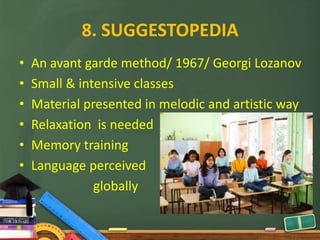
8.SUGGESTOPEDIA
9.COMMUNITY LANGUAGE LEARNING.

10. LANGUAGE IMMERSION
11. COMMUNICATIVE LANGUAGE TEACHING
12. STRUCTURAL APPROACH
1. GRAMMAR - TRANSLATION METHOD (I)

• Originally used to teach 'dead' languages (and literatures)
  such as Latin and Greek. (1890 – 1930)
• Language = collection of isolated words.
• Principles:
   o Literary language is superior to the spoken language.
   o Translating is the goal.
   o Teacher = authority.
   o The primary skills to be improved are reading and writing no
     spoken communication or listening comprehension.
   o Its focus is on accuracy and not fluency.
   o Error correction: If a student’s answer is incorrect, the teacher
     asks another student to answer no feedback
1. GRAMMAR - TRANSLATION METHOD (II)
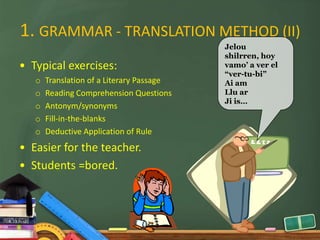
                                           Jelou
                                           shilrren, hoy
• Typical exercises:                       vamo’ a ver el
                                           “ver-tu-bi”
   o   Translation of a Literary Passage   Ai am
   o   Reading Comprehension Questions     Llu ar
                                           Ji is…
   o   Antonym/synonyms
   o   Fill-in-the-blanks
   o   Deductive Application of Rule
• Easier for the teacher.
• Students =bored.
2. COGNITIVE APPROACH
• Origin1950ies psychology & applied linguistics ( J.B. Carroll and K.
  Chastain)
• Language = a set of skills the modern version of the grammar-
  translation method
• FL learning = the conscious study of grammatical rules (deductive)  only
  meaningful practice is effective.
• FL teaching = the development of linguistic competence.
• Careful with imitation and memorization.
• Student’s mistakes = a necessary and natural phenomenon.
• The cognitive approach is essentially a theoretical
   framework.
• LAD is determining.
3. AUDIOLINGUAL METHOD
• Origin WWII Behaviorist theory (stimulus-response-reinforcement)
• Language = a collection of habits.
• FL learning = a mechanical process of habit formation.
• FL teaching = manipulation of language elements that occur in fixed
  relationships .
• “Drill, drill, and more drill, and only enough vocabulary to make such drills
  possible" (Hockett 1959)
• Student’s mistakes = don´t help to develop the habits,
  should be corrected immediately.
• The child is moulded by regularities the
  environment.
4.Direct Method (1970)
• Developed by Maximilian Berlitz
• No use of mother tongue=meaning
 is connected with a target language
• Grammar rules avoided
 (don´t give rules:make them figure out the rule)
• Never translate= act and demonstrate
• Teacher-student/student-student activities(reading
    aloud,question-answer exercises,fill-in-the-blank
• Emphasis on good pronunciation/oral transmission
• Speech and listening comprehension are
    taught(contextual/topical teaching)
5.The natural/communicative
                 approach
• origin→Tracy Terrell and Stephen Krashen
• Focus on communicative competence:aural
comprehension/ early speech production/
 speech activities
• Comprehension precedes production
• Small groups of students
• Visualization activities:
 slide presentations, word
   games, dialogues, recreational activities,realia
• The classroom=student-centered
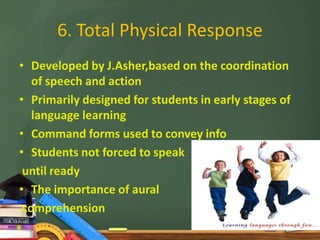
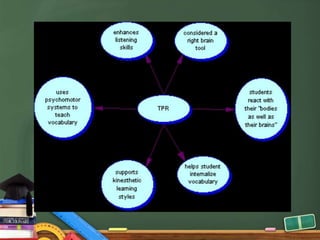
6. Total Physical Response
• Developed by J.Asher,based on the coordination
   of speech and action
• Primarily designed for students in early stages of
   language learning
• Command forms used to convey info
• Students not forced to speak
 until ready
• The importance of aural
 comprehension
7. THE SILENT WAY
•   Originated in 1963 by Dr.Caleb Gattegno (Egypt)
•   Teacher – silent , learners – speaking
•   Emphasis on PRONUNCIATION. Self-correction.
•   Role of the teacher – observer
•   No use of the mother tongue. No translation. Context
•   No formal evaluation just observation.
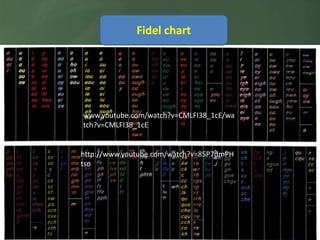
•   Use of CHARTS
Sound/ Colour chart
           Word chart
           Fidel chart


www.youtube.com/watch?v=CMLFI38_1cE/wa
tch?v=CMLFI38_1cE


http://www.youtube.com/watch?v=85P7dmPH
tso
8. SUGGESTOPEDIA
•   An avant garde method/ 1967/ Georgi Lozanov
•   Small & intensive classes
•   Material presented in melodic and artistic way
•   Relaxation is needed
•   Memory training
•   Language perceived
               globally
9. COMMUNITY LANGUAGE
              LEARNING
• Elaborated by Charles Curran (USA)
• It encourages personal growth, and self-development
• Learning a language is viewed as collective experience
• Based on communication  Oral proficiency
• Use of the mother tongue.
• Activities : translation, transcription, free
  conversation, listening, reflection and
  observation, repeating
• Focus on fluency rather than accuracy
•         GoalsUnderstanding & Speaking
10. LANGUAGE IMMERSION
• The regular school curriculum is taught through the
  medium of the target language.
• The second language is the vehicle for content
  instruction
• Focus on fluency
• Main purposes: to promote bilingualism and develop
  learner’s communicative competence
• The first modern language immersion programs
  appeared in Canada in the 1960’s
11. COMMUNICATIVE LANGUAGE
             TEACHING (CLT)
• Aim: to communicate effectively and appropriately
• Emphasis on interaction
• Similar to the Communicative Approach
• Different        situations       and        functions:
  inviting, suggesting, expression of time, visiting a
  doctor…
• More important to achieve the defined outcome rather
  than have accuracy on language forms
• Language use outside the classroom
• Classroom activities
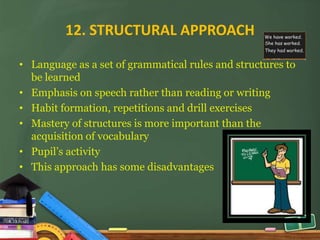
12. STRUCTURAL APPROACH

• Language as a set of grammatical rules and structures to
  be learned
• Emphasis on speech rather than reading or writing
• Habit formation, repetitions and drill exercises
• Mastery of structures is more important than the
  acquisition of vocabulary
• Pupil’s activity
• This approach has some disadvantages
THANK YOU
      FOR
YOUR ATTENTION!!!

Language teaching methods (1)

  • 1.
    LANGUAGE TEACHING METHODS IRYNA MYKYTKA IRINA SPIRINA ALENA RYNEISKAYA SHTUKAR GABRIELA LOBO MAYORDOMO
  • 2.
    INDEX 1. GRAMMAR-TRANSLATION METHOD 2.COGNITIVEAPPROACH 3.AUDIOLINGUAL METHOD 4. DIRECT METHOD 5. THE NATURAL/COMMUNICATIVE APPROACH 6.TOTAL PHYSICAL RESPONSE 7.THE SILENT METHOD 8.SUGGESTOPEDIA 9.COMMUNITY LANGUAGE LEARNING. 10. LANGUAGE IMMERSION 11. COMMUNICATIVE LANGUAGE TEACHING 12. STRUCTURAL APPROACH
  • 3.
    1. GRAMMAR -TRANSLATION METHOD (I) • Originally used to teach 'dead' languages (and literatures) such as Latin and Greek. (1890 – 1930) • Language = collection of isolated words. • Principles: o Literary language is superior to the spoken language. o Translating is the goal. o Teacher = authority. o The primary skills to be improved are reading and writing no spoken communication or listening comprehension. o Its focus is on accuracy and not fluency. o Error correction: If a student’s answer is incorrect, the teacher asks another student to answer no feedback
  • 4.
    1. GRAMMAR -TRANSLATION METHOD (II) Jelou shilrren, hoy • Typical exercises: vamo’ a ver el “ver-tu-bi” o Translation of a Literary Passage Ai am o Reading Comprehension Questions Llu ar Ji is… o Antonym/synonyms o Fill-in-the-blanks o Deductive Application of Rule • Easier for the teacher. • Students =bored.
  • 5.
    2. COGNITIVE APPROACH •Origin1950ies psychology & applied linguistics ( J.B. Carroll and K. Chastain) • Language = a set of skills the modern version of the grammar- translation method • FL learning = the conscious study of grammatical rules (deductive)  only meaningful practice is effective. • FL teaching = the development of linguistic competence. • Careful with imitation and memorization. • Student’s mistakes = a necessary and natural phenomenon. • The cognitive approach is essentially a theoretical framework. • LAD is determining.
  • 6.
    3. AUDIOLINGUAL METHOD •Origin WWII Behaviorist theory (stimulus-response-reinforcement) • Language = a collection of habits. • FL learning = a mechanical process of habit formation. • FL teaching = manipulation of language elements that occur in fixed relationships . • “Drill, drill, and more drill, and only enough vocabulary to make such drills possible" (Hockett 1959) • Student’s mistakes = don´t help to develop the habits, should be corrected immediately. • The child is moulded by regularities the environment.
  • 7.
    4.Direct Method (1970) •Developed by Maximilian Berlitz • No use of mother tongue=meaning is connected with a target language • Grammar rules avoided (don´t give rules:make them figure out the rule) • Never translate= act and demonstrate • Teacher-student/student-student activities(reading aloud,question-answer exercises,fill-in-the-blank • Emphasis on good pronunciation/oral transmission • Speech and listening comprehension are taught(contextual/topical teaching)
  • 8.
    5.The natural/communicative approach • origin→Tracy Terrell and Stephen Krashen • Focus on communicative competence:aural comprehension/ early speech production/ speech activities • Comprehension precedes production • Small groups of students • Visualization activities: slide presentations, word games, dialogues, recreational activities,realia • The classroom=student-centered
  • 9.
    6. Total PhysicalResponse • Developed by J.Asher,based on the coordination of speech and action • Primarily designed for students in early stages of language learning • Command forms used to convey info • Students not forced to speak until ready • The importance of aural comprehension
  • 11.
    7. THE SILENTWAY • Originated in 1963 by Dr.Caleb Gattegno (Egypt) • Teacher – silent , learners – speaking • Emphasis on PRONUNCIATION. Self-correction. • Role of the teacher – observer • No use of the mother tongue. No translation. Context • No formal evaluation just observation. • Use of CHARTS
  • 12.
    Sound/ Colour chart Word chart Fidel chart www.youtube.com/watch?v=CMLFI38_1cE/wa tch?v=CMLFI38_1cE http://www.youtube.com/watch?v=85P7dmPH tso
  • 13.
    8. SUGGESTOPEDIA • An avant garde method/ 1967/ Georgi Lozanov • Small & intensive classes • Material presented in melodic and artistic way • Relaxation is needed • Memory training • Language perceived globally
  • 14.
    9. COMMUNITY LANGUAGE LEARNING • Elaborated by Charles Curran (USA) • It encourages personal growth, and self-development • Learning a language is viewed as collective experience • Based on communication  Oral proficiency • Use of the mother tongue. • Activities : translation, transcription, free conversation, listening, reflection and observation, repeating • Focus on fluency rather than accuracy • GoalsUnderstanding & Speaking
  • 15.
    10. LANGUAGE IMMERSION •The regular school curriculum is taught through the medium of the target language. • The second language is the vehicle for content instruction • Focus on fluency • Main purposes: to promote bilingualism and develop learner’s communicative competence • The first modern language immersion programs appeared in Canada in the 1960’s
  • 16.
    11. COMMUNICATIVE LANGUAGE TEACHING (CLT) • Aim: to communicate effectively and appropriately • Emphasis on interaction • Similar to the Communicative Approach • Different situations and functions: inviting, suggesting, expression of time, visiting a doctor… • More important to achieve the defined outcome rather than have accuracy on language forms • Language use outside the classroom • Classroom activities
  • 17.
    12. STRUCTURAL APPROACH •Language as a set of grammatical rules and structures to be learned • Emphasis on speech rather than reading or writing • Habit formation, repetitions and drill exercises • Mastery of structures is more important than the acquisition of vocabulary • Pupil’s activity • This approach has some disadvantages
  • 18.
    THANK YOU FOR YOUR ATTENTION!!!