HOW TO RELATE TO A DEAF CHILD:
A Seminar for Parents of the Deaf
March 5, 2011
Joy L. Cristal
.joycristal@gmail.com
joy.cristal@benilde.edu.ph
Objectives of the Seminar
EXAMINE Hearing parents -Deaf children
relationship by identifying issues &
points of conflict;
UNDERSTAND Hearing parents-Deaf children
relationship by recognizing the impact &
consequences of deafness on the relatoinship;
PROPOSE ways to improve the relationship
between Hearing parents and Deaf children.
Joy L. Cristal /March 5, 2011
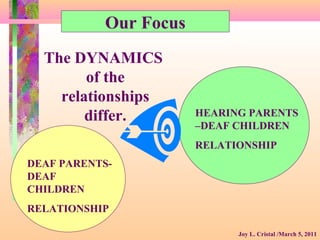
DEAF PARENTS-
DEAF
CHILDREN
RELATIONSHIP
HEARING PARENTS
–DEAF CHILDREN
RELATIONSHIP
Our Focus
The DYNAMICS
of the
relationships
differ.
Joy L. Cristal /March 5, 2011
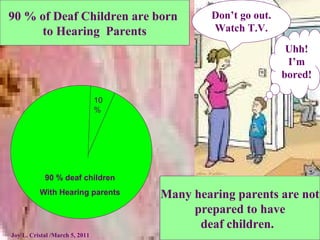
90 % deaf children
With Hearing parents
10
%
90 % of Deaf Children are born
to Hearing Parents
Many hearing parents are not
prepared to have
deaf children.
Don’t go out.
Watch T.V.
Uhh!
I’m
bored!
Joy L. Cristal /March 5, 2011
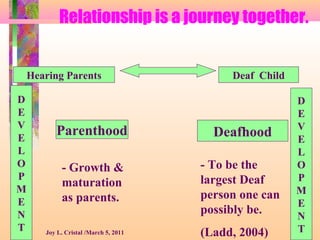
Relationship is a journey together.
Hearing Parents Deaf Child
D
E
V
E
L
O
P
M
E
N
T
D
E
V
E
L
O
P
M
E
N
T
Parenthood Deafhood
- Growth &
maturation
as parents.
- To be the
largest Deaf
person one can
possibly be.
(Ladd, 2004)Joy L. Cristal /March 5, 2011
Joy L. Cristal /March 5, 2011
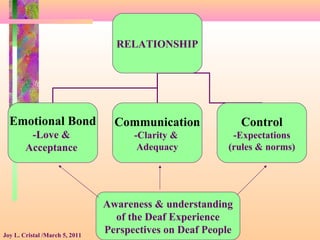
RELATIONSHIP
Emotional Bond
-Love &
Acceptance
Communication
-Clarity &
Adequacy
Control
-Expectations
(rules & norms)
Awareness & understanding
of the Deaf Experience
Perspectives on Deaf People
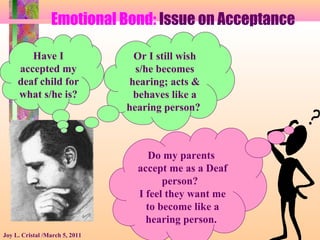
Emotional Bond: Issue on Acceptance
Joy L. Cristal /March 5, 2011
Have I
accepted my
deaf child for
what s/he is?
Or I still wish
s/he becomes
hearing; acts &
behaves like a
hearing person?
Do my parents
accept me as a Deaf
person?
I feel they want me
to become like a
hearing person.
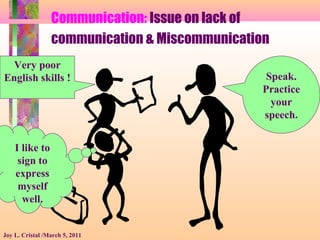
Communication: Issue on lack of
communication & Miscommunication
Joy L. Cristal /March 5, 2011
I like to
sign to
express
myself
well.
Speak.
Practice
your
speech.
Very poor
English skills !
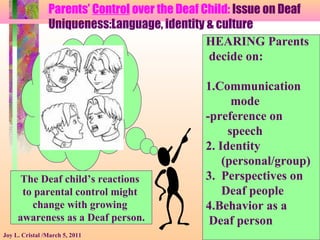
Parents’ Control over the Deaf Child: Issue on Deaf
Uniqueness:Language, identity & culture
Joy L. Cristal /March 5, 2011
HEARING Parents
decide on:
1.Communication
mode
-preference on
speech
2. Identity
(personal/group)
3. Perspectives on
Deaf people
4.Behavior as a
Deaf person
The Deaf child’s reactions
to parental control might
change with growing
awareness as a Deaf person.
Understanding the Deaf Experience
How well do hearing parents understand
the Deaf Experience?
Joy L. Cristal /March 5, 2011
ANO PO ANG
GUSTO NYONG
MALAMAN SA
INYONG MGA
ANAK NA DEAF?
ANO ANG
PROBLEMA NYO
SA MGA ANAK
NYONG DEAF?
Joy L. Cristal /March 5, 2011
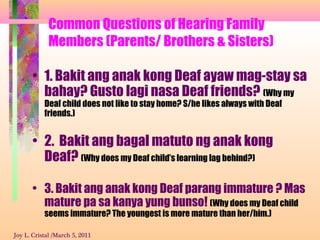
Common Questions of Hearing Family
Members (Parents/ Brothers & Sisters)
• 1. Bakit ang anak kong Deaf ayaw mag-stay sa
bahay? Gusto lagi nasa Deaf friends? (Why my
Deaf child does not like to stay home? S/he likes always with Deaf
friends.)
• 2. Bakit ang bagal matuto ng anak kong
Deaf? (Why does my Deaf child’s learning lag behind?)
• 3. Bakit ang anak kong Deaf parang immature ? Mas
mature pa sa kanya yung bunso! (Why does my Deaf child
seems immature? The youngest is more mature than her/him.)
Joy L. Cristal /March 5, 2011
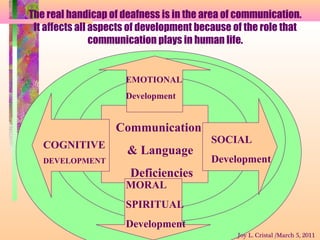
The real handicap of deafness is in the area of communication.
It affects all aspects of development because of the role that
communication plays in human life.
Communication
& Language
Deficiencies
COGNITIVE
DEVELOPMENT
SOCIAL
Development
EMOTIONAL
Development
MORAL
SPIRITUAL
Development
Joy L. Cristal /March 5, 2011
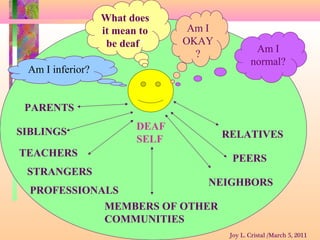
PARENTS
TEACHERS
STRANGERS
PROFESSIONALS
RELATIVES
PEERS
NEIGHBORS
SIBLINGS
DEAF
SELF
What does
it mean to
be deaf? Am I
normal?
Am I
OKAY
?
Am I inferior?
MEMBERS OF OTHER
COMMUNITIES
Joy L. Cristal /March 5, 2011
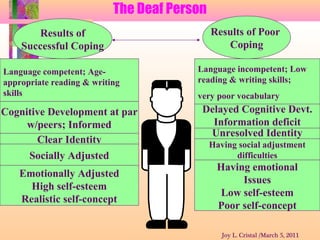
The Deaf Person
Results of
Successful Coping
Results of Poor
Coping
Having social adjustment
difficulties
Clear Identity
Unresolved Identity
Socially Adjusted
Emotionally Adjusted
High self-esteem
Realistic self-concept
Having emotional
Issues
Low self-esteem
Poor self-concept
Cognitive Development at par
w/peers; Informed
Delayed Cognitive Devt.
Information deficit
Language competent; Age-
appropriate reading & writing
skills
Language incompetent; Low
reading & writing skills;
very poor vocabulary
Joy L. Cristal /March 5, 2011
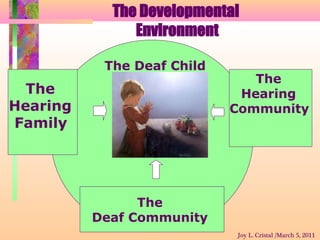
The Developmental
Environment
The
Hearing
Family
The
Hearing
Community
The
Deaf Community
The Deaf Child
Joy L. Cristal /March 5, 2011
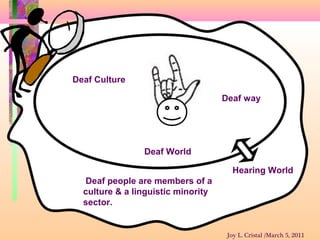
Deaf way
Deaf World
Deaf Culture
Deaf people are members of a
culture & a linguistic minority
sector.
Hearing World
Joy L. Cristal /March 5, 2011
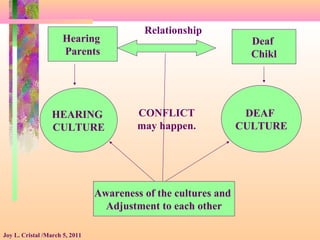
Hearing
Parents
Deaf
Chikl
HEARING
CULTURE
DEAF
CULTURE
Awareness of the cultures and
Adjustment to each other
Relationship
CONFLICT
may happen.
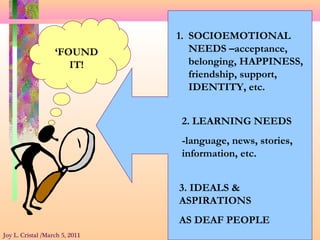
1. SOCIOEMOTIONAL
NEEDS –acceptance,
belonging, HAPPINESS,
friendship, support,
IDENTITY, etc.
2. LEARNING NEEDS
-language, news, stories,
information, etc.
3. IDEALS &
ASPIRATIONS
AS DEAF PEOPLE
‘FOUND
IT!
Joy L. Cristal /March 5, 2011
Some recommendations …
AWARENESS
BALANCE
COMMUNICATION
- learn about Deaf people.
-consider the Deaf child’s feelings/needs.
- “talk” & LISTEN to your
Deaf child; dialogue if
necessary.
Joy L. Cristal /March 5, 2011

How to relate with deaf children

  • 1.
    HOW TO RELATETO A DEAF CHILD: A Seminar for Parents of the Deaf March 5, 2011 Joy L. Cristal .joycristal@gmail.com joy.cristal@benilde.edu.ph
  • 2.
    Objectives of theSeminar EXAMINE Hearing parents -Deaf children relationship by identifying issues & points of conflict; UNDERSTAND Hearing parents-Deaf children relationship by recognizing the impact & consequences of deafness on the relatoinship; PROPOSE ways to improve the relationship between Hearing parents and Deaf children. Joy L. Cristal /March 5, 2011
  • 3.
    DEAF PARENTS- DEAF CHILDREN RELATIONSHIP HEARING PARENTS –DEAFCHILDREN RELATIONSHIP Our Focus The DYNAMICS of the relationships differ. Joy L. Cristal /March 5, 2011
  • 4.
    90 % deafchildren With Hearing parents 10 % 90 % of Deaf Children are born to Hearing Parents Many hearing parents are not prepared to have deaf children. Don’t go out. Watch T.V. Uhh! I’m bored! Joy L. Cristal /March 5, 2011
  • 5.
    Relationship is ajourney together. Hearing Parents Deaf Child D E V E L O P M E N T D E V E L O P M E N T Parenthood Deafhood - Growth & maturation as parents. - To be the largest Deaf person one can possibly be. (Ladd, 2004)Joy L. Cristal /March 5, 2011
  • 6.
    Joy L. Cristal/March 5, 2011 RELATIONSHIP Emotional Bond -Love & Acceptance Communication -Clarity & Adequacy Control -Expectations (rules & norms) Awareness & understanding of the Deaf Experience Perspectives on Deaf People
  • 7.
    Emotional Bond: Issueon Acceptance Joy L. Cristal /March 5, 2011 Have I accepted my deaf child for what s/he is? Or I still wish s/he becomes hearing; acts & behaves like a hearing person? Do my parents accept me as a Deaf person? I feel they want me to become like a hearing person.
  • 8.
    Communication: Issue onlack of communication & Miscommunication Joy L. Cristal /March 5, 2011 I like to sign to express myself well. Speak. Practice your speech. Very poor English skills !
  • 9.
    Parents’ Control overthe Deaf Child: Issue on Deaf Uniqueness:Language, identity & culture Joy L. Cristal /March 5, 2011 HEARING Parents decide on: 1.Communication mode -preference on speech 2. Identity (personal/group) 3. Perspectives on Deaf people 4.Behavior as a Deaf person The Deaf child’s reactions to parental control might change with growing awareness as a Deaf person.
  • 10.
    Understanding the DeafExperience How well do hearing parents understand the Deaf Experience? Joy L. Cristal /March 5, 2011
  • 11.
    ANO PO ANG GUSTONYONG MALAMAN SA INYONG MGA ANAK NA DEAF? ANO ANG PROBLEMA NYO SA MGA ANAK NYONG DEAF? Joy L. Cristal /March 5, 2011
  • 12.
    Common Questions ofHearing Family Members (Parents/ Brothers & Sisters) • 1. Bakit ang anak kong Deaf ayaw mag-stay sa bahay? Gusto lagi nasa Deaf friends? (Why my Deaf child does not like to stay home? S/he likes always with Deaf friends.) • 2. Bakit ang bagal matuto ng anak kong Deaf? (Why does my Deaf child’s learning lag behind?) • 3. Bakit ang anak kong Deaf parang immature ? Mas mature pa sa kanya yung bunso! (Why does my Deaf child seems immature? The youngest is more mature than her/him.) Joy L. Cristal /March 5, 2011
  • 13.
    The real handicapof deafness is in the area of communication. It affects all aspects of development because of the role that communication plays in human life. Communication & Language Deficiencies COGNITIVE DEVELOPMENT SOCIAL Development EMOTIONAL Development MORAL SPIRITUAL Development Joy L. Cristal /March 5, 2011
  • 14.
    PARENTS TEACHERS STRANGERS PROFESSIONALS RELATIVES PEERS NEIGHBORS SIBLINGS DEAF SELF What does it meanto be deaf? Am I normal? Am I OKAY ? Am I inferior? MEMBERS OF OTHER COMMUNITIES Joy L. Cristal /March 5, 2011
  • 15.
    The Deaf Person Resultsof Successful Coping Results of Poor Coping Having social adjustment difficulties Clear Identity Unresolved Identity Socially Adjusted Emotionally Adjusted High self-esteem Realistic self-concept Having emotional Issues Low self-esteem Poor self-concept Cognitive Development at par w/peers; Informed Delayed Cognitive Devt. Information deficit Language competent; Age- appropriate reading & writing skills Language incompetent; Low reading & writing skills; very poor vocabulary Joy L. Cristal /March 5, 2011
  • 16.
  • 17.
    Deaf way Deaf World DeafCulture Deaf people are members of a culture & a linguistic minority sector. Hearing World Joy L. Cristal /March 5, 2011
  • 18.
    Joy L. Cristal/March 5, 2011 Hearing Parents Deaf Chikl HEARING CULTURE DEAF CULTURE Awareness of the cultures and Adjustment to each other Relationship CONFLICT may happen.
  • 19.
    1. SOCIOEMOTIONAL NEEDS –acceptance, belonging,HAPPINESS, friendship, support, IDENTITY, etc. 2. LEARNING NEEDS -language, news, stories, information, etc. 3. IDEALS & ASPIRATIONS AS DEAF PEOPLE ‘FOUND IT! Joy L. Cristal /March 5, 2011
  • 20.
    Some recommendations … AWARENESS BALANCE COMMUNICATION -learn about Deaf people. -consider the Deaf child’s feelings/needs. - “talk” & LISTEN to your Deaf child; dialogue if necessary. Joy L. Cristal /March 5, 2011