Dr Neeta Gupta
Associate Professor
Department of psychology
Certified Practitioner of EFT &
REBT (London) & CBT
(Scotland)
DAV PG College
Dehradun
Cognitive-
Development
Language development is a critical part of
child development. It supports your child's ability to
communicate, and express and understand feelings. It also
supports thinking and problem-solving, and developing and
maintaining relationships. Language is a communication
system that involves using words and systematic rules to
organize those words to transmit information from one
individual to another.
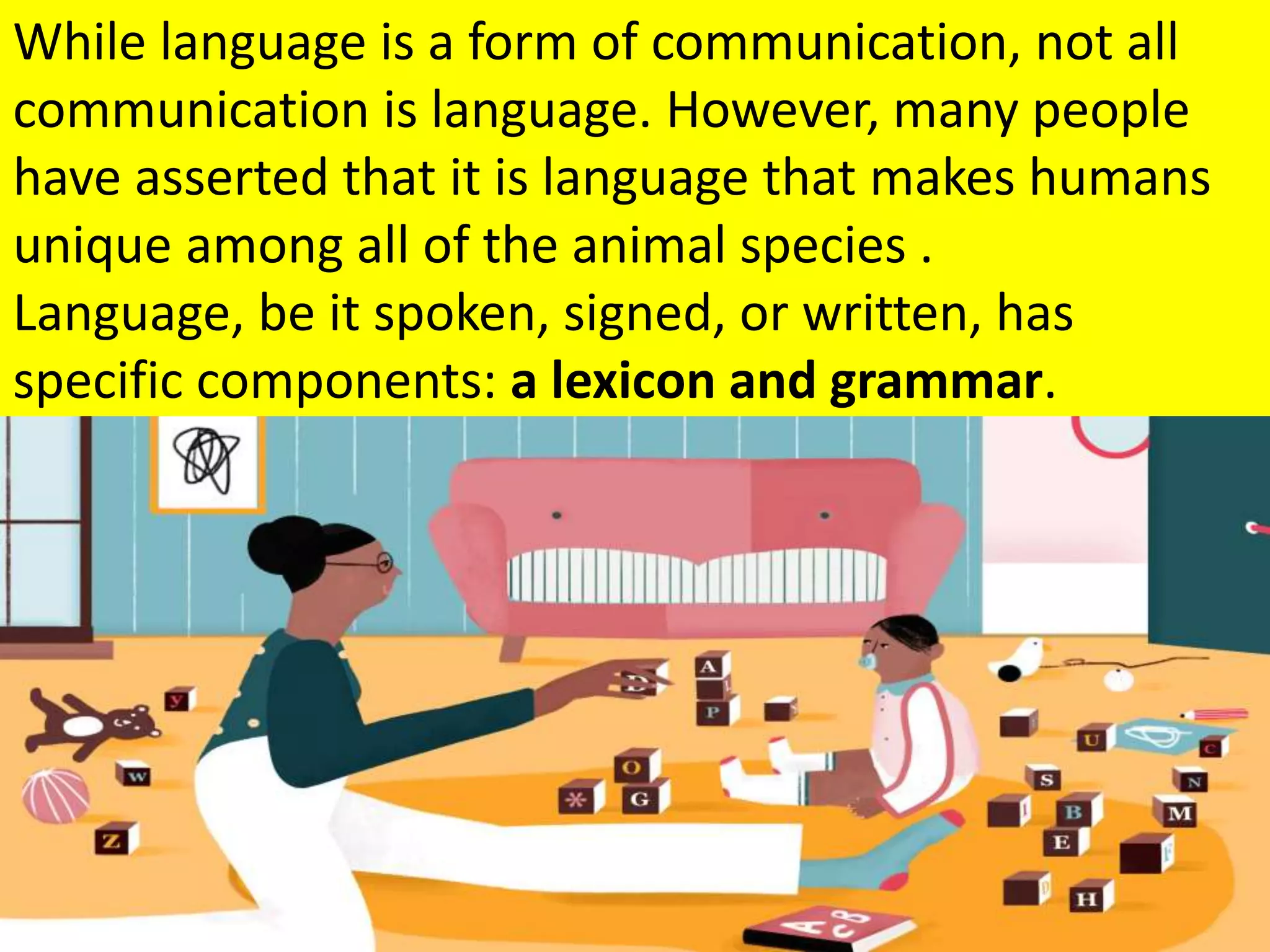
While language is a form of communication, not all
communication is language. However, many people
have asserted that it is language that makes humans
unique among all of the animal species .
Language, be it spoken, signed, or written, has
specific components: a lexicon and grammar.
1.Lexicon refers to the words of a given language.
Thus, lexicon is a language’s vocabulary.
2.Grammar refers to the set of rules that are used to
convey meaning through the use of the lexicon
(Fernández & Cairns, 2011). For instance, English
grammar dictates that most verbs receive an “-ed” at
the end to indicate past tense.
Words are formed by combining the various phonemes that
make up the language. A phoneme (e.g., the sounds “ah” vs.
“eh”) is a basic sound unit of a given language, and different
languages have different sets of phonemes. Phonemes are
combined to form morphemes, which are the smallest units
of language that convey some type of meaning (e.g., “I” is
both a phoneme and a morpheme).
Stages of Language Development/ Acquisition:
There are four main stages of normal language acquisition:
The babbling stage,
The Holophrastic or one-word stage,
The two-word stage and
The Telegraphic stage.
These stages can be broken down even more into these
smaller stages:
Pre-production,
Early production,
Speech emergent,
Beginning fluency
Intermediate fluency and
Advanced fluency.
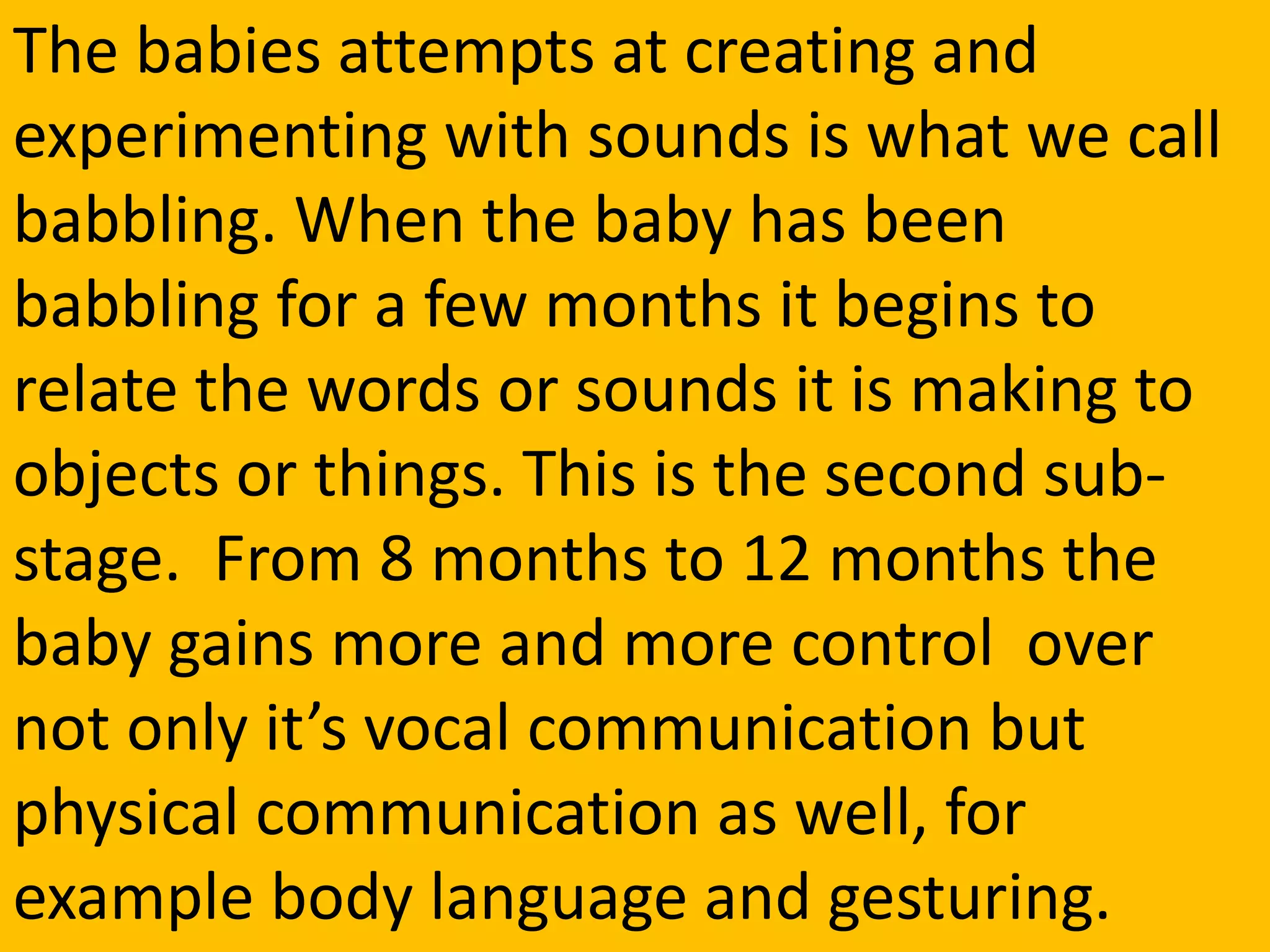
1.Babbling:
Within a few weeks of being born the baby begins to
recognize it’s mothers’ voice. There are two sub-
stages within this period. The first occurs between
birth – 8 months. During these months the baby hears
sounds around them and tries to reproduce them.
The babies attempts at creating and
experimenting with sounds is what we call
babbling. When the baby has been
babbling for a few months it begins to
relate the words or sounds it is making to
objects or things. This is the second sub-
stage. From 8 months to 12 months the
baby gains more and more control over
not only it’s vocal communication but
physical communication as well, for
example body language and gesturing.
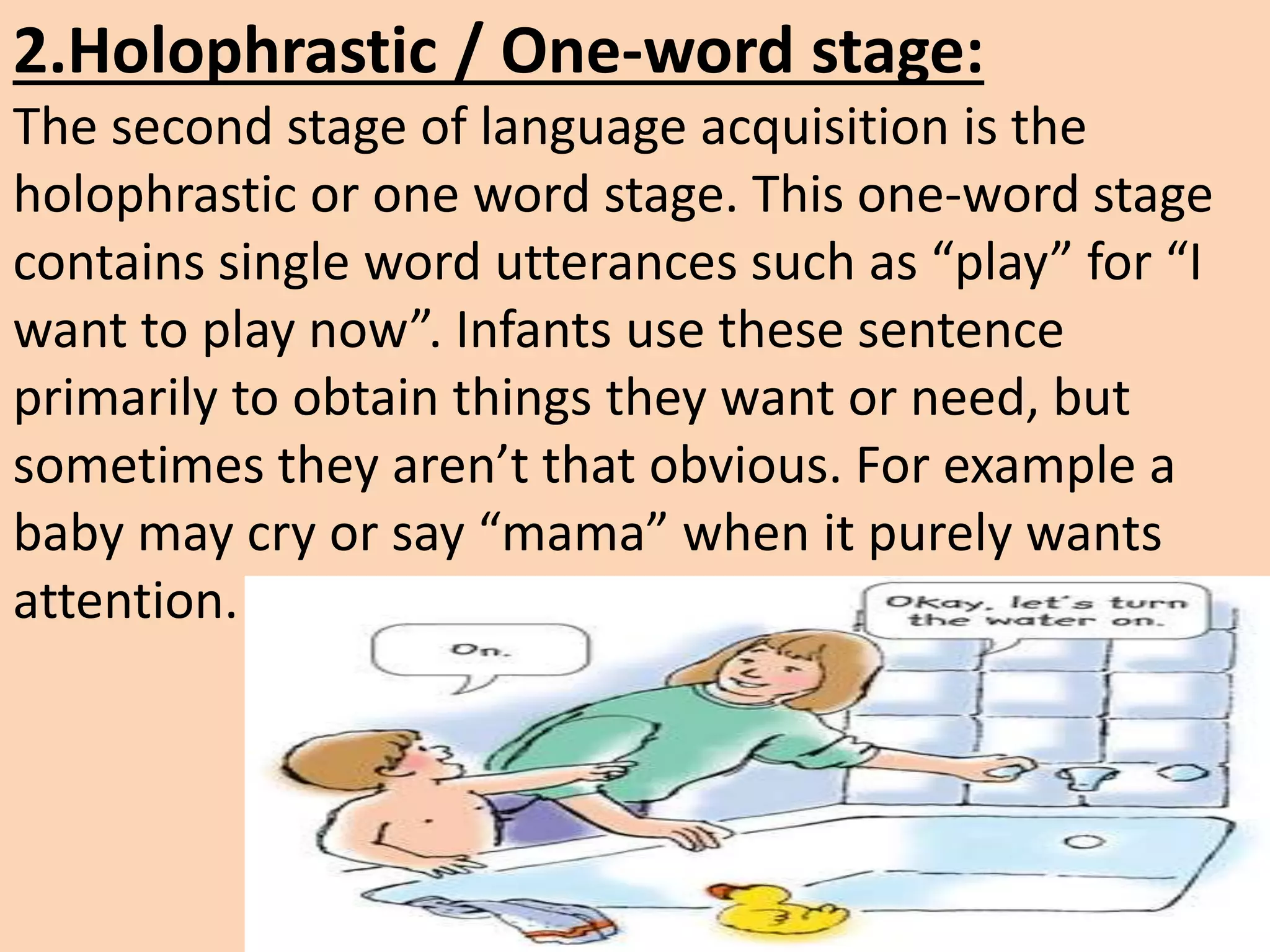
2.Holophrastic / One-word stage:
The second stage of language acquisition is the
holophrastic or one word stage. This one-word stage
contains single word utterances such as “play” for “I
want to play now”. Infants use these sentence
primarily to obtain things they want or need, but
sometimes they aren’t that obvious. For example a
baby may cry or say “mama” when it purely wants
attention.
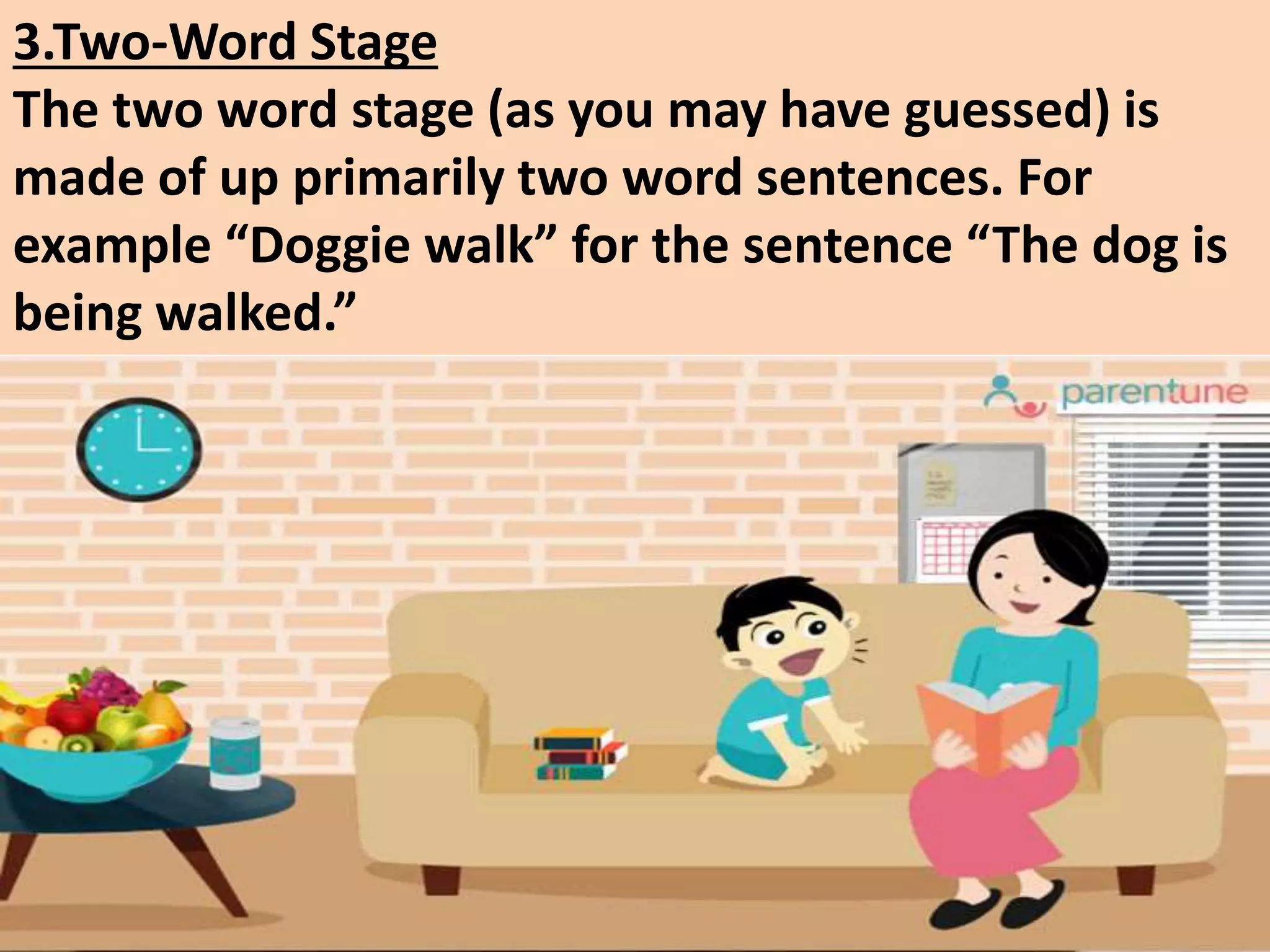
3.Two-Word Stage
The two word stage (as you may have guessed) is
made of up primarily two word sentences. For
example “Doggie walk” for the sentence “The dog is
being walked.”
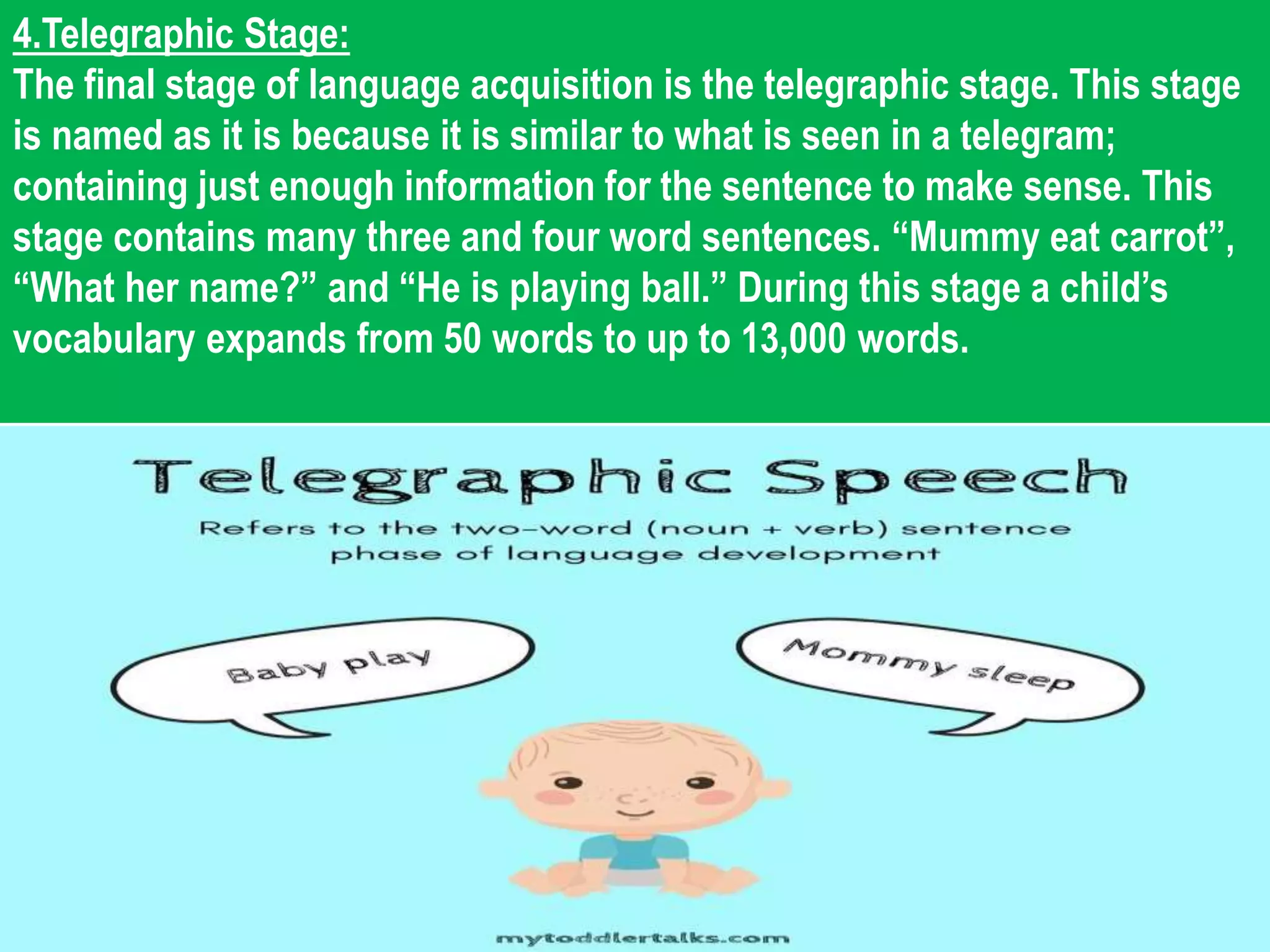
4.Telegraphic Stage:
The final stage of language acquisition is the telegraphic stage. This stage
is named as it is because it is similar to what is seen in a telegram;
containing just enough information for the sentence to make sense. This
stage contains many three and four word sentences. “Mummy eat carrot”,
“What her name?” and “He is playing ball.” During this stage a child’s
vocabulary expands from 50 words to up to 13,000 words.
There is a definite order of speech sounds. Children first
start speaking vowels, starting with the rounded mouthed
sounds like “oo” and “aa”. After the vowels come the
consonants, p, b, m, t, d, n, k and g. The consonants are first
because they are easier to pronounce then some of the
others, for example ‘s’ and ‘z’ require specific tongue place
which children cannot do at that age.
As all human beings do, children will improvise something
they cannot yet do. For example when children come across
a sound they cannot produce they replace it with a sound
they can e.g. ‘Thoap” for “Soap” and “Wun” for “Run.” These
are just a few example of resourceful children are, even if in
our eyes it is just cute.
REFERENCES:
https://enlsac2max.wordpress.com/stages-of-
language-acquisition/
https://courses.lumenlearning.com/wmopen-
psychology/chapter/language/
https://thumbs.gfycat.com/GrouchyGloriousAphid-
small.gif
https://media0.giphy.com/media/O4EChIxazzrHi/giph
y.gif
https://www.hanen.org/SiteAssets/Article-
Images/Research-in-your-daily-work/Telegraphic-
ITTT-91.aspx
Language Development

Language Development

  • 1.
    Dr Neeta Gupta AssociateProfessor Department of psychology Certified Practitioner of EFT & REBT (London) & CBT (Scotland) DAV PG College Dehradun Cognitive- Development
  • 2.
    Language development isa critical part of child development. It supports your child's ability to communicate, and express and understand feelings. It also supports thinking and problem-solving, and developing and maintaining relationships. Language is a communication system that involves using words and systematic rules to organize those words to transmit information from one individual to another.
  • 3.
    While language isa form of communication, not all communication is language. However, many people have asserted that it is language that makes humans unique among all of the animal species . Language, be it spoken, signed, or written, has specific components: a lexicon and grammar.
  • 4.
    1.Lexicon refers tothe words of a given language. Thus, lexicon is a language’s vocabulary. 2.Grammar refers to the set of rules that are used to convey meaning through the use of the lexicon (Fernández & Cairns, 2011). For instance, English grammar dictates that most verbs receive an “-ed” at the end to indicate past tense.
  • 5.
    Words are formedby combining the various phonemes that make up the language. A phoneme (e.g., the sounds “ah” vs. “eh”) is a basic sound unit of a given language, and different languages have different sets of phonemes. Phonemes are combined to form morphemes, which are the smallest units of language that convey some type of meaning (e.g., “I” is both a phoneme and a morpheme).
  • 6.
    Stages of LanguageDevelopment/ Acquisition: There are four main stages of normal language acquisition: The babbling stage, The Holophrastic or one-word stage, The two-word stage and The Telegraphic stage. These stages can be broken down even more into these smaller stages: Pre-production, Early production, Speech emergent, Beginning fluency Intermediate fluency and Advanced fluency.
  • 7.
    1.Babbling: Within a fewweeks of being born the baby begins to recognize it’s mothers’ voice. There are two sub- stages within this period. The first occurs between birth – 8 months. During these months the baby hears sounds around them and tries to reproduce them.
  • 8.
    The babies attemptsat creating and experimenting with sounds is what we call babbling. When the baby has been babbling for a few months it begins to relate the words or sounds it is making to objects or things. This is the second sub- stage. From 8 months to 12 months the baby gains more and more control over not only it’s vocal communication but physical communication as well, for example body language and gesturing.
  • 9.
    2.Holophrastic / One-wordstage: The second stage of language acquisition is the holophrastic or one word stage. This one-word stage contains single word utterances such as “play” for “I want to play now”. Infants use these sentence primarily to obtain things they want or need, but sometimes they aren’t that obvious. For example a baby may cry or say “mama” when it purely wants attention.
  • 10.
    3.Two-Word Stage The twoword stage (as you may have guessed) is made of up primarily two word sentences. For example “Doggie walk” for the sentence “The dog is being walked.”
  • 11.
    4.Telegraphic Stage: The finalstage of language acquisition is the telegraphic stage. This stage is named as it is because it is similar to what is seen in a telegram; containing just enough information for the sentence to make sense. This stage contains many three and four word sentences. “Mummy eat carrot”, “What her name?” and “He is playing ball.” During this stage a child’s vocabulary expands from 50 words to up to 13,000 words.
  • 12.
    There is adefinite order of speech sounds. Children first start speaking vowels, starting with the rounded mouthed sounds like “oo” and “aa”. After the vowels come the consonants, p, b, m, t, d, n, k and g. The consonants are first because they are easier to pronounce then some of the others, for example ‘s’ and ‘z’ require specific tongue place which children cannot do at that age. As all human beings do, children will improvise something they cannot yet do. For example when children come across a sound they cannot produce they replace it with a sound they can e.g. ‘Thoap” for “Soap” and “Wun” for “Run.” These are just a few example of resourceful children are, even if in our eyes it is just cute.
  • 13.