Language Culture and World View 
• Language 
The word “language” means the most specialized sound signalling system which seems to be 
genetically programmed to develop in humans 
• Characteristic of Language 
• “ Language is the dress of thought” 
• “ Language shapes our ideologies and world view” 
• “ Language and culture are directly proportional to each other” 
• “ The shared languge of a community is the most essential carrier of their common 
culture” 
• Language and culture are grown up together” 
• The form of language used determines individual’s thought” 
• The structure of language influences how its speaker view the world around them” 
• Culture 
Culture in narrow sense means “art and sciences”. In broad sense means “our ways of living, 
religion, laws, manners, housing, dress, etc are called culture 
• Characteristics of Culture 
• Culture is acquired 
• Culture is shared 
• Culture is learnt 
• Culture is transmitted 
• Culture is dynamic
• Culture is adaptive 
• Culture is influential 
• Types of Culture 
There are four types of culture 
• Material / Physical culture 
• Non-material / cognitive culture 
• Real culture 
• Ideal culture 
• Material / Physical culture 
It includes man-made objects such as tools, implements, furniture, etc. It is concerned 
with the external, mechanical and utilitarian objects. It includes our banks, parliments, insurance 
scheme, currency systems, and etc. It is referred to as civilization. 
• Non-material / Cognitive Culture 
It is something internal and intrinsically valuable. It reflects the inward nature of man. It 
consists of the words the people use or the language they speak etc. It includes our customs, 
tastes, attitute ans outook, in brief, our acting, feeling and thinking etc. It is mental organization 
in each individual’s mind. 
• Real culture 
It is that culture which can be observed in our daily life. The culture on which we act upon 
in our social life is real. It is the culture people adopt in their real life. The whole of the culture 
can never be real because some of its part may remain unpracticed. Real culture include the 
values and norms being practiced. 
• Ideal culture 
The culture which is presented as a pattern or precedent to the people is called ideal 
culture. It is the goal of the society It can never be achieved fully because some part of it remains 
out of practice. Ideal culture encompasses the values and norms a culture demands. 
• Language and Culture
Language and culture both are determined by each other. It is generally agreed that language and 
culture are closely related. Language can be viewed as a verbal expression of culture. It is used 
to maintain and convey culture and cultural ties. Language provides us with many of the 
categories we use for expression of our thoughts, so it is therefore natural to assume that our 
thinking is influenced by the language which we use. The values and customs in the country we 
grow up in shape the way in which we think to a certain extent 
Culture and Language 
What We Say Influences What 
We Think, What We Feel and 
What We Believe 
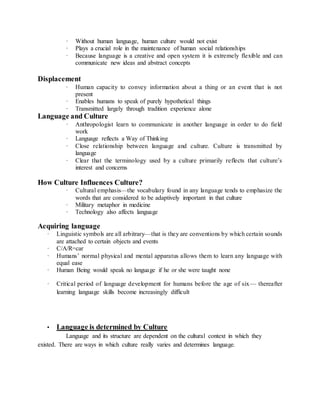
Unique human ability 
· Ability to create and use language is the most distinctive feature of humans 
· Humans learn their culture through language 
· Culture is transmitted through language 
The nature of language 
· Considerable variation in the number of languages in the world 
· 95% of the world’s people speak fewer that 100 of the approximate 6,000 different 
languages 
· Linguists concerned about the last 5% of the world’s languages which are in danger of 
disappearing 
Seven functions of Language 
· Instrumental Language 
· Regulatory Language 
· Interactional Language 
· Personal Language 
· Imaginative Language 
· Heuristic Language 
· Informative Language 
Regulatory Language 
· Using language to control the behavior of others or getting them to do what we want 
them to do 
· May include giving orders or at more subtle levels manipulating and controlling others 
· Positive regulatory language is “life skills” of parents, management and administrator 
must know 
Interactional Language 
· Used to establish and define social relationships and language all of us use in group 
situation 
· “small talk”, negotiations, encouragement, expression of friendship are examples
· Because those who are effective in building social skills are likely to succeed, children 
need to develop need to develop awareness of the ability to use language to establish 
relationships 
· Work cooperatively, enjoy companionship 
Personal Language 
· Used to express individuality and personality 
· Strong feelings and opinions are a part of personal language 
· Often neglected in classrooms and thought inappropriate. 
· Yet through personal language that students relate their own lives to the subject 
matter being taught establish their own identities, build selfesteem and confidence 
Heuristic Language 
· Used to explore, to investigate, to acquire knowledge, to do research, to acquire 
understanding 
· It is the language for wondering, for figuring things out 
· Inquiry is its most important function 
· Dense Textbooks? 
Communication 
· The act of transmitting information that influences the behavior of another person 
· While communication among animals is critical to their survival, it is limited 
compared to human language 
Call Systems 
· Animal systems of verbal communication are referred to as call system 
· Call system—a form of communication among non-human primates composed of 
a limited number of sounds that are limited to specific stimuli in the environment 
· Chimp-”Squeal Squeal” –”danger here” 
· “Closed System” 
Call System/Closed System 
· Primate Communication system is complex 
· Non-Human Primate have a Closed Call System 
· Sounds are unique in form and message 
· Sounds are mutually exclusive 
· Can’t signal “Tomorrow I’ll climb that tree” 
Humans/Open Call System 
· Starting with a limited number of sounds. Human are capable of producing an 
infinite number of meanings by combining sounds and words into new meanings 
· Can send messages that have never been sent before. 
· Can talk about things not present and have yet to happen 
Human Language 
· Is capable of recreating and complex thought patterns and experiences in words
· Without human language, human culture would not exist 
· Plays a crucial role in the maintenance of human social relationships 
· Because language is a creative and open system it is extremely flexible and can 
communicate new ideas and abstract concepts 
Displacement 
· Human capacity to convey information about a thing or an event that is not 
present 
· Enables humans to speak of purely hypothetical things 
· Transmitted largely through tradition experience alone 
Language and Culture 
· Anthropologist learn to communicate in another language in order to do field 
work 
· Language reflects a Way of Thinking 
· Close relationship between language and culture. Culture is transmitted by 
language 
· Clear that the terminology used by a culture primarily reflects that culture’s 
interest and concerns 
How Culture Influences Culture? 
· Cultural emphasis—the vocabulary found in any language tends to emphasize the 
words that are considered to be adaptively important in that culture 
· Military metaphor in medicine 
· Technology also affects language 
Acquiring language 
· Linguistic symbols are all arbitrary—that is they are conventions by which certain sounds 
are attached to certain objects and events 
· C/A/R=car 
· Humans’ normal physical and mental apparatus allows them to learn any language with 
equal ease 
· Human Being would speak no language if he or she were taught none 
· Critical period of language development for humans before the age of six— thereafter 
learning language skills become increasingly difficult 
• Language is determined by Culture 
Language and its structure are dependent on the cultural context in which they 
existed. There are ways in which culture really varies and determines language.
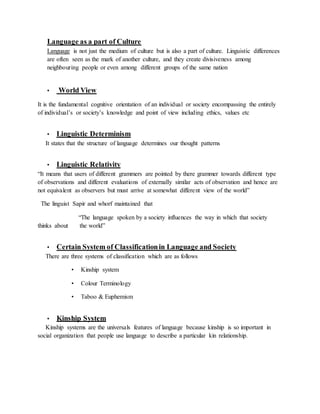
Language as a part of Culture 
Language is not just the medium of culture but is also a part of culture. Linguistic differences 
are often seen as the mark of another culture, and they create divisiveness among 
neighbouring people or even among different groups of the same nation 
• World View 
It is the fundamental cognitive orientation of an individual or society encompassing the entirely 
of individual’s or society’s knowledge and point of view including ethics, values etc 
• Linguistic Determinism 
It states that the structure of language determines our thought patterns 
• Linguistic Relativity 
“It means that users of different grammers are pointed by there grammer towards different type 
of observations and different evaluations of externally similar acts of observation and hence are 
not equivalent as observers but must arrive at somewhat different view of the world” 
The linguist Sapir and whorf maintained that 
“The language spoken by a society influences the way in which that society 
thinks about the world” 
• Certain System of Classification in Language and Society 
There are three systems of classification which are as follows 
• Kinship system 
• Colour Terminology 
• Taboo & Euphemism 
• Kinship System 
Kinship systems are the universals features of language because kinship is so important in 
social organization that people use language to describe a particular kin relationship.
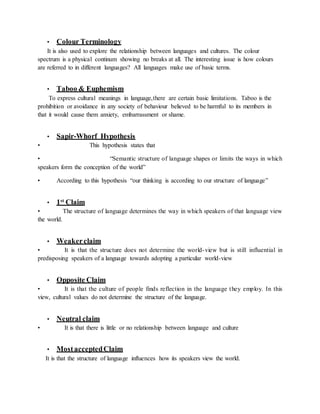
• Colour Terminology 
It is also used to explore the relationship between languages and cultures. The colour 
spectrum is a physical continum showing no breaks at all. The interesting issue is how colours 
are referred to in different languages? All languages make use of basic terms. 
• Taboo & Euphemism 
To express cultural meanings in language,there are certain basic limitations. Taboo is the 
prohibition or avoidance in any society of behaviour believed to be harmful to its members in 
that it would cause them anxiety, embarrassment or shame. 
• Sapir-Whorf Hypothesis 
• This hypothesis states that 
• “Semantic structure of language shapes or limits the ways in which 
speakers form the conception of the world” 
• According to this hypothesis “our thinking is according to our structure of language” 
• 1st Claim 
• The structure of language determines the way in which speakers of that language view 
the world. 
• Weaker claim 
• It is that the structure does not determine the world- view but is still influential in 
predisposing speakers of a language towards adopting a particular world-view 
• Opposite Claim 
• It is that the culture of people finds reflection in the language they employ. In this 
view, cultural values do not determine the structure of the language. 
• Neutral claim 
• It is that there is little or no relationship between language and culture 
• Most accepted Claim 
It is that the structure of language influences how its speakers view the world.
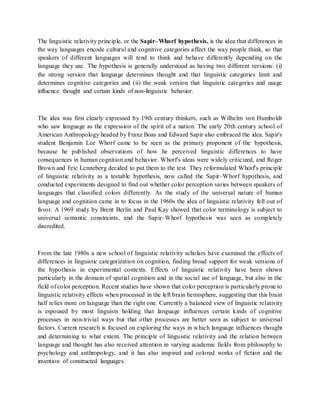
The linguistic relativity principle, or the Sapir–Whorf hypothesis, is the idea that differences in 
the way languages encode cultural and cognitive categories affect the way people think, so that 
speakers of different languages will tend to think and behave differently depending on the 
language they use. The hypothesis is generally understood as having two different versions: (i) 
the strong version that language determines thought and that linguistic categories limit and 
determines cognitive categories and (ii) the weak version that linguistic categories and usage 
influence thought and certain kinds of non-linguistic behavior. 
The idea was first clearly expressed by 19th century thinkers, such as Wilhelm von Humboldt 
who saw language as the expression of the spirit of a nation. The early 20th century school of 
American Anthropology headed by Franz Boas and Edward Sapir also embraced the idea. Sapir's 
student Benjamin Lee Whorf came to be seen as the primary proponent of the hypothesis, 
because he published observations of how he perceived linguistic differences to have 
consequences in human cognition and behavior. Whorf's ideas were widely criticized, and Roger 
Brown and Eric Lenneberg decided to put them to the test. They reformulated Whorf's principle 
of linguistic relativity as a testable hypothesis, now called the Sapir–Whorf hypothesis, and 
conducted experiments designed to find out whether color perception varies between speakers of 
languages that classified colors differently. As the study of the universal nature of human 
language and cognition came in to focus in the 1960s the idea of linguistic relativity fell out of 
favor. A 1969 study by Brent Berlin and Paul Kay showed that color terminology is subject to 
universal semantic constraints, and the Sapir–Whorf hypothesis was seen as completely 
discredited. 
From the late 1980s a new school of linguistic relativity scholars have examined the effects of 
differences in linguistic categorization on cognition, finding broad support for weak versions of 
the hypothesis in experimental contexts. Effects of linguistic relativity have been shown 
particularly in the domain of spatial cognition and in the social use of language, but also in the 
field of color perception. Recent studies have shown that color perception is particularly prone to 
linguistic relativity effects when processed in the left brain hemisphere, suggesting that this brain 
half relies more on language than the right one. Currently a balanced view of linguistic relativity 
is espoused by most linguists holding that language influences certain kinds of cognitive 
processes in non-trivial ways but that other processes are better seen as subject to universal 
factors. Current research is focused on exploring the ways in which language influences thought 
and determining to what extent. The principle of linguistic relativity and the relation between 
language and thought has also received attention in varying academic fields from philosophy to 
psychology and anthropology, and it has also inspired and colored works of fiction and the 
invention of constructed languages.
Conclusion 
Language = knowledge 
Knowledge = culture 
So, 
Language = culture 
Both are the means of identity. Both denotes life style and both are dynamic 
Language is the keystone to the culture. Language is the carrier and container of cultural 
information. Language expresses and symbolize cultural reality. Language is the primary means 
to the cultural transmission.

Language culture and world view (Long one)

  • 1.
    Language Culture andWorld View • Language The word “language” means the most specialized sound signalling system which seems to be genetically programmed to develop in humans • Characteristic of Language • “ Language is the dress of thought” • “ Language shapes our ideologies and world view” • “ Language and culture are directly proportional to each other” • “ The shared languge of a community is the most essential carrier of their common culture” • Language and culture are grown up together” • The form of language used determines individual’s thought” • The structure of language influences how its speaker view the world around them” • Culture Culture in narrow sense means “art and sciences”. In broad sense means “our ways of living, religion, laws, manners, housing, dress, etc are called culture • Characteristics of Culture • Culture is acquired • Culture is shared • Culture is learnt • Culture is transmitted • Culture is dynamic
  • 2.
    • Culture isadaptive • Culture is influential • Types of Culture There are four types of culture • Material / Physical culture • Non-material / cognitive culture • Real culture • Ideal culture • Material / Physical culture It includes man-made objects such as tools, implements, furniture, etc. It is concerned with the external, mechanical and utilitarian objects. It includes our banks, parliments, insurance scheme, currency systems, and etc. It is referred to as civilization. • Non-material / Cognitive Culture It is something internal and intrinsically valuable. It reflects the inward nature of man. It consists of the words the people use or the language they speak etc. It includes our customs, tastes, attitute ans outook, in brief, our acting, feeling and thinking etc. It is mental organization in each individual’s mind. • Real culture It is that culture which can be observed in our daily life. The culture on which we act upon in our social life is real. It is the culture people adopt in their real life. The whole of the culture can never be real because some of its part may remain unpracticed. Real culture include the values and norms being practiced. • Ideal culture The culture which is presented as a pattern or precedent to the people is called ideal culture. It is the goal of the society It can never be achieved fully because some part of it remains out of practice. Ideal culture encompasses the values and norms a culture demands. • Language and Culture
  • 3.
    Language and cultureboth are determined by each other. It is generally agreed that language and culture are closely related. Language can be viewed as a verbal expression of culture. It is used to maintain and convey culture and cultural ties. Language provides us with many of the categories we use for expression of our thoughts, so it is therefore natural to assume that our thinking is influenced by the language which we use. The values and customs in the country we grow up in shape the way in which we think to a certain extent Culture and Language What We Say Influences What We Think, What We Feel and What We Believe Unique human ability · Ability to create and use language is the most distinctive feature of humans · Humans learn their culture through language · Culture is transmitted through language The nature of language · Considerable variation in the number of languages in the world · 95% of the world’s people speak fewer that 100 of the approximate 6,000 different languages · Linguists concerned about the last 5% of the world’s languages which are in danger of disappearing Seven functions of Language · Instrumental Language · Regulatory Language · Interactional Language · Personal Language · Imaginative Language · Heuristic Language · Informative Language Regulatory Language · Using language to control the behavior of others or getting them to do what we want them to do · May include giving orders or at more subtle levels manipulating and controlling others · Positive regulatory language is “life skills” of parents, management and administrator must know Interactional Language · Used to establish and define social relationships and language all of us use in group situation · “small talk”, negotiations, encouragement, expression of friendship are examples
  • 4.
    · Because thosewho are effective in building social skills are likely to succeed, children need to develop need to develop awareness of the ability to use language to establish relationships · Work cooperatively, enjoy companionship Personal Language · Used to express individuality and personality · Strong feelings and opinions are a part of personal language · Often neglected in classrooms and thought inappropriate. · Yet through personal language that students relate their own lives to the subject matter being taught establish their own identities, build selfesteem and confidence Heuristic Language · Used to explore, to investigate, to acquire knowledge, to do research, to acquire understanding · It is the language for wondering, for figuring things out · Inquiry is its most important function · Dense Textbooks? Communication · The act of transmitting information that influences the behavior of another person · While communication among animals is critical to their survival, it is limited compared to human language Call Systems · Animal systems of verbal communication are referred to as call system · Call system—a form of communication among non-human primates composed of a limited number of sounds that are limited to specific stimuli in the environment · Chimp-”Squeal Squeal” –”danger here” · “Closed System” Call System/Closed System · Primate Communication system is complex · Non-Human Primate have a Closed Call System · Sounds are unique in form and message · Sounds are mutually exclusive · Can’t signal “Tomorrow I’ll climb that tree” Humans/Open Call System · Starting with a limited number of sounds. Human are capable of producing an infinite number of meanings by combining sounds and words into new meanings · Can send messages that have never been sent before. · Can talk about things not present and have yet to happen Human Language · Is capable of recreating and complex thought patterns and experiences in words
  • 5.
    · Without humanlanguage, human culture would not exist · Plays a crucial role in the maintenance of human social relationships · Because language is a creative and open system it is extremely flexible and can communicate new ideas and abstract concepts Displacement · Human capacity to convey information about a thing or an event that is not present · Enables humans to speak of purely hypothetical things · Transmitted largely through tradition experience alone Language and Culture · Anthropologist learn to communicate in another language in order to do field work · Language reflects a Way of Thinking · Close relationship between language and culture. Culture is transmitted by language · Clear that the terminology used by a culture primarily reflects that culture’s interest and concerns How Culture Influences Culture? · Cultural emphasis—the vocabulary found in any language tends to emphasize the words that are considered to be adaptively important in that culture · Military metaphor in medicine · Technology also affects language Acquiring language · Linguistic symbols are all arbitrary—that is they are conventions by which certain sounds are attached to certain objects and events · C/A/R=car · Humans’ normal physical and mental apparatus allows them to learn any language with equal ease · Human Being would speak no language if he or she were taught none · Critical period of language development for humans before the age of six— thereafter learning language skills become increasingly difficult • Language is determined by Culture Language and its structure are dependent on the cultural context in which they existed. There are ways in which culture really varies and determines language.
  • 6.
    Language as apart of Culture Language is not just the medium of culture but is also a part of culture. Linguistic differences are often seen as the mark of another culture, and they create divisiveness among neighbouring people or even among different groups of the same nation • World View It is the fundamental cognitive orientation of an individual or society encompassing the entirely of individual’s or society’s knowledge and point of view including ethics, values etc • Linguistic Determinism It states that the structure of language determines our thought patterns • Linguistic Relativity “It means that users of different grammers are pointed by there grammer towards different type of observations and different evaluations of externally similar acts of observation and hence are not equivalent as observers but must arrive at somewhat different view of the world” The linguist Sapir and whorf maintained that “The language spoken by a society influences the way in which that society thinks about the world” • Certain System of Classification in Language and Society There are three systems of classification which are as follows • Kinship system • Colour Terminology • Taboo & Euphemism • Kinship System Kinship systems are the universals features of language because kinship is so important in social organization that people use language to describe a particular kin relationship.
  • 7.
    • Colour Terminology It is also used to explore the relationship between languages and cultures. The colour spectrum is a physical continum showing no breaks at all. The interesting issue is how colours are referred to in different languages? All languages make use of basic terms. • Taboo & Euphemism To express cultural meanings in language,there are certain basic limitations. Taboo is the prohibition or avoidance in any society of behaviour believed to be harmful to its members in that it would cause them anxiety, embarrassment or shame. • Sapir-Whorf Hypothesis • This hypothesis states that • “Semantic structure of language shapes or limits the ways in which speakers form the conception of the world” • According to this hypothesis “our thinking is according to our structure of language” • 1st Claim • The structure of language determines the way in which speakers of that language view the world. • Weaker claim • It is that the structure does not determine the world- view but is still influential in predisposing speakers of a language towards adopting a particular world-view • Opposite Claim • It is that the culture of people finds reflection in the language they employ. In this view, cultural values do not determine the structure of the language. • Neutral claim • It is that there is little or no relationship between language and culture • Most accepted Claim It is that the structure of language influences how its speakers view the world.
  • 8.
    The linguistic relativityprinciple, or the Sapir–Whorf hypothesis, is the idea that differences in the way languages encode cultural and cognitive categories affect the way people think, so that speakers of different languages will tend to think and behave differently depending on the language they use. The hypothesis is generally understood as having two different versions: (i) the strong version that language determines thought and that linguistic categories limit and determines cognitive categories and (ii) the weak version that linguistic categories and usage influence thought and certain kinds of non-linguistic behavior. The idea was first clearly expressed by 19th century thinkers, such as Wilhelm von Humboldt who saw language as the expression of the spirit of a nation. The early 20th century school of American Anthropology headed by Franz Boas and Edward Sapir also embraced the idea. Sapir's student Benjamin Lee Whorf came to be seen as the primary proponent of the hypothesis, because he published observations of how he perceived linguistic differences to have consequences in human cognition and behavior. Whorf's ideas were widely criticized, and Roger Brown and Eric Lenneberg decided to put them to the test. They reformulated Whorf's principle of linguistic relativity as a testable hypothesis, now called the Sapir–Whorf hypothesis, and conducted experiments designed to find out whether color perception varies between speakers of languages that classified colors differently. As the study of the universal nature of human language and cognition came in to focus in the 1960s the idea of linguistic relativity fell out of favor. A 1969 study by Brent Berlin and Paul Kay showed that color terminology is subject to universal semantic constraints, and the Sapir–Whorf hypothesis was seen as completely discredited. From the late 1980s a new school of linguistic relativity scholars have examined the effects of differences in linguistic categorization on cognition, finding broad support for weak versions of the hypothesis in experimental contexts. Effects of linguistic relativity have been shown particularly in the domain of spatial cognition and in the social use of language, but also in the field of color perception. Recent studies have shown that color perception is particularly prone to linguistic relativity effects when processed in the left brain hemisphere, suggesting that this brain half relies more on language than the right one. Currently a balanced view of linguistic relativity is espoused by most linguists holding that language influences certain kinds of cognitive processes in non-trivial ways but that other processes are better seen as subject to universal factors. Current research is focused on exploring the ways in which language influences thought and determining to what extent. The principle of linguistic relativity and the relation between language and thought has also received attention in varying academic fields from philosophy to psychology and anthropology, and it has also inspired and colored works of fiction and the invention of constructed languages.
  • 9.
    Conclusion Language =knowledge Knowledge = culture So, Language = culture Both are the means of identity. Both denotes life style and both are dynamic Language is the keystone to the culture. Language is the carrier and container of cultural information. Language expresses and symbolize cultural reality. Language is the primary means to the cultural transmission.