What is language?
Language is a system of vocal signs
through which humans communicate.
It is a SYSTEM because it consists of patterns, or rules, for
putting together elements such as sounds to make words
and words to make sentences that when violated result in
loss of meaning
Language is open-ended and creative
 Following rules we can make up new
words, combine them and create
sentences never uttered before
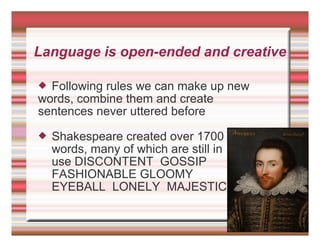
 Shakespeare created over 1700
words, many of which are still in
use DISCONTENT GOSSIP
FASHIONABLE GLOOMY
EYEBALL LONELY MAJESTIC
Language functions through a
system of contrasts
 Linguists call this Duality of Patterning
This is the ability of language or a sign system to
create distictions between sounds, words, and
units of meaning through a system of
differences between two elements
 http://www.youtube.com/watch?v=hck55Z8lhFU
Language is intentional
 Humans use it purposefully to
communicate facts, ideas and emotions
 All humans are born with language
capability http://www.youtube.com/watch?v=_JmA2ClUvUY
 Humans have many ways to communicate
http://www.youtube.com/watch?v=LeyofQK6tRw
 Why do we speak to each other? Why are
we the only animals that seem to be able
to communicate in sucha complex way?
Think about the twin babies...
 Children learn to make sounds that
correlate to a desire for something. They
learn very quickly to say something to
indicate they are thirsty or hungry
 But researchers have also found children
can communicatew something about the
world around them that gives them no
apparent benefit
Language is inherent
 The ability to communicate through
language is part of being human
 It is a part of being human, not something
you learn http://www.youtube.com/watch?v=2i1z37nYMrM
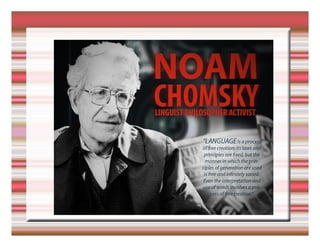
 Noam Chomsky in 1957 based on
observation concluded that human beings
are born with Universal Grammar or basic
language-creating faculty
The emergentist perspective
 Language is the adaptation to the world
around us. We learn aspects of language
use from those around us.
 A “new machine built of old parts” (Bates
& McWhinney)
 Children have a remarkable ability to pick
up the complexities of language very
quickly http://www.youtube.com/watch?v=wR0AfDVhgqU
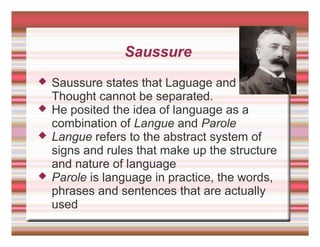
Saussure
 Saussure states that Laguage and
Thought cannot be separated.
 He posited the idea of language as a
combination of Langue and Parole
 Langue refers to the abstract system of
signs and rules that make up the structure
and nature of language
 Parole is language in practice, the words,
phrases and sentences that are actually
used
Chomsky
 Competence & Performance
 Competence is the set of abilities the
speaker of a language would develop over
time. The ability a human has at birth, the
“universal grammar” is developed into a
more complex set of rules
 Performance is the way in which the
language is actually used (Langue)
Language & Culture
 What is culture?
 Culture broadly defines a system of
meaning for a group of people and it
includes language, laws, customs, myths,
images, texts and daily practices.
 But much of culture is arbitrary and its
features are meaningful only to a particular
group of people
Cultural boundaries
 Culture is like a bricolage within a
particular group overtime
 Moreover, in an increasingly globalized
worlds, the boundaries of one culture and
another are often blurred
Cultural Relativism
 All elements of our culture are learnt and
they are all ARBITRARY.
 The conclusion is that no culture has “the
right” answers
 Examples: women's education, corporal
punishment, death penalty – Universal
rights?
 CR. has its complexities. In order to
understand a culture we must truly
understand its context
Then, how do we describe
“A Culture”?
 Do we describe its Food? Sports? Laws?
Religion? Manners? Language?
 We must be careful with stereotypes
 Understanding, or trying to understand,
different cultures we intend to understand
the world aroud us
How to apply this information?
 One of the goals of this course is to
investigate the ways in which language
conveys, defines or reflects culture.
 We study cultural context in order to help
us understand the meaning and effect of
the words and images around us

Thinking about language

  • 1.
    What is language? Languageis a system of vocal signs through which humans communicate. It is a SYSTEM because it consists of patterns, or rules, for putting together elements such as sounds to make words and words to make sentences that when violated result in loss of meaning
  • 2.
    Language is open-endedand creative  Following rules we can make up new words, combine them and create sentences never uttered before  Shakespeare created over 1700 words, many of which are still in use DISCONTENT GOSSIP FASHIONABLE GLOOMY EYEBALL LONELY MAJESTIC
  • 3.
    Language functions througha system of contrasts  Linguists call this Duality of Patterning This is the ability of language or a sign system to create distictions between sounds, words, and units of meaning through a system of differences between two elements  http://www.youtube.com/watch?v=hck55Z8lhFU
  • 4.
    Language is intentional Humans use it purposefully to communicate facts, ideas and emotions  All humans are born with language capability http://www.youtube.com/watch?v=_JmA2ClUvUY  Humans have many ways to communicate http://www.youtube.com/watch?v=LeyofQK6tRw  Why do we speak to each other? Why are we the only animals that seem to be able to communicate in sucha complex way?
  • 5.
    Think about thetwin babies...  Children learn to make sounds that correlate to a desire for something. They learn very quickly to say something to indicate they are thirsty or hungry  But researchers have also found children can communicatew something about the world around them that gives them no apparent benefit
  • 6.
    Language is inherent The ability to communicate through language is part of being human  It is a part of being human, not something you learn http://www.youtube.com/watch?v=2i1z37nYMrM  Noam Chomsky in 1957 based on observation concluded that human beings are born with Universal Grammar or basic language-creating faculty
  • 8.
    The emergentist perspective Language is the adaptation to the world around us. We learn aspects of language use from those around us.  A “new machine built of old parts” (Bates & McWhinney)  Children have a remarkable ability to pick up the complexities of language very quickly http://www.youtube.com/watch?v=wR0AfDVhgqU
  • 9.
    Saussure  Saussure statesthat Laguage and Thought cannot be separated.  He posited the idea of language as a combination of Langue and Parole  Langue refers to the abstract system of signs and rules that make up the structure and nature of language  Parole is language in practice, the words, phrases and sentences that are actually used
  • 10.
    Chomsky  Competence &Performance  Competence is the set of abilities the speaker of a language would develop over time. The ability a human has at birth, the “universal grammar” is developed into a more complex set of rules  Performance is the way in which the language is actually used (Langue)
  • 11.
    Language & Culture What is culture?  Culture broadly defines a system of meaning for a group of people and it includes language, laws, customs, myths, images, texts and daily practices.  But much of culture is arbitrary and its features are meaningful only to a particular group of people
  • 12.
    Cultural boundaries  Cultureis like a bricolage within a particular group overtime  Moreover, in an increasingly globalized worlds, the boundaries of one culture and another are often blurred
  • 13.
    Cultural Relativism  Allelements of our culture are learnt and they are all ARBITRARY.  The conclusion is that no culture has “the right” answers  Examples: women's education, corporal punishment, death penalty – Universal rights?  CR. has its complexities. In order to understand a culture we must truly understand its context
  • 14.
    Then, how dowe describe “A Culture”?  Do we describe its Food? Sports? Laws? Religion? Manners? Language?  We must be careful with stereotypes  Understanding, or trying to understand, different cultures we intend to understand the world aroud us
  • 15.
    How to applythis information?  One of the goals of this course is to investigate the ways in which language conveys, defines or reflects culture.  We study cultural context in order to help us understand the meaning and effect of the words and images around us