INTERCULTURAL
COMMUNICATION
 At the end of this chapter, you should be able
to:
1. understand the meaning of communication
and language
2. show the relationship between language and
culture
3. enumerate the characteristics of culture
4. identify the communication, behavioral,
cognitive, and material components of
culture
5. understand and explain cultural relativism
 The world today is characterized by an ever
growing number of contacts resulting in
communication between people with different
linguistic and cultural backgrounds.
 This communication takes place because of
contacts in the areas of business, military
cooperation, science, education, mass media,
entertainment, tourism and also because of
immigration brought about by labor shortage
or political conflict.
Communication
- is an act or instance of
transmitting
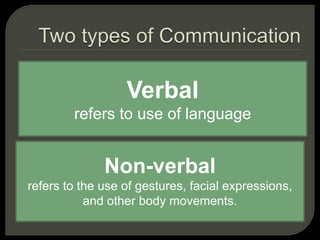
Verbal
refers to use of language
Non-verbal
refers to the use of gestures, facial expressions,
and other body movements.
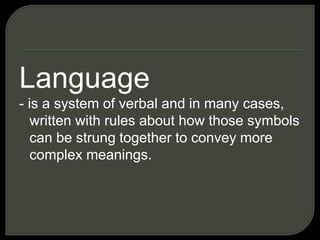
Language
- is a system of verbal and in many cases,
written with rules about how those symbols
can be strung together to convey more
complex meanings.
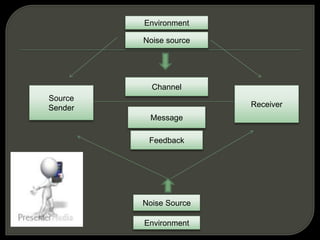
Environment
Noise source
Channel
Source
Sender Receiver
Message
Feedback
Noise Source
Environment
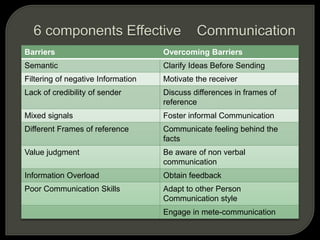
Barriers Overcoming Barriers
Semantic Clarify Ideas Before Sending
Filtering of negative Information Motivate the receiver
Lack of credibility of sender Discuss differences in frames of
reference
Mixed signals Foster informal Communication
Different Frames of reference Communicate feeling behind the
facts
Value judgment Be aware of non verbal
communication
Information Overload Obtain feedback
Poor Communication Skills Adapt to other Person
Communication style
Engage in mete-communication
1. E-mails – including people in various parts
of the world exchanging and sharing new
information and knowledge.
2. Web log or Journal – is a rapidly growing
from of electronics communication.
3. Computer or generated slide software such
as PowerPoint
4. Telecommunicating - is an arrangement in
which employees use computers to perform
their regular work responsibilities at home or
somewhere.
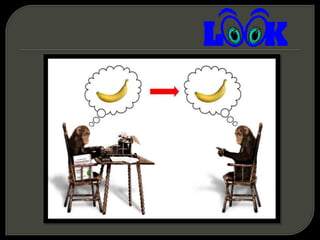
Paralanguage - is the language of
gestures, expressions and postures.
Body Language or Kinesics - the most
obvious form of paralanguage
A man’s language - is a reflection of the
kind of person he is, the family where he
comes from, the level of education he has
attained.
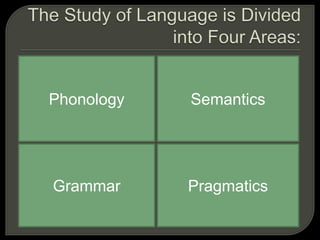
Phonology Semantics
Grammar Pragmatics
Phonology - the system of sounds that a
particular language uses, includes not
only the language’s basic unit of sounds,
or phonemes, but rules about how we put
phonemes together to form words and
rules about the proper intonation patterns
for phrases and sentences.
Semantics - is the study of word meanings
and combinations. Comprehension of
written as well as spoken language
requires not only a knowledge of specific
words and their definitions but an
understanding of how we use words and
how we combine them in phrases, clauses,
and sentences.
Grammar - describes the structure of a
language which consists of two major
parts: morphology and syntax. Morphology
is the study of the language’s smallest
units of meaning called morphemes –
prefixes, suffixes, and root words.
Pragmatics - consists of rules for the use of
appropriate language in particular
contexts. Thus pragmatics is concerned
not only with speaking and writing but with
social interaction, and it directly addresses
the issue of effective communication.
Perhaps the most significant of the
inventions made possible by culture is
language. The learning of culture takes
place through language. From our
enormous capacity to learn and use
language is derived our collective memory,
as well as writing, art, and all other media
that shape human consciousness and
store and transmit knowledge.
According to Panopio et al, 1992:
Language is an integral part of culture and
human culture cannot exist without it. All
human societies have languages. In some
simple societies where people cannot read
or write, they have a spoken language.
Through the use of language, wide vistas
of reality have been opened.
 One way a society’s language may reflect its
corresponding culture is in lexical content, or
vocabulary. When experiences, events, or
objects are singled out and given words it
may be the result of cultural characteristics.
 If culture can affect the structure and content
of its language, then it follows that linguistic
diversity derives in part from cultural diversity.
According to Edward Sapir:
The linguistic relativity hypothesis
asserts that language determines
thought and therefore culture. In
reality language and culture influence
each other.
Every society has a culture, no matter
how simple the culture may be, and
every human being is cultured in the
sense of participating in some culture
or other.
As our nation continues to change, we all
will interact with others from quite different
backgrounds from our own, especially in
the classroom. The manner in which we
respond to others who seem different can
have a serious impact on success in
school, work, and harmonious relationship
with others.
WHAT
IS
CULTURE?
 Culture is defined as the set of learned
behaviors, beliefs, attitudes, values, and
ideals that are characteristics of a particular
society or population. (Ember, 1999)
 Culture, as defined by Calhoun, et al., (1994)
is the learned norms, values, knowledge,
artifacts, language, and symbols that are
constantly communicated among people who
share a common ritual and technology.
 Allan Johnson (1996)said that culture is the sum
total of symbols, ideas, forms of expressions, and
material products associated with a collective way
of life reflected in such things as beliefs, values,
music, literature, art, dance, science, religious
ritual and technology.
 E.B. Taylor, defines culture as that complex whole
which includes knowledge, belief, art, morals, law,
custom, and any other capabilities and habits
acquired by man as a member of society.
(Panopio, 1992)
 . Leslie A. White refers to culture as an
organization of phenomena that is dependent upon
symbols, phenomena which include acts(patterns
of behavior); objects(tools and things made by
tools); ideas(beliefs, knowledge); and
sentiments(attitudes, values).
 Hofstede(1997) states that culture consists of
patterns, explicit and implicit, of and for behavior
acquired and transmitted by symbols, constituting
the distinctive achievement of human groups,
including their embodiments in artifacts
CHARACTERISTICS
OF
CULTURE
1. Culture is learned. The first essential
characteristic of culture is that it is
learned .
2. Culture is shared by a group of people.
For a thought or action to be considered
cultural, it must be commonly shared by
some population or group of individuals.
3. Culture is cumulative. Knowledge is stored
and passed on from one generation to the
next, and new knowledge is being added to
what is existing.
4. Culture change. All cultural knowledge does
not perpetually accumulated. At the same
time that new cultural traits are added, some
old ones are lost because they are no longer
useful.
5. Culture is dynamic. This is a characteristic of
culture that stems from its cumulative quality. No
culture is ever in a permanent state. It is constantly
changing because new ideas and new techniques
are added and old ways are constantly modified
and discarded.
6. Culture is ideational. Culture is an ideal pattern of
behavior which the members are expected to
follow. Man assigns meanings to his environment
and experiences by symbolizing them.
7. Culture is diverse. The sum total of human culture
consists of a great many separate cultures, each of
them is different. Culture as a whole, is a system of
with many mutually interdependent parts.
8. Culture gives us a range of permissible behavior.
Every culture allows a range of ways in which men
can be men and women can be women. Culture
also tells us how different activities should e
conducted, such as how one should act as a
husband, wife, parent, child, etc.
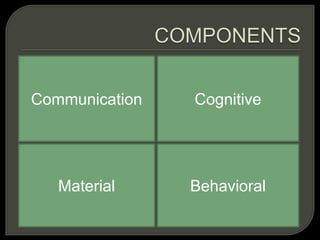
COMPONENTS
OF
CULTURE
Communication Cognitive
Material Behavioral
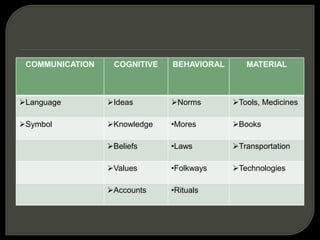
COMMUNICATION COGNITIVE BEHAVIORAL MATERIAL
Language Ideas Norms Tools, Medicines
Symbol Knowledge •Mores Books
Beliefs •Laws Transportation
Values •Folkways Technologies
Accounts •Rituals
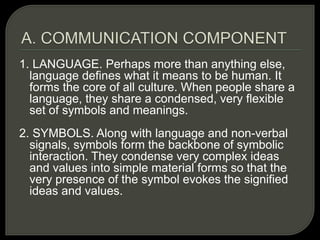
1. LANGUAGE. Perhaps more than anything else,
language defines what it means to be human. It
forms the core of all culture. When people share a
language, they share a condensed, very flexible
set of symbols and meanings.
2. SYMBOLS. Along with language and non-verbal
signals, symbols form the backbone of symbolic
interaction. They condense very complex ideas
and values into simple material forms so that the
very presence of the symbol evokes the signified
ideas and values.
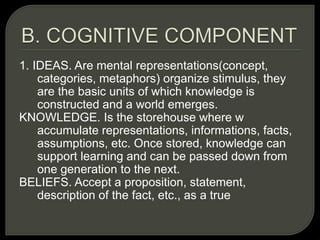
1. IDEAS. Are mental representations(concept,
categories, metaphors) organize stimulus, they
are the basic units of which knowledge is
constructed and a world emerges.
KNOWLEDGE. Is the storehouse where w
accumulate representations, informations, facts,
assumptions, etc. Once stored, knowledge can
support learning and can be passed down from
one generation to the next.
BELIEFS. Accept a proposition, statement,
description of the fact, etc., as a true
2. VALUES. Are defined as culturally defined
standards of desirability goodness and
beauty, which serve as broad guidelines
for social living.
3. ACCOUNTS. People who share a
common language for talking about their
inner selves.
1. NORMS. Are rules and expectations by
which a society guides the behavior of its
members. Norms can change over time,
as illustrated by norms regarding sexual
behavior. Norms may vary in terms of
their degree of importance.
MORES. They are customary behavior patterns or
folkways which have taken on a moralistic value.
This includes respect for authority, marriage and
sex behavior patterns, religious rituals, and other
codes of human behavior.
LAWS. Laws constitute the most formal and
important norms. Laws are the mores deemed so
vital to dominant interests that they become
translated into legal formalizations that even
nonmembers of society are required to obey.
FOLKWAYS. These are behavior patterns of society
which are organized and repetitive. The key feature of
all folkways is that there is no strong feeling of right or
wrong attached to them. They are simply the way the
people usually do things.
RITUALS. These are highly scripted ceremonies or strips
of interaction that follow a specific sequence of actions.
The ff. are examples: - ceremonies: graduation, baptism,
funerals, weddings, birthdays - holidays: thanksgiving,
Christmas - Everyday public rituals: greeting, kissing,
answering the telephones, birthday and cards
Human make objects, sometimes for
practical reasons and sometimes for
artistic ones. Material components of
culture refer to physical objects of culture
such as machines, equipment, tools,
books, clothing, etc.
THE
ORGANIZATION
OF
CULTURE
A CULTURAL TRAIT, either of a material or
non-material culture, represents a single
element or a combination of elements related
to a specific situation.
Example of cultural traits are kissing the hands
of the elders after Sunday mass and at
Angelus. Clusters of culture traits are known
as culture complexes which, in turn, group
together to form a culture pattern.
Culture is transmitted through:
1. Enculturation. It is the process of learning
culture of one’s own group.
2. Acculturation. It is the process of learning
some new traits from another culture.
3. Assimilation. It is the term used for a process
in which an individual entirely loses any
awareness of his/her previous group identity
and takes on the culture and attitudes of
another group.
IMPORTANCE
AND
FUNCTIONS
OF
CULTURE
Culture is what distinguishes human
beings from the lower animal forms
making them unique. It is a powerful
force in the lives of all people and
shapes and guides people’s
perceptions of reality.
1. Culture helps the individual fulfill his
potential as a human being.
2. Through the development of culture, man
can overcome his physical disadvantages
and allows him to provide himself with fire,
clothing, food and shelter.
3. Culture provides rules of proper conduct
for living in a society.
According to Rosado(2003), is in essence
an approach to the question of the nature
and role of values in culture.
Cultural relativism in anthropology is a key
methodological concept which is
universally accepted within the discipline
According to Glazer(1996), is an
anthropological approach which posits that
all cultures are of equal value and need to
be studied in a neutral point of view. The
basis of cultural relativism is a scientific
view of culture, which also rejects value
judgments on cultures.
Here is an illustration of cultural relativism:
Practices considered immoral or taboo to a certain
group of people but are accepted by other groups
with a different cultural orientation.
“The central point in cultural relativism is that in a
particular setting certain traits are right because
they work in that setting while other traits are
wrong because they clash painfully with parts of
the culture.”
- Hunt et., 1998
“No culture can live, if it
attempts to be exclusive.”
-Mahatma Gandhi
Reference:
Social Dimensions of Education
(Violeta A. Vega Ph.D., Nelia G.Prieto, Myrna L. Carreon ph.D.)
THANK YOU!
Prepared by:
Ariel Omangayon
Ronelyn Vargas
Daryl Cruta

Intercultural Communication

  • 1.
  • 2.
     At theend of this chapter, you should be able to: 1. understand the meaning of communication and language 2. show the relationship between language and culture 3. enumerate the characteristics of culture 4. identify the communication, behavioral, cognitive, and material components of culture 5. understand and explain cultural relativism
  • 3.
     The worldtoday is characterized by an ever growing number of contacts resulting in communication between people with different linguistic and cultural backgrounds.  This communication takes place because of contacts in the areas of business, military cooperation, science, education, mass media, entertainment, tourism and also because of immigration brought about by labor shortage or political conflict.
  • 4.
    Communication - is anact or instance of transmitting
  • 5.
    Verbal refers to useof language Non-verbal refers to the use of gestures, facial expressions, and other body movements.
  • 6.
    Language - is asystem of verbal and in many cases, written with rules about how those symbols can be strung together to convey more complex meanings.
  • 7.
  • 8.
    Barriers Overcoming Barriers SemanticClarify Ideas Before Sending Filtering of negative Information Motivate the receiver Lack of credibility of sender Discuss differences in frames of reference Mixed signals Foster informal Communication Different Frames of reference Communicate feeling behind the facts Value judgment Be aware of non verbal communication Information Overload Obtain feedback Poor Communication Skills Adapt to other Person Communication style Engage in mete-communication
  • 9.
    1. E-mails –including people in various parts of the world exchanging and sharing new information and knowledge. 2. Web log or Journal – is a rapidly growing from of electronics communication. 3. Computer or generated slide software such as PowerPoint 4. Telecommunicating - is an arrangement in which employees use computers to perform their regular work responsibilities at home or somewhere.
  • 10.
    Paralanguage - isthe language of gestures, expressions and postures. Body Language or Kinesics - the most obvious form of paralanguage A man’s language - is a reflection of the kind of person he is, the family where he comes from, the level of education he has attained.
  • 13.
  • 14.
    Phonology - thesystem of sounds that a particular language uses, includes not only the language’s basic unit of sounds, or phonemes, but rules about how we put phonemes together to form words and rules about the proper intonation patterns for phrases and sentences.
  • 15.
    Semantics - isthe study of word meanings and combinations. Comprehension of written as well as spoken language requires not only a knowledge of specific words and their definitions but an understanding of how we use words and how we combine them in phrases, clauses, and sentences.
  • 16.
    Grammar - describesthe structure of a language which consists of two major parts: morphology and syntax. Morphology is the study of the language’s smallest units of meaning called morphemes – prefixes, suffixes, and root words.
  • 17.
    Pragmatics - consistsof rules for the use of appropriate language in particular contexts. Thus pragmatics is concerned not only with speaking and writing but with social interaction, and it directly addresses the issue of effective communication.
  • 19.
    Perhaps the mostsignificant of the inventions made possible by culture is language. The learning of culture takes place through language. From our enormous capacity to learn and use language is derived our collective memory, as well as writing, art, and all other media that shape human consciousness and store and transmit knowledge.
  • 20.
    According to Panopioet al, 1992: Language is an integral part of culture and human culture cannot exist without it. All human societies have languages. In some simple societies where people cannot read or write, they have a spoken language. Through the use of language, wide vistas of reality have been opened.
  • 21.
     One waya society’s language may reflect its corresponding culture is in lexical content, or vocabulary. When experiences, events, or objects are singled out and given words it may be the result of cultural characteristics.  If culture can affect the structure and content of its language, then it follows that linguistic diversity derives in part from cultural diversity.
  • 22.
    According to EdwardSapir: The linguistic relativity hypothesis asserts that language determines thought and therefore culture. In reality language and culture influence each other.
  • 23.
    Every society hasa culture, no matter how simple the culture may be, and every human being is cultured in the sense of participating in some culture or other.
  • 24.
    As our nationcontinues to change, we all will interact with others from quite different backgrounds from our own, especially in the classroom. The manner in which we respond to others who seem different can have a serious impact on success in school, work, and harmonious relationship with others.
  • 25.
  • 26.
     Culture isdefined as the set of learned behaviors, beliefs, attitudes, values, and ideals that are characteristics of a particular society or population. (Ember, 1999)  Culture, as defined by Calhoun, et al., (1994) is the learned norms, values, knowledge, artifacts, language, and symbols that are constantly communicated among people who share a common ritual and technology.
  • 27.
     Allan Johnson(1996)said that culture is the sum total of symbols, ideas, forms of expressions, and material products associated with a collective way of life reflected in such things as beliefs, values, music, literature, art, dance, science, religious ritual and technology.  E.B. Taylor, defines culture as that complex whole which includes knowledge, belief, art, morals, law, custom, and any other capabilities and habits acquired by man as a member of society. (Panopio, 1992)
  • 28.
     . LeslieA. White refers to culture as an organization of phenomena that is dependent upon symbols, phenomena which include acts(patterns of behavior); objects(tools and things made by tools); ideas(beliefs, knowledge); and sentiments(attitudes, values).  Hofstede(1997) states that culture consists of patterns, explicit and implicit, of and for behavior acquired and transmitted by symbols, constituting the distinctive achievement of human groups, including their embodiments in artifacts
  • 29.
  • 30.
    1. Culture islearned. The first essential characteristic of culture is that it is learned . 2. Culture is shared by a group of people. For a thought or action to be considered cultural, it must be commonly shared by some population or group of individuals.
  • 31.
    3. Culture iscumulative. Knowledge is stored and passed on from one generation to the next, and new knowledge is being added to what is existing. 4. Culture change. All cultural knowledge does not perpetually accumulated. At the same time that new cultural traits are added, some old ones are lost because they are no longer useful.
  • 32.
    5. Culture isdynamic. This is a characteristic of culture that stems from its cumulative quality. No culture is ever in a permanent state. It is constantly changing because new ideas and new techniques are added and old ways are constantly modified and discarded. 6. Culture is ideational. Culture is an ideal pattern of behavior which the members are expected to follow. Man assigns meanings to his environment and experiences by symbolizing them.
  • 33.
    7. Culture isdiverse. The sum total of human culture consists of a great many separate cultures, each of them is different. Culture as a whole, is a system of with many mutually interdependent parts. 8. Culture gives us a range of permissible behavior. Every culture allows a range of ways in which men can be men and women can be women. Culture also tells us how different activities should e conducted, such as how one should act as a husband, wife, parent, child, etc.
  • 34.
  • 35.
  • 36.
    COMMUNICATION COGNITIVE BEHAVIORALMATERIAL Language Ideas Norms Tools, Medicines Symbol Knowledge •Mores Books Beliefs •Laws Transportation Values •Folkways Technologies Accounts •Rituals
  • 37.
    1. LANGUAGE. Perhapsmore than anything else, language defines what it means to be human. It forms the core of all culture. When people share a language, they share a condensed, very flexible set of symbols and meanings. 2. SYMBOLS. Along with language and non-verbal signals, symbols form the backbone of symbolic interaction. They condense very complex ideas and values into simple material forms so that the very presence of the symbol evokes the signified ideas and values.
  • 38.
    1. IDEAS. Aremental representations(concept, categories, metaphors) organize stimulus, they are the basic units of which knowledge is constructed and a world emerges. KNOWLEDGE. Is the storehouse where w accumulate representations, informations, facts, assumptions, etc. Once stored, knowledge can support learning and can be passed down from one generation to the next. BELIEFS. Accept a proposition, statement, description of the fact, etc., as a true
  • 39.
    2. VALUES. Aredefined as culturally defined standards of desirability goodness and beauty, which serve as broad guidelines for social living. 3. ACCOUNTS. People who share a common language for talking about their inner selves.
  • 40.
    1. NORMS. Arerules and expectations by which a society guides the behavior of its members. Norms can change over time, as illustrated by norms regarding sexual behavior. Norms may vary in terms of their degree of importance.
  • 41.
    MORES. They arecustomary behavior patterns or folkways which have taken on a moralistic value. This includes respect for authority, marriage and sex behavior patterns, religious rituals, and other codes of human behavior. LAWS. Laws constitute the most formal and important norms. Laws are the mores deemed so vital to dominant interests that they become translated into legal formalizations that even nonmembers of society are required to obey.
  • 42.
    FOLKWAYS. These arebehavior patterns of society which are organized and repetitive. The key feature of all folkways is that there is no strong feeling of right or wrong attached to them. They are simply the way the people usually do things. RITUALS. These are highly scripted ceremonies or strips of interaction that follow a specific sequence of actions. The ff. are examples: - ceremonies: graduation, baptism, funerals, weddings, birthdays - holidays: thanksgiving, Christmas - Everyday public rituals: greeting, kissing, answering the telephones, birthday and cards
  • 43.
    Human make objects,sometimes for practical reasons and sometimes for artistic ones. Material components of culture refer to physical objects of culture such as machines, equipment, tools, books, clothing, etc.
  • 44.
  • 45.
    A CULTURAL TRAIT,either of a material or non-material culture, represents a single element or a combination of elements related to a specific situation. Example of cultural traits are kissing the hands of the elders after Sunday mass and at Angelus. Clusters of culture traits are known as culture complexes which, in turn, group together to form a culture pattern.
  • 46.
    Culture is transmittedthrough: 1. Enculturation. It is the process of learning culture of one’s own group. 2. Acculturation. It is the process of learning some new traits from another culture. 3. Assimilation. It is the term used for a process in which an individual entirely loses any awareness of his/her previous group identity and takes on the culture and attitudes of another group.
  • 47.
  • 48.
    Culture is whatdistinguishes human beings from the lower animal forms making them unique. It is a powerful force in the lives of all people and shapes and guides people’s perceptions of reality.
  • 49.
    1. Culture helpsthe individual fulfill his potential as a human being. 2. Through the development of culture, man can overcome his physical disadvantages and allows him to provide himself with fire, clothing, food and shelter. 3. Culture provides rules of proper conduct for living in a society.
  • 50.
    According to Rosado(2003),is in essence an approach to the question of the nature and role of values in culture. Cultural relativism in anthropology is a key methodological concept which is universally accepted within the discipline
  • 51.
    According to Glazer(1996),is an anthropological approach which posits that all cultures are of equal value and need to be studied in a neutral point of view. The basis of cultural relativism is a scientific view of culture, which also rejects value judgments on cultures.
  • 52.
    Here is anillustration of cultural relativism: Practices considered immoral or taboo to a certain group of people but are accepted by other groups with a different cultural orientation. “The central point in cultural relativism is that in a particular setting certain traits are right because they work in that setting while other traits are wrong because they clash painfully with parts of the culture.” - Hunt et., 1998
  • 53.
    “No culture canlive, if it attempts to be exclusive.” -Mahatma Gandhi
  • 54.
    Reference: Social Dimensions ofEducation (Violeta A. Vega Ph.D., Nelia G.Prieto, Myrna L. Carreon ph.D.)
  • 55.
    THANK YOU! Prepared by: ArielOmangayon Ronelyn Vargas Daryl Cruta