COMMUNICATIVE
STYLES
COMMUNICATIVE STYLES
 The way you communicate has a big
impact on how you get on with people
and get the things you want. Good
communication skills can help you
avoid conflict and solve problems –
they’re also important for making
friends and having healthy
relationships.
TYPES OF COMMUNICATIVE
STYLES
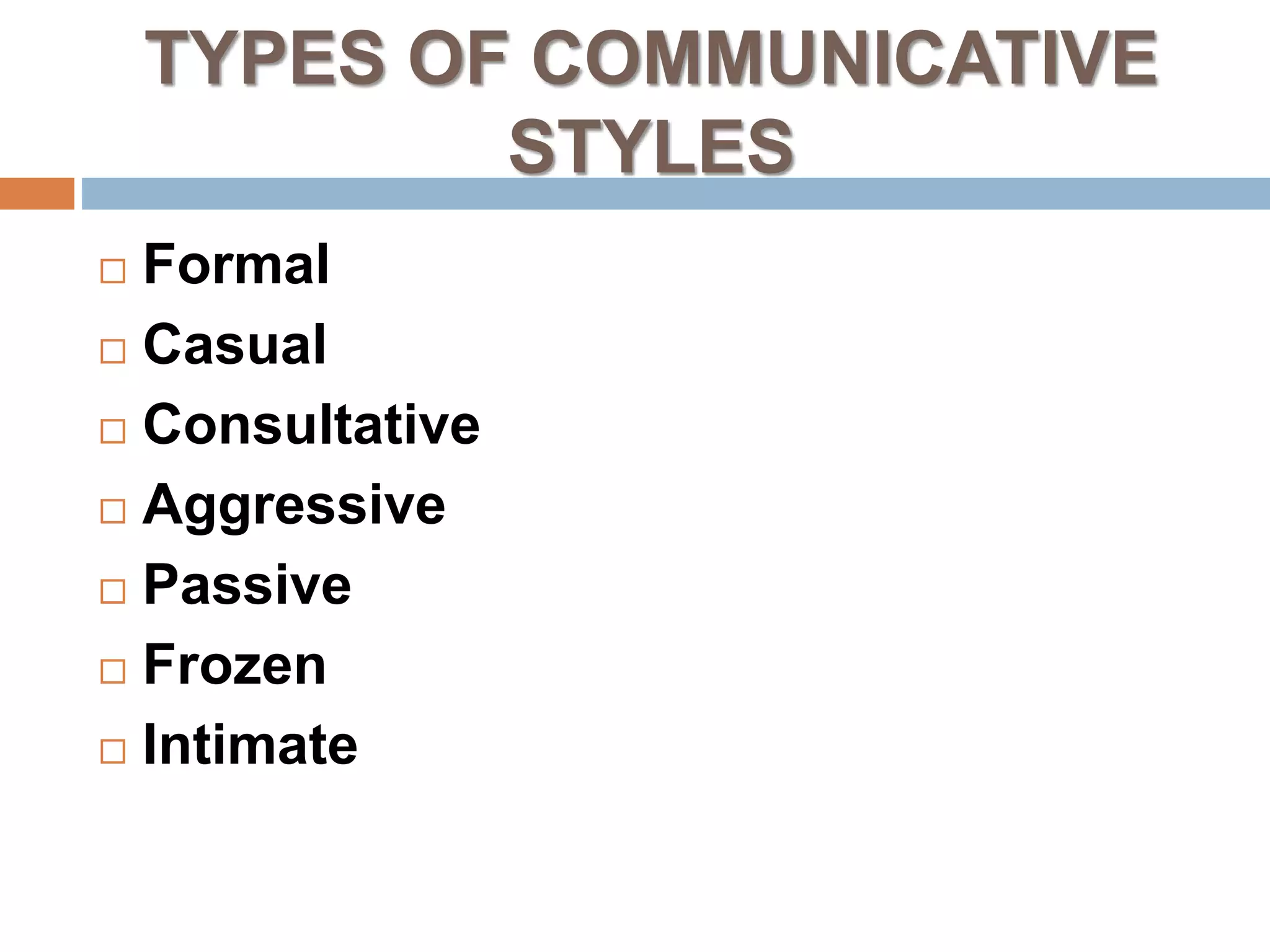
 Formal
 Casual
 Consultative
 Aggressive
 Passive
 Frozen
 Intimate
Informal or Casual
 A casual form of information sharing
typically used in personal
conversations with friends
or family members.
 Phone Texts, Conversation with friends
or family members, etc.
Formal
 A type of
verbal presentation or document intend
ed to share information and which
conforms
to established professional rules,
standards and processes and
avoids using slang terminology.
Frozen
 It is the most formal communicative
style that is usually used in respectful
situation or formal ceremony.
Consultative
 It is used in some group discussion, regular
conversation at school, companies, trade,
speech conversation, etc. it was the most
operational among the other styles. One of
the characteristics of consultative language
is its tendency of average speed, which is
higher than formal style. The sentence tend
to be shorter (resemble or indeed, phrase)
and less well planned (tend to spontaneous).
Since it is spontaneous, people tend to
repeat some unnecessary words, choose the
wrong word choice or use many slang or
Intimate
 It is a style among intimate members of
a family or friends that do not need a
complete language with clear
articulation. It is enough to use short
utterances. Another characteristic of
this style is grammar unnecessarily
used here, because it can bring
disorder to this intimate style.
Aggressive
 Aggressive communication is
expressed in a forceful and hostile
manner, and usually involves alienating
messages such as ‘you-statements’
(blaming the other person and
accusing them of being wrong or at
fault) and labelling. In addition, the
person’s tone of voice and facial
expressions are unfriendly.
Passive
 Passive communication involves
putting your needs last. You don’t
express your thoughts or feelings, or
ask for what you want. Passive
communication involves putting your
needs last. You don’t express your
thoughts or feelings, or ask for what
you want.
Communicative Styles

Communicative Styles

  • 1.
  • 2.
    COMMUNICATIVE STYLES  Theway you communicate has a big impact on how you get on with people and get the things you want. Good communication skills can help you avoid conflict and solve problems – they’re also important for making friends and having healthy relationships.
  • 3.
    TYPES OF COMMUNICATIVE STYLES Formal  Casual  Consultative  Aggressive  Passive  Frozen  Intimate
  • 4.
    Informal or Casual A casual form of information sharing typically used in personal conversations with friends or family members.  Phone Texts, Conversation with friends or family members, etc.
  • 5.
    Formal  A typeof verbal presentation or document intend ed to share information and which conforms to established professional rules, standards and processes and avoids using slang terminology.
  • 6.
    Frozen  It isthe most formal communicative style that is usually used in respectful situation or formal ceremony.
  • 7.
    Consultative  It isused in some group discussion, regular conversation at school, companies, trade, speech conversation, etc. it was the most operational among the other styles. One of the characteristics of consultative language is its tendency of average speed, which is higher than formal style. The sentence tend to be shorter (resemble or indeed, phrase) and less well planned (tend to spontaneous). Since it is spontaneous, people tend to repeat some unnecessary words, choose the wrong word choice or use many slang or
  • 8.
    Intimate  It isa style among intimate members of a family or friends that do not need a complete language with clear articulation. It is enough to use short utterances. Another characteristic of this style is grammar unnecessarily used here, because it can bring disorder to this intimate style.
  • 9.
    Aggressive  Aggressive communicationis expressed in a forceful and hostile manner, and usually involves alienating messages such as ‘you-statements’ (blaming the other person and accusing them of being wrong or at fault) and labelling. In addition, the person’s tone of voice and facial expressions are unfriendly.
  • 10.
    Passive  Passive communicationinvolves putting your needs last. You don’t express your thoughts or feelings, or ask for what you want. Passive communication involves putting your needs last. You don’t express your thoughts or feelings, or ask for what you want.