This is your
presentation title
2
Hello!
3
MELC: Employ the appropriate communicative styles for various situations (intimate,
casual, formal, consultative, and frozen)
At the end of the lesson, you are expected to:
A. Distinguish between various formal and informal
communicative styles;
B. Value the effectiveness of these styles in
communication considering variety of audience and
purposes; and
C. Analyze situations which are appropriate for each
style.
4
“
Complete the famous movie
lines…
5
Akala mo lang wala, pero ____, ____, ____.
- BATA, BATA…PANO KA GINAWA, 1998
6
7
She loved me at my worst, you had me ___ ___
___, at binalewala mo lang lahat yun.
- ONE MORE CHANCE, 2007
8
9
Pero bakit parang galit ka? Pero bakit kasalanan
ko? Parang ______ ____. Eh sa totoo lang
ako yung inggit na inggit sa inyong lahat.
- FOUR SISTERS AND A WEDDING, 2013
10
11
12
13
Let’s test what you know!
14
15
16
Reminder:
17
COMMUNICATIVE STYLES
The way you communicate has a big impact on how you
get on with people and the things you want. Good
communication skills can help you avoid conflict and
solve problems– they’re also important for making
friends and having healthy relationships.
18
COMMUNICATIVE STYLES
• FROZEN/ STATIC
The frozen communicative style, also called the oratorical style, is the most formal
style and is reserved for very formal situations such as during weddings, other
religious services or rituals, court proceedings, and other formal ceremonies.
This style is used to address or is given before an audience of absolute strangers. It
uses prescribed and highly formal language. In this style, statements are learned by
heart.
19
COMMUNICATIVE STYLES
Examples:
20
COMMUNICATIVE STYLES
• FORMAL
The formal communicative style is also considered to be a straightforward speech. There is no
participation from the listener.
This style is often used in the following formal situations where there is only one way
communication:
Speeches, school lessons, graduation ceremony, television newscast
giving announcement, business meeting, interview or in a classroom.
The enunciation of words, diction and grammar rules should be applied
properly. Thus, errors must be avoided. Ideas are presented cohesively, and all necessary
information are clearly given.
21
COMMUNICATIVE STYLES
Examples:
22
COMMUNICATIVE STYLES
VALEDICTORY SPEECH ANNOUNCEMENT
• CONSULTATIVE
The consultative speech style happens in a two-way participation. It is used in semi-
formal situations in which a speaker needs to provide background information. The
listener participates by giving feedback. Thus, both the speaker and the listener are
active participants.
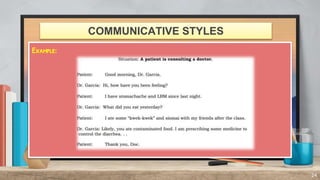
Take note that this style is often used in business or in other professional
situations, such as conversations between a doctor and a patient, or a teacher and
a student.
23
COMMUNICATIVE STYLES
Example:
24
COMMUNICATIVE STYLES
• CASUAL
The casual communicative style uses a language used between
friends, peers, colleagues, or family. Most of the ambience with
this style is relaxed and very light. And so, the participants may
use group language only members of the group can understand.
Jargon, slang, or the vernacular language are used. The tone is
conversational, and interruptions are very common. Also,
nicknames are used in addressing one another.
25
COMMUNICATIVE STYLES
Example:
26
COMMUNICATIVE STYLES
• INTIMATE
The intimate communicative style is defined as total absence of social
interactions. This style is used by participants who know each other well or
share a very close relationship, such as between close friends, siblings,
husband and wife, parents and children, and boyfriend and girlfriend.
The participants in this style do not need for clear articulation of words or
additional explanations. They may use words of endearment such as babe,
love, dear, honey as a sign of intimacy.
27
COMMUNICATIVE STYLES
Example:
28
COMMUNICATIVE STYLES
Let’s test your knowledge!
29
DIRECTIONS: What follows now is a checklist of different communication styles/ scenarios. Identify each
by checking under the appropriate column
30
31
1
2
3
4
5
6
7
8
9
10
11
12
13
14
15
32
Check your answers!
33
34
35
Work with your parents or family members…
36

communicative styles.pptx

  • 1.
  • 2.
  • 3.
  • 4.
    MELC: Employ theappropriate communicative styles for various situations (intimate, casual, formal, consultative, and frozen) At the end of the lesson, you are expected to: A. Distinguish between various formal and informal communicative styles; B. Value the effectiveness of these styles in communication considering variety of audience and purposes; and C. Analyze situations which are appropriate for each style. 4
  • 5.
    “ Complete the famousmovie lines… 5
  • 6.
    Akala mo langwala, pero ____, ____, ____. - BATA, BATA…PANO KA GINAWA, 1998 6
  • 7.
  • 8.
    She loved meat my worst, you had me ___ ___ ___, at binalewala mo lang lahat yun. - ONE MORE CHANCE, 2007 8
  • 9.
  • 10.
    Pero bakit paranggalit ka? Pero bakit kasalanan ko? Parang ______ ____. Eh sa totoo lang ako yung inggit na inggit sa inyong lahat. - FOUR SISTERS AND A WEDDING, 2013 10
  • 11.
  • 12.
  • 13.
  • 14.
  • 15.
  • 16.
  • 17.
  • 18.
    The way youcommunicate has a big impact on how you get on with people and the things you want. Good communication skills can help you avoid conflict and solve problems– they’re also important for making friends and having healthy relationships. 18 COMMUNICATIVE STYLES
  • 19.
    • FROZEN/ STATIC Thefrozen communicative style, also called the oratorical style, is the most formal style and is reserved for very formal situations such as during weddings, other religious services or rituals, court proceedings, and other formal ceremonies. This style is used to address or is given before an audience of absolute strangers. It uses prescribed and highly formal language. In this style, statements are learned by heart. 19 COMMUNICATIVE STYLES
  • 20.
  • 21.
    • FORMAL The formalcommunicative style is also considered to be a straightforward speech. There is no participation from the listener. This style is often used in the following formal situations where there is only one way communication: Speeches, school lessons, graduation ceremony, television newscast giving announcement, business meeting, interview or in a classroom. The enunciation of words, diction and grammar rules should be applied properly. Thus, errors must be avoided. Ideas are presented cohesively, and all necessary information are clearly given. 21 COMMUNICATIVE STYLES
  • 22.
  • 23.
    • CONSULTATIVE The consultativespeech style happens in a two-way participation. It is used in semi- formal situations in which a speaker needs to provide background information. The listener participates by giving feedback. Thus, both the speaker and the listener are active participants. Take note that this style is often used in business or in other professional situations, such as conversations between a doctor and a patient, or a teacher and a student. 23 COMMUNICATIVE STYLES
  • 24.
  • 25.
    • CASUAL The casualcommunicative style uses a language used between friends, peers, colleagues, or family. Most of the ambience with this style is relaxed and very light. And so, the participants may use group language only members of the group can understand. Jargon, slang, or the vernacular language are used. The tone is conversational, and interruptions are very common. Also, nicknames are used in addressing one another. 25 COMMUNICATIVE STYLES
  • 26.
  • 27.
    • INTIMATE The intimatecommunicative style is defined as total absence of social interactions. This style is used by participants who know each other well or share a very close relationship, such as between close friends, siblings, husband and wife, parents and children, and boyfriend and girlfriend. The participants in this style do not need for clear articulation of words or additional explanations. They may use words of endearment such as babe, love, dear, honey as a sign of intimacy. 27 COMMUNICATIVE STYLES
  • 28.
  • 29.
    Let’s test yourknowledge! 29
  • 30.
    DIRECTIONS: What followsnow is a checklist of different communication styles/ scenarios. Identify each by checking under the appropriate column 30
  • 31.
  • 32.
  • 33.
  • 34.
  • 35.
    35 Work with yourparents or family members…
  • 36.